Showing posts sorted by relevance for query Phillipa Soo. Sort by date Show all posts

Saturday, September 26, 2015

Not Throwing Away Its Shot: Hamilton on Broadway

Hamilton at the Richard Rodgers Theatre (photo by Sara Krulwich/The New York Times).

It’s hard to separate the new Broadway musical Hamilton from the hype surrounding it. Its creator, Lin-Manuel Miranda, has been performing versions of its songs since early 2009, when he presented an early draft of the show’s opening number at the White House. It has garnered breathless praise since it opened Off-Broadway at the Public Theater at the beginning of this year. On August 6, it officially opened at the Richard Rodgers Theatre on Broadway.

It’s not hard to see where the hype comes from: Hamilton is one of the freshest, most energetic productions I can remember seeing on Broadway. It’s especially surprising that this should be the case, because its plot is a fairly comprehensive chronicle of Alexander Hamilton’s (played by Lin-Manuel Miranda) life, adapted from Ron Chernow’s approximately 800-page biography. The plot hits every major episode of Hamilton’s life: his brutal early childhood in the Caribbean, his service as George Washington’s (Christopher Jackson) right-hand man during the Revolutionary War, his marriage to Elizabeth Schuyler (Phillipa Soo), his role in shaping the Constitution and the nation’s financial system, the sex scandal that ruined his career, and ultimately his death at the hands of Aaron Burr (Leslie Odom, Jr.). It doesn’t exactly sound like a blockbuster premise for a musical.

Monday, April 17, 2023

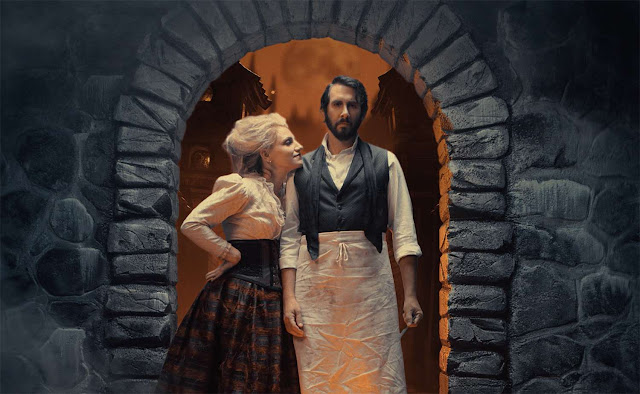
Musical Revivals II: Sweeney Todd and Camelot

Annaleigh Ashford and Josh Groban in Sweeney Todd.

Despite the intermittently brilliant Stephen Sondheim score and a superb cast headed by Len Cariou and an unforgettable Angela Lansbury, I had a medium cool experience with the original 1979 Broadway production of Sweeney Todd. It felt inflated, overproduced (a response I have had to a few other Prince shows), and determined to make a statement competitive with that of Brecht and Weill’s The Threepenny Opera, which was the obvious inspiration for Sondheim, book writer Hugh Wheeler and Prince. But the material, a grisly horror derived from Christopher Bond’s 1973 rewrite of a mid-Victorian melodrama, is thin. At the end of the first act, thinking he’s missed his chance to murder the  corrupt Judge Turpin, who trumped up a charge against him and had him transported so he could get his mitts on Sweeney’s innocent wife Lucy, Sweeney, “the demon barber of Fleet Street,” sings “Epiphany,” in which he decides that he’s going to visit his frustrated revenge on his customers because “they all deserve to die.” And Mrs. Lovett, his landlady, who runs a pathetic pie shop with the only stringy meat she can afford, comes up with the scheme of using the corpses to make her wares sweeter and juicier.  Todd loves the idea, so they become business partners. In the first-act finale, “A Little Priest,” he argues that since society is built on men devouring each other, he and Mrs. Lovett might as well make the metaphor literal. “A Little Priest” is a wonderful burlesque-style novelty number constructed on a series of increasingly funny puns about their imagined victims. But it’s not exactly “The Second Threepenny Finale” (“What keeps a man alive? He lives on others”). Sweeney Todd is a cleverly devised penny dreadful, not a social satire.

What turned me around about the musical was the 2005 Broadway revival, directed by John Doyle, which had begun life in the West End. Starring Michael Cerveris as Sweeney and Patti LuPone as Mrs. Lovett, it was leaner and tighter than the original, with ingenious Brechtian effects – and it made no attempt to sell itself as profound social commentary. The new Sweeney Todd, directed by Thomas Kail, with musical direction by Alec Lacamoire – both Hamilton alumni – is almost as good as Doyle’s. And it has an even better Mrs. Lovett than LuPone, Annaleigh Ashford, whom I loved in Dogfight and the 2014 revival of You Can’t Take It with You (with James Earl Jones) and the 2017 revival of Sunday in the Park with George (where she played opposite Jake Gyllenhaal). She’s amazing. Slighter and more kinetic than her predecessors, Ashford looks like a devilish rag doll, and every physical choice she makes – and many of her vocal ones (like switching keys twice in the middle of her show-stopping first song, “The Worst Pies in London”) – is inspired. When she played this role Lansbury embodied the play’s music-hall origins, while LuPone’s numbers were like Brecht and Weill done as punk rock. Ashford is lighter on her feet and loonier, and her performance harks back to revue comedy – specifically to Imogene Coca, who partnered Sid Caesar so sublimely in the live TV days.

Monday, December 11, 2017

The Parisian Woman: Those Devious Politicos

Uma Thurman and Blair Brown in The Parisian Woman. (Photo: Matthew Murphy)

The last time I saw Uma Thurman, she appeared, in a remarkable ensemble, in the 2015 NBC miniseries The Slap, which deserved more attention than it got. Now she’s starring in a new Broadway play, Beau Willimon’s The Parisian Woman, and at forty-seven she looks more beautiful than ever – that long, sleek frame, that sculpted goddess’s face. She hasn’t done much previous stage work (she played Célimène in a production of Molière’s The Misanthrope at Classic Stage Company in 1999), but she seems just as comfortable on the stage of the Hudson Theatre as she does on camera, and, with Jane Greenwood’s elegant dresses dripping off her, her presence is mesmerizing.

Monday, July 14, 2014

Playwrights: Benefactors, A Great Wilderness, The Normal Heart, A Little Night Music

Walton Wilson, David Adkins, and Barbara Sims in Benefactors (Photo by Emily Faulkner)

Eric Hill’s compelling production of Benefactors at the Berkshire Theatre Group’s Unicorn space in Stockbridge provides audiences with an opportunity to become acquainted with an intelligent, intriguing text by Michael Frayn that doesn’t receive many revivals. (It won the Olivier Award for best new play in 1984.) The play, set between 1968 and 1970, is a four-hander about the relationship between David (David Adkins), an architect with a commitment to providing housing for the poor, and his wife Jane (Corinna May) and their neighbors across the road, Colin (Walton Wilson), a journalist, and Sheila (Barbara Sims). David and Colin have known each other since university, and when they find themselves living in close proximity the two couples and their children are constantly in and out of each other’s houses. Colin is a difficult man with a contrary temperament and a tendency to belittle his wife; self-effacing, easily intimidated, and somewhat in awe of David and Jane, Sheila barely opens her mouth at first when the quartet gets together for dinner. But she begins to spend more and more time hanging out with Jane during the day, and eventually confides her fears that Colin is going to leave her. To help her develop a life of her own, Jane encourages David to hire Sheila as a secretary – to take over the work Jane herself has been doing for him – and the shift ushers in a new phase of their lives.