Showing posts sorted by relevance for query jerome Kern. Sort by date Show all posts

Sunday, November 9, 2014

Four Decades of the American Musical

Oklahoma! on Broadway in the 1940s.

Half a century ago The Modern Library published Six Plays by Rodgers & Hammerstein and the complete libretti of Gilbert & Sullivan operettas; when I was in grade school, those two books were the earliest purchases I made for my own library of musical-theatre scripts. I recalled my excitement at having these musicals at my fingertips when I received my copy of The Library of America’s new two-volume collection American Musicals.  It’s expertly edited by Laurence Maslon (who was responsible for Kaufman and Co.: Broadway Comedies, their aggregate of George S. Kaufman collaborations) and handsomely packaged, with gorgeous production photos – most of which I’ve never seen before – and copies of show posters and sheet music. Each of the volumes contains the books and lyrics of eight musicals, arranged chronologically and divided roughly into decades, 1927-1949 and 1950-1969.

Monday, April 1, 2019

Jeeves and Wooster in Perfect Nonsense: Slapstick Trio

Eddie Korbich, Chandler Williams, and Arnie Burton in Jeeves and Wooster in Perfect Nonsense. Photo by T. Charles Erickson

I fell for P.G. Wodehouse’s Jeeves novels when I was twelve or thirteen and a friend who’d succumbed before me passed one onto me. I believe it was Right Ho, Jeeves (published in the U.S. as Brinkley Manor), and I was thoroughly smitten – by the sublimely ridiculous plotting, the cast of caricatures, the distinctive language of the upper-class and upper-middle-class eccentrics, and above all the relationship between Bertie Wooster, the fumbling, cracked-brain young protagonist and his unflappable, endlessly resourceful valet Jeeves. Around the same time I discovered that Wodehouse and Guy Bolton had written the books for a series of Jerome Kern musicals in the late teens and the twenties – the ones that preceded Kern’s ground-breaking collaboration with Oscar Hammerstein II, Show Boat – and he became one of my literary heroes.

Robert and David Goodale cottoned onto the Jeeves books (there are eleven, in addition to several collections of short stories) in their twenties and Robert fashioned two of them into one-man shows, the second directed by David. Jeeves and Wooster in Perfect Nonsense, their third adaptation, which Hartford Stage is producing currently, is a three-hander in which Bertie (played by Chandler Williams) relates the story of The Code of the Woosters, the sequel to Right Ho, Jeeves, acting it out with the aid of Jeeves (Arnie Burton) and Bertie’s Aunt Dahlia’s manservant Seppings (Eddie Korbich). The conceit of the play, which has been staged by Sean Foley, is that Jeeves provides the theatrical appendages, like a set that either he or Seppings rotates with the aid of a bicycle, while the two men between them play all the other roles. That is, Perfect Nonsense is a play in the mold of the fantastically successful 2005 adaptation of The 39 Steps, where the audience watch the actors shifting madly from one role to another with not only comic pleasure but also the appreciation we’d accord a magician’s sleight of hand or an acrobat’s dexterity.

Wednesday, July 12, 2023

Shy: The Life of Mary Rodgers

Carol Burnett and Joe Bova in the original Broadway production of Once Upon a Mattress (1959).

Mary Rodgers, the daughter of the legendary Broadway (and occasionally Hollywood) composer Richard Rodgers, wrote the music for the 1959 musical Once Upon a Mattress. Aside from The Mad Show, a downtown revue she contributed to that ran for a year, Mattress was her only hit show, but she worked on many other stage musicals that flopped (often out of town) as well as a handful of TV musicals. She also wrote the Freaky Friday children’s books, assisted Leonard Bernstein on the Young People’s Concerts on TV, chaired or served on the boards of many schools and other organizations, and raised five kids; a sixth died tragically in childhood. (One of them, Adam Guettel, is the composer-lyricist of The Light in the Piazza, which I join my Critics at Large colleague Joe Mader in calling the best musical written in the twenty-first century.) This life, which Oscar Wilde’s Lady Bracknell would have pronounced “crowded with incident,” is memorialized in Shy: The Alarmingly Outspoken Memoirs of Mary Rodgers  (Farrar, Straus and Giroux, 2022), which Rodgers co-wrote with the current New York Times theatre critic Jesse Green and on which he provided the finishing touches after she died, at the age of eighty-three, in 2014. (Green was then reviewing plays for New York Magazine.)

Monday, June 27, 2016

Musical Revivals in London's West End

Emmanuel Kojo (centre) and members of the cast of Show Boat at London's New London Theatre. (Photo: Johan Persson)

There are three major American musicals in which the main male characters are gamblers, and by chance all three have been revived in London’s West End this season. So audiences who check out Show Boat at the New London and see Gaylord Ravenal (Chris Peluso) toss his winnings in the air as he shares his good luck with his wife Magnolia (Gina Beck) may feel a weird déjà vu sensation if they’ve already seen Nick Arnstein (Darius Campbell) perform the same action with Fanny Brice (Natasha J. Barnes) in Funny Girl, which moved to the Savoy from its original venue, the Meunier Chocolate Factory. No such scene appears in Guys and Dolls at the Phoenix, but nonetheless it is the quintessential gambling musical.

Monday, November 27, 2017

Brigadoon: Love and Loss

Robert Fairchild in Brigadoon at New York's City Center. (Photo: Joan Marcus)

The 1947 musical fantasy Brigadoon was the fourth collaboration between Alan Jay Lerner (book and lyrics) and Frederick Loewe (music), but it was the one that put them on the musical-theatre map. It ran for nearly two years and became a staple of regional and community theatres; there were three revivals on Broadway within a decade and a half of the end of its original run. Now it’s revived only rarely, having somehow acquired the reputation of being syrupy and old-fashioned, like a Rudolf Friml or Sigmund Romberg operetta from the twenties. That’s inaccurate. I think it’s a beauty, and that the score is one of the glories of the golden age of Broadway musicals. The 1954 movie adaptation – directed, with a surprising lack of conviction, by Vincente Minnelli, and starring Gene Kelly and Cyd Charisse – didn’t get at the show’s charm; nor did a 1966 TV version with Robert Goulet and Sally Ann Howes, though it did have the great dancer Edward Villella repeating his performance from the 1963 New York City Center production in the principal dance role, Harry Beaton. But anyone lucky enough to catch one of the performances of the staged concert of Brigadoon, once again at City Center, between November 15 and 19 got a taste of what made – and makes – the musical so special. Christopher Wheeldon, the deservedly lauded director-choreographer of the 2015 An American in Paris, staged the show exquisitely with no set except for a bridge, some simple projections, and a motif of hickory branches that he used in the choreography and, in one dialogue scene, to stand in for the arms of chairs. Though obviously a far more modest presentation than his work for An American in Paris, this Brigadoon was so evocative and imaginative that I’m tempted to say that it was just about as good. The music director was Rob Berman, conducting the Encores! orchestra. Visually, musically and emotionally it was a thrilling evening of musical theatre.

Monday, April 25, 2016

Constructing Musicals: Jack Viertel’s The Secret Life of the American Musical

Cast of Fiddler on the Roof on Broadway, 1977. (Photo: Bobby Bank)

Jack Viertel’s new book The Secret Life of the American Musical (Sarah Crichton Books) is a gift for those of us who love musical theatre; I read it over just a couple of days and would have devoured it in a single sitting if time had allowed. Viertel, a one-time dramaturg, drama critic and arts editor who is now, among many other accomplishments, the artistic director of City Center’s Encores! series, has taught musical theatre at NYU’s Tisch School for the last ten years, and this volume emerged from his classes as well as from his extensive experience with musicals over the past three decades. I suspect it would be impossible to find anyone who knows more about the subject, and in The Secret Life of the American Musical he offers a comprehensive master class in how good musicals are constructed. Even for those of us who have seen and listened to hundreds of musicals, the book is a series of revelations – mostly because of his method of juxtaposing shows that are vastly different in style, tone and subject matter to show how the same principles operate across the spectrum.

Saturday, February 14, 2015

Ol’ Man River: A Song, a Drama and a Life

Stogie Kenyatta as Paul Robeson in The World Is My Home – The Life of Paul Robeson. (Photo by Lexi Lewis)

"Nations go to war, but it’s always our culture that unites us.” – Stogie Kenyatta as Paul Robeson in The World Is My Home – The Life of Paul Robeson.
Rarely do a song’s lyrics reflect the life of its singer, particularly one whose life is largely unknown today. Yet the African American, Paul Robeson, was possibly the most gifted artist – a polymath who could speak and sing in fourteen languages – and one of the most courageous activists of the twentieth century. Although he had appeared at the Cotton Club as a singer in Harlem in the early 1920s, Robeson’s career as an artist was inaugurated in 1928 when he performed the part of Joe in the London production of Show Boat (by Jerome Kern and Oscar Hammerstein II), which had been a huge hit in New York. The musical chronicles the lives of people working on a Mississippi River showboat, and its black characters reflected the era’s stereotypes. Robeson’s rendition of “Ol’ Man River,” that was specifically written for him, was its most memorable number, no doubt enhanced by his rich baritone voice and large physical presence, and became one of his trademark songs whose lyrics evolved throughout his career. In the 2006 Criterion tribute to Robeson, Sydney Poitier narrates with illustrative visual clips how the words changed as Robeson and the world changed. Beginning with “Niggers all work on the Mississippi,” he altered the word “niggers” to “darkies” within a few years And when he made the film version in 1936, he transformed the opening line entirely to “There’s an ol’ man called the Mississippi; that’s the ol’ man I don’t like to be.” He also eventually changed the defeatist line “I’m tired of livin’ and feared of dyin’” to the more political “We must keep fightin’ until we’re dying” that he first sang in 1938 during the Spanish Civil War, a day that the war stopped so that both sides could hear the man sing. This last lyrical alteration signified his shift from subservience to militancy, and his capacity for seamlessly weaving his artistry with his politics. That trend accelerated after the Second World War in a concert in Warsaw: “The Mississippi was no longer the man I want to be.” From being the most famous black man in the world triumphing artistically and commercially in theatre, film and on the concert stage – and an icon to Welsh miners, anti-lynching marchers in the American south, and anti-fascists everywhere – he became one of the most reviled activists in his native country after the Second World War for his outspoken support for the Soviet Union and his scathing criticism of the United States.

Monday, March 15, 2021

The United States vs. Billie Holiday: Billie’s Blues

Andra Day in The United States vs. Billie Holiday.

What is it about Billie Holiday that brings out the twenty-four-carat fakery in dramatists? The 1972 biopic Lady Sings the Blues was a manufactured pop romance built around the various appeals of Diana Ross, Billy Dee Williams and Richard Pryor; luckily they were considerable, and Ross, in her dramatic debut, gave such an enchanting performance as Holiday that you could forgive the fatuous screenplay and the sometimes outrageous factual inaccuracies, like turning Holiday’s abusive last husband, the mobster Louis McKay (played by Williams), into a devoted champion who struggles manfully but in vain to keep her off heroin. Lanie Robertson’s play Lady Day at the Emerson Bar & Grill, set a few months before Holiday’s death in 1959, is a series of musical performances linked by melodramatic monologues. (The last time around Audra McDonald played it on Broadway, in 2014, in a display of scenery chewing that I wouldn’t have thought her capable of.) Now we’ve got the glum, self-serious The United States vs. Billie Holiday (available on Hulu) starring the singer Andra Day. The director is Lee Daniels (Precious, The Butler), but to put it kindly he’s not at his best because he’s chained to a screenplay by the playwright Suzan-Lori Parks that’s a real stinker.

Wednesday, May 18, 2016

Barron and Charlap: The Art of the Jazz Trio

In 1961, at 19 years of age, a young pianist named Kenny Barron broke into the heart of the jazz scene just as it was peaking in popularity and innovation. Barron (born in Philadelphia, the city of John Coltrane) moved to New York and free-lanced with the young lions Roy Haynes, Lee Morgan and James Moody, three different and yet distinct voices in American music. As the jazz form stretched out, he enriched his musical vocabulary and became a working sideman. Barron proved himself worthy of such stellar company by cutting his first record in 1962 with James Moody. Moody recommended the young piano-player to Dizzy Gillespie. Gillespie was infatuated with the Afro-Cuban sounds in those days and his influence on Barron was profound. Between 1962 and 1968, Barron had steady work with either Gillespie or Moody in a rich repertoire of standards, be-bop and Afro-Cuban music. By 1971 he joined the truly adventurous reed-player Yusef Lateef for six albums released on Atlantic Records. Barron’s talent lie in his ability to fuse all these musical styles (be-bop, Latin, Avant-Garde) while building his own voice, making him one of the most versatile pianists in jazz. As the decades followed, Barron quietly made his mark as a soloist and bandleader. Over the years, he’s cut some memorable records with Stan Getz and Charlie Haden. His splendid 2014 release with bassist Dave Holland, called The Art of Conversation (Impulse), was marvelous recording.

Kenny Barron’s new release is called Book of Intuition (Impulse) and it’s everything one would expect from this veteran musician: passion, joy and sensitivity. Kiyoshi Kitagawa, bass, and Johnathan Blake, drums, round out the trio on this occasion.

Sunday, September 7, 2025

Summer Musicals

Mary Antonini as Reno Sweeney and the cast of Anything Goes. (Photo: David Cooper.)

This article includes reviews of musicals at the Shaw Festival and the Stratford Shakespeare Festival as well as at Ogunquit Playhouse in Maine.

Anything Goes opened on Broadway in 1934 and proved to be Cole Porter’s biggest hit until Kiss Me, Kate nearly a decade and a half later; it ran for 420 performances, hefty for the time. But it just escaped turning into a fiasco because the book Guy Bolton and P.G. Wodehouse, writing from different cities, cobbled together was so scattershot that the producer, Vinton Freedley, asked the director, Howard Lindsay, to rewrite it. With the collaboration of Russel Crouse he did so in three weeks, while the show was in tryouts out of town, and that’s the version audiences saw whenever it was produced over the next half-century. Lewis Milestone made a sweet movie of it in 1936 with Bing Crosby and Ethel Merman, (the leading lady of the Broadway production), though I suspect even many Porter devotees don’t know it. (The 1956 M-G-M movie with Crosby, Donald O’Connor and Mitzi Gaynor, has nothing in common with the show except the title and, in the opening section, a shipboard setting.) There was only one major revival, off-Broadway in 1962, which cut a few of the songs and interpolated others from the Porter archive, like “It’s De-Lovely” from Red, Hot and Blue (which has become a permanent addition) and “Take Me Back to Manhattan” from The New Yorkers. When it finally returned to Broadway in 1987, with Patti LuPone in the Merman role, Crouse’s son Timothy and John Weidman rewrote it, staying faithful to the spirit of the original but making their own emendations to the score. This is the Anything Goes that Kathleen Marshall directed triumphantly in a 2011 Broadway revival starring Sutton Foster and Joel Grey, and it’s the one graced by an ebullient production at the Shaw Festival this season (in their Festival Theatre) directed and choreographed by Kimberley Rampersad.

Monday, November 6, 2017

In Pieces: Rags

Sean MacLaughlin, Samantha Massell, and Christian Michael Camporin in Rags. (Photo:Diane Sobolewski)

Rags failed spectacularly on Broadway in 1986, closing after eighteen previews and four performances. Rumors of trouble during the Boston tryouts may have dogged the New York opening, though my recollection is that they focused on the unreliability of the star, opera diva Teresa Stratas in her musical-theatre debut, who kept missing performances. (That’s the reason I didn’t make an effort to see the show – I didn’t want to be disappointed if Stratas, a great actress as well as a great singer, didn’t appear that night.) So I was staggered when, on the advice of a friend, I bought a copy of the original cast album, recorded with Julia Migenes-Johnson substituting for Stratas. It’s not just that the score is lush and thrilling, Charles Strouse’s music inviting comparisons to Jerome Kern and Kurt Weill and Stephen Schwartz’s lyrics displaying a specificity and emotional authenticity that none of his previous work for the theatre could have led anyone to anticipate. It’s also that the story the songs develop and embellish, as the plot synopsis in the liner notes confirms, is a complex and multi-leveled examination of the experience of Jewish immigrants living in New York at the end of the first decade of the twentieth century. The book writer, Joseph Stein, was most famous for writing Fiddler on the Roof, and Rags seems intended as an unofficial sequel.The protagonist is Rebecca Hershkowitz, who comes to America with her little boy David to escape the Russian pogroms, though her husband Nathan, who preceded them to these shores, doesn’t know they’re seeking him and she doesn’t connect with him until the end of the first act. In the meantime she works in a sweatshop and is drawn somewhat reluctantly into the life of her new home. The musical is her coming of age, which is prompted not only by the hardship of her time in America but also by the people around her: David’s curiosity and openness to the new world, the anger of her friend Bella Cohen at the poverty they can’t rise above, and the labor organizer Saul, who at first unsettles her and then gets her thinking. (They’re also attracted to one another.) Nathan, it happens, has changed his name to Nat Harris and gone to work for the corrupt Tammany Hall political machine. When they find each other again, he promises to take her out of the slums to a sheltered, luxurious uptown existence, but Bella’s death in the Triangle Factory fire radicalizes her and she leaves Nathan’s world for Saul’s. The finale is bittersweet: Rebecca’s moral triumph and her self-discovery are filtered through the tragedy of Bella’s death and the deaths of her co-workers and mediated by the reprise of the first chorus number, “Greenhorns,” which views the wave of immigrants as mere grist for the economic mill rather than as human beings striving to find happiness. That’s the view that Saul and Rebecca have pledged to fight, and the fight has just started.

Monday, September 5, 2016

Broadway to the Small Screen: Early TV Musicals

Keith Andes and Barbara Cook in Bloomer Girl (1956)

In the heyday of live TV (the fifties), weekly and monthly series regularly offered abridged versions of plays, and between 1954 and 1956 one show, Max Liebman Spectaculars (a.k.a. Max Liebman Presents), which aired every fourth Sunday evening, produced ninety-minute adaptations of Broadway musicals as well as variety showcases and a handful of original musicals. (Liebman was better known for producing the inspired Sid Caesar-Imogene Coca sketch comedy, Your Show of Shows, one of the high-water marks of early television.) Surprisingly NBC preserved these musicals on kinescope, and several have surfaced on DVDs from Video Artists International, which has added to its repertory a couple of the early Hallmark Hall of Fame musicals and one from Producer’s Showcase. The result is a treasure trove for musical-theatre aficionados like me – especially since some of these shows have never been picked up by Hollywood (Bloomer Girl, A Connecticut Yankee and Dearest Enemy) and others were seriously altered – plots rewritten, scores decimated – in the movie versions. One Touch of Venus, for instance, reached the big screen with only a handful of the delightful Kurt Weill-Ogden Nash tunes intact; the Victor Herbert operetta Naughty Marietta and the Oscar Strauss import The Chocolate Soldier were retooled as Jeanette MacDonald-Nelson Eddy vehicles. (You wouldn’t know from the movie of The Chocolate Soldier that it was originally a musicalization – OK, a bowdlerization – of Shaw’s satirical romantic comedy Arms and the Man.) There is a crummy movie musical called A Connecticut Yankee in King Arthur’s Court starring Bing Crosby, but the longer title, which replicates the name of the Mark Twain comic novel, alerts owl-eyed movie buffs that it isn’t based on the hit show by Richard Rodgers and Lorenz Hart, which was produced on Broadway in 1927 and revived in 1943, at the very end of their collaboration.

Monday, December 16, 2013

Heart and Soul: Camelot & After Midnight

It’s still taken for granted that the team of Richard Rodgers and Oscar Hammerstein altered the American musical theatre, but to my mind none of their collaborations stands on equal footing with those of Alan Jay Lerner and Frederick Loewe, who overlapped with them. That’s because, even when Rodgers’s music was at its most lush (South Pacific) or most heart-rending (Carousel), Hammerstein’s words, with their resolute banality and didacticism, kept pulling it down to their populist, fake-real-folks level, whereas Lerner’s extraordinarily literate lyrics elevated Loewe’s beautiful tunes. The Austrian-born Loewe, like Jerome Kern and Kurt Weill, brought the melodic legacy of the fin-de-siècle European operettas, with their swirl of melancholy, to the American stage; you can hear it in ballads like “There But for You Go I” and “From This Day On” (Brigadoon), “I Still See Elisa” and “Another Autumn” (Paint Your Wagon), “I’ve Grown Accustomed to Her Face” (My Fair Lady), “Before I Gaze at You Again” and “I Loved You Once in Silence” (Camelot). And Lerner, who bore the witty influence of Cole Porter and especially Ira Gershwin but was more of a thinker than either, strove to match him. They were at par on the 1956 My Fair Lady, which is still, I think, the zenith in American lyric writing, and again on the 1960 Camelot, their musical about King Arthur and the Knights of the Round Table, which is currently being revived by Boston’s New Rep Theatre.

Monday, February 23, 2015

Lady, Be Good!: Flapper-Era Gershwin

Tommy Tune in Lady, Be Good! at New York’s City Center. (Photo by Sara Krulwich)

George Gershwin wrote sixteen Broadway musical scores in the 1920s (two were shared with other composers), and though some of the early ones rendered up small treasures like “Drifting Along with the Tide,” “I’ll Build a Stairway to Paradise” and “Somebody Loves Me,” his first distinguished work was for Lady, Be Good! in 1924. It was his initial collaboration with his brother Ira, and the first he wrote for the peerless team of Fred and Adele Astaire, who later starred in the Gershwins’ Funny Face. (In Hollywood, at what turned out to be the final years of George’s far-too-short life, he and Ira wrote two fantastic movie scores for Astaire and Ginger Rogers, and one for Astaire without Rogers.) Adele never made a movie – she retired in 1932 to marry an English lord – but she was reportedly Fred’s most gifted dance partner, and if there is no visual record of the quality of her dancing, the recordings they did together preserve her quicksilver flapper personality. Several of the most charming ones are from Lady, Be Good!, including “Hang on to Me” and the ineffable “Fascinating Rhythm,” a syncopated tune that seems to embody an entire era.

Monday, July 6, 2020

Time and Place: Tonight with Belafonte, The Mikado, And So We Come Forth

Harry Belafonte in Tonight with Belafonte (1959).

A friend who was trolling through YouTube this week came across something truly extraordinary: Tonight with Belafonte, an hour-long “special” (as they used to be called) from 1959 directed by Norman Jewison – who went on to make Fiddler on the Roof, among many other movies – and starring Harry Belafonte and Odetta. The Jamaican-American Belafonte was at the peak of his popularity: when I was a Montreal kid in the fifties, every family I knew stocked his albums, his rendition of “The Banana Boat Song” was a big hit, and he even made a pass at a movie career, though it didn’t pan out for him as it did for his buddy Sidney Poitier. (Belafonte made only a handful of movies, including Otto Preminger’s adaptation of Carmen Jones, Oscar Hammerstein’s Americanized version of the Bizet opera.) Staggeringly handsome and sexy – he had caramel skin and a taut, high-waisted frame – with a warm, dynamic presence and a magnificent vocal instrument, he was most famous for popularizing calypso in North America. But as charming as those sides were, I think he was at his best with ballads (like my childhood favorite “Scarlet Ribbons”), which he rendered with a focused emotional intensity that lit them up. Odetta was a folksinger with a deep contralto whose fame was eclipsed by the movement of folk to rock ‘n’ roll, but she had one of the great soulful voices of the twentieth century, phrasing of diamond-like purity and precision and a powerhouse delivery. (Think Ethel Waters, Mahalia Jackson, Nina Simone.)

Monday, May 27, 2019

The Flamingo Kid: Bare Bones

Alex Wyse, Jimmy Brewer, and Ben Fankhauser in The Flamingo Kid. (Photo: T. Charles Rickson)

In The Flamingo Kid, the new musical premiering at Hartford Stage, with music by Scott Frankel and lyrics by Robert L. Freedman, an impressionable Brooklyn teenager named Jeffrey Winnick (Jimmy Brewer) spends the summer before college – the summer of 1962 – as a cabana boy at a posh Long Island club. There he loses his virginity to a beautiful, grounded UCLA freshman (Samantha Massell) and gets swept up in the lifestyle and values of her uncle, a car salesman named Phil Brody (Marc Kudisch) who is legendary for his finesse at gin rummy. The book, like the screenplay of the 1984 Gary Marshall movie on which it’s based, pits Jeffrey’s real father, Arthur (Adam Heller), an honest, industrious plumber who wants his son to get a college education, against Brody, who is all flash and offers the kid the appeal of an entrée into the high life – though it’s clear to us that, to Phil’s brittle, unhappy wife Phyllis (Lesli Margherita) and the rest of the El Flamingo clientele, Jeffrey will always be “the cabana boy” (whose shapely ass the sex-starved women are forever ogling or pinching). The material, set firmly in the world of New York Jews, is all about class – and it’s rigged. We don’t have to be told that Phil cheats at cards just as he cheats on his wife, and that Jeffrey, who’s a good kid, will ultimately expose him (while he slaughters him in a legit card game) and choose his father’s square, unvarnished life over Brody’s superficial one, which is both morally and emotionally vacuous. If the seductive car salesman weren’t such a transparent phony and Jeffrey’s parents (his mother, Ruth, is played by Liz Larsen) weren’t so solid and decent – if we could sympathize with the boy’s restlessness with his Brooklyn roots and his fascination with Brody – then the musical (and the movie) might be more than a pat fable. But even Karla, Jeffrey’s girl, is drawn to the Winnicks the moment she meets them and appalled at his insensitive treatment of them.

Thursday, December 23, 2021

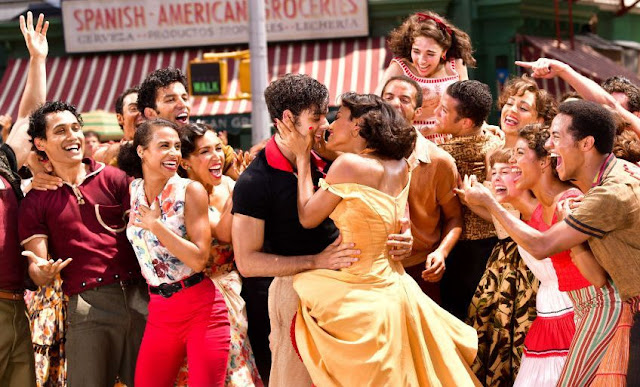
West Side Story: Rumble in the Rubble

David Alvarez Ariana DeBose in West Side Story (2021).

The enthusiasm over Steven Spielberg’s remake of West Side Story, the street-gang retelling of Romeo and Juliet that opened on Broadway in 1957 and was first filmed by Robert Wise in 1961, reminds me of the outpouring of praise that greets Rodgers and Hammerstein’s 1945 Carousel every time it generates another Broadway revival. Just imagine, runs the usual buzz, someone wrote this serious, important musical back in the dark ages when musicals were frivolous! How modern, how prescient! How daring to kill off the protagonist, to incorporate domestic abuse, to put disaffected youth on the stage! How fresh it still seems, how up-to-the-minute! Well, I see no reason to condescend to lighthearted musicals, especially when they come equipped with scores by Kern, the Gershwins, Porter, Berlin and Rodgers and Hart. But the truth is that the American musical took its first resounding step past frivolity when Kern and Oscar Hammerstein II wrote Show Boat, with its tragic racial subplot, exactly three decades before West Side Story. And that’s a good musical. 

Monday, July 10, 2017

Musicals Round-up Part I: Niagara-on-the-Lake and London

Kristi Frank and Michael Therriault in the Shaw Festival production of Me and My Girl. (Photo: David Cooper)

This article contains reviews of Me and My Girl (Shaw Festival), Dreamgirls (West End), and On the Town (Regent’s Park).

Michael Therriault is so thoroughly winning and energetic in Me and My Girl at the Shaw Festival that you feel he could carry the production on his back if he had to. The musical is built as a vehicle for the performer who plays Bill Snibson, the Lambeth Cockney who discovers he has inherited an earl’s title and is expected to relocate to Mayfair, and the diminutive Therriault, with his pop-eyed charm and apparently elastic body, claims squatter’s rights to every scene he’s in. Therriault is a well-known Canadian musical-theatre actor (he played Gollum in the musical of Lord of the Rings both in Toronto and in the West End), but the only time I’d seen him before this summer was in Studio 180’s production (in Toronto) of Parade, as the Jewish factory owner Leo Frank, framed for the rape and murder of one of his employees in pre-World War One Atlanta. He was superb, but the role was so downbeat that I didn’t immediately make the connection to the song-and-dance man who plays the lovable, insouciant Bill. Therriault’s peculiar gift is for balancing charisma with modesty – like Dick Van Dyke, though his musical-comedy gifts are more extensive than Van Dyke’s and he’s more believable as a Cockney than Van Dyke was in Mary Poppins.

Monday, July 22, 2013

New York Musicals: On the Town and Hello, Dolly!

On the Town at the Barrington Stage

Though they’re best known for writing Singin’ in the Rain, the funniest movie musical ever made, the book and lyric writers Betty Comden and Adolph Green were the most notable proponents – perhaps even the inventors – of the New York musical. During their long-term and prolific collaboration they worked together on On the Town, Wonderful Town, Bells Are Ringing, Do Re Mi and, on screen, It’s Always Fair Weather, all of which unfold against the backdrop of a bustling Manhattan peopled with colorful caricatures of New York types. There’s an exuberance in the way Comden and Green employ specific New York settings: the Greenwich Village of the 1930s in Wonderful Town, the subway in the “Hello, Hello There” number in Bells are Ringing, Stillman’s Gym in It’s Always Fair Weather. Their first Broadway show, On the Town, which just closed in a marvelous production at Barrington Stage in the Berkshires, begins and ends in the Navy dockyard, and in between takes us to Carnegie Hall, the Museum of Natural History, Coney Island and the interior of a taxi driven by a boisterous female cabbie named Hildy. It’s a valentine to the city, seen through the eyes of three young sailors who encounter it for the first time during a twenty-four-hour furlough.

Wednesday, June 28, 2023

Plays with Music: Brokeback Mountain and The Curious Case of Benjamin Button – and a Brief Farewell

Mike Faist and Lucas Hedges in Brokeback Mountain. (Photo: Manuel Harlan)

Receiving its world premiere at London’s compact, comfortable new Sohoplace in London, Brokeback Mountain, Ashley Robinson’s ninety-minute dramatization of the Annie Proulx story most people know through the 2005 film, is a trim, skillful production. Jonathan Butterell has staged it effectively in the round on Tom Pye’s pared-down set and Mike Faist and Lucas Hedges, the two actors succeeding Jake Gyllenhaal and the late Heath Ledger in the roles of the young Wyoming cowboys embarking on a forbidden, tragic gay romance, are both excellent, especially Hedges as Ennis Del Mar, the more inexperienced of the two lovers. The problem is that damn material, which is meager and phony and keeps striking the same mournful note over and over. The show includes a small band playing country-western ballads (mostly) that merely replicate the mood. You walk out of the theatre starved for a little variety – and, God knows, an ounce of humor.