Showing posts sorted by relevance for query sherlock bbc cumberbatch. Sort by date Show all posts

Thursday, July 29, 2010

Sherlock: The BBC Brings Us Holmes Again

Benedict Cumberbatch and Martin Freeman as the new Holmes and Watson.

Every once in a while, a television series comes along and surprises you. Sometimes it’s because a show is so stunningly original that no precedent could have prepared you for it (e.g. HBO’s Carnivale and Fox’s Buffy the Vampire Slayer). But other times, it’s because a road has been so well-trodden that you go along for the ride, but honestly don’t expect to see anything new there. This past Sunday, BBC One broadcast “A Study in Pink” the first episode of Sherlock, a 21st century re-imagining of the celebrated Arthur Conan Doyle character. Benedict Cumberbatch (BBC’s The Last Enemy, Creation, The Other Boleyn Girl) stars as the titular Holmes and Watson is played by the more recognizable Martin Freeman (Tim in BBC’s The Office, and Arthur Dent in the 2005 film adaptation of The Hitchhiker's Guide to the Galaxy). The series is the brainchild of Steven Moffat (Doctor Who, Jekyll, Coupling) and actor/writer Mark Gatiss (The League of Gentlemen, Doctor Who). Moffat has a long history of critical and popular success on the BBC, and it is possible his career has recently reached a new height. In addition to this new series, this past year he took on the helm of BBC’s flagship series, Doctor Who. Given the numerous imaginings of Holmes available on television and film, one might be forgiven for thinking we need a new Sherlock Holmes series as urgently as we need a new brand of vanilla ice cream. Fortunately, this is one instance when that persistent gap between what we believe we need and what we get works decidedly in our favour!

This first run of Sherlock consists of three feature-length episodes, each running 90-minutes. (This coming fall, the series will air in the U.S. on PBS, under the Masterpiece Mystery! banner. It will also air, beginning September 10, on Showcase in Canada.) Set in contemporary London, the show succeeds in bringing familiar and beloved characters firmly into the new century while preserving the magic of the source material. The final result is a show that is funny, suspenseful, and eminently entertaining. Sherlock has something to offer both to those pre-inclined to love it, and those with no familiarity with Sherlock Holmes or the BBC.

Thursday, January 7, 2016

The Seriously Underdeveloped Bride: Sherlock’s New Year’s Special

Martin Freeman and Benedict Cumberbatch in Sherlock, "The Abominable Bride."

Six years ago today, on January 7, 2010, Kevin Courrier, David Churchill and Shlomo Schwartzberg launched Critics at Large with the aim of providing a place for new critical writing outside the narrowing constraints of the media industry. Since then, we have published a new piece of criticism every day (on films, books, television, theatre, dance, and popular and high culture of all genres), and have gathered a still-growing group of writers – both established and emerging – from across the continent. Over 2,200 posts later, Critics at Large continues to be committed to providing a space when a true diversity of voices can resound. It is particularly meaningful to mark the anniversary of the site with a piece by Danny McMurray on Sherlock. The BBC series was dear to David, who we lost to illness in the spring of 2013, and we at Critics at Large will read Danny's analysis with pride and with loving memories of David. 

Mark Clamen
Managing Editor,
Critics at Large

Kevin Courrier
Editor-in-Chief,
Critics at Large

Note: This review contains spoilers for Sherlock's "The Abominable Bride".

Fans have waited almost two years since Sherlock, the BBC’s beloved modern-day adaptation of Sir Arthur Conan Doyle’s Sherlock Holmes mysteries, closed out its 3rd season with the shocking return of Holmes’ nemesis, Jim Moriarty (Andrew Scott). To some frustration, the latest episode, titled “The Abominable Bride” and billed as a feature-length holiday special, does little to further the plot showrunners Mark Gatiss and Steven Moffat left us with two Januarys ago. Instead, the holiday special takes the form of an “alternate reality” story that transports Sherlock Holmes (Benedict Cumberbatch) and partner Dr. John Watson (Martin Freeman) to the lush, gothic Victorian London from which their characters were born.

Thursday, February 16, 2012

Elementary: BBC's Sherlock – Season Two

Benedict Cumberbatch and Martin Freeman as Holmes and Watson

One of the great joys of writing for this website is discovering hidden treasures that you can share with the reader. Sometimes you can also warn folks, too, about the dreck that litters the popular culture landscape. But for me the biggest pleasure I get is when one of my colleagues unearths something, writes about it and turns me on to it. That is exactly what Mark Clamen did nearly two years ago when he reviewed the first season of the new BBC TV version of Sherlock Holmes, called simply Sherlock. Up until Mark reviewed it I didn't know it existed. And until that moment I'd also never heard of Benedict Cumberbatch (Tinker, Tailor, Soldier, Spy; National Theatre’s Frankenstein) who was cast as Sherlock Holmes.

Because of his review (he'd seen it in advance of its Canadian premiere), I was able to keep my eye out for it when the first season was finally broadcast on the Canadian cable channel, Showcase (it played on PBS in several markets, but not on my Buffalo-based PBS station for some reason). I won't rehash Mark's review, but suffice it to say that adapters – Mark Gatiss (who also plays Mycroft Holmes on the show) and Steven Moffat (creator of another fascinating but finally unsuccessful updating with his version of Dr. Jekyll and Mr. Hyde, called Jekyll) – have brilliantly updated to our current era these stories based on Arthur Conan Doyle's. Some of the updating is inspired with twisty variations to the original stories. Some of the updating is incredibly simple, but very effective. For example, Dr. John Watson (a really good Martin Freeman) is a veteran of a war in Afghanistan, just as the Dr. Watson was in Doyle's original stories. Some things never change.

Sunday, April 21, 2013

Tribute to David: Mark Clamen

David Churchill (1959-2013)

Given the sad passing of our friend and colleague David Churchill, we've decided to honour him in a manner totally fitting to our memory of him. Since he was such a strong advocate of Critics at Large from the beginning, he was quick to initiate ideas. One thing he was quite fond of were omnibus projects like the Remembering 9/11 collection (which led to our first e-book) and the Titanic 100th Anniversary commemoration. Therefore, we felt strongly that we could best salute our late columnist by creating an Omnibus of David. From April 16 until April 24, we plan to publish – daily – the best of David Churchill as chosen by our writers.

Today's piece is from Mark Clamen.

The Editors at Critics at Large.


When I first met David, he was sitting at a table with Kevin Courrier – I would quickly discover that this was exactly as it should be. This was three years ago. It was only a few days after Shlomo Schwartzberg had generously invited me on board to write for Critics at Large, and we all met at a Chinese restaurant on Yonge Street, in Toronto. It was actually at that same restaurant that the three of them had come up with the germ of the idea for the blog several months earlier: a project born from the love of, and perhaps even the need for, writing. Three years is not a very long time, but it is difficult for me today to imagine a time before that Tuesday night. David, Kevin and I would continue to meet regularly, ostensibly to manage the daily operations of publication and to brainstorm upcoming posts and projects but (as I would come to both expect and look forward to) most of our time was spent simply talking. David and Kevin had been friends for decades, and while they never tired of speaking with one another – eagerly beginning and finishing each other's stories – from the first meeting, I never felt like an outsider. The topics of conversation would vary (personal, political, currents events) but at the core was always the arts: movies, music, books and, the one topic I felt I could contribute to, television. David Churchill – a lifelong writer – had only recently returned to arts writing, but this was the only David I have even known: the one whose eyes shone with engagement when you spoke with him. I don't think I've ever felt quite as listened to as when David was on the other side of the table. These regular dinners (which continued until late December of 2012) remain the heart of what Critics at Large has become for me: a warm, inviting, sometimes hilarious and always engaging, inspirational space of friendship, ideas, and a shared love for the popular arts.

David possessed a fearlessness – in living, and in writing – that I’ve always wished to have. That quality of David has long amazed and inspired me, as a writer and critic, but it would be wrong to imply that David was a passive agent of inspiration. Always encouraging and positive, he would often pull me (it seemed quite literally) to produce what he seemed so much surer than I was I could do. Just one example: regularly, over a period of months, he would remind me – gently, jokingly, and always firmly – that I should write a piece for the 9/11 e-book he was editing from the blog’s writers. I had hedged and procrastinated for so long that it still amazes me that he could always find the energy to bring the topic up as often as he did. When I finally did do it (and it wasn’t even remotely the hurdle I had been imagining it was), David’s email response was immediate, unequivocally enthusiastic, and (due to some all-caps profanity) unprintable here. Later that evening, at our regular meeting, I was greeted by David’s wry, bright-eyed smile. Whether he said it out loud that night or not, the words I hear in my mind are all his (words I know I will hear for years to come every time I miraculously meet a deadline): “I always knew you could do it, brother.”

I’ve chosen David’s review of Sherlock’s second season as a tribute, not only because it displays David’s unique voice – that fantastic admixture of enthusiasm and critical attention – but because it reminds of precisely what David brought into my life, and what is now lost to me with his disastrously premature passing. One of the very first pieces I ever wrote for Critics at Large was a review of the show’s first episode. When David finally saw the show, he loved the series as much as I did but he came to it (as we all do) from a different place. Together, I like to see these two pieces as a conversation, a kind of tribute to the energizing space that David could create, just by sitting across the table.

Next year when Sherlock returns for its much-anticipated third season, it will be bittersweet for me. But I’ve already reserved a glass of wine with David’s name on it ready to raise up when the credits roll.

Mark Clamen is a writer, critic, film programmer and lifelong television enthusiast. He lives in Toronto, where he often lectures on television, film, and popular culture.


Sunday, December 22, 2013

Television Goes Global, and Other Reflections on TV in 2013

The final episode of AMC's Breaking Bad aired this past September.

The past twelve months have brought an embarrassment of riches to the dedicated television viewer. Not only a number of promising new series, but technological and industry developments have made television viewing richer, more diverse, and more convenient than it's ever been. But even on wholly traditional terms, TV has had a good year. AMC's Breaking Bad came to a powerful and satisfying conclusion. FX's Justified had another strong year, and its fifth season is set to air early in January. After some uneven early episodes, CBS's Americanized Sherlock Holmes procedural Elementary went from strength to strength, culminating in a powerful first season, and this fall has proven itself to be much more than the pale shadow of BBC's incomparable Sherlock it threatened to be on paper. In November, TBS premiered The Ground Floor, a new laugh track rom-com/office comedy from Bill Lawrence (Scrubs, Cougar Town) that has grown more charming and likeable with every passing episode. And a year ago, long before Fox's Brooklyn Nine-Nine hit the airwaves in September, who could have guessed that the best comedy team-up on television would be Homicide: Life on the Street's Andre Braugher and Saturday Night Live alum Andy Samberg? All in all, we have a lot to be thankful for this year. Below I review some of the more interesting developments in television in 2013.

Monday, April 4, 2011

Measure of a Man: Danny Boyle's Frankenstein

No. Director Danny Boyle (127 Hours, Slumdog Millionaire) has not done a new film version of Frankenstein. Currently on the boards in London's West End, Boyle's brilliant play Frankenstein (it was written by Nick Dear) is a monster hit sell-out (it closes, or is supposed to, on May 2nd). I was fortunate to see it four days ago without having to drop a fortune for an airline ticket, or scalper prices at the theatre.

Beginning in 2009, the National Theatre Company in London began offering live broadcasts of shows on their stages to movie theatres around the world. It is a fabulous idea. The National Theatre attracts some of England's finest actors and actress, such as Helen Mirren, Judi Dench (I was able to see her live in London in 2009 in the scintillating play, Madame de Sade – and, gushing fan moment, got to meet her briefly at the stage door after), Derek Jacobi and Jude Law. There are risks involved in these broadcasts. Since they are sent via satellite to the cinemas around the world, there is a chance that you might pay your money and see nothing if the signal is lost. I thought that was going to happen on the night I saw Frankenstein. Before the play started, on screen there was a hostess setting up the night, followed by a short documentary on the making of the play. The sound wasn't working. After twice springing out of my seat to complain, they fixed the problem just before the play itself was to begin. The show was mildly marred all evening long by occasional sound drop-outs (something they warn about at the start), but compared to not seeing it at all because of no sound, it was something I was happy to live with.

Sunday, October 7, 2012

Vegas, Revolution, and Elementary: Something Old, Something Borrowed, Something New

Lucy Liu and Jonny Lee Miller star in Elementary, a new drama series on CBS

The 2012 fall television season is in full swing – most of the new TV series have premiered and many old favourites are back with new episodes. Back at the beginning of September I have to admit that I was far less excited about the new shows than I have been in many years. Few jumped out at me, and for the first time in a while, there wasn’t a single standout show I was eagerly awaiting (as I had anticipated The Walking Dead and Awake in years past). It seemed like if anything, Fall 2012 was destined to be a season of more-of-the-same: a post-apocalyptic story with conspiracy undertones reminiscent of Lost and Terra Nova, an Americanized Sherlock, at least two Modern Family-inspired sitcoms, a new ode to Justified complete with a gun-toting cowboy/sheriff who plays by own rules, and yet another Matthew Perry comedy!

To my delight and surprise more than a few of these shows have far exceeded my admittedly low expectations. Today I’m looking at three network dramas – Vegas (CBS), Revolution (NBC), and Elementary (CBS) – which, while classic examples of some well-worn television tropes, have so far turned out to be remarkably rich variations on those themes. (Next week, I’ll weigh in similarly on some of the networks’ best new comedy offerings.) 2012 may not be a year for creative risk, but it may turn out to be the year of slow and steady, with more than enough solid network fare to keep you warm throughout the fall.

Sunday, January 30, 2022

Exposure: Jane Campion’s The Power of the Dog

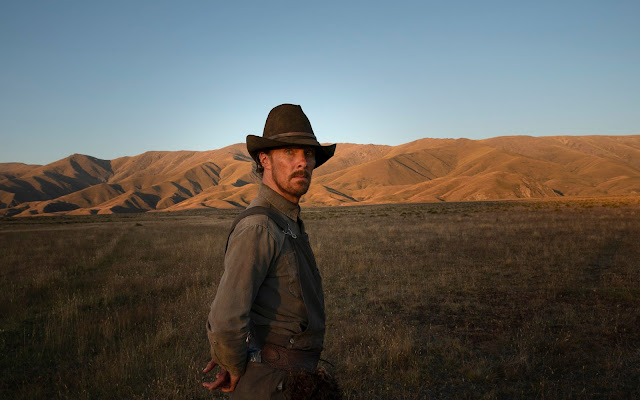
Benedict Cumberbatch in The Power of the Dog, currently streaming on Netflix.

Reading the rapturous reviews of The Power of the Dog is a bit like talking to an anti-vaxxer. The experience is so disorienting – the depiction of reality so inverted – that after a while you begin to question your own sanity. I forced myself to sit through the movie a second time, just to be sure I hadn’t missed something. I hadn’t. Jane Campion has made a pretentious, incoherent, excruciating adaptation of Thomas Savage’s 1967 novel of the same name. Many audience members may feel similarly, I suspect, but raising questions can invite gaslighting from critics ready to anoint the film. Witness Slate editor Jeffrey Bloomer, a self-described Campion fan, who found the viewing experience “absolutely miserable.” In response to his heresy, the poor man is led by reviewer Dana Stevens through some kind of struggle session to get him to recant his view and assent to the picture’s inscrutable wisdom. Watching them try to decode the movie like an ancient rune is disturbing. It seems every year brings us an empty art house film that the chattering classes adore. But The Power of the Dog has to rank near the top for eliciting such an Orwellian campaign of misinformation. 

Thursday, December 20, 2018

Cultural Offerings for the Holidays

Jonny Lee Miller, Jon Michael Hill and Lucy Liu CBS's Elementary.

It can be difficult to decide what to buy people for the holidays, what with so much stuff available out there. So here is my annual list of holiday suggestions, (hopefully) suitable presents for the film/book buff, music lover and TV aficionado in your circle.

Friday, September 19, 2014

All That Is Old Is New Again: On the Current State of Doctor Who

Peter Capaldi as the Doctor, on BBC's Doctor Who

This past winter, my wife knit a Tom Baker-era Doctor Who scarf as a birthday gift for a friend. It turned out my friend has been wanting one since he was a kid, and could not have been more thrilled with the gift. He proudly wore the 12-foot scarf, its colourful tassels dragging along the streets of Washington, D.C., for the remaining cold days of the year, and even beyond them. Recently he told me a story: while walking to work on one such day, he crossed paths with a young boy (perhaps nine-years-old) and his mother. The boy, on seeing my friend, began jumping up and down and pulling at his mom's coat, yelling with delight: ""Doctor Who Scarf! Doctor Who Scarf!!!"

I tell this story, not only because of the profound pleasure the incident provoked in my friend, but because it reveals something I've long believed about Doctor Who as a televisual and cultural phenomenon. Even after 50 years and over 34 seasons, the show appeals across cultures, continents, and generations. (Tom Baker stopped wearing that scarf more than three decades before that young American boy was even born!) I loved the show as a child, when episodes of Peter Davison's Doctor aired on my local PBS channel, and as an adult the relaunched BBC series has topped my list of favourite shows since the show appeared in 2005.

Friday, December 21, 2012

Two Views: Peter Jackson's The Hobbit: An Unexpected Journey

Martin Freeman as Bilbo and a room full of dwarves

Today, we have two of our critics weighing in on Peter Jackson's The Hobbit: An Unexpected Journey. Neither David Churchill nor Shlomo Schwartzberg know what the other wrote, so this is a bit of a voyage of discovery for them now that the two reviews are up. 

Finishing a Patchwork Quilt

Over the years, there seems to be a building hatred for Peter Jackson, especially in the critical universe, because, as some have said, “he no longer has any street cred.” No, I have no idea what that means (expect maybe they expected him to make low budget splatter movies his whole career). It's just empty verbiage trotted out when they have really nothing to say. It's the critical world equivalent of businessmen who spout phrases like, “new paradigms,” “moving forward,” etc. Granted, Lovely Bones (2009) was a failure with some good ideas, as I outlined here; while King Kong (2005) divided critics too; but the real vitriol began when Lord of the Rings: The Fellowship of the Ring came out in 2001. There was so much sneering at the first film among the Toronto-based critical community that one reviewer for a major publication was heard to tell another critic he'd put it on his Top 10 not because he actually liked it, but because he didn't want to get nasty letters from Tolkien/Jackson fans. How craven! Was he afraid he'd be banished from the in crowd who thought Jackson had lost his “street cred?” Probably, but what is completely clear is that this critic, who is still employed by a major publication, has no ethics. If you hate it, state it and say why.