Showing posts sorted by relevance for query yoko ono. Sort by date Show all posts

Thursday, January 13, 2022

The Ballad of Paul and Yoko: Artfully Linked

Yoko Ono; Paul McCartney.


Yoko One, "Death of Samantha," Approximately Infinite Universe, 1973.

The Firemen, Strawberries, Ships, Oceans, Forest, 1993.


To think of Yoko Ono and Paul McCartney in the same sentence, let alone in the same artfully appreciative article, might strike some people as a surprising proposition, and yet as a narrative ballad they share much more in common that you might at first imagine. Not just the fact that they shared an intimate partnership with a famous musician and pop star but also the fact that they have often been collaterally damaged victims of an ongoing mythology about who they actually were and what they actually did. To some extent, this might just be the occupational hazard of any huge cultural icon, but it could also be a revealing indication of how much we all want to believe what we want to believe, despite what the facts and evidence may show us otherwise. Luckily for us however, Peter Jackson’s masterfully edited documentary called Get Back at least contributes somewhat to their rehabilitation at celebrities anonymous.

Wednesday, July 5, 2017

No East or West in Dreams: Yoko Ono, Buddhism and the Avant-Garde

Fly (1971) was Yoko Ono's second album.

Welcome to the world of transformation and transcendental art. The art in multiple media produced by the 1960’s neo-dadaist movement known as Fluxus in general, and the art of Yoko Ono in particular, in addition to being challenging and thought-provoking, is also an exceptionally suitable vehicle for the subtle transmission of sophisticated Buddhist principles which can be found in both Zen and Dzogchen teachings. In many cases the artworks themselves are embodied meanings, crystallized manifestations of certain Buddhist perspectives on the interactive nature of reality.

Inspired profoundly by the brilliant breakthroughs of two twentieth-century conceptual masters, Marcel Duchamp and John Cage, the art produced by Ono and this mere decade-long assembly of experimental mixed media artists and musicians is also an ideal pivot with which to appreciate the more pronounced (and more revealing) affinity which has long existed between Buddhist philosophy (especially as transmitted to the west by D.T. Suzuki in the post-war period) and the west’s most adventurous avant-garde (especially that practiced by visionary artists and musicians such as Duchamp, Maciunas, Cage, and the Fluxus group). And Yoko Ono. Perhaps especially Yoko Ono.

Sunday, November 21, 2010

Borrowed Time: Listening to John Lennon's Signature Box Set

“I’ve always been slightly jealous of the world for having had more time with my father than I did” – Sean Lennon

Sean Lennon makes a valid point considering that he was just 5 years old when his father died. Consequently, our own memories of John Lennon resonate differently. But, in considering the music, we have to take into account Lennon’s relationship with his family and his openly political activities. This is especially true when you examine his entire body of work, as collected in the recently released Signature Box Set. Remastered by the same team that did the excellent work on The Beatles’ mono and stereo box sets from last year, this collection reflects the same standard of audio excellence. The set features Lennon’s singles, demos and completed albums, including a brochure of essays from Yoko Ono, Julian Lennon and his half-brother, Sean.  The set also includes a book examining Lennon’s short life and a print of one of his ink illustrations. I took the time to listen to these albums once again in chronological order just as they were intended.

Friday, December 8, 2017

Chaos to the Core: The Zapple Diaries by Barry Miles

Beatles's manager Allen Klein, John Lennon and Yoko Ono in 1969

The title is long but The Zapple Diaries: The Rise and Fall of the Last Beatles Label, the story of The Beatles’s failed business endeavor by Barry Miles, is a fascinating first-hand account. Miles was a personal friend of Paul McCartney when he opened the Indica Bookshop in London that featured art installations and poetry books by the leading avant-garde artists of the day. (One of those artists was Yoko Ono.) He started the bookstore in 1965 with Peter Asher, brother of Jane Asher, McCartney’s girlfriend at the time. Miles reflects on those early days with a kind of pragmatic fondness, “There is no question that without Paul McCartney’s support Indica Books would have gone under several years before it did . . . in 1970.” He says that the Beatle’s involvement was “kept quiet.” But the seeds for starting a new business to record new poets were planted and McCartney was particularly enthusiastic about supporting the Miles/Asher partnership in this manner. While Asher kept the store going, The Beatles hired Miles when they formed Zapple, an imprint of Apple, in 1968. Zapple was created to release “more experimental material” such as spoken word recordings and his job was to approach and record American poets for the new label. His book is about that gig, the artists he recorded and the office politics of The Beatles’ risky new business.

Saturday, March 8, 2025

Primal Screen Therapy: The Optical Unconscious Writ Large


“The screen is a magic medium. It has such power that it can retain interest as it conveys emotions and moods that no other art form can ever hope to tackle."
--Stanley Kubrick

“Going to the cinema is like returning to the womb; you sit there still and meditate in the darkness, waiting for life to appear on the screen. One should go to the cinema with the innocence of a fetus.”
          --Federico Fellini​​​​​​​

Culture critic Walter Benjamin once remarked that the invention of the camera introduced us to unconscious optics, just as Freud’s invention of psychoanalysis did for unconscious impulses, and he knew whereof he spoke. That insight reveals the same prescience that Freud’s chief acolyte and primary competitor Carl Jung also sensed, in a somewhat more refined and spiritual manner: that cinema is the artful language of dreams we speak while we’re still awake. Two insightful books, American Avant-Garde Cinema’s Philosophy of the In-Between by Rebecca Sheehan and Screening Fears: On Protective Media by Francesco Casetti, share an equally insightful exploration of the archetypal and collective mythologies that define classic cinema regardless of its genre. Looking at films through a psychological lens provides us with a valuable map and a discursive language which we can use to orient ourselves within the imaginal landscape of the motion picture art form. These two books, with a kind of cogent synchronicity, also definitely offer a deep dive into cinema as the quintessential art form of the 20th century. They deftly penetrate our shared psychic myths as revealed through the language of films and thus help us to more deeply understand our own hopes and fears while doing so, and as such they supply a kind of primal screen therapy which assists the audience in conversing with our own optical unconscious.

Friday, June 16, 2023

Parallel Forces of Culture: Chuck Berry and Bob Dylan

Hachette Books, 2022;  Hachette/Back Bay Books, 2021.

“I never wanted to be a 60’s artist, but to be an artist for all time. If it’s not for all time it’s not worth doing. My mind works in a timeless way. 1966 might as well be 2090—it’s all the same to me.” – Robert Zimmerman

“There’s two things that a man must know in order to get closer to himself, to be a man. One is mathematics, since everything is controlled by numbers; the second thing is money.” – Chuck Berry

These two titanic musical artists were two parallel storms that first ripped across America’s unsuspecting 50’s and 60’s heartland, and then rapidly tore across the whole planet earth with a ferocity only matched by The Beatles. Ironically, the first artist, Chuck Berry, inspired The Beatles, who then were creatively reborn themselves once inspired dramatically by Bob Dylan, along with every other singer-songwriter on the convulsing planet of pop culture. Both from Hachette Books, these books are also an ideal tag team match for taking the full measure of true innovation and influence within their respective fields. In a very real sense, there was popular music before Chuck Berry and then after Berry, just as both folk and rock can only be fully appreciated if assessed both before Dylan and then after his astonishing ascent. RJ Smith’s biography of Chuck Berry, Chuck Berry: An American Life, can rightfully be called the definitive one in a prior flock of works of varying degrees of serious intent: the most serious, the most revealing (often embarrassingly so) and also easily the most readable for both music devotees as well as the general public with a curiosity as to how rock and roll music was born and how it grew into its adulthood as rock. One of his most ardent fans, the equally accomplished pop musician John Lennon, once quipped that if you wanted to give rock and roll another name, you might just call it Chuck Berry. While this is technically true, and quite touching, I’d point out that you could also call it Sister Rosetta Tharpe and Louis Jordan, both of whom were active for a full decade, making the kind of jump rhythm and blues that white folks (most notably the disc jockey Alan Freed in about 1951) eventually called rock and roll. Add into that heady mix Jackie Brenston and Ike Turner and his Rhythm Kings, whose 1951 hit “Rocket 88” was technically the earliest song we can identify as full-blooded rock.

Thursday, May 13, 2021

S O L A C E: The Art of Intimate Absence – Theme for an Imaginary Exhibition

Dreamwalk, Mimi Gellman, Edward Day Gallery, Giclee print, 2002. (Image courtesy of the artists)

Note: All images are courtesy of the artists.

“In dreams begin responsibilities . . . ”– Delmore Schwartz

In the museum of dreams, anything is possible. Perhaps prompted by viral circumstances, I imagined an installation of images, objects, films, videos and performances addressing social issues of import which impact everyone in today’s world: anyone who wonders how we maintain our mutual bond as people and cultures during a challenging time of collective isolation. The three well-known artists contemplated, Mimi Gellman, Vessna Perunovich and Nayra Martin Reyes, have a unique but shared interest in exploring isolation and identity politics, gender issues, exile and refuge, persona and displacement, and travel, in what I am designating as a post-proximity world. They express through their artifacts a transnational and humanist domain which is essential for us if we are all to survive the challenges facing our global cultures at this precarious moment in our common history. They each approach a new vista verging on the merger of safe place and secure shelter with vulnerable empathy and alienated exclusion.

Sunday, May 25, 2025

Life is a Game of Go: The Enigmatic Literature of Yoko Tawada

(New Directions.)

“It is the second job of literature to create myth. But its first job is to destroy it.”
--Kenzaburo Oe

Yoko Tawada’s beautiful and strange literary work is totally saturated with mythology, both the public and the private sort, mixed together through a frantic postmodern blender to shake up a truly startling smoothie of poetic insights about the odd sensations that accompany our situation as human beings in a weary century. True, Tawada’s novels, often written in both German and Japanese before being deftly translated into the only language I can access, are what we might quaintly refer to as an acquired taste. But then, so is sake. But sake, once tasted, and whether hot, chilled or room temperature, alters our senses forever after. And so it is with Tawada’s marvelous and marvel-filled stories. They have the capacity to inalterably change the open-minded reader, in the way that only great literature can, and after reading her surreal, dreamlike reveries about our relationship to words and language, most other literary beverages feel slightly bland by comparison. So we won’t compare them, any more than we would compare sake to tapwater.

Wednesday, November 4, 2020

Harvest of Memory: The Multi-Faceted Art of Bea Nettles

Harvest of Memory, Bea Nettles (University of Texas Press)

“I see my career as a spiral with my ideas always circling and picking up reflections of earlier thoughts.”– Bea Nettles, Journal, 1990.

“There are parallels to making art and tending one’s garden . . . an image or an idea can be split up, shared, and even better yet, transplanted into someone else’s garden.”– Bea Nettles, Journal, 2011.

John Lennon once famously, and sarcastically, remarked to a journalist that his wife was the “most famous unknown artist in the world,” something that was true only in the sense that Yoko Ono’s serious art-world credentials (which pretty much disintegrated when she married him) were submerged in the notoriety that surrounded their alliance. But as an art historian I can tell you without a doubt that though I greatly admire Yoko’s prescient and poetic pre-John visual-object work (and her first three brilliant recordings), the actual title of Most Famous Unknown Artist really belongs to one Bea Nettles, whose radical work over fifty years is now being celebrated through major retrospective shows that clearly demonstrate how far ahead of her time she was. Only in the rarefied off-the-map art-world circles where true cultural revolution and evolution usually take place was she rightly famous.

Sunday, September 24, 2023

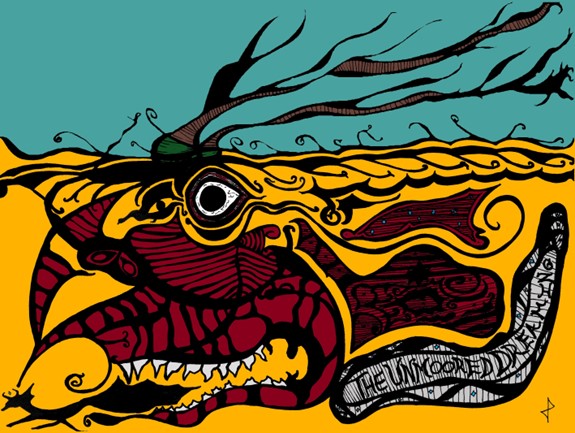
At the Threshold: The Unmoored Dreaming

Album cover art: Bjorn Vandenneucker
“What is typical of our century and largely promoted by the media, is the general belief that everything that is broadcast or distributed must be instantly comprehensible. But that is an enormous misconception. It is rooted in the assumption that there is such a thing as an audience. We must correct this view and make it clear that people are individuals, each of whom is following a unique path toward learning and development and free to make personal choices. So let us be less eager to teach and to prescribe rules, and rather just say: ‘If you want to listen, you can; here are the recordings and scores. We give concerts; we will provide information. But whether or not you come or you are interested is your own business.”
– Karlheinz Stockhausen, “Every Day Brings New Discoveries” (1991)

New music, and I do mean new, has arrived in our space-time continuum. And poised, rather gracefully I might add, somewhere between the free jazz traditions of Ornette Coleman and Anthony Braxton, and the new music domains of George Crumb and John Cage. Yes, this is lofty territory, but these two composer-performers hold their own in the rarified atmospheres I’ve often delineated as soundtracks for an imaginary film, or national anthems for a utopian country. In this case, the country is a multi-cultural effort. The Unmoored Dreaming is a free jazz group consisting of Goncalo Oliveira, a Portuguese guitarist based in Den Haag, and Bjorn Vandenneucker, a double bass player and composer based in Brussels, that explores its mutually created repertoire in an expansive and open format. Open is the operative word here, since their charming music doesn’t so much begin or end as simply happen. And elegantly so.

The Unmoored Dreaming is also the title of their eleven-piece debut album, the result of what the duo call their “reinless traveling through sonic landscapes,” which was released on Bandcamp in April of 2023. As disparate as jazz and serialism might at first appear to be, the tangible and even haptic link between them is clearly the delivery of multiple tempos played simultaneously. The individual pieces in the recording from this daringly confident collaborative duo are also linked as in a suite of sonatas, though each work also stands comfortably alone on its own. Their partnership itself is also identified with and embodied by that evocative name, which captures the shared motive and aesthetic agenda of their initial release, recorded, mixed and produced by Manolo Cabras at Studio Noyer in Brussels.

Sunday, May 28, 2023

Tina Bids Farewell: The Exuberant Buddhism of the Late Tina Turner

Tina Turner, in 2018. (Photo: Charles Gates)

“The Buddhist concept of changing poison into medicine works. My life has proven it."  – Tina Turner, Living Buddhism, July 2018.

As a Buddhist, I don’t, of course, believe in the customary concepts of heaven or hell, since as fellow practitioners well know, we humans do a pretty good job of manufacturing our own versions of those two domains right here on earth while we’re alive in this material world. Like many of you, though, I do, however, believe in reincarnation, and that’s where my mind first went when I learned of the passing of the great Tina Turner at the age of 83 at her home in Switzerland on May 23, 2023, with her beloved second husband Erwin Bach at her side. Her first husband, the notoriously abusive Ike Turner, whose sole role in history has become his introduction of a shy sixteen-year-old girl named Anna Mae Bullock to the recording industry and his transformation of that girl into Tina, the larger-than-life talent we all came to adore, has drifted off into whatever hellish domain awaits the cruel and inhuman among us. But Tina, she might well have gone elsewhere.

Wednesday, March 10, 2010

Thrillington (1977)

It’s been commonly assumed over the years that it was John Lennon who was the true avant-garde performer in The Beatles and Paul McCartney was - literally - the straight man. That view developed mostly out of Lennon’s bold outspokenness in both his personality and music, while McCartney submerged his personality in the craft of writing songs. Lennon possessed a romantic spirit, but it was one that made his art real and intimate to the listener. McCartney however was perceived as whimsical and impersonal (i.e. a light-weight). Of course, this is a rather simplistic perception because Lennon was equally whimsical in “Bungalow Bill”; just as McCartney could rock hard in “I’m Down.” It was McCartney after all who came up with the tape-loop experiments that Lennon incorporated into “Tomorrow Never Knows.” McCartney was also the first to create a sonic collage called “Carnival of Light” (still unreleased) before Lennon and Ono did their own “Revolution #9” on the White Album. During that period, John Lennon stayed home to live a more isolated domestic existence, while Paul McCartney was going to art shows and listening to Stockhausen.

Monday, July 6, 2026

One of a Kind, Twice in a Row: Legacy and Legend


“Art never saved the world. It cannot do so.”
--Marcel Duchamp

“Everyone is an artist.”
--Joseph Beuys

The 20th century. Oh how I do miss that century these days. It was a virtual dynasty of dissonance and discontinuity, a breathtakingly radical realm of overturned assumptions and collapsing complacent expectations. Almost all the accepted truths, from science and religion to literature, music and visual art, were being overturned practically on a daily basis. And the two artists profiled in two new tomes from Princeton University Press were at the forefront of the mission to alter our perceptions of what art was and what it can be expected to do to and for us. Marcel Duchamp (1887-1968) and Joseph Beuys (1921-1986) pretty much invented what we now call conceptual art. But it didn’t really have a name back when they were blazing a trail through the exotic hinterland of aesthetic exploration. And these valuable books, one a collection of snappy quotations from the cheeky and provocative Duchamp, Duchampisms, edited by Larry Warsh, and the other a deeply revealing study, Joseph Beuys and History by Daniel Spaulding, each shed new light on the dazzling outer range of cultural possibility back in the daring century they so personally embodied.

Thursday, January 9, 2025

Time Transfixed: The Momentary Music of Hemisphere


“My desire was not to compose, but to project sounds into time, free from any compositional rhetoric. Music which specifically defined pitch but allowed the temporal dimension to remain indeterminate, thus creating a sonic world where each instrument is living out its own individual life in its own individual sound world.”
Morton Feldman

To become transfixed is to be rendered motionless with wonder, to be immobilized by astonishment. To some extent it touches upon the condition which in more classical eras was associated with what was known as the sublime, a state akin to awe. The sublime is still with us, of course, but it is often sublimated since the course of modernism conducted its now well-known radical discontinuity. This was especially the case in the domain of music, which is a durational art, one occurring strictly as momentary sonic situations, relying historically on the laws of harmony in order to soothe the savage breast. The aleatory and organic flow of what became known as “new music,” however, tended to naturally embrace dissonance in a manner which celebrates time transfixed. If we try to imagine the notion of time transfixed we can also determine how frozen time might amount to space itself: to hear and see them as one in the same quantum thing, or, in Zen terms, no-thing.

Friday, February 21, 2025

The Brain Doctor: William Burroughs (1914-1997)

Portrait of William S. Burroughs by Lance Austin Olsen.

“Language is a virus.”
W. B.

William S. Burroughs’ supernal and subterranean Beat influence on Allen Ginsberg and Jack Kerouac alone would secure him a stable place in the modernist canon of American letters, as would Norman Mailer’s prescient early acclamation, “Burroughs might be the only American writer of sheer genius.” For me, Alexander Kafka penned what I’ve long felt was an ideal characterization of this experimental literary legend: “Burroughs was an ethereal intermediary between the here and the fiery beyond, pausing to give us the purgatorial skinny.” That skinny was transmitted in haunting and disturbing novels such as Junky (1953), Naked Lunch (1959), The Soft Machine (1961), and The Ticket That Exploded (1962), among many others. However, it was through his influence on every other aspect of 20th-century culture in all media that his spectral presence as a testifier was most perhaps most long-lasting.

Wednesday, February 8, 2023

Outside Looking In: The Seriously Funny Life and Work of George Carlin

“Comedy equals tragedy plus time.” – Dorothy Parker (among others).

“Dying is easy. Comedy is hard.” – George Burns (on his deathbed).

Having previously penned an excellent reappraisal of the consummately eccentric Frank Zappa, unique American composer and creator of the Mothers of Invention rock band, John Corcelli was perhaps ideally situated to undertake this new tome released by Applause Books in which he skillfully explores the similarly exotic outsider status of renegade comedian George Carlin. In his absolutely perfectly titled Outside Looking In: The Seriously Funny Life and Work of George Carlin, he lifts the curtain on the complexities of our mirth, and most importantly for such a delicate mission behind the front lines of laughter, he is sharp enough to appreciate the complex art of stand-up comedy but clever enough to know that it’s much easier to write about it than it is perform it. He leaves that to the experts, while still conducting a master class in how they do what they do. He did, however, study improv at Second City, thus certifying some of his credentials as a keen-minded participant in truly arcane craft.

Tuesday, June 4, 2024

Deep Listening: The Immersive Music of Rosanna Gunnarson and Karin Johansson

Cover: Dan Froberg

I Grunda Vikar Ar Bottnarna Mjuka, 2024
(Outerdisk Recordings, Gothenberg Sweden)


“When they trailed their spikes over the strings, the strings sounded again; but they played in a new way, for now they were tuned to another pitch.” – August Strindberg

“The rest is silence.” – Hamlet’s last words

I once knew an artist, Mario Reis, who told me in a sotto voce tone that he desperately wanted to capture what he called the slow accretion of time, in a painting that would contain the true sediment of time. Not a mere representation of that phenomenon, mind you, he emphasized, but the actual sediment itself, splayed out on the canvas for onlookers to behold in all its fleeting and melancholy essence. He then proceeded, over the course of several years, to immerse his large stretched canvases in rivers, lakes, bays and occasionally oceans, allowing the silt to autograph his paintings, using the riverbeds and rocks as living brushes to establish a base upon which he would subsequently improvise his own subtle stylistic markings. His pictures thus became snapshots of time itself, and also left a residue of flowing watery movements amounting to frozen music. They stunned me in their beauty as artifacts which skillfully narrated nature as a sequence of uncontrolled and uncontrollable moments.

Sunday, January 19, 2025

Argonaut of Modernity: Impersonating Pessoa

“You are what you contemplate, so choose wisely.”
--Machado de Assis

Reaktion Books/University of Chicago Press.

This new entry into the modernist archive by CultureLab member Bartholomew Ryan, Critical Lives: Fernando Pessoa, sheds fresh and welcome light on one of the most mysterious and elusive figures in the annals of contemporary literary culture. He was, in fact, not only a prototypical modernist, but also a stylistic harbinger of the amorphous postmodern ethos long before it even existed. The French writer Jules Michelet once declaimed, “Each epoch dreams the era to follow it.” Pessoa seems to have been the brilliant dreamer who imagined the relativistic and quantum-drenched psychological environment in which we currently dwell. Assis certainly knew whereof he spoke, for both he and his younger countryman Pessoa may have bravely contemplated the very shaky future we all live in now as a wobbly present.

Sunday, March 29, 2015

Where Dreams Don't Go to Die: John Lennon's "God" and The Beatles' Love


Eight months after The Beatles broke up in 1970, John Lennon released Plastic Ono Band, named after his new group. But rather than being a utopian vision from a collection of musicians shaping the future of a Seventies counter-culture, it was instead a solo autobiographical record which began as a stark recollection of Lennon's traumatic childhood. One listen to the album’s intensely austere songs made it clear that the world of possibility Lennon once heard in Elvis Presley's "Heartbreak Hotel," or the inclusive spirit he once proclaimed with The Beatles on "There’s a Place," he was now refuting. Lennon stripped the songs of their quixotic power for the purpose of discovering the naked truth about himself. "Mother" opened the album with the peeling of funeral bells, as Lennon ranted angrily at the father who abandoned him as a boy and at the mother who was killed soon after. "I Found Out" expressed his angry contempt for religion and the pop culture The Beatles helped inspire. "Working Class Hero," a mournful old-fashioned folk ballad, despaired of an authoritarian society that stripped its citizens of their souls. Critic Albert Goldman, in his controversial biography The Lives of John Lennon, compared the theme of Plastic Ono Band to The Who’s rock opera Tommy. "For what is the famous rock opera about?" Goldman asks. "A boy traumatized by his mother’s cheating loses all his senses but the most primitive, the sense of touch. He employs this mute yet passionate faculty to become a pinball hero—a symbol of rock ’n’ roll. Acclaimed by the world’s youth as a pop star, he continues to evolve, becoming first a guru and ultimately a saint. There is the legend of John Lennon to a T." On Plastic Ono Band, Lennon set out to reveal himself as a new man who was reborn.

Thursday, February 6, 2025

So Long, Marianne (1946-2025): What Becomes of the Brokenhearted

Marianne Faithfull. (Photo: Peter Seeger.)

“The men and women who produce works of genius are not those who live in the most delicate atmosphere, whose conversation is the most brilliant or culture the most extensive, but rather those who have had the power, ceasing suddenly to live only for themselves, to transform their own personality into a sort of mirror.”
Marcel Proust

If there is a sadder singer-songwriter on earth, I’m not sure who it might be. The late Marianne Faithfull was sadder than Neil Young, sadder than Leonard Cohen, sadder than sad. She even exceeds the sorrow and bleakness quotient of one of the great lamenters of all time, Nico, the chanteuse of pain who originally performed with The Velvet Underground but who left them, probably because they were too happy for her. She might be sadder that Amy Winehouse, although she was fortunate enough to live a full half-century longer than the poor lamentable Amy. Marianne Faithfull was the dark side of Joni Mitchell: while it’s true that Mitchell had her own dark side, Faithfull was the dark side of Joni’s dark side. She was an exile who lived in a dream world for so long that her reports from its frontier took on the status of legend. She was also, apart from being a consummate risk-taker, an empath of the highest order, with a remarkable ability for turning sheer survival practically into an authentic religion.