Showing posts sorted by relevance for query Hannibal. Sort by date Show all posts

Thursday, July 21, 2016

A Tale of Two Hannibals: Michael Mann’s 1986 Manhunter

William Petersen as Will Graham in Manhunter (1986).

Hannibal Lecter, the psychiatrist who moonlights as a cannibal (or is it the other way around?), has been a household name since 1991’s The Silence of the Lambs. In Jonathan Demme’s thriller based on the novel by Thomas Harris, Sir Anthony Hopkins ushered the good doctor into the cultural milieu opposite Jodie Foster’s FBI Agent Clarice Starling. Eleven years later, Hopkins reprised the role in 2002’s prequel, Red Dragon, which explored the relationship between Dr. Lecter and his first FBI pet, the fatally empathetic FBI profiler Will Graham (Ed Norton). While the film received mixed reviews, the unique relationship between Graham and Lecter captivated audiences, paving the way for another adaptation in yet another eleven years. In 2013, Mads Mikkelsen brought the character to the small screen in Brian Fuller’s critically acclaimed TV series Hannibal. Co-starring Hugh Dancy as the newest and shiniest Will Graham, the series finally explored the largely untouched inception of Graham’s friendship with Lecter, culminating three seasons later in a rehashing of Red Dragon’s hunt for serial killer Francis Dollarhyde (Richard Armitage).

Bookended by two other middle-of-the-road titles (namely, 2007’s origin story Hannibal Rising and, at the opposite end of the storyline, 2001’s Hannibal) cinema’s favourite cannibal has had a rich and lengthy on-screen life. But did you know (and I’m looking at you, Millennials) that The Silence of the Lambs wasn’t Hannibal’s big screen debut? And, furthermore, that Red Dragon isn’t the first time a director has tried to tackle the symbiotic relationship between Graham and Hannibal that the TV series ultimately popularized? I didn’t. So imagine my surprise when my monthly trip to Toronto’s Royal Cinema to catch the latest neo-noir film selected by the Neon Dreams Cinema Club exposed me to Michael Mann’s Manhunter – a film I’ve somehow managed to avoid despite my deep adoration for Doctor Lecter’s corpus.

Tuesday, January 13, 2015

The Fearsome Female Protagonist Program: Marvel’s Agent Carter

Hayley Atwell stars as Peggy Carter in Marvels: Agent Carter on ABC.

When Marvel pushes an agenda, it pushes hard. The Marvel Cinematic Universe can be called many things, but lazy generally isn’t one of them. And there’s quite a lot to prove with ABC's Agent Carter, their first miniseries, being both a continuation of an established Captain America storyline and a testing ground for the miniseries format (Marvel has plans for five more Netflix-based mini-shows, whose existence will largely depend on the success of this first effort).  Agent Carter is also a melting pot of proven talent, bringing in Christopher Markus and Stephen McFeely, writers of both Captain America movies, and Joe Russo, who co-directed the excellent CA: The Winter Soldier, for the first two episodes. It’s hard to imagine such a strange, mutant project earning many accolades out of the gate, especially when it’s based on a character with so little audience recognition power outside of the comics-and-cosplay community – but if the MCU has taught us anything, it’s that Marvel will leverage all its power to see it succeed.

Well, if the pop culture press is to be believed, the show has done just that. Comparisons to The Rocketeer and – be still my heart – Indiana Jones are not misplaced. This “lesser-known” heroine everyone is suddenly taking notice of is Peggy Carter (Hayley Atwell), agent of the Strategic Scientific Reserve (“SSR”), who has to keep up appearances at her mundane office job while secretly helping Howard Stark (Dominic Cooper) keep the operatives of a shadowy organization called “Leviathan” at bay (and away from his dangerous technology, or as he calls his more deadly inventions, his “bad babies”). She also has to dodge the annoyances of a male-dominated 1940s workplace, all while mourning the loss of her lover, Steve Rogers, whose “death” from the first Captain America film is replayed at the beginning of Agent Carter’s premiere. Stark offers Carter the help of his persnickety butler, Edwin Jarvis (James D’Arcy), whose prim adherence to the rigid structures of genteel living grate on Peggy’s dynamic superspy sensibilities. Taken together, these elements make Agent Carter a funny, exciting adventure serial that revels in its period details, a striking retro world guided by an exceptionally strong lead.

Friday, November 23, 2012

Pastiche: Sam Mendes' Skyfall


My original intention was to look at the last 50 years of cinematic James Bonds, ending with the just-released Skyfall. I was planning to write about how each generation gets the Bond that suits the times. Sean Connery was the Bond for the men (and women) who'd fought in World War II. He was a man's man who fought the good fight, drank like a fish, smoked like a fiend, bedded a couple of “broads” and saved the world from diabolical evilness (i.e., Hitler). He was also the Bond for the first of the Baby Boomers who were born just after the war, so they would have been hormonal 16- or 17-year-old boys when Dr. No (1962) was released (they all drooled over Ursula Andress and her bikini). By the time Connery made his last original Bond in 1971, Diamonds Are Forever, he was the Bond for the end of the hippie era (the ideals destroyed, now usurped by scum such as slightly hippieish/psychopathic Mr. Wint (Bruce Glover) and Mr. Kidd (Putter Smith)).

I was going to talk about how Roger Moore's first Bond, Live and Let Die (1973), was an attempt to come to terms with blacksploitation films such as Shaft (1971). I watched it again recently, having loved it when I was 14. My God, is it terrible and borderline racist. The Me Decade was encapsulated with the rest of Moore's work, with its disco overtones and not-funny quips. The new-seriousness of Timothy Dalton failed because the screenwriters seemed to forget that Moore had retired. The less said about the Pierce Brosnan era the better. Daniel Craig, in Casino Royale (2006), was the first post 9/11 Bond working in a world filled with confusion and trust being constantly betrayed.

Thursday, January 16, 2014

Time Killer: HBO's True Detective

Matthew McConaughey and Woody Harrelson in True Detective.

Knowledgeable TV watchers inked True Detective in as the first cultural event of the year as soon as news of it began to filter out last spring. In an industry where it’s unusual for even ambitious series to have just a few people at the helm insuring unity of personal vision and style, the series was conceived by the novelist Nic Pizzolatto, who also wrote all eight episodes, all of which were directed by Cary Joji Fukunaga. (Fukunaga previously made the fine 2011 feature adaptation of Jane Eyre.) The main characters, a mismatched pair of police detectives working a homicide case in Louisiana in the mid-80s, are played by a couple of movie stars: Matthew McConaughey and Woody Harrelson.

Even now that the barriers that used to separate movie and TV careers have eroded, it’s unusual to see a couple of big names as successful and adventurous as these two agreeing to headline a weekly TV show, and McConaughey and Harrelson won’t be sweating out the wait to see if the series gets renewed; like Ryan Murphy’s conceptually audacious (albeit deranged) American Horror Story, this is an anthology series, designed to tell one story over the course of a season, then return to tell a different one, with a different set of characters, in the same basic genre. This ought to be a good way to attract talented people who are reluctant to tie themselves to a regular TV schedule (although Murphy has made a fetish of bringing back certain actors, from season to season, in different roles); it’s also a smart way to get past what’s always been the great creative trap of American series TV, which has demanded that creators keep drawing their stories out past the point of dramatic tension and common sense for as long as it remains profitable to keep their shows on the air, instead of thinking in terms of stories with a beginning, a middle, and an end. Everything about True Detective sounds great in theory. And to a degree that I don’t remember seeing on American TV before, that’s just what it is: a show that’s absolutely bursting with pride at how great it is in theory.

Thursday, October 10, 2013

Face Value: Ron Howard's Rush

Chris Hemsworth and Daniel Bruhl in Ron Howard's Rush

Like many people who have spent their entire adult lives, and then some, working in Hollywood, Ron Howard has a frame of reference shaped far more by movies than real life experience or history. As a child actor, Howard made a career out of gazing, in awe and worshipful confusion, at those who had mastered adult life, and as a successful, middle-aged movie director, that’s still his specialty. This can be a problem when he insists on making movies about people who have one foot in common, everyday experience, set in a world that is meant to be our own. I don’t remember ever having had a worse time at the movies than Backdraft (1991), his battling-firefighter-brothers movie, with a story thread about political corruption and a rip-off of Hannibal Lecter thrown in for good measure; the movie had a lot of problems to choose from, but the one at its core was its embarrassing, confident assumption that everyone still feels about firemen the way they did when they were eight years old. (If it had been released ten years later, in the wake of 9/11, it might have been acclaimed for its Zola-like realism.)

Howard’s new movie, Rush, is about Formula One race car drivers. It’s his most entertaining movie since the one about astronauts, Apollo 13, which may have something to do with the fact that its heroes are people for whom making those in civilian life feel as if they’re eight years old is part of their job description. It’s lighter, faster, and trashier than the solemnly engaging Apollo 13, maybe because it’s possible to make an argument that astronauts have a job that’s worth doing. Rush was written by Peter Morgan, the docudrama specialist who previously collaborated with Howard on the movie version of his play Frost/Nixon – a project that was in some ways a perfect fit for Howard, since it called for a director capable of gazing, with some degree of awe and worshipful confusion, on David Frost. Rush is set in the 1970s and deals with the rivalry between two top-dog drivers, the glamorously sexy, low-born thrill seeker James Hunt (Chris Hemsworth) and the methodical, self-possessed gearhead and German control freak Niki Lauda (Daniel Bruhl). The script includes deep thoughts about the nature of competition, and how one man needs his opposite number to drive him to be the best, but the movie is really about stardom, and about wondering whether one means of achieving it has more integrity, and ultimately means more, than another. It’s also about ‘70s hair.

Friday, October 28, 2016

Let's Get Small: Netflix's Easy

Malin Akerman and Orlando Bloom in Easy.

The Netflix series Easy was created by the independent filmmaker Joe Swanberg (V/H/S), who also directed, produced, and edited it, and is the sole writer credited on each of its eight half-hour episodes. It’s an anthology series set in Chicago, a collection of self-contained stories about the relationship and career problems of a couple of dozen characters, some of whom make fleeting appearances in one episode but may return to play a more prominent role in another. Many of the characters are involved in some kind of creative work, from acting or writing to setting up an illegal – dare one say, “indie” – brewery. And most of them are in their twenties or thirties and either just getting the hang of adult life or struggling with the conflict between reaping the rewards of committing to a long-term relationship or starting a family and settling into a rut and closing off other unexplored possibilities. (There are also a few older characters who are weighed down by regrets and blown chances: Jane Adams as an aging actress and Marc Maron as an autobiographical cartoonist who’s one part Robert Crumb to two parts Marc Maron.)

Thursday, March 6, 2014

Red-Letter Day: Thomas Vinterberg’s The Hunt

Mads Mikkelsen in The Hunt, directed by Thomas Vinterberg

The Danish actor Mads Mikkelsen has proven his ability to play nice guys and even romantic leads, but with his heavy lids and puckered-up lips, on a large head riding atop an incongruously lumbering frame, he doesn’t have to work very hard to give audiences the impression that there may be something creepy and perverse about him. (Especially in the case of English-language audiences, who know him best for playing the villain in Daniel Craig’s first James Bond movie and Hannibal Lector on TV.) Mikkelsen is well-cast in Thomas Vinterberg’s The Hunt (Jagten, in Danish), about a divorced, fortyish kindergarten teacher who is accused of sexual assault by a little girl who’s the daughter of his best friend, Theo (Thomas Bo Larsen). Mikkelsen’s character, Lucas, is totally sympathetic, and there’s nothing ambiguous about his innocence. One day, the girl, carelessly jumbling together the events of a day that began with her brother showing her a pornographic photo, says the wrong thing to the women who work at the kindergarten, and that’s it: the snowball has started rolling. But with Mikkelsen in the role, Lucas doesn’t have to be guilty, or even act guilty, for it to be plausible that the media, and people’s lurid imaginations, would take one look at him and think, as they did with Richard Jewell and Liddy Chamberlain, “Yeah, we can work with this.”

Sunday, May 7, 2017

A Storm is Coming: Starz's American Gods

Ian McShane and Ricky Whittle in American Gods. (Photo: Jan Thijs/Starz Network)

Note: This piece contains spoilers for the first episode of Starz's American Gods. It was written before the airing of the show's second episode last night.

"The Universe is made of stories,
not of atoms."
- Muriel Rukeyser, "The Speed of Darkness" (1968)
"Without our stories we are incomplete."
– Neil Gaiman, from The View from the Cheap Seats
Shadow Moon is having a very bad week. When we meet the protagonist of Starz's American Gods, he has just been released from three years in prison (served for a crime he hasn't committed), only to find out that his wife and his best friend have been killed in a car accident, taking with them any promise of a return to normalcy. Even before arriving at the funeral and learning some of the more gruesome details of their deaths, he meets a mysterious man calling himself Mr. Wednesday, who offers him a job as a kind of bodyguard, errand boy, Man Friday (so to speak) – and things quickly go from weird to worse, as Shadow falls headlong in an epic battle between forces struggling for the souls of America.

Adapted from Neil Gaiman's award-winning 2001 novel, and developed for television by Michael Green (Kings) and Bryan Fuller (Dead Like Me, Pushing Daisies, Hannibal), the first episode of American Gods premiered last Saturday night – landing with a gritty and glorious bang. Gaudy and beautiful, messy and poetic, it steps headlong into a compelling vision of a vibrant and contradictory America made of big skies and flashy neon. In a different era, Gaiman's sprawling, ambitious novel would have definitely fallen into the "unadaptable" category. The story the book tells, though set in the narrative's present era, is broad, allegorical, and clearly too big for anything but a thinly told feature film that would probably be generously labelled as "inspired by." But when it comes to bringing to novels to the screen, television has dethroned film and small is the new big – and so the time of American Gods has finally come.

Monday, August 22, 2022

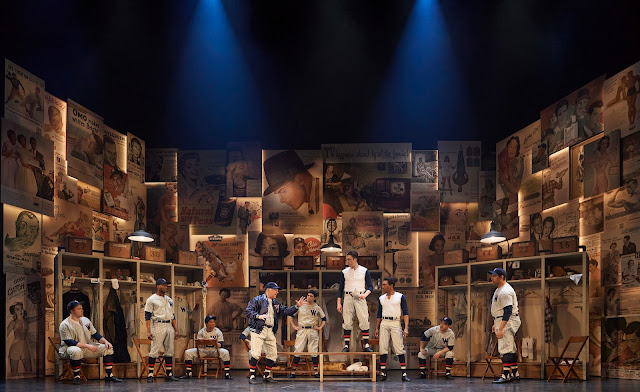
Crowd Pleasers: Damn Yankees and Gaslight at the Shaw Festival

Jay Turvey with the Ballplayers in Damn Yankees, at the Shaw Festival. (Photo: Michael Cooper)

Richard Adler and Jerry Ross might have entered the pantheon of Broadway songwriters if fate hadn’t extinguished their star so fast. Adler was thirty-one and Ross twenty-eight when George Abbott commissioned them to write the score for The Pajama Game (1954), adapted by Abbott and Richard Bissell from Bissell’s novel 7-1/2 Cents, about the tensions between labor and management in a Midwestern pajama factory. It was a legendary show: Abbott and Jerome Robbins co-directed, a young Bob Fosse staged the dances, and it ran for three years. (A boisterous movie version in 1957, helmed by Abbott and Stanley Donen, captures the spirit of the original, with all but two members of the Broadway cast reprising their performances.) In 1955 lightning struck again for Adler and Ross with Damn Yankees. Adapted by Abbott and Douglass Wallop from Wallop’s book The Year the Yankees Lost the Pennant, Damn Yankees was as big a hit as The Pajama Game. But six months after its triumphant premiere, Ross died suddenly of lung disease. Adler never had another success, alone or with a collaborator, though his lovely score for the South Africa-set musical Kwamina, which he wrote for his wife, Sally Ann Howes, is ripe for rediscovery. (Its interracial love story was undoubtedly too controversial for 1961.)

Thursday, July 18, 2013

The Male Gaze: The Fall

Gillian Anderson as SDI Gibson in The Fall

When Gillian Anderson was on The X-Files in 1990s, she was often overshadowed – in the media, if not on the show itself – by her co-star, David Duchovny. It was Duchovny who was constantly being singled out in the press for being unusually intelligent – you know, for an actor – and who stepped away from the series to pursue a movie career. (It was also Duchovny who seemed to go out of his way to select movie roles that seemed to call attention to his lack of range and who, in recent years, has raised the question of just how intelligent someone who can stay interested in his Showtime series Californication can possibly be.) After starring in Terence Davies’ The House of Mirth in 2000, Anderson seemed to step away from the spotlight; she worked on the stage in Britain, took sizable roles in a few small films and small roles in a few higher-profile films (The Last King of Scotland, Tristram Shandy), and played Lady Dedlock in the superb 2005 BBC production of Bleak House. She’s been more active, or at least easier for Americans to catch sight of, in the last year or so than at any time since The X-Files went off the air in 2002. Last year, she gave brief but strong, compellingly weird performances in TV versions of Great Expectations (as a spectral, wounded-bird Miss Haversham) and Michel Faber’s The Crimson Petal and the White (as a madam with aspirations to haughtiness), and in the last few months she’s had a recurring role on NBC’s Hannibal and played the lead – a police detective investigating a serial murder case – in the five-hour Irish TV series The Fall.

Tuesday, May 5, 2015

Fighting for Fun – Avengers: Age of Ultron


Note: This review contains spoilers for Avengers: Age of Ultron.

During the climactic battle of Avengers: Age of Ultron, Captain America (Chris Evans) tells his team, “If you’re hurt, hurt them back. If you’re killed… walk it off.” It’s a snarky quip that encapsulates the whole film: gone is the comic energy that glowed at the heart of The Avengers (2012), but that doesn’t stop director/geek deity Joss Whedon from doing his damnedest to keep the franchise limping along, and fighting to be fun through to its last overstuffed, brooding gasp. Whether or not it’s a fight that he and his ever-inflating cast actually win… is a matter of opinion.

Sunday, January 30, 2011

Heavy Metal Thunder: R.E.D. (2010)

There's something strangely satisfying about watching Dame Helen Mirren fire round after round of heavy ordinance at bad guys. In the movie R.E.D. (just released on DVD – the title is an acronym for Retired: Extremely Dangerous), Mirren plays a retired CIA sniper who is forced out of her now-genteel life by circumstances beyond her control. The fact that she doesn't appear in the movie until the one-hour mark is one of this comic thriller's few problems.

At the start of the picture, we are introduced to Frank Moses (Bruce Willis), a lonely, also retired, former CIA black ops agent who has fallen in love with the voice of Sarah Ross (Mary-Louise Parker), the woman at the benefits office that manages his pension. He is so smitten that he's practically a telephone stalker. She's kind to him, but she's also a little creeped out. After one of his phone calls, his house in a quiet residential neighbourhood is attacked by several assassins. (Yes, his house. The shooters essentially blast the shit out of the place, à la the 'let's shoot a million rounds into that truck' in the Clint Eastwood film, The Gauntlet). He dispatches the killers and then pops up at Sarah's house in Kansas City, insisting that her life is also in danger.

Here, the logic of the film veers off the rails. The first 25 minutes are a little incomprehensible. There seems to be no credible reason for Willis to connect the attack on him to Sarah and then deduce she is now in danger too. Perhaps it's on the cutting room floor. Essentially, he kidnaps her because she doesn't believe he is former CIA. (Does she not know what pension she's dealing with?) They go to New Orleans for no reason I can think of other than New Orleans looks good (except for those New Orleans sequences, the rest of the picture was shot in Toronto – it is fun playing 'spot the T.O. locales'). It's not until she escapes him and then is almost kidnapped by a New Orleans 'police officer' (Moses rescues her) that she finally believes him. As I said, the first 25 minutes are confusing. The attempts to kill Moses seem to be connected to a list of operatives who, many years prior, were sent into Guatemala to extract an American military unit, led by an unnamed rogue officer that supposedly annihilated an entire village. I think Moses was among them, or some old friends were (it really isn't clear) and I think Sarah had pension dealings with some of those men on the list, most of whom now dead.

Thursday, April 7, 2016

A Clearly Marked Trail: The First Episode of The Path

Michelle Monaghan and Aaron Paul in The Path.

“In the beginning, I sort of just made up stuff,” said The Path’s showrunner, Jessica Goldberg, in a Decider.com interview about the invention of the TV show’s fictionalized religion, Meyerism. A hodgepodge of various religions and belief systems, Meyerism is at the heart of the drama in the Goldberg’s first television series which launched Wednesday April 6th on Hulu. While American Hulu subscribers can take in all 10 episodes of The Path right away, here in Canada we’re forced to walk the sacred ancient path of weekly installments. The series’ pilot, “What the Fire Throws,” aired last Thursday April 7th on Showcase and will be followed by tonight’s second episode titled, “The Era of the Ladder.” While the pilot was amusing enough, Goldberg’s aforementioned approach to screenwriting shows in this largely predictable first episode.

Thursday, September 15, 2016

If You Must Blink, Do It Now: Kubo and the Two Strings


The publicity for Kubo and the Two Strings didn’t hook me because my eyes deceived me; I saw the trailer and thought the strangely-stylized CGI visuals looked janky and oddly angular, and said no thanks. It wasn’t until the film came out and I heard that it had been made by LAIKA, purveyors of stop-motion magic like Coraline and Paranorman, that I suddenly became interested. That wasn’t odd-looking CG I had seen, it was beautiful stop-motion animation! I was amazed at how starkly different my reaction was to the film’s look once I was processing it through the correct lens – to say nothing of how amazed I was by the craft and power of the final product.

Thursday, October 27, 2016

Critic’s Crypt: Threequel Thursday – The Exorcist III & A Nightmare on Elm Street 3

Ed Flanders and George C. Scott in The Exorcist III (1990).

The Halloween movie season is, for me, as much about discovering new favourites as revisiting old ones. Classics like Suspiria, Poltergeist, Halloween, and Evil Dead 2 are like friends I welcome back each year with open arms and a beaming heart, and I’m ever eager to add new friends to that group. That’s why I make time every October to fill in the gaps in my horror repertoire that represent the sequels, prequels, and other continuations of movies I already know and love. Over time I’d heard many good things about two such cinematic hellspawns, which both happened to be the third entry (a.k.a. “threequel”) in a series that suffered from a sub-par sequel: The Exorcist III (1990) and A Nightmare on Elm Street 3: Dream Warriors (1987).

Thursday, May 3, 2018

The Grand Experiment – Marvel's Avengers: Infinity War

Josh Brolin as Thanos in Avengers: Infinity War.

Note: This review contains spoilers for Avengers: Infinity War.

In the production logos that precede Disney and Marvel’s Avengers: Infinity War, the “io” in “Marvel Studios” slowly morphs into the number 10, signifying the real-life decade that has passed since Iron Man was released in 2008, when this whole “cinematic universe” experiment began in earnest. It is not overstating things to say that this process, whether or not you’ve enjoyed following its peaks and valleys, is unprecedented in cinematic history, and that fact in itself anchors Infinity War in a sense of tangible accomplishment. Much ballyhoo has been made about the fact that the film doesn’t make a lick of sense if you haven’t seen the Marvel movies leading up to this (and if you haven’t, then what exactly is driving you to buy a ticket for this one?), but that attitude belies the mind-boggling time and effort that has gone into setting up these dominoes, so that this film can concern itself primarily with knocking them down. Experiencing the setup is worth it, because Infinity War is nearly three hours of pure payoff.

Saturday, December 2, 2017

The Vocabulary of Bullets: The Punisher

Jon Bernthal as Frank Castle in The Punisher, on Netflix.

Country, I was a soldier to you.
I did what you asked me to.
It was wrong, and you knew.

Country, now I'm just a stranger to you.
A number, a name; it's true.
Throw me away when you're through.
– "I Wish It Was True" by The White Buffalo/Jake Smith
Now, that’s more like it. After two long years, we finally get a Marvel/Netflix series worthy of the promise demonstrated by the first season of Daredevil and the audacious Jessica Jones. (The last 18 months have given us an uneven sophomore season of Daredevil, the missteps at the end of the otherwise impressive Luke Cage, the terminally sluggish Iron Fist and the fun, action-packed, but ultimately forgettable Defenders team-up miniseries in August.) Frank Castle – a.k.a. The Punisher, played again by Jon Bernthal – was the best thing by far in Daredevil’s second season, and now he is back in The Punisher. If you (like me) lost faith in Netflix’s small urban corner of the MCU sometime during your viewing of Iron Fist (I abandoned the show in the middle of its 8th episode and have never looked back), this first season of The Punisher is likely to bring you back to the fold. Though bloodier by far than any other Netflix/Marvel outing, Punisher offers its most character-driven story since Jones, and its most relevant since Luke Cage.

Monday, June 9, 2014

Audra McDonald, Sutton Foster and Those Damn Yankees

Audra McDonald and Shelton Becton (left) in Lady Day at Emerson’s Bar & Grill. (Photo by Evgenia Eliseeva)

Playing Billie Holiday in 1959, just months before her death, in Lady Day at Emerson’s Bar & Grill, Audra McDonald does an uncanny vocal impersonation of the great jazz singer in her late phase, when heroin had worn her astonishingly pliable buttered-rum contralto down to a nub yet her phrasing hadn’t lost its ability to wipe you out and she could still swing. It’s an impressive stunt – but it’s a stunt, and one that I wish McDonald, who has the finest instrument among today’s musical-theatre stars, hadn’t attempted. I had the same problem when, more than forty years ago, Diana Ross mimicked Holiday’s voice in the movie Lady Sings the Blues. It’s one thing when an actress who isn’t a singer plays a famous vocalist and lip-syncs her songs: in the title role of the TV movie Life with Judy Garland: Me and My Shadows, Judy Davis got so far into the character that when you heard Garland’s singing voice come out of her, the results were spookily convincing. (It’s the best work Davis has ever done, which means, of course, that it’s one of the greatest performances ever put on the screen.) It’s quite another thing when one towering singer buries her own style and picks up another’s. I understand why McDonald chose to go this route: Holiday’s sound is distinctive and famous, like Garland’s. But so is Audra McDonald’s – and, certainly, Diana Ross’.

Actually I wish McDonald had passed on this project altogether. Lanie Robertson’s play (which I reviewed twenty years ago at Providence’s Trinity Repertory Company, when an actress named Rose Weaver took the part) is nothing but a series of monologues strung around fourteen songs – some of them Holiday standards (“What a Little Moonlight Can Do,” “Crazy He Calls Me,” “God Bless the Child,” “Easy Living,” “Strange Fruit,” “Don’t Explain” and “T’ain’t Nobody’s Business If I Do”) and some fairly obscure. (The final number, George Cory and Douglas Cross’ “Deep Song,” which I’d never heard Holiday sing until Charlie Haden built a beautiful instrumental around it on his 1992 album Haunted Heart, is a personal favorite.) Holiday, performing in a dive in South Philly because, as a result of her drug conviction, she’s lost her cabaret card in New York, is drunk and high when she staggers onto the stage to accompany a three-piece combo, and in the course of the evening she gets drunker and higher. The set-up is both dramatically hobbled and purely melodramatic and the script is bald; it barely qualifies as a play at all. And McDonald, normally a splendid actress, gives a shrill, maudlin performance interrupted by a couple of moments of authentic power: one when she remembers getting the news of her father’s death and one when she talks bitterly about the humiliation of losing the right to perform professionally in New York, where she’d become famous in the thirties.

Sunday, October 29, 2017

Monsters Among Us: Netflix's Mindhunter

Holt McCallany and Jonathan Groff in Mindhunter

If the average citizen ever comes across [the psychopath] in his reading, he ordinarily imagines raving madmen and consigns them to the care of hospital psychiatrists. Or, if the citizen is a little more sophisticated, he thinks in terms of crime and daring escapades, and relegates the perpetrators to the province of the police. He does not know – he has not been told – that the psychopath is the enemy of his life, the adversary of his welfare. He does not know – he has not been told – that the psychopath is the harbinger of social and political distress, the carrier of a plague of wars, revolutions, and convulsions of social unrest.
– Robert Lindner, Must You Conform? (1956)

When the Las Vegas shooter, Stephen Paddock, recently took out over 500 people at a country music event, people struggled in vain to find a motive. Since there was nothing in recent history with which to compare this horrific deed, people sought the most obvious clues to define his actions. Was he recruited by ISIS? Could he have been a white supremacist? Since Paddock was described in the news as 'a quiet and loving man' by all who apparently knew him (as if silence automatically guaranteed sanity), the question remained: what made him commit such a monstrous act? When you spend many months acquiring a huge arsenal, meticulously planning both your location and your prey, and then you present a horrific display of mass murder, clearly there's a lot more going on than being a 'quiet and loving' guy. At the very least, his actions reveal that he didn't like people very much. But since no one found a convenient label with which to define his actions, Paddock was quickly dropped from the headlines and returned to the oblivion where he once resided. He disappeared from the news as if he had never been there.

Thursday, August 2, 2012

Bad Faith: The Dark Knight Rises


As fans of superhero pictures (and that’s most of the world, evidently) know, the Batman series divides into three categories. There are the Tim Burtons, Batman (1989) and Batman Returns (1992), with their magnificent, High Romantic Anton Furst designs and Michael Keaton as a brooding, mysterious Bruce Wayne – a portrayal that, in a better world, would have made him an actor to be cherished forever. Burton put a premium on character and let the stories unravel like fairy tales. The Joel Schumacher entries, Batman Forever (1995) and Batman and Robin (1997), were extravagantly (but not wittily) overdesigned; they were like arcades, or gay roller discos, and they underused their stars, Val Kilmer and George Clooney respectively, so that afterwards you couldn't remember anything they’d done.

Then Christopher Nolan took over the franchise in 2005 with Batman Begins, which he also co-wrote with Davis G. Goyer. Nolan brought art-house credentials (Memento, a wildly overrated puzzle picture that didn’t make basic plot sense) and a grim relentlessness that I would have said was precisely the wrong kind of approach for a comic-book adventure. And the concept was misconceived. Bruce (Christian Bale), like the character Michael Keaton played in the Burton pictures, has never been able to move past the pointless deaths of his parents, before his eyes, at the hands of a mugger, but it isn’t grief that motivates this Bruce; it’s guilt. As a boy, Bruce was so terrified of bats as a result of falling down a well on his dad’s estate that, when his parents took him to see the operetta Die Fledermaus (The Bat), the prop bats on stage distressed him and he asked to be taken home early. They encountered the mugger on a deserted street outside the opera house; if Bruce had only been able to control his phobia, his parents might be alive today. So when, years later, returning to a Gotham City overrun with gangsters and all manner of corruption, he chooses to disguise himself as a bat, it’s his way of conquering those childhood fears and doing penance for the fact that his inability to handle them led his parents to their deaths. (The real corruption – or at least stupidity of a monumental order – must have been at Warner Brothers, where this plot premise made it past the pitch stage.) But first there’s a long sequence at a Tibetan monastery, which seems to belong in some other movie altogether, where Wayne is trained in martial arts by mystics (the westerner among them is Ra’s Al Ghul, played by Liam Neeson, whose goatee is more expressive than his performance) who turn out to be the League of Shadows, fanatics with a sort of Sodom and Gomorrah God complex, dedicated to wiping out cities overrun with evil, like Gotham. So Bruce has to defeat them – temporarily, at least – and stage an escape before he can return to battle the more homegrown evil in his own hometown.

Bruce Wayne and his murdered parents in Batman Begins 

The chief villain in Batman Begins, though, is the sinister Dr. Jonathan Crane (Cillian Murphy), who, as The Scarecrow, poisons his victims with a psychotropic aerosol that maddens them and projects their worst fears onto his burlap mask. Perhaps I’m hopelessly old-fashioned, but I consider it a sign of bad faith in a director of a comic-book movie that he thinks nothing of putting his audience through the same misery as the characters entrapped in their cruelest fantasies – like the maggots foisted on a screaming Katie Holmes (as Bruce’s childhood friend Rachel Dawes, now an ADA of impressive moral fiber and courage). By the time Crane had pumped enough aerosol in the streets of Gotham in the climax to send paranoid zombies after Rachel and some unfortunate little boy, I was looking around for something to throw at the screen.