Showing posts sorted by relevance for query Robert De Niro. Sort by date Show all posts

Monday, April 14, 2025

Doppelgänger: Barry Levinson's The Alto Knights

Robert De Niro and Robert De Niro in The Alto Knights. (Photo: Warner Bros.)

Witty, gripping and grandly entertaining, Barry Levinson’s The Alto Knights centers on the complicated relationship of two legendary Mafiosi, Frank Costello and Vito Genovese, who were both recruited to work for bootlegger Giuseppe Masseria in the 1920s alongside Lucky Luciano. After the murders of Masseria and his successor, Salvatore Maranzano, Genovese became Luciano’s second in command with Costello, who claimed to have abjured violence at the end of the First World War and stopped carrying a gun, as his consigliere. Genovese took over in 1936 when Luciano went to prison and expanded the operations of the organization Luciano had reconfigured as the Commission into narcotics. But he had to flee the U.S. to avoid a murder charge and took sanctuary in Italy. (Both men had been born there: Costello in Naples, Genovese in Calabria.) Costello took over, trading drugs for gambling. When Genovese returned to the States after the war – neatly bypassing conviction for that old killing when two key witnesses against him turned up dead – he didn’t take well to being his former colleague’s underboss. All of this narrative is background, much of it unstated or understated, to Levinson’s picture, which takes place in 1957, the year Costello appeared before the Senate Committee investigating the Mafia, and the year Genovese engineered the assassination of the former head of Murder Inc., Albert Anastasia, and attempted unsuccessfully to eliminate Costello.

Monday, January 13, 2020

The Big Guns: The Irishman, Marriage Story and 1917

Joe Pesci and Robert De Niro in The Irishman. (Photo: Niko Tavernise/Netflix)

This article includes reviews of The Irishman, Marriage Story and 1917. 

The Irishman is the cinematic equivalent of a thick, expensive coffee-table book prominently displayed in Rizzoli’s for the Christmas trade. Martin Scorsese’s three-hour-and-twenty-nine-minute epic has as much prestige as one awards-season release can handle. Steven Zaillian (screenwriter of Schindler’s List, Moneyball and The Girl with the Dragon Tattoo, creator/co-writer of the TV limited series The Night Of) wrote the adaptation of Charles Brandt’s bestseller I Heard You Paint Houses, a biography of Teamsters Union official Frank “The Irishman” Sheeran, a middleman for the Bufalino crime family who, shortly before his death, told Brandt that he’d murdered Jimmy Hoffa. (Sheeran’s claim has been disputed since the 2004 publication of Brandt’s book, by the journalist Bill Tonelli in Slate and by the Harvard law professor Jack Goldsmith in The New York Review of Books.) Rodrigo Prieto, the terrific cinematographer associated with Alejandro Iñárritu and Scorsese’s collaborator on The Wolf of Wall Street and Silence, shot it, in handsome dark tones befitting a classic. The star, Robert De Niro, shares the screen with both Al Pacino (as Hoffa) and De Niro’s Raging Bull co-star Joe Pesci (as Russell Bufalino, who pulls Sheeran’s strings). The list of the cast, which also includes Harvey Keitel, Ray Romano, Bobby Cannavale and Anna Paquin, is thirty-three computer screens long on imdb.com.

Friday, June 9, 2017

The Wizard of Lies: The Con Man as Misanthrope

Nathan Darrow, Robert De Niro, and Alessandro Nivola in HBO's The Wizard of Lies.

The American con man first shows up in nineteenth-century American literature in the inventions of Herman Melville (The Confidence-Man, 1857) and Mark Twain (the Duke and the King in The Adventures of Huckleberry Finn, 1884). The two archetypal con men in American drama are Hickey, the salesman and son of a preacher man in Eugene O’Neill’s 1947 play The Iceman Cometh, and “Professor” Harold Hill in Meredith Willson’s 1957 musical The Music Man – characters immortalized by two great American actors, Jason Robards in Sidney Lumet’s 1960 TV transcription of Iceman and Robert Preston in the 1962 movie of Willson’s musical (both recreating legendary performances they had originally given on the stage). Hickey has sold himself on his own con, though in the play, it turns out, what he’s peddling is death of the spirit: he tricks his barroom buddies into losing faith in their own illusions (“pipe dreams” is O’Neill’s phrase) but doing so hollows them out. Only the eleventh-hour realization that he’s been cherishing his own delusion restores them to their happy drunken selves, safe in their pipe dreams once again. Hill manages to convince the citizens of an insulated early-twentieth-century Iowa town that a boys’ marching band will solve problems they never had in the first place. Hill is operating on the principle Hickey sets out in O’Neill’s play for the success of any sale: figure out what the customer wants and then convince him that only you can supply it. River City doesn’t need a boys’ band, but, though Willson presents them comically, Hill plays on small-town Midwestern prejudices – small-mindedness, corseted sexuality, a suspicion of liberalism in any of its forms – and then presents his product, musical instruments, as a way to guard against the things the citizens fear will corrupt their youth. Like The Iceman Cometh, The Music Man has a twist: as it turns out, River City does need that band and Harold Hill (softened by the love of a good woman, Marian the librarian) winds up a hero. But what puts the sale over  long before that reversal is a commodity that Hill and Hickey both have plenty of: charm. It’s the con artist’s ace in the hole.

In the HBO movie The Wizard of Lies, Robert De Niro as Bernie Madoff explores a different sort of con man – one that is, I think, an archetypal American character for the twenty-first century.  Under Barry Levinson’s focused, probing direction, De Niro gives his finest performance in years. It’s the De Niro we recognize: charismatic, authoritative, but ill at ease in the world as the result of an essential misanthropy. The casting is perfect, because in the movie’s view – the screenplay by Samuel Baum, Sam Levinson and John Burnham Schwartz is based on Diana Henriques’s 2011 book The Wizard of Lies: Bernie Madoff and the Death of Trust – Madoff’s ability to manipulate the men and women he defrauded out of an estimated $64.8 billion in the most extensive Ponzi scheme ever perpetrated is based not on charm but on a combination of charisma and an aura of unassailable authority. Madoff, the one-time non-executive chairman of NASDAQ, presented himself to his clients – many of them long-time friends, some of them family members, and one, Elie Wiesel, the image of integrity and an icon in modern Jewish history – as the undisputed expert, the sole man who could navigate the treacherous waters of finance even in the wake of the 2008 economic downturn. Madoff, as we see in the film, shifts in and out of the roles of trusted family friend and adviser, father figure, rabbi and noodge, alternately lecturing and consoling, bullying and reassuring. His aura of immovable certainty is his client’s bulwark. The fact that he isn’t charming is, for these (mostly) Jews who pride themselves on their tough-mindedness and skepticism, part and parcel of what makes him so trustworthy. How can such an irascible, street-smart, no-bullshit guy be, in fact, sitting on a fortune made of paper and feathers?  His refusal to kiss his clients’ asses, in tandem with his unchallengeable air of authority, is the ultimate con. When Bernie Madoff turns out to be a fraud, trust really is dead.

Monday, March 21, 2022

Acting and Actors – The Method: How the Twentieth Century Learned to Act

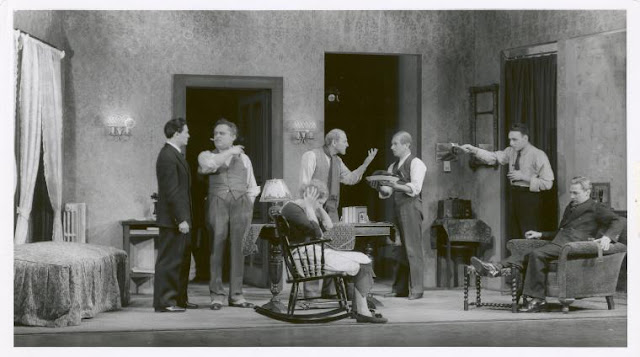
The 1935 Broadway production of Awake and Sing!

The Method: How the Twentieth Century Learned to Act by Isaac Butler (Bloomsbury Publishing) is a gossipy, entertaining and informative history of Stanislavskian acting – how it developed in Russia at the Moscow Art Theatre and how two of Stanislavski’s associates, Richard Boleslavsky and Maria Ouspenskaya, imported it to American shores, where, through its dissemination by the Group Theatre in the 1930s, it became the Method. Butler has rounded up an impressive amount of material and presents it coherently and compellingly. I didn’t realize how little I knew about the tensions between Stanislavski and the M.A.T.’s co-director, Vladimir Nemirovich-Danchenko; about the role each of the personalities who were drawn into Stanislavski’s circle played in the development of his approach to acting; about the effect Stalin’s rise to power had on the M.A.T. generally and on Stanislavski specifically – or certainly about Boleslavsky’s intriguing and rather crazy biography. No account I’ve read deals so clearly and in such dramatic detail with the break in the Group Theatre, when Stella Adler, its most gifted actress, challenged the weight Lee Strasberg, one of the company’s co-founders, placed on affective memory, where the actor digs into his or her past to unearth emotional dynamite to blast open a scene. Adler and Strasberg became the most important American acting teachers of the twentieth century. The Method’s examination of the differences in their styles and approaches and that of Sanford Meisner, another Group alumnus who became a famous and influential teacher, is fascinating. He identifies Adler’s greatest quality as her gift at script analysis; her book, compiled posthumously from her class notes, on Ibsen, Strindberg and Chekhov, and to a lesser extent the one on American playwrights, bear him out.

Sunday, December 31, 2017

The Best of CAL 2017

Critics at Large Summer Meeting, August 4/17 (l.to r. Kevin Courrier, Danny McMurray, Steve Vineberg, Devin McKinney, Justin Cummings, Bob Douglas and Mark Clamen)

Back in January 2010, David Churchill, Shlomo Schwartzberg and I came up with the idea of Critics At Large. We envisioned a daily online arts journal that would provide for us the freedom to write – a freedom we were beginning to lose working in magazines and newspapers. Growing rapidly tired of plying our trade in a field where desperate careerism was taking the place of collegiality and editors were beginning to reward expedience, we wanted to remain more true to the pleasures of critical writing. We also wanted to discover what kind of reader we could cultivate and who they might turn out to be. Over the last eight years, many things changed in both our writing and in our audience. For one thing, Critics At Large became less a haven for frustrated writers and more an accomodating home for a diverse and hopeful group who saw the magazine as a possibility. We began attracting a motley crew from various backgrounds who helped change Critics at Large for the better. A number of men and women, young and old, experienced and not, came to shape our identity rather than take on the one we already had. Along that path, we also attracted veteran arts critics who wanted to continue to address the work that inspired them, but we also drew inexperienced writers trying to find the true value of having a voice to speak with. When I read individual pieces each day, I marvel at the sheer range of material and the keen passion each writer brings to their subject. As for our readers, not only have they been rapidly growing, but the diversity of opinion in the magazine has helped us reach out to a much wider audience.What became most important for me, as one of its co-founders, was watching Critics At Large grow beyond my own expectations into a continually morphing organism that embraces the freedom our writers bring to it. For those who believe that arts criticism isn't about having the right opinion, but instead is a means by which the writer and reader mutually discover their own personal relationship to the arts, I think we are succeeding in getting there. As a way to celebrate that goal, and, I suppose, to amply demonstrate it, here is a look back at some of my own favourite pieces from 2017. They aren't presented in any order of preference. Rather than commenting on the writer and their work, I've selected specific quotes that I think best reflects their value to me as critics. As I continue on as editor, writer, and reader, I can truly say that I'm proud to call them colleagues.

Kevin Courrier
Editor-in-Chief
Critics At Large

Sunday, February 6, 2011

The Day Players: Single-Scene Attractions

Oksana Akinshina in The Bourne Supremacy
Oksana Akinshina and Danielle DuClos. Never heard of either of these actresses, have you? Neither one has had what you could call a major career, at least not in English-language films. Akinshina is a still-working Russian actress who has made only one American film, The Bourne Supremacy (2004), and American Danielle DuClos's career in movies essentially ended shortly after she appeared in her one major motion picture, Midnight Run (1988). And yet, their small contributions to both films enriched the finished product immeasurably. In both films, they were what are called in the industry a day player. Sure, it may take more than a day to shoot their scenes in a motion picture (since the process is so slow), but essentially they are hired for one scene. Fortunately, for both of them, they got to appear in an extended sequence with the film's star.

Wednesday, May 2, 2012

When Movies Still Mattered: 1970s American Cinema

Al Pacino and Marlon Brando in The Godfather

Years ago, I remember watching Rancho Deluxe (1975) – a modern day comedy western starring Jeff Bridges and Sam Waterston – and marveling how this rather middling, but entertaining, Hollywood movie was still smart, adult and honest. In fact, even a second-tier movie, such as Rancho Deluxe, from 1970s American cinema (the last Golden Age of American movies) was considerably more worthwhile than almost anything coming out from Hollywood, or American independent cinema, in the 21st century. As I prepare to teach a course on this decade in cinema history, it’s worth speculating on why movies turned out so consistently good and gratifying during that time.

Much has already been written, and showcased, about the era in documentaries such as Easy Rider, Raging Bulls (2002, based on Peter Biskind’s provocative 1998 book Easy Riders, Raging Bulls: How the Sex-Drugs-and Rock N’ Roll Generation Saved Hollywood) and A Decade Under the Influence (2003). Both looked at how the younger set of Martin Scorsese, Brian De Palma, Peter Bogdanovich, Francis Ford Coppola and Steven Spielberg, as well as their elders Robert Altman (who didn’t begin his movie career until he was in his 40s) and Paul Mazursky were given the filmmaking reins in a failing and geriatric Hollywood that was out of touch with '60s American culture. Fearing complete failure, the ageing Hollywood had no choice but to take chances with whom it allowed to make movies. Also remarked upon was how a new breed of (often identifiably ethnic) actors and actresses (ordinary looking folk, and not gorgeous looking movie stars: Al Pacino, Robert De Niro, Dustin Hoffman, Barbra Streisand, Jack Nicholson) were allowed to play front and centre in movies that worked off of their eccentricities and plain appearances. But I’d argue that the dominant factor in why the movies were so good and relevant in the '70s was trust. The studio executives generally trusted (to a point) that these maverick moviemakers would still make films that had cachet and appeal and, more significantly, audiences could be expected to follow them in whatever endeavours they undertook in that regard. (The '30 and '40s movies, the last Golden Age before the '70s, did the same in an assumption of literacy on the part of the filmgoing audiences.)

Friday, August 16, 2013

Neglected Gem #45: What Just Happened? (2008)

Robert De Niro and John Turturro in Barry Levinson's What Just Happened?

Barry Levinson’s 2008 What Just Happened? approaches Hollywood venality, greed and ego with a razor edge, an elegant style and a distanced wit – a killer combination. It’s adapted from What Just Happened?: Bitter Hollywood Tales from the Front Line, a juicy, deftly written and economical (150-page) memoir by producer Art Linson, who lays out the process of getting movies made in the film industry and tells amazing and often scathing stories about some of the ones he worked on, like Great Expectations, Fight Club, The Edge and Pushing Tin. (He has an earlier book, A Pound of Flesh: Perilous Tales of How to Produce Movies in Hollywood.) Here’s Linson holding forth on the subject of the pitch:

For those of you who have never been in a pitch meeting, it’s nothing much different from door-to-door sales except the financial stakes are higher. You must convince the guy with the checkbook that he needs whatever soap you are selling. I’m not sure anyone actually needs to buy an idea for a movie. If you buy an idea, you have to pay to have the script written. Writers are expensive. In most instances the scripts are badly done and only a small percentage ever get filmed. Because of the high turnover factor, the executive who winds up buying the script probably won’t even have his job by the time the wretched thing gets made and is ready for release. Either someone else will be the beneficiary of its success, or the poor sucker who was fired will inevitably be blamed for supporting it. Under these rules, I’m always amazed at the optimism that’s displayed so early on for something that might not pay off for years. 

Monday, October 30, 2023

Killers of the Flower Moon: Martin Scorsese’s Hobbled Epic

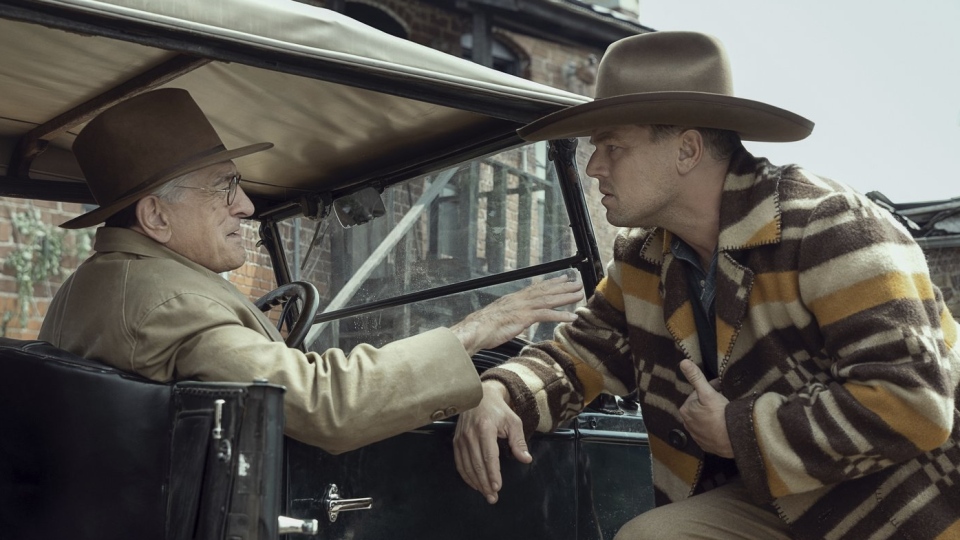
Robert De Niro and Leonardo DiCaprio in Killers of the Flower Moon.

Killers of the Flower Moon is great around the edges. Martin Scorsese’s movie, adapted from David Grann’s jaw-dropping 2017 account of the serial murders of Osage Indians in Oklahoma in the 1920s that enabled white men to secure their “headrights” – the legacy, shared equally among the community, of land rich in oil – is three and a half hours long and cost $200 million, and God knows you can see the money on the screen. The film, shot by Rodrigo Prieto, with production design by Jack Fisk and costumes by Jacqueline West, looks magnificent. The period reconstructions are dazzling and capture a cross-hatched culture, rich in visual irony, where natives, professing a faith that mixes Catholicism with the religion of their ancestors, dress in a combination of traditional garb and the flamboyant style of wealthy white men while they tool around in chauffeured Pierce Arrow roadsters and fly private airplanes. The opening scenes are lively and exciting, a circus-like montage of oil strikes and auctions and raucous general celebration that spills out of barrooms and restaurants into the streets of Fairfax, the Osage reservation town that has grown out of the oil boom. This is some of Scorsese’s best filmmaking – visually dense, outré, darkly funny. We barely have a chance to process the omnipresence of white men who have intermarried with the Osage women before it all turns sinister. The natives are dying in staggering numbers, some the victims in unsolved murders, others expiring from suspicious illnesses.

Thursday, December 20, 2012

Born Again: David O. Russell’s Silver Linings Playbook

Jennifer Lawrence and Bradley Cooper in Silver Linings Playbook

We are pleased to welcome a new critic, Phil Dyess-Nugent, to our group.

Soap opera fans have a term – SORAS (for “Soap Opera Rapid Aging Syndrome”) – to describe the process by which a child character who’s too young to have a very dramatic romantic life may be sent away to boarding school or summer camp, disappear from the show for a while, and then return, suddenly being played by a 24-year-old actor. Following the careers of some movie actresses, it’s easy to get the feeling that there’s been an outbreak of SORAS in Hollywood. Actresses who make a strong impression as children – Christina Ricci, Kirsten Dunst, Natalie Portman – may turn into leggy, intimidatingly sultry-eyed sirens, with a speed that could snap your neck. In some cases, as with Ricci, they may go from seeming eerily mature and self-assured at eleven to working hard to not overwhelm male actors who fit in all too well in a movie culture where guys can extend their boyhood into their fifties. Jennifer Lawrence was already twenty when she starred in Winter’s Bone in 2010, but there, as in this year’s mainstream hit The Hunger Games, she projected a flinty resourcefulness and inner strength, while coming across as a frightened little girl who was in over her head. Good as Lawrence was, nothing she did in those movies can prepare you for the daring and emotional range of her performance in the romantic comedy Silver Linings Playbook, directed by David O. Russell, from a script he adapted from a novel by Matthew Quick.

Monday, June 1, 2020

Allen Garfield: A Fond Farewell

Allen Garfield and Peter O'Toole in The Stunt Man (1980).

Allen Garfield died on April 7 at the age of eighty, one of the early COVID-19 casualties in the acting community. He was a fantastically vivid performer who managed to straddle the line between the old Hollywood and the new. He was a character actor who, like the most memorable big-studio stock-company players, could bring verve and wit to supporting roles that lit up the margins of the movies he appeared in, but his bristling, aggressive, off-center style was quintessentially modern. (He had attended the Actors Studio in New York.) He belonged in the American renaissance era; he would have been too daring, too subversive for the forties or the fifties.

Thursday, May 10, 2012

Neglected Gem #13: Alfonso Cuarón’s Great Expectations (1997)

Alfonso Cuarón’s 1997 Great Expectations transposes Dickens to contemporary America without violating the spirit of the original. This is the third movie version of the beloved novel: there was an unmemorable Hollywood adaptation in 1934 (with Jane Wyatt as Estella), and David Lean made a deservedly famous one in England in 1946, paring down the book’s nearly five hundred pages but remaining very faithful to the story. His edition, an exceedingly handsome, high-style rendering, is almost a model for how to adapt Dickens: he gets so close to the way the classic scenes in Great Expectations look and feel to a reader’s imagination that, if you saw his movie when you were young enough, you may no longer be able to distinguish between his setting of the graveyard opening or Pip’s first view of Miss Havisham’s mouse-eaten wedding cake and the one you first envisioned when you read the book. But there are other approaches to adapting literature, and it’s a pity that critics were so quick to either jump on Cuarón’s or dismiss it outright when it was released. It’s a stunner.

The screenwriter, Mitch Glazer, has a nutty accuracy about his Dickens. Back in the late eighties, he wrote Scrooged, the updated Christmas Carol built around Bill Murray as an ambitious, mean-spirited, workaholic TV-exec Scrooge, and none of the many other film and TV versions of the story, except perhaps for the one from the early fifties featuring Alastair Sim, deserves to be talked about in the same conversation. Glazer brought out the best in the director, Richard Donner, who dreamed up surprising images to match the wondrous script, but in Great Expectations his collaborator came equipped with his own magic touch. In his previous picture, A Little Princess, Cuarón fitted out Frances Hodgson Burnett’s celebrated children’s story with sections – a fable within a fable – from Hindu mythology. Great Expectations is even better.

Monday, May 29, 2023

New York, New York: Stepping Around the Heart of Scorsese’s Movie Musical

 The wonderful "Wine and Peaches" number in New York, New York. (Photo: Paul Kolnik)

Martin Scorsese’s 1977 New York, New York, perhaps the only Big Band musical film after the collapse of the Big Band era, is about the meeting – collision is more accurate – of two young musical hopefuls in Manhattan on V-J Day, both newly out of the service. Jimmy Doyle (Robert De Niro, at the end of his astonishing early career – the year after Taxi Driver) is a relentlessly confident saxophonist and Francine Evans (Liza Minnelli, in her least-known great performance) is a vocalist. He keeps asking her out; she keeps telling him no. But his persistence, obnoxious as it sometimes gets, is inseparable from his charm, and though she tries to resist she ends up acceding to every one of his demands. She does go out with him, she lands him a job by performing a duet with him at an audition – it’s “You Brought a New Kind of Love to Me,” and they’re a knockout together (Georgie Auld, who plays a supporting role, dubs Jimmy’s sax) – and they become lovers, then husband and wife. You’d have to be De Niro to pull off this part. The marriage is a disaster, because Jimmy is demonically focused on his career and professionally competitive, and when Francine doesn’t – or can’t – do exactly what he demands of her, he steams. And he cheats on her. The divergence in their careers – she becomes a star of stage and movie musicals, he becomes one of the inventors of bop – operates as a symbol for all the ways in which their relationship is unworkable.

Thursday, January 9, 2014

Gutter Balls: Martin Scorsese's The Wolf of Wall Street

Leonardo DiCaprio as Jordan Belfort in The Wolf of Wall Street.

Martin Scorsese’s three-hour, head-crushing The Wolf of Wall Street stars Leonardo DiCaprio as Jordan Belfort, a stockbroker who loses his job with a big Wall Street firm after the 1987 crash and re-invents himself as a dealer in penny stocks, making a fortune (and soon setting up his own firm) by pitching shares of virtually worthless businesses to strangers on the phone. There is a real Jordan Belfort; the screenplay, by Terence Winter, takes it title and many of its characters and events from Belfort’s autobiography, which describes his rapid rise in the 1990s, his party-hearty lifestyle, and his eventual arrest for stock fraud. At the end of the movie, he has remade himself, yet again, as a motivational speaker. It’s easy to imagine a worse outcome for a guy like this, but when DiCaprio is standing in front of a roomful of shmucks, half-heartedly inviting them to show them what they’ve got and handing around a pen to use as a prop, he has the same dead-eyed, cast-out-of-Eden look as Ray Liotta’s Henry Hill at the end of GoodFelllas.

Friday, March 18, 2011

Noir Lite: Neil Burger's Limitless

There are clever visual bits littered throughout Neil Burger's sunlit noir Limitless, but the experience is noir lite. Eddie Morra (Bradley Cooper) is an unemployed aspiring writer who is mired in inertia. He can't write a word, can't hold onto his girl (Abbie Cornish), and can't even comb his hair. When his former brother-in-law introduces him to an experimental drug NZT (before being murdered for possessing it), Eddie discovers easy access to every square inch of his brain. He recalls everything he's read, learns every language he hears, becomes a piano prodigy, wins back his girl. And he learns to comb his hair. Soon Eddie becomes a genius in the world of high finance, too, drawing the attention of business mogul Carl Van Loon (Robert De Niro). Van Loon sees Eddie as a potential means to making a ton of cash. But NZT also has its downside for Eddie, giving him headaches, lost moments, forgotten homicides, attracting Russian mobsters and facing a dwindling supply of pills to keep him hopping. Luckily, he finds a way to keep his luck running and his ambitions fulfilled.

It's daring to set a film noir drama almost entirely in the daytime and Burger provides a clever subtext of linking the use of drugs to the world of high finance (high, or course, being the operative word). But Limitless still ends up being a rather limited drama. As he proved though in his dreamy and seductive The Illusionist (2006), Burger knows how to think with his eyes. In Limitless, however, it's his brain that fails him. Most good noirs show how good men make bad choices by giving in to desires that destroy their lives. Their lives, in fact, spiral downward in their attempt to succeed. Limitless shows Eddie instead creating a lot of wreckage while becoming upwardly mobile, but he's never left accountable for it. Eddie's insider trading and metaphysical manner of cheating his way to the top is presented as something victorious.

Wednesday, June 14, 2017

Time Waits for No One


Coming back to Ryerson University to teach a film course for the first time since being diagnosed with cancer over a year ago, I decided to start with a class about the nature of time. Even though I had had the idea shortly before I became sick, it had acquired some poignancy during the months of treatment. Time wasn't just the philosophical exercise I first considered, but a tangible entity that I was growing quite intimate with. I came to see that you can't beat time because – to paraphrase George Harrison – time flows on within you and without you. We may try to organize time through our calendars and appointment books to construct a linear path of going forward through the weeks, months and years. But we can run out of time despite what our daytimer tells us. When we are awake, we are conscious of time passing. Yet we sleep for eight hours a night and it never seems like eight hours when we open our eyes to the morning.

Time is independent of our existence whether we are conscious of it or not. It may be one reason why some of us fear going to sleep at night because it's then that our futile control over time slips out of our grasp. As we enter the world of dreams, time shifts into realms of abstract reality. It's movies that allow us to experience time in that abstract reality, as if we were to find ourselves in a waking dream. Perhaps that's why some people fear movies and choose to attend only some pictures, while avoiding others that may disturb their sense of order. Unlike in the other arts such as literature, theatre, opera and the visual arts, where we can experience a work in linear time – giving us full control of what we read, watch and hear – movies are about surrendering our control to the eye of the camera and the sensibility of the person behind the lens.

Sunday, March 2, 2014

And the Oscar Doesn’t Go To…: Ten Snubs by the Academy

I've long made my peace with the Academy Awards, although I do still remember being pretty infuriated in 1980 when Milo Forman’s Hair wasn’t nominated for Best Picture. Instead of watching the Oscar telecast, I went off and saw the movie again that night. Since then I’ve calmed down and stopped taking the show so seriously: partly because there is a rough justice in the winners. Most good actors do win an Oscar but usually not for the right film. Despite the show’s frequent dull bits, I also enjoy many parts of the ceremony. I like seeing the movie stars, the moving ‘In Memoriam’ tribute to the industry folk who have passed away in the last year and I revel in the excitement of those winners. They're usually from outside the U.S. and they are absolutely thrilled to get one of the gold statues, a testimony to how much Hollywood accolades still mean to so many people who make movies. You’re also guaranteed to hear at least a couple of great speeches from the winners, particularly from the British contingent.

Saturday, August 28, 2010

Unfinished Notes From an Abandoned Book: The Weight (2009)

The Band in Martin Scorsese's The Last Waltz (1978).

A couple of years ago, I was toying with the idea of writing a book called The Weight. It was about Martin Scorsese's The Last Waltz (1978), his concert documentary about The Band's farewell Thanksgiving concert on November 25, 1976 at the Winterland in San Francisco. My thought was to send a proposal and a sample chapter to the British Film Institute for their annual chapbook publications on key films. Having just done a CBC Radio documentary on The Band's debut album, Music From Big Pink (1968), I was primed to delve into the air of melancholy that lay beneath the spirit of celebration that Scorsese caught while shooting that extraordinary concert. But I decided to abandon the project when there didn't seem to be any interest from publishers. However, I came across some of the notes I'd written in preparation for The Weight which, upon re-reading them, looked apt for a posting.  Kevin Courrier

Tuesday, June 9, 2015

Unsung and Unknown - The Wrecking Crew & I Knew it Was You: Rediscovering John Cazale

The Wrecking Crew.

It's largely held to be true that when The Beatles invaded America in 1964, one of the seismic impacts they had was in wiping out the Sixties rebirth of Tin Pan Alley. An ambitious group of songwriters (Carole King and Gerry Goffin, Neil Diamond, Tommy Boyce and Bobby Hart, Ellie Greenwich and Jeff Barry, 'Doc' Pomus and Mort Shuman) were all situated in the Brill Building in New York City there looking to sell hit songs. And many great ones they did indeed sell. But The Beatles proved that by writing your own tunes and playing your own instruments you needn't be solely dependent on other songwriters to provide your material. Pretty soon, just about anyone who could pick up a guitar started performing and composing – but not all of them could do both. In Los Angeles, there lurked a famous collection of somewhat anonymous session musicians – dubbed 'The Wrecking Crew' – who played on an abundance of familiar hits by The Byrds, The Mamas and the Papas, The Beach Boys, The Monkees, not to mention just about every hit song produced by Phil Spector, including The Ronettes' "Be My Baby," The Crystals' "He's a Rebel" and Ike and Tina Turner's "River Deep, Mountain High." Totally unsung, and yet playing key roles in songs ranging from "God Only Knows," "California Dreamin'," "The Beat Goes On," "Last Train to Clarksville" and "Mr. Tambourine Man" to Frank Zappa's masterful orchestral absurdity Lumpy Gravy (1967), the Wrecking Crew were sonic dreamers and dedicated trench soldiers who conjured up a storehouse of memorable hooks, even if, as a nameless group, they existed in the dark.(The album covers for bands like The Monkees didn't even credit them as the players on the record.)

Wednesday, September 18, 2013

Scorsese's Jukebox


Rock music didn't make its true first appearance in movies until 1955 when Bill Haley & the Comets' "Rock Around the Clock" introduced movie audiences to its power in Richard Brooks' youth drama Blackboard Jungle. This jumping tune, heard over the opening credits, got people hopping with the kind of infectious enthusiasm not seen since the beginning of The Swing Era. Blackboard Jungle was the story of a new teacher (Glenn Ford) who begins a job at a school in the 'wrong' part of town. He initially gets a lot of grief from the underclass students he's trying to teach. But one of his colleagues gets more than just grief. He tries to interest his charges in jazz. But the music of Stan Kenton and Bix Beiderbecke makes no impressionable dent in their not-so-impressionable minds. (The poor teacher is forced to watch his prize collection of records get tossed around the room and smashed to bits.) The picture was noted for introducing to audiences the raw and exciting presence of Sidney Poitier, but the lasting memory is of a public so startled by "Rock Around the Clock" that Clare Boothe Luce, the American ambassador to Italy, protested Blackboard Jungle's inclusion in the Venice Film Festival that year because (thanks to Bill Haley & The Comets) it incited people to violence.