Showing posts sorted by relevance for query Martin Scorsese. Sort by date Show all posts

Friday, February 19, 2010

Scorsese's Labyrinth: Shutter Island

 
Martin Scorsese’s Shutter Island is less an adaptation of author Dennis Lehane’s mystery thriller than it is a virtual funhouse of the director’s favourite film noir tropes – only there’s no fun in it. As he did in his ridiculous re-make of Cape Fear (1991), Scorsese gets so absorbed invoking the work of various film stylists - including Jacques Tourneur's I Walked With a Zombie (1943), Vincente Minnelli’s The Cobweb (1955), Don Siegel’s Invasion of the Body Snatchers (1956), Alfred Hitchcock’s Vertigo (1958) and Sam Fuller’s Shock Corridor (1963) - that he can’t find a style of his own to take us inside the drama. Working from a dense but convoluted script (by Laeta Kalogridis), Shutter Island is a cluttered labyrinth that begins as an ingenious detective story but slowly shifts into a psychological character study. However, Scorsese gets so jazzed on creating a surreal atmosphere, aided by the atonal sounds of Ligeti, Penderecki and John Adams, that he clouds the clarity of the story. If it wasn’t for the good work by many of the performers, desperately breathing life into their stock roles, the picture would sink under the weight of the director’s B-movie fetishes.

Wednesday, September 18, 2013

Scorsese's Jukebox


Rock music didn't make its true first appearance in movies until 1955 when Bill Haley & the Comets' "Rock Around the Clock" introduced movie audiences to its power in Richard Brooks' youth drama Blackboard Jungle. This jumping tune, heard over the opening credits, got people hopping with the kind of infectious enthusiasm not seen since the beginning of The Swing Era. Blackboard Jungle was the story of a new teacher (Glenn Ford) who begins a job at a school in the 'wrong' part of town. He initially gets a lot of grief from the underclass students he's trying to teach. But one of his colleagues gets more than just grief. He tries to interest his charges in jazz. But the music of Stan Kenton and Bix Beiderbecke makes no impressionable dent in their not-so-impressionable minds. (The poor teacher is forced to watch his prize collection of records get tossed around the room and smashed to bits.) The picture was noted for introducing to audiences the raw and exciting presence of Sidney Poitier, but the lasting memory is of a public so startled by "Rock Around the Clock" that Clare Boothe Luce, the American ambassador to Italy, protested Blackboard Jungle's inclusion in the Venice Film Festival that year because (thanks to Bill Haley & The Comets) it incited people to violence.

Saturday, August 28, 2010

Unfinished Notes From an Abandoned Book: The Weight (2009)

The Band in Martin Scorsese's The Last Waltz (1978).

A couple of years ago, I was toying with the idea of writing a book called The Weight. It was about Martin Scorsese's The Last Waltz (1978), his concert documentary about The Band's farewell Thanksgiving concert on November 25, 1976 at the Winterland in San Francisco. My thought was to send a proposal and a sample chapter to the British Film Institute for their annual chapbook publications on key films. Having just done a CBC Radio documentary on The Band's debut album, Music From Big Pink (1968), I was primed to delve into the air of melancholy that lay beneath the spirit of celebration that Scorsese caught while shooting that extraordinary concert. But I decided to abandon the project when there didn't seem to be any interest from publishers. However, I came across some of the notes I'd written in preparation for The Weight which, upon re-reading them, looked apt for a posting.  – Kevin Courrier

Thursday, January 9, 2014

Gutter Balls: Martin Scorsese's The Wolf of Wall Street

Leonardo DiCaprio as Jordan Belfort in The Wolf of Wall Street.

Martin Scorsese’s three-hour, head-crushing The Wolf of Wall Street stars Leonardo DiCaprio as Jordan Belfort, a stockbroker who loses his job with a big Wall Street firm after the 1987 crash and re-invents himself as a dealer in penny stocks, making a fortune (and soon setting up his own firm) by pitching shares of virtually worthless businesses to strangers on the phone. There is a real Jordan Belfort; the screenplay, by Terence Winter, takes it title and many of its characters and events from Belfort’s autobiography, which describes his rapid rise in the 1990s, his party-hearty lifestyle, and his eventual arrest for stock fraud. At the end of the movie, he has remade himself, yet again, as a motivational speaker. It’s easy to imagine a worse outcome for a guy like this, but when DiCaprio is standing in front of a roomful of shmucks, half-heartedly inviting them to show them what they’ve got and handing around a pen to use as a prop, he has the same dead-eyed, cast-out-of-Eden look as Ray Liotta’s Henry Hill at the end of GoodFelllas.

Friday, December 9, 2011

Not Quite Magical: Martin Scorsese’s Hugo

Hugo, the film adaptation of Brian Selznick’s modern children’s classic The Invention of Hugo Cabret, is both an impressive achievement and a disappointing movie. On the one hand, it marks something of a return to form for director Martin Scorsese, who’s floundered of late with choppy films like Gangs of New York (2002) and The Departed  (2006), and superficial ones like Shutter Island (2010). Yet, while he directs the picture with supreme self-confidence, he doesn’t quite bring the right light and airy tone to the movie's subject matter.

That story owes something to the magic of early cinema, and also to the recent steampunk genre, which marries Victorian attitudes to advanced technology to create alternate worlds that are similar but not quite like our own. (It’s a pallid genre that usually leaves me cold, but in Hugo it actually possesses some frisson and verve.) It’s also a classic tale of a boy finding himself, growing up and learning that life contains both hardships and joys.

The earliest parts of the film fare the best as Scorsese, screenwriter John Logan (Rango) and cinematographer Robert Richardson (Shutter Island, Inglourious Basterds) craft a unique world, mostly set in the main train station in Paris in the early 1930s. Shot in 3D, Hugo is a live action movie with a lovely animated, fantastical look and feel. I’m still not a fan of the process, but this is one case where it nevertheless adds something to the whole.

Hugo (Asa Butterfield) is a young, sensitive boy who lives in the train station where he makes sure the giant clocks run on time, and does his level best to stay out of the clutches of the station’s police inspector, Gustav (Sacha Baron Cohen) – a disaffected war veteran who loves to catch the boys who hide out at the station and send them to (presumably nasty) orphanages. When Hugo is caught stealing by toy shop owner Papa Georges (Ben Kingsley), events are set in motion whereby he will find out who the mysterious Georges really is, meet Georges’ goddaughter Isabelle (Chloë Grace Moretz) and discover where the broken automaton brought to him by his inventor father (Jude Law) actually came from. (It was his attempt to steal parts for the robot which saw him caught by the store owner.) That journey is compelling and richly depicted, but also emotionally flat.

Saturday, October 8, 2011

Within You, Without You: George Harrison Living in the Material World


The late John Lennon probably characterized his friend and band mate George Harrison best in 1968 when he told a journalist that, while George himself was no mystery, the mystery inside George was immense. "It's watching him uncover it all little by little that's so damn interesting," Lennon remarked. You get some sense of that slow peeling away of paradoxical mystery while watching Martin Scorsese's two-part HBO documentary, George Harrison Living in the Material World, which examines Harrison's life both as one of The Beatles and his search for spiritual solace in the aftermath of Beatlemania. Scorsese has described his film, in fact, as an exploration into Harrison's endless quest for serenity. "We don't know," he said while making the picture. "We're just feeling our way through." That unfortunately is also a pretty accurate assessment of the movie. George Harrison Living in the Material World is filled with fleeting bits of revelation and insight but it seldom finds its focus. At times, the jagged storytelling and impressionistic glimpses seem arbitrary and puzzling rather than revealing. You may be inside the immense mystery that makes up George Harrison, but Scorsese can't seem to tell us why we're there.

Wednesday, February 8, 2017

Piety: Martin Scorsese's Silence

Adam Driver and Andrew Garfield in Silence.

No question: Martin Scorsese's religious epic, Silence, is aptly named. Unlike his last feature, The Wolf of Wall Street (2013), with its frenetic, speed-freak pacing, or the pilot of the HBO series, Vinyl, where the editing rhythms were so percussive that they became assaulting, Scorsese's new picture unfolds with a quiet and solemn reverence, as if we were in church, and the atmosphere is hushed. Silence has a lulling seductiveness going for it (the cinematography by Rodrigo Prieto is both lush and vibrant), so it's clear that the asceticism of Shūsaku Endō’s 1966 novel has drawn the director – once again – into a sojourn in search of spiritual values and truths, but the drama itself turns out to be no more substantial than in The Wolf of Wall Street. If the sensational highs of sex, cocaine and larceny were the driving force of that picture, rather than an attempt to bring the audience to a dramatic understanding of how Jordan Belfort (Leonardo DiCaprio) swindled his way to the top of Wall Street, the piety of religious faith becomes the drug of Silence, substituting for a rendering of spiritual belief. Scorsese may be aiming for the formalist poetry of Robert Bresson's Diary of a Country Priest (1951), where a man of God gets tested by those who reject him, but the result is actually closer to Carl Dreyer's Ordet (1955) where spirituality is reduced to pedantic dogma.

Thursday, March 29, 2012

Our Waking Dreams: Movies in the Digital World (Hugo, The Artist, & The Girl with the Dragon Tattoo)

While watching the Academy Awards this year, I was struck by an ongoing motif that seemed to run throughout the evening. Often it was impacted in the periodic jokes of host Billy Crystal, but I could also detect it in the asides by various presenters. There was a constant reference to the early origins of cinema being made just when technology has dramatically transformed the art form – and continues to do so at warp speed. Not only could a viewer detect some concern over whether the technology would come to diminish the quality of the dramatic material, the nominated movies seemed to embody the very argument that was at the heart of the show.

When I was growing up the only way you could watch movies was when they opened in theatres. Movies on television were limited then and they were often burdened by commercials. The limited window of opportunity that theatres offered you to see the picture was partly what built your enthusiasm and anticipation in going to the movies. If the picture was really good, you feared that once it abandoned the movie house you might never get to experience it again. (Part of what got me interested in collecting movie soundtracks was so I could listen to the dramatic score and evoke my favourite scenes from the film.) It was also true that when you saw something really bad, you got worried it might disappear from your city before you had a chance to try it again to test your first reaction to it. 

Monday, March 30, 2020

Rolling Thunder Revue: Showmanship

Joan Baez  and Bob Dylan in Rolling Thunder Revue: A Bob Dylan Story by Martin Scorsese, now streaming on Netflix.

The Rolling Thunder Revue traveled around the U.S. and Canada in 1975 and 1976 in two long arcs with a brief respite in between. I saw it at the Montreal Forum when I was in my mid-twenties, and it was overwhelming – the musicality and the musical variety, the charisma of the performers, led by Bob Dylan and Joan Baez, the eccentric but undeniable communal spirit. It was different from the other great rock concerts I sat through around the same time (the best were Dylan’s Before the Flood tour with The Band and Bruce Springsteen’s Born to Run tour). It was a nutty collage with a rotating cast; performers would join the principals onstage when the show opened in their neck of the woods and then sometimes they’d extend their stay and travel around with it for a while. (That’s what happened when Joni Mitchell appeared in the concert during the Connecticut piece.)

Monday, March 28, 2022

New on Criterion: The Last Waltz (1978)

The Band on stage in The Last Waltz (1978)

In the forty-four years since Martin Scorsese released The Last Waltz, his film of The Band’s final concert, at San Francisco’s Winterland Arena on Thanksgiving Day in 1976, the movie hasn’t lost any of its visceral excitement, both as a piece of filmmaking and as a keepsake of one of the signal events in the history of rock ‘n’ roll. It’s the greatest concert movie ever made. (The other contenders, in my view, would be Bert Stern’s 1959 Jazz on a Summer’s Day, a chronicle of the 1958 Newport Jazz Festival, which inspired Scorsese; Jonathan Demme’s 1984 Talking Heads film Stop Making Sense; and Scorsese’s one-of-a-kind 2019 Rolling Thunder Revue, which casts a backward glance at the all-star show, headed by Bob Dylan and Joan Baez, that circled the continent in 1975 and 1976.) The new Criterion disc of The Last Waltz is as beautiful to look at as the film was in theatres in 1978. The veteran Hollywood production designer Boris Leven, borrowing the San Francisco Opera’s set for La Traviata and framing it with a trio of chandeliers, transformed Winterland into something that looks like a remnant of the Romantic era, and Michael Chapman, who had worked with Scorsese on Taxi Driver, lit it, while some of the most talented cinematographers in America (Vilmos Zsigmond, Laszlo Kovacs, David Myers, Bobby Byrne, Michael Watkins and Hiro Narita) manned the other six cameras covering the spectacle. It was the first concert film with a shooting script, which Scorsese had drawn up; the stories about the filming, where his meticulous planning met the inevitable challenges and accidents of a once-in-a-lifetime event that had to be captured spontaneously, are sometimes funny and always thrilling. (You won’t want to skip the extras on the Criterion disc, which include two audio commentaries, a 1978 Canadian television interview with Scorsese and The Band’s Robbie Robertson, a twenty-fifth-anniversary doc about the making of the movie, and a supremely articulate new interview with Scorsese conducted by film critic David Fear. There’s also a single outtake, a twelve-minute jam session that occurred at the end of the concert and is the only surviving piece of archival footage.)

Monday, October 30, 2023

Killers of the Flower Moon: Martin Scorsese’s Hobbled Epic

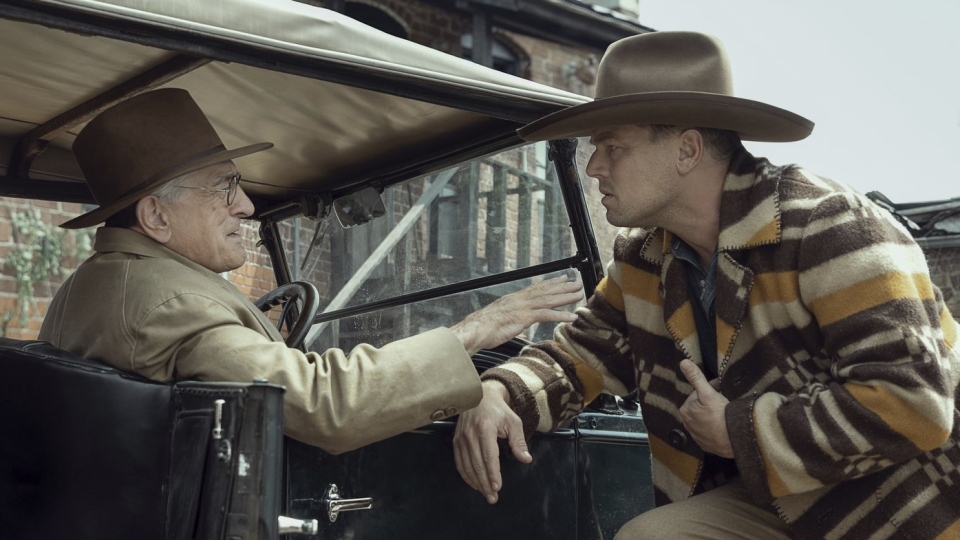
Robert De Niro and Leonardo DiCaprio in Killers of the Flower Moon.

Killers of the Flower Moon is great around the edges. Martin Scorsese’s movie, adapted from David Grann’s jaw-dropping 2017 account of the serial murders of Osage Indians in Oklahoma in the 1920s that enabled white men to secure their “headrights” – the legacy, shared equally among the community, of land rich in oil – is three and a half hours long and cost $200 million, and God knows you can see the money on the screen. The film, shot by Rodrigo Prieto, with production design by Jack Fisk and costumes by Jacqueline West, looks magnificent. The period reconstructions are dazzling and capture a cross-hatched culture, rich in visual irony, where natives, professing a faith that mixes Catholicism with the religion of their ancestors, dress in a combination of traditional garb and the flamboyant style of wealthy white men while they tool around in chauffeured Pierce Arrow roadsters and fly private airplanes. The opening scenes are lively and exciting, a circus-like montage of oil strikes and auctions and raucous general celebration that spills out of barrooms and restaurants into the streets of Fairfax, the Osage reservation town that has grown out of the oil boom. This is some of Scorsese’s best filmmaking – visually dense, outré, darkly funny. We barely have a chance to process the omnipresence of white men who have intermarried with the Osage women before it all turns sinister. The natives are dying in staggering numbers, some the victims in unsolved murders, others expiring from suspicious illnesses.

Monday, January 13, 2020

The Big Guns: The Irishman, Marriage Story and 1917

Joe Pesci and Robert De Niro in The Irishman. (Photo: Niko Tavernise/Netflix)

This article includes reviews of The Irishman, Marriage Story and 1917. 

The Irishman is the cinematic equivalent of a thick, expensive coffee-table book prominently displayed in Rizzoli’s for the Christmas trade. Martin Scorsese’s three-hour-and-twenty-nine-minute epic has as much prestige as one awards-season release can handle. Steven Zaillian (screenwriter of Schindler’s List, Moneyball and The Girl with the Dragon Tattoo, creator/co-writer of the TV limited series The Night Of) wrote the adaptation of Charles Brandt’s bestseller I Heard You Paint Houses, a biography of Teamsters Union official Frank “The Irishman” Sheeran, a middleman for the Bufalino crime family who, shortly before his death, told Brandt that he’d murdered Jimmy Hoffa. (Sheeran’s claim has been disputed since the 2004 publication of Brandt’s book, by the journalist Bill Tonelli in Slate and by the Harvard law professor Jack Goldsmith in The New York Review of Books.) Rodrigo Prieto, the terrific cinematographer associated with Alejandro Iñárritu and Scorsese’s collaborator on The Wolf of Wall Street and Silence, shot it, in handsome dark tones befitting a classic. The star, Robert De Niro, shares the screen with both Al Pacino (as Hoffa) and De Niro’s Raging Bull co-star Joe Pesci (as Russell Bufalino, who pulls Sheeran’s strings). The list of the cast, which also includes Harvey Keitel, Ray Romano, Bobby Cannavale and Anna Paquin, is thirty-three computer screens long on imdb.com.

Sunday, February 21, 2010

Robert Richardson's Shutter

Salvador Dali isn’t available these days to craft a surreal dream sequence, as he did for Alfred Hitchcock’s Spellbound in 1945. But director Martin Scorsese had talented contemporary artists -- among them, cinematographer Robert Richardson -- to help him fashion the freakish cerebral terrain of Shutter Island. Each of those psychological thrillers is set in a mental hospital where the lead character arrives confused and eerie conspiracies abound. But it’s the stunning Vertigo, which opened in 1958, that seems aesthetically similar to the current film by Scorsese -- who has suggested that all of his work taps into much the same “sense of obsession” evident in Hitchcock’s oeuvre.

Tuesday, April 26, 2011

A Better Scream: Criterion's DVD release of Brian De Palma's Blow Out (1981)

Contrary to popular opinion, there have been far too few good political conspiracy thrillers over the years. Most, like The Parallax View (1974), are so content creating faceless and sinister cabals that we become helpless pawns in a predetermined chess match. While there have been some imaginative and daring experiments like John Frankenheimer's The Manchurian Candidate (1962), or fast-paced exciting melodramas like Costa-Gavras' Z (1969), none have had the prescience and the personal obsession of Brian De Palma's consummate thriller Blow Out (1981). Released today by Criterion (on both regular and Blu-ray DVD), in a sparkling new digital transfer supervised by the director, Blow Out is the sharpest, most devastating, American conspiracy picture. It's also one that audiences and critics either ignored (or dismissed) when it was first released thirty years ago.

Although Brian De Palma was part of the American film renaissance of the seventies, which brought us such gifted and original directors as Martin Scorsese (Mean Streets, Taxi Driver), Peter Bogdanovich (The Last Picture Show), Hal Ashby (The Landlord, Shampoo), Francis Coppola (The Godfather I & II), Steven Spielberg (Jaws, Close Encounters of the Third Kind), he never quite achieved the critical (or audience) acclaim that his peers did. People weren't exactly indifferent to him. Often he would inspire scorn. Even violence. When I took a good friend on opening night to see Blow Out, at its conclusion, when I asked him what he thought, he took a swing at me. Luckily, I was quick to duck.

Director Brian De Palma.
Throughout his career, De Palma has had to do some ducking of his own. From his earliest underground political and social satires (Greetings, Hi Mom!) to his expressionistic horror thrillers (Carrie, The Fury) and the sexual reveries (Dressed to Kill), De Palma (unlike his contemporaries) presented himself sardonically as an ironist. Where Martin Scorsese treated violent dramatic subjects with a reverence for the art form, De Palma chose a more irreverent attitude. He treated film history as a form of farce pulling the rug out from under our more hopeful expectations. But unlike Michael Haneke (Caché), who plays intellectual abstract games with the audience (while emotionally distancing the viewer), De Palma brought a sweeping emotional intensity to his work that seductively drew you in. When he sprang sublime jokes in the climax, he cleverly implicated us in our very basic desire to watch, to indulge our forbidden desires.

Tuesday, April 22, 2014

Songs We Continue to Sing: Rob Ford and the Culture of Corruption

The night Rob Ford was elected Mayor of Toronto, almost four years ago, he had just won a bitterly fought battle to lead the city, and he did it by marshalling and manipulating a populist rage towards city government. Ford had warned us of a "gravy train" of bureaucratic waste depriving us of our hard-earned taxed dollars. While he positioned himself as city saviour, he also began targeting those he described as 'liberal elites,' a pampered, educated and entitled bunch, whom he saw as the true enemy of the hard-working individual. If Margaret Thatcher had once casually dismissed the notion that society actually existed, Ford went a step further. He talked about the city of Toronto only in terms of the taxpayer rather than in terms of its citizens. Since we all pay taxes – even when we're homeless and buy a cup of coffee – taxpayer was merely a code word for property owner. To Ford, Toronto wasn't a diverse and multiculturally vibrant urban community, made up of those who are privileged and those who aren't; it was instead a dysfunctional corporation he was about to restore to efficiency. His message to the city, where he alone could determine those he'd serve and those he wouldn't, was communicated with obscene clarity on the day of his coronation. CBC Television broadcaster and former NHL coach Don Cherry had arrived in his flamingo pink suit to drape the chain of office around Ford's neck. It was Cherry who helped set the new tone for the city in his opening remarks. "Well, actually I'm wearing pinko for all the pinkos out there that ride bicycles and everything," Cherry began with cheers from the crowd in the upper rotunda while city counsellors sat in shock. "I say he's going to be the greatest mayor this city has ever, ever seen, as far as I'm concerned – and put that in your pipe, you left-wing kooks." One thing certain in those tone-setting remarks: contempt was now public policy.

Thursday, March 7, 2013

Getting Un-Surrounded: Glenn Frankel on The Searchers

Jeffrey Hunter and John Wayne, in a scene from John Ford's The Searchers

Among the autuerist critics who re-evaluated the reputations of American studio directors in the 1960s, and the new generation of filmmakers who created a renaissance in American moviemaking in the 1970s, no Hollywood film casts a more intimidating shadow than John Ford’s 1956 Western The Searchers. Legend has it that the movie was overlooked in its time, only to be rediscovered by a discerning group of artists and movie lovers as, in the words of J. Hoberman, one of the “few Hollywood movies so thematically rich and so historically resonant they may be considered part of American literature.” As Glenn Frankel acknowledges in his fine new book, The Searchers: The Making of an American Legend, the mythology around the film’s rediscovery is a little overblown. No, it wasn’t nominated for any Oscars, if that’s your idea of the true credit due a work of film art. But it wasn’t a flop; it did pretty well at the box office, and the reviews were mostly good. If there’s anything scandalous about the response to the movie when it was new, it’s only that critics and audience seemed to regard it “merely” as another John Ford-John Wayne Western, albeit a good one with an epic scope. The general consensus among those who came along to acclaim the film ten or fifteen years after its initial release is that it is so much more.

Monday, April 14, 2025

Doppelgänger: Barry Levinson's The Alto Knights

Robert De Niro and Robert De Niro in The Alto Knights. (Photo: Warner Bros.)

Witty, gripping and grandly entertaining, Barry Levinson’s The Alto Knights centers on the complicated relationship of two legendary Mafiosi, Frank Costello and Vito Genovese, who were both recruited to work for bootlegger Giuseppe Masseria in the 1920s alongside Lucky Luciano. After the murders of Masseria and his successor, Salvatore Maranzano, Genovese became Luciano’s second in command with Costello, who claimed to have abjured violence at the end of the First World War and stopped carrying a gun, as his consigliere. Genovese took over in 1936 when Luciano went to prison and expanded the operations of the organization Luciano had reconfigured as the Commission into narcotics. But he had to flee the U.S. to avoid a murder charge and took sanctuary in Italy. (Both men had been born there: Costello in Naples, Genovese in Calabria.) Costello took over, trading drugs for gambling. When Genovese returned to the States after the war – neatly bypassing conviction for that old killing when two key witnesses against him turned up dead – he didn’t take well to being his former colleague’s underboss. All of this narrative is background, much of it unstated or understated, to Levinson’s picture, which takes place in 1957, the year Costello appeared before the Senate Committee investigating the Mafia, and the year Genovese engineered the assassination of the former head of Murder Inc., Albert Anastasia, and attempted unsuccessfully to eliminate Costello.

Wednesday, January 2, 2013

This 'n That: Intriguing Discoveries Made in 2012

This isn't a top ten for 2012. Rather, it's an overview of things I discovered this year, one more than 45 years old, and some as current as last year. I thought about writing stories on all of the below, but never got around to it. They interested me anyway, so here they are, in short-form.

Monday, April 16, 2018

Romance and Regret: The Age of Innocence

The cast of Douglas McGrath's adaptation of The Age of Innocence (Photo: T. Charles Erickson).

I returned to Edith Wharton’s 1920 novel
The Age of Innocence before seeing Douglas McGrath’s stage adaptation, the latest collaboration between Hartford Stage and the McCarter Theatre Center, currently playing a run in the former space. It’s a diverting read but it’s never been one of my favorites. Wharton retraces Henry James’s steps and, coming seventeen years after The Ambassadors, her book feels shallow and a little obvious. In The Ambassadors the characters’ motivations are concealed behind exquisite screens that keep shifting, and you have to catch those motivations during the shifts, through the minute shafts of light that vanish moments later; his feat is to raise our stake in discovering the truth of these human interactions so high that the epiphany at the end, which is devastating for the hero, Strether, is devastating for us as well. Wharton also builds her novel around a blind American, half-stiffened by his upbringing, who is seduced and altered by the whiff of European exoticism and mystique, in the form of Ellen Olenska, an émigré New Yorker who returns home on the lam from a disastrous marriage to a count. But Wharton spells everything out for us. And her protagonist Newland Archer, who is about to marry the Countess Olenska’s cousin May Welland, doesn’t synthesize our own conflicted feelings, the way Strether does; he comes across as a boob.  When Ellen falls in love with him, you wonder what on earth she could see in him.

Friday, February 5, 2010

Prophetic Voices: Mahalia, Muddy & Martin

Mahalia Jackson

Back in the late fifties, my parents frequently took me to the Drive-In. My formative movie experiences were forged there. I saw a lot of bad films on those excursions (Butterfield 8, anyone?), but one of them found a way of staying with me for years. David Churchill attested to yesterday in his piece on The Abyss, there are sometimes scenes within terrible movies that are mini masterpieces. For me, a perfect case in point is Douglas Sirk’s Imitation of Life (1959), the second Hollywood adaptation of Fanny Hurst’s famous weeper.

Sirk made a number of glossy melodramas for producer Ross Hunter in the fifties including All That Heaven Allows and Written on the Wind. These soaps would later be acclaimed as subversive by auteur film critics in the ‘80s who were basically enamoured with the rather turgid work of the German director Rainer Werner Fassbinder (who used Sirk's style as his model particularly in The Marriage of Maria Braun). Imitation of Life is ostensibly about an aspiring actress (Lana Turner) who is also a single mother. While trying to develop a career and raise her young daughter, she gets help when she befriends a jobless black maid (Juanita Moore) and her young daughter (Susan Kohner). Once they come to live with the actress, however, the story shifts to the problems of two generations of black Americans and Lana Turner’s issues become comparatively minor.