Showing posts with label Criterion. Show all posts

Tuesday, May 23, 2023

Making the Myth True: The Fisher King on Criterion

Robin Williams and Jeff Bridges in The Fisher King.

Around the turn of the millennium, the director Terry Gilliam struggled to bring an updated Don Quixote to the screen; the documentary Lost in La Mancha (2002) chronicles the breakdown of the project after bad weather and the illness of his Quixote, the French actor Jean Rochefort, threw it into financing hell. When he finally released a version of it called The Man Who Killed Don Quixote in 2018, he’d lost the momentum. Really, though, he’d already made his Don Quixote, back in 1991. In his best movie, The Fisher King, written by Richard LaGravenese, two men strangely bonded by a tragedy heal each other through a crackpot mission to locate the Holy Grail, devised by one of them, a schizophrenic (Robin Williams) who used to be a Hunter College English professor named Henry Sagan, and carried through by the other, a one-time radio talk host named Jack Lucas (Jeff Bridges) whose life has become meaningless. The tragedy is a mass shooting at a popular bar called Babbitt’s perpetrated by a lunatic who has received encouragement for his paranoia by Jack, whose favorite targets is the yuppies who frequent Babbitt’s. Jack’s spleen isn’t real; his diatribes are cynical inventions to entertain his listeners and fuel his career. Until the killer strikes, it never occurs to him that there might be consequences to his habit of revving them up. Afterwards, shattered by what he’s brought into being, Jack goes into retreat, drinking and hiding from the world while his girlfriend Anne (Mercedes Ruehl) shelters him and lets him help her manage the video shop below her apartment.

Monday, January 9, 2023

New from Criterion: Hôtel du Nord, Le Corbeau and Summertime

Jean-Pierre Aumont and Annabella in Hôtel du Nord (1938).

I look eagerly forward to the monthly announcements of the new Blu-Ray releases from Criterion and to viewing (or more often re-viewing) a handful of them in gleaming new prints. Here are three that came my way over the past few months. 

Monday, March 28, 2022

New on Criterion: The Last Waltz (1978)

The Band on stage in The Last Waltz (1978)

In the forty-four years since Martin Scorsese released The Last Waltz, his film of The Band’s final concert, at San Francisco’s Winterland Arena on Thanksgiving Day in 1976, the movie hasn’t lost any of its visceral excitement, both as a piece of filmmaking and as a keepsake of one of the signal events in the history of rock ‘n’ roll. It’s the greatest concert movie ever made. (The other contenders, in my view, would be Bert Stern’s 1959 Jazz on a Summer’s Day, a chronicle of the 1958 Newport Jazz Festival, which inspired Scorsese; Jonathan Demme’s 1984 Talking Heads film Stop Making Sense; and Scorsese’s one-of-a-kind 2019 Rolling Thunder Revue, which casts a backward glance at the all-star show, headed by Bob Dylan and Joan Baez, that circled the continent in 1975 and 1976.) The new Criterion disc of The Last Waltz is as beautiful to look at as the film was in theatres in 1978. The veteran Hollywood production designer Boris Leven, borrowing the San Francisco Opera’s set for La Traviata and framing it with a trio of chandeliers, transformed Winterland into something that looks like a remnant of the Romantic era, and Michael Chapman, who had worked with Scorsese on Taxi Driver, lit it, while some of the most talented cinematographers in America (Vilmos Zsigmond, Laszlo Kovacs, David Myers, Bobby Byrne, Michael Watkins and Hiro Narita) manned the other six cameras covering the spectacle. It was the first concert film with a shooting script, which Scorsese had drawn up; the stories about the filming, where his meticulous planning met the inevitable challenges and accidents of a once-in-a-lifetime event that had to be captured spontaneously, are sometimes funny and always thrilling. (You won’t want to skip the extras on the Criterion disc, which include two audio commentaries, a 1978 Canadian television interview with Scorsese and The Band’s Robbie Robertson, a twenty-fifth-anniversary doc about the making of the movie, and a supremely articulate new interview with Scorsese conducted by film critic David Fear. There’s also a single outtake, a twelve-minute jam session that occurred at the end of the concert and is the only surviving piece of archival footage.)

Monday, March 14, 2022

New from Criterion: Love Affair (1939)

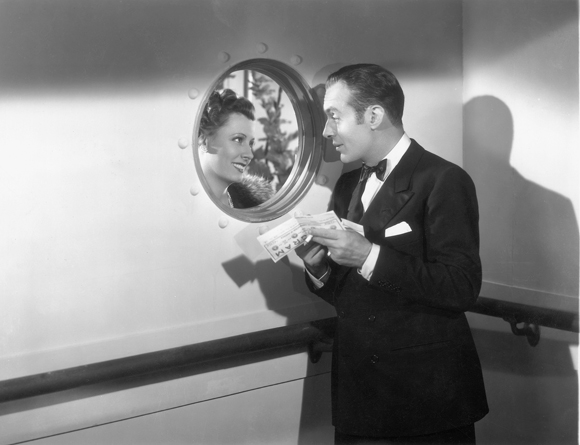
Irene Dunne and Charles Boyer's shipboard first meeting in Love Affair (1939).

The filmmaker Leo McCarey has been largely forgotten, but his Hollywood career spanned four decades and bridged the silent and talkie eras. Like Frank Capra, he received his training in silent comedy: he directed more than seventy-five shorts, and he was responsible for the collaboration of Stan Laurel and Oliver Hardy. When movies began to speak, he put his expertise at working fast and off the cuff to great effect – he directed the most brilliant of the Marx Brothers’ early Dadaist masterpieces, Duck Soup (1933), as well as helming pictures that starred W.C. Fields, Mae West and Eddie Cantor. His thirties output included two memorable comedies, Ruggles of Red Gap (with Charles Laughton as an English butler in the Wild West) and The Awful Truth, where Cary Grant strives to win back his ex-wife,  played by Irene Dunne. It also includes the romantic melodrama Love Affair, starring Dunne and Charles Boyer, which Criterion has just put out in a glistening print restored from sources in the Museum of Modern Art collection.

Monday, October 18, 2021

The Criterion Release of Satyajit Ray’s Devi (1960)

Soumitra Chatterjee and Sharmila Tagore (foreground) in Devi (1960).

By the nineties, the films of the great Indian director Satyajit Ray were in a shocking state of disrepair. Merchant Ivory re-released eight of them to arthouses in 1995, but the company didn’t make any attempt to restore them to their former glory; it simply found the best prints available, and I guess that was better than nothing. But the wizardry performed by the Criterion Collection and L’Immagine Ritrovata in Bologna on The Apu Trilogy, which collaborated to reconstruct negatives burned in a fire at a London laboratory, resurrected three premier masterpieces of world cinema. (They were returned to theatres six years ago; a thrilling documentary on the Criterion Channel details the process by which they were rebuilt.) Now you can access seventeen Ray pictures on Criterion, including his documentary about the Indian author Rabindranath Tagore, and Three Daughters, the complete short-story film anthology previously unavailable in North America: when I was introduced to it in my twenties – in the years when I discovered Ray and fell deeply in love with his work, it was called Two Daughters. The Ray collection is a treasure trove. A realist-humanist on the order of Jean Renoir, who was his chief influence, Ray ought to be essential viewing for anyone who reveres the art of filmmaking.

Monday, June 7, 2021

New from Criterion: Masculine Féminin

Jean-Pierre Léaud and Chantal Goya in Masculine Féminin (1966).

Between 1960 and 1967 Jean-Luc Godard made fifteen features, all of them vibrant, provocative and almost impossibly innovative, many of them masterpieces. What filmmakers in the history of movies had streaks that were in any way comparable? I can think of only five: D.W. Griffith in the teens and early twenties, Buster Keaton in the twenties, Jean Renoir in the thirties, Satyajit Ray between the mid-1950s and the mid-1980s (his lasted the longest) and Robert Altman between 1970 and 1975 (his was the most concentrated). Masculin Féminin, which Criterion has just released on Blu-Ray and DVD in an immaculately restored print, was the eleventh of these pictures; it came right after Pierrot le Fou (which is referenced in this movie) and before Made in U.S.A. It’s one of my favorite Godards but I realized as I sat down to watch the Blu-Ray that the last time I saw it was thirty years ago, on a drab videotape. Viewing it again with the black-and-white images returned to their original, tactile quality – showcasing Godard’s ability to make contemporary Paris look newly minted – is a revelation. He isn’t working here with his greatest cinematographer, Raoul Coutard; Willy Kurant’s lighting doesn’t knock your eye out the way Coutard’s does, but the movie still looks terrific.

Monday, May 24, 2021

New on Criterion: History Is Made at Night

Charles Boyer and Jean Arthur in History Is Made at Night (1937).

There are romantic comedies that veer into high comedy (like Ernst Lubitsch’s The Shop Around the Corner) and movies that blur the line between high comedy and melodrama (like Dinner at Eight). History Is Made at Night, out in a sparkling new Blu-Ray from Criterion (also available on a standard DVD), is a mélange of the three. It’s finally rather lunatic but very entertaining.

Friday, December 18, 2020

Cultural Recommendations in this COVID Year

Erik Larson's The Splendid and the Vile was published by Crown Publishers in February. (Photo: Nina Subin)

Pandemic or not, culture continues on. Here are some recommended books, CDs, DVDs and magazines you might want to purchase for the holidays, as presents for others or just to treat yourself.

Friday, September 25, 2020

Balls: The Criterion Collection Release of Town Bloody Hall (1979)


“It was a trivializing, peripheral, silly sort of event, in the best uptown tradition,” Germaine Greer said in 2004 of the panel discussion — or public forum, or celebrity sideshow, or one-off improvised sitcom episode — that was staged by the Theatre of Ideas at New York’s Town Hall on April 30, 1971, under the banner “A Dialogue on Women’s Liberation.” In one respect at least, she wasn’t wrong: the event, which put Greer onstage with three other women representing a range of feminisms, plus Norman Mailer, was very much a production of and for the Manhattan intellectual elite. But the evening was also what it promised to be, a theater of ideas — ideas held up, tossed down, kicked about, laughed at, shouted over, defended, derided. It was raucous and suspenseful and dirty and funny and unsettling, and everything else we’d want theater to be.

It’s all there in Town Bloody Hall, which D.A. Pennebaker (along with two other cameramen) filmed on the night, and which Pennebaker’s creative partner and wife, Chris Hegedus, edited into shape in 1979. The film has now been restored and given its first DVD release by the Criterion Collection, with stellar extras including a new interview with Hegedus; years-later interviews with Greer and Mailer; a partial reunion panel convened in 2004; audio commentary from Hegedus and Greer; and the complete Dick Cavett Show of December 1, 1971, in which Mailer, his brow darkened by drink and professional resentment, took a combative posture toward guests Gore Vidal and Janet Flanner, Cavett, and finally the audience. The Criterion release is a nifty package, and the main attraction still packs a punch. Whatever evasions are attributable to the event or its participants, as a film and as a document Town Bloody Hall is nothing less than thrilling for anyone who cares about the people, the issues, or the history. 

Friday, September 29, 2017

Beauty of Action, Beauty of Character: The Criterion Collection Release of Only Angels Have Wings

Cary Grant and Jean Arthur in Only Angels Have Wings

The opening twenty minutes of the 1939 Only Angel Have Wings are a marvel – emotionally and tonally double-jointed, with a loose, jocular quality and a spontaneous energy, underscored by the overlapping of Jules Furthman’s expert hard-boiled dialogue, that masks the astonishing control of the director, Howard Hawks. A pair of flyboys, Joe (Noah Beery Jr.) and Les (Allyn Joslyn), who work for a South American airmail service, pick up Bonnie Lee (Jean Arthur), a singer with an evening’s layover before she’s to re-embark on the boat to Panama. They buy her drinks and offer her a steak dinner at the bar-restaurant owned by Dutchy (Sig Rumann), whose money provides the operating budget for the mail company. But their boss, Geoff Carter (Cary Grant), interrupts the meal to send Joe out on a mail run, through the rain and fog that stalled Bonnie’s ship here in the tiny town of Barranca. Joe doesn’t make it. When the weather makes his passage impractical and Geoff radios him to come on back, he’s so eager to resume his courtship of Bonnie that he insists on short-shrifting his landing rather than hanging out in the skies long enough for Geoff and his best buddy and employee Kid Dabb (Thomas Mitchell) to wave him in safely. Joe’s plane hits a tree and crashes. Bonnie’s devastated – and appalled at what she sees as a lack of gravity among Carter and the other pilots in the face of this tragedy. What she doesn’t understand at first is that their joking is a form of gallantry and their apparent insensitivity is the only way they can keep going when death is always hovering over them; unspoken grief underlines their raucousness. Eventually she gets it: when she sits down at the piano and leads some of the others in a rendition of “Some of These Days,” she cottons onto the feeling of camaraderie at Barranca Airlines. The miraculously extended episode ends with one of those unconventional depictions of community that Hawks is justly famous for.

Saturday, April 22, 2017

Recovering a Lost Treasure: The Criterion Blu-ray Release of Tony Richardson's A Taste of Honey (1961)

Rita Tushingham as Jo in Tony Richardson's A Taste of Honey 

Shelagh Delaney was only nineteen when she wrote A Taste of Honey, a 1958 coming-of-age play about a teenage girl set in Delaney’s home town of Salford, Lancashire, but it’s one of the treasures of its patch of British theatre, sometimes called the angry young man movement and sometimes the epoch of kitchen-sink realism. The heroine, Jo – played in the West End by Frances Cuka and on Broadway in 1960 by Joan Plowright – lives with her promiscuous mother, Helen, who sneaks them out of their digs whenever they can’t pay the rent and relocates so often that Jo never has a chance to make school friends. Helen cares about Jo, though they quarrel habitually and Helen’s attention has a habit of wandering. At forty, she finds a man eight years her junior who wants to marry her; he and Jo can’t get n so, she goes off to live with him and leaves her self-sufficient daughter behind. Jo has a fling with a sailor; after he goes off on his ship she discovers she’s pregnant. She sets up house with a gay man named Geoffrey who’s devoted to her, but when he decides to hunt down her mother because he thinks Helen should know about Jo’s condition, he finds himself displaced. Helen’s new husband leaves her for a younger woman (“his bit of crumpet”) and she’s drawn back to the daughter she traded in for a new life.

Monday, February 20, 2017

Electric Blues: Bette Midler in The Criterion Collection Blu-ray Release of The Rose

Bette Midler in The Rose (1979).

When Bette Midler takes the stage as The Rose in Mark Rydell’s 1979 movie of the same name, singing the rocker “Whose Side Are You On?,” her face, mashed up as she spits out the lyrics, is ferocious. She’s not trying to look beautiful; on the contrary, she’s owning her odd-duck looks, facing off the stadium audience, daring them not to love her for who she is. There’s no grandeur to her self-presentation, just fuck-you bravado and sexual aggressiveness, but then she makes a connection with a handsome young man at the edge of the stage and she breaks into an unexpected toothy smile, as if she’s found a date for the high school prom. At other times her smile can look voracious, even predatory. Her whole face seems to be pushed toward her nose, and both her dramatic eye make-up and her frizzy hair accentuate the bones in that face, though when Vilmos Zsigmond’s lighting attaints its softest neon glow, her hair is like an aureole that turns her into a pop Madonna. You can’t pin down her look, and God knows you can’t pin down her performance to one thing. When we first see her, stepping off the tour’s private plane, she’s dressed like Janis Joplin in a broad-brimmed hat with gauze dripping from the back and a thin, wavy pink dress and shades, and she’s so drunk that she can’t stay upright: she has to hold onto the railing, and she misses a step or two, as if the stairway were melting under her. This is the wayward, unmoored side of Rose. We see it again on the plane when she sings a cozy, growling, sloshed version of “Let Me Call You Sweetheart” – a song she learned off a Furry Lewis side – with a muted guitar accompaniment, then peers out the window, disoriented, bursting into tears.  And again late in the picture, when her manager and promoter Rudge Campbell (Alan Bates) tells her he’s setting her adrift (it’s his way of scaring her into submission) and she looks away from him, her face wavering on the edge of another realm.

Wednesday, November 9, 2016

A Game of Chance: The Criterion Blu-ray Release of Robert Altman's McCabe and Mrs. Miller (1971)

Warren Beatty and Julie Christie in McCabe and Mrs. Miller.

Some forty-five years after its initial release, Robert Altman's seductive and allusive 1971 western, McCabe and Mrs. Miller, still has the potency of a dream you don't wish to wake from. And as dreams distort the familiar, Altman's picture also alters our sense of reality and transforms the genre's myths we've come to recognize into a lingering reverie of the past. Despite a script, based on an Edmund Naughton 1959 novel (McCabe), Altman doesn't just tell a story here; he lets one unfold intuitively as our narratives often do in life and from directions we can't predict and with outcomes we can't anticipate. The howling wind that opens the film may push gambler John McCabe (Warren Beatty) towards his fate in the growing town of Presbyterian Church (just as it will later bury him in the snow), but Altman is also playing a game of chance, and destiny is as much a crap shoot as the changing weather. While the camera pans right, the credits move horizontally to the left, turning our field of vision into a peripheral map that's always in search of a focal point. It sets us up beautifully for an elliptical tale where the meanings are delineated from between the lines of the story. Robert Altman might draw from the sources of the western, but he does it as if he were trying to uncork an old undiscovered bottle that once stored its essence.

Sunday, May 8, 2016

Jack in the Box: The Criterion Blu-ray Release of Five Easy Pieces

Jack Nicholson and Karen Black in Five Easy Pieces.

Unlike many of the key actors who became part of the American New Wave of the Seventies, Jack Nicholson was paradoxically alluring. Dustin Hoffman, Al Pacino, Robert de Niro, Diane Keaton and Warren Beatty etched their eccentricities and differences in characters that formed clear lines of definition to form a close rapport with the audience. Whereas Nicholson rode a wobbly wavelength in search of a port that never arrived. There was no perceived goal of resolution in the characters he played early in his career. He was the man in the mirror seeking out definition while simultaneously railing at the world around him for continually honing him in. And, yet, movie audiences still became closely allied with his smart-ass independence. As critic Steve Vineberg remarked in his book Method Actors: Three Generations of an Acting Style, if Nicholson was playing a son of a bitch, he was his own man, and on terms that had their own unorthodox integrity. Hoffman and Pacino tied themselves close to the Method style and that inspired them to dig for the passport that defined their characters, Vineberg went on to suggest, but Nicholson cut loose from all those ties to create a compelling portrait of solitude.

In his Westerns, John Wayne sought to build a sense of community out of his stance as a loner, but he was always cast out in the end into the very wilderness that spawned him. Nicholson was instead a hermetic figure forever living in bustling communities, but more content to be the jack-in-the-box surprise who popped out aggressively with a lewd grin and bopping eyebrows and keeping everyone on their toes. This aggression he displayed was also key to the roles that made him a star. It set him apart from his contemporaries who chose instead to go deeper into the interior of their characters to explore the promise that abandoned them. In an age when America's greatest ideals were up against defeat and failure, it was no surprise that Jack Nicholson didn't wear that defeat quietly – or passively. His George Hansen in Easy Rider (1969) warned Peter Fonda and Dennis Hopper that their country would strike out violently at those seeking freedom, but his spiky humour made him a more memorable victim than Fonda or Hopper's mythic martyrs would be by the end. Detective J.J. Gittes in Chinatown (1974) didn't simply recoil from the evil deeds of John Huston's powerfully rich patriarch, he mocked them. In The Last Detail (1973), his navy lifer, Billy Buddusky (perhaps the doppelganger of Melville's Billy Budd), could be the cock-of-the-walk showing a good time to a young navy recruit he's taking to the brig, but his tap-dancing profanities proved to also mask his own impotence. Nicholson's sly and subtle paradoxes, a key to his success as a movie star, would bloom even later in his career in movies nobody saw. In The Border (1982), playing a quietly righteous border patrol agent, he defies the corruption offered by his partner (Harvey Keitel) by confronting him and literally drawing a line in the sand that he says he won't cross – only to walk over that line right after he finishes his confrontation. In that lightning quick moment, Nicholson reminds us of both his defiance and his vulnerability.

Saturday, April 2, 2016

Fearless Satire: The Criterion Blu-ray Release of The Manchurian Candidate (1962)

Frank Sinatra and Janet Leigh in John Frankenheimer’s The Manchurian Candidate (1962).

(Spoiler alert: This article discusses plot details that The Manchurian Candidate keeps hidden until quite late in the narrative. Though they are quite famous, if you don’t know them you might prefer to see the movie first and encounter the revelations with all the suspense and surprise that the 1962 audience would have experienced.)

Political conspiracy thrillers flourished during the early days of the Cold War and especially during the Korean War. Generally their heroes were pure-hearted Federal agents who succeeded in stemming the insidious behavior of Communist infiltrators, icy devils with no more dimensions than the Nazis bad guys Hollywood had featured just a few years earlier. The exception was Leo McCarey’s notorious and distasteful 1952 My Son John, in which the Commie is a young American man (Robert Walker) who comes home to give the commencement speech at his old high school and alarms his mother (Helen Hayes) by mocking his parents’ patriotism and refusing to attend church with them. He is also clearly gay, though the movie doesn’t say so explicitly; you deduce it from the flourishes in Walker’s performance, which are recycled from the truly splendid one he gave the year before in Hitchcock’s Strangers on a Train. The idea seems to be some debased version of the Renaissance notion about the clustering of vices in a corrupted personality. In the great Jacobean tragedy The Changeling by Thomas Middleton and William Rowley, when the husband of the protagonist realizes she’s a murderess and her partner in crime calls her a whore, the husband replies, “It could not choose but follow.” More specifically in My Son John, the un-American elements in John’s behavior – cynicism, atheism, homosexuality – all point to his being under the influence of a foreign power.

Sunday, January 11, 2015

The Age of Coming: The Criterion Blu-ray release of Alfonso Cuarón's Y tu mamá también (And Your Mama Too)

No one has ever fused the indissoluble relationship between sex and death in a coming of age story quite like the wildly gifted Mexican director Alfonso Cuarón does in his 2001 Y tu mamá también (And Your Mama Too). Recently re-released on DVD in a sparkling new Blu-ray print by the Criterion Collection, Y tu mamá también boldly plumbs the depths of adolescent eroticism, where sexual surrender brings one in touch with the primal terrors of loss and separation, with a refreshing and shocking candidness. It immediately calls up Bernardo Bertolucci's Last Tango in Paris, which examined with equal frankness the turmoil of sex and death from the vantage point of middle age. After charming audiences with the sophisticated fairy tale A Little Princess (1995), and the sumptuously expressionistic Great Expectations (1997), Cuarón returned to his Mexican homeland to make a sexually rowdy and wildly funny road movie, where two teenage boys, who are best friends in Mexico City, hit the road with the runaway wife of one of their cousins while their girlfriends are away in Italy. Armed with a juvenile code of conduct that is quickly undermined and rendered inadequate by the older woman they journey with, Cuarón unveils with buoyantly sportive humour the unacknowledged homoerotic bonds of male companionship – while also confronting the desperate need one has for sexual satisfaction when mortality looms large in the future. Y tu mamá también, which won the Best Screenplay Award at the 2001 Venice Film Festival, has virtually nothing in common with the more conventional coming of age stories like Rob Reiner's Stand By Me (1986), which sentimentalizes death by using it to reinforce the dubious virtues of staying young, or the Harlequin romanticism of the early Seventies hit, Summer of '42, where sex becomes a tender awakening that makes one forget the finality of death. The more welcoming sensibility that informs Y tu mamá también is alive and anarchic, much like sex itself, and suggests a delinquent version of Truffaut's Jules and Jim (1962) coupled with the rough house friskiness of Bertrand Blier's Going Places (1974).

Saturday, September 27, 2014

A Formula Film with a Human Face: The Criterion Collection Release of Lawrence Kasdan's The Big Chill

When Lawrence Kasdan's The Big Chill came out back in 1983, it was understandable (especially if you were a political activist in the Sixties) if you found yourself appalled at just how glib and superficial the whole treatment of the period was. In it, a group of former college radicals gather for a weekend when one of their former comrades, Alex, who has lost his way, commits suicide. As they bury him, they dredge up the good ol' days and reflect on what has happened to each of them since. This would have been perfectly compelling if The Big Chill had believably suggested that any one of these people were ever once radical, let alone political activists. The level of ease they reach together in that South Carolina home, even when they rub each other the wrong way, doesn't take into consideration the uneasy course the country has taken since they last took up sides against it. The group seems more caught up in what middle-age and their choice of occupation has done to them rather than what has happened to the United States by 1983.

For a movie supposedly about the politics of a turbulent period, there is little to find that's political in it. With no sense of what happened in the land between their time as committed activists and now, there's not even a comprehension of how some of the counter-culture (especially the Weathermen) began turning criminal, even psychopathic, like the political revolutionaries in Dostoyevsky's The Possessed, or the bombers in Jean-Luc Godard's prescient La Chinoise (1967), as the decade drew to a close. The shootings at Kent State and Jackson State in the early Seventies are never alluded to on this mournful weekend, and the picture never once mentions a President. The country itself is what ends up missing-in-action in The Big Chill. For all their former activism, and their engagement in the world, the collective gathered here are only interested in their state of mind and their own well-being rather than the state of the country. You're never convinced that this group was ever made up of idealists who, by the Eighties, turned into narcissists. They suggest instead refugees from one of Werner Erhard's human potential encounter groups rather than anyone who did time in the SDS. Despite the death of one of their own, which provides the very title of the picture, there is little in the way of a chill in the air considering where America actually was when the film came out.

Saturday, June 7, 2014

Eight Arms to Hold You: The Criterion Collection Celebrates the Fiftieth Anniversary of A Hard Day's Night

"The first rock and roll movies had little or nothing to do with rock and roll music, and everything to do with the rock and roll ethos," wrote Greil Marcus in his assessment of the genre. That ethos he describes was present in many Fifties pictures where adolescents were no longer accepting the proscribed values of the status quo. You could see it in Marlon Brando's defiance in The Wild One (1953), where when asked about what he was rebelling against, he replied, "Whaddya got?" You could recognize it in the painfully vulnerable James Dean in Rebel Without a Cause (1955), as he attempts to wake up his incognizant parents to the misunderstood youth they were alienating. The distilled essence of what would soon become rock 'n' roll was weaved into the fabric of those movies. According to Marcus, though, its power wasn't fully comprehended until Bill Haley & the Comets drove home the combined sociological screeds of The Wild One and Rebel in The Blackboard Jungle (1955), with its opening blast of "Rock Around the Clock."

After that, aspiring rock artists started lining up to see their possible future on the silver screen; and John Lennon began thinking that maybe this was a cool job. The Beatles were first turned on by The Girl Can't Help It (1956), which featured Little Richard in the opening credits singing the title song. The plot was largely superfluous, but significantly, it was about how the music business was run by the mob (giving a whole new meaning to the word hitmen). Besides grooving to Little Richard, Gene Vincent, the Platters and Eddie Cochran, youngsters also swooned as the buxom bombshell Jayne Mansfield strutting by in her tight clothes, clutching milk bottles to her heaving breasts. In 1956, having been one of those kids first stunned by Brando, Elvis Presley stepped onto the screen in the Civil War drama Love Me Tender, where two brothers fight over politics and the love of Debra Paget. His elegiac ballad, "Love Me Tender," which maybe planted the early seeds for McCartney's eventual "Yesterday." But it was his role as the violent rockabilly singer Vince Everett in 1957's Jailhouse Rock where the rock ethos fused effortlessly with the music. From there, just as the rock movie began, it seemed almost over. Except for the tabloid chic of High School Confidential (1958), which delved pruriently into a teen dope ring, it was the sanitized Frankie Avalon/Annette Funicello beach party movies and Elvis's decline in Hollywood.

Sunday, March 30, 2014

Bildungsroman: The Criterion Collection Blu-ray DVD Release of Blue is the Warmest Color


When Steven Spielberg awarded the Palme d’Or to Blue is the Warmest Color – released on DVD this year by the Criterion Collection – last May, he remarked that the jury had taken the exceptional measure of bestowing it not upon one artist but three: Adèle Exarchopoulos, Léa Seydoux, and Abdellatif Kechiche. Directed and written by Kechiche, who adapted it from Julie Maroh’s graphic novel of the same title (with the help of his regular collaborator Ghalia Lacroix), Blue is a coming-of-age story of startling intimacy. At its core is a love affair between two women, Adèle (Exarchopoulos), a high school girl whose deep appetite for sensual experience is flared by a momentary chance meeting with a blue-haired stranger on a city street, and Emma (Seydoux), the punkish art student who captures Adèle’s curiosity and then her passion. This picture is as entirely a collaboration as Richard Linklater’s Before movies, which he co-created with his stars Ethan Hawke and Julie Delpy, or as My Dinner with André and Vanya on 42nd Street were between Wallace Shawn, André Gregory and Louis Malle, but Blue is the Warmest Color is yet more electrically and originally sensual and more philosophically capacious. It reminded me of at least a dozen pictures I love, but it’s not quite like anything I’ve seen before: it’s a groundbreaking erotic drama.

Thursday, January 30, 2014

The Higher Depths: The Criterion Collection Blu-ray Release of Aki Kaurismaki's La Vie de Boheme

When the Finnish writer-director Aki Kaurismaki first appeared on the world film scene in the late 1980s, he risked being typecast as a sort of Nordic-European doppelgänger to Jim Jarmusch, who shared Kaurismaki’s dry wit, his fixation on slightly outdated lowlife-bohemian milieus, and devotion to visual and narrative spareness. Like Jarmusch, Kaurismaki has sometimes rushed into production with only one joke in mind – as in his rock-band road movie Leningrad Cowboys Go America, which boasted a cameo by Jarmusch himself – and one audience member in mind, himself. La Vie de Boheme, which has just been released on DVD and Blu-ray by the Criterion Collection, was Kaurismaki’s most full-bodied and accessibly funny picture to date when it was first released in 1992. (He’s since topped himself, with The Man Without A Past, his 2002 comedy about an amnesiac who reinvents himself as a promotor of “rhythm music,” i.e., jumpy, stripped-down rock and roll.) In some ways, this, too, is a one-joke movie, but the director loves the joke, and the people who embody it, so much that it takes on the quality of a world view.