Showing posts sorted by relevance for query multiverse. Sort by date Show all posts

Friday, June 10, 2022

Headtrip: Everything Everywhere All at Once

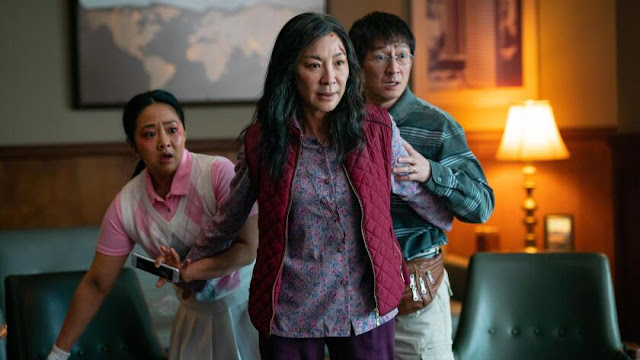
from left: Stephanie Hsu, Michelle Yeoh, and Ke Huy Quan in Everything Everywhere All at Once.

Theories of the multiverse go as far back to ancient Greek philosophy, though we associate them today with the hard sciences. Part of the discussion, historically, involves speculation about whether ours is the best of all possible worlds. Gottfried Wilhelm von Leibniz (one of the most important early modern philosophers) made this idea the cornerstone of his work The Monadology. There, the German polymath addresses theodicy, or the problem of evil. He speculates that the world we inhabit must be the best of all possible worlds, since God – who is good and who could have chosen to make any world he wished – made this one. The presence of evil, then, must have some mysterious, salutary effect – perhaps contrasting goodness for us, so we appreciate it all the more. In a world without evil, he surmises, we wouldn’t be able to recognize goodness, since it would just be the banal, uniform state of affairs. A fish doesn’t notice water unless it’s thrown on land.

Tuesday, April 1, 2014

A Flawed Theory: Particle Fever

The CERN Large Hadron Collider, in Mark Levinson's documentary Particle Fever

The challenge of Particle Fever is to distil a hugely complex subject into something we can grasp and appreciate: the hunt for the elusive Higgs boson particle, and through it a deeper understanding of the fundamental laws of the universe. It rises to the challenge, presenting a deeply momentous scientific undertaking with passionate clarity. But I’m not sure it will convert those who are not already scientifically-inclined. For those of us who retain the thirst for knowledge we cultivated as children, however, it’s an exciting ride. The film focuses on the theoretical and experimental physicists who gather at Europe’s CERN from all corners of the globe in 2008, before the switch was first flipped on the Large Hadron Collider – a singular moment in the history of science, where literally everything we thought we knew about the universe and how it worked was up in the air. These scientists were buzzing with excitement at the prospect of gathering some truly unprecedented data, using the largest and most complex tool ever designed by human hands. As one physicist remarks, it’s “history happening right before our eyes.”

Monday, February 9, 2015

Constellations: Love in the Multiverse

Jake Gyllenhaal and Ruth Wilson in Constellations. (Photo by Sara Krulwich)

In Nick Payne’s brainy, open-hearted two-hander Constellations, Jake Gyllenhaal and Ruth Wilson play an English couple – Marianne is a physicist, Roland a beekeeper – who meet at a barbecue, move in together, break up, rediscover each other and get married. It’s the arc of a love affair with a tragic ending, only it takes place, as the program informs us, in “the multiverse,” where, according to Marianne’s research, “at any given moment, several outcomes can co-exist simultaneously . . . [and] every choice, every decision you’ve ever and never made exists in an unimaginably vast ensemble of parallel universes.” So the fleet seventy-minute play (measured in conventional time, that is) consists of a series of short scenes that continually reimagine the scenario. In alternate versions of Roland and Marianne’s opening gambit, they fail to connect because he has a girl friend or is already married and her interest in him ricochets back on her. In alternate versions of their first date, she invites him in but reconsiders and sends him packing, which he understands or resents. The stop-and-start structure recalls David Ives’ comic one-act Sure Thing, an undergraduate directing-class perennial, but the tone is entirely different.

Friday, October 28, 2022

Outlier/Indweller: Writing as Walking

Milkweed Editions, 2022.
 

“The wanting was a wilderness and I had to find my own way out of the woods.” – Cheryl Strayed
In her 2012 memoir called Wild: From Lost to Found, the American writer Cheryl Strayed recalls taking herself off on a thousand-mile hike of self-discovery, observing, “I’d finally come to understand what it had been: a yearning for a way out, when actually what I had wanted to find was a way in.” She was also sharing her experience of wanting per se, almost as a location in space and time, one she could arrive at by escaping from its insistent desire, even comparing her wanting to a wilderness she needed to be liberated from. Unfettered physical space and its traversal are frequently perceived as a conduit to expanded consciousness, but the latter is, however, not the only way to free oneself from the sense of confinement which often ironically accompanies a heightened sense of self-awareness.

The Canadian poet and visual artist Adam Wolfond’s new book of mesmerizing poems, The Wanting Way, is perhaps an ideal example of how effectively a being who at first glance appears to occupy a profound sense of confinement can, upon reflection and closer observation, reveal himself to be freely traversing interior expansive landscapes of exquisite beauty with a charming sense of humility and grace. He has, in fact, clearly documented, in his own inimitable style, how he manages to travel as an exceptionally gifted poetic flâneur and arrive at an often poignant way out of the woods of wanting and also to arrive at a way into self-expression of a truly extraordinary sort. He explores an interior wilderness.

Sunday, August 28, 2022

Silver Screen Time Machine: Beyond the Infinite Two Minutes (2020)

Tosa Kazunari in Beyond the Infinite Two Minutes (2020).

Somehow, Kato doesn’t freak out.

The essence of time travel is narrative. Like the unread pages of a good book, the future has already happened; it just hasn’t yet happened to you. The metaphor applies doubly to filmmaking, which usually takes a narrative and shoots it out of order. Continuity must be maintained, and character and emotional arcs made convincing. If they aren’t, paradoxes manifest, the cinematic world collapses, and viewers branch off from the storyworld prematurely, each into their own individual lifeworlds.

2020’s Beyond the Infinite Two Minutes (ドロステのはてで僕ら “We at the End of the Droste”), director-cinematographer-editor Yamaguchi Junta’s feature debut, realizes this metaphor in the most direct way. Beyond is shot to look like it was done in a single take, using just one phone, tripod, boom mic, the world’s longest power cord, and lots and lots of stopwatches. To give you a sense of its flavor, it was inspired by One Cut of the Dead (カメラを止めるな! “Don’t Stop the Camera!”), Ueda Shinichiro’s 2017 smash hit about a group of people tasked with making a one-shot microbudget zombie film. There are cuts in Beyond – of course there are cuts; it’s a time travel film – but to keep up the illusion, the requisite plot complications have to develop organically from the situation the characters find themselves in, and from who they are as characters, as people. Writer Ueda Makoto does a hell of a job in just 70 minutes.