Showing posts sorted by date for query "breaking bad". Sort by relevance Show all posts

Wednesday, June 28, 2023

Plays with Music: Brokeback Mountain and The Curious Case of Benjamin Button – and a Brief Farewell

Mike Faist and Lucas Hedges in Brokeback Mountain. (Photo: Manuel Harlan)

Receiving its world premiere at London’s compact, comfortable new Sohoplace in London, Brokeback Mountain, Ashley Robinson’s ninety-minute dramatization of the Annie Proulx story most people know through the 2005 film, is a trim, skillful production. Jonathan Butterell has staged it effectively in the round on Tom Pye’s pared-down set and Mike Faist and Lucas Hedges, the two actors succeeding Jake Gyllenhaal and the late Heath Ledger in the roles of the young Wyoming cowboys embarking on a forbidden, tragic gay romance, are both excellent, especially Hedges as Ennis Del Mar, the more inexperienced of the two lovers. The problem is that damn material, which is meager and phony and keeps striking the same mournful note over and over. The show includes a small band playing country-western ballads (mostly) that merely replicate the mood. You walk out of the theatre starved for a little variety – and, God knows, an ounce of humor.

Friday, June 16, 2023

Parallel Forces of Culture: Chuck Berry and Bob Dylan

Hachette Books, 2022;  Hachette/Back Bay Books, 2021.

“I never wanted to be a 60’s artist, but to be an artist for all time. If it’s not for all time it’s not worth doing. My mind works in a timeless way. 1966 might as well be 2090—it’s all the same to me.” – Robert Zimmerman

“There’s two things that a man must know in order to get closer to himself, to be a man. One is mathematics, since everything is controlled by numbers; the second thing is money.” – Chuck Berry

These two titanic musical artists were two parallel storms that first ripped across America’s unsuspecting 50’s and 60’s heartland, and then rapidly tore across the whole planet earth with a ferocity only matched by The Beatles. Ironically, the first artist, Chuck Berry, inspired The Beatles, who then were creatively reborn themselves once inspired dramatically by Bob Dylan, along with every other singer-songwriter on the convulsing planet of pop culture. Both from Hachette Books, these books are also an ideal tag team match for taking the full measure of true innovation and influence within their respective fields. In a very real sense, there was popular music before Chuck Berry and then after Berry, just as both folk and rock can only be fully appreciated if assessed both before Dylan and then after his astonishing ascent. RJ Smith’s biography of Chuck Berry, Chuck Berry: An American Life, can rightfully be called the definitive one in a prior flock of works of varying degrees of serious intent: the most serious, the most revealing (often embarrassingly so) and also easily the most readable for both music devotees as well as the general public with a curiosity as to how rock and roll music was born and how it grew into its adulthood as rock. One of his most ardent fans, the equally accomplished pop musician John Lennon, once quipped that if you wanted to give rock and roll another name, you might just call it Chuck Berry. While this is technically true, and quite touching, I’d point out that you could also call it Sister Rosetta Tharpe and Louis Jordan, both of whom were active for a full decade, making the kind of jump rhythm and blues that white folks (most notably the disc jockey Alan Freed in about 1951) eventually called rock and roll. Add into that heady mix Jackie Brenston and Ike Turner and his Rhythm Kings, whose 1951 hit “Rocket 88” was technically the earliest song we can identify as full-blooded rock.

Tuesday, February 21, 2023

Literary Remakes: Pinocchio, All Quiet on the Western Front and Lady Chatterley’s Lover

Federico Ielapi as Pinocchio and Marine Vacth as The Blue Fairy in Matteo Garrone's Pinocchio (2019).

Those with fond memories of the 1940 Walt Disney Pinocchio are likely to respond to last year’s two screen incarnations of Carlo Collodi’s story – published in serial form in 1881 and 1882, and as a novel in 1883 – with some combination of bafflement and irritation. The Disney crew softened the original and bled out the folk-fable elements, but it’s gorgeous to behold, and the writers (seven credited, two uncredited) and supervising and sequence directors (seven, including one who signs himself “T. Hee”) and animators (too many to count) modeled the humor on a combination of vaudeville and silent-film comedy. (I chuckle whenever I think about the scene in the ocean where a school of fish swarm Jiminy Cricket and try to eat his umbrella.) And the Pleasure Island sequence, where Pinocchio, led astray by a cadre of schoolboys lured by the promise of an endless holiday, turn into donkeys fated to be put on the market is one of those genuinely terrifying set piece sequences that dot the early full-length animated Disney features. I tend to be wary of Disney cartoons, but this is one of the few I genuinely like.

Sunday, February 19, 2023

Opening Wednesday at a Theater or Drive-In Near You: An Interview with Charles Taylor

Author and film critic Charles Taylor. (Photo: Lelia McCabe)

I've long been a fan of 1970s American movies, a time when American cinema mattered and when it was a far cry from the mostly bland, pallid fare on tap in America today. Films from that era – The Godfather, Taxi Driver, Nashville, Alice Doesn't Live Here Anymore, McCabe & Mrs. Miller, The Conversation, Carrie, The Sugarland Express, Five Easy Pieces, Chinatown, The Last Picture Show, Blue Collar, The Landlord and many more – were nuanced, complex, often morally ambiguous, and reflected the breadth and depth of American society and the issues of the day that mattered. And the many talented filmmakers making those movies, including Martin Scorsese, Steven Spielberg, Robert Altman, Francis Ford Coppola, Brian De Palma, Hal Ashby, Arthur Penn, Peter Bogdanovich and Paul Mazursky, strived both for relevance and for impact but also displayed a sheer excitement in making movies that translated to the screen and the audience's enjoyment of what they were seeing.  For that reason, that thrilling era of moviemaking has also been the subject of a favourite course, American Cinema of the '70s: The Last Golden Age, that I have taught over the years and that I'm constantly tweaking – and, hopefully, improving – with each iteration. When Charles Taylor's superb book Opening Wednesday at a Theater Or Drive-In Near You: The Shadow Cinema of the American '70s (Bloomsbury USA) came out in 2017, I was so impressed that I switched things up and made it the subject of one of my classes. 

Monday, September 19, 2022

The Church of Baseball: How to Work a Miracle

“Making a good and successful movie is a minor miracle every time.” – Ron Shelton, The Church of Baseball.

I love Ron Shelton’s movies the way I love those of the legendary 1940s filmmaker Preston Sturges. Both are quintessentially American writer-directors with a wild sense of humor and a gift for using language in astonishingly fresh ways. Both work intimately with hip, canny character actors to create small worlds that are somehow simultaneously wittily devised and vividly familiar. Sturges may be more off-kilter (though Shelton can be just as nutty) and Shelton less skittish about betraying emotion (though he’s never sentimental), but both come to their material with an attitude of wry amusement and sublime common sense   You can trace both men’s approach to the same master comic voice: Mark Twain’s.

Monday, July 11, 2022

Chains: A Resurrection from the Mint Theater

Laakan McHardy and Jeremy Beck in Chains. (Photo: Todd Cerveris)

The Mint Theater Company, an off-Broadway house in the business of reviving obscure European and American plays, has been on my radar for several years, but I had never seen one until they began to stream shows from their archive while the New York theatre was shut down by the pandemic. The plays themselves were interesting, but what struck me was the high quality of the productions. To be honest, I felt foolish for not having checked out Mint much earlier. (They’ve been around since 1995.)

Their current offering – their second since the reopening of live theatre and their first back in their home space on Theater Row – is Chains, a 1909 realist play from England by Elizabeth Baker. Baker had been inspired to try her hand at playwriting by the work Harley Granville-Barker was presenting at the Court Theater during his three seasons as artistic director. Chains was her first effort, but it’s a sophisticated piece of dramatic writing: skillfully structured, compelling in subject matter and character, illuminated by indisputable authorial intelligence. The social setting is the lower middle class residing in the London suburbs in the years before the First World War. The chains of the title are those imposed by duty, pragmatism and convention. The protagonist, Charley Wilson (played by Jeremy Beck), is a clerk suffocated by the dullness of his job and the dim prospects of improving his lot. He and his wife Lily (Laakan McHardy) live in genteel poverty, taking in boarders to alleviate some of the financial strain. They’re counting on his getting a raise, but instead his company, on the unconvincing excuse that they’ve had a bad year, reduces his pay. When their current boarder, Fred Tennant (Peterson Townsend), decides to walk away from his job and try his luck farming in Australia, his courage and optimism affect both Charley and his sister-in-law Maggie Massey (Olivia Gilliatt), who has become engaged to a man she doesn’t love in order to escape the shop where she’s employed. Everyone else who hears the news of Fred’s decision holds onto the conservative notion that a sure thing, however suffocating to the spirit, is better than a risk; they’re inured to the idea that work isn’t supposed to be pleasant. Only Charley and Maggie identify with his bid for freedom.

Monday, June 20, 2022

Transitions: The Secrets of Dumbledore and Fiddler’s Journey to the Big Screen

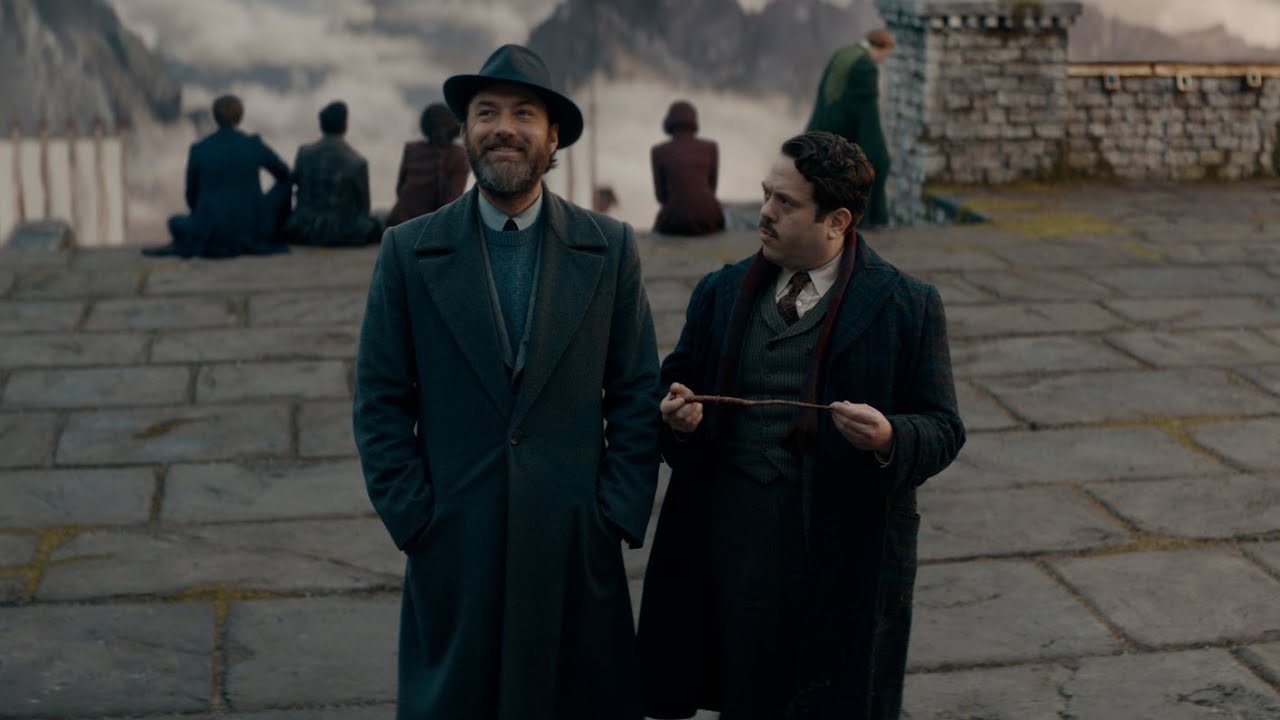
Jude Law and Dan Fogler in Fantastic Beasts: The Secrets of Dumbledore.

The third chapter of the Fantastic Beasts series, The Secrets of Dumbledore, begins with an exquisite piece of fairy-tale storytelling.  In the forests of China, Newt Scamander (Eddie Redmayne) – the English magizooogist (i.e., scholar of and caretaker for magical creatures) at the center of the narrative, set in the 1920s – oversees the birthing of a calf by a rare equine animal known as a Qilin, pronounced Chillin. The mother has a woven golden mane and a face like a mask; her tender calf is skeletal, a golden glow pulsating through his fragile skin. When the minions of the series’ villain, Gellert Grindelwald, attack, felling the mother, Newt struggles to save the baby Qilin, but he fails. He has to watch, helpless, as the calf is kidnaped and the mother expires, a single tear rolling down her cheek. It’s only then that Newt sees what everyone has missed in the chaos:  that she actually gave birth to twins.

Sunday, June 19, 2022

White Knight: The Batman

Zoë Kravitz as Catwoman and Robert Pattinson as Batman in The Batman. (Photo: Jonathan Olley/Warner Bros.)

In his 1957 architectonic study Anatomy of Criticism, structuralist Northrop Frye sketches a taxonomy of literary heroes. Those of the Mythic mode, he argues, are gods: they’re superior in kind to other characters and to their environment. They defy the laws of nature and possess divine gifts. Examples include Zeus, Bacchus, and Shiva. In a tragic narrative, they die. In a comic one, they rejoin the heavenly realm. (The Christian narrative is neither tragic, nor comic, but ironic: Christ is crucified, yet raised to the Father on the third day.)

The heroes of the Romantic mode are superior to others and their environment only by degree. Their actions are marvelous, but they themselves are human beings. In tragedy, their deaths are elegiac and tied to the decay of the created order (think Beowulf). In comedy, they ride off into a pastoral setting (e.g., the cowboy in a Western).

Following this schema, contemporary superheroes dwell in a gray area between the Mythic and Romantic modes. Some, like Superman, are gods – different from us in kind. Others, like the X-Men, are mortals but possess mutations that give them supernatural powers. And still more, like Iron Man, don’t have genetic enhancements so much as advanced technology, making them more Romantic than Mythic.

Friday, March 25, 2022

Aiming High: The National Ballet of Canada’s Mixed Program

Jillian Vanstone and Harrison James in After the Rain. (Photo: Karolina Kuras, courtesy of The National Ballet of Canada)

A departure, a beginning, a wobble, a blast from the past. The ebb and flow of life united four works seen on the mixed program that the National Ballet of Canada presented at Toronto’s Four Seasons Centre for the Performing Arts last week. Amid two world premieres – one each by company principal dancer Siphe November and guest choreographer Alysa Pires – was the company debut of Christopher Wheeldon’s After the Rain, and a reprise of Kenneth MacMillan’s Elite Syncopations as the evening’s frolicsome conclusion. But one at a time.

Monday, March 14, 2022

New from Criterion: Love Affair (1939)

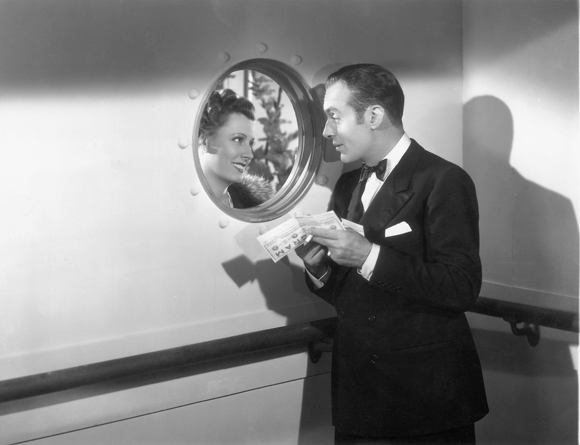
Irene Dunne and Charles Boyer's shipboard first meeting in Love Affair (1939).

The filmmaker Leo McCarey has been largely forgotten, but his Hollywood career spanned four decades and bridged the silent and talkie eras. Like Frank Capra, he received his training in silent comedy: he directed more than seventy-five shorts, and he was responsible for the collaboration of Stan Laurel and Oliver Hardy. When movies began to speak, he put his expertise at working fast and off the cuff to great effect – he directed the most brilliant of the Marx Brothers’ early Dadaist masterpieces, Duck Soup (1933), as well as helming pictures that starred W.C. Fields, Mae West and Eddie Cantor. His thirties output included two memorable comedies, Ruggles of Red Gap (with Charles Laughton as an English butler in the Wild West) and The Awful Truth, where Cary Grant strives to win back his ex-wife,  played by Irene Dunne. It also includes the romantic melodrama Love Affair, starring Dunne and Charles Boyer, which Criterion has just put out in a glistening print restored from sources in the Museum of Modern Art collection.

Wednesday, November 17, 2021

Cracked Mirrors, Part Two: The Minstrel’s Dilemma

Don van Vliet, aka Captain Beefheart. (Photo: Andy Freeberg)

Part One of Cracked Mirrors was published on this site on October 27, 2021.

There should be a kind of periodic table for singer-songwriters, the way there is one for the elements and their interactive relationships. Maybe there is one, and we just haven’t noticed what it looks like. Does the table of their relative values and sonic weights as elements resemble the Grammy Awards? No, it couldn’t be, otherwise Don van Vliet would have won a Grammy years ago for his wonderful portrayal of Captain Beefheart before retiring to return to his first love of painting. If so, he would be Helium.
 

Friday, September 10, 2021

Stabbed in the Heart: The Twilight Saga (2008-2012)

Robert Pattinson and Kristen Stewart in Twilight (2008).

I confess: I too used to shit freely on Twilight (2008). What started changing my mind is the excellent work of its two leads, Kristen Stewart and Robert Pattinson, in their work after Twilight, though never again together after their breakup. This, and not my internalized misogyny against media embraced by teenage girls, is the angle from which I have approached these films, based on the four novels by Stephenie Meyer. And they're fascinating.

Wednesday, October 21, 2020

Cinema Comes of Age: Two Books on the Early and Late Stages


“Filmmaking is more athletics than art and filmmaking comes from the thighs.” – Werner Herzog, 2011.

Yes, this is an art review, even though it’s about cinema, because although movies are magic, as Van Dyke Parks once sang, they are also the premier art form of the twentieth century. As a visual art critic, I often hasten to point out that from my perspective visual art, and the history of art writ large, must perforce contain not only the aesthetic by-products of the French invention of photography in about 1840 but also the captivating artifacts resulting from the invention of cinema roughly fifty years later. Joseph Niepce, and then later on the Lumière Brothers, who jointly ushered in a seismic shift in the radical creation and revolutionary distribution of images, were visionary frontiersmen inaugurating the dreamlike epoch of the work of art in the age of mechanical reproduction.

Was it science, fashion novelty, documentary evidence, or artistic medium? Well, it was all of the above. The still camera and the movie camera are now of course considered among the most modern of all modernist devices, but in those early heady days it was unclear how to situate the new technology, what to call it or how to judge its artistic merits. Such questions have naturally fallen far by the wayside in the wake of remarkable photographic artists such as Stieglitz, Evans, Frank, Arbus, Callahan, and Winogrand (to name only a few) as well as the breathtakingly beautiful motion pictures of Keaton, Bresson, Fellini, Kurosawa, Godard, Tarkovsky and Herzog (to mention some of my own personal favourites). 

Monday, August 10, 2020

Harry Clarke: Breaking the Ice

Barrington Stage Company artistic director Julianne Boyd (left) with Mark H. Dold during rehearsal for Harry Clarke. (Courtesy Barrington Stage Company)

The mood at the Barrington Stage Company production of the solo performance Harry Clarke, which I saw over the weekend, was cautiously jubilant. As the ad campaign reminds us, this is the first live production in the United States since March, performed under a tent down the street from BSC’s home space in Pittsfield to a restricted, socially distanced audience that was ushered in slowly, temperatures taken at the door. The only unmasked people in the arena were on the stage: the artistic director, Julianne Boyd (who also directed the play), when she introduced the show with a speech – expected but not unwelcome – about the need for art in challenging times and reported that the company had put up the tent during the hurricane, and the actor, Mark H. Dold. I won’t underestimate how great it felt to be seeing live theatre again, whatever the special conditions may be under which it must be purveyed.

Monday, December 2, 2019

Blacks and Whites: Slave Play, Hansard, and Michael J. Pollard

James Cusati-Moyer and Ato Blankson-Wood in Slave Play. (Photo: Matthew Murphy)

This review contains spoilers for Slave Play.
 
Slave Play, written by Jeremy O. Harris and directed for Broadway by Robert O’Hara (who also staged the professional premiere at the New York Theatre Workshop last season), begins with three broadly satirical vignettes about interracial couples copulating on pre-Civil War southern plantations: a white overseer with a black female slave, a black male slave with the white mistress of the house, and a black foreman with an indentured white male servant. The style is familiar, especially to anyone who lived through the downtown theatre of the sixties and seventies; only the gay content of the last sketch and the racial reversal, as well as a few outré details (like the huge black dildo the white woman useson the black buck and the fact that he serenades her with his violin after coition), seem fresh. But then two contemporary characters appear above the stage to halt the proceedings for a Brechtian effect and we wonder if we might be watching a rehearsal. They turn out to be not stage managers, however, but therapists, Teá (Chalia La Tour) and Patricia (Irene Sofia Lucio), another interracial couple who are running a program called Antebellum Sexual Performance Therapy – which, they assure their clients, has had tremendous benefits for their own relationship. Each of the pairs we have just seen performing in the sketches is a couple that has enrolled in the group because the black partner has been unable to respond sexually for some time. The idea of Antebellum Sexual Performance Therapy is that the source of the problem – the reason these African Americans have closed down – is that any sexual connection with a white lover invariably evokes the legacy of slavery and these farcical re-enactments are intended to break through the block. The reason the two therapists stop the exercise is that it turns out to be so startlingly effective with Gary (Ato Blankson-Wood) that he has an orgasm and then dissolves in tears, while his partner, Dustin (James Cusati-Moyer), not only is caught off guard but feels superfluous, even though he knows he’s supposed to be happy for Gary. The subsequent group discussion gives rise to turbulent emotions for all six of the participants.

Wednesday, August 14, 2019

Art and the Limits of Morality: The Night Porter (1974)

Charlotte Rampling and Dirk Bogarde in The Night Porter (1974).

Liliana Cavani's The Night Porter (Il portiere di note, 1974) is probably the most twisted film I've seen in my twenty-eight years of life on Earth. Not, it should be said, because of the sexual kinkiness, or even the portrayal of a twisted psyche, but because of what it threatens to do with the viewer’s identification with the protagonist. From an artistic perspective, it's a pity the film doesn't follow through.

Thursday, June 13, 2019

L'art pour l'humanité: A Bread Factory, Parts I and II (2018)

George Young, Trevor St. John, and Janet Hsieh in A Bread Factory, Part One (2018)

The question of the power of art is an ancient one. Confucius said, “If you do not study the Songs, you will be at a loss as to what to say.” And Plato had such a powerful view of the performing arts that he banned all poet-singers from his ideal Republic for fear their work would override people’s reason. But under the utilitarian logic of our contemporary neoliberal society, the question “What does art do?” has been reduced to a mere shadow of its storied history: “What can art do?” Writer-director Patrick Wang’s A Bread Factory (2018), four hours split right down the middle into two parts, ambitiously attempts to answer this question, not intellectually with auteur-surrogate characters spouting exposition, but performatively and cinematically, juxtaposing the contrast between bean-counting life and expansive humanist living in almost every one of his vignette-like scenes. Most audacious of all, the film doesn’t rest on its Manichean haunches; instead, it humanizes even the supposed antagonists, offering us the formal victory of art in the face of its thematic defeat.

Friday, April 26, 2019

Dialectics False and True: Captive State and A. I. Rising

John Goodman and Ashton Sanders in Captive State (2019).

Look, some films are just garbage; that’s just a fact. But sometimes when you go dumpster diving you find something that, when looked at from just the right angle, isn’t so much garbage after all.

Captive State (2019) is ambitious and has no lack of “the vision thing.” Writers Rupert Wyatt (who directed) and Erica Beeney attempt to portray a Chicago succumbed to alien colonization by telling the story of Gabriel (Ashton Sanders) and the morally murky father figure he doesn’t want at all, collaborationist Detective William Mulligan (John Goodman), embedding them within a larger plot about an insurgent cell bent on hitting the aliens where it hurts. But – here’s the thing – the audience identification is whipped around from Gabriel, who’s the actual non-collaborationist here, to Mulligan, who’s the hinge of both plots, and back, once Mulligan starts to shake down Gabriel’s apartment building to look for him.

Thursday, March 28, 2019

Breaking Down Conceptual Binaries: Maborosi (1995)

Makiko Esumi in Hirokazu Kore-eda's Maborosi (Maboroshi no Hikari / 幻の光, 1995).

Grief is a many-faceted thing. I’ve often felt that mainstream portrayals treat it like an illness to be gotten over, rather than what it really is: a new state of being. It becomes an indelible part of one’s life, not necessarily a bad thing or a good thing, just another thing. (The explosion of the good/bad experience binary is one of the groundbreaking aspects of Inside Out [2015].) This is one of my biggest issues with First Man (2018) and, in retrospect, Manchester by the Sea (2016). Maborosi (Maboroshi no Hikari / 幻の光, 1995), the Ozu-tinged fiction feature debut of current art-house darling Hirokazu Kore-eda, is a detailed and deeply empathetic portrayal of one woman carried along by the passage of time, bringing her grief with her.

Wednesday, February 27, 2019

Sound and Fury, Signifying Nothing: Harry Potter and the Cursed Child (Parts 1 & 2)

Noma Dumezweni, Jamie Parker, and Paul Thornley in Harry Potter and the Cursed Child. (Photo: Manuel Harlan)

I grew up reading Harry Potter. I can still remember the seismic event that was each new book release. When I demonstrated textual analysis to my students, it was my go-to source text for impromptu examples. So imagine how utterly disappointed I was when reading the text of Harry Potter and the Cursed Child and realizing that it is, in fact, bad: sentimental, blunt, and (ironically) unrealistic. And diehard Potterheads hate it for breaking with canon at seemingly every turn. I asked a friend who had seen the show in London whether it fares better on stage, and (there was still hope!) she said it does.

Having finally seen it on Broadway, I can say with certainty that the story is still bad, even though the jokes land better. And yet, I still recommend it, because its presentation of magic is a capital “s” Spectacle.