Showing posts sorted by date for query Christian Bale. Sort by relevance Show all posts

Monday, January 15, 2024

Year-End Movies III: The Boy and the Heron and The Boys in the Boat

The heron in Hayao Miyazaki's The Boy and the Heron.

One of the cinematic high points of 2023 was surely the great Japanese animator Hayao Miyazaki’s return from retirement with The Boy and the Heron. (His last feature was The Wind Rises in 2013, though imdb.com lists a 2018 short, unknown to me, called Boro the Caterpillar.) Conceived and written by Miyazaki, The Boy and the Heron is a gorgeous fairy tale set, like The Wind Rises, during the Second World War. The young hero, Mahito (voiced in the dubbed version by Luca Padovan), loses his mother during the bombing of Tokyo; a year later his father, Shoichi (Christian Bale), moves them into the countryside, where he has opened a new factory. He is now romantically involved with Natsuko (Gemma Chan), who is carrying his child. This will be Mahito’s new home, but it’s alienating to him. Aside from the sudden news that a woman he has never met before, whom he addresses politely as “ma’am,” is about to become his new stepmother, there’s little actual education going on in his new school. The children spend more time working the land for the war effort than in the classroom, and as soon as he arrives he’s bullied by his classmates; his response is to bash himself in the head with a rock, claiming a fall, so he doesn’t have to go back the next day. Yet in unexpected ways this unfamiliar environment links up with the boy’s identity. Natsuko, it turns out, is his aunt and looks eerily like her, and this is the place where the two sisters grew up; the strange, Medieval tower that is the most striking landmark was created by their great-uncle. And a talking grey heron (Robert Pattinson) who gloms onto Mahito insists that he’s an emissary sent to take him to his mother, who isn’t dead at all. The boy’s adventures begin when Natsuko, whom he has seen, from his bedroom window, entering the woods, vanishes, and his quest, at the heron’s invitation, to find his mother becomes, in the mysterious transformative manner of a dream, a search for Natsuko. It takes him into the tower and out again into an island world where pelicans and parakeets are omnivorous creatures the size of human adults (the main pelican is voiced by Willem Dafoe, the main parakeet by Dan Stevens) and where the bent-backed, protective domestics from Mahito’s world are echoed by small wooden dolls that reside on shelves and around beds and operate as totems.

Monday, January 23, 2023

In Passing

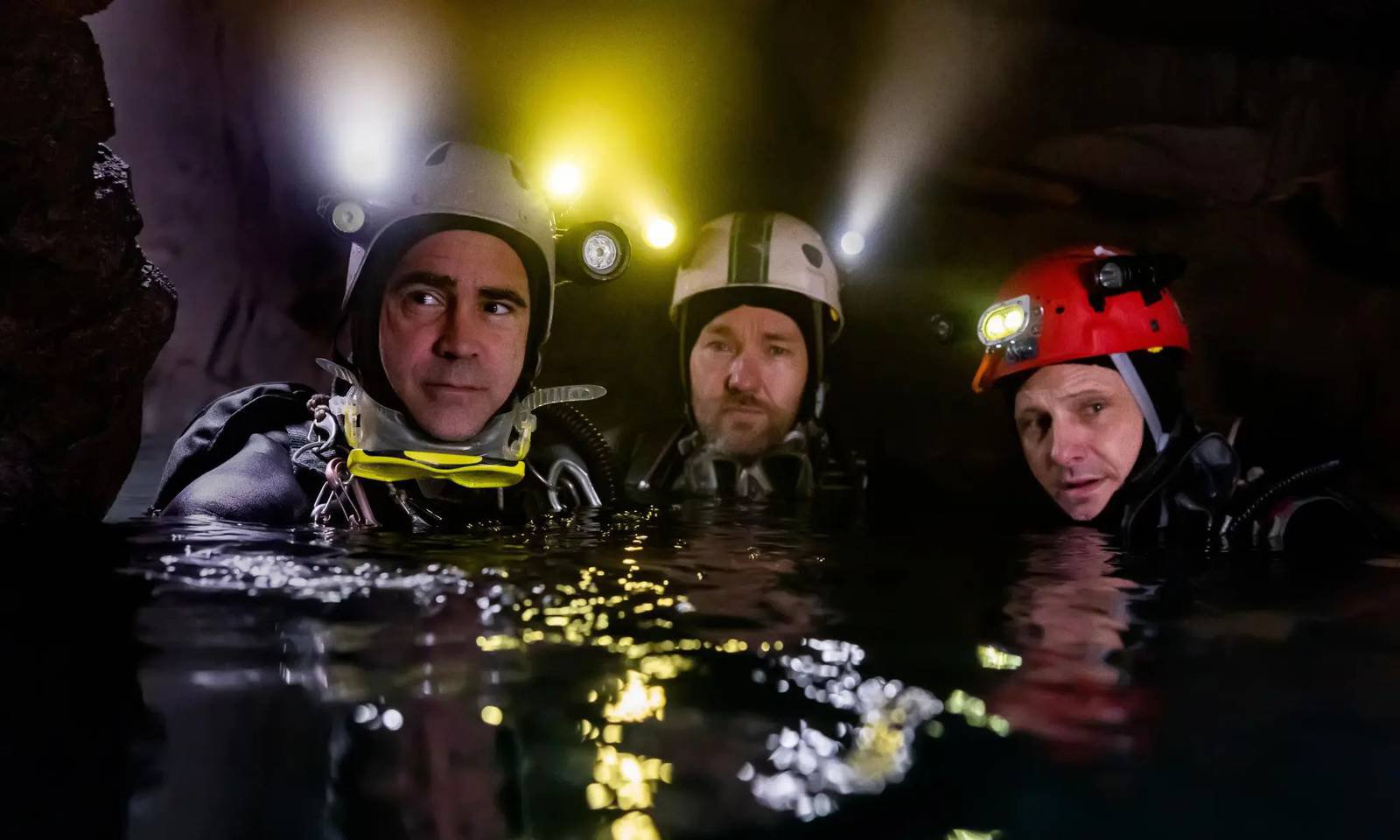
Colin Farrell, Joel Edgerton and Viggo Mortensen in Thirteen Lives.

This piece includes reviews of Thirteen Lives,The Good Nurse,Glass Onion: A Knives Out Mystery and The Pale Blue Eye.

At the outset of Thirteen Lives, Ron Howard’s dramatization of the 2018 Tham Luang Cave rescue in northern Thailand, we see the twelve pre-teen and teenage football players and their coach enter the cave and then the monsoon begin to batter it. But then Howard and the screenwriter, William Nicholson, make an unconventional choice: they don’t show us the trapped souls again until, about halfway through the picture, the British divers, Rick Stanton (Viggo Mortensen) and John Volanthen (Colin Farrell), come upon them near the mouth of the cave twelve days into the ordeal, when many participating in the story or following it on the news fear they must be dead. Naturally the filmmakers understand that presenting the facts of the narrative from the point of view of those outside the cave is dramatically effective, but I think there’s an ethical dimension to their showing us what Stanton and Volanthen discover as they discover it. Howard and Nicholson strive to avoid melodrama; they don’t want to rev up the audience by cutting back and forth between the deprivations the footballers are suffering and the efforts of the crew – a wide, disparate combination of divers, Thai Navy SEALS and other military, police officers, volunteers of every stripe and the representatives of about a hundred government agencies – to track them down. They are resolute about draining Thirteen Lives of sentimentality; I wouldn’t say there’s none at all, but given the nature of the material there’s remarkably little. It’s a film of great integrity as well as tremendous skill. And the subject matter is so gripping that you’re grateful for the foreknowledge that the coach and all the kids got out alive. (One of the SEALS, Saman Kunan, played by a charismatic young actor named Sukollowat Kanarat, did not survive the operation, and another died a year and a half later of a blood infection he contracted during it.) 

Sunday, June 19, 2022

White Knight: The Batman

Zoë Kravitz as Catwoman and Robert Pattinson as Batman in The Batman. (Photo: Jonathan Olley/Warner Bros.)

In his 1957 architectonic study Anatomy of Criticism, structuralist Northrop Frye sketches a taxonomy of literary heroes. Those of the Mythic mode, he argues, are gods: they’re superior in kind to other characters and to their environment. They defy the laws of nature and possess divine gifts. Examples include Zeus, Bacchus, and Shiva. In a tragic narrative, they die. In a comic one, they rejoin the heavenly realm. (The Christian narrative is neither tragic, nor comic, but ironic: Christ is crucified, yet raised to the Father on the third day.)

The heroes of the Romantic mode are superior to others and their environment only by degree. Their actions are marvelous, but they themselves are human beings. In tragedy, their deaths are elegiac and tied to the decay of the created order (think Beowulf). In comedy, they ride off into a pastoral setting (e.g., the cowboy in a Western).

Following this schema, contemporary superheroes dwell in a gray area between the Mythic and Romantic modes. Some, like Superman, are gods – different from us in kind. Others, like the X-Men, are mortals but possess mutations that give them supernatural powers. And still more, like Iron Man, don’t have genetic enhancements so much as advanced technology, making them more Romantic than Mythic.

Monday, January 17, 2022

Belfast: Memories of an Irish Childhood

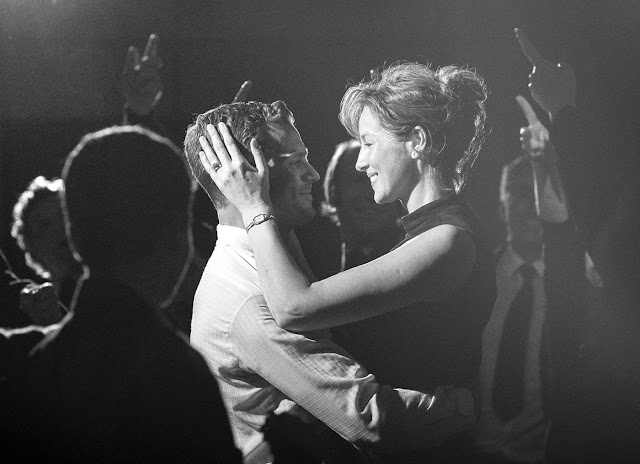
Jamie Dornan and Caitriona Balfe in Belfast.

Watching the black-and-white trailers for Belfast, Kenneth Branagh’s fictionalized memoir of growing up Protestant in the titular city at the peak of the Irish Troubles (the film begins in the summer of 1969), I feared that he’d been caught in the trap of turning his childhood into self-conscious neo-realism, like Alfonso Cuarón in the strenuously overrated Roma. I needn’t have worried. Haris Zambarloukos’s cinematography opens in almost hallucinatory color that reveals Belfast in all its complexity, modernist and glittering as well as enshrining gorgeous old buildings. And when the color morphs into black and white, it’s the bustling, lived-in black and white of the Parma Bertolucci and his photographer, Aldo Scavarda, captured in his the 1964 Before the Revolution or, as a friend observed, the black and white of the pictures Tony Richardson made in the late fifties and early sixties out of the great English New Wave dramas Look Back in Anger and The Entertainer (both shot by Oswald Morris) and A Taste of Honey (shot by Walter Lassaly). Belfast isn’t quite up to those movies – or the other movies I thought of while I sat through it, John Boorman’s 1987 Hope and Glory (based on his memories of a childhood in London during the Second World War) and Jim Sheridan’s 2002 In America (a too-little-known magic-realist marvel about a struggling Irish family living illegally in Hell’s Kitchen). But Belfast is plenty good enough. It’s vibrant and vivifying, and I was carried away by it.

Monday, January 6, 2020

Little Women: Temporal Bigotry

Emma Watson, Saoirse Ronan, Florence Pugh, and Eliza Scanlen in Greta Gerwig's Little Women.

Greta Gerwig’s Little Women is the first movie version in which almost none of the charm and poignancy of the beloved Louisa May Alcott novel, published in 1868 and 1869, comes through. Not counting the lost silents – there were two, in 1917 and 1918, one in England and one in America – Gerwig’s is the fourth major adaptation for the big screen. George Cukor’s 1933 film, with its picture-postcard visuals, came out from RKO, though it's in the mold of MGM’s vellum-bound, studio-set approach to the Victorian classics. It’s beautifully adapted (by Sarah Y. Mason and Victor Heerman, though imdb.com lists nine other uncredited contributors, including Charles Brackett) and meticulously detailed, with an A-list cast that features Spring Byington as Marmee, Joan Bennett as Beth, the stunning beauty Frances Dee as Meg and Douglass Montgomery as Laurie. And in Katharine Hepburn’s portrayal of Jo it touches greatness. It was Hepburn’s second year in Hollywood and her fourth picture, and no one has ever been more ideally suited to the role of Alcott’s feisty, ambitious, iconoclastic – and autobiographical – heroine. In the early scenes she overplays Jo’s gawkiness and tomboyishness, but she seems to find her stride as her character does, her grandiose romantic flourishes taking on the shape of Jo’s discovery of the world and her place within it. Hepburn shows us how Jo grows up, and I can’t be the only viewer who has never forgotten the moment when her Jo, after rejecting Laurie’s marriage proposal, confesses to Marmee in an anguished moan, “I feel as if I’d stabbed my best friend in the heart!”

Thursday, May 24, 2018

Neglected Gem: Metroland (1997)

Christian Bale and Emily Watson in Metroland. (Photo: IMDB)

Philip Savile, who died in 2016, was one of those journeymen British directors who nevertheless helmed some interesting, original projects in his career. Those included Shadey (1985), a quirky, off-kilter spy story; the poignant gay coming-of-age thriller The Fruit Machine (1988); and The Cloning of Joanna May (1989), a striking TV adaption of Fay Weldon’s inventive science-fiction novel. But perhaps his most impressive achievement was Metroland, his finely directed, acute adaptation of Julian Barnes’s novel about two best friends who come a cropper over their differing goals in life. Metroland is one of those modestly laid-out, underplayed dramas that too often go missing in action when it comes to filmgoers’ preferences. It’s also a necessary reminder that actor Christian Bale, who is the main focus of the movie, can play human-sized, recognizable protagonists rather than just over-the-top roles like his morose Batman in Christopher Nolan’s heavy-handed The Dark Knight trilogy or pull off gimmicks like losing all that weight for unduly heightened and singularly uninteresting "reality" films such as The Machinist and The Fighter.

Metroland is what the London suburb of Eastwood has been nicknamed by those who say they would never consider living there. It’s also the place where Chris (Bale) grew up and swore he’d never return to again. Now as an adult, circa 1977, he lives there with his wife Marion (Emily Watson) and their baby girl, and instead of having become a freelance photographer, as he dreamed of doing, he works in an advertising agency. Yet he doesn’t consciously question his life path or career decisions. But when his childhood buddy, Toni (Lee Ross), who's still carefree, pops up after a few years abroad, Chris is suddenly asking that age-old question: is that all there is?

Thursday, April 14, 2016

Reanimating a Beloved Corpse: Burr Steers’ Pride and Prejudice and Zombies

Lily James as Miss Elizabeth Bennet in Pride and Prejudice and Zombies.

There are so many times in my life where I wish I had a time machine. It would have a vast array of applications, both big and small, from correcting gaffs in my own life (looking at you, English degree) to visiting some of history’s greatest moments. Today, I would like a time machine so I can visit Jane Austen around 1814 and inform her of her looming 2016 screenwriting credit for Burr Steers’ Pride and Prejudice and Zombies. There would be lots of explaining to do:
–  "... so because of this ‘public domain’ idea, in 202 years you're going to be credited as a writer on a zombie movie."
– “Why are they called ‘zombies?”
– “I think it’s a Haitian voodoo thing!”
– “And they eat brains? Why brains?”
– “I… ah… you know, I don’t know, Jane. It’s canon. I’m sure it’s on the Wikipedia page.”
– “Should I have included zombies in the original?”
– “No. Definitely not.”
As a fellow spinster writer, I feel a kind of kinship with Jane Austen. I’d like to think she’d be pleasantly amused by this news – more so, I’m sure, with the assurance that the reviews aren’t great and yet not a single critic faults her for the film’s problems. It’s almost as if she wrote all the good parts of Pride and Prejudice and Zombies’s screenplay and somehow we all know it.

Saturday, October 10, 2015

Black Mass: Not Enough Color

Johnny Depp as James “Whitey” Bulger, in Black Mass.

As James “Whitey” Bulger in Black Mass, Johnny Depp levels a cobra’s hooded gaze at his enemies and at those he suspects might become his enemies. That isn’t much of a distinction, and it doesn’t take much to cross it. Depp gives a thoughtful, intelligent performance as a charismatic sociopath, and in some scenes he’s very frightening. But he needs more colors, and I don’t think that’s his fault but the fault of the screenplay, which Mark Mallouk and Jez Butterworth culled from Dick Lehr and Gerard O’Neill’s book Whitey: The Life of America’s Most Notorious Mob Boss. I haven’t read the source material, but Depp is obviously faithful to the Bulger you saw in the news every day during his 2013 trial and who emerges in last year’s riveting documentary Whitey: United States of America v. James J. Bulger. The prosthetics have transformed Depp’s face so that he looks eerily like Bulger, but this kind of real-person camouflage, impressive as it is, always misses the point. (God knows it did when Steve Carell was buried under his make-up in Foxcatcher: the combination of Carell’s vocal tics and that artificial face, constructed to replicate that of a true-life lunatic most people couldn’t identify anyway, made him look and sound like an automaton.) Black Mass, which was directed by Scott Cooper, is a prestige project, carefully assembled and made with obvious integrity. But it would be a more satisfying movie if Depp were slyer, more ironic – if he loosened up and had more fun with the part. You don’t want Jack Nicholson’s Bulger-inspired turn in The Departed, whose behavior was so clownish and preposterous that you couldn’t believe his gang didn’t just stage an insurrection and take him out, but you do need to get more of a sense of the character’s charm and of an outrageousness that isn’t just linked to a pathological taste for violence.

Thursday, May 14, 2015

Neglected Gem #75: A Midsummer Night's Dream (1999)

Stanley Tucci and Rupert Everett in A Midsummer Night's Dream (1999).

I’ve seen so many productions – professional and amateur – of A Midsummer Night’s Dream that, much as I love the play, for some time I’ve been fairly sure I could live my life happily without seeing another. But Michael Hoffman’s 1999 film of it is so fresh and so supremely acted that my first impulse on leaving the theatre was a desire to come back again with other friends to show it off to them. Hoffman has turned Shakespeare’s Athens (which doesn’t even try to pass for ancient Greece) into turn-of-the-century Italy (“Monte Athena”). That turns out to be an inspired choice, right from the opening sequence where the feast is being prepared for the wedding of the duke, Theseus (David Strathairn), and his bride, the stranger queen Hippolyta (Sophie Marceau, whose French accent makes a suitable division from Strathairn’s American-ness). Italians would, of course, of course, focus on the sensuality of the food; the glimpses we get of the duke’s kitchen are lush. Those aren’t the very first images. As we hear the famous Mendelssohn music drift in, we see the fairies –beams of light dancing over a violet dawn that turn into butterflies as the morning light takes over the sky. There’s a tendency (unfortunate, I think) in modern productions of Midsummer to de-emphasize the ethereal quality of the supernatural elements and make them not only carnal – which they certainly are – but earthy, even brutal. Some of the directors who have gone in that direction may have taken their cue from Jan Kott’s essay “Titania and the Ass’s Head” in Shakespeare Our Contemporary. But it would be a waste to put the play on screen and ignore the resources that enable filmmakers to make the kind of magic you can’t conjure on the stage.

Monday, March 2, 2015

The Last Five Years: Two-Handed Musical

Jeremy Jordan and Anna Kendrick stars in The Last Five Years.

What could have been in writer-director Richard LaGravenese’s head when he came up with the cockeyed idea of adapting Jason Robert Brown’s through-sung two-character musical The Last Five Years to the screen? Did he believe that the two characters, Jamie (played in the film by Jeremy Jordan) and Cathy (Anna Kendrick), whose five-year relationship disintegrates in the opening minutes, were so compelling that an audience would ignore the inescapable staginess of the conceit? (They’re not.) Did he imagine that the baffling flashback/flash-forward structure would be somehow elucidated by editing? (It isn’t.)

Thursday, January 29, 2015

Attack of the Cyber Mann: Blackhat

Chris Hemsworth and Wei Tang in Blackhat.

Michael Mann’s new action thriller Blackhat is set in the up-to-the-minute world of  international cybercrime, with a hero (Chris Hemsworth) who’s a computer hacker pitted against an apolitical cyber-terrorist who engineers cataclysms, such as a near-meltdown at a nuclear power planet, in order to cash in on them. The term “blackhat” refers to this villain (played by the Dutch actor Yorick van Wageningen), but the character doesn’t have the stature to justify his being the film’s title character; he’s nameless and, for most of the movie, faceless. (We only get a good look at him as the movie is heading into its violent climactic set piece, so we’ll know which of the people on screen the hero is going to try to kill last.) Maybe his speeches about not knowing where, or even who, he is are meant to make his character seem computer-age, but he just comes across as seedy and dazed. Probably Mann just thought the title sounded cool. 

Thursday, December 25, 2014

Biblical Bore – Exodus: Gods and Kings

Christian Bale as Moses in Ridley Scott's Exodus: Gods and Kings

Director Ridley Scott’s latest epic, Exodus: Gods and Kings, makes Moses the second biblical patriarch to have his story butchered by Hollywood this year. The first, of course, was Noah in Darren Aronofsky’s deluded treatment last spring. Scott’s film doesn’t punish its audience with caustic melodrama the way the second half of Noah did. He’s a better craftsman than Aronofsky, and his visual palette more sensible – the movie’s landscape has the craggy wildness you associate with the Old Testament universe. But it matches its predecessor for clouding the meaning of the central narrative themes and injecting bizarre, half-baked spirituality into them. The result is a rare feat: a movie that’s at once both bloated and a fiasco.

Wednesday, September 3, 2014

La Dolce Vita: The Trip to Italy


Movies like Michael Winterbottom’s The Trip (2010) elude the reductive marketing categories of studio advertising. The trailer pitched the film as a buddy flick and a road movie, which was certainly true. But those qualities, and the loose-limbed improvisational humor from Steve Coogan and Rob Brydon, belied its directorial craftsmanship and thematic depth. Winterbottom put on this front intentionally, letting the easy pleasures of the comic structure seduce you into the serious philosophical question at play: Namely, what makes for the good life? Coogan and Brydon traipse around the countryside of northern England, taking in coldly beautiful vistas, fine French cuisine, and precious fraternal companionship. Yet only one of them, Mr. Brydon, actually enjoys the manifold pleasures surrounding them. Mr. Coogan can’t get out of his own egotism. He stumbles through the excursion in haze of pot, career ambitions, empty one-night stands, and narcissistic self-pity. Everything’s a competition with him, even their leisurely impersonations of Michael Caine and James Bond, and you winch at how he squanders relationships – including that with his good friend. For a moment, standing on a cliff of prehistoric rock formations, he steps outside himself and beholds the scene’s grandeur with wonder. But it’s short-lived and he quickly snaps back into his unhappy prison. Winterbottom contrasts him with Brydon’s simpleminded joviality and stable family life, and the picture ends with the question it secretly begins with: Why are some people blissfully content and others impossible to satisfy?

But if the studio execs didn’t know what to make of this character study last time, they’ve got a second chance with the release of The Trip to Italy, Winterbottom’s follow-up (both began as BBC series before morphing into feature films). And he’s made it easier for them, requiring less critical thinking and more pleasurable imbibing. The director and his two actors cut right to the chase (or the road as it were) repeating the premise of the first installment: The pair are to review a series of meals they share on holiday, this time in Italy. In a flash, they’re cruising Piedmont mountain roads in a Mini Cooper and dining on the culinary delights of the Cinque Terre. The ribald banter is back, even more uproarious than before: Coogan and Brydon mind meld into a withering parody of The Dark Knight Rises, the latter yelling inaudibly into his mouth in mockery of Bain before switching to an absurdly hoarse Christian Bale. Coogan matches and even exceeds him later in Capri with an impossibly dead-on imitation of Brando’s Don Corleone. But his is done in reverence; their skewering of Christopher Nolan is mercilessly accurate. Winterbottom also quickly dispatches the question of what a second movie, using the same structure as its predecessor, could have left to say. The boys take jabs at bands who succumb to “second-album syndrome,” after a successful debut; the self-awareness here disarms you with ease.

Tuesday, April 22, 2014

Songs We Continue to Sing: Rob Ford and the Culture of Corruption

The night Rob Ford was elected Mayor of Toronto, almost four years ago, he had just won a bitterly fought battle to lead the city, and he did it by marshalling and manipulating a populist rage towards city government. Ford had warned us of a "gravy train" of bureaucratic waste depriving us of our hard-earned taxed dollars. While he positioned himself as city saviour, he also began targeting those he described as 'liberal elites,' a pampered, educated and entitled bunch, whom he saw as the true enemy of the hard-working individual. If Margaret Thatcher had once casually dismissed the notion that society actually existed, Ford went a step further. He talked about the city of Toronto only in terms of the taxpayer rather than in terms of its citizens. Since we all pay taxes – even when we're homeless and buy a cup of coffee – taxpayer was merely a code word for property owner. To Ford, Toronto wasn't a diverse and multiculturally vibrant urban community, made up of those who are privileged and those who aren't; it was instead a dysfunctional corporation he was about to restore to efficiency. His message to the city, where he alone could determine those he'd serve and those he wouldn't, was communicated with obscene clarity on the day of his coronation. CBC Television broadcaster and former NHL coach Don Cherry had arrived in his flamingo pink suit to drape the chain of office around Ford's neck. It was Cherry who helped set the new tone for the city in his opening remarks. "Well, actually I'm wearing pinko for all the pinkos out there that ride bicycles and everything," Cherry began with cheers from the crowd in the upper rotunda while city counsellors sat in shock. "I say he's going to be the greatest mayor this city has ever, ever seen, as far as I'm concerned – and put that in your pipe, you left-wing kooks." One thing certain in those tone-setting remarks: contempt was now public policy.

Friday, January 3, 2014

Hair Club: David O. Russell’s American Hustle

Amy Adams and Christian Bale in American Hustle

The very title of David O. Russell’s American Hustle (from a script credited to the director and Eric Warren Singer) announces a level of ambition that’s been missing from Russell’s movies since his out-of-control 2004 satire I Heart Huckabees. Loosely inspired by the Abscam investigations of the late 1970s, in which FBI agents worked with con men (including a bogus Arab sheik) to ensnare crooked Congressmen by offering them bribes, the new movie has some of the broad canvass and satirical edge of Russell’s masterpiece, the 1999 Iraq War movie Three Kings. But American Hustle’s driving force – what makes it one of the most entertaining movies of the swaggering awards-bait season – mostly come down to Russell’s skill with the actors and his enjoyment of putting them together and watching them cook, which is what made his comeback pictures The Fighter and Silver Linings Playbook stand out. (It was also the best thing about I Heart Huckabees.)

Most of the principal players appeared in one of Russell’s two previous movies, and the performances have the confidence and experimental looseness of actors letting themselves go under the watchful eye of someone they’ve come to trust. Usually, that would be the set-up to describe how some actor has plumbed his inner depths and gone deeper into himself than he’d ever gone before, but Christian Bale – who starved himself for both The Machinist and Rescue Dawn and practiced his glower in Christopher Nolan’s Batman films, before winning an Oscar for his role as a junkie in The Fighter – has been needing to lighten up for a while, and Russell has gently managed to lead him out of the strobe-lit Method torture chamber inside his head and goad him into having fun onscreen again.

Thursday, December 5, 2013

Hard to Kill: Dallas Buyers' Club


Dallas Buyers’ Club, based-on-a-true-story directed by Jean-Marc Vallee from a screenplay by Craig Borten and Melisa Wallack, has a few big things going for it, right from the start. For one thing, it’s based on a true story that hasn’t already been well-aired on TV and in magazines. The principal published source of information about its hero—Ron Woodroof (Matthew McConaughey), a Texas good ol’ boy and sometime drug dealer, with a rowdy, low-rent social life (and the homophobia that goes with the good ol’ boy territory who contracted HIV in 1985)—is an article that appeared in the Dallas Morning News in 1992, the same year Woodroof died. (The doctor who diagnoses his condition tells him that he has thirty days to get his affairs in order.) The screenwriters actually did some reporting of their own flesh out Woodroof’s story, and this gives the movie some of the fresh-ink feel of investigative journalism.

When Woodroof gets the bad news, he sinks into drugs and drink, though getting sunk there was already a big part of his usual routine. Then he shakes it off and starts buying AZT, which is being used in clinical trials, from a hospital orderly who sneaks it to him on the sly. When the orderly cuts him off, he lights out for Mexico, where he wakes up in a Third World hellhole presided over by an unlicensed American expatriate (Griffin Dunne), who tells him that the AZT helped trigger full-blown AIDS by shutting down his immunity system. Dunne plies him with vitamins and drugs that aren’t legally available in the States, and Woodroof returns to Texas transformed into a man with a mission. He doesn’t shed his homophobia overnight. (A split-second flashback to Woodroof banging a woman with track marks on her arms—the moment, he realizes, that he contracted the disease—seems meant just to take the possibility that he’s a closet case who’s had a secret life on the down-low off the table.)

Thursday, November 7, 2013

Lonely Outcasts: The Death of Lou Reed and Velvet Goldmine


The news that Lou Reed had died sent me back to his records – to his work with the Velvet Underground, which redefined the subject matter and artistic possibilities of rock music, and to personal favorites among his solo albums, from Berlin to Street Hassle to Ecstasy. But it also sent me back to the most memorable and affecting things written about Reed, especially the grappling that Lester Bangs did with him in the early seventies when Bangs was the marquee star and aesthetic and moral compass of the Detroit-based rock magazine Creem. (For the buoyant details, see Bangs’ posthumously assembled best-of collection, Psychotic Reactions and Carburetor Dung.) Rock criticism was never more many-hued and exciting than in the late sixties and seventies that became Bangs’ heyday; it had the thrill of a field populated by young hotshot writers excited about something that was going through a metamorphosis and that hadn’t yet been written about to death.

Someone like Lou Reed, with his tear-it-down-and-start-again approach to the music and his combination of grand literary ambitions and simple diaristic writing style – what Bangs once referred to “the Lou Reed ‘I walked to the chair/ Then I sat in in’ school of lyrics”– made rock criticism necessary. It’s not just that someone needed to try to make sense of this work, but that someone needed to get the word out about it, and keep it alive until it could be properly discovered; in the case of the Velvets, the traditional ways of making sure that excellent work in popular music, such as the radio, weren’t doing their jobs. Reed, who started out as an in-house songwriter for Pickwick Records, seems to have had, at best, mixed feelings about being written about by people who, as he scornfully put it, were “analyzing rock and roll!”

Tuesday, October 8, 2013

Elmore Leonard: An Appreciation


We are pleased to welcome a new critic, Howard Shrier, to our group.

When Elmore Leonard died in August, shortly after suffering a stroke at age 87, tributes flowed fast and furious in newspapers, on blogs and other media. Some were from writers you would expect to love Leonard (Robert Crais, Michael Connelly); others came from those on whom he would seem to have had little or no influence (Jackie Collins).

I suppose I fall somewhere in between. My crime novels, save for one, have been first-person private eye stories. With the exception of his classic Western, Hombre, Leonard never wrote in the first person. Nor did he ever feature a private eye as a protagonist. My first loves and most direct influences were Ross Macdonald and Raymond Chandler, and, later on, Robert B. Parker, Crais and Dennis Lehane, all of whom featured first-person private eyes who mixed humour and action in a blend I found satisfying and inspiring.

Thursday, August 2, 2012

Bad Faith: The Dark Knight Rises


As fans of superhero pictures (and that’s most of the world, evidently) know, the Batman series divides into three categories. There are the Tim Burtons, Batman (1989) and Batman Returns (1992), with their magnificent, High Romantic Anton Furst designs and Michael Keaton as a brooding, mysterious Bruce Wayne – a portrayal that, in a better world, would have made him an actor to be cherished forever. Burton put a premium on character and let the stories unravel like fairy tales. The Joel Schumacher entries, Batman Forever (1995) and Batman and Robin (1997), were extravagantly (but not wittily) overdesigned; they were like arcades, or gay roller discos, and they underused their stars, Val Kilmer and George Clooney respectively, so that afterwards you couldn't remember anything they’d done.

Then Christopher Nolan took over the franchise in 2005 with Batman Begins, which he also co-wrote with Davis G. Goyer. Nolan brought art-house credentials (Memento, a wildly overrated puzzle picture that didn’t make basic plot sense) and a grim relentlessness that I would have said was precisely the wrong kind of approach for a comic-book adventure. And the concept was misconceived. Bruce (Christian Bale), like the character Michael Keaton played in the Burton pictures, has never been able to move past the pointless deaths of his parents, before his eyes, at the hands of a mugger, but it isn’t grief that motivates this Bruce; it’s guilt. As a boy, Bruce was so terrified of bats as a result of falling down a well on his dad’s estate that, when his parents took him to see the operetta Die Fledermaus (The Bat), the prop bats on stage distressed him and he asked to be taken home early. They encountered the mugger on a deserted street outside the opera house; if Bruce had only been able to control his phobia, his parents might be alive today. So when, years later, returning to a Gotham City overrun with gangsters and all manner of corruption, he chooses to disguise himself as a bat, it’s his way of conquering those childhood fears and doing penance for the fact that his inability to handle them led his parents to their deaths. (The real corruption – or at least stupidity of a monumental order – must have been at Warner Brothers, where this plot premise made it past the pitch stage.) But first there’s a long sequence at a Tibetan monastery, which seems to belong in some other movie altogether, where Wayne is trained in martial arts by mystics (the westerner among them is Ra’s Al Ghul, played by Liam Neeson, whose goatee is more expressive than his performance) who turn out to be the League of Shadows, fanatics with a sort of Sodom and Gomorrah God complex, dedicated to wiping out cities overrun with evil, like Gotham. So Bruce has to defeat them – temporarily, at least – and stage an escape before he can return to battle the more homegrown evil in his own hometown.

Bruce Wayne and his murdered parents in Batman Begins 

The chief villain in Batman Begins, though, is the sinister Dr. Jonathan Crane (Cillian Murphy), who, as The Scarecrow, poisons his victims with a psychotropic aerosol that maddens them and projects their worst fears onto his burlap mask. Perhaps I’m hopelessly old-fashioned, but I consider it a sign of bad faith in a director of a comic-book movie that he thinks nothing of putting his audience through the same misery as the characters entrapped in their cruelest fantasies – like the maggots foisted on a screaming Katie Holmes (as Bruce’s childhood friend Rachel Dawes, now an ADA of impressive moral fiber and courage). By the time Crane had pumped enough aerosol in the streets of Gotham in the climax to send paranoid zombies after Rachel and some unfortunate little boy, I was looking around for something to throw at the screen.

Monday, July 23, 2012

Screen to Stage: Newsies and Dogfight

Jeremy Jordan (centre-top) and company in Newsies (Photo by Deen van Meer)

The latest Broadway hit musical from Disney is Newsies, which transfers the 1992 movie musical to the stage of the Nederlander, and the news is mostly pretty good. Kenny Ortega’s 1992 picture has a juicy plot premise: the 1899 strike of newsboys (“newsies”) peddling The New York Herald, after its publisher, Joseph Pulitzer, opts to elevate his profits by raising the price of the paper – but only to the newsies, not to the paying customers. (The newsies have to buy their papers, or “papes,” outright, and eat the cost of any copies that are left at the end of the day.) The movie has considerable period personality – the story begins in the third week of a trolley workers’ strike and contains a memorable image of a blazing trolley shooting down a Manhattan street – and Ortega and his co-choreographer, Peggy Holmes, picked a fine model, Carol Reed’s 1968 Oliver!, one of the best film musicals ever made. Newsies isn’t at the level of Oliver!, but it’s great fun, with rousing anthems by Alan Mencken (music) and Jack Friedman (lyrics), wonderful high-stepping dances, and tough, nimble-witted newsboys (led by a young Christian Bale, just five years after Empire of the Sun, as the charismatic Jack Kelly and David Moscow as David, the brains of the gang) with plenty of attitude and thick, stylized New York accents that make them sound like the Dead End Kids. The Bob Tzudiker-Noni White screenplay is crowded with incident; the movie is a very speedy two-hour ride.