Showing posts sorted by date for query Kate Hennig. Sort by relevance Show all posts

Monday, July 31, 2023

Summer Musicals: Summer Stock and Gypsy

Corbin Bleu and the dancers in Summer Stock. (Photo: Diane Sobolewski)

Summer Stock, released in 1950, followed a particularly unhappy time in Judy Garland’s life and career – after the deterioration of her marriage to the director Vincente Minnelli, after she made her first suicide attempt and was committed to a rehab center, and after M-G-M replaced her on Annie Get Your Gun with Betty Hutton. Yet it feels like a breather for her: though her weight fluctuated during the filming (in her last big number, “Get Happy,” she’s strikingly trim), her performance is ebullient and unstrained. It was her third and final pairing with Gene Kelly – the others were For Me and My Gal in 1942 (his film debut, after he’d conquered Broadway in Rodgers and Hart’s Pal Joey) and The Pirate, for Minnelli, in 1948 – and his warmth and virility, his earthiness and easy jocularity, always brought out an appealing vaudevillian quality in her. None of her other co-stars was so ideal a vocal match for her, and though it’s great to see her with Fred Astaire in Easter Parade (1948), especially in the “Couple of Swells” number, when she and Kelly dance together they seem to belong to the same club. Summer Stock (which Charles Walters directed) is lightweight, and there’s nothing much in the George Wells-Sy Gomberg script that hadn’t been done in previous backstage movie musicals like the ones Garland and Mickey Rooney co-starred in, or Irving Berlin’s Holiday Inn. Garland plays Jane Falbury, who’s struggling to keep her farm from going under, and Kelly is Joe Ross, who persuades her to let him produce a show in her barn. But it never pushes the sweetness or the rural Americana, it has a fine supporting cast (except for Gloria De Haven as Jane’s self-centered sister: her acting is really awful), and Garland and Kelly’s scenes together are endearing.

Monday, September 5, 2022

The Importance of Being Earnest and Too True to Be Good: The Gift of Gab

Martin Happer and Julia Course in The Importance of Being Earnest. (Photo: Emily Cooper)

Tim Carroll’s production of The Importance of Being Earnest at the Shaw Festival is no doubt giving pleasure to a great many theatregoers this year.  No one has ever, to my knowledge, written a funnier play than Oscar Wilde’s 1895 comedy of Victorian manners, and Carroll’s mounting honors both the wit and the style of the text. It is also – thanks to Gillian Gallow’s set (with its multiple frames), Kevin Lamotte’s lighting and especially Christina Poddubiuk’s costumes – lovely to look at.

Monday, August 22, 2022

Crowd Pleasers: Damn Yankees and Gaslight at the Shaw Festival

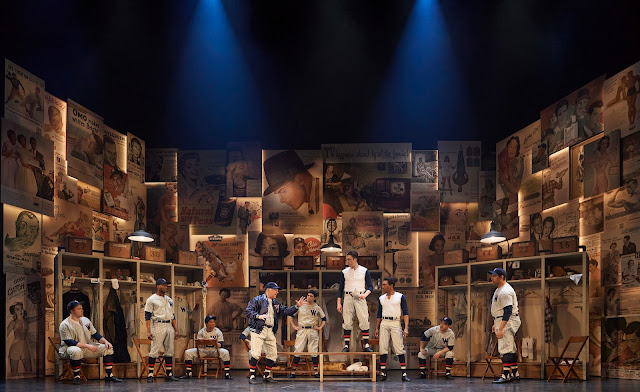
Jay Turvey with the Ballplayers in Damn Yankees, at the Shaw Festival. (Photo: Michael Cooper)

Richard Adler and Jerry Ross might have entered the pantheon of Broadway songwriters if fate hadn’t extinguished their star so fast. Adler was thirty-one and Ross twenty-eight when George Abbott commissioned them to write the score for The Pajama Game (1954), adapted by Abbott and Richard Bissell from Bissell’s novel 7-1/2 Cents, about the tensions between labor and management in a Midwestern pajama factory. It was a legendary show: Abbott and Jerome Robbins co-directed, a young Bob Fosse staged the dances, and it ran for three years. (A boisterous movie version in 1957, helmed by Abbott and Stanley Donen, captures the spirit of the original, with all but two members of the Broadway cast reprising their performances.) In 1955 lightning struck again for Adler and Ross with Damn Yankees. Adapted by Abbott and Douglass Wallop from Wallop’s book The Year the Yankees Lost the Pennant, Damn Yankees was as big a hit as The Pajama Game. But six months after its triumphant premiere, Ross died suddenly of lung disease. Adler never had another success, alone or with a collaborator, though his lovely score for the South Africa-set musical Kwamina, which he wrote for his wife, Sally Ann Howes, is ripe for rediscovery. (Its interracial love story was undoubtedly too controversial for 1961.)

Monday, July 31, 2017

Didacticism and Virtue at the Shaw Festival

Shawn Wright and Jeff Irving with the cast of Androcles and the Lion at the Shaw Festival. (Photo: David Cooper)

At every performance of the Shaw Festival’s production of Androcles and the Lion, George Bernard Shaw’s 1913 dramatization of the Aesop fable, a member of the audience is picked to play the lion. Other theatregoers who have been handed colored balls before the play begins are invited to throw them onto the stage at will, interrupting the dramatic action and prompting a variety of responses from the actors, who have to tell an anecdote or recite a section of Shaw’s preface to the play or share any thought that pops into their heads. This process is in the service of what Tim Carroll, the Shaw’s new artistic director, calls “two-way theatre,” which is intended to break down the barrier between the actors and the audience. Carroll directed Androcles, but his mission is visible in the productions he didn’t stage, too. In Wilde Tales, the lunchtime show, adapted by Kate Hennig from four Oscar Wilde fairy tales and directed by Christine Brubaker, children from the audience sit along the sides of the Court House stage with signs and other props; their participation is encouraged at certain points in the action. In Alan Bennett’s The Madness of King George, directed by Kevin Bennett (who trained with Carroll during his tenure as associate director at Shakespeare’s Globe in London), the house lights remain on during the performance and the cast interacts with members of the audience – especially those who are sitting right on the stage of the Royal George – just as actors at the Globe play up to those groundlings who have found standing room right below the thrust, within easy reach of the performers. Five of the six plays I saw at the Shaw began with a member of the staff – an assistant stage manager or head dresser or what have you – addressing the audience and providing some tidbits of information about his or her job.

Monday, September 8, 2014

A Small Surprise: A Lovely Sunday for Creve Coeur

Deborah Hay and Kate Hennig in A Lovely Sunday for Creve Coeur. (Photo:David Cooper)

For its annual lunchtime one-act, an eagerly anticipated tradition, this year the Shaw Festival has picked one of Tennessee Williams’s last and least known plays, A Lovely Sunday for Creve Coeur. (It was first produced in 1979, four years before his death, with Shirley Knight in the lead.) Williams wrote it as a full-length work in two scenes; trimmed by the director, Blair Williams, to just under an hour, it turns out to be one of the highlights of the season.

The play is both raucous and lyrical-tender – a trademark Williams combination. Set in St. Louis in the mid-thirties, it centers on Dorothea (Deborah Hay), a delicate, easily frazzled young woman who teaches high-school civics classes and shares an apartment with Bodey (Kate Hennig), a working-class German-American spinster who calls her Dotty. The two names hint at the tension between the protagonist’s current lifestyle and the one she intends to shift into. Bodey keeps trying to set her up with her twin brother Buddy, a hefty, beer-drinking, cigar-smoking fellow (whom we never meet), but he holds no remote interest for Dotty. On this particular Sunday, Bodey is putting together a picnic for the three of them to share at Creve Coeur, out in the country. But Dotty doesn’t want to encourage Buddy, and unbeknownst to Bodey she’s made arrangements to move in with the art history teacher, Helena (Kaylee Harwood), in a more upscale neighborhood that she can’t really afford. (Dotty isn’t good with money; you might think of one of the lines Williams wrote for Blanche DuBois, whom Dotty is a variation of: “Money just goes. It just goes places.”) Helena always refers to Dotty as Dorothea.

Friday, August 2, 2013

Disenchantment: Two Shakespeare Plays at Stratford

Daniel Briere (Romeo) and Sara Topham (Juliet) at the 2013 Stratford Theatre Festival (All Photos by David Hou)

There’s a reason Romeo and Juliet is so popular with teenaged audiences. And with theatre companies hoping to attract teenaged audiences, of course. To begin with, the plot is relatively straightforward, for Shakespeare, anyway; the action is frequent and noisy, and it’s all about young love – tragic, heart-breaking, parentally disapproved-of young love.

In the Stratford Festival’s Romeo and Juliet, British director Tim Carroll has given us a forthright production. This quality is partly a function of his theory of “original concept” Shakespeare, plays done as closely as possible to the way they would have been produced in the Bard’s era: with declaimed texts, plain sets, Renaissance-style costumes and a fair bit of interaction between the cast and the audience. The audience also shares the lighting with the actors, apparently to give the effect of an afternoon performance at the open-air Globe theatre. (Though original practices – in Stratford’s case, at least – do not include boy actors playing the women’s roles and standing room only for the audiences. And there is electrical lighting; you don’t want to go overboard with this stuff.)

Monday, August 20, 2012

Ragtime at the Shaw Festival: History Lessons for the Already Enlightened

In his novel Ragtime, E.L. Doctorow uses the ragtime era – roughly the period between the turn of the twentieth century and the beginning of the First World War – to investigate the confluence of contradictory impulses as America begins to hog the world spotlight. Henry Ford and J.P. Morgan embody the American dream in its quintessential (Horatio Alger) form, but their domination implies the oppression of wage slaves and the muting of voices that aren’t white and Christian. In Doctorow’s narrative scheme, the white-bread, well-off New Rochelle family, which has no reason to expect to meet anyone who isn’t exactly like them, crosses paths with African Americans (Mother finds a black baby buried but still breathing in her garden and takes in both mother and child), Jewish immigrants (in Atlantic City, Mother makes the acquaintance of Tateh, the Latvian Jewish immigrant who brings his little girl to America and winds up becoming a filmmaker) and the forces of radicalism (Younger Brother, Mother’s sibling, hears Emma Goldman orate in Union Square and later volunteers himself as a bomb maker for the mightily abused black man Coalhouse Walker, a one-time ragtime pianist and the baby’s father).

Ragtime is a relatively compact book with an epic feel. Doctorow is fascinated by all of the strands of this chapter in American history; his modernist contribution is a rich sense of irony.  He juxtaposes opposites: Ford and Morgan with Goldman and Booker T. Washington (Coalhouse's hero); the industrial dream that Ford represents with Tateh's immigrant dream to pull his daughter out of poverty; Ford's automobile with Tateh's moving pictures -- both produced by a mixture of art and technology. He also juxtaposes Coalhouse's rags with the vaudeville show in which Evelyn Nesbit, a celebrity but not an artist, draws curious crowds. Nesbit's husband, Harry Thaw, has killed her lover, the architect Stanford White; this so-called "crime of the century" makes her a star -- at least, for a few moments. In the first phase of his coming of age, Younger Brother falls in love with her. When she rejects him, he turns to other obsessions. Goldman's oratory and Walker's ordeal politicize him, turning him from a callow would-be lover into a warrior for the cause of the downtrodden and disenfranchised. And Harry Houdini’s escape trick becomes a metaphor for the escape trick every successful immigrant masters – yet, like Houdini, never masters completely.