Thursday, October 6, 2022

Hamp Rising Up: Bracing for Stiff Headwinds

Hampshire student Rhys MacArthur stands in front of the image of Hampshire College President Miriam “Mim” Nelson and talks about the protest. If she weren’t at Hampshire, she says, “I’d probably be sitting on my stoop at home smoking cigarettes.”  

Those of us worried about the future of American democracy might do well to take a look at a new documentary that chronicles a smaller but no less perilous experiment in governing. The Unmaking of a College (2022) tells the story of Hampshire College, a small liberal arts school in Amherst, MA that, just before the pandemic, nearly closes. Hampshire has a radical philosophy of education. Professors don’t lecture; they advise. Students design their own curriculum. There are no grades. The school boasts alumni like Jon Krakauer, Liev Schreiber, and Ken Burns. 50 years old, its endowment is only $54 million, which pales in comparison to older institutions like nearby Amherst College, with a treasure chest of nearly $3.8 billion. As a consequence, over the past few years, Hampshire began operating on a shoestring budget. One trustee began writing personal checks to cover shortfalls. 

Wednesday, October 5, 2022

Frozen Music: The Celluloid Dreams of Richard Kerr

All images courtesy of the artist.

“Now, why should the cinema follow the forms of theatre and painting rather than the methodology of language, which allows wholly new concepts and ideas to arise from the combination of two separate concrete objects?” – Sergei Eisenstein

The elegant artifacts crafted in this time-tapestry originate in a mythical country I like to call Analogos. This land is the opposite of the digital world we currently occupy and harkens back to an era when the image ruled its optical kingdom in a nearly sacred dance of montage assembly and patterned sequence. This limited-edition artist’s book, as a kind of guidebook for tourists traveling in time, captures moments from a celluloid dream world that is anti-Hollywood and pro-haptic: it privileges a domain where physical touch was much more important than cerebral reflection. And yet much of its basic content also references the very dream factory that it also seeks to escape from, plunging us fully forward into the realm of experimental cinema and celebrating cinema itself as a kind of music for the eyes.

Kirk Tougas, the founder of Cinematheque in Vancouver, which traces its own origins way back to the land of Analogos in the early pre-digital 1970’s, has often cautioned me about using the word experimental to describe films which provide alternatives to linear entertainment and take us on a fabulous flight to the outer edges of visual art. Experiential, he has helped me realize, is often a more accurate term to characterize those filmmakers, such as the Canadian Richard Kerr, who wants us to experience and explore his works as paintings that move, or don’t move at all. Hence, perhaps, Kerr’s primary notion of a project which utilizes a haunting inventory of images solely as the raw material, the paint of light and time, so to speak, in a weaving motif which arrives at a core moment of inherent stillness: when time stops and looking starts.

Tuesday, October 4, 2022

Coming Around Again

David Adkins, Corinna May, Tim Jones and Kate Goble in Seascape.

This article includes reviews of Seascape, Persuasion, Mrs. Harris Goes to Paris and Sing Street.

Edward Albee’s Seascape first appeared on Broadway in 1975, in a production he directed that featured Barry Nelson, Deborah Kerr, Frank Langella and Maureen Anderman. Its run was short – a couple of months – but it won Albee the second of his three Pulitzer Prizes. (The others were for A Delicate Balance and Three Tall Women.) Though it’s a marvelous work, but it seldom comes up for revival, presumably because it’s such an oddity. It’s about a meeting between a middle-aged couple, marking retirement with a beachside vacation, and a pair of lizards, also a couple, who have come up from the sea; Albee, taking the special poetic license reserved for absurdists, has conveniently allowed the lizards to converse in English. With its taste for revisiting plays, mostly American, that have fallen into obscurity, Berkshire Theatre Group has just opened Seascape at its Unicorn Theatre in Stockbridge. This is only the second time I’ve seen it performed. Mark Lamos staged a dazzling production in 2002 with a flawless cast – George Grizzard, Pamela Payton-Wright, David Patrick Kelly and Annalee Jeffries; I can still remember the costumes Constance Hoffman designed for the lizards. Lamos remounted it at Lincoln Center in 2005 with Grizzard, Frances Sternhagen, Frederick Weller and Elizabeth Marvel.

Monday, September 19, 2022

The Church of Baseball: How to Work a Miracle

“Making a good and successful movie is a minor miracle every time.” – Ron Shelton, The Church of Baseball.

I love Ron Shelton’s movies the way I love those of the legendary 1940s filmmaker Preston Sturges. Both are quintessentially American writer-directors with a wild sense of humor and a gift for using language in astonishingly fresh ways. Both work intimately with hip, canny character actors to create small worlds that are somehow simultaneously wittily devised and vividly familiar. Sturges may be more off-kilter (though Shelton can be just as nutty) and Shelton less skittish about betraying emotion (though he’s never sentimental), but both come to their material with an attitude of wry amusement and sublime common sense   You can trace both men’s approach to the same master comic voice: Mark Twain’s.

Sunday, September 18, 2022

Anything Is Possible Once the Sun Goes Down: Au Revoir Taipei (Yi Ye Taibei / 一頁台北 2010)

Chun-Yao Yao in Au Revoir Taipei (Yi Ye Taibei / 一頁台北 2010).

Writer-director Arvin Chen’s feature debut, Au Revoir Taipei (Yi Ye Taibei / 一頁台北, 2010) – the Mandarin title is a pun on “one night in Taipei” – is a whimsical and slightly farcical romantic comedy that I believe could only have been made in Taiwan, and it’s on YouTube. The key to its tonal success lies in the characterization. It’s my favorite Taiwan film.

In Taiwan, we have this thing we do in social situations: we play dumb instead of taking the initiative, lest we propose something that someone doesn’t want to do, but would go along with anyway just to be polite. The film captures this idea perfectly, which is why it’s one of the few contemporary films to nail a natural-sounding Taiwanese Mandarin. In fact, almost the entire film features characters who don’t know each other very well sharing a scene, and playing dumb describes most of the dialogue.

Monday, September 5, 2022

The Importance of Being Earnest and Too True to Be Good: The Gift of Gab

Martin Happer and Julia Course in The Importance of Being Earnest. (Photo: Emily Cooper)

Tim Carroll’s production of The Importance of Being Earnest at the Shaw Festival is no doubt giving pleasure to a great many theatregoers this year.  No one has ever, to my knowledge, written a funnier play than Oscar Wilde’s 1895 comedy of Victorian manners, and Carroll’s mounting honors both the wit and the style of the text. It is also – thanks to Gillian Gallow’s set (with its multiple frames), Kevin Lamotte’s lighting and especially Christina Poddubiuk’s costumes – lovely to look at.

Thursday, September 1, 2022

So it Goes: Accommodating the Sublime

W. W. Norton & Company, 2018.

“Having looked at a work of art, I leave the museum or gallery in which it is on display, and tentatively enter the studio in which it was made. And there I wait in hope of learning something of the story of its making.” – John Berger

Where to begin with the two greatest English landscape painters in history? So great that even an art critic is challenged to find the most accurate ways to extol their truly magnificent achievements? Well, in a diversionary tactic during which I can gather my far-flung thoughts into something resembling coherence, I may start by mentioning that persistent readers of Critics At Large, or even occasional readers with a canny eye, will notice that I have long been intrigued by dualities, polarities, alternates, dichotomies, parallels, binaries, opposites and what Dr. Jung called synchronicity. Far from being merely coincidence, or even what the good doctor called meaningful coincidence, he further explained that synchronicity occurs when two archetypes (images or ideas shared by all of us in the collective unconscious) arise at the same time in roughly the same place.

And so it is with two great painters, Joseph Turner (1775-1851), more commonly identified by the way he signed his works, J.M.W. Turner, and John Constable (1776-1837), the paired and most recognizable icons of landscape representation and also the two most daringly innovative risk takers in the history of painting. That history contains a basic template for presenting images to our insatiably hungry eyes: portrait (close to), still life (nearby), landscape (far from). But in the case of these two exemplars, both of whom were surprising emissaries for a fledgling modernism just then on the cusp of occurring with the advent of the French invention of the camera in about 1839, and the resulting plunge into overall pictorial abstraction continuing to this day, we have a unique case of merging the three formats into one single vertiginous entity.

Sunday, August 28, 2022

Silver Screen Time Machine: Beyond the Infinite Two Minutes (2020)

Tosa Kazunari in Beyond the Infinite Two Minutes (2020).

Somehow, Kato doesn’t freak out.

The essence of time travel is narrative. Like the unread pages of a good book, the future has already happened; it just hasn’t yet happened to you. The metaphor applies doubly to filmmaking, which usually takes a narrative and shoots it out of order. Continuity must be maintained, and character and emotional arcs made convincing. If they aren’t, paradoxes manifest, the cinematic world collapses, and viewers branch off from the storyworld prematurely, each into their own individual lifeworlds.

2020’s Beyond the Infinite Two Minutes (ドロステのはてで僕ら “We at the End of the Droste”), director-cinematographer-editor Yamaguchi Junta’s feature debut, realizes this metaphor in the most direct way. Beyond is shot to look like it was done in a single take, using just one phone, tripod, boom mic, the world’s longest power cord, and lots and lots of stopwatches. To give you a sense of its flavor, it was inspired by One Cut of the Dead (カメラを止めるな! “Don’t Stop the Camera!”), Ueda Shinichiro’s 2017 smash hit about a group of people tasked with making a one-shot microbudget zombie film. There are cuts in Beyond – of course there are cuts; it’s a time travel film – but to keep up the illusion, the requisite plot complications have to develop organically from the situation the characters find themselves in, and from who they are as characters, as people. Writer Ueda Makoto does a hell of a job in just 70 minutes.

Monday, August 22, 2022

Crowd Pleasers: Damn Yankees and Gaslight at the Shaw Festival

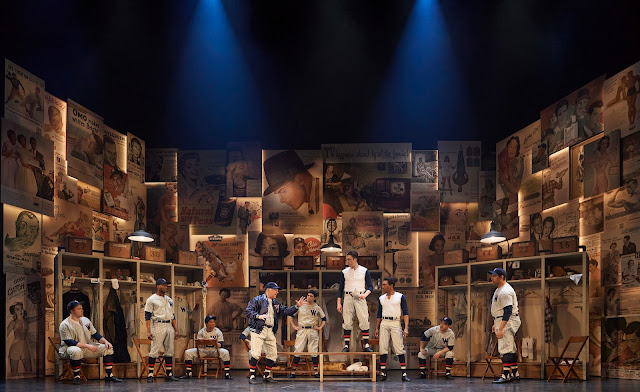
Jay Turvey with the Ballplayers in Damn Yankees, at the Shaw Festival. (Photo: Michael Cooper)

Richard Adler and Jerry Ross might have entered the pantheon of Broadway songwriters if fate hadn’t extinguished their star so fast. Adler was thirty-one and Ross twenty-eight when George Abbott commissioned them to write the score for The Pajama Game (1954), adapted by Abbott and Richard Bissell from Bissell’s novel 7-1/2 Cents, about the tensions between labor and management in a Midwestern pajama factory. It was a legendary show: Abbott and Jerome Robbins co-directed, a young Bob Fosse staged the dances, and it ran for three years. (A boisterous movie version in 1957, helmed by Abbott and Stanley Donen, captures the spirit of the original, with all but two members of the Broadway cast reprising their performances.) In 1955 lightning struck again for Adler and Ross with Damn Yankees. Adapted by Abbott and Douglass Wallop from Wallop’s book The Year the Yankees Lost the Pennant, Damn Yankees was as big a hit as The Pajama Game. But six months after its triumphant premiere, Ross died suddenly of lung disease. Adler never had another success, alone or with a collaborator, though his lovely score for the South Africa-set musical Kwamina, which he wrote for his wife, Sally Ann Howes, is ripe for rediscovery. (Its interracial love story was undoubtedly too controversial for 1961.)

Monday, August 15, 2022

Revisiting Stratford: The Miser and Girls & Boys

Colm Feore, Lucy Peacock and Qasim Khan star in The Miser, at Canada's Stratford Festival. (Photo: David Hou)

This summer I was able to cross the Canadian border for the first time since COVID, on a trip framed by brief visits to Stratford and Niagara-on-the-Lake, home of the Shaw Festival. Regrettably, my timing at Stratford didn’t allow for the chance to see All’s Well That Ends Well, a problem comedy I love that gets produced only infrequently. But I did manage to check out artistic director Antoni Cimolino’s production of Molière’s 1668 prose comedy The Miser (at the Festival Theatre) in a contemporary adaptation by Ranjit Bolt that has been embellished further with Ontario references. In Bolt’s version Molière’s title character, Harpagon, is called Harper, and his children, Élise and Cléante, who desire to marry the people they love without risking being disinherited by their parsimonious papa, are called Eleanor and Charlie. The director’s note in the program argues that the subject of greed and the generational tensions make The Miser relevant to a 2022 audience. Of course you can make that case for any of Molière’s best satires; human nature, after all, hasn’t changed much through the centuries. I’m not sure, though, that the present-day setting adds anything to the play or sharpens its thrust.

Sunday, August 14, 2022

Getting Gerried by Nature: Gerry

Matt Damon and Casey Affleck in Gerry (2002).

This review contains major spoilers for Gus Van Sant's Gerry (2002).

In 2002, Gus Van Sant followed his aggressively mediocre Finding Forrester (2000) with the aggressively experimental Gerry (2002). It doesn’t have opening titles, and for most of its 103 minutes the only two people we see are Matt Damon and Casey Affleck, who both play guys named Gerry. (I’m going to use the actors’ names to avoid confusion.) There’s even a running joke about how the name “Gerry” gets turned into a vague, all-purpose word. (Affleck, Damon, and Van Sant co-wrote as well as co-editing.) A few examples: “I crow’s-nested up here to scout-about the ravine ’cause I thought maybe you gerried the rendezvous”; “We could have just bailed early, you know. There were so many gerrys along the way”; “And then we gerried off to the animal tracks.” The first 20 minutes are just long takes of Matt and Casey driving and then walking in the California semi-desert with minimal dialogue.

Thursday, August 11, 2022

Shining On Brightly: The Power of Sharing the Spotlight

(W.W. Norton Press)

“The Beatles, like Duke Ellington, are virtually unclassifiable musicians.” – Lillian Ross, writing in The New Yorker in 1967.

How can one possibly explain the majestic presence of music such as Duke Ellington/Billy Strayhorn’s  “Lush Life” and “Chelsea Bridge”? Or the shimmering beauty of Lennon/McCartney’s “She’s Leaving Home” and their entire “Abbey Road Medley”? What secret alchemical equation is behind the binary Odd Couple Code in the creative arts that makes such great collaborations so fruitful? A team of rivals, often incompatible and yet somehow incomparable, whose rivalry makes the team grow stronger and succeed far in excess of what either competitive team member could achieve alone, is an often mystifying but vastly entertaining cultural phenomenon. As long as they maintain the precarious balance required to equally channel their dramatically opposite energies in the same direction, that is.   

Help!: The Beatles, Duke Ellington and the Magic of Collaboration, the wonderful book by Thomas Brothers from W.W. Norton, is one of the most informative and inspiring places to begin examining this remarkable ability for two artists to meld into a unified field, a single creative force in tandem. The odd-couple metaphor of a relational golden mean suggests something hidden but potentially profound, something we could even call reciprocal maintenance. This arrangement of forces basically requires both partners to take turns, maybe even alternate, at being the dominant prevailing portion of the whole, pivoting frequently to allow the opposite partner to assume the same majority role as often as possible. 

Monday, August 8, 2022

New Work at the Goodspeed and Williamstown: Anne of Green Gables and we are continuous

Juliette Redden and D.C. Anderson and cast in Anne of Green Gables. (Photo: Diane Sobolewski)

Based on Lucy Maud Montgomery’s 1908 children’s novel – the most popular work of literature ever to come out of Canada and the first in a series of nine books – the new musical Anne of Green Gables (at the Goodspeed Opera House) is the latest effort to make a classic story feel contemporary. The narrative, about a willful, self-dramatizing orphan girl named Anne Shirley who is adopted by Matthew and Marilla Cuthbert, a pair of aging unmarried siblings on Prince Edward Island, by accident (they’d requested a boy to help work their farm) and winds up winning over the entire town of Avonlea, is easily recognizable. But the playbill identifies the setting vaguely as “the start of a New Century,” and the playwright-lyricist, Matte O’Brien, has circled the proto-feminist elements in red and added a not-too-convincing queer subtext to Anne’s friendship with her classmate Diana Barry, to whom she provides intellectual encouragement and helps to pry out of the grasp of her stiflingly conventional mother. The ensemble, boys and girls from their peer group, has been costumed (by Tracy Christensen) to look like teenagers from the turn of the twenty-first century, and Matt Vinson’s music has a generic 1970s, Stephen Schwartzish folk-rock feel. (Three or four of the tunes are quite pretty.) The disjunction between the chorus numbers and the plot appears to have been inspired by the potent Duncan Sheik-Steven Sater musical Spring Awakening, but there it had a point. The Frank Wedekind play Sater and Sheik adapted was so far ahead of its time when it was written in 1891 that it took much of the twentieth century for the culture to catch up to it, so when, on Broadway in 2006, the teenagers in Victorian outfits sang out their plaints of abuse and sexual confusion to rock rhythms, the strange period mix sounded exactly right. But you have to work at making Anne Shirley and the citizens of Avonlea, adolescent and adult alike, sound like they could have been at home two decades ago. 

Monday, August 1, 2022

Karen Kain’s New Version of Swan Lake Fails to Fly

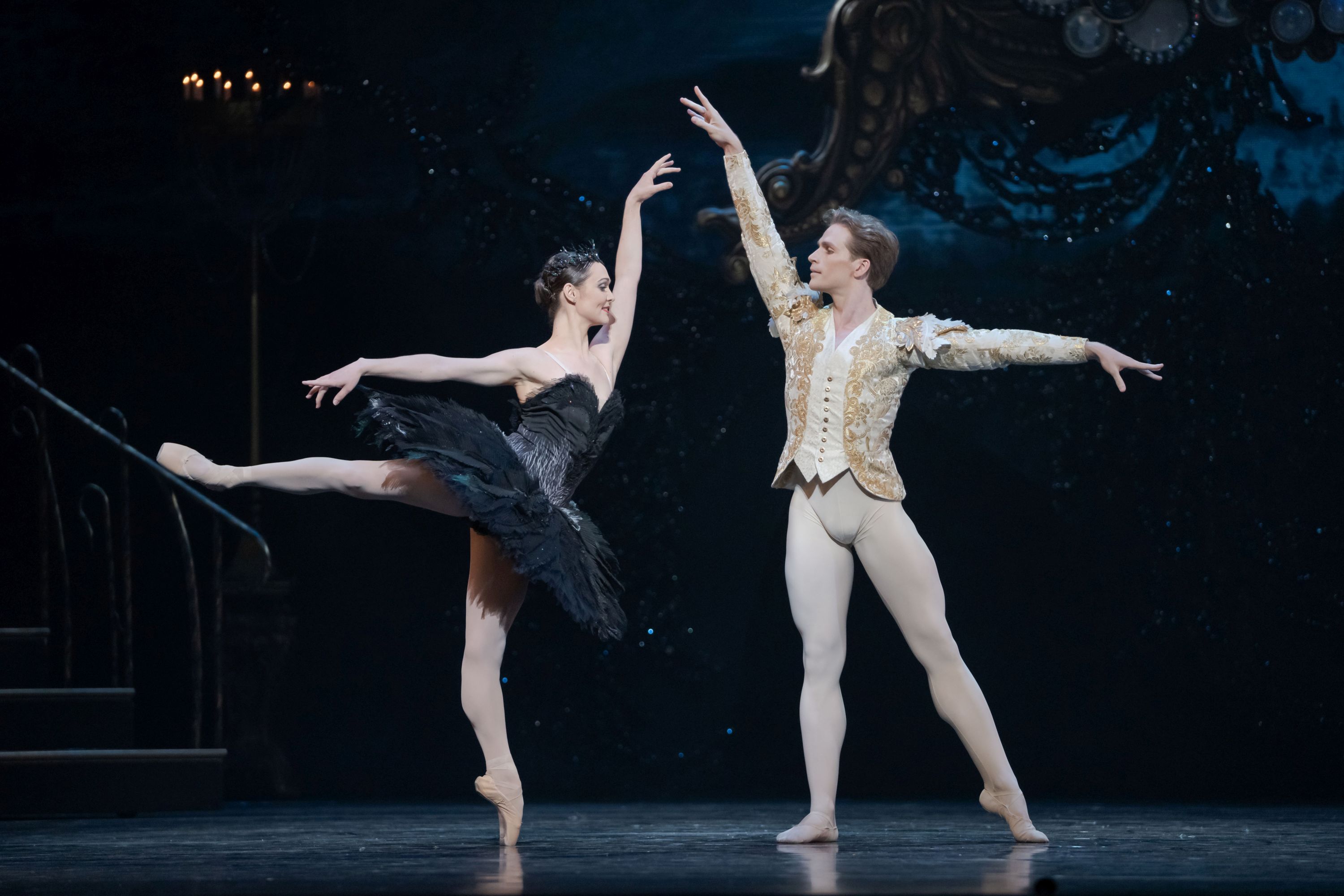
Harrison James and Jurgita Dronina in Swan Lake. (Photo: Karolina Kuras)

As far as highly anticipated world premieres go, Karen Kain’s Swan Lake had an extraordinary amount of buildup, making it – from a box office perspective alone – a hit before it even opened. Originally scheduled for 2020, and delayed two years because of the pandemic, the $3.5-million production, a presentation of the National Ballet of Canada, sold out its two-week run in advance of its debut at Toronto’s Four Seasons Centre on June 10. This is unprecedented for any ballet outside The Nutcracker, let alone one whose merits had yet to be assessed. At the end of the day, those merits were found to be wanting, making this Swan Lake, after all the hype, a total letdown.

What was wrong with it? In brief, everything.

Monday, July 25, 2022

Random Notes on Actors

Matthew Mcfadyen and Colin Firth in Operation Mincemeat.

For anyone who follows British actors – and that includes just about everybody I know who’s turned on by actors these days – Operation Mincemeat (on Netflix) is a banquet. It features Colin Firth, Matthew Macfadyen, Kelly Macdonald, Penelope Wilton and Jason Isaacs, with Alex Jennings, Hattie Morahan, Mark Gatiss and Johnny Flynn (from The Dig) in supporting roles and Simon Russell Beale, in a cameo, the latest first-rank actor to in recent years to play Winston Churchill. Across the board, the performances are superlative. The movie, beautifully directed by John Madden from an ingenious, immensely satisfying script by Michelle Alford (adapting book by Ben Macintyre), is a true-life World War II spy story and romantic melodrama. In 1943, British Intelligence Fleet Commander Charles Cholmondeley (Macfadyen, with a bushy mustache) whips up a scheme to mislead the Germans into thinking that the Allies are directing their attention to Greece while in truth they’re focusing on Sicily. Cholmondeley’s plan is to dress up a corpse as an English agent, plant phony documents on him, and have him wash up in Spain, in the Gulf of Cadiz, and then make sure that Allied moles get news of his discovery to Hitler’s ears. Working with Commander Ewen Montagu (Firth) and Hester Leggett (Wilton), head of the Admiralty’s secretarial unit, he appropriates a suicide named Glyndwr Michael for the dead man, renames him Major William Martin, and manufactures a biography for him that includes a romantic backstory. Jean Leslie (Macdonald), a widow working under Hester, gets involved when she offers her own photo to stand in for the sweetheart photo in Martin’s wallet. (Then they throw in a love letter.) Isaacs plays Admiral John Godfrey, their consistently wrongheaded boss, who is skeptical about the operation from the get-go and suspicious of Montagu because he’s convinced his left-leaning brother Ivor (Gatiss) is a Soviet spy. (The fact that the Russians are fighting on the same side as the Allies hasn’t calmed him down.)

Wednesday, July 20, 2022

The Anxious Object: The Sublime Void and Art in the Age of Anxiety

The Sublime Void (Ludion Press, Antwerp / DAP, 1993); Art in the Age of Anxiety (MIT Press/Morel Books, 2021)

“Perhaps it was always like this. Perhaps there was always a vast alien expanse between an epoch and the great art which it produced. What distinguishes works of art from all other objects is the fact that they are, as it were, things of the future, things whose time has not yet come.” – Rainer Maria Rilke.

“Art in the age of anxiety explores the ways in which everyday devices, technologies and networks have altered our collective consciousness. We are all living in an age where anxiety has become a part of our daily life.” – Omar Kholeif, curator.

When my wife Dr. Mimi first gave me these two books as a birthday gift, it was not immediately apparent how intimately connected, as if by some subterranean river of meaning, both of them were to me in the present, nor how substantially that meaning would expand exponentially over time to encompass almost every aspect of what tenuously living in both the 20th and 21st centuries actually might signify. That gift might just be the unexpected case where profundity drops down on us, apparently carried on winds that at first are not quite even discernible by us, until later on, one day, it comes crashing through the roof of our skulls and rearranges the furniture in our minds.

Monday, July 18, 2022

Epiphany: Death and Community

The cast of Epiphany. (Photo: Jeremy Daniel)

The new Brian Watkins play Epiphany, which closed last weekend at Lincoln Center’s Mitzi E. Newhouse Theater, is wildly ambitious and wildly erratic, and the two hours without intermission really began to feel long by the final half-hour. You’d have to account it a failure, but it’s an imaginative, fascinating one, a phrase I wouldn’t apply to, say, the generously reviewed POTUS or The Minutes. There were certainly some high points in the New York theatre season: The Lehman Trilogy, Girl from the North Country and Skeleton Crew, all of which I saw before COVID (the first during its run in London’s West End, the last at Boston’s Huntington Theatre), the Lynn Nottage/Ricky Ian Gordon opera of Nottage’s play Intimate Apparel and the Mint Theater’s recent revival of Elizabeth Baker’s 1909 Chains. A Case for the Existence of God didn’t reach down deep enough, but it had ideas and a pair of splendid actors, Kyle Beltran and Will Brill. The other shows I saw weren’t much good and left little or nothing behind to contemplate. But you couldn’t say the same about Epiphany, which was directed by Tyne Rafaeli. It’s often very funny and occasionally quite moving, and it tickles the brain.

Friday, July 15, 2022

A Few Brief Thoughts on Some (More) Interesting Short Films

A scene from Ottó Foky’s Scenes with Beans (1976).

It’s been a year and a half since my last shorts roundup, and the pandemic is still ongoing; the only difference is that people are starting to not care anymore. I wonder if it has something to do with how the internet has diminished our attention spans and memories. In any case, here in chronological order of premiere date are the shorts I watched that engaged me enough to want to finish them and write about them. If I don’t provide a link, I saw it on MUBI.

Monday, July 11, 2022

Chains: A Resurrection from the Mint Theater

Laakan McHardy and Jeremy Beck in Chains. (Photo: Todd Cerveris)

The Mint Theater Company, an off-Broadway house in the business of reviving obscure European and American plays, has been on my radar for several years, but I had never seen one until they began to stream shows from their archive while the New York theatre was shut down by the pandemic. The plays themselves were interesting, but what struck me was the high quality of the productions. To be honest, I felt foolish for not having checked out Mint much earlier. (They’ve been around since 1995.)

Their current offering – their second since the reopening of live theatre and their first back in their home space on Theater Row – is Chains, a 1909 realist play from England by Elizabeth Baker. Baker had been inspired to try her hand at playwriting by the work Harley Granville-Barker was presenting at the Court Theater during his three seasons as artistic director. Chains was her first effort, but it’s a sophisticated piece of dramatic writing: skillfully structured, compelling in subject matter and character, illuminated by indisputable authorial intelligence. The social setting is the lower middle class residing in the London suburbs in the years before the First World War. The chains of the title are those imposed by duty, pragmatism and convention. The protagonist, Charley Wilson (played by Jeremy Beck), is a clerk suffocated by the dullness of his job and the dim prospects of improving his lot. He and his wife Lily (Laakan McHardy) live in genteel poverty, taking in boarders to alleviate some of the financial strain. They’re counting on his getting a raise, but instead his company, on the unconvincing excuse that they’ve had a bad year, reduces his pay. When their current boarder, Fred Tennant (Peterson Townsend), decides to walk away from his job and try his luck farming in Australia, his courage and optimism affect both Charley and his sister-in-law Maggie Massey (Olivia Gilliatt), who has become engaged to a man she doesn’t love in order to escape the shop where she’s employed. Everyone else who hears the news of Fred’s decision holds onto the conservative notion that a sure thing, however suffocating to the spirit, is better than a risk; they’re inured to the idea that work isn’t supposed to be pleasant. Only Charley and Maggie identify with his bid for freedom.

Monday, July 4, 2022

Top Gun: Maverick – Pablum

Tom Cruise, Jennifer Connelly in Top Gun: Maverick.

Top Gun, which came out in 1986, was a Reagan-era special if there ever was one. It harked back to the flyboy epics of the late silent and early talkie era but eliminated everything that had made the best of them – Wings, Hell’s Angels, Only Angels Have Wings – witty, exciting and romantic, like three-dimensional characters and actors who drew on their own dimensionality to make them memorable, and substituted high gloss and displays of masculinity that would have looked embarrassing in Medieval times. There was plenty of action, but I can’t remember a single flying sequence that truly engaged the senses, let alone the brain. I would have skipped the long-delayed sequel, Top Gun: Maverick, but the director is Joseph Kosinski, whose true-life firefighter picture, the 2017 Only the Brave, is an unknown gem. So I opted to check it out. And it’s perfectly well directed, which is to say that you can sit through it without dozing off or looking for excuses to visit the lobby of your local Cineplex. But aside from the pristine cinematography by Claudio Miranda (who also lit Only the Brave and Kosinski’s Netflix sci-fi film, Spiderhead, which came right on its heels) and the climactic dogfight, Top Gun: Maverick is a stupid movie and a desperate exercise in picking the bare bones of a one-time commercial success that wasn’t any good to start with.