Showing posts with label Visual Arts. Show all posts

Saturday, August 15, 2026

The Theatre Within the Ink

Uproar in Heaven (1979), Collection of the Shanghai Chinese Painting Academy.

The figures in Guan Liang’s paintings seem almost to have wandered out of a child’s notebook. Warriors lean at improbable angles. Mythological heroes appear slightly awkward, their bodies stretched, compressed, or tilted beyond the limits of realism. The colours arrive in sudden bursts, the lines appear hesitant, and the compositions often seem deliberately incomplete. Yet this childlike simplicity was the result of a lifelong artistic pursuit by one of twentieth-century China’s most radical modernists.

Monday, July 6, 2026

One of a Kind, Twice in a Row: Legacy and Legend


“Art never saved the world. It cannot do so.”
--Marcel Duchamp

“Everyone is an artist.”
--Joseph Beuys

The 20th century. Oh how I do miss that century these days. It was a virtual dynasty of dissonance and discontinuity, a breathtakingly radical realm of overturned assumptions and collapsing complacent expectations. Almost all the accepted truths, from science and religion to literature, music and visual art, were being overturned practically on a daily basis. And the two artists profiled in two new tomes from Princeton University Press were at the forefront of the mission to alter our perceptions of what art was and what it can be expected to do to and for us. Marcel Duchamp (1887-1968) and Joseph Beuys (1921-1986) pretty much invented what we now call conceptual art. But it didn’t really have a name back when they were blazing a trail through the exotic hinterland of aesthetic exploration. And these valuable books, one a collection of snappy quotations from the cheeky and provocative Duchamp, Duchampisms, edited by Larry Warsh, and the other a deeply revealing study, Joseph Beuys and History by Daniel Spaulding, each shed new light on the dazzling outer range of cultural possibility back in the daring century they so personally embodied.

Saturday, July 4, 2026

The Five Colours of White

Ink-and-Brush painting by Zhang Shuqi. (Photo: Jason Wang.)

In the glass-and-concrete halls of the Zhejiang Provincial Museum in Hangzhou, Zhang Shuqi’s work bursts with an urgency that belies its age. Echoes of the Homeland is a retrospective of a Chinese painter long overshadowed in the West. A native of Zhejiang Province, Zhang Shuqi (or Chang Shu Chi, 1900–1957) was hailed as one of the “Three Masters of Jinling” along with Xu Beihong (1895–1953) and Liu Zigu (1901–1986), pioneers who adapted traditional ink-and-brush to a modern world. Amid the fourth-floor galleries, his flowering branches and roiling flocks of fowl feel like a living ecosystem, each petal and plume pulsing with the tensions of war, exile, and cultural survival.

Wednesday, June 10, 2026

Dostoevsky in the Water Town

The Dostoyevsky: Man is a Mystery exhibit at the Muxin Art Museum. (Photo: Jason Wang.)

To reach the Muxin Art Museum, one first passes through Wuzhen, a historic water town in Zhejiang Province that has been carefully polished for tourism. Stone paths are kept immaculately clean, boats drift slowly through the canals, and the entire district often feels suspended in a state of permanent display. At the edge of Yuanbao Lake, the museum rises as a cluster of spare concrete volumes designed by OLI Architecture. The shift from the cultivated brightness outside to the cool, inward atmosphere of the galleries is immediate.

Sunday, February 15, 2026

Iconophilia: Perpetual Morphosis

(Zone Books, Princeton University Press.)

“Unframedness. Presentness. Immediateness. It is under these three titles — intimately related — that we now experience the image by means of those devices that constitute image-making strategies: virtual immersive environments.”
Andrea Pinotti

The title of this breathtakingly insightful book by Andrea Pinotti, At the Threshold of the Image: From Narcissus to Virtual Reality, should be taken quite literally. Consider it what rightly amounts to a veritable biography of the Image: its history, both overt and covert in all our lives, and as both a secret story communally shared and also an unimaginable one taunting us to keep going towards what used to be called the future. The book’s image-archive extends from a time long before any recorded history even existed, right through to a time after which history, at least as we once regarded it, may also have vanished. And perhaps owing to the sheer acceleration and amplification of our lives, the future of the real and recognizable image itself might even have ceased to exist at all. The most succinct and accurate synopsis of At the Threshold of the Image is equally breathless: this is an exploration of the impact of immersive experiences on visual practices from cave painting to virtual reality.

Tuesday, December 23, 2025

Being and Somethingness: Barnett Newman: Here

Princeton University Press.

“Here. A place in the world. Proof that one exists. Barnett Newman spent a lifetime searching for confirmation of a simple idea.”
Amy Newman

For many decades as an art historian I have often remarked to those who would listen that what matters most about visual art and art history is not exactly what you’re looking at in front of you. Puzzled expressions often ensue. I frequently share the observation that there’s more to fine art than meets the eye, and that what matters is what’s behind your eyes, not what’s in front of them. In other words, how much you know about what you’re seeing, in the sense not of privileged knowledge but rather of the kind of basic information that can be accessed by anyone who is curious about what’s going on in the world of contemporary art, that quantum which can alter your perception forever. By anyone who can, that is, suspend immediate snap value judgments and pursue any credible art text in any reasonable library. And if my audience were still listening, I would proceed to further clarify this perspective: the image is in front of us but the imagination is in our minds, lurking behind our visual apparatus, just waiting to be fully engaged in a deeply personal and, for lack of a better term, existential revelation.

Tuesday, October 14, 2025

When A Film Lab Cancels an AI Show, Who Gets to Define a Cultural Commons?

Works by the artist Rick Valicenti from the exhibit Playbot Companions.

We are pleased to welcome a new critic, Jason Wang, to Critics at Large.

In the first week of October, Toronto hosted a small but telling cultural collision. On Oct. 1, artist and designer Rick Valicenti opened Playbot Companions at 99 Frames Parliament Street: a two-week presentation of framed, AI-generated hairstyles linked by QR code to tiny “playbot” faces and backstories. The conceit is simple and unnerving — show the hair, hide the face, and force the viewer to complete the “playbot” as a person. But the sharper question is: what happens when intimacy becomes a design choice and companionship a consumable commodity?

Sunday, April 13, 2025

Form and Legacy: Jane Corkin’s Vision of Photography as Fine Art

A display wall from Between Life and Light at the Jane Corkin Gallery.

The Jane Corkin Gallery’s 45th-anniversary exhibition, Between Life and Light, begins with the space itself: a historic tank house in Toronto’s Distillery District. The oak floors and wooden beams, reimagined in 2003 by architects Shim-Sutcliffe, create a gallery of light and levels that feels both expansive and intimate. This architectural transformation mirrors the exhibition’s premise—photography as a continuum of history and innovation, spanning nearly two centuries from 1857 to 2024.

Saturday, December 28, 2024

Edges of Ailey: A Personal Reflection on Legacy and Movement

Alvin Ailey, circa 1960. (Photo: John Lindquist/Whitney Museum of American Art)

In mid-November, unaware of the poignant irony that would soon unfold, I found myself wandering through the vibrant halls of the Whitney Museum of American Art, eyes scanning the Edges of Ailey exhibition for glimpses of Judith Jamison. The legendary dancer, who led the Alvin Ailey American Dance Theater as artistic director after its founder’s death from AIDS-related complications in 1989, had been my original dance idol and a beacon of inspiration throughout my life. As a teenager with dreams of dance, I had her majestic image from Ailey’s Cry pinned to my fridge, praying daily to channel even a fraction of her grace and power. Now, I searched for her influence, her indelible mark on the company, hoping to reconnect with that youthful adoration.

Tuesday, March 26, 2024

In Passing: The Enigmatic Paintings of Janna Watson

 Air Signs Talking, 48 x 48 in.

“Tantra is a technique that allows you to connect with your inner energy and experience transformation. One can visualize energy moving through the body with each and every breath.” – David Frawley

“Wu wei invites spontaneous and inevitable behaviors to happen naturally. Rather than painting a pre-planned idea, I let go of the ego in order to unify myself with the environment.”Janna Watson

Tantric diagrams. The visually compelling paintings of Flesherton-born and Toronto-based artist Janna Watson, usually produced on sensual birch wood panels, represent a significant development in what has been called biomorphic abstraction. With their energetic dance-like forms coming together, gently colliding and receding apart, they also provide an added visual bonus of taking gestural abstraction itself to new heights of emotive splendor. Viewing her colourful and almost calligraphic work offers us a chance to vividly remember a time when our tired retinas, less lulled by flickering digital pixels, were much more open to being transported out of ourselves and into the open-ended narrative that great painting always invites and provides.

Thursday, October 26, 2023

In the Labyrinth: Picasso’s Graphic Work

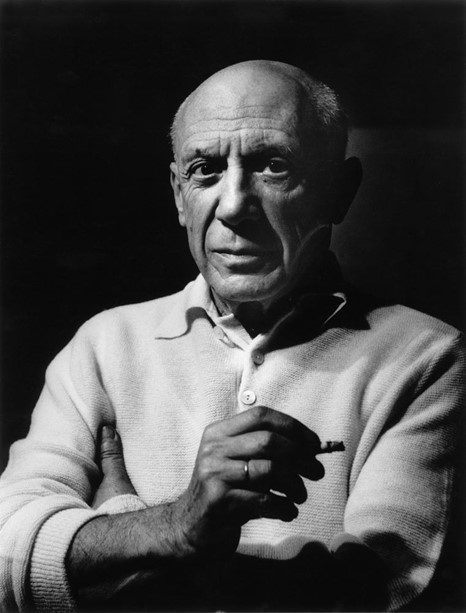
Lucien Clergue, Portrait (1956).

“Mystery is the essential ingredient of every work of art.” – Luis Buñuel

Who and what do we see when we study the splendid photographic portrait of Pablo Ruiz Picasso captured by the esteemed Lucien Clergue in1956, when the Spanish artist was at the height of his powers? Having been adopted as a global cultural citizen beyond all mere geographical borders, the words who and what are both applicable in his unique case, as someone who was as vital and revolutionary in painting as his countryman Cervantes was in literature three hundred years earlier. So when Clergue memorialized that dramatic face, some four decades after the artist first reinvented the history of art at the turn of the last century, recasting it in his own image by collaborating with Georges Braque in the revelation of Cubism, and with roughly another two tumultuous decades still remaining in his titanic aesthetic mission, what sort of portrait telegram did the photographer manage to send us all in the future, and yet further into the future of the future? His portrait seems to whisper: behold, a living archetype.

Picasso’s elusive and mercurial character, a persona he appeared to perform as if he lived on a stage, still has the capacity to allure and amaze us. With good reason, and these powerful works on paper assembled here are an accurate indication of exactly why. He was a towering figure who looms large in both the art world and the world of popular culture, a gargantuan artist beyond most limits and even any definitions. Gazing at the overwhelming confidence in the awesome face of the man behind these prints, I am often reminded of the words of a favourite Brazilian author, Clarice Lispector: “He had the elongated skull of a born rebel.” I do hope so, Clarice, but all the landforms of his skull grew inward, like stalagmites, rather than upward and out. His Guernica painting from 1937 was one such interior landform, but then, so are his many masterful prints: each one is a mountain peak in reverse on paper, a spritely graphic Everest.

Thursday, April 20, 2023

Double Vision: Beyond Binary Art History

Princeton University Press (2022); Princeton University Press (2022)

“We have arrived at an era of humans and their doubles. We no longer need mirrors in order to talk to ourselves.” –Jean-Luc Godard, 1965.

Polarity, duality, dichotomy, opposition, contradiction, mutuality: these art books run the gamut of this spectrum.

As almost always in my case, synchronicity appeared to be at play (in its usual subterranean manner) with the arrival of two remarkably insightful books that explore our binary condition and what lies beyond it, each in its own distinctive way, but both in shared terms of expanding our appreciation for art and cultural artifacts which transcend outmoded definitions of traditional media disciplines and aesthetic values. Global Objects: Towards a Connected Art History, by Edward Cooke, and The Double: Identity and Difference in Art Since 1900, by Peter Meyer, are excellent in-depth explorations of how contemporary art provides a mirror of reality, even when that mirror is clouded by myth or fixation. Both are released by Princeton University Press and both approach the polarities of art versus craft and the dichotomies of singular self, with a deft command of their subject matter and theme.

Wednesday, October 5, 2022

Frozen Music: The Celluloid Dreams of Richard Kerr

All images courtesy of the artist.

“Now, why should the cinema follow the forms of theatre and painting rather than the methodology of language, which allows wholly new concepts and ideas to arise from the combination of two separate concrete objects?” – Sergei Eisenstein

The elegant artifacts crafted in this time-tapestry originate in a mythical country I like to call Analogos. This land is the opposite of the digital world we currently occupy and harkens back to an era when the image ruled its optical kingdom in a nearly sacred dance of montage assembly and patterned sequence. This limited-edition artist’s book, as a kind of guidebook for tourists traveling in time, captures moments from a celluloid dream world that is anti-Hollywood and pro-haptic: it privileges a domain where physical touch was much more important than cerebral reflection. And yet much of its basic content also references the very dream factory that it also seeks to escape from, plunging us fully forward into the realm of experimental cinema and celebrating cinema itself as a kind of music for the eyes.

Kirk Tougas, the founder of Cinematheque in Vancouver, which traces its own origins way back to the land of Analogos in the early pre-digital 1970’s, has often cautioned me about using the word experimental to describe films which provide alternatives to linear entertainment and take us on a fabulous flight to the outer edges of visual art. Experiential, he has helped me realize, is often a more accurate term to characterize those filmmakers, such as the Canadian Richard Kerr, who wants us to experience and explore his works as paintings that move, or don’t move at all. Hence, perhaps, Kerr’s primary notion of a project which utilizes a haunting inventory of images solely as the raw material, the paint of light and time, so to speak, in a weaving motif which arrives at a core moment of inherent stillness: when time stops and looking starts.

Thursday, September 1, 2022

So it Goes: Accommodating the Sublime

W. W. Norton & Company, 2018.

“Having looked at a work of art, I leave the museum or gallery in which it is on display, and tentatively enter the studio in which it was made. And there I wait in hope of learning something of the story of its making.” – John Berger

Where to begin with the two greatest English landscape painters in history? So great that even an art critic is challenged to find the most accurate ways to extol their truly magnificent achievements? Well, in a diversionary tactic during which I can gather my far-flung thoughts into something resembling coherence, I may start by mentioning that persistent readers of Critics At Large, or even occasional readers with a canny eye, will notice that I have long been intrigued by dualities, polarities, alternates, dichotomies, parallels, binaries, opposites and what Dr. Jung called synchronicity. Far from being merely coincidence, or even what the good doctor called meaningful coincidence, he further explained that synchronicity occurs when two archetypes (images or ideas shared by all of us in the collective unconscious) arise at the same time in roughly the same place.

And so it is with two great painters, Joseph Turner (1775-1851), more commonly identified by the way he signed his works, J.M.W. Turner, and John Constable (1776-1837), the paired and most recognizable icons of landscape representation and also the two most daringly innovative risk takers in the history of painting. That history contains a basic template for presenting images to our insatiably hungry eyes: portrait (close to), still life (nearby), landscape (far from). But in the case of these two exemplars, both of whom were surprising emissaries for a fledgling modernism just then on the cusp of occurring with the advent of the French invention of the camera in about 1839, and the resulting plunge into overall pictorial abstraction continuing to this day, we have a unique case of merging the three formats into one single vertiginous entity.

Wednesday, July 20, 2022

The Anxious Object: The Sublime Void and Art in the Age of Anxiety

The Sublime Void (Ludion Press, Antwerp / DAP, 1993); Art in the Age of Anxiety (MIT Press/Morel Books, 2021)

“Perhaps it was always like this. Perhaps there was always a vast alien expanse between an epoch and the great art which it produced. What distinguishes works of art from all other objects is the fact that they are, as it were, things of the future, things whose time has not yet come.” – Rainer Maria Rilke.

“Art in the age of anxiety explores the ways in which everyday devices, technologies and networks have altered our collective consciousness. We are all living in an age where anxiety has become a part of our daily life.” – Omar Kholeif, curator.

When my wife Dr. Mimi first gave me these two books as a birthday gift, it was not immediately apparent how intimately connected, as if by some subterranean river of meaning, both of them were to me in the present, nor how substantially that meaning would expand exponentially over time to encompass almost every aspect of what tenuously living in both the 20th and 21st centuries actually might signify. That gift might just be the unexpected case where profundity drops down on us, apparently carried on winds that at first are not quite even discernible by us, until later on, one day, it comes crashing through the roof of our skulls and rearranges the furniture in our minds.

Thursday, May 26, 2022

Otherworldly: The Haunting Icons of Fatima Jamil

Red Army II, 2022 digital print on metal, 48 x 48 inches.

“Art ceases to be solely a form of self-expression alone in the electronic age. Indeed, it becomes a necessary kind of shared research and of internal probing.” – Marshall McLuhan, Through the Vanishing Point: Space in Poetry and Painting (1968).

1. Singularity

The powerfully evocative and resonant works of Fatima Jamil are encountered by the entranced viewer as a truly nuanced hybrid of Eastern and Western traditions. In fact, it strikes me that they reveal a salient truth about the artistic urge to make images and our human appetite to absorb them into our nervous systems as a kind of remedy to the stresses of everyday living: the fact that there is no East or West in the immersive dimension of dreams. I instinctively refer to her otherworldly visions as icons, but not in the liturgical and canonical sense of that word, rather in the neutral sense of being iconic: a picture, image or other representation residing in analogy. She is also a visual storyteller par excellence.

Thursday, April 7, 2022

A Dance to the Music of Time: 4-Dimensional Sculptures by Joachim Waibel

Nude portraits of antique clocks without their hands, silently holding their vigil and thus calmly reminding us of Henri Bergson’s bold 1911 admonition: “Time is invention, or it is nothing at all.”


“For reasons not at the time explicable, there are specific occasions when events begin suddenly to take on a significance previously unsuspected, so that before we really know where we are, we ourselves, scarcely aware that any change has taken place, are careening uncontrollably down the slippery avenues of eternity.”  – Anthony Powell, 1955.

When the French novelist Marcel Proust finally published his long-awaited seven-volume magnum opus In Search of Lost Time in 1913, after labouring meticulously, some would say obsessively, over his work for almost as many years as there were volumes, he was sharing with us the culmination of his devotion to memorializing not just memory but the actual passage of time itself. He had attempted and clearly succeeded in producing almost a balsamic reduction of himself and his reveries in words that are at once poetic and precise. Further, he had achieved a landmark, not only in literature but in the poetics of psychological introspection, coming in the end to almost perfectly embody the ethos of poet Wallace Steven’s definition of poetry: the search for the inexplicable.

Thursday, March 24, 2022

Post-What: Just What Was Modernism, Anyway?


“By 'modernity,' I mean the ephemeral, the fugitive, the contingent, the half of art whose other half is the so-called eternal and the supposedly immutable . . . “ – Charles Baudelaire, poet of the inexpressible.
It is very important, perhaps even crucial for some of us, that we come to have a full and clear grasp of what modernism actually was before even dreaming of approaching the thorny question of what so-called postmodernism might mean. Let’s not be too hasty here. Like most advanced forms of alternative thinking, at least on the surface, modernity emerged as a discussable notion during the mid-19th century in Europe, specifically France, which had already long established itself as a vanguard socially, politically and culturally, especially with the invention of the camera in about 1840. But also like most advanced ideas, the concept of the modern was imported by America and drastically enhanced before being blown up to global proportions.

In the context of art history, modernité, and the designation of modern art covering the early period from roughly 1860-1870, first entered the lexicon in the head, hands and pen of French poet Charles Baudelaire, whose 1864 essay entitled “The Painter of Modern Life” tossed his invented neologism like a conceptual hand grenade into the cultural marketplace. The radical symbolist poet, and possibly the first modern art critic, referred to “the fleeting, ephemeral experience of life in an urban metropolis and the responsibility which art has to capture and explore that experience.” 

Saturday, March 5, 2022

Acres of Time: Signifying Solace

Handmade sonic instrument used in Lance Austin Olsen’s sound environment.

Lost Foundry/Fukushima Rising: a collaborative site-specific installation curated by Sue Donaldson, featuring paintings/soundtracks by Lance Austin Olsen and a sculptural diorama by Jeremy Borsos, from February 4-March 6, in Victoria, British Columbia.   


“What art is, in reality, is this missing link, not the actual links which exist. It's not what you see that is art; art is the gap between the things you see.” – Marcel Duchamp

The obscure psychic explorer Edgar Cayce (1877-1945) once confidently asserted, “The medicine of the future will be music and sound,” a seemingly cryptic remark that comes more clearly into focus when one contemplates the power of sonics to alter everything from our perception of time and space to the condition of our own bodies. Especially subsequent to 1945, when the compositions of John Cage and Conlon Nancarrow called into question the entire landscape of silence we had previously overlooked, and then later on in the twentieth century, when ambient music created a whole other dimension to listening in a statue of suspended animation approaching rapture, Cayce may finally be coming into his own.

Wednesday, February 9, 2022

Stillpoint: Buddhism and the Avant-Garde

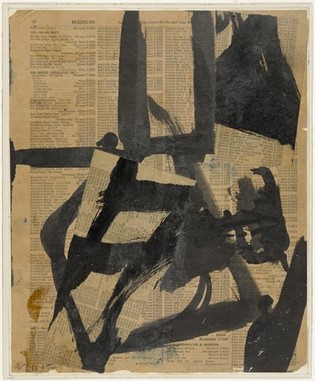
Franz Kline, Untitled, New York, 1952.


“The cultural environment is merely the reflection of what is in us, and if the cultural environment has changed, then something in us must have changed.” – Suzy Gablik, 2004.

Whenever I consider these two subjects and themes, which is something I tend to do several times a week, I can’t help thinking that the reason so many avant-garde artists either practice Buddhism, or are at least deeply influenced by its vibe, is the basic and simple fact that even though it’s more than two and a half millennia old, the philosophy that originated in India and swiftly moved to the East and West already was and still is a highly experimental venture in its own right. Few things, after all, could be more radical and avant than the notion that there is actually no tangible, abiding and independent self, and that impermanence is really the only guiding principle upon which we can construct a code of conduct grounded in compassion.