Tuesday, August 29, 2023

Fond Farewell: Alan Arkin (1934-2023)

Jeff Bridges and Alan Arkin in Hearts of the West (1975).

Alan Arkin died on June 29, two years after he was killed off on his penultimate gig, the Netflix series The Kominsky Method, where he played Michael Douglas’s agent and best friend, Norman Newlander; the show had begun, movingly, in 2018 with Norman mourning the loss of his wife from cancer. (Arkin’s official final employment was a voice job on the animated film Minions: The Rise of Gru.) Arkin dropped out of Bennington to perform in a successful folk music combo, The Tarriers, for which he co-wrote “The Banana Boat Song” – a calypso hit for The Tarriers but a bigger hit for Harry Belafonte. Then he trained in revue-sketch comedy with Second City before breaking through on Broadway in 1963’s Enter Laughing, for which he won a Tony Award. He launched his movie career three years later with the affable Norman Jewison farce The Russians Are Coming, The Russians Are Coming, where he gave a very funny – and almost demonically controlled – performance as a Russian navy lieutenant who sets out to find a way to liberate his submarine when it runs aground in Gloucester, Massachusetts without igniting an international incident. Within the next few years Arkin was everywhere – in Murray Schisgal's The Love Song of Barney Kempinski on the TV anthology series ABC Stage 67; as the sociopathic killer who menaces blind Audrey Hepburn in Wait Until Dark; as the deaf-mute protagonist of an adaptation of Carson McCullers’s The Heart Is a Lonely Hunter; as Yossarian in Mike Nichols’s film of Joseph Heller’s Catch-22; in Jules Feiffer’s Little Murders, which he directed himself.

Thursday, August 24, 2023

Being the Best: Pop Journalism Comes of Age

Hachette Books, 2022; Hachette Books, 2022.

“How does it feel, to be on your own, a complete unknown, with no direction home . . .” – Bob Dylan

I suppose I’ve always been mystified, in an entertaining way, with our culture’s virtual obsession with the best this and the best that, as if selecting from the taste menu in arts, letters or music actually meant “I’ll have what everyone else is having.”  Maybe it does. Academy Awards, Tony Awards, Nobel Prizes, Grammy Awards, best car, best restaurant, best fashion, best wine, best hotel, and so on forever. Generally, of course, such a designation usually refers to most popular, and nowhere does popularity often equal quality as it does in the rarefied world of pop music. How it could it be otherwise, since the very name says it all? But I’ve never believed that pop meant disposable or frivolous; far from it, since pop, and especially great pop music, is quite often the most accurate gauge of what the French call mentalité, the state of mind of a culture. And pop, at the virtuosic and technically complex level of The Beatles, The Stones, Brian Wilson’s Beach Boys, or The Mamas and the Papas, is obviously an art form demonstrating admirable aesthetics. High-quality pop is invariably a mirror of our reality, regardless of how distorted or clouded by various biases that mirror may be. 

Tuesday, August 22, 2023

All Hail the Comic Muse

Mike Nadajewski and Kristi Frank in On the Razzle. (Photo: Emily Cooper)

This piece includes reviews of On the Razzle, Blithe Spirit and Village Wooing.

This summer the Shaw Festival has been bowing to the comic spirit. In addition to Shaw’s The Apple Cart and The Playboy of the Western World, which mix serious and humorous elements, the roster has included productions of four comedies from different eras: Marivaux’s The Game of Love and Chance (1730), performed outdoors in an improvised version – the only one of the quartet I didn’t get to; Shaw’s Village Wooing (1934), this season’s lunchtime one-act; Noël Coward’s Blithe Spirit (1941); and Tom Stoppard’s On the Razzle (1981). In truth, the last of these can claim connection to several periods. It began in 1835 as a one-act English play by John Oxenford called A Day Well Spent, which the Viennese playwright and actor Johann Nestroy adapted seven years later as Einen Jux will er sich machen (He’s Out for a Fling). Thornton Wilder reworked it for Broadway in 1938 as The Merchant of Yonkers – a failure, despite direction by the legendary Max Reinhardt – and then again in 1955 as The Matchmaker, which altered the story about shop clerks out on the town by inventing the assertive, charismatic title character (played by Ruth Gordon on Broadway) and reconfiguring the play around her. It was filmed the following year with Shirley Booth in the role and featuring three talented young performers early in their careers: Anthony Perkins, Shirley MacLaine and Robert Morse. In 1964 The Matchmaker became the musical Hello, Dolly!, which, of course, ran for years. On the Razzle is Stoppard’s rewrite of the Nestroy, not the Wilder, so there’s no Dolly Gallagher Levi dashing around in aid of the young lovers while manipulating her sour-faced client into marrying her rather than the widow he’s after or the fictitious millionairess she’s promised him.

Tuesday, August 15, 2023

The Playboy of the Western World and The Apple Cart: Flying High at the Shaw

Marla McLean and Qasim Khan in The Playboy of the Western World. (Photo: Emily Cooper)

In the preface to his 1907 masterpiece The Playboy of the Western World, the Irish playwright John Millington Synge writes, “On the stage one must have reality and one must have joy . . . In a good play every speech should be as fully flavoured as a nut or apple . . .” This dictum explains the play’s unusual style and texture, realism folded in with folk-fable imagination and humor and language so musical that it sings in your ears even when you’re just reading the text. Synge claims that he owes both the wildness of the narrative and the richness of the vernacular to his close attention to the way rural working-class Irish people speak (or did around the turn of the twentieth century).

Monday, July 31, 2023

Summer Musicals: Summer Stock and Gypsy

Corbin Bleu and the dancers in Summer Stock. (Photo: Diane Sobolewski)

Summer Stock, released in 1950, followed a particularly unhappy time in Judy Garland’s life and career – after the deterioration of her marriage to the director Vincente Minnelli, after she made her first suicide attempt and was committed to a rehab center, and after M-G-M replaced her on Annie Get Your Gun with Betty Hutton. Yet it feels like a breather for her: though her weight fluctuated during the filming (in her last big number, “Get Happy,” she’s strikingly trim), her performance is ebullient and unstrained. It was her third and final pairing with Gene Kelly – the others were For Me and My Gal in 1942 (his film debut, after he’d conquered Broadway in Rodgers and Hart’s Pal Joey) and The Pirate, for Minnelli, in 1948 – and his warmth and virility, his earthiness and easy jocularity, always brought out an appealing vaudevillian quality in her. None of her other co-stars was so ideal a vocal match for her, and though it’s great to see her with Fred Astaire in Easter Parade (1948), especially in the “Couple of Swells” number, when she and Kelly dance together they seem to belong to the same club. Summer Stock (which Charles Walters directed) is lightweight, and there’s nothing much in the George Wells-Sy Gomberg script that hadn’t been done in previous backstage movie musicals like the ones Garland and Mickey Rooney co-starred in, or Irving Berlin’s Holiday Inn. Garland plays Jane Falbury, who’s struggling to keep her farm from going under, and Kelly is Joe Ross, who persuades her to let him produce a show in her barn. But it never pushes the sweetness or the rural Americana, it has a fine supporting cast (except for Gloria De Haven as Jane’s self-centered sister: her acting is really awful), and Garland and Kelly’s scenes together are endearing.

Wednesday, July 12, 2023

Shy: The Life of Mary Rodgers

Carol Burnett and Joe Bova in the original Broadway production of Once Upon a Mattress (1959).

Mary Rodgers, the daughter of the legendary Broadway (and occasionally Hollywood) composer Richard Rodgers, wrote the music for the 1959 musical Once Upon a Mattress. Aside from The Mad Show, a downtown revue she contributed to that ran for a year, Mattress was her only hit show, but she worked on many other stage musicals that flopped (often out of town) as well as a handful of TV musicals. She also wrote the Freaky Friday children’s books, assisted Leonard Bernstein on the Young People’s Concerts on TV, chaired or served on the boards of many schools and other organizations, and raised five kids; a sixth died tragically in childhood. (One of them, Adam Guettel, is the composer-lyricist of The Light in the Piazza, which I join my Critics at Large colleague Joe Mader in calling the best musical written in the twenty-first century.) This life, which Oscar Wilde’s Lady Bracknell would have pronounced “crowded with incident,” is memorialized in Shy: The Alarmingly Outspoken Memoirs of Mary Rodgers  (Farrar, Straus and Giroux, 2022), which Rodgers co-wrote with the current New York Times theatre critic Jesse Green and on which he provided the finishing touches after she died, at the age of eighty-three, in 2014. (Green was then reviewing plays for New York Magazine.)

Friday, June 30, 2023

Shining Through: Encores’ The Light in the Piazza

Anna Zavelson and Ruthie Ann Miles in The Light in the Piazza. (Photo: Joan Marcus)

Director Chay Yew provides The Light in the Piazza, the final offering of Encores’ 2023 season, a slight spin on the 2005 original by casting the two lead roles with Asian-American actresses. Margaret Johnson, the role that won Victoria Clark a Tony, is now played by Ruthie Ann Miles, while her daughter Clara, a luminous Kelli O’Hara in the original, is newcomer Anna Zavelson. 

Wednesday, June 28, 2023

Plays with Music: Brokeback Mountain and The Curious Case of Benjamin Button – and a Brief Farewell

Mike Faist and Lucas Hedges in Brokeback Mountain. (Photo: Manuel Harlan)

Receiving its world premiere at London’s compact, comfortable new Sohoplace in London, Brokeback Mountain, Ashley Robinson’s ninety-minute dramatization of the Annie Proulx story most people know through the 2005 film, is a trim, skillful production. Jonathan Butterell has staged it effectively in the round on Tom Pye’s pared-down set and Mike Faist and Lucas Hedges, the two actors succeeding Jake Gyllenhaal and the late Heath Ledger in the roles of the young Wyoming cowboys embarking on a forbidden, tragic gay romance, are both excellent, especially Hedges as Ennis Del Mar, the more inexperienced of the two lovers. The problem is that damn material, which is meager and phony and keeps striking the same mournful note over and over. The show includes a small band playing country-western ballads (mostly) that merely replicate the mood. You walk out of the theatre starved for a little variety – and, God knows, an ounce of humor.

Monday, June 19, 2023

Shakespeare in London

The closing image of The Comedy of Errors at the Globe. (Photo: Marc Brenner)

One of the consequences of Covid and its attendant economic challenges for London theatre is the shortage of classical English productions this summer – even, and most glaringly, Shakespeare. This is the only time I’ve ever been in London at this time of year when the National Theatre isn’t mounting a single play by Shakespeare. All I’ve managed to see are The Comedy of Errors (his first comedy) at Shakespeare’s Globe and Romeo and Juliet (his earliest tragedy) at the Almeida.

Friday, June 16, 2023

Parallel Forces of Culture: Chuck Berry and Bob Dylan

Hachette Books, 2022;  Hachette/Back Bay Books, 2021.

“I never wanted to be a 60’s artist, but to be an artist for all time. If it’s not for all time it’s not worth doing. My mind works in a timeless way. 1966 might as well be 2090—it’s all the same to me.” – Robert Zimmerman

“There’s two things that a man must know in order to get closer to himself, to be a man. One is mathematics, since everything is controlled by numbers; the second thing is money.” – Chuck Berry

These two titanic musical artists were two parallel storms that first ripped across America’s unsuspecting 50’s and 60’s heartland, and then rapidly tore across the whole planet earth with a ferocity only matched by The Beatles. Ironically, the first artist, Chuck Berry, inspired The Beatles, who then were creatively reborn themselves once inspired dramatically by Bob Dylan, along with every other singer-songwriter on the convulsing planet of pop culture. Both from Hachette Books, these books are also an ideal tag team match for taking the full measure of true innovation and influence within their respective fields. In a very real sense, there was popular music before Chuck Berry and then after Berry, just as both folk and rock can only be fully appreciated if assessed both before Dylan and then after his astonishing ascent. RJ Smith’s biography of Chuck Berry, Chuck Berry: An American Life, can rightfully be called the definitive one in a prior flock of works of varying degrees of serious intent: the most serious, the most revealing (often embarrassingly so) and also easily the most readable for both music devotees as well as the general public with a curiosity as to how rock and roll music was born and how it grew into its adulthood as rock. One of his most ardent fans, the equally accomplished pop musician John Lennon, once quipped that if you wanted to give rock and roll another name, you might just call it Chuck Berry. While this is technically true, and quite touching, I’d point out that you could also call it Sister Rosetta Tharpe and Louis Jordan, both of whom were active for a full decade, making the kind of jump rhythm and blues that white folks (most notably the disc jockey Alan Freed in about 1951) eventually called rock and roll. Add into that heady mix Jackie Brenston and Ike Turner and his Rhythm Kings, whose 1951 hit “Rocket 88” was technically the earliest song we can identify as full-blooded rock.

Tuesday, June 13, 2023

Saint Infidelity: The Circle and Yours Unfaithfully

Clive Francis and Jane Asher in The Circle. (Photo: Ellie Kurttz)

The two most interesting plays I’ve encountered in London over the past two weeks are century-old high comedies by English playwrights that challenge sexual mores. Both are receiving admirable productions. The Circle by W. Somerset Maugham was first produced in 1921 and long ago vanished from the repertory; it has been taken up by the Orange Tree Theatre in Richmond, with Tom Littler directing. (The last Broadway revival, in 1990, starred Rex Harrison, who died during the run.) Yours Unfaithfully was penned in 1933 by the actor and writer Miles Malleson but remained unproduced until Jonathan Banks, the artistic director of Mint Theater Company, staged it in New York in 2016. He helms the current edition at the Jermyn Street Theatre, with a British cast.

Monday, June 5, 2023

Water in the Desert: Summer, 1976 and Good Night, Oscar

Laura Linney and Jessica Hecht in Summer, 1976. (Photo: Jeremy Daniel)

Almost every straight play I’ve seen in the last two years has either infuriated me or made me feel desperate about the state of the American theatre. It’s partly the result of the Covid shutdown, partly the elevation of identity politics as subject matter, partly the pushback against the old priorities, like structure and narrative logic and character development – which is, of course, a form of the rejection of professional expertise, now considered a cover for racism or sexism or homophobia. But after you’ve sat through Fairview, POTUS, The Minutes, Straight Line Crazy and A Prayer for the French Republic (some of which were written by playwrights with some talent), you might long for a display of skill the way a stranded traveler in the Gobi Desert longs for water.

Monday, May 29, 2023

New York, New York: Stepping Around the Heart of Scorsese’s Movie Musical

 The wonderful "Wine and Peaches" number in New York, New York. (Photo: Paul Kolnik)

Martin Scorsese’s 1977 New York, New York, perhaps the only Big Band musical film after the collapse of the Big Band era, is about the meeting – collision is more accurate – of two young musical hopefuls in Manhattan on V-J Day, both newly out of the service. Jimmy Doyle (Robert De Niro, at the end of his astonishing early career – the year after Taxi Driver) is a relentlessly confident saxophonist and Francine Evans (Liza Minnelli, in her least-known great performance) is a vocalist. He keeps asking her out; she keeps telling him no. But his persistence, obnoxious as it sometimes gets, is inseparable from his charm, and though she tries to resist she ends up acceding to every one of his demands. She does go out with him, she lands him a job by performing a duet with him at an audition – it’s “You Brought a New Kind of Love to Me,” and they’re a knockout together (Georgie Auld, who plays a supporting role, dubs Jimmy’s sax) – and they become lovers, then husband and wife. You’d have to be De Niro to pull off this part. The marriage is a disaster, because Jimmy is demonically focused on his career and professionally competitive, and when Francine doesn’t – or can’t – do exactly what he demands of her, he steams. And he cheats on her. The divergence in their careers – she becomes a star of stage and movie musicals, he becomes one of the inventors of bop – operates as a symbol for all the ways in which their relationship is unworkable.

Sunday, May 28, 2023

Tina Bids Farewell: The Exuberant Buddhism of the Late Tina Turner

Tina Turner, in 2018. (Photo: Charles Gates)

“The Buddhist concept of changing poison into medicine works. My life has proven it."  – Tina Turner, Living Buddhism, July 2018.

As a Buddhist, I don’t, of course, believe in the customary concepts of heaven or hell, since as fellow practitioners well know, we humans do a pretty good job of manufacturing our own versions of those two domains right here on earth while we’re alive in this material world. Like many of you, though, I do, however, believe in reincarnation, and that’s where my mind first went when I learned of the passing of the great Tina Turner at the age of 83 at her home in Switzerland on May 23, 2023, with her beloved second husband Erwin Bach at her side. Her first husband, the notoriously abusive Ike Turner, whose sole role in history has become his introduction of a shy sixteen-year-old girl named Anna Mae Bullock to the recording industry and his transformation of that girl into Tina, the larger-than-life talent we all came to adore, has drifted off into whatever hellish domain awaits the cruel and inhuman among us. But Tina, she might well have gone elsewhere.

Tuesday, May 23, 2023

Making the Myth True: The Fisher King on Criterion

Robin Williams and Jeff Bridges in The Fisher King.

Around the turn of the millennium, the director Terry Gilliam struggled to bring an updated Don Quixote to the screen; the documentary Lost in La Mancha (2002) chronicles the breakdown of the project after bad weather and the illness of his Quixote, the French actor Jean Rochefort, threw it into financing hell. When he finally released a version of it called The Man Who Killed Don Quixote in 2018, he’d lost the momentum. Really, though, he’d already made his Don Quixote, back in 1991. In his best movie, The Fisher King, written by Richard LaGravenese, two men strangely bonded by a tragedy heal each other through a crackpot mission to locate the Holy Grail, devised by one of them, a schizophrenic (Robin Williams) who used to be a Hunter College English professor named Henry Sagan, and carried through by the other, a one-time radio talk host named Jack Lucas (Jeff Bridges) whose life has become meaningless. The tragedy is a mass shooting at a popular bar called Babbitt’s perpetrated by a lunatic who has received encouragement for his paranoia by Jack, whose favorite targets is the yuppies who frequent Babbitt’s. Jack’s spleen isn’t real; his diatribes are cynical inventions to entertain his listeners and fuel his career. Until the killer strikes, it never occurs to him that there might be consequences to his habit of revving them up. Afterwards, shattered by what he’s brought into being, Jack goes into retreat, drinking and hiding from the world while his girlfriend Anne (Mercedes Ruehl) shelters him and lets him help her manage the video shop below her apartment.

Tuesday, May 16, 2023

Gypsy at the Goodspeed: The Vaudeville Spirit

Talia Suskauer and Laura Sky Herman in Gypsy. (Photo: Diane Sobolewski)

You know that Jenn Thompson, the director of the Goodspeed Opera House’s production of Gypsy, has a steady hand on the wheel right from the opening scene. It’s an audition for child acts in a dilapidated Seattle theatre in the grim last years of vaudeville, when the talkies dealt it a long, painful death that coincided with the Depression. The stage is crowded with kids in a variety of garish get-ups and their mothers until Uncle Jocko (Edward Juvier), the ulcerated, borderline creepy, far-from-unbiased comic hosting the variety show, banishes the latter. Then Rose (Judy McLane), who is promoting her little girl, Baby June (Emily Jewel Hoder), bulls her way down the aisle; the rules don’t apply to her. June has a head full of blonde curls and an affected squeal; she’s a nightmarish proto-Shirley Temple, flanked by her awkward older sister Louise (Cameron Blake Miller). Thompson’s staging picks up the show-biz chaos, its comedy and preposterousness and desperation, which finds its most feverish embodiment in Rose, the quintessential stage mother – perhaps the greatest and most original creation in the history of musical theatre.

Tuesday, May 9, 2023

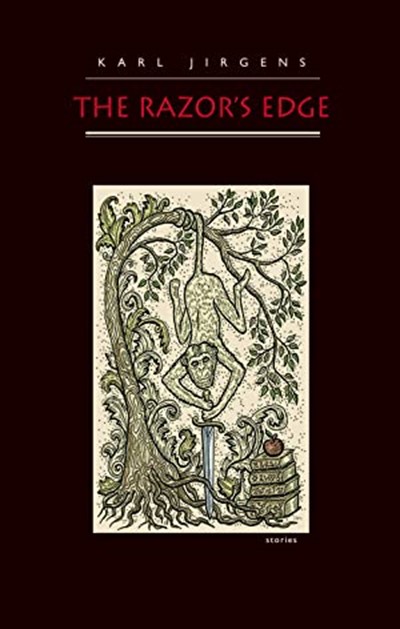
Reveries Unlimited: The Razor’s Edge Stories of Karl Jirgens

Porcupine’s Quill Press, 2022.


"There is something missing . . . if I knew what it is then it wouldn't be so missing . . . " – Hans in The Recognitions by William Gaddis (1955).

No, Reveries Unlimited is not the corporate name of a company specializing in providing services related to waking dreams, dreams we have with our eyes wide open while engaging in psychological wanderings. I’ve coined this hopefully supple phrase to encapsulate the kind of author who prompts, encourages, inspires and otherwise seduces us into sharing his or her narrative roamings through a past, present and future which collide, intersecting gently in a series of gently linked stories. Such is the service provided by Karl Jirgens in the recent collection called The Razor’s Edge, from Porcupine’s Quill Press, which subtly touches upon Maugham’s classic tale of a search for the meaning of life, in which we often feel as if we were walking on that precarious edge, posed between transcendence and a fall into oblivion.

Monday, May 8, 2023

Air: The Spirit That Moves a Business

Peter Moore (Matthew Maher) gives Sonny Vaccaro (Matt Damon) and Rob Strasser (Jason Bateman) a first look at the Air Jordan, in Air. (Photo: Ana Carballosa)

Ben Affleck’s roisterous comedy Air may be the most unconventional true-story sports movie ever made with the exception of Ron Shelton’s Cobb. (And Cobb is a masterpiece that transcends its genre.) Air’s focus isn’t exactly on a sport or a heroic player, but on the birth of a business decision and a company’s effort to turn it into reality. Moneyball veered off the genre’s beaten path by choosing a protagonist, Oakland A’s general manager Billy Beane (Brad Pitt), who made baseball history not by harnessing the spirit of a downtrodden team or devising a strategy to turn them into triumphant players but by choosing his recruits through computer-generated analysis. Its twenty-first century brand of pragmatism – the fact that it celebrated virtues that have nothing to do with the romantic vision baseball lovers cling to of their favorite sport – gave Moneyball a new kind of sharp edge. But the protagonist of Air, set in 1984, isn’t a professional athlete or someone whose job it is to make champions. It’s a businessman, Sonny Vaccaro (played by Matt Damon), who works as a talent scout for Nike, unearthing young players on the hopeful cusp of basketball careers whose endorsement of the company’s basketball sneakers might make it competitive with Converse – whose shoes carry the imprimatur of Magic Johnson and Larry Byrd – and Adidas. (Nike’s runaway success in selling sneakers has markedly failed to extend to the basketball market.) Air is about Vaccaro’s courtship, over the reluctance of the company’s CEO, Phil Knight (Affleck), of eighteen-year-old Michael Jordan and the creation of the Air Jordan.

Thursday, April 20, 2023

Double Vision: Beyond Binary Art History

Princeton University Press (2022); Princeton University Press (2022)

“We have arrived at an era of humans and their doubles. We no longer need mirrors in order to talk to ourselves.” –Jean-Luc Godard, 1965.

Polarity, duality, dichotomy, opposition, contradiction, mutuality: these art books run the gamut of this spectrum.

As almost always in my case, synchronicity appeared to be at play (in its usual subterranean manner) with the arrival of two remarkably insightful books that explore our binary condition and what lies beyond it, each in its own distinctive way, but both in shared terms of expanding our appreciation for art and cultural artifacts which transcend outmoded definitions of traditional media disciplines and aesthetic values. Global Objects: Towards a Connected Art History, by Edward Cooke, and The Double: Identity and Difference in Art Since 1900, by Peter Meyer, are excellent in-depth explorations of how contemporary art provides a mirror of reality, even when that mirror is clouded by myth or fixation. Both are released by Princeton University Press and both approach the polarities of art versus craft and the dichotomies of singular self, with a deft command of their subject matter and theme.

Monday, April 17, 2023

Musical Revivals II: Sweeney Todd and Camelot

Annaleigh Ashford and Josh Groban in Sweeney Todd.

Despite the intermittently brilliant Stephen Sondheim score and a superb cast headed by Len Cariou and an unforgettable Angela Lansbury, I had a medium cool experience with the original 1979 Broadway production of Sweeney Todd. It felt inflated, overproduced (a response I have had to a few other Prince shows), and determined to make a statement competitive with that of Brecht and Weill’s The Threepenny Opera, which was the obvious inspiration for Sondheim, book writer Hugh Wheeler and Prince. But the material, a grisly horror derived from Christopher Bond’s 1973 rewrite of a mid-Victorian melodrama, is thin. At the end of the first act, thinking he’s missed his chance to murder the  corrupt Judge Turpin, who trumped up a charge against him and had him transported so he could get his mitts on Sweeney’s innocent wife Lucy, Sweeney, “the demon barber of Fleet Street,” sings “Epiphany,” in which he decides that he’s going to visit his frustrated revenge on his customers because “they all deserve to die.” And Mrs. Lovett, his landlady, who runs a pathetic pie shop with the only stringy meat she can afford, comes up with the scheme of using the corpses to make her wares sweeter and juicier.  Todd loves the idea, so they become business partners. In the first-act finale, “A Little Priest,” he argues that since society is built on men devouring each other, he and Mrs. Lovett might as well make the metaphor literal. “A Little Priest” is a wonderful burlesque-style novelty number constructed on a series of increasingly funny puns about their imagined victims. But it’s not exactly “The Second Threepenny Finale” (“What keeps a man alive? He lives on others”). Sweeney Todd is a cleverly devised penny dreadful, not a social satire.

What turned me around about the musical was the 2005 Broadway revival, directed by John Doyle, which had begun life in the West End. Starring Michael Cerveris as Sweeney and Patti LuPone as Mrs. Lovett, it was leaner and tighter than the original, with ingenious Brechtian effects – and it made no attempt to sell itself as profound social commentary. The new Sweeney Todd, directed by Thomas Kail, with musical direction by Alec Lacamoire – both Hamilton alumni – is almost as good as Doyle’s. And it has an even better Mrs. Lovett than LuPone, Annaleigh Ashford, whom I loved in Dogfight and the 2014 revival of You Can’t Take It with You (with James Earl Jones) and the 2017 revival of Sunday in the Park with George (where she played opposite Jake Gyllenhaal). She’s amazing. Slighter and more kinetic than her predecessors, Ashford looks like a devilish rag doll, and every physical choice she makes – and many of her vocal ones (like switching keys twice in the middle of her show-stopping first song, “The Worst Pies in London”) – is inspired. When she played this role Lansbury embodied the play’s music-hall origins, while LuPone’s numbers were like Brecht and Weill done as punk rock. Ashford is lighter on her feet and loonier, and her performance harks back to revue comedy – specifically to Imogene Coca, who partnered Sid Caesar so sublimely in the live TV days.