Showing posts sorted by relevance for query Clifford Odets. Sort by date Show all posts

Monday, August 1, 2011

Lessons in Playwriting: Haunting Julia, Rocket to the Moon and Cause Célèbre

Alan Ayckbourn wrote Haunting Julia in 1994 but it didn’t receive a London premiere until this year – when it opened far from the West End, at the Riverside Studios in Hammersmith. But it’s a lovely little play, a three-handed ghost story that disseminates some compelling themes through extremely well-drawn characters, and the modest production, directed by Andrew Hall, does the text full justice. The characters are three men, all of whose lives have been deeply affected by their contact with a prodigious undergraduate musician who killed herself several years earlier. Joe Lukin (Christopher Timothy) is her father, whose care for her – he and her mother moved to be closer to her when she began university – drove her to take a flat on her own, which he has now converted into The Julia Lukin Centre, a sort of museum that preserves her old environs and in which, creepily, a recording narrates in the first person a sentimental, air-brushed chronicle of her life. Andy Rollinson (Dominic Hecht) was her boy friend; he found her body. Now he’s a high school music teacher with a family of his own, but he’s kept up his relationship with Joe and his wife. The play begins when Joe guides Andy through the newly constructed centre – it’s clear to us, if not to Joe, that Andy finds the experience profoundly uncomfortable – and then presents what he believes is evidence that her ghost is haunting it. The third character is a psychic named Ken Chase (Richard O’Callaghan) who turns out to be someone who actually knew her, the janitor who lived downstairs from her with his family, whom she often visited.

Timothy, Hecht, and O'Callaghan (Photo Tristram Kenton)
The play is about the loneliness of genius, about the unrelenting demands of the muse, and about the smothering kind of parental love that can both impede adulthood and drive a grown-up child mad. It’s also about moving on from the powerful grip of a first love – that’s Andy’s story. Ayckbourn doesn’t underline any of these ideas; he allows them to leak out through the development of the narrative, which is a series of surprising revelations after each of which we feel we understand the characters, including the absent Julia, a little better. One of my favorites, really just a detail but an inspired one, is Ken’s referring to the dead girl as Julie, because that’s what he and his family used to call her when, divested of her obligations to her music and to her parents, she dropped by to share their ordinary lives.

Monday, December 3, 2012

Golden Boy: Art vs. Commerce

Tony Shalhoub, Seth Numrich, Dagmara Dominczyk, and Michael Aronovin Golden Boy (Photo by Paul Kolnik)
 
When you read about the Group Theatre, the legendary company that introduced Stanislavskian acting to the American theatre in the 1930s, you can’t help wondering what their performances were really like. You can get some sense of this pioneering Method acting style when you watch John Garfield, the only one of the troupe who became a movie star, or Lee J. Cobb, who went on to play Willy Loman in Death of a Salesman on Broadway (and revisited the role years later on television) and the gangster Johnny Friendly in On the Waterfront, or the few remnants Morris Carnovsky, the Group’s master actor, has left us of his work, in featured movie roles and TV appearances. But the first time I really got a feel for the Group Theatre style was when a PBS documentary about them included a clip I’d had no idea even existed: Luther Adler’s screen test from the mid-thirties, which replicated a scene that he and Phoebe Brand had played together on stage in Clifford Odets’s Awake and Sing! (Adler and his sister Stella, the children of the celebrated Yiddish Theatre star Jacob Adler, were two of the Group’s leading actors; Brand, who married Carnovsky, came out of retirement to play Nanny in Vanya on 42nd Street.) The clip is maybe two minutes long, and you can’t even see Brand’s face, yet it’s a revelation. Certainly the acting is grounded by a rock-bound naturalism, but it’s more heightened than I’d imagined, more theatrical – in the best way. The scene is between Moe Axelrod and Hennie Berger, one-time lovers who are still desperate for each other but so resentful and defensive that they circle each other warily like nervous animals, every now and then reaching out a paw to swipe one another; and the two actors aren’t afraid to go for broke. You can hear the stage training in the broad vocal palette, in Brand’s free use of tremolo (a more old-fashioned choice than I would have guessed, but extremely effective here) to underscore her character’s woefulness and in the nobility in Adler’s stature and in the way he holds his face to the light.  (Among the Method actors of the next generation of Method actors, Ben Gazzara notably retained that quality.) You believe fully that you’re watching the characters, yet you don’t forget you’re watching actors. Perhaps no Method actor could make you forget that until Marlon Brando.

I thought of Adler’s screen test during Golden Boy, Bartlett Sher’s magnificent new Broadway production of the 1937 Odets play that was the Group’s biggest hit. (Adler played the title role, Carnovsky was his father, and Cobb, Garfield and Brand were all in the company, as well as the Hollywood actress Frances Farmer and two future directors, Elia Kazan and Martin Ritt.) Odets trained as an actor with the Group but early on he began to write plays for them; seven were produced during the Group’s decade-long existence (it finally collapsed in 1941), including Waiting for Lefty, Paradise Lost and of course Odets’s masterpiece, Awake and Sing! He was the closest they had to an official playwright-in-residence, and Golden Boy is his most personal play. Before he wrote it, and again afterwards, he spent time in Hollywood, where he knew his talents were being squandered, as Hollywood squandered the gifts of so many of the great east-coast writers in the thirties and forties, but which offered him a luxurious lifestyle that, like so many others, he found hard to resist. The battle between what you do for your soul and what you do to make a buck is at the heart of Golden Boy, in which Joe Bonaparte, the working-class son of Italian immigrants, a talented violinist, becomes a boxer, a choice that breaks his own heart as well as his father’s and imperils his soul.

Friday, May 24, 2013

Beyond Palookaville: The Criterion Collection Release of On the Waterfront

"I can't discuss it as a movie anymore," director Martin Scorsese tells film critic Kent Jones in an interview included on the new Criterion Collection release of Elia Kazan's powerhouse 1954 drama On the Waterfront. "It's more of a phenomenon. Are there better movies? Probably. I see how the story is structured to make a point...[Yet] there is something revolutionary about that film." There are few movies that take us beyond the experience of simply watching one. Certainly Citizen Kane (1941) does, with its dazzling sound and visual innovations, where director Orson Welles – having come to Hollywood out of his daring work in theatre and radio – combines the two mediums in order to treat our eyes in the way we often use our ears. In doing so, he distracts us from some of the shallowness and the flaws in the plot and unleashes something boldly new and entertaining. Jean Renoir's The Rules of the Game (1939) is undoubtedly another, where all the rules of genre get broken to create a masterpiece of multiple genres mingling together into something so new that the viewer is both engaged and moved by a picture that defies classification.

On the Waterfront is a straight-forward drama, written by Budd Schulberg (What Makes Sammy Run), about a New Jersey longshoreman and ex-boxer Terry Malloy (Marlon Brando) who comes to tackle the moral dilemma of whether to remain loyal to his mob-connected boss Johnny Friendly (Lee J. Cobb) and Terry's brother, Charlie (Rod Steiger), who is the mobster's right-hand man, or to talk instead to the crime commission and name names. It doesn't seem to belong in the same category of films that could be described as "revolutionary." But that's only if you seize solely upon the melodramatic structure of its plot. What sets On the Waterfront apart from more conventional melodrama, besides the emotional force of its storytelling, happens between the lines of the story. It even goes beyond the film into the larger world that shaped it. "On the Waterfront is no more about the real business of the docks – working conditions, union racketeering, or reform – than Hamlet is an expose of corruption in the medieval Danish court," writes filmmaker Michael Almereyda (Nadja) in the DVD liner notes. "[On the Waterfront arrives] at an elevated place in our collective consciousness, a place where familiar images and scenes continue to seem urgent, to surprise us, to trigger intense feelings, reaching past the long shadows of politics and the blind wind of success or failure." To define that elevated place Almereyda refers to, you first have to grasp the social and political issues that turned On the Waterfront into the very phenomenon that Scorsese describes.

Monday, November 17, 2014

Awake and Sing!: Loveless Intimacy

Awake and Sing!, directed by Melia Bensussen, at the Boston's Huntington Theatre Company (Photo: T. Charles Erickson)

In a brilliant 1946 essay about Awake and Sing!, Robert Warshow called Clifford Odets the “poet of the Jewish middle class,” and when you hear his dialogue spoken from the stage of the Huntington Theatre in its deeply moving revival of the play you know exactly what Warshow meant. Odets – working from his own first-hand knowledge of Jews fighting to forge an identity in America, his consciousness of the hand-to-mouth struggle of families during the Depression, his Communist principles, his devotion to Chekhov, and his Stanislavskian training as a company actor in the Group Theatre – created a new kind of American drama. In 1935 he was twenty-eight and working at astonishing speed. In that year alone he churned out the agit-prop labor play Waiting for Lefty (which mixed Brechtian and naturalist elements and brought audiences literally to their feet, chanting, “Strike!” at the end along with the actors) and two magnificent realist dramas, Awake and Sing! and Paradise Lost. The best of the three – the best thing Odets ever wrote – is the Bronx-set Awake and Sing!, where the Berger family, in Warshow’s phrase, “live on top of one another, in that loveless intimacy which is the obverse of the Jewish virtue of family solidarity.” It’s a matriarchy that Bessie Berger rules over with increasingly desperate tyranny as the family threatens to come apart. Her husband Myron, who dropped out of law school for financial reasons, is a well-meaning, gentle-souled man who long ago ceded authority to his wife and who, in these hard times, has lost his breadwinner role, his work days cut back to three. When Hennie, their elder child, gets pregnant by an out-of-towner she can’t track down (either he gave her a false name or he lied about the company that employed him), Bessie marries her off post-haste to an adoring recent immigrant with a decent job who never questions the baby’s paternity. When Ralph, the younger child, falls in love with a poor girl, Bessie throws up obstacles; so does the girl’s family, and the romance dwindles. Ralph is close to the other inhabitant of this tenement apartment, his grandfather, Jacob, a Marxist who, though he himself is cowed by his daughter, fans the flame of the boy’s dreams and urges him to go out and change the world “so life won’t be printed on dollar bills.”

Sunday, May 19, 2013

The Big Knife: Botching the Trick

Marin Ireland and Bobby Cannavale in The Big Knife, at the Roundabout Theatre Company (Photo by Joan Marcus)

Staging Clifford Odets is tricky business, but Bartlett Sher’s production of his 1937 Golden Boy last fall showed that in the twenty-first century there’s still a way to use his language – stylized but firmly grounded in Stanislavskian psychological realism – to unleash theatrical power. Unhappily, the second Odets revival of the season, The Big Knife at the Roundabout, is a lame duck. Under Doug Hughes’ direction the actors either pretend the language isn’t heightened at all or else they seize on it as an excuse for overacting.

Monday, April 18, 2016

Arnold Wesker (1932-2016)

Playwright Arnold Wesker (1932-2016) at the Durham Book Festival in 2008. (Photo: Simon James)

The angry young man movement, which attacked England’s obstinacy about holding onto its vision of itself as an empire after the Second World War and quarreled with the bourgeois gentility of the mid-century English drama, detonated the British theatre in the mid-1950s. But except for John Osborne, whose Look Back in Anger and The Entertainer are still performed as Tony Richardson’s film versions continue to represent the exciting early years of the English New Wave, the playwrights who came out of that movement have mostly been forgotten. One of them, Arnold Wesker, died last week at the age of eighty-three. His output included fifty plays as well as fiction, poetry, essays and memoirs, but only in the first five years of his theatrical career did he write plays – five of them – that made both critics and audiences sit up and take notice – though unlike Osborne’s plays or Shelagh Delaney’s A Taste of Honey, they never developed lives beyond English shores. They were The Kitchen (1957), which the National Theatre revived in 2011, Chips with Everything (1962), and – book-ended by these two – the plays known as “the Wesker trilogy,” Chicken Soup with Barley (1958), Roots (1959) and I’m Talking About Jerusalem (1960).

The trilogy – in particular the first and third plays – is about the golden promise of socialism and how its true believers handle the fallout when, inevitably, it smashes up against the realities of the world. Political idealism is a great subject, yet only a handful of playwrights have chosen to dramatize it since Sophocles in Antigone. Clifford Odets took up the challenge in Awake and Sing! and Paradise Lost, both written in 1935, and John Guare in his Lydie Breeze plays in 1982, and more recently it’s provided one of the themes for Richard Nelson’s Apple family plays (which were written to coincide with significant American political moments) and Temple by the talented young English playwright Steve Waters. The Wesker trilogy is a kind of British equivalent to the Odets plays, and just as Odets found his home with the Group Theatre, the Wesker plays were produced at the Royal Court, the heart and soul of the angry young man movement.

Monday, March 21, 2022

Acting and Actors – The Method: How the Twentieth Century Learned to Act

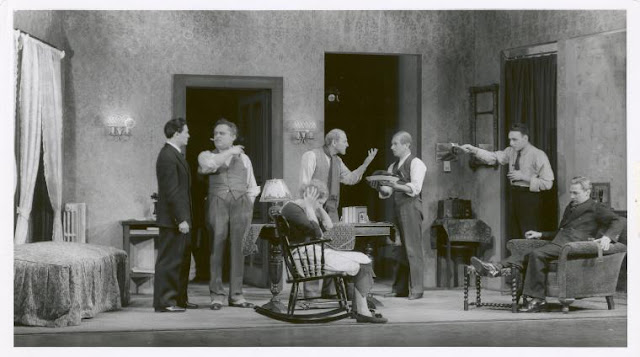
The 1935 Broadway production of Awake and Sing!

The Method: How the Twentieth Century Learned to Act by Isaac Butler (Bloomsbury Publishing) is a gossipy, entertaining and informative history of Stanislavskian acting – how it developed in Russia at the Moscow Art Theatre and how two of Stanislavski’s associates, Richard Boleslavsky and Maria Ouspenskaya, imported it to American shores, where, through its dissemination by the Group Theatre in the 1930s, it became the Method. Butler has rounded up an impressive amount of material and presents it coherently and compellingly. I didn’t realize how little I knew about the tensions between Stanislavski and the M.A.T.’s co-director, Vladimir Nemirovich-Danchenko; about the role each of the personalities who were drawn into Stanislavski’s circle played in the development of his approach to acting; about the effect Stalin’s rise to power had on the M.A.T. generally and on Stanislavski specifically – or certainly about Boleslavsky’s intriguing and rather crazy biography. No account I’ve read deals so clearly and in such dramatic detail with the break in the Group Theatre, when Stella Adler, its most gifted actress, challenged the weight Lee Strasberg, one of the company’s co-founders, placed on affective memory, where the actor digs into his or her past to unearth emotional dynamite to blast open a scene. Adler and Strasberg became the most important American acting teachers of the twentieth century. The Method’s examination of the differences in their styles and approaches and that of Sanford Meisner, another Group alumnus who became a famous and influential teacher, is fascinating. He identifies Adler’s greatest quality as her gift at script analysis; her book, compiled posthumously from her class notes, on Ibsen, Strindberg and Chekhov, and to a lesser extent the one on American playwrights, bear him out.

Monday, May 5, 2014

Of Mice and Men: Depression Dream

James Franco and Chris O'Dowd in Of Mice and Men (Photo: Richard Phibbs)

Depression plays are a distinctive genre in American theatre, and Of Mice and Men, which John Steinbeck fashioned from his 1937 novel, is perhaps the finest example written by anyone other than Clifford Odets. (Odets was the undisputed master of the form, and Awake and Sing!, produced two years earlier than Of Mice and Men, was his masterpiece.) Steinbeck’s book is practically a play – it’s mostly dialogue and it has a clear dramatic arc – so the transposition was a natural one. The play opened on Broadway while the novel was still on the bestseller lists. The original production starred Wallace Ford as George and Broderick Crawford as the physically strong but mentally challenged Lennie, whom George has known since childhood and has always cared for and protected. There was a marvelous film version in 1940, directed by Lewis Milestone, with Burgess Meredith and Lon Chaney Jr. and an Aaron Copland score that I’d call the greatest music ever written for a movie. It was remade in 1992 with Gary Sinise and John Malkovich, and there have been a couple of TV adaptations, including a memorable version in 1968, directed by Ted Kotcheff, with George Segal and Nicol Williamson. But perhaps because it’s shown up so often on the screen, it’s rarely revived on stage, so Anna D. Shapiro’s beautiful new Broadway production is an occasion. (The last New York mounting was in 1987.)

Saturday, January 20, 2018

Going in Circles: Woody Allen's Wonder Wheel

Justin Timberlake and Kate Winslet in Woody Allen's Wonder Wheel 

It's been decades since Woody Allen was the comic voice of the shaggy and diminutive outsider. In those first seventies films (Bananas, Love and Death, Sleeper), Allen not only cleverly tweaked the WASP stereotypes that came to define masculinity and femininity; he also satirized them as role models. The eager audiences who strongly welcomed Allen's verbal and physical slapstick – a whirling affront to cultural and sexual repression – also came to relax around their own neurosis and self-doubt. Describing him as "the first post-Freudian movie comedian," critic Pauline Kael said that Allen was "the first to use his awareness of his own sexual insecurities as the basis for his humor, and when he turned psychodrama into comedy he seemed to speak – to joke – for all of us." But all of that changed once he won the Academy Award for Best Picture and Best Director with Annie Hall in 1978. The massive success of that seminal comedy about neurosis found Woody Allen no longer perched on the outside of mainstream culture. Once accepted by the insiders of Hollywood (for a film that was partly a poison-pen letter to L.A.), he seemed to feel that he had to earn his keep in the Insider's Club. Now viewing making comedy as something akin to embracing the Golden Calf, Allen began to strive for seriousness and started emulating those dramatic artists he worshiped as his betters.

Monday, May 7, 2012

The Lyons: Lavin the Great

Linda Lavin and Dick Latessa stars in The Lyons

Linda Lavin is familiar to long-time TV buffs as the star of Alice (for ten years beginning in the mid-seventies, she played the waitress role Ellen Burstyn had created in the movie Alice Doesn’t Live Here Anymore) and as Peter Gallagher’s demanding Jewish mother, a recurring part on the appealing teen melodrama series The O.C. But New York theatre audiences know her as one of the great stage performers. Last season, in a revival of Donald Margulies’s Collected Stories, as a distinguished writer and N.Y.U. writing teacher who is betrayed by her most gifted student (Sarah Paulson), she gave the kind of performance that, in Broadway’s heyday, would have been legendary: you would have read about it in the columns of the prestigious New York theatre critics alongside the work of Alla Nazimova and Pauline Lord and Ethel Barrymore. I’ve seen only a handful of American actresses in a lifetime of New York theatregoing with Lavin’s stage technique and mesmerizing command; Blythe Danner has it, and Cherry Jones and Stockard Channing, and Donna Murphy in musicals, and after them the list starts to thin out. (There’s also Lily Tomlin, but her one-of-a-kind style and the genre she works in make her a special case.) Lavin suggests what Stella Adler might have been like in the Group Theatre productions of the 1930s – but that’s really a guess, based partly on the fact that Lavin’s combination of high-octane theatricality and emotional depth points toward the lineage of the Yiddish theatre (Adler’s father Jacob was a celebrated Yiddish actor and she got her early training working with him) and partly on the fact that the magnificent Clifford Odets parts Adler created, Bessie Berger in Awake and Sing! and Clara Gordon in Paradise Lost, could just as easily have been written for Lavin – and someone should be smart enough to let her play them. But Lavin’s also got a vaudevillian side. She’s got the force of a mature Shelley Winters (the Shelley Winters, that is, of Lolita and the Paul Mazursky pictures Blume in Love and Next Stop, Greenwich Village) and Kay Medford’s irony of Kay Medford, but she’s far more elegant than either of these women. I’d compare her to Gertrude Berg, the radio and early TV star (The Goldbergs), but that link doesn’t suggest the undercurrents of lunacy that you see in her current performance as Rita Lyons in the new Nicky Silver comedy The Lyons.

Monday, March 25, 2013

Missouri Waltz: Talley’s Folly

Matt Friedman, the narrator of Talley’s Folly, explains to the audience at the top of the show that what we’re about to witness between him and Sally Tally in the dilapidated, once-extravagant boathouse on her family’s property in Lebanon, Missouri will be a waltz, as he coaxes his year-long courtship of her (which he has conducted mostly from his home in St. Louis, by letter) to a proposal of marriage. And by the end of ninety-seven intermissionless minutes he does indeed get her to say yes, but the journey turns out to be considerably rockier than he’d anticipated. Lanford Wilson’s 1979 play, set in 1944, is the tale of two people with secrets that have wounded them so ferociously that Sally, and for many years Matt (until he met Sally, on vacation, at a Lebanon dance), have preferred to stave off any hope of romance rather than reveal them and risk further heartbreak. Matt is a European-Jewish émigré in his forties who works as an accountant; his secret concerns the tragic story of his family. Sally, a nurse who tends to the war casualties at the local hospital, is a left-wing intellectual in a family of conservative family-owning bigots (they think of Matt as “the Jew” and find his politics even more dangerous than FDR’s). She hold so tight to her secret that we don’t learn it until moments before the finale, when the play turns at last into the love waltz Matt promised us it would be.

Saturday, January 13, 2018

Beyond Raisin: Sighted Eyes/Feeling Heart

playwright Lorraine Hansberry

Any attempt to assess the entirety of Lorraine Hansberry’s career quickly runs into the inescapable fact of her untimely death. Since she was only 34 when she died, Hansberry’s entire legacy has become identified with her first play, A Raisin in the Sun. Although the play will always retain a firm place in the American theatrical canon, not least because it was the first on Broadway to be written by an African-American woman as well as the first to be staged by an African-American director, that status has also made it a target for a range of criticism, from Pauline Kael’s dismissal of its filmed version as proof “that a Negro family can be as dreary as a white family” to attacks on its perceived political and social complacency by George C. Wolfe, who mercilessly mocked it in a section of his play The Colored Museum.

A new documentary, Sighted Eyes/Feeling Heart, attempts to reorient our understanding of Hansberry by placing the success of Raisin in the context of Hansberry’s overall life and career. Written and directed by Tracy Heather Strain, the film airs on PBS on January 19. (I should disclose that I viewed the film as preparation for an interview that I conducted with Strain for my podcast on theatre history.)

Friday, June 13, 2014

Neglected Gem #58: What Happened Was . . . (1994)

Karen Sillas and Tom Noonan in What Happened Was... (1994)

As Tom Noonan’s 1994 two-hander What Happened Was . . . begins, Jackie (Karen Sillas), an executive assistant at a Manhattan law firm, gets ready for a date; she’s invited one of the paralegals, Michael (Noonan), home for a meal. Sillas has a sensuous vulnerability, and as Jackie rushes about, semi-distracted, driven by something unspoken – loneliness? sexual desperation? – we’re hypnotized by her mysterious inward focus, her almost balletic gracefulness, her unexpected tempo shifts.What we’re watching might be an acting exercise performed by a stunningly gifted actress. We register that there’s nothing to the scene, really, except Sillas’s invention, her ability to keep the moves fresh through a conviction to stake out every corner of this woman’s personality and through the high premium Jackie places on how well the evening turns out.

In fact, all of What Happened Was . . . – which began as a stage play, written by Noonan – isn’t much more than an extended acting-class encounter on the theme of the tensions underpinning an attempt at a romantic interlude. Michael is a cynical know-it-all who’s made himself persona non grata among the lawyers at the firm, but he’s impressed Jackie, whom he pays attention to at the office and who thinks he’s smart and funny. But from the moment he arrives, too early, things start to go wrong. He’s so nervous and ill at ease he can’t shut up, and he makes a faux pas right off the bat by mocking her title at work (“Is that what they call secretaries now?”). She takes the wrong tack when she tells him she’s always defending him to co-workers who don’t see how insecure he really is. The movie, which is beautifully acted and directed, is a kind of sonata spun on their eccentricities and crossed signals. It’s slight – and the more serious it gets, the thinner it feels. (The script keeps reminding you of Paddy Chayefsky and other dramatists of the kinescope era who liked to write about the “little people.”) But you’re absolutely held by the two actors.

Saturday, January 4, 2014

The Damned Hurt: Albert Maltz’s The Journey Of Simon Mckeever


While writing about Henry Fonda a few years ago, I learned about a movie project he desired to make late in his life, but never did an adaptation of a novel called The Journey of Simon McKeever, written by Albert Maltz and published in 1949. I’d never heard of the book. But I got a copy, and read it. It haunted me for days, and I've wanted ever since to tell people about it.

Simon McKeever is seventy-three and lives meagerly in a Sacramento nursing home; his wife and child, both killed in an explosion, are long dead. Born in Ireland and raised in America, he has labored all his life, and now suffers from crippling arthritis. Yet he resolves to hitchhike, by himself, 400 miles of highway to find the doctor someone says will cure him. Simon is a sober, sensible man who accepts pain and even death, but not uselessness; he’s also a man of great complexity and sensitivity who is plagued by Kafkaesque nightmares in which he finds himself to be “a cockroach after all; not a man, a bug.” But above all, Simon is profoundly, rebelliously alive.

Anyone who has read about the McCarthy-era blacklist knows Albert Maltz’s name, even if they can’t quite remember his work. Born in Brooklyn in 1908, he was one of the Hollywood Ten – a group of screenwriters who, called before the House Committee on Un-American Activities during its 1947 investigation of Communist influence in the movies, refused to answer questions, and were subsequently banned from the industry and jailed for contempt. Prior to the HUAC hearing, Maltz had been a playwright in the WPA-era Theater Union; an award-winning short story writer and respected novelist; and a screenwriter who, answering Hollywood’s siren call à la his compatriot Clifford Odets, chalked up some decent credits: This Gun for Hire (1942), Pride of the Marines (1945), Cloak and Dagger (1946), The Naked City (1948).

Tuesday, July 16, 2024

Standing at the Sky’s Edge: Working-Class Heroes

The cast of Standing at the Sky's Edge in the West End. (Photo: Brinkhoff-Moegenburg)

Standing at the Sky’s Edge is playing to enthusiastic audiences in the West End after transferring from the National’s Olivier Theatre. Its original home was the Crucible Theatre in Sheffield, where it opened in 2019 and again in 2022, and Sheffield is its setting – specifically Park Hill, a high-rise public housing project built in 1959 to replace the slum housing that had dominated the area since the 1920s. Standing at the Sky’s Edge is a Brechtian jukebox musical that chronicles the history of Park Hill. The music is by singer-songwriter Richard Hawley, a son of Sheffield who played in several Britpop bands before going solo in the early days of the millennium. Hawley isn’t well known on this side of the Atlantic, but a friend turned me onto his music after he released his third solo album, Coles Corner. He’s a balladeer, a working-class romantic with a throbbing, plaintive voice and a distinctive stripped-down lyricism. His music is the beating heart of the production and the musical director, Alex Beetschen, and the beautiful, full-throated voices of the ensemble bring out its latent exuberance.

Monday, May 7, 2018

Musical Comedy Revivals: My Fair Lady and The Will Rogers Follies

Harry Haddon-Paton, Lauren Ambrose, and Allan Corduner in Bartlett Sher's My Fair Lady. (Photo: WNYC)

In Bartlett Sher’s lush, rewarding revival of My Fair Lady at Lincoln Center, Lauren Ambrose gives the best portrayal I’ve ever seen of Eliza Doolittle, the Cockney flower seller transformed into an Edwardian lady. Ambrose, best known as one of the co-stars of TV’s Six Feet Under, has only a smattering of theatrical experience (which includes a fine performance in Sher’s production of Clifford Odets’s Awake and Sing! in 2006) and no background at all in musicals, but she turns out to have a pellucid lyric soprano voice and an unerring sense of musical-comedy style.

Monday, September 30, 2019

Struggles and Thrills: What the Jews Believe and Passengers

Benim Foster and Logan Weibrecht in What the Jews Believe. (Photo: Emma K. Rothenberg-Ware)

Mark Harelik’s ambitious new play, What the Jews Believe (Berkshire Theatre Group), juxtaposes three religious positions. Dave (Benim Foster) insists that his twelve-year-old son Nathan (Logan Weibrecht) prep for his Bar Mitzvah, though they are the only Jewish family in a small Texas town and the nearest rabbi – Rabbi Bindler (Robert Zukerman), who married Dave and his wife Rachel (Emily Donahoe) – is in El Paso and can come to tutor the boy only infrequently. Dave has the cockeyed notion that somehow Nathan can learn his Torah portion from recordings made by Dave’s grandfather. His idea of Judaism is inextricably bound up with his feeling about family – his determination that the influence of his father shouldn’t die out, especially in a place where everybody else is Christian, even though (somewhat unconvincingly) the family doesn’t appear to observe any other Jewish customs. Dave’s holding onto this plan, despite the apparent hopelessness of the boy to learn the Hebrew, appears to be connected to the fact that Rachel is dying of cancer. She takes advantage of Bindler’s visit to express her despair over her condition and query him about its spiritual meaning. When he tries to present a Jewish philosophical stance on suffering and faith, Dave hustles him out of the house; his answer to her anguish is to comfort her with love – that is, again to substitute family for what a traditional Jew would see as faith. It’s her Aunt Sarah (Cynthia Mace), a convert to Christian Science in childhood as a result of, she believes, a miracle that saved her life, who offers Rachel an alternative, and overnight Rachel, too, becomes a Christian Scientist.

Monday, February 29, 2016

Buried Child: Sam Shepard and Ed Harris

Ed Harris and Paul Sparks in Buried Child, at the Pershing Square Signature Center. (Photo: Monique Carboni)

When you watch Ed Harris as Dodge, the contrary, irascible patriarch of Sam Shepard’s Buried Child, in the current revival at New York City's Pershing Square Signature Center, you realize he was born to play this role – or more aptly, that the role has been waiting around for him to get old enough for it. I didn’t see Joseph Gistirak, who created the character at the Magic Theatre in San Francisco in 1978, or Richard Hamilton, who took it over in the original off-Broadway production, but I did see James Gammon in the 1996 Broadway version, and, playing the old man as a kind of ghost sniping at everyone around him as he continues to haunt the dilapidated Illinois family farmhouse, he performed marvels with that whiskey-soaked, hollowed-out voice. It didn’t occur to me that I’d ever see a better Dodge. But Harris injects the character, who’s stationed in front of his TV set, sneaking hits of apple jack until his son Tilden (Paul Sparks) makes off with his bottle while he’s asleep, with a hilariously mean-spirited life force that makes him seem unkillable, even if you know the play and realize he fades out at the end. Harris became famous for playing a straight-arrow American hero, John Glenn in Philip Kaufman’s 1983 The Right Stuff, but he’s sometimes used his classical American looks, that rangy cowboy handsomeness, as a starting point for an in-depth portrait – perhaps most vividly as Charlie Dick, husband to Jessica Lange’s Patsy Cline in the 1985 Sweet Dreams. He’s also used it ironically, as he did, also early on in his career, as the conscienceless mercenary in Under Fire. His performance in Buried Child belongs in the ironic category. You look at this ornery old codger, who doesn’t have a kind word to say about anybody – except, perhaps, his grandson Vince’s girl friend Shelly (Taissa Farmiga), whose obstinacy he can appreciate (he certifies her “a pistol”) – and see the corruption of the whole frontier legacy. It’s Harris’ scheme to make that corruption richly funny.

Thursday, January 16, 2025

Coming of Age as an Apologue – and the Reverse

Elliott Heffernan and Saiorse Ronan in Steve McQueen's Blitz. (Photo: Parisa Taghizadeh/Apple TV+.)

Steve McQueen’s film Blitz, set in September 1940, in the early days of Hitler’s incessant bombing of London, is an obvious labor of love. It takes place over just a couple of days, during which Rita (Saiorse Ronan), an armaments factory worker, puts her nine-year-old son George (Elliott Heffernan), on a train bound for the countryside with other children but he jumps out and tries to make his way back to Stepney, the working-class neighborhood where he lives with Rita and her father (Paul Weller); he never knew his father, who is African and was deported unjustly after a street fight. Production designer Adam Stockhausen’s recreations of the period are gorgeous, as is the cinematography by Yorick Le Soux, the favorite collaborator of the French director Olivier Assayas. The editing by Peter Sciberras is masterful: it actualizes McQueen’s remarkable sense of rhythm, which was showcased in his Small Axe series and especially in Lovers Rock. The film is propelled forward, moving back and forth between Rita and her wayward boy with remarkable fluidity and from one London location to another so that the continuity is simultaneously whole-cloth and fragmented. It contains a number of beautifully constructed setpieces that rank with the finest work that has been done with this period in film. And along the way McQueen takes care to pay homage to some of its predecessors: Hope and Glory, Empire of the Sun, Saving Private Ryan, Atonement. (There’s also a subplot out of Oliver Twist and a speech in an underground shelter by a left-wing character, played by Leigh Gill, who seems to have been inspired by Agate in Clifford Odets’s Waiting for Lefty.)

Monday, December 3, 2018

Halves: Man in the Ring and The Lifespan of a Fact

Kyle Vincent Terry and John Douglas Thompson in Michael Cristofer's Man in the Ring. (Photo: T. Charles Erickson)

Michael Cristofer’s new play Man in the Ring, receiving its premiere at Boston’s Huntington Theatre, is the biography of Emile Griffith, the middleweight boxing champ of the late fifties and sixties, born on St. Thomas. It’s a fascinating story about a man whose life is haunted by demons – of Benny “Kid” Paret, who died as a result of the Griffith’s last victory over him in the ring, and, in Cristofer’s portrait, of his bisexuality. (Cristofer recreates the vicious beating Griffith received outside a gay bar in 1992.) Cristofer’s dramatic strategy is to tell it in flashback through the point of view of an aging Emile (John Douglas Thompson), living in New York with Luis (Victor Almanzar), a younger man who nurses him through his struggles with dementia pugilistica.

Michael Greif has given the work an exciting production, gracefully staged and visually beautiful. David Zinn designed the set, which is delineated at the wings by staggered fire-escape balconies and upstage by a curved cyclorama on which Peter Nigrini and Dan Scully’s projections evoke the period urban feel as well as echoing key moments in the play, Brechtian style. Zinn relies on muted colors, blacks and browns and sepias, while Emilio Sosa’s costumes provide exotic flashes of color that link back to Emile’s island birthplace. The brilliant lighting design is by Ben Stanton, who takes a leaf from Raging Bull cinematographer Michael Chapman’s book: blinding, crackling flashbulbs heighten the fight scenes. Matt Tierney created the vibrant sound design, and Michael McElroy arranged the music, Caribbean hymns and folk songs that, like the titles, have a Brechtian function. The supporting cast is flawless; the standout performances are by the charismatic Kyle Vincent Terry as young Emile, Almanzar as both Luis (who was Griffith’s adopted son) and a male lover, and Sean Boyce Johnson as Benny Paret, but Starla Benford as Emile’s mother, Emelda, and Gordon Clapp as his manager, Howie Albert, are also memorable. Towering above them is the majestic John Douglas Thompson. His portrayal of the physiologically and psychically impaired Griffith, who stumbles through the play like a wounded colossus, howling like Lear against the immovable universe, is surely one of the highlights of the theatrical season, here or anywhere.