Showing posts sorted by relevance for query Fluxus. Sort by date Show all posts

Wednesday, July 5, 2017

No East or West in Dreams: Yoko Ono, Buddhism and the Avant-Garde

Fly (1971) was Yoko Ono's second album.

Welcome to the world of transformation and transcendental art. The art in multiple media produced by the 1960’s neo-dadaist movement known as Fluxus in general, and the art of Yoko Ono in particular, in addition to being challenging and thought-provoking, is also an exceptionally suitable vehicle for the subtle transmission of sophisticated Buddhist principles which can be found in both Zen and Dzogchen teachings. In many cases the artworks themselves are embodied meanings, crystallized manifestations of certain Buddhist perspectives on the interactive nature of reality.

Inspired profoundly by the brilliant breakthroughs of two twentieth-century conceptual masters, Marcel Duchamp and John Cage, the art produced by Ono and this mere decade-long assembly of experimental mixed media artists and musicians is also an ideal pivot with which to appreciate the more pronounced (and more revealing) affinity which has long existed between Buddhist philosophy (especially as transmitted to the west by D.T. Suzuki in the post-war period) and the west’s most adventurous avant-garde (especially that practiced by visionary artists and musicians such as Duchamp, Maciunas, Cage, and the Fluxus group). And Yoko Ono. Perhaps especially Yoko Ono.

Wednesday, February 9, 2022

Stillpoint: Buddhism and the Avant-Garde

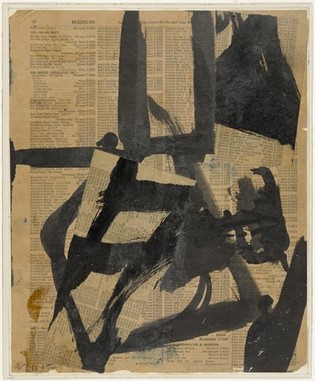
Franz Kline, Untitled, New York, 1952.


“The cultural environment is merely the reflection of what is in us, and if the cultural environment has changed, then something in us must have changed.” – Suzy Gablik, 2004.

Whenever I consider these two subjects and themes, which is something I tend to do several times a week, I can’t help thinking that the reason so many avant-garde artists either practice Buddhism, or are at least deeply influenced by its vibe, is the basic and simple fact that even though it’s more than two and a half millennia old, the philosophy that originated in India and swiftly moved to the East and West already was and still is a highly experimental venture in its own right. Few things, after all, could be more radical and avant than the notion that there is actually no tangible, abiding and independent self, and that impermanence is really the only guiding principle upon which we can construct a code of conduct grounded in compassion.

Thursday, January 13, 2022

The Ballad of Paul and Yoko: Artfully Linked

Yoko Ono; Paul McCartney.


Yoko One, "Death of Samantha," Approximately Infinite Universe, 1973.

The Firemen, Strawberries, Ships, Oceans, Forest, 1993.


To think of Yoko Ono and Paul McCartney in the same sentence, let alone in the same artfully appreciative article, might strike some people as a surprising proposition, and yet as a narrative ballad they share much more in common that you might at first imagine. Not just the fact that they shared an intimate partnership with a famous musician and pop star but also the fact that they have often been collaterally damaged victims of an ongoing mythology about who they actually were and what they actually did. To some extent, this might just be the occupational hazard of any huge cultural icon, but it could also be a revealing indication of how much we all want to believe what we want to believe, despite what the facts and evidence may show us otherwise. Luckily for us however, Peter Jackson’s masterfully edited documentary called Get Back at least contributes somewhat to their rehabilitation at celebrities anonymous.

Monday, July 6, 2026

One of a Kind, Twice in a Row: Legacy and Legend


“Art never saved the world. It cannot do so.”
--Marcel Duchamp

“Everyone is an artist.”
--Joseph Beuys

The 20th century. Oh how I do miss that century these days. It was a virtual dynasty of dissonance and discontinuity, a breathtakingly radical realm of overturned assumptions and collapsing complacent expectations. Almost all the accepted truths, from science and religion to literature, music and visual art, were being overturned practically on a daily basis. And the two artists profiled in two new tomes from Princeton University Press were at the forefront of the mission to alter our perceptions of what art was and what it can be expected to do to and for us. Marcel Duchamp (1887-1968) and Joseph Beuys (1921-1986) pretty much invented what we now call conceptual art. But it didn’t really have a name back when they were blazing a trail through the exotic hinterland of aesthetic exploration. And these valuable books, one a collection of snappy quotations from the cheeky and provocative Duchamp, Duchampisms, edited by Larry Warsh, and the other a deeply revealing study, Joseph Beuys and History by Daniel Spaulding, each shed new light on the dazzling outer range of cultural possibility back in the daring century they so personally embodied.

Wednesday, January 23, 2019

It’s Been a Hard Day’s Life: Growing Up Berman

Tosh Berman (left) gesturing tantrically with family friend Allen Ginsberg. (Photo: Wallace Berman)

Review of the new memoir, Tosh: Growing Up in Wallace Berman’s World by Tosh Berman, published by City Lights Books.


"If the first movie your father takes you to as a child is . . .  And God Created Woman, you can be sure of two things. First, that your father is an extraordinary person. Second, that you are destined to lead an extraordinarily interesting life." – Ron Mael, Sparks
Both of Mael’s observations ring totally true in this engaging, endearing, and surprisingly modest chronicle of a life lived under the white hot lights of a radical couple of proto-hippie parents: Wallace and Shirley Berman, an avant-garde artist famed as one of the originators of “assemblage art” and his gorgeous and exceedingly generous (for letting him be who he was) wife and muse. The Bermans were obviously not your average family, and their son Tosh (from the Russian Antosha) is partly the living evidence of a life lived for reasons far beyond the quotidian behavioral realm of domestic security or conventional social structures. His father , and the legendary works of art he made, as well as the stratospheric friendships he cultivated, were a vital transitional link between the beat culture of the '50s and the hippie counterculture of the '60s. Thus young Tosh grew up on the circus high-wire in the big-top tent of accelerated Change.

Thursday, May 13, 2021

S O L A C E: The Art of Intimate Absence – Theme for an Imaginary Exhibition

Dreamwalk, Mimi Gellman, Edward Day Gallery, Giclee print, 2002. (Image courtesy of the artists)

Note: All images are courtesy of the artists.

“In dreams begin responsibilities . . . ”– Delmore Schwartz

In the museum of dreams, anything is possible. Perhaps prompted by viral circumstances, I imagined an installation of images, objects, films, videos and performances addressing social issues of import which impact everyone in today’s world: anyone who wonders how we maintain our mutual bond as people and cultures during a challenging time of collective isolation. The three well-known artists contemplated, Mimi Gellman, Vessna Perunovich and Nayra Martin Reyes, have a unique but shared interest in exploring isolation and identity politics, gender issues, exile and refuge, persona and displacement, and travel, in what I am designating as a post-proximity world. They express through their artifacts a transnational and humanist domain which is essential for us if we are all to survive the challenges facing our global cultures at this precarious moment in our common history. They each approach a new vista verging on the merger of safe place and secure shelter with vulnerable empathy and alienated exclusion.

Wednesday, January 31, 2018

Ellipsis: The Art of Benny Profane

Future Relics: Image Object #1: “How to Want What You Have”(Cabinet interior view)
Carpet, painting, poem, rulers, teacups, light bulb, coin, pocket watch, film canisters

Ellipsis: The Art of Benny Profane is an imagined exhibition curated by Donald Brackett.

1. Exhibiting the Living Archive
One day after an especially long and arduous shift in the dream factory, the art critic arrived home to discover his mailbox stuffed with letters from artists, from painters and icon makers to be more exact, each one proposing a highly appealing yet physically impossible exhibition. They had the tone of epistles from an extinct race, and from a long ago time, each one lamenting their personal sentence to The Outpost. Comparisons between Kafka's "In The Penal Colony" would not at all be out of order here, for sure enough, each icon maker does in fact bear a personal tattoo identifying his or her affiliations in the hierarchy of art history: a dream tattooed.

So it came to pass that either in their own media or in a different one unknown to them, they were choosing to express, albeit only metaphysically since most of the concepts could never be realized by the curator, their feelings as exiles from the mainstream of twenty-first-century culture, in that traditional form of lamentation so richly played out in the classical period.

It then became clear that they were all “painters,” of course, because only painters among all icon makers have been awarded a fugitive status rare in aesthetics, and only because of the insistent glare of the present digital domain. Both the notion of the "fugitive status" and also the notion of the archive of collected artists’ musings on "impossible to realize" Utopian visual projects, emerged as a result of ongoing triadic conversations among the art critic, the curator and the artist.

In the shadow of the ghost of history, while pondering these relationships, it suddenly occurred to me that perhaps extinction is only an intermission, an interruption, an ellipsis between one stage of our cultural narrative and another. It was at this point that I became accidentally familiar with the seductive faux-archival work of Benny Profane.

Wednesday, July 17, 2019

Uncanny Kingdom: The Enigmatic Art of Mowry Baden

Marsupial, 2013, by Mowry Baden. (Steel aluminum fabric rubber. Image: VAG)

Mowry Baden, curated by Grant Arnold, Vancouver Art Gallery: March 9-June 9, 2019

Ever since the French invented a mechanical device called the camera in about 1840, visual artists have been liberated from the tyranny of mere pictorial representation. Likewise, sculptors, who are best described as making three-dimensional drawings in space, have been offered the authority to leave behind the pedestal in favour of incorporating everyday life into their tableaux. And no one has taken that liberty of expression to heart with as much consistent passion and creative commitment as Mowry Baden, originally from Los Angeles but since 1971 a resident of Victoria, British Columbia, from where a steady stream of emotionally compelling and intellectually rigorous works have issued.

Having decided that by the end of the '60s “painting seemed all used up,” Baden's self-stated strategy was as simple as it was ambitious: provoking a perceptual crisis in the viewer through the manifestation of constructed environments, or “envelope spaces,” which invite us to experience kinesthesia, the sensory awareness of position and movement most often contained in task-oriented and body-centred physical settings. This serious form of play is encapsulated in its earliest stages in the 1970 floor-mounted piece called Untitled (Seatbelt), which is just what it says: an excessively long looped seatbelt bolted in three places to the floor and permitting interactive but non-utilitarian use.

The result is a kind of physical calligraphy whose poetry is hard to describe, with an ever-shifting graphic placement depending on each visitor’s chance re-arrangement and resulting in a palpable haptic haiku written on the museum floor. Basically the entire architectural ground has become his conceptual pedestal. The rest of this career-length retrospective of the Governor Award-winning mixed-media artist is just as cheeky and engaging, a living demonstration of how the basic definition of what an art object is and what it’s supposed to do underwent a drastic upheaval in the post- photography era, culminating in the ascent and supremacy of abstraction in all forms.

The Vancouver Art Gallery exhibition of fifteen sculptural pieces, as well as journal drawings and an archive of public art projects, was a masterful crash course in the efficacy of Jules Michelet’s nearly mystical observation that each epoch dreams the one to follow and creates it in dreams. It showed just how far a liberated artist can go once technology sets him or her free, and in Baden’s case it also celebrated his legitimate allegiance to major international art movements such as Fluxus, assemblage, and art povera, through the elevation of quotidian objects far above their usual thing status.

A perfectly curated coss-section of Baden’s often whimsical and sardonic sculptural assemblages, the eponymous Mowry Baden, was an ideal but not idealistic show perfectly suited to our own epoch. Basically, the trajectory from the strictures of vertiginous modernity to the open-ended ambiguities of the postmodern realm are charted almost cartographically in the creative arc of Baden’s work from the mid-'60s up to the present. Art history itself, in many ways, arrives after its feverish marathon of shifting meanings into the waiting arms of this West Coast tactician of irony.

Cheap Sleeps Columbine,1994. (Mattress boxspring, pillow fabric, wood, mirror. Image: VAG)

His many oneiric sculptural objects, often splendidly tongue-in-cheek re-configurations of engineering poetry and mechanical theatre, almost always relate to or involve collisions of everyday things with a surreal narrative which is usually perceptible to the sense of touch. Pieces such as the superbly chilling Cheap Sleeps Columbine (1994), with its mandala of mattresses, box springs and mirrors, as well as one of my favourites from the survey show, Marsupial (2013), with its spooky wheelbarrow and cage-like enclosure for a human bearer, are definitely canny testaments to the uncanny kingdom we all occupy in this disturbing century.

Cézanne, who practically invented pictorial modernism, once remarked, referring to his own late visionary evocations of nature in oil, “The landscape thinks itself in me, I am its consciousness.” And while strolling like a psychic flâneur through the calm splendour of Baden’s post-industrial mystery-objects, I was struck by the potential to characterize them in a way that echoed but far outdid Cézanne: “The machine thinks itself in us, we are its consciousness.” If art history is a relay race (which it must be) with individual artists passing the baton from one to the next, then Baden has grabbed Cézanne’s baton and run right off the racetrack with it.

Baden’s charming and confounding works, especially a trio of rubber and stainless-steel sculptures such as Braille (2016), Punched and Grilled (2015) and Tachycardia (2016), quite literally embody and personify the character of what Walter Benjamin called the work of art in the age of mechanical reproduction, as well as the vivid personality of a dynamic which that press agent for the future, Siegfried Gideon, accurately declared as mechanization takes command. They are engineered dream objects come to life: emblems of an industrial domain suddenly rendered mute of customary meaning.

Tachyardia, 2016. (Rubber and steel. Image: VAG)

But he is not all about just puns or bemusement; his work is also about suspended satisfaction, anxious anticipation, delayed gratification, and most especially unfulfilled expectations. He often addresses important aesthetic issues such the physical embodiment of spirit through sculpture and its discomforts through thought. Such a piece is his Rubber Thistle (2013), with three interlocked warehouse pushcarts which can be moved in circles but not utilized practically.

Baden explores polarities of life and death, as well as the dualities of waking and dreaming, through the strange affinity that inherently exists between his uncanny engineering effigies in a museum and his clever disruptions of aesthetic representation embedded in certain radical art traditions. Indeed, his pieces can be seen both as a source of macabre spectacle and educational entertainment, via the image of a site which copies life, but also as a territory which negotiates the development of unsettling new genres of representation.

As this gifted senior artist so ably illustrates, the sculptural image itself is deeply wedded to the living human body in motion and at rest, but it is also a passage haunted by stillness and absence, as exemplified clearly by the obscure objects of desire so effectively examined in this retrospective installation. Economy of means, complexity of meaning: few artists employ dislocation as a strategic tool to elicit both empathy and jamais vu quite as powerfully as Mowry Baden.

This article also appeared in the magazine Vie des Arts. 

– Donald Brackett is a Vancouver-based popular culture journalist and curator who writes about music, art and films.He is the author of the book Back to Black: Amy Winehouse’s Only Masterpiece (Backbeat Books, 2016). In addition to numerous essays, articles and radio broadcasts, he is also the author of two books on creative collaboration in pop music: Fleetwood Mac: 40 Years of Creative Chaos, 2007, and Dark Mirror: The Pathology of the Singer-Songwriter, 2008, and is a frequent curator of film programs for Pacific Cinematheque. His latest book is Long Slow Train: The Soul Music of Sharon Jones and The Dap-Kings, published in November 2018. His new book, Tumult! The Incredible Life and Music of Tina Turner, is forthcoming from Backbeat Books in 2020.

Wednesday, November 4, 2020

Harvest of Memory: The Multi-Faceted Art of Bea Nettles

Harvest of Memory, Bea Nettles (University of Texas Press)

“I see my career as a spiral with my ideas always circling and picking up reflections of earlier thoughts.”– Bea Nettles, Journal, 1990.

“There are parallels to making art and tending one’s garden . . . an image or an idea can be split up, shared, and even better yet, transplanted into someone else’s garden.”– Bea Nettles, Journal, 2011.

John Lennon once famously, and sarcastically, remarked to a journalist that his wife was the “most famous unknown artist in the world,” something that was true only in the sense that Yoko Ono’s serious art-world credentials (which pretty much disintegrated when she married him) were submerged in the notoriety that surrounded their alliance. But as an art historian I can tell you without a doubt that though I greatly admire Yoko’s prescient and poetic pre-John visual-object work (and her first three brilliant recordings), the actual title of Most Famous Unknown Artist really belongs to one Bea Nettles, whose radical work over fifty years is now being celebrated through major retrospective shows that clearly demonstrate how far ahead of her time she was. Only in the rarefied off-the-map art-world circles where true cultural revolution and evolution usually take place was she rightly famous.

Friday, April 13, 2018

The Assassination of Art Nuko by the Curator John O’Brian

Cruising down the Rideau in Ottawa by Carl Chaplin.

We are pleased to welcome a new critic, Kirk Tougas, to our group.

Obviously an exaggeration, but a Vancouver artist has been "disappeared" by guest curator John O’Brian in BOMBHEAD at the Vancouver Art Gallery. Rephrased, perhaps an alternate title could be Shadowboxing with History: How Curators Can Erase Artists, but between erasure and assassination, let’s settle on the latter.

Thursday, April 7, 2022

A Dance to the Music of Time: 4-Dimensional Sculptures by Joachim Waibel

Nude portraits of antique clocks without their hands, silently holding their vigil and thus calmly reminding us of Henri Bergson’s bold 1911 admonition: “Time is invention, or it is nothing at all.”


“For reasons not at the time explicable, there are specific occasions when events begin suddenly to take on a significance previously unsuspected, so that before we really know where we are, we ourselves, scarcely aware that any change has taken place, are careening uncontrollably down the slippery avenues of eternity.”  – Anthony Powell, 1955.

When the French novelist Marcel Proust finally published his long-awaited seven-volume magnum opus In Search of Lost Time in 1913, after labouring meticulously, some would say obsessively, over his work for almost as many years as there were volumes, he was sharing with us the culmination of his devotion to memorializing not just memory but the actual passage of time itself. He had attempted and clearly succeeded in producing almost a balsamic reduction of himself and his reveries in words that are at once poetic and precise. Further, he had achieved a landmark, not only in literature but in the poetics of psychological introspection, coming in the end to almost perfectly embody the ethos of poet Wallace Steven’s definition of poetry: the search for the inexplicable.

Wednesday, February 14, 2018

Fabula: The Mythological Mind of Joachim Waibel

Telephone, Sculptural Object, 2015: rotary phone, tarred and feathered.

“You never see further than your headlights. But you can make the whole trip that way.” – E.L. Doctorow
Joachim Waibel works with fabricated dreams. A mixed-media visual artist and poet, his art practice is interdisciplinary and multi-faceted and has one common denominator: he uses whatever symbolic form in whatever medium best conveys his philosophical interests at the moment of creation. From drawing and painting to photography and film, from conceptual sculpture to concrete poetry, his creative approach is living proof that the medium is the message. Originally from Germany, where he was born in 1959, he relocated to North America in 1973 and has since explored many avenues of self-expression, in keeping with his eclectic cultural upbringing and diverse experiences as a maker. He is very German but he is also an international citizen of a conceptual country without borders. He is in fact a neo-faber, a new maker, and his active Vancouver-based studio is exploring fresh and flexible ways to operate above and beyond the traditional gallery system. He is also a postmodern renaissance man of sorts. A new maker of what? A maker of tall tales told visually, of fabula, the original name for all our stories and narratives. Out of the seductive stories that he weaves he also manufactures a steady stream of hypnotic miniature worlds for us to contemplate and even to dwell in temporarily.

Tuesday, January 16, 2018

Arcade of the Aura: In Case of Future Break Glass


“The dream has grown gray. The gray coating of dust on things is its best part. Dreams are now a shortcut to banality. Technology consigns the outer image of things to a long farewell, like banknotes that are bound to lose their value. It is then that the hand retrieves the outer cast in dreams and, even as they are slipping away, makes contact with familiar contours. . . . [W]hich side does an object turn toward dreams? What point is its most decrepit? It is the side worn through by habit and patched with cheap maxims. The side which things turn toward the dream is kitsch.”  – Walter Benjamin, 1936
Part One: Encountering the Aura

The great German culture critic Walter Benjamin warned us early on, perhaps too early for him to be fully believed, that our relentlessly elegant procession into the machine age was also leading us into a zone where representation replaces reality. His awkward prescience may also have been compounded by the fact that few people understood fully what he was talking about, since television was in its early stages and the computer, and of course the internet, had yet to be invented.

Photography and its nervous cousin the movies were the only talismanic augers he could have used to declare that the ritual aura associated with the historical transmission of our embodied meanings in varied art formats was in danger of eroding, decaying and disappearing entirely as a result of the eventual existence of copies without an original. Like most time-ghosts (the literal meaning of the word zeitgeist) he had his finger on the pulse of a throbbing wrist that he alone could witness and interview.

He warned us that we were plunging headlong into the long farewell of a kitsch conglomerate in which meaning was incorporated into automatic systems while its former embodiments were dis-incorporated phantoms shimmering under showers of imaginary gold. Nonetheless, he invented a future conceptually, which we currently occupy physically, psychically and psychologically and which I identify as cyber-kitsch: the perpetual present.

Tuesday, August 12, 2025

Soluble Thoughts: Late André Breton

André Breton claimed with these glasses he could see the future. He was right. (Photo: InLibris.)

“How very hard to run a movement and be oneself. Tristan Tzara somehow managed it with Dada, as long as he did, but then Dada died. As for Surrealism’s André Breton, something about his personality and everything about his style permits the singular endurance of his self and his strong selving.”
--Mary Ann Caws, Dalkey Archive