Showing posts sorted by relevance for query Greil marcus. Sort by date Show all posts

Sunday, October 31, 2010

Mind Out of Time: Bob Dylan by Greil Marcus: Writings 1968-2010

For close to fifty years, Bob Dylan has transformed himself into any number of incongruent characters while keeping his fans both baffled and infuriated in the process. Critic Greil Marcus is one of those baffled and infuriated fans. But rather than worship at Dylan's altar, or burn him in effigy, Marcus has instead assembled a fascinating chronicle of reviews, stories, asides and rumours about Dylan that he has written over the last four decades. In Bob Dylan: Writings 1968-2010 (Public Affairs, 2010), Marcus has created a riveting and imaginative collection of criticism where he not only traces a popular artist's erratic career through a chronology of pieces, his book also becomes an engagement where sometimes the hunter gets captured by the game.

While Marcus shapes the arc of Dylan's work, as one would untangle a long, convoluted mystery, we also witness how Dylan has equally shaped him as a writer. "I was never interested in figuring out what the song's meant," Marcus writes in the introduction. "I was interested in figuring out my response to them, and other people's responses. I wanted to get closer to the music than I could by listening to it - I wanted to get inside of it, behind it, and writing about it, through it, inside of it, behind it was my way of doing that."

Although Bob Dylan: Writings 1968-2010 bears some resemblance to Marcus's last book When That Rough God Goes Riding (see Critics at Large review here), which took us through the equally uneven career of Van Morrison, that book shifted back and forth through time as if Marcus was randomly picking Morrison's albums from the shelf to see if they still added up. By contrast, Bob Dylan is a more linear tale. Yet the very nature of Dylan's art has a way of pulling the rug out from any assumptions concerning what happens next, so Marcus's book becomes (to invert the title of one Dylan album) a mind out of time.

Tuesday, June 26, 2012

Rummaging Through the Dustbin: Greil Marcus's The Dustbin of History (1996)

For all the value we assign to history, both as a field of study in school and for understanding the ways of the world, it's also dead meat. Our best friend's marriage ends and we say it's history. Sports commentators, eager to create an air of finality, always remark: "With that goal in overtime, the playoff series becomes history." One goal and everything that came before it is now superfluous. The winning team moves on; the losing team is history. History might even be worse than dead meat because (to paraphrase Johnny Rotten) it's got nooooo future. It's history.

In high school, we often treated the subject as a function of correcting mistakes. The teacher told us that if we studied what took place back then, then maybe we could prevent it from happening again. Know it and you can control it. History was something you could beat by simply having all the right facts. With certain truths on your side, you could stop time itself in order to properly dissect it. But why should history's dustbin become such a convenient dumping ground for facts left behind like last week's garbage? This is the central question in Greil Marcus's uneven, yet fascinating book The Dustbin of History (Harvard University Press, 1996), which sets out to provide a road map to find some answers.

Thursday, December 22, 2022

Dylan in Winter, Part II: Greil Marcus’s Folk Music

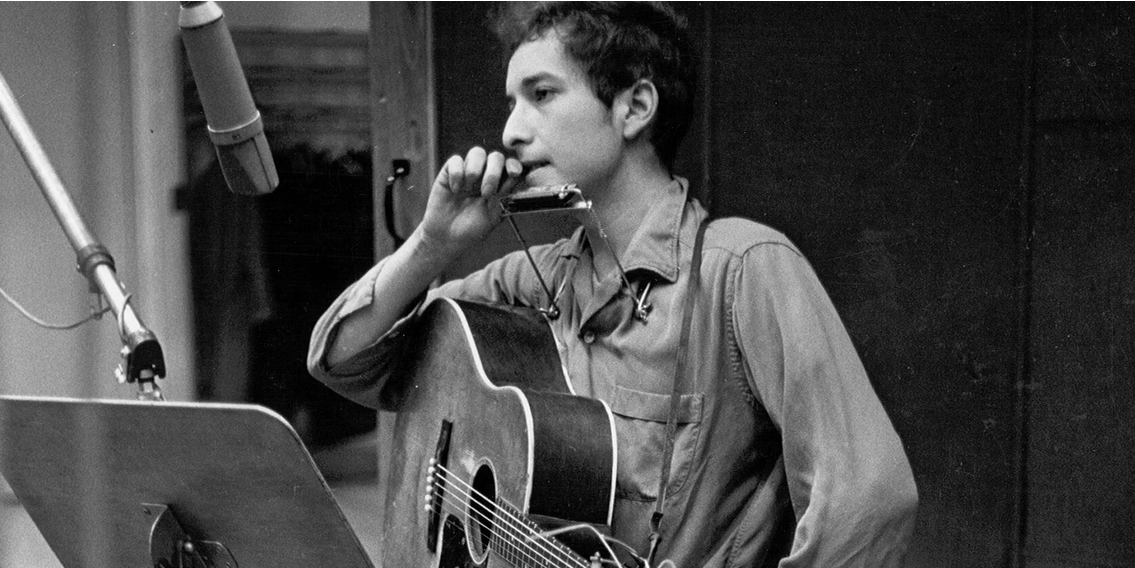
Bob Dylan, November 1961. (Photo: Michael Ochs)

I.

Many things matter about Folk Music: A Bob Dylan Biography in Seven Songs (Yale University Press; 273 pp.), Greil Marcus’s fourth—and, he has said, last—book about its subject. But your personal allegiance to Dylan in recent times isn’t one of those things. Whether you particularly value or even like the songs Marcus studies—in order of presentation, “Blowin’ in the Wind” (1962), “The Lonesome Death of Hattie Carroll” (1964), “Ain’t Talkin’” (2006), “The Times They Are A-Changin’” (1964), “Desolation Row” (1965), “Jim Jones” (1992), and “Murder Most Foul” (2020)—also doesn’t matter. The Dylan we surveil in these pages is not the sum of his successes or failures, or of any reader’s likes or dislikes. He is a creative force, a dark, hunched, music-producing presence prowling through decades of celebrity and centuries of history. If you retain a nerve of commitment to anything Dylan has ever done or been, that will be your point of entry, and meanings will flow even from songs you never cared about—songs you may not care about now, except as vehicles for Marcus to do what he does best. 

Tuesday, December 13, 2011

The Rump of the Sixties: The Doors – A Lifetime of Listening to Five Wild Years by Greil Marcus

Looking over the pieces I've written in the last year, I've spent a good deal of time dealing with the troubling legacy of the Sixties. Even my next book, which I'm now writing and preparing for publication, begins with the early promise of that decade and follows the subsequent ones as if tracing the endless ripple of a pebble tossed in the sea. My preoccupation is not based on my age either (although I grew up in the Sixties), or holding on to some sense of nostalgia for better times. I'm also not locked into the glory days of my youth (they weren't very glorious to begin with) and clinging to some talisman against the bitter cold. Although there are some people I know who decided to stop listening to music, reading books, and seeing movies that didn't conform to the values they treasured when they were young, I'm not grappling with the Sixties, either as an idea or a time and place, as a means to avoid the realities of the current decade. Quite the contrary.

As far as popular culture goes, for me, it still lives and breathes in the present. For instance, I'd love to write more about contemporary music; why I'm mesmerized by Matthew Friedberger's sinewy guitar that snakes its way through The Fiery Furnaces' "Two Fat Feet" from their debut 2003 album Gallowsbird's Bark; how Seattle's Fire Theft seems to effortlessly embody in their single "Chain," an emotional hailstorm, the void left by Nirvana; or, the impish joy I hear in Rachel Nagy's libidinous "very nice" that kicks off The Detroit Cobras' "Ya Ya Ya (Looking For My Baby)," a full-tilt boogie that would make John Lee Hooker smile; on how I'm moved in the most peculiar way by The Handsome Family's "Weightless Again," a song that both laments and justifies suicide in a manner as wistfully satirical about the subject as Steely Dan's "Any World (That I'm Welcome To)"; or why Okkervil River, on I Am Very Far, and the Decemberists, on The King is Dead, continue to rehabilitate our notions of what constitutes musical Americana.

As much as I continue to enjoy new music, it's still too immediate, too much of its time, for me to reflect back on it with any real authority. It has yet to trace its own path into the future where it might find a meaning for itself beyond what it represents now. What I enjoy in writing about Sixties culture is the task of putting to the test the relics that have stood the test of time, as well as the things that haven't; that is, figuring out what new meaning continues to breathe life into work that could have (and maybe should have) expired a long time ago. In a sense, that's the underlining theme of The Doors A Lifetime of Listening to Five Wild Years (Public Affairs, 2011), where critic Greil Marcus ponders the dark magic of the L.A. group The Doors, a rock band dead for over forty years now, but hardly gone from cultural relevance. In examining what they mean today, indeed how they've endured both on the radio and as part of the embroidery of the lost Sixties, Marcus not only reveals the obvious (that they weren't really a group of their time), but that they somehow (despite this) characterized their time, and took on the leaner, meaner, violent side of that decade's demise. (As Marcus reminds us, they weren't one of the 'love' bands.) And their best music, like that pebble in the sea I mentioned earlier, continues to ripple along as if they never went away.

Monday, April 12, 2010

Listen to the Lion: Greil Marcus's When That Rough God Goes Riding

When That Rough God Goes Riding, the new book by critic Greil Marcus (Mystery Train, The Shape of Things to Come) opens a lot of doors. It does so by going through the process of randomly dipping into the fascinating and turbulent music of singer/songwriter Van Morrison. Marcus isn't writing a biography here of this perplexing pop figure; nor is he setting out to draw a chronological study of his many albums, from the masterpieces (Astral Weeks), the vastly underrated (Veedon Fleece), the deeply satisfying (Saint Dominic’s Preview, Into the Music), or the failures (Inarticulate Speech of the Heart, Poetic Champions Compose); this book instead is about articulating how listening to Van Morrison is a rich and complex experience.

Morrison began life in East Belfast forming one of the hardest rock groups in the sixties called Them. Their hit song “Gloria” was a blast of teenage lust that left The Rolling Stones sounding mannered by comparison. His solo career, which began with the conventional 1967 pop hit “Brown Eyed-Girl,” turned mystical in the seventies where within his best music you could hear Morrison speaking in tongues and conjuring the foreboding voices of Leadbelly, Muddy Waters, Sister Rosetta Tharpe and John Lee Hooker, as if he were inviting these ghosts to a poker game where they could all happily collect their winnings.

When That Rough God Goes Riding (named after the kick-off track for his sublimely unsettling 1997 CD The Healing Game) isn't trying to make any one point about Van Morrison’s music, rather Marcus takes us inside the meaning of Morrison's singular voice, a voice that can reveal unspoken truths when he sings. Therefore, there’s no summation of Morrison’s career, a career that’s both satisfying and desultory. Marcus delves instead inside the grooves of songs, albums and lost tracks, in order to map out what he calls a quest for “moments of disruption, when effects can seem to have no cause, when the sense of an unrepeatable event is present, when what is taking place in a song seems to go beyond the limits of respectable speech.” Marcus’s own writing in When That Rough God Goes Riding also goes beyond the respectable speech of conventional criticism and reveals the hidden impulses and pleasures that great artists call up in a critic who is drawn to their work.

Monday, February 27, 2017

All the Criticism That's Fit to Print: Revisiting The Rolling Stone Record Review and The Rolling Stone Record Review II

Led Zeppelin (courtesy of Getty Images).

In March 1969, writer John Mendelsohn was given the assignment for Rolling Stone to review the debut album of Led Zeppelin, a high-octane blues-rock outfit that had just emerged out of the ashes of The Yardbirds – a popular British Invasion band with a string of hits behind them including "Heart Full of Soul" and "For Your Love." Although there were no great expectations that this new ensemble would make history, Mendelsohn's words came to suggest that they might just become history. Chalking up their sound to formula, Mendelsohn remarked that Zeppelin "offers little that its twin, the Jeff Beck Group, didn't say as well or better..." Robert Plant's "howled vocals" were described as "prissy" on their cover of Joan Baez's "Babe I'm Gonna Leave You," and Mendelsohn went on to add that "[Plant] may be as foppish as Rod Stewart, but he's nowhere near so exciting." Jimmy Page gets complimented as an "extraordinarily proficient blues guitarist," but he's also singled out as "a very limited producer and a writer of weak, unimaginative songs." Criticizing them as wasting their talent on "unworthy material," Mendelsohn saw little from that first record that suggested that Led Zeppelin would be talked about fifty years later. "It would seem that, if they're there to fill the void created by the demise of Cream," he wrote, "they will have to find a producer (and editor) and some material worthy of their collective attention."

Wednesday, April 15, 2015

For Your Ears Only – Stranded: Rock and Roll for a Desert Island (1979)


What album would you take with you if you were isolated on a desert island? It's always been a tempting question, or a popular party staple in which you get to display your cultural credentials without giving away too much about yourself. For critics, especially those always armed with their lists of favourites, it offers a casual forum to defend your tastes, test the wits of others, plus flex some muscle by bragging about rare records that nobody else could give a fuck about. In the literal sense, the idea of the desert island has always been a bit ridiculous. (What critic would ever want to be isolated on a desert island with no access to concerts, free music, or even an outlet to express his or her persuasive views?) After all, isn't music, even in the current age of solitary streaming, best enjoyed in a communal environment. Maybe now, as music is perpetually pigeonholed by genre, we don't even need a desert island because you can retreat to one anytime you like. But the desert island seems to negate the whole purpose of music. It denies music an audience, save for that one lone fan, to test its true value. Yet this question became the subject of a 1979 book called Stranded: Rock and Roll for a Desert Island, in which twenty prominent American rock critics were asked by fellow scribe Greil Marcus to contribute an essay in response to this hypothetical request.

Thursday, September 4, 2014

Allegories and Prophesies in Song: "The Beehive State" and "The Devil Came From Kansas"

Singer/Songwriter Randy Newman, in 1971 (Photo by Charles Seton)

Historian Constance Rourke once observed that Americans are "a people unacquainted with themselves, strange to the land, unshaped as a nation." That particular kind of estrangement is rarely taken up in song, but listening the other day to Randy Newman's deceptively obscure "The Beehive State," from his 1968 debut album Something New Under the Sun, I caught some of the intriguing aloofness in the mystery she poses of what it means to actually be an American. "The Beehive State" begins with a delegate from Kansas taking the Senate floor, where he is asked to describe what his state is all about. But we don't find out very much from him. First, we discover that Kansas is for the farmer and "the little man." The representative then, with a persistence that suggests a declaration of war, tells the senators gathered that they all they need is a firehouse in Topeka. Hardly worth the trouble. Next, the senate calls to the floor a delegate from Utah. He steps forward with a desperate plea that is also rather opaque: he insists Utah needs water to irrigate their desert, but mostly he just urges everyone to tell this country about his state. Why? "'Cause nobody seems to know." But how much do we really know when the song – which is barely two minutes in length – is over? With a relentless staccato rhythm that he builds on the piano, Newman tells this story so swiftly that he barely gives you time to absorb what the song is actually saying (which could be nothing so urgent as a laundry list). But he gives the song all the immediacy of prophesied fact and portentous calamity. "It should be longer," Newman once told an interviewer. "But I couldn't think of more to say." So is less truly more?

Saturday, October 8, 2016

Things Went Down: Joel Selvin’s Altamont

Things went down we don’t understand, but I think in time we will.
– The Grateful Dead, “New Speedway Boogie”

It’s been 47 years: were The Dead right, wrong, or both? There are different kinds of understanding – factual, emotional, metaphorical – but even combined, they will never add up to any final understanding, any state of Zen, when it comes to certain things. The Altamont concert of December 6, 1969 – the free show that climaxed the Rolling Stones’ autumn tour of the United States – was a day-long cataclysm which the evidence suggests was, for the vast majority in attendance, a uniquely dumb and ugly experience. But it may also have been, as Joel Selvin calls it in the subtitle of his new book, “rock’s darkest day.” It was certainly, as has been pointed out many times, a gruesomely apt metaphor. It illustrated contradictions that were intrinsic to the era, to the people, and to the style of music which brought 300,000 to a racetrack in the windy voids near Livermore, California, to see Santana, The Flying Burrito Brothers, The Jefferson Airplane, Crosby, Stills, Nash and Young, The Grateful Dead (who didn’t play), and The Rolling Stones. Like a knife, a metaphor needs its absolute edge, its implacable point. At Altamont, that point was the stabbing, as The Stones played “Under My Thumb,” of Meredith Hunter, an 18-year-old from Berkeley who happened to be black and flashing a gun, by Hell’s Angel Alan Passaro, a 22-year-old from San Jose who happened to be white and wielding a knife. Other, mostly unidentified Angels finished the lynching Passaro had begun, and Hunter was dead before the ambulance came. “A young black man murdered in the midst of a white crowd by white thugs as white men played their version of black music”: thus did Greil Marcus summarize the metaphor, the knife point of the event.

Saturday, June 7, 2014

Eight Arms to Hold You: The Criterion Collection Celebrates the Fiftieth Anniversary of A Hard Day's Night

"The first rock and roll movies had little or nothing to do with rock and roll music, and everything to do with the rock and roll ethos," wrote Greil Marcus in his assessment of the genre. That ethos he describes was present in many Fifties pictures where adolescents were no longer accepting the proscribed values of the status quo. You could see it in Marlon Brando's defiance in The Wild One (1953), where when asked about what he was rebelling against, he replied, "Whaddya got?" You could recognize it in the painfully vulnerable James Dean in Rebel Without a Cause (1955), as he attempts to wake up his incognizant parents to the misunderstood youth they were alienating. The distilled essence of what would soon become rock 'n' roll was weaved into the fabric of those movies. According to Marcus, though, its power wasn't fully comprehended until Bill Haley & the Comets drove home the combined sociological screeds of The Wild One and Rebel in The Blackboard Jungle (1955), with its opening blast of "Rock Around the Clock."

After that, aspiring rock artists started lining up to see their possible future on the silver screen; and John Lennon began thinking that maybe this was a cool job. The Beatles were first turned on by The Girl Can't Help It (1956), which featured Little Richard in the opening credits singing the title song. The plot was largely superfluous, but significantly, it was about how the music business was run by the mob (giving a whole new meaning to the word hitmen). Besides grooving to Little Richard, Gene Vincent, the Platters and Eddie Cochran, youngsters also swooned as the buxom bombshell Jayne Mansfield strutting by in her tight clothes, clutching milk bottles to her heaving breasts. In 1956, having been one of those kids first stunned by Brando, Elvis Presley stepped onto the screen in the Civil War drama Love Me Tender, where two brothers fight over politics and the love of Debra Paget. His elegiac ballad, "Love Me Tender," which maybe planted the early seeds for McCartney's eventual "Yesterday." But it was his role as the violent rockabilly singer Vince Everett in 1957's Jailhouse Rock where the rock ethos fused effortlessly with the music. From there, just as the rock movie began, it seemed almost over. Except for the tabloid chic of High School Confidential (1958), which delved pruriently into a teen dope ring, it was the sanitized Frankie Avalon/Annette Funicello beach party movies and Elvis's decline in Hollywood.

Tuesday, July 11, 2017

Bridge Over Troubled Water: The Fiftieth Anniversary of Bobby Gentry's "Ode to Billie Joe"


Throughout the early sixties, tragic teen ballads – beguiling and haunting mini-operas cured in the melodrama of adolescent angst – dominated the charts. Most were extravagant tales of woe and heartbreak like The Shangri-Las' "Leader of the Pack," where the rejected biker/lover dies proudly on his wheels, while others included Frank J. Wilson's "Last Kiss," where Frank's girl dies not-so-proudly because of her boyfriend's faulty wheels. Other earlier sagas of loss were downright perverse. Mark Dinning's 1960 hit "Teen Angel" got the sixties off to a fiendishly grim start. His bizarre story concerns the singer's girlfriend, who gets leveled by a train after she rushes back to her stalled car to rescue her high school ring. (Perhaps today you'd have to substitute a cell phone for the prized jewelry.) And if "Teen Angel" weren't already more than enough, Johnny "Mr. Bass Man" Cymbal came along that same year with "The Water is Red," where the singer's girl gets torn apart by a shark while swimming at the beach. The boyfriend, with chivalry as his shield, bravely wades through the bloodied waters, not to just gather up her torn remains, but to take on (with his pocketknife, no less) this early relative of Jaws. By the jaded seventies, then, it was no surprise that Randy Newman parodied, with expert precision, this strangely popular genre in "Lucinda." Drawing from the slow blues style of Ray Charles, he tells us of a woman who accidentally gets chewed up by a beach-cleaning machine. Lying in the sand in her graduation gown with some boy she just met that night, Lucinda seems to have fallen asleep just as the mechanical contraption started chugging along. Her companion tries vainly to wake her up, but it's to no avail: Lucinda is doomed to lie under the sand. (Given her fate, and the style of the song, Newman may also be parodying murder blues ballads such as "Sleeping in the Ground.") Later in the decade, Warren Zevon went Newman's macabre tale one better with his hilarious satire "Excitable Boy," revisiting the song as if the narrator might be Ted Bundy (and he's backed with affirmative "ooh-wah-ooh's" by Linda Ronstadt and Jennifer Warnes in the manner of gregarious high school cheerleaders ). 

If these tragic pop dramas of the past were always bathed in tears (linking them in a significant way to the romantic heartbreak heard in fifties doo-wop), there was one popular tragic song in the summer of 1967 that drew from different sources, avoiding melodrama altogether and casting a spell on listeners for decades. Bobbie Gentry's "Ode to Billie Joe" was a quiet Southern Gothic ballad about suicide and other mundane matters of the day which get shared over the dinner table with the biscuits and peas. Where "Leader of the Pack," "Teen Angel" and "Last Kiss" could have been ripped from the headlines of city tabloids, "Ode to Billie Joe" was as cryptic and mysterious as an old Appalachian murder ballad. What made it even more curious was that the summer of 1967 was hardly a quiet one. Some were celebrating a Summer of Love with the Monterey Pop Festival, but in his book, The Old, Weird America, Greil Marcus (in discussing "Ode to Billie Joe") reminds readers that a number of calamitous events were taking place that summer besides growing flowers in your hair and heading west. Fifty years ago today, the day after Gentry recorded her single, twenty-six black citizens were killed in protests in Newark, New Jersey. Detroit almost doubled that number two weeks later. Arthur Penn started a revolution in American movies with the premiere of Bonnie and Clyde, a picture about two Depression-era bank robbers that implicated us in the murders we watched on screen.

Friday, January 20, 2017

A Change Is Gonna Come: The End of the Obama Era


As many of us this week watched President Barack Obama exit the presidential stage with dignity, grace, and even some humour, an inescapable melancholy also permeated the air. Besides the passing of a historic moment in time, one couldn't help but notice the new history about to be made. We were about to watch Donald Trump – a populist demagogue who built his road to the White House by spending years attempting to delegitimize Obama in a Truther campaign that questioned his citizenship – become president. He continued by bullying opponents, toadying up to Russia and hiding his tax returns (which may provide clues to why he plays footsies with Putin), proudly promoting the traits of a sexual predator, exploiting racism and fear, and making promises that pander to anger rather than seeking the means to healing the wounds that stoke that rage. The democratic dream hasn't died and I believe it will survive the man about to be president who has chosen to demean those ideals. But the Obama era, which opened the door to finally laying rest the stained legacy of racism and exploitation, could not close that door on those who sought to ignore it. The idealistic impulse in American exceptionalism is not bathed in light. "America is a place and a story, made up of exuberance and suspicion, lynch mobs and escapes, its greatest testaments are made of portents and warnings," critic Greil Marcus writes in The Shape of Things to Come: Prophecy and the American Voice. "The story of America as told from the beginning is one of self-invention and nationhood." He also reminds us that prophetic voices – from John Winthrop to Martin Luther King Jr. – were "raised to keep faith with the past, or with the future to which the past committed their present." That is also true of the popular culture that reflects that covenant.

Sunday, December 17, 2017

To Gather No Moss: Alex Gibney and Blair Foster's Rolling Stone: Stories From the Edge


You're likely to be disappointed by Alex Gibney and Blair Foster's two-part four-hour HBO documentary Rolling Stone: Stories From the Edge if you're expecting a thorough exposé that trolls through the pop culture magazine's turbulent fifty-year history. For instance, you won't find much of a nuanced portrait of its boy-wonder founder, editor and publisher, Jann Wenner, when they parse through his struggles with sexuality and drugs. They avoid entirely the paradoxical life of Wenner, whose contradictory impulses – both personally and professionally – came to shape the personality of the magazine for half a century. Since the documentary was made under Wenner's aegis, Gibney and Foster also stay pretty clear of addressing directly the popular perception that Rolling Stone Magazine may have begun as an avatar of the counter-culture in 1968, but eventually it became yet another celebrity journal for aspiring yuppies.Yet even if Rolling Stone: Stories From the Edge skirts some of the more complex dimensions built into Jann Wenner, and the turbulent direction the magazine would take in its long history, Gibney and Foster don't whitewash their subject either. “[Rolling Stone is] not just about music, but also the things and attitudes that the music embraces,” wrote Wenner earnestly in an editorial published in the debut issue to define its promise. Yet the film recognizes that promises can't always be kept, especially if the culture itself changes in ways you can't possibly predict. So Rolling Stone is currently up for sale, perhaps recognizing that its potent synergy with popular culture is now gone. In light of this coming event, Rolling Stone: Stories From the Edge decides to look back at some of the key stories the magazine covered over its fifty years, along with the writers who penned them, to see if (despite the changing tenor of the times and the journal that chronicled those changes) they still managed to live up to their promise.

Thursday, February 19, 2015

Critic's Notes & Frames Vol. XII

It would be tempting to call Hampton Sides' Hellhound On His Trail: The Electrifying Account of the Largest Manhunt In American History (Doubleday Anchor) a thriller – as many did in their reviews – but that assessment doesn't come close to describing its power. His 2011 account of the events leading up to the assassination of Martin Luther King, Jr. in 1968, its investigation, and the assassin's escape and eventual capture, is what Sides calls a requiem for an era that's passed. But Hellhound on His Trail also opens up room for a more unnerving and contemporary context – a context that in the Obama era is unshakable even if the events he depicts happened almost fifty years ago. Borrowing his title from Robert Johnson's haunting "Hellhound on my Trail" (but written in the mood of "If I Had Possession Over Judgment Day"), Sides illuminates the country that Johnson mapped out in his songs, a land that Greil Marcus called in his essay on Johnson in Mystery Train, "a world without salvation, redemption, or rest." It's a book where an assassin, James Earl Ray, passes (as most assassins do) into anonymity. He becomes a construct who continually recreates himself in a country that invites its citizens to do just that – only to eventually step into the light and snuff out a prophetic voice, a man who made demands on his country to live up to its founding ideals.

Sides deliberately borrows the fictional style of historian Shelby Foote who "employ[ed] the novelist's methods without his license." But unlike, for instance, the documentary films of Errol Morris (The Thin Blue Line, The Fog of War) that aestheticize reality, Sides enhances and enlarges the drama instead and makes the familiar seem strange, the obvious feel more mysterious, and the events of 1968 more vividly real and heartbreaking. Creating a number of narrative paths that begin with James Earl Ray (as alias Eric Starvo Galt) breaking out of a Missouri prison in 1967 that runs parallel to Martin Luther King, Jr. breaking with President Lyndon Johnson over the Vietnam War and planning a Poor People's March on Washington, Sides sets up a convergence that paves a road to King's inevitable and tragic death in Memphis. Yet even as we know the events to happen are inescapable and that history will change irrevocably that year, you're always at war with the chapters, with time itself, and with your desire to step back into history to alter its pull. Sides doesn't flinch from that pull either. Like a great detective, he realizes that looking for clues can uncover yet more mysteries, so he thankfully doesn't succumb to the helpless paranoia and safety of conspiracy theories, or take refuge in irony. Hellhound on His Trail takes stock of loss, and like Robert Johnson watching his baby's train disappear in the distance in "Love in Vain," considers its cost.

Saturday, February 28, 2015

Guts on the Page: Notes on the Absolute Unity of Robert Christgau

Robert Christgau. (Photo by Carola Dibbell)

I.

The one time I broke bread with Robert Christgau, he told me a variant of the old joke equating opinions with assholes: “Everybody’s got one.” “Ah,” he grinned, “but not everybody has 10,000!” That joke turns up in the introduction to his new book, Going into the City: Portrait of a Critic as a Young Man (Dey Street; 367 pp.), but it’s followed by the real zinger: “It distresses me that the wit of this riposte so often fails to impress the asshole I’m talking to.” Wondering if I laughed hard enough at the time to have eluded that tag, I bored into this mass of unadulterated Bob-ness and felt on every single page the pull of warmth and acuity against the push of bluster and bullying—the alternating currents that for me have always characterized Christgau’s criticism.

This applies to Going into the City as much as to any other thing he’s written. A partial list of words describing his work might include self-aggrandizing, pompous, invidious, overwritten, showoffy, superficial, and hipsterish. Among the things his work could never be accused of being are uninformed, ungenerous, humorless, evasive, snobbish, sluggish, falsely modest, and truly modest. That he lacks the latter has always made Christgau one of the few pop critics worth following; that he brandishes the former has meant that reading him is a conflicted, jittery experience, pleasurable and despairing both, in which a helpless and melting love for one so wise and wonderful is certain to be summarily smacked by an ego so unmediated one can scarcely countenance it in an adult old enough to get drugstore discounts.

Sunday, August 14, 2016

MOR: Showtime's Roadies


The Showtime series Roadies is an ensemble comedy set amid the barely controlled chaos surrounding a tour by a successful, veteran stadium-rock group, the Staton-House Band. The series was created by Cameron Crowe, who directed the first three episodes and wrote the pilot, and it represents his return to conquered territory after a string of projects—the pretentiously vapid Vanilla Sky and the theoretically more audience-friendly Elizabethtown and Aloha—that bombed with critics and audiences alike. Although Roadies is set in the present day, its set-up and tender, hagiographic attitude towards rock and roll as a cultural force hearken back to Almost Famous (2000), Crowe’s semi-autobiographical ‘70s nostalgia trip about a 15-year-old rock journalist (played by Patrick Fugit, currently driving out demons on Cinemax’s Outcast) coming of age while on the road with a band called Stillwater.

In Almost Famous, the hero was mainly focused on the rock stars, and their groupies; this time, the central figures are those wonderful people working behind the scenes to make sure the fans get to see their musical heroes. But even if you’ve never seen a movie about the music business before, you’ll be familiar with these characters. Carla Gugino is Shelli, the perpetually over-worked production manager who’s always dashing from one crisis to the next, who’s just enough older than most of the people working under her for her sexy warmth and glowing smile to have a faint maternal tinge. The one-man fireworks display at the center of it all is the veteran tour manager Phil, a grinning, all-embracing bear of a man who dispenses advice and anecdotes in a way that tells you that he’s the spirit of the music incarnate. The “Blue Collar Comedian” Ron White has a firm handle on his character and has no trouble communicating Phil’s self-image and infectious love of his own bullshit, but Crowe doesn’t have much faith in the audience’s ability to figure anything out for itself, so White is required to growl, “When you’re lookin’ at me, you’re lookin’ at rock and roll in America!” (He is, someone says, “being paid a lot of money to hug people and make them feel good about the old way.”)

Sunday, February 16, 2014

A Termite in the Wood: Captain Beefheart & The Magic Band's Trout Mask Replica (1969)

Not every record is for its time. Some don't even care about time. In the case of the strange masterpiece, Captain Beefheart & The Magic Band's Trout Mask Replica, it doesn't even pretend to keep time. In the summer of 1969, Trout Mask came out as an abstract sound collage that followed no trend, or provided even a hint to what was dominating the rock airwaves. Rather than build on what was popular then, it seemed to anticipate the rude gesture of punk almost a decade later. But it did it without the artists involved wanting to upset, or alienate anyone. Walt Whitman wrote about the spirit that Trout Mask inherited some seventy years before it was made. "A perfect writer would make words sing, dance, kiss, do the male and female act, bear children, weep, bleed, rage, stab, steal, fire cannon, steer ships, sack cities, charge with cavalry or infantry, or do any thing, that man or woman or the natural powers can do," Whitman wrote in An American Primer. Trout Mask dances and weeps and bleeds and sacks cities by integrating free form verse, the urban blues of Howlin' Wolf, the gospel blues of Blind Willie Johnson, and the free jazz of Ornette Coleman. The record was so dissonantly original that it annoyed more people than it attracted. People even heard it in records that weren't Trout Mask. A friend of mine once bought one of John Coltrane's more wildly improvisational records (John Coltrane in Seattle) only to call me later to complain, "This isn't Coltrane. It's Beefheart!" But to understand the shock and disbelief surrounding the release of this 1969 landmark, a wildly original (and unsurpassed) experimental leap in popular music, one that defied all the reasons why we listen to popular music, you have to first consider the music already on the airwaves, or perhaps about to arrive there.

Saturday, February 13, 2010

One Night of Sin

Although Elvis died over thirty years ago, he’s still very much alive in many parts of the popular culture and always turning up in the most interesting ways. Whether he's brought up in comparison to Michael Jackson’s recent death, or alluded to in television dramas, novels, songs and visual art, Elvis continues to mutate into every kind of wish fulfillment. He never really left the building.

The list of pop culture references is too long to indulge here, but one notion clearly fascinates me. I always think of Elvis in relation to Marlon Brando. While both emerged out of the rebellion of the ‘50s, they also embodied America’s noblest democratic principle, the idea that a man can make of himself anything he desires. With that goal, or course, comes the eventual failure to live up to that quest for pure freedom that both men created in their work. Their failure to do so came, in part, because of our need to tame in them what we loved most in their distinctiveness; that is, we sought to make them ordinary, to be more like us. But their failure is also due to their own inability to maintain their distinctiveness, the very quality that attracted us to them in the first place. Although both became iconic figures in mass culture, they each ended up horribly isolated and trapped. They even at times became parodies of themselves as if to deny that iconic status, as if to mock it and make it less real. Perhaps that why it’s no accident that these charismatically handsome men would, in succumbing to those pressures, eventually become bloated.

Saturday, August 28, 2010

Unfinished Notes From an Abandoned Book: The Weight (2009)

The Band in Martin Scorsese's The Last Waltz (1978).

A couple of years ago, I was toying with the idea of writing a book called The Weight. It was about Martin Scorsese's The Last Waltz (1978), his concert documentary about The Band's farewell Thanksgiving concert on November 25, 1976 at the Winterland in San Francisco. My thought was to send a proposal and a sample chapter to the British Film Institute for their annual chapbook publications on key films. Having just done a CBC Radio documentary on The Band's debut album, Music From Big Pink (1968), I was primed to delve into the air of melancholy that lay beneath the spirit of celebration that Scorsese caught while shooting that extraordinary concert. But I decided to abandon the project when there didn't seem to be any interest from publishers. However, I came across some of the notes I'd written in preparation for The Weight which, upon re-reading them, looked apt for a posting.  Kevin Courrier

Sunday, December 11, 2016

Critic's Notes & Frames Vol. XXI


Brian De Palma's Home Movies is a 1979 low-budget independent film made with the help of his film class at Sarah Lawrence as a hands-on training exercise. (They were given the primary responsibilities of raising money, arranging the shooting schedule, and editing the film, all under De Palma's supervision.) What they got was a spirited primal comedy laced with episodes from De Palma's early life that also came to make sense of his movie obsessions. Kirk Douglas (who had just starred in De Palma's last thriller, The Fury) plays a film instructor who uses the medium as a form of therapy. His prize student Dennis Byrd (Keith Gordon) decides to turn the camera on his family life, which is filled with enough neurotic issues to fuel numerous sessions. Besides competing with a favoured and pompous older brother (the hilarious Gerrit Graham, who played the glam rock star, Beef in De Palma's Phantom of the Paradise), Dennis also has to deal with a mother (Mary Davenport) who pops pills because of her philandering husband (Vincent Gardenia), a physician on whom his son ultimately turns his lens to catch him in the act. When his older sibling brings home his girlfriend, Kristina (Nancy Allen), Dennis is immediately drawn to this striking blonde while still torn by guilt over his parents' marital issues. Home Movies is a shaggy satire with Oedipal gags that pop like party balloons. While the picture has a relaxed charm compared to the fervently exciting thrillers, Carrie and The Fury, that preceded it, the themes of voyeurism and fear would carry over effectively into his next picture, Dressed to Kill, where the comedy and horror have a more lasting after-bite.