![]() |
| Guillaume Côté in Grand Mirage. (Photo: Karolina Kuras.) |
Independent reviews of television, movies, books, music, theatre, dance, culture, and the arts.
Friday, June 6, 2025
Guillaume Côté’s Adieu: A Daring Farewell at the National Ballet of Canada
Tuesday, June 25, 2013
A Thing of Wonder: National Ballet of Canada Mixed Program
![]() |
| The National Ballet of Canada performing George Balanchine's Theme and Variations. |
It’s not every day you get a news hook attached to your dance review. But here you go, and hot off the presses: National Ballet of Canada principal dancer Guillaume Côté has just been appointed to the newly created position of choreographic associate, the company announced Sunday following the final performance of his No. 24, an eight-minute pas de deux performed to a live accompaniment of Niccoló Paganini’s virtuosic violin solo, Caprice 24.
No. 24, which was performed by three separate casts over a five-day run, was one of three works on the Mixed Program which opened last week at Toronto’s Four Seasons Centre for the Performing Arts. The other works were Jorma Elo’s Pur Ti Miro, a revival of the work which the Finnish choreographer first created on the National Ballet dancers in 2010; James Kudelka’s decidedly unballetic but indisputably powerful The Man in Black, inspired by an unusual series of hurtin’ songs by the late Johnny Cash; and, for the glittering finalé (and that is meant literally given the the abundance of faux diamonds which lent sparkle to the ballerinas’ necks and ear lobes), George Balanchine’s 1947 neo-classical masterpiece, Theme and Variations.
Sunday, November 17, 2024
Liquid Moonlight: The National Ballet of Canada’s 2024 Winter Season
![]() |
| Christopher Gerty and Hannah Galway in Silent Screen. (Photo: Bruce Zinger) |
Last Saturday night, the National Ballet of Canada launched its winter season at Toronto’s Four Seasons Centre with a triple bill featuring works new to the company. Running until November 16, the two-hour program included Sol León and Paul Lightfoot’s evocative Silent Screen, Frederick Ashton’s sparkling Rhapsody, and Guillaume Côté’s introspective Body of Work. Côté’s solo piece expressed his personal connection to dance as he prepares for retirement at the end of the 2024/25 season.
Sunday, March 17, 2013
John Neumeier’s Nijinsky: As Brilliant and Mad as its Subject
| Guillaume Côté in Nijinsky. (Photo by Erik Tomasson) |
I am aware that saying I am over the moon mad for a ballet about a dancer who spent half his life in and out of insane asylums sounds, well, a little crazy. But go ahead, commit me. Because I am certifiably nuts about Nijinsky, choreographer John Neumeier’s two-act homage to the great Ballets Russes dancer who tragically lost his mind in 1919, at the age of 29, after only 10 years of blazing like a comet across the stage. This ballet is my amour fou.
Monday, February 9, 2026
Dance You Want to Know: Small Screens, Post‑Pandemic Stages and the Pull of the Crowd
![]() |
| A still from CDK Company's dance video, Gotye's "Somebody That I Used to Know." |
I’ve been noticing something. It started, as these things often do now, on my phone. One of my favourite pop laments, Gotye’s “Somebody That I Used to Know”, kept resurfacing not as a song, but as a dance: a viral clip of dozens of young bodies in retro office‑casual dress, swirling and lunging in tight formation across a pastel‑toned courtyard. The choreography by Netherlands-based CDK Company was sharp but not presentational, massed yet curiously intimate, as if a crowd scene from an old Hollywood musical had slipped into 2020s streetwear and discovered contemporary release technique. I watched it over and over, wondering: what am I looking at here? A music video? A fashion film? A new kind of ensemble dance built for the camera rather than the stage?
Wednesday, October 6, 2021
The Right Touch: Guillaume Côté’s Immersive Dance Thrills the Senses
![]() |
| Natasha Poon Woo and Larkin Miller in Touch. (Photo: Dahlia Katz) |
Physical contact – what we all once took for granted – has become a precious commodity in the pandemic. Social distancing, lockdowns and the wearing of masks have frustrated a basic need for human contact, compelling choreographer Guillaume Côté, a long-time National Ballet of Canada principal dancer, to delve deep into what it means to form a human bond. Touch, whose world premiere took place last week (and which will run until November 7) at what is left of the Toronto Star’s former printing press at One Yonge Street, explores the powerful dynamics arising from a close encounter between two people. But it’s much more than that. Billed as an immersive dance show, Touch harnesses laser mapping, light art technology and video integration to create an all-enveloping 3D-world where the quest for forging connections is not just a theme. It’s a stunning achievement.
Tuesday, November 16, 2021
Raising the Curtain: The National Ballet of Canada Returns from Lockdown
![]() |
| Artists of the Ballet in Angels ’ Atlas. (Photo: Johan Persson, Courtesy of The National Ballet of Canada) |
Excitement surrounding the return of the National Ballet of Canada to the Toronto stage, following 18 months of pandemic-imposed lockdowns, swelled as soon as the doors reopened at the Four Seasons Centre for the Performing Arts on Thursday night. “Welcome Back,” words writ large on the stage curtain, greeted the fully masked members of the audience as soon as they stepped into the theatre. The mood became immediately celebratory, jubilant, even festive, as if at any moment confetti would fall from the ceiling along with balloons.
Tuesday, June 6, 2017
When Suggestion Becomes Statement: John Neumeier's A Streetcar Named Desire
![]() |
| Sonia Rodriguez and Guillaume Côté in the National Ballet of Canada’s production of A Streetcar Named Desire. (Photo: Karolina Kuras) |
Ballets there are many. But few have the equivalent of a PG-13 rating. Tickets to the student matinee of the National Ballet of Canada's production of A Streetcar Named Desire, at Toronto's Four Seasons Centre for the Performing Arts through June 10, come with a warning that the "mature subject matter" – often a euphemism for pornography – is suitable for grades 10 and up only.
But relax. While the depictions of suicide, prostitution and rape are graphic, they are not corrupting. Neither are they sordid or morbid or at risk of getting anyone arrested. John Neumeier's ballet, based on the Tennessee Williams play of the same name, shines a light on life's underbelly, its dark perversions, while also making room for a fantastical dreamer like Blanche DuBois. It's a stunning achievement, despite a few bumps encountered along Streetcar's fabled route. To wit: the first act threatens to be boring while the second pokes you in the eye with a prolonged act of forcible violation as repellent as it is artistically risqué. Subtlety takes a backseat to psychology, the result of a need to know about underlying causes, blunting the overall impact.
Friday, October 4, 2013
Emotion in Motion: ProArteDanza at Fleck Dance Theatre
![]() |
| Anisa Tejpar, Erin Poole and Tyler Gledhill performing Shifting Silence, for ProArteDanza (Photo: Geneviève Caron) |
Funky, fast and fierce, ProArteDanza opens with a bang at Toronto’s Fleck Dance Theatre at Harbourfront Centre, affirming its status as one of the most exciting small dance ensembles in the country with a new showcase of original work and hard-core dancing that will have you panting for more.
Three eye-grabbing pieces dominate the approximately 90-minute program, which opened to an enthusiastic crowd on Wednesday night and continues through Saturday. Each is by a choreographer with an association with ProArteDanza (literally, for the art of dance) which was founded in Toronto in 2004 as a vehicle for new creation: Shifting Silence, by company artistic associate Robert Glumbek, is a reprise (and Canadian premiere) of a work the Polish-born dancer and choreographer originally created for Ballett Nationaltheater Mannheim in Germany in 2012. Beethoven’s 9th-3rd Movement is a world premiere created jointly by Glumbek and artistic director Roberto Campanella, while Fractals: a pattern of chaos, the third and final piece, is by guest artist Guillaume Côté, the celebrated National Ballet principal dancer recently appointed to that company’s newly created position of Choreographic Associate in recognition of his burgeoning talent as a choreographer.
Saturday, November 12, 2016
Stars Through the Rain: Soirée des Étoiles/A Night With the Stars
| Naoya Ebe (Photo by Karolina Kuras) |
Rain fell heavily on the makeshift stage inside a tent set up outside on the Saint-Sauveur High School parking lot, and for most of the day local volunteers were kept busy sponging up puddles in anticipation of the evening’s highly anticipated international dance gala. It was a scenario that at first seemed to spell disaster for Soirée des Étoiles/A Night With the Stars, a two-hour program featuring leading dancers from The Royal Ballet, American Ballet Theatre, and The National Ballet of Canada and Quebec intended to conclude the week-long Festival Des Arts de Saint-Sauveur (FASS) with two performances on Aug. 12 and 13. Tickets had been sold out weeks in advance and fears ran high that the star-studded talent, some of whose legs are insured for millions of dollars, could take a spill on the sodden stage. But not even the added burden of soaked-through front-row seats could dampen the spirits of the organizers. The show must go on, and without delay. Mais, oui! "Of course we have our fingers crossed," said executive director Etienne Lavigne anxiously before the curtain rose on the first of the gala’s two nights of performances. "Let's hope the weather cooperates."
It did, the rain letting up for the duration of the Friday night performance, which spelled a huge relief to ballet fans who had travelled great distances to attend the 25th-anniversary edition of the popular Francophone summer arts in the picturesque resort town of Saint-Sauveur, about a 45-minute drive north of Montreal. The lure was the opportunity to experience dance talent rarely seen in Quebec, if not the rest of Canada. The brainchild of Guillaume Côté, the National Ballet principal dancer and associate choreographer who assumed the role of FASS artistic director in the fall of 2014, the gala gathered together dancers from as far as London and New York to perform in close proximity to nature. Not a ballet dancer’s usual gig. Saint-Sauveur is not La Scala. But on this wet summer's night you could easily have confused the two based on dancing flair alone.
Friday, June 10, 2016
Crash Landing: Le Petit Prince at the National Ballet of Canada
![]() |
| Dylan Tedaldi in National Ballet of Canada's Le Petit Prince. (Photo by Karolina Kuras) |
Le Petit Prince, Guillaume Côtè's ambitious retelling of Antoine de Saint-Exupéry's classic children's story of a planet-hopping boy on a quest for truth, takes a wrong turn by over-complicating what in essence is a poetic tale simply told. The two-hour long ballet, whose highly anticipated world premiere took place at Toronto's Four Seasons for the Performance Arts last Saturday night, is fussily over-choreographed in places, resulting in a blurred focus. What does Côtê want to say about Le Petit Prince? After two hours of watching the ballet unfold against Michael Levine's cosmic set design and Kevin Lau's lushly descriptive original score, this remains the million dollar question. Correction. The two-million-dollar question.
Friday, February 28, 2014
Spies, Lies And Pointe Shoes: The National Ballet Of Canada's Mixed Program
![]() |
| Aszure Barton's Watch her |
The Ashton ballet is more obviously a narrative being an adaptation of the Ivan Turgenev play of the same name. Barton’s piece, on the other hand, is more evocative and less declarative about its intentions. Yet, there is no mistaking the taut dramatic line upon which her choreography hangs and sways. Like the Ashton ballet, hers is a work which eviscerates human psychology, laying the guts on the floor. Both one-act ballets, the works have other elements in common. Each is concerned with themes of keeping secrets, spying and feeling betrayed. Each also offers up a chocolate box of impossible relationships doomed to have unsatisfying endings for all involved. In both works, the dancers use dancing to bring to life characters attempting to navigate a vivid situation. And really they have rarely looked better: solid ensemble performances and acting worthy of an Academy Award. This is the real show to watch this weekend. The range alone is marvellous.
Tuesday, January 3, 2017
West Coast Wonder: Goh Ballet’s The Nutcracker in Vancouver
![]() |
| Goh Ballet's The Nutcracker ran at The Centre in Vancouver for Performing Arts from December 15-20. (Photo: Louis Li) |
The shows, which ended on Dec. 20, were mostly sold out, attracting audiences from as far away as the coastal islands and across the border from nearby Washington State. The draw is a charming ballet that many readily identify with Christmas, if not the entire month of December. Gorgeously nostalgic, the sets and costumes invoke a bygone era when the Christmas festivities came shrouded in glamour and mystery. Drosselmeyer (guest dancer Adonis Daukaev) is here an actual magician whose conjuring and disappearing tricks highlight Christmas as a time of enchanting transformations. With its scenes of dancing snowflakes, bears and sweets, The Nutcracker speaks to the child within, never failing to cast a spell.
Tuesday, November 24, 2015
Falling for Dance, Canadian Style
![]() |
| DanceBrazil performed Jelon Vierira’s Malungos at Toronto's Fall for Dance North festival. (Photo: Andrea Mohin) |
Toronto fell big time for the inaugural Fall for Dance North festival that took over the city’s Sony Centre earlier in the autumn. An initiative of artistic director Ilter Ibrahimof and executive director Madeleine Skoggard, the two-part program showcased exciting new dance creation from across Canada, and other points around the world including New York where the Fall for Dance franchise launched in 2004. Like the original, Fall for Dance North (so-called because of the event’s revamped presence north of the 49th parallel) offered up a variety of dance styles at a cost of $10 a ticket. The Sony Centre, which seats approximately 3,200, was sold-out for each of the three performances that took place from Sept. 29 to Oct. 1 – proof that if you make dance affordable the people will come. But that wasn’t the only reason the festival packed them in.
Saturday, April 12, 2014
Harmony in Motion: Contemporary Dance in Toronto
![]() |
| Aleatoric Duet No. 2 from he/she |
Three different programs of contemporary dance by three different companies took place within days of each other in Toronto at the end of March: Dichterliebe, a revival of a 2012 suite of 16 dances set to 16 sung sections of Robert Schumann’s same titled song cycle (the lyrics are by the late-Romantic German poet Heinrich Heine) which Coleman Lemieux & Co. presented at their Citadel theatre and studio complex in Regent Park; he/she, an evening of new and revised work by Peggy Baker Dance Projects at the Betty Oliphant Theatre, and Around, a new 60-minute work by Dancemakers artistic director Michael Trent which the company, this year celebrating its 40th anniversary, performed as an ensemble at its Distillery District-located Centre for Creation.
Saturday, June 9, 2018
Moving Pictures: Frame by Frame at the National Ballet of Canada
![]() |
| Artists of the National Ballet of Canada in Frame by Frame. (Photo: Karolina Kuras) |
Film is a form of dance. – Norman McLaren
Frame by Frame, a new Canadian ballet about National Film Board animator Norman McLaren, had its world premiere at Toronto’s Four Seasons Centre for the Performing Arts on June 1, and with results as variable as the lines and shapes animating one his low-budget, high-impact films. Masterminded by Canadian theatrical powerhouse Robert Lepage in collaboration with the NFB and National Ballet of Canada dancer and choreographer Guillaume Côté, the 110-minute work (whose final performances are this weekend) features 22 company dancers in addition to film, video and theatricalized special effects. But in addition to all the technological wizardry making this a ballet for the digital age, a small wooden body figure, the kind typically used by art students for figure drawing and appearing both at the beginning and the end of the intermissionless show, absorbs your attention. The bendable mannequin serves several purposes in the work, dramatically and thematically speaking.
First, it early on establishes the art-school roots of the Glasgow-born filmmaker who drew image and sound directly onto celluloid to expand the boundaries of creative animation. Second, it underscores McLaren’s deep-set fascination with the expandable kinetics of the human form and with movement in general, the inspiration behind his award-winning moving pictures. Third, being a kind of toy, it helps elucidate the filmmaker’s playful side. Finally, appearing at the end of the ballet as a stand-in for McLaren, who passed in 1987 at the age of 72, the double-jointed model symbolizes the hyper-flexible mind which shaped his long and arrestingly innovative career. It’s a small prop but it speaks volumes about the late Canadian film pioneer, and how well Lepage has read him in creating this, his first full-length ballet.
Tuesday, November 19, 2013
Still Going Strong: James Kudelka's Swan Lake, Christopher House's Eleven Accords and Margie Gillis' The Light Between
Friday, March 11, 2022
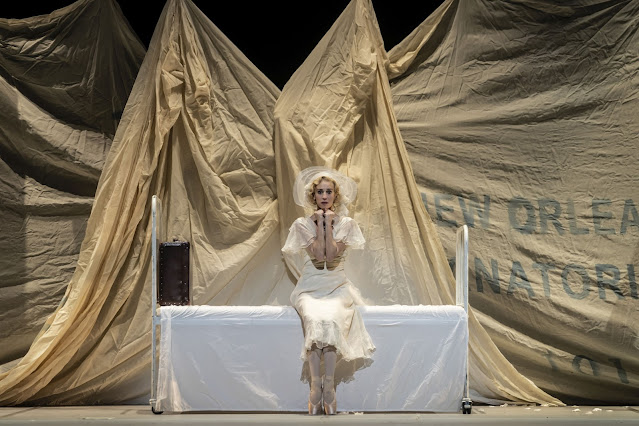
Last Stop: Ballerina Sonia Rodriguez’s Farewell Performance in A Streetcar Named Desire
| Sonia Rodriguez as Blanche DuBois in A Streetcar Named Desire. (Photo: Johan Persson) |
Blanche DuBois, one of the most memorable female characters born of the theatre, is a hot mess of narcissism, nymphomania and other neuroses wrapped in white satin. A nervous breakdown just waiting to happen. The vaporous southern belle at the centre of John Neumeier’s ballet version of Tennessee Williams’s A Streetcar Named Desire requires a seasoned dancer who can peel back the layers to expose the fragility behind the tragedy of her fall. Sonia Rodriguez is that dancer.
Born in Canada, raised in Spain and trained in Monaco, the National Ballet of Canada principal is one of the country’s greatest dancer-actresses. She doesn’t just perform a part; she inhabits it, bringing it fully, palpably, to life. That’s her legacy, what she will be remembered for after leaving Canada’s largest ballet company following an illustrious 32-year career.
Wednesday, December 26, 2012
From Ballet to Bharatanatyam: Dance in Toronto Breaks New Ground in 2012
![]() |
| Piotr Stanczyk in Hamlet at the National Ballet of Canada (Photo: Corbin Smith) |
With the Mayan calendar predicting the end of the world, 2012 was a year tinged with doomsday prophecies if not apocalyptic visions. But in dance, the zeitgeist was reversed. Instead of calling it quits, artists whose métier is choreographed movement instead ushered in a new era of renewal, presenting dance pieces that pushed forward into new directions. This feeling of regeneration was wide-spread, affecting a diversity of genre from ballet in the West to bharatanatyam in the East, all traditions re-considered and re-calibrated to make them more relevant and reflective of the times. Accepted notions of beauty were also re-investigated and re-invigorated, with some dance artists exploring the beast within as a way of unbalancing the audience, stripping away complacency, in presenting dance as a conduit for exploring the human condition. This transformational trend in dance was global but proponents of it reached Canada as a result of inspired artistic directors at the helm of the country’s leading and experimental dance troupes. looking to rejuvenate the domestic dance scene with work signalling, if not the end of dance as we have come to know it, then certainly its rebirth. Among them was Karen Kain who, as head of the National Ballet of Canada, this year ushered in the North American premiere of Hamlet by Ballett Mannheim artistic director Kevin O’Day – a dark and difficult and occasionally obtuse work that pushed both the ballet dancers and their audience members to the far-most edges of their comfort zone. For that, Canada’s former prima ballerina needs to be applauded. In adding non-traditional ballets to her company’s roster, Kain is helping to strengthen the dramatic, emotional and technical range of her dancers. Composer John King's electro score is largely improvised, forcing the dancers constantly to be on edge. No two performances are alike as a result of the dancers having to adapt the choreography to suit the music on a given night. There's nothing safe or predictable about it, for neither spectator or performer. And yet the NBOC took to it well, seamlessly holding together the fragments. Dancers include principal dancer Piotr Stanczyk, alternating with Guillaume Côté and Naoya Ebe in the eponymous role of the Shakespearean prince immobilized by analyzing situations he instead needed to act upon, performed acrobatic stunts on one hand but also soft shoe shuffles as part of his character’s schizophrenic relationship with both himself and his dysfunctional society. Stancyzk’s Ophelia was Sonia Rodriguez. 2012 was Rodriguez’s season to shine. Besides garnering standing ovations for her role in Hamlet, the wife of Canadian figure skater Kurt Browning, a working mother of two, went from strength to strength in the company’s revival of Alice’s Adventures in Wonderland in which she played the female lead. She rounded out the season getting a star on Canada’s Walk of Fame. The ballerina is back, but as new and revitalized artist. (See also my book!)
Thursday, March 19, 2020
Danse Macabre: Three Works by the National Ballet of Canada
![]() |
| Greta Hodgkinson in Marguerite and Armand. (Photo: Karolina Kuras) |
None of the three works the company presented two weeks ago at Toronto’s Four Seasons Centre for The Performing Arts simulated a contagion – nothing as obvious or as graphic as that. Featuring the world premiere of Angels’ Atlas by Vancouver’s Crystal Pite, a remount of Wayne McGregor’s Chroma and the Canadian debut of Sir Frederick Ashton’s Marguerite and Armand, the two-hours-plus evening more explored momentum and transience – metaphors, if you will, for the human condition in the throes of an existential crisis.


.jpg)