
Showing posts sorted by relevance for query Harold Arlen. Sort by date Show all posts
Showing posts sorted by relevance for query Harold Arlen. Sort by date Show all posts
Monday, December 5, 2011
Jazz Babies: Cotton Club Parade


Monday, July 9, 2018
Music Scenes: The Moderate Soprano, Coming Back Like a Song! & Mood Music
 |
| Roger Allam as John Christie in The Moderate Soprano. (Photo: Tristram Kenton) |
David Hare’s The Moderate Soprano tells the story of the beginnings of the Glyndebourne Festival on the lawn of Captain John Christie’s Sussex estate in 1934. Christie (played by Roger Allam), a Wagner fanatic, is determined to use his fortune to make opera count in England, which has a paltry tradition of housing it and an almost nonexistent history of creating it. (The masterpieces of Benjamin Britten are still in the future.) Christie also wants to open a space for his wife, Audrey Mildmay (Nancy Carroll) – the “moderate soprano” of the title, a decade and a half his junior – to perform. His dream is to see Parsifal on his newly erected stage in the first season; he envisions an English Bayreuth. It doesn’t happen. The experts he hires – two Germans, conductor Fritz Busch (Paul Jesson) and stage director Carl Ebert (Anthony Calf), and an Austrian, impresario-in-the-making Rudolph Bing (Jacob Fortune-Lloyd), who is Ebert’s right-hand man – patiently explain to him that the jewel box he’s built, seating about three hundred, is unsuitable for Wagner, unless, Ebert quips, he puts the audience on the stage and the singers in the auditorium. And, though their critical judgment is that his theatre is “completely unsuited to the serious production of opera” and that “the whole thing has the air of the amateur,” they finally agree to try to make it work because it’s their best option, the Nazis having made it impossible for all three of them to continue to work in Germany. But, to Christie’s irritation, they claim that the size of the theatre and Ebert’s special gift for staging Mozart make him the local composer for Glyndebourne’s debut season. Christie doesn’t get Mozart at all, but he capitulates. Glyndebourne opens with The Marriage of Figaro and CosÌ Fan Tutte, and it’s several years before his experts permit any other composer to be sung there.
Saturday, September 13, 2014
A Drama of History: The 40th Anniversary of Randy Newman's Good Old Boys

"It's hard to hear a new voice, as hard as it is to listen to an unknown language," D.H. Lawrence wrote in Studies in Classic American Literature (1924). "We just don't listen." Lawrence wasn't just talking about something as basic as the fear of something new. New ideas, as he later suggested, can always be pigeon-holed. "The world fears a new experience more than it fears anything," Lawrence explained. "It can't pigeon-hole a real experience. It can only dodge. The world is a great dodger, and the Americans the greatest. Because they dodge their own very selves." Lawrence was addressing here the varied works of American writers James Fenimore Cooper, Edgar Allen Poe, Nathaniel Hawthorne and Herman Melville. A panoramic and illuminating study, the polemic examines how a number of gifted writers were coming to terms with the experience of a young country still in the process of finding its identity. For an artist who has barely registered on the public's consciousness, except in his movie music and his songs for Pixar pictures, singer/songwriter Randy Newman could be one of Lawrence's great dodgers – an Artful Dodger – and one who deliberately creates paradoxical narratives in his songs. And his music, like the writers of the previous century, has also been on a comparable sojourn. For almost half a century now, the country he depicts with both love and devotion is also riddled with broken promises, violence, paranoia, superstition and arrogance.
Monday, February 19, 2018
Hey, Look Me Over!: Also-Rans
 |
| Vanessa Williams and members of the ensemble in Hey, Look Me Over! at New York's City Center. (Photo: Joan Marcus) |
Artistic director Jack Viertel’s concept for Hey, Look Me Over!, which opened the twenty-fifth anniversary season of Encores!, was to put together a revue of excerpts from shows that have never been revived in City Center’s beloved series. But to be honest, what you come away from the show with is a pretty good understanding of why you wouldn’t want to see a production of Wildcat (Cy Coleman & Carolyn Leigh, 1960) or Milk and Honey (Jerry Herman, 1961), Sail Away (Noël Coward, 1961) or, God help us, Greenwillow (Frank Loesser, 1960). I’d be more curious about checking out Jamaica (1957), which Harold Arlen and E.Y. Harburg wrote for Lena Horne, or All American (Charles Strouse and Lee Adams, 1962), which originally starred Ray Bolger, or Herman’s Mack and Mabel (1974), in which Robert Preston played silent-comedy king Mack Sennett and Bernadette Peters played his star and romantic partner Mabel Normand. I’d seen only one of the shows included in the compilation, George M! (1968), which the Goodspeed Opera House produced some years ago, a bio of George M. Cohan that isn’t remotely in the same class as the movie Yankee Doodle Dandy – though it must have been worth seeing on Broadway with Joel Grey.
Monday, June 13, 2016
The Tappin’ Life: What the Eye Hears, Shuffle Along, Tappin’ Thru Life
 |
| Donald O'Connor and Gene Kelly in Singin' in the Rain (1952). |
Brian Seibert’s hefty (612-page), comprehensive book on tap dance, published last year by Farrar, Straus and Giroux, carries the poetic title What the Eye Hears: A History of Tap Dancing. The author lays out his premise in the introduction:
Most dance arises from an interaction between music and movement. But because tap can be both dancing to music and dancing as music, it’s especially concerned with the combination. As the tap dancer Paul Draper once explained, “What the eye sees is sharpened by what the ear hears, and the ear hears more clearly that which sight enhances.” A dancer jumps up at tilt with bent knees, shaping his legs into a bell; when, still in the air, he brings his heels together, that bell rings.And he slams that premise home in every conceivable way, some of them incidental and quirky, like his evaluation of tap on vinyl (a paragraph on Fred Astaire’s tapping on mid-1920s recordings of “Puttin’ on the Ritz” and “Crazy Feet” offers an evocative example) and his parenthetical claim that “the right hand of the bop pianist Bud Powell produced, to my ear, some of the [1940’s] era’s greatest tapping.” The Illustrated London News, reviewing a performance by the great mid-nineteenth-century black dancer Juba, or Master Juba, proclaimed him “a musician as well as a dancer,” and that’s how Seibert talks about the hundreds of dancers he memorializes in this marvelous book – as men and women who make sublime music with their feet.
Monday, March 14, 2022
New from Criterion: Love Affair (1939)
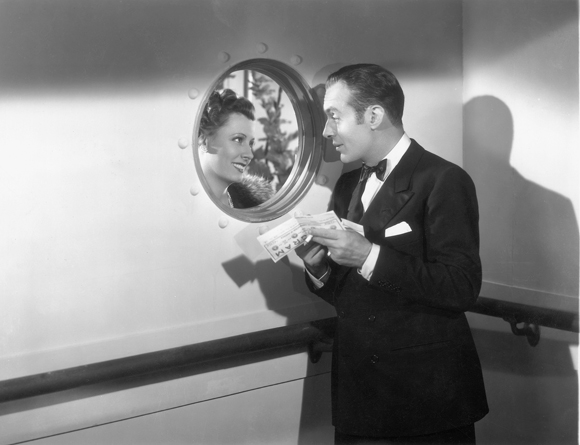 |
| Irene Dunne and Charles Boyer's shipboard first meeting in Love Affair (1939). |
The filmmaker Leo McCarey has been largely forgotten, but his Hollywood career spanned four decades and bridged the silent and talkie eras. Like Frank Capra, he received his training in silent comedy: he directed more than seventy-five shorts, and he was responsible for the collaboration of Stan Laurel and Oliver Hardy. When movies began to speak, he put his expertise at working fast and off the cuff to great effect – he directed the most brilliant of the Marx Brothers’ early Dadaist masterpieces, Duck Soup (1933), as well as helming pictures that starred W.C. Fields, Mae West and Eddie Cantor. His thirties output included two memorable comedies, Ruggles of Red Gap (with Charles Laughton as an English butler in the Wild West) and The Awful Truth, where Cary Grant strives to win back his ex-wife, played by Irene Dunne. It also includes the romantic melodrama Love Affair, starring Dunne and Charles Boyer, which Criterion has just put out in a glistening print restored from sources in the Museum of Modern Art collection.
Monday, July 31, 2023
Summer Musicals: Summer Stock and Gypsy

Corbin Bleu and the dancers in Summer Stock. (Photo: Diane Sobolewski)
Summer Stock, released in 1950, followed a particularly unhappy time in Judy Garland’s life and career – after the deterioration of her marriage to the director Vincente Minnelli, after she made her first suicide attempt and was committed to a rehab center, and after M-G-M replaced her on Annie Get Your Gun with Betty Hutton. Yet it feels like a breather for her: though her weight fluctuated during the filming (in her last big number, “Get Happy,” she’s strikingly trim), her performance is ebullient and unstrained. It was her third and final pairing with Gene Kelly – the others were For Me and My Gal in 1942 (his film debut, after he’d conquered Broadway in Rodgers and Hart’s Pal Joey) and The Pirate, for Minnelli, in 1948 – and his warmth and virility, his earthiness and easy jocularity, always brought out an appealing vaudevillian quality in her. None of her other co-stars was so ideal a vocal match for her, and though it’s great to see her with Fred Astaire in Easter Parade (1948), especially in the “Couple of Swells” number, when she and Kelly dance together they seem to belong to the same club. Summer Stock (which Charles Walters directed) is lightweight, and there’s nothing much in the George Wells-Sy Gomberg script that hadn’t been done in previous backstage movie musicals like the ones Garland and Mickey Rooney co-starred in, or Irving Berlin’s Holiday Inn. Garland plays Jane Falbury, who’s struggling to keep her farm from going under, and Kelly is Joe Ross, who persuades her to let him produce a show in her barn. But it never pushes the sweetness or the rural Americana, it has a fine supporting cast (except for Gloria De Haven as Jane’s self-centered sister: her acting is really awful), and Garland and Kelly’s scenes together are endearing.
Monday, March 14, 2016
The Color Purple: Voices
 |
| Cynthia Erivo in the Broadway revival of The Color Purple at the Bernard B. Jacobs Theater. (Photo: Sara Krulwich) |
When Cynthia Erivo opens her mouth to sing in the Broadway revival of The Color Purple, she looks as if she’s been touched with grace, and the music that pours out is honeyed gospel. I can’t remember the last time I heard a musical-theatre performer who commanded so much unfiltered power and possessed such purity of tone. The songs by Brenda Russell, Allee Willis and Stephen Bray were obviously written to be delivered with this kind of full-throated intensity – singing that carries the force of the north wind behind it. (I didn’t see the original production, which starred LaChanze and opened in 2005.) The first ensemble number, “Mysterious Ways,” a hymn by a black Baptist preacher (Lawrence Clayton) in small-town Georgia and his congregation, practically rips the seats out of the theatre. It’s in the tradition of “Leavin’ Time” from Harold Arlen and Johnny Mercer’s St. Louis Woman and “Walk Him Up the Stairs” from Gary Geld and Peter Udell’s Purlie.
Sunday, December 2, 2012
The Monkees: The Revenge and Resurrection of Tin Pan Alley

 |
| Tin Pan Alley |
Tin Pan Alley was the name given to a publishing company located on West 28th Street between Broadway and Sixth Avenue. From 1880 to 1953, this block became something of an epicenter for both songwriting and music publishing in America; and it provided the foundation for what became the standards in American song penned by composers like Rodgers and Hart, Irving Berlin, George and Ira Gershwin, Harold Arlen, Frank Loesser and Yip Harburg. Composers and lyricists were hired on a permanent basis to provide an industry for popular music. For until the emergence of Tin Pan Alley, European operettas had been the predominant norm and influence on American songs.
Thursday, September 24, 2015
Out of This World: John Coltrane in Seattle (1965)
 |
| John Coltrane and Elvin Jones (drums) at the Half Note in 1965. |
For twenty years, between 1947 and 1967, John Coltrane (whose birthday was yesterday) played saxophone while engrossed with the desire to reach a place unheard, never before felt, and spiritually solvent. Beginning his career with an equal longing to be "consumed" by the spirit of Charlie Parker, in actuality, he was consumed (like Parker had been himself) with drugs and alcohol. One day, though, Coltrane had a spiritual awakening through vegetarianism and eastern religion which lead him on a quest "to make others happy through music." Who knew then that this sojourn would take him to the furthest edges of what many would call listenable music? And it would leave some people less than pleased let alone happy.
His career had begun with Dizzy Gillespie's band in the late Forties, but when Coltrane hooked up with Miles Davis in the mid-Fifties, he began to hone a virtuosity in improvisation.They were an audacious contrast in styles. Where Davis was a master of spareness, Coltrane could never seem to cram enough notes into a bar of music. His heroin problems got him kicked out of Davis's group, but then he began a short term with pianist Thelonious Monk before kicking his habit permanently. Coltrane had found a mentor in Monk. Monk taught him methods of creating complex harmonic structures within his sax solos, which in time would be long, difficult excursions into abstract blues. Coltrane could take a pop standard such as Rodgers and Hammerstein's "My Favourite Things" in 1960 and enlarge the melody on the soprano saxophone by building an extended solo overtop the basic chords of the theme. Within a year, though, in a series of concerts at the Village Vanguard, Coltrane used melody as merely a starting place for epic solos that built in intensity like a chainsaw cutting through a tornado. Sometimes they would last for close to an hour. "Chasin' the Trane," for instance, featured over eighty choruses that were built upon a twelve-bar blues. That intensity would reach a spiritual epiphany in 1964 with the luxuriant devotional suite A Love Supreme.
Wednesday, September 7, 2016
A Voice That Still Matters - Barbra: The Music, The Mem’ries, The Magic & Encore: Movie Partners Sing Broadway

When it comes to the hits Streisand often tells the story of the time she went to see Charles Aznavour, the popular French singer, at a concert in the sixties, but she was disappointed when he didn’t perform her favourite song; a song she really wanted to hear. That changed her life as a performer because she recognized that many people would come to her concert expecting to hear their favourite Streisand track. Consequently, her recent show included five of her all-time hits, “Evergreen,” “People,” “Happy Days Are Here Again,” “Don’t Rain On My Parade,” and “The Way We Were,” which opened the concert. All the rest of the songs are her picks: eagerly accepted by an adoring audience. For this particular tour she had 35 albums from which to choose a set list. Has she ever cut a bad record? Let’s put it this way: some records are more successful than others but they all have her stamp of excellence even if the music isn’t always memorable.
Monday, August 19, 2013
The Bridges of Madison County: Indistinct
 |
| Elena Shaddow and Steven Pasquale in The Bridges of Madison County |
Last year the Williamstown Theatre Festival premiered a new musical based on Todd Haynes’s movie Far from Heaven – a perplexing choice, since the material (whatever one thinks of it) is so rarefied and dependent on cinematic reference points that transposing it could only alter the meaning, or at least reduce it to a series of social-problem-melodrama clichés. This year WTF mounted another new musical, based on Robert James Waller’s The Bridges of Madison County, and that’s puzzling too, though for a different reason. Waller’s novel about a short-lived affair between a married Iowa farm woman who’s an Italian émigré and an itinerant photographer is basically a Harlequin romance for the women’s-book-club set, with sufficiently self-conscious style to make readers believe that it should be taken seriously. It’s a suffocatingly bland volume, with characters who are barely more than ciphers, and the only thing that makes the 1995 movie version more distinctive is the miscasting of Meryl Streep and Clint Eastwood in the two principal roles. (Eastwood directed the picture.) So why bother turn this story into a musical?
Monday, September 5, 2016
Broadway to the Small Screen: Early TV Musicals
 |
| Keith Andes and Barbara Cook in Bloomer Girl (1956) |
In the heyday of live TV (the fifties), weekly and monthly series regularly offered abridged versions of plays, and between 1954 and 1956 one show, Max Liebman Spectaculars (a.k.a. Max Liebman Presents), which aired every fourth Sunday evening, produced ninety-minute adaptations of Broadway musicals as well as variety showcases and a handful of original musicals. (Liebman was better known for producing the inspired Sid Caesar-Imogene Coca sketch comedy, Your Show of Shows, one of the high-water marks of early television.) Surprisingly NBC preserved these musicals on kinescope, and several have surfaced on DVDs from Video Artists International, which has added to its repertory a couple of the early Hallmark Hall of Fame musicals and one from Producer’s Showcase. The result is a treasure trove for musical-theatre aficionados like me – especially since some of these shows have never been picked up by Hollywood (Bloomer Girl, A Connecticut Yankee and Dearest Enemy) and others were seriously altered – plots rewritten, scores decimated – in the movie versions. One Touch of Venus, for instance, reached the big screen with only a handful of the delightful Kurt Weill-Ogden Nash tunes intact; the Victor Herbert operetta Naughty Marietta and the Oscar Strauss import The Chocolate Soldier were retooled as Jeanette MacDonald-Nelson Eddy vehicles. (You wouldn’t know from the movie of The Chocolate Soldier that it was originally a musicalization – OK, a bowdlerization – of Shaw’s satirical romantic comedy Arms and the Man.) There is a crummy movie musical called A Connecticut Yankee in King Arthur’s Court starring Bing Crosby, but the longer title, which replicates the name of the Mark Twain comic novel, alerts owl-eyed movie buffs that it isn’t based on the hit show by Richard Rodgers and Lorenz Hart, which was produced on Broadway in 1927 and revived in 1943, at the very end of their collaboration.
Monday, July 27, 2015
All That Jazz: Paradise Blue and The Wild Party
 |
| Kristolyn Lloyd and Blair Underwood in Paradise Blue. (Photo: T. Charles Erickson) |
Paradise Blue, a new play by Dominique Morisseau at the Williamstown Theatre Festival, is set in the African-American community of Blackbottom in Detroit in 1949, during the heyday of bop. Its protagonist, Blue (Blair Underwood), is a jazz trumpeter who owns a club, the Paradise, and headlines the combo that plays there. He’s struggling to attain the zenith of his creative powers while battling the ghosts of his childhood: he saw his father murder his mother. Morisseau intends Blue to embody the musicians in the bop movement, gifted and intellectually self-challenging, restless and haunted. It’s a great subject, but she’s also working with black archetypes that limit the play imaginatively. The quintet of hard-working actors in Ruben Santiago-Hudson’s production strive to bring a vibrancy to the play but they’re stuck playing caricatures.
Monday, December 16, 2013
Heart and Soul: Camelot & After Midnight

Monday, February 15, 2016
A Classic and a Rarity: Fiddler on the Roof and Cabin in the Sky
 |
| Lori Wilner (left), Jessica Hecht and Danny Burstein in Fiddler on the Roof. (Photo: Joan Marcus) |
I fell in love with Fiddler on the Roof when, at thirteen, I heard the original cast album; by the time I saw it on Broadway I knew the wonderful Jerry Bock-Sheldon Harnick score by heart and I’d read Joseph Stein’s libretto through several times. (Those were the days when Random House regularly published new playscripts in deluxe hardback copies furnished with production photos.) Zero Mostel had already been replaced in the role of Tevye by the distinguished Group Theatre alumnus Luther Adler; I caught it again on the road a few years later with Herschel Bernardi. In my senior year at college Norman Jewison’s movie version came out, with the robust, warm-toned Israeli actor Topol in the starring role. It managed not only to reproduce the glories of the stage version (including, of course, the Jerome Robbins choreography) but to make a link, in the final moments, to the next chapter of the story of the Jewish diaspora: the exiles from the Russian shtetls, borne away on a raft in the film’s most exquisite image, would be the first generation of Jewish-Americans.
In his magnificent new Broadway revival, Bartlett Sher tries to make the leap to the twenty-first century by bookending the show with his leading man, Danny Burstein, in a parka reading from a book about the Jews of Anatevka before – and after – he dons the hat and prayer shawl of Tevye the dairyman. This frame is meant to situate the story in the larger one about refugees that is still, of course, with us. But it’s too vague to work and frankly, why would you want it to? If you felt the need to imply that the narrative of Fiddler on the Roof is only one chapter in a broader story, then the direction you’d have to head in would lead to the Holocaust – and that would be a truly terrible idea. The subject matter of the musical is rich enough; it doesn’t need generalization. Its great virtue is its specificity.
Saturday, November 15, 2014
Appreciating Victor Fleming
 |
| Clark Gable and Vivien Leigh in Victor Fleming's Gone with the Wind |
“It’s amazing: you ask people as a trivia question ‘Who directed Gone with the Wind?” and nobody knows; you give them a second clue – it’s the same guy who directed The Wizard of Oz – and they say Mervyn LeRoy. Victor Fleming was either a wonderful director or the luckiest son of a bitch in the world.” – Joseph L. Mankiewicz
Among the big studio-era Hollywood filmmakers whose
sturdy masculinity – an affinity for Westerns and other kinds of action
pictures, a love of robust characters (both male and female), a comfortableness
with the physical and the outdoors, a skill for shaping the distinctive
qualities of all-American movie stars – Victor Fleming has traditionally been
shortchanged. John Ford has been glorified, partly because he made the most
consciously pictorial movies; he was always after art, and at his best he got
it, in Young Mr. Lincoln, The Long Voyage Home, How Green Was My Valley. Howard Hawks,
who worked in every genre, parlayed a love of raucousness and sass and
tossed-off professionalism into a hard-boiled character ethic that infused all
his work, whether he was making a gangster picture like Scarface or an aviator actioner like Only Angels Have Wings or a newspaper movie-cum-romantic comedy
like His Girl Friday; his movies
were companionable and often so speedy (the overlapping dialogue) that they
felt wired. Fleming doesn’t get the same kind of respect. One reason may be
that he did his best work in the thirties and very early forties and was dead
by the end of the decade, whereas Hawks and Ford continued to make movies for
another couple of decades; they were still around and working, if not at the height
of their talents, when the film studies programs started operating in the
sixties. Another reason, ironically, is that the two most famous projects
Fleming was attached to, The Wizard of
Oz and Gone with the Wind, came
out the same year, 1939, and because they were vastly different and he wasn’t
the only director who worked on either – King Vidor directed
the Kansas footage in the first after Fleming prepared it, and Fleming replaced
George Cukor in the latter – Fleming
has been saddled with a reputation as a hired gun.
Subscribe to:
Posts (Atom)