Showing posts sorted by relevance for query Jessica Lange. Sort by date Show all posts

Monday, June 6, 2016

The Great American Tragedy: The Latest Long Day’s Journey into Night

John Gallagher Jr. and Jessica Lange in Long Day's Journey into Night at Roundabout Theatre Co.’s American Airlines Theatre. (Photo: Joan Marcus)

Eugene O’Neill’s Long Day’s Journey into Night is the greatest of all American plays, and every time someone mounts a fine new production of it, the effect on those of us who adore it is two-fold. On the one hand, we’re sucked back into the play’s riptide – its crosscurrents of conflicting realities as each of the four Tyrones fights against the others for his or her version of family history, the shifting alliances, the repeatedly dredged-up memories, the intricate interplay of guilt and recrimination. Like the great tragedies of the Greeks and of Shakespeare, this is a play that keeps biting you, digging at you; when it’s performed well there’s no safe space for an audience. And on the other hand, a worthy new mounting always reimagines the characters – especially Mary, the morphine-addicted matriarch whose husband James and grown-up sons Jamie and Edmund discover, on this August day in 1912 at their Connecticut home, that after a period of hopeful sobriety she’s relapsed. In Sidney Lumet’s 1962 film version, Katharine Hepburn brings her entire thirty-year career into her performance: the regal star presence and oddball mannerisms and air of authority apparent from her earliest screen appearances, the peerless technique for high comedy showcased in Holiday and The Philadelphia Story, the gift for transforming masochism into emotional devastation from Summertime and The Rainmaker, the ability to shift from one age to another with delicate precision that had been a hallmark of her work since her portrayal of Jo in Little Women. I think it’s the greatest performance by an American film actress since the advent of sound. Colleen Dewhurst, in a version performed at the Long Wharf Theatre in New Haven in 1988, seemed to grow slighter and less substantial as the evening wore on, so that by the turbulent last act, when she appeared with her wedding gown in her arms, she was like a ghost carrying a smaller ghost. When Vanessa Redgrave played Mary on Broadway in Robert Falls’ superb 2005 revival, she injected an element of savagery; she seemed to strip down the character and rebuild it physically, drawing on her Amazonian frame to elevate her. It was a creation of dissonant grandeur. Now Jessica Lange is playing the role in a magnificent new production at Roundabout Theatre Company’s American Airlines Theatre staged by the English director Jonathan Kent. What she brings to the role are an edgy lyricism, a bitter humor and an earthy quality that’s utterly unlike anything I’ve seen in other Marys. Anyone who has loved Lange in movies like Tootsie, Frances, The Postman Always Rings Twice, Crimes of the Heart, Music Box and Blue Sky will recognize her here in a performance that certainly marks the zenith of her acting career.

Monday, June 18, 2012

Neglected Gem #18: Blue Sky (1994)

Jessica Lange and Tommy Lee Jones star in Blue Sky

Whenever Jessica Lange tackles Tennessee Williams directly – on TV in Cat on a Hot Tin Roof, on Broadway and TV in A Streetcar Named Desire – she seems cowed; she falls back on stagy acting-class clichés no one knew she was even capable of.  But she creates a great Williams character – part Blanche, part Maggie the Cat, part Amanda Wingfield – in Carly Marshall, the glamorous southern belle chafing against her role as an army role and suffering from bi-polar disorder, in the 1994 Blue Sky. Blue Sky was completed in 1991, when Orion was on the verge of bankruptcy, so the movie, like several others, was held back; the director, Tony Richardson, whose final picture it was, didn’t live to see it in release.  It’s not his most consistent work; there are two movies rolling around in it, and unfortunately in the second half the lesser of the two takes over.  But he had every right to be proud of the texture he got in the domestic scenes, and the way he coached his cast, especially Jessica Lange and, as her husband, Major Hank Marshall, Tommy Lee Jones.

The good movie locked inside Blue Sky has some of the sizzle and emotional engagement of From Here to Eternity and The Long Hot Summer.  It’s the story of Carly, who’s miserable about leaving Hawaii, Hank’s last posting, for airless, remote Nevada.  (The time is the early sixties.) Carly wears her hair in a Marilyn Monroe bob and tosses her head like Monroe; she even gets the rhythm of Monroe’s champagne laughter.  She’s hot stuff; her movie-star affectations (at the end she switches to Liz Taylor) and her flamboyant sexuality are her way of expressing what’s inside her – everything army conduct is supposed to tamp down.  Carly’s a beautiful woman, but she’s terrified of losing her looks.  She stares at herself in the mirror and swears she sees the ghost of the old hag she’s fated to become.  She thinks she’s going to disappear, and – both spooked and fascinated – she seems to be peering for evidence that the process has already begun to happen.  Mirrors mesmerize her, and Lange mesmerizes us.  She climbs inside her mirror and peers around – the psychic equivalent of Cocteau’s Orpheus breaking through to the underworld behind the glass.  At her best, Carly has esprit and a southern graciousness; that’s when her daughters, Alex (Amy Locaine) and Becky (Anna Klempt), can’t resist her.  At her worst, she throws tantrums or loses her self-control and takes on other men.  On the Marshalls’ first day in Nevada, she paces their unattractive new house like a caged cat, then goes wild, screaming and crying, smashing up the car, talking to herself in a local store.

Wednesday, March 5, 2014

In Secret: Lovers in Hell

Oscar Isaac and Elizabeth Olsen in In Secret

The new film In Secret has had a limited release and drawn very little notice, but it’s tense and intelligent and beautifully acted. The only generic thing about it, really, is its title. The writer-director, Charlie Stratton, has based it on Émile Zola’s harrowing 1867 novel Thérèse Raquin. Zola’s Thérèse is a young woman brought up by her aunt, who marries her off to her weak, fever-prone son Camille, whose bed the girl shared when they were children. Having relocated to Paris from the country to please Camille, they live above Mme. Raquin’s shop in a glum alley. Thérèse helps out behind the counter during the day; in the evenings she has nothing to do but cook dinner and take care of Camille when he comes home from his shipping-office job. The only distraction in her dull life is the games of dominos they play with some friends one night a week. Mme. Raquin is contented by this bourgeois existence, but Thérèse is so bored that she generally sits in defeated silence as the others play. Then one evening Camille brings one of his co-workers, Laurent – who knew the family as a boy in the provinces – home for supper. He’s an aspiring painter who speaks openly of the free-spirited world of the artist – of the women who model nude – as he executes Camille’s portrait (really a way of endearing himself to the Raquins so that he can enjoy their hospitality on a daily basis). And though at first his sensuality unsettles Thérèse and makes him dislikable to her, when she finds herself alone with him for an hour and he scoops her up in a kiss, she allows him to make her his mistress. The affair transforms her from a virtual sleepwalker to an alert, voracious young animal who finds it surprisingly easy to deceive both her husband and her mother-in-law. Eventually she and Laurent both grow impatient with the restrictions on their life together – especially Laurent, a soft, indolent character who gave up studying the law because he found it too rigorous and would like someone to take care of him so that he could quit his job and go back to the studio (out of laziness, not out of dedication to art). So he takes Thérèse and Camille rowing and drowns his friend while she watches, horrified yet paralyzed by the recognition that he’s acting on their mutual desire. Both the lovers believe that this murder will liberate them, but instead it dooms them: the image of Camille’s sodden corpse haunts their dreams when they’re apart and even after they marry – after a respectable mourning period, and with the blessing of the ignorant Mme. Raquin, who thinks of Laurent as a second son – they see that image in their bed like a ghost. It drives a stake between them and inevitably causes them to turn on each other.

Thursday, April 3, 2014

Last of the Great Gadflies: Remembering Lorenzo Semple Jr.

Screenwriter Lorenzo Semple Jr. (1923-2014)

There are two kinds of legendary screenwriters: the folks on Olympus, who (like Robert Towne) pen masterpieces on subjects that are important to them, with every word in perfectly in place, and the gadflies, who live on the money they get for bringing some wit and craftsmanship to commercial assignments and eat out on their collection of great stories. (There is considerable overlap between the two camps.) Citizen Kane was written by a gadfly, Herman J. Mankiewicz; part of Towne’s legend is how much time he’s spent away from his own dream projects to parachute into film sets and work as a script doctor, sometimes on such projects as The Godfather and Bonnie & Clyde, more often on a vast wasteland of junk. Towne once tried to work out his feelings about his career as a much-sought-after, richly paid writer-for-hire, but he needed to assign the protagonist a profession that would reflect what he himself felt about the work but that seemed to him more glamorous, and maybe less morally reprehensible, than trying to tone up the screenplays of Orca and 8 Million Ways to Die. This is how he came to write and direct the 1988 Tequila Sunrise, a movie whose hero is a drug dealer.

Lorenzo Semple, Jr., who died last week at the age of 91, may have been one of the last of the great gadflies. A nephew of Philip Barry, Semple wrote plays and short magazine fiction when he was young, but he found his niche in his forties, when the producer William Dozier hired him to “create” the Batman TV series. Semple had previously worked with Dozier on a series spin-off of Charlie Chan called Number One Son, which was set to go into production when ABC decided it didn’t want a show with an Asian-American hero; according to Semple, the Batman job was Dozier’s way of making it up to him. Semple wrote the first four episodes and the screenplay for the 1966 Batman movie, and stayed on as “Executive Story Editor” throughout its three seasons on the air. He devised and and maintained the poker-faced, Pop Art campiness of the show—the mock-stolid Batman of Adam West pitted against the hamminess of the guest villains, the fight scenes punched up with written sound effects flashing on the screen. All of which is to say that he played an enormous role in making self-aware pop irony mainstream—a accomplishment that it’s easy to have mixed feelings about today, though it must have been fun and refreshing at the time.

Monday, May 27, 2024

Toni Stone, Mother Play, Uncle Vanya: Deserting the Audience

Stanley Andrew Jackson and Jennifer Mogbock in Toni Stone. (Photo: T. Charles Erickson)

The titular protagonist of Toni Stone, currently playing in the Huntington Theatre’s revered space in Boston’s Back Bay, is the first woman who played baseball regularly in a professional league. She played for three Negro leagues in the forties and fifties, culminating in a season with the Indianapolis Clowns of the Negro American League, where she replaced Hank Aaron, who had been picked up by the Milkwaukee Braves. It’s an appealing story for the stage and especially for contemporary audiences. But the playwright, Lydia R. Diamond, hasn’t worked out how to dramatize it.

Friday, March 11, 2016

What about this Place: Louis C.K's Horace and Pete

Steve Buscemi and Louis C.K. in Horace and Pete.

Sometimes I wonder why do we tear ourselves to pieces / I just need some time to think / Or maybe I just need a drink / At Horace & Pete’s.
– from the theme song to Horace and Pete, written and performed by Paul Simon. 
On January 30, without fanfare, press release, or social media campaign, Louis C.K. sent out a mass email to his fans: “Hi there. ‘Horace and Pete’ episode one is available for download. $5. Go here to watch it. We hope you like it. Regards, Louis.” (Subsequent episodes were downloadable at a lesser cost: $2 for episode two and $3 for each episode after that.) For the past six years, C.K.'s Louie has been the standard bearer for indie TV within the network model, so this move to direct-to-consumer series distribution seems, though maybe only in retrospect, like a natural next step for him. Unlike Louie, which remains a comedy (albeit a dark and sometimes surreal one), Horace and Pete is a drama, in every best sense of the word: both in that it has the deliberate texture of a stage production and that it lands with a surprising weight of reality.

Tuesday, March 21, 2023

Marlowe and Boston Strangler: Mythologies

Jessica Lange in Marlowe.

The Irish writer John Banville’s The Black-Eyed Blonde, published in 2014 and the source of the new Neil Jordan picture Marlowe, is a Raymond Chandler reset of no special distinction except a rather puzzling one. (Banville’s other output is divided between high-flown literary works like The Sea – an exquisite piece of writing – and a series of mysteries, written under the pen name Benjamin Black, that feature a pathologist named Garret Quirke.) At the climax of this tale, set in late-1950s L.A., of the disappearance of a shady Hollywood agent named Nico Peterson, which Peterson’s lover, the wealthy Clare Cavendish, has hired Marlowe to solve, a potent figure out of the gumshoe’s past, a drinking buddy named Terry Lennox, resurfaces. Lennox is the pivotal character in one of Chandler’s later books, The Long Goodbye, which begins with Marlowe’s agreeing to drive him to Tijuana, no questions asked, after the murder of his wife, and ends with the detective’s helping him to establish a new identity in Mexico. The point of The Black-Eyed Blonde, as far as I can tell, is to punish Terry – to turn him into a thoroughgoing villain. But Robert Altman and his screenwriter, Leigh Brackett (who had collaborated with William Faulkner and Jules Furthman on the most famous Marlowe film, The Big Sleep), already did that in the brilliant 1973 movie of The Long Goodbye, where Marlowe is played by Elliott Gould and Terry by the ballplayer Jim Bouton, and where the story ends very differently.

Friday, February 10, 2012

Strictly Genteel: Michael Sucsy's The Vow

When you fall in love, it can strike out of the blue, in serendipitous ways, totally out of your control. Michael Sucsy's The Vow, on the other hand, is so predictable and controlled that you can set your watch to it. The picture is also based on a true story, but usually when a movie has to remind you of such things it offers the opposite. Now I've seen a lot worse romantic dramas, including popular ones that are especially disingenuous and effective in wooing audiences (Sleepless in Seattle immediately springs to mind), but The Vow isn't one of those. It wants to wear its heart on its sleeve, but it falls victim to its lack of conviction even in its own formula plot.

The story follows a happily married couple, Paige (Rachel McAdams) and Leo (Channing Tatum), artist bohemians out of Chicago, whose lives are shattered one night when a car accident seriously injures Paige. After coming out of her coma, she wakes up with severe memory loss without remembering that she is married to Leo. Since we quickly discover that Paige originally came from a wealthy family that she abandoned for reasons explained later in the picture, we know that the film is going to be a battle of wills between the sensitive artist husband she's forgotten and the rich rotters who want her back. Guess who wins?

Thursday, October 15, 2015

Checking Out “Checking In” – The Season Premiere of American Horror Story: Hotel


Last Wednesday, creators Brad Falchuk and Ryan Murphy checked us into the fifth season of their anthology horror series, American Horror Story, with a gore-packed hour-long premiere. The episode, aptly titled “Checking In,” introduces us to this season’s setting of The Cortez Hotel and an assortment of bizarre and fascinating key players. Like the previous installments of American Horror Story, the fifth season (subtitled Hotel) tells a new, self-contained story with many familiar faces stepping into fresh characters. Falchuk and Murphy have hinted that American Horror Story: Hotel will be the season that ties American Horror Story’s previous story arcs together at last into one cohesive (and undoubtedly messed up) narrative through the use of flashbacks and crossover characters. Whether it does indeed all come together or not remains to be seen, but Hotel’s return to the present day Los Angeles from season one’s Murder House storyline certainly bodes well for fans looking for closure. As a fan looking mostly for fun, the episode's gorgeous setting and wild performances bode well for me too.

Friday, November 2, 2018

All Work and No Play: Bohemian Rhapsody

Gwilym Lee and Rami Malek in Bohemian Rhapsody.

Rock and roll has long seemed wedded to the movies despite the fact that film started a good 50 years before those percussive, jangling refrains entered the mainstream. But the immediacy, intimacy, and gigantism of that shimmering screen is so related to the feeling of excess engendered in rock and pop that it can seem like they have always been intertwined. (A movie like Rebel Without a Cause was so steeped in the youthful mythos of rock that it’s still surprising to realize it was released before rock existed as a mass phenomenon.) Thus it’s no surprise that the lives of rock gods and goddesses have served as fodder for numerous screenplays and treatments. The rock-and-roll biopic is a genre unto itself. The best of these pictures tend to hinge on who portrays the pop deity – if the actor is able to tear into both the myth and reality of their subject, the results can be spectacular, even if the movie itself is so-so. Jamie Foxx was terrific as Ray Charles, Joaquin Phoenix’s astonishing turn as Johnny Cash, and to a lesser extent, Reese Witherspoon’s as June Carter Cash, still haunt me, and Jessica Lange’s Patsy Cline was a revelation. (Lange also had the great fortune to have Robert Getchell writing sharp, incisive dialogue for her.) Both Paul Dano and John Cusack broke my heart as The Beach Boys’ Brian Wilson in Love & Mercy, and Beyoncé was mesmerizing as Etta James in the too little-seen Cadillac Records, to name just a few. Even if the movie is out-and-out terrible, a great star turn can make the experience worthwhile. It’s hard to see how Lady Sings the Blues could be much worse, just as it’s almost as hard to see how Diana Ross’s performance could be much better. (Go have the argument whether Lady is a jazz or blues biopic somewhere else: Ross’s performance is pure rock and roll.) But rock cinema is also riddled with great promise greatly denied: Dennis Quaid put all sorts of effort into his portrayal of Jerry Lee Lewis, but never really came to life. Val Kilmer’s Jim Morrison was stillborn (perhaps due to director Oliver Stone’s apparent belief there’s no greater rock star than himself), and let’s not talk about Kevin Spacey’s Bobby Darin.

Friday, December 30, 2016

The Best of CAL 2016


Back in January 2010, when David Churchill, Shlomo Schwartzberg and I came up with the idea of Critics At Large, we envisioned a daily online arts journal that would provide us the freedom to write – a freedom we were beginning to lose in magazines and newspapers. Growing rapidly tired of working in a field where desperate careerism and craven expedience was being rewarded, we wanted to remain true to the pleasures of critical writing. We also wanted to discover who our readers might be. Over the last seven years, many things changed in both our writing and in our audience. For one thing, Critics At Large grew to be less a haven for frustrated writers and more a home for a diverse and hopeful group who saw us as a possibility. We began attracting a motley crew from various backgrounds who helped change the magazine for the better. A number of men and women, young and old, experienced and not, came to shape our identity as a journal rather than take on the identity we originally gave it. Along that path, we attracted veteran arts critics who wanted to continue to address the work that inspired them, but we also drew inexperienced voices trying to find out the true value of having one to speak with. When I read individual pieces each day, I marvel at the sheer range of material and the keen passion each writer brings to their subject. As for our readers, they have not only been rapidly growing, but the diversity of opinion in the magazine has helped us reach out to a much wider readership.What became most important for me, as one of its co-founders, was watching Critics At Large grow beyond my own expectations into a continually morphing organism that embraces the freedom our writers bring to it. For those who believe that criticism is not about everyone having the right opinion, but instead a means by which the writer and reader mutually discover their own personal relationship to a work, I think we are succeeding in getting there. As a way to celebrate that goal, and I suppose to demonstrate it, here is a look back at some of my own favourite pieces from the past year. Rather than commenting on the writer and their work, I've selected specific quotes that I think best reflects their value to me as critics. As I continue on as both writer and reader, I can truly say that I'm proud to call them colleagues.

Kevin Courrier
Editor-in-Chief
Critics At Large

Monday, January 3, 2022

Nightmare Alley and The Tragedy of Macbeth: Cinematic “Art”

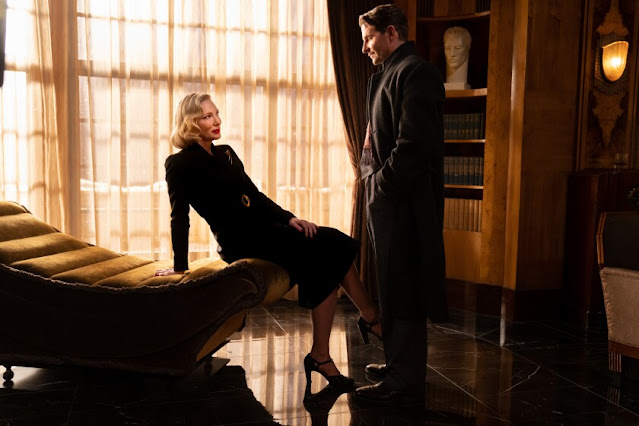
Cate Blanchett and Bradley Cooper in Nightmare Alley.

William Lindsay Gresham’s tough, darkly lyrical 1946 novel Nightmare Alley moves from the carny life to the world of phony spiritualists – scam artists who make a living off the sorrow of rich people trying desperately to contact loved ones on the other side of the grave. (In real life Harry Houdini was one of the more celebrated marks.) Gresham’s anti-hero is Stanton Carlisle, who joins a carnival and partners up with his lover, Zeena, to revive the mentalist act she used to perform with her husband Pete, a hopeless drunk who dies when Stan hands him a flask of wood alcohol. (It’s an accident: both the poison and a flask of potable gin have been stored in the same trunk. But as Gresham writes the incident, it’s one of those sinister acts of wish fulfillment, like Bruno’s murdering Guy’s blackmailing wife in Strangers on a Train.) Stan proves to be so good at the act that he soon outgrows it and takes it on the nightclub circuit, with a younger, prettier girlfriend as his assistant – Molly, whose carny performance used to involve an electric current and an alluring skimpy costume: sex and sci-fi “magic” intertwined. That’s when he crosses paths with a higher type of parasite, a psychoanalyst named Lilith who teams up with him to take advantage of her grieving patients. Stan and Lilith become lovers too, and their main target is a fabulously wealthy man named Ezra Grindle who is suffused with guilt over the fate of the girl he impregnated when he was a young man. Gresham never lets us forget how important a role sex plays in both low and high-class scams. (The Library of America, faithful purveyor of forgotten treasures, republished the book about a quarter of a century ago in a first-rate collection called Crime Novels: American Noir of the 1930s and 40s.)

Wednesday, November 23, 2016

Denial: Making “Drama”

Rachel Weisz as Deborah Lipstadt in Denial. (Photo: Laurie Sparham/Bleecker Street Media)

Playing Deborah Lipstadt, the American Holocaust scholar sued for libel in an English court by alleged historian David Irving for calling him a Holocaust denier in print, Rachel Weisz carries herself with the uneasy tension of a warrior in repose in Denial. Contemporary movies and TV are loaded with examples of British actors who have so mastered not just the accents but also the verbal rhythms of Americans from different regions that it’s a shock to discover their true origins; it’s one trick that even the great generation of Brits who came up before the Second World War – the Oliviers and Gielguds and Richardsons – could never quite manage. But Weisz doesn’t just sound like a New Yorker. She’s physicalized all the elements of Lipstadt’s identity, including the Jewish part and the feminist part and the teacher-scholar part. (Lipstadt has an endowed chair in Modern Jewish and Holocaust Studies at Emory University.) A friend told me that when he watched Jessica Lange dancing in the opening scene of Music Box, set at a Midwestern Hungarian community center, he murmured to himself, “Oh, my God, she’s turned herself into a Hungarian.” That’s how I felt about Weisz playing an American Jew in Denial: it’s in the sound and the look. Lipstadt is an intellectual with a lifelong comfortableness with speaking her mind; Weisz plays her as alert, gutsy, dukes-up. It’s a vibrant, comprehensive portrait.

Thursday, April 30, 2015

Underappreciated Performances from 2014: A Selection

Philip Seymour Hoffman in A Most Wanted Man.

It’s in the nature of movie awards to underscore the work that’s already receiving a glut of (often unmerited) attention and neglect the worthier achievements that slipped by unnoticed. And these days, when there’s so little difference between the movies that get nominated for Academy Awards and the ones that are recognized by critics’ groups, there are fewer chances than ever to bring fine neglected work into the limelight. Since more than any other element in movies, it’s the acting that excites me – and since no movie year, however dim in other respects, is without its long list of impressive performances – the sidelining of deserving actors during awards season always puts me in a funk. Of course, some of the actors who win praise deserve it, like the Oscar-nominated actors from The Imitation Game, Wild, Boyhood and The Theory of Everything. The ones showcased below deserve it too, however, and weren’t so lucky. Since I reviewed some of the performances I liked best on Critics at Large in the course of the year, I won’t recycle my impressions of Al Pacino in The Humbling, Timothy Spall in Mr. Turner, Chadwick Boseman and Viola Davis in Get On Up, Keira Knightley in Begin Again, Jessica Lange in In Secret, Mia Wasichowska in Tracks, Agata Kulesza in Ida, Kenneth Branagh in his own film, Jack Ryan: Shadow Recruit, Annette Bening in The Face of Love, and the three stars of The Last of Robin Hood (Kevin Kline, Susan Sarandon and Dakota Fanning).

Monday, May 20, 2019

Sentimental Journeys: Frankie and Johnny in the Clair de Lune, Burn This, Doris Day

Michael Shannon and Audra McDonald in Frankie and Johnny in the Clair de Lune. (Photo: Deen van Meer)

I’ve been skipping productions of Terrence McNally’s two-hander Frankie and Johnny in the Clair de Lune for decades – I didn’t see Kathy Bates with F. Murray Abraham or with Kenneth Welsh in the off-Broadway version in 1987, or Edie Falco with Stanley Tucci in the last revival, in 2002 – but I opted to see the latest one, on Broadway, with Audra McDonald and Michael Shannon. It’s a lousy play, an American variation on an English kitchen-sink drama that begins with a pair of lovers in bed naked, having sex, and then takes a couple of hours to show them opening up to each other in other ways. The (stock) idea is that they’re both desperately lonely but he’s willing to acknowledge it and she isn’t, and, attempting to persuade her that she should see him as more than a one-night stand, he’s got his work cut out for him because emotionally she’s closed down. It’s an unconventional courtship drama with the same basic structure as Lanford Wilson’s Talley’s Folly (1980), which takes a far more inventive approach to the man’s effort to win over the cautious, distanced woman – and which has far more interesting characters. Talley’s Folly is a comedy with serious undertones; Frankie and Johnny tries for loopy romanticism but ends up glum and monochromatic, though with a sentimental ending.

Friday, July 24, 2015

Olive Kitteridge: Portrait of a Marriage

Frances McDormand and Richard Jenkins in the HBO miniseries, Olive Kitteridge.

Note: There are spoilers ahead in this review. 

The Maine coastal town where the sensational four-part HBO miniseries Olive Kitteridge, directed by Lisa Cholodenko and now on DVD, is set seems blighted by disaster and grief, but the story isn’t a Gothic. Jane Anderson’s screenplay, based on the Pulitzer Prize-winning 2009 novel by Elizabeth Stout, puts the lives of the women and men who inhabit this community under a microscope to reveal how difficult the path is that all of us take through life, tortuous and stone-strewn and obscure. Some of the fates that befall subordinate characters are unusual. One is shot on a hunting foray by his best friend, who mistakes him for a deer. (Perhaps Stout was thinking of the plaintive reel “Molly Bán,” where a young man shoots his fiancée because, her apron up to shield her from a rainstorm in the forest, he takes her for a swan.) Another, whom we only hear about, becomes a psychotic killer. Most of the tragedies, though, are ordinary enough. The assistant to the local pharmacist, Henry Kitteridge (Richard Jenkins), collapses of a heart attack in the street outside the store and dies. Henry himself, in the middle of Part 3 (“A Different Road”), has a stroke and hangs on for four years, unable to communicate with his wife Olive (Frances McDormand), a retired math teacher.

Thursday, December 16, 2010

Waterlogged: Julie Taymor's The Tempest

Helen Mirren and Felicity Jones in The Tempest
In the Shakespearean canon, The Tempest, reportedly his last written play, stands out as one of his weakest works. It’s essentially a simple tale about Prospero, the former Duke of Milan, who’s been exiled to a deserted island for over a decade with his daughter, Miranda. As The Tempest opens, by use of magic, Prospero has stranded his enemies – who usurped his post – and some others, on various parts of the island. There, they endeavour to make their way back to civilization even as Prospero instructs his child on life and love, and commands the resentful half-man/half-monster Caliban and the loyal sprite Ariel to torment their reluctant guests. It all builds to, not a climax, exactly, but a mild confrontation between the parties concerned, and then a flat and dull happy ending. Slapdash, superficial and thin, The Tempest, even when staged well, as it was at Stratford this past summer (see my review here), cannot surmount its many failings and shortcomings. But when you let a talentless filmmaker like Julie Taymor (Titus, Frida) tackle the project, the results are considerably worse.

Monday, May 13, 2019

Tootsie: In Name Only

 Julie Halston, James Moye, Santino Fontana, Lilli Cooper, John Behlmann in Tootsie. (Photo: Matthew Murphy)

The new musical of Tootsie, with a book by Robert Horn and music and lyrics by David Yazbek, has “smash hit” written all over it. It’s slick and rapid-fire. The veteran director, Scott Ellis (who’s also represented on Broadway this season by the revival of Kiss Me, Kate at Studio 54), and his expert cast build the farce perfectly, so that the more complications that are piled on top of the premise – actor Michael Dorsey (Santino Fontana), whose temperament has made it impossible for his agent (Michael McGrath) to land him jobs, finally gets one by presenting himself as a woman, Dorothy Michaels – the funnier it is. Rather than set the story in the period in which the movie was made, the early eighties, Horn has contemporized it. There are #MeToo jokes – Michael’s wry aspiring-playwright roommate Jeff Slater (Andy Grotelueschen) quips that in an era when women are literally seizing power from between the legs of men, Michael is risking infuriating everyone by pretending to be female. There are jokes about sexual fluidity – when Michael, forgetting momentarily that he’s in drag, kisses his co-star, Julie Nichols (Lilli Cooper), whom he’s fallen for, instead of scaring her off since she’s not gay, she likes him so much that she decides to try to be gay. It’s all very up to the minute, and the audience at the Saturday matinee I attended screamed with laughter. I would be dishonest if I said that I didn’t have a pretty good time, too. But I haven’t the slightest idea what the hell this Tootsie is about.

Monday, February 29, 2016

Buried Child: Sam Shepard and Ed Harris

Ed Harris and Paul Sparks in Buried Child, at the Pershing Square Signature Center. (Photo: Monique Carboni)

When you watch Ed Harris as Dodge, the contrary, irascible patriarch of Sam Shepard’s Buried Child, in the current revival at New York City's Pershing Square Signature Center, you realize he was born to play this role – or more aptly, that the role has been waiting around for him to get old enough for it. I didn’t see Joseph Gistirak, who created the character at the Magic Theatre in San Francisco in 1978, or Richard Hamilton, who took it over in the original off-Broadway production, but I did see James Gammon in the 1996 Broadway version, and, playing the old man as a kind of ghost sniping at everyone around him as he continues to haunt the dilapidated Illinois family farmhouse, he performed marvels with that whiskey-soaked, hollowed-out voice. It didn’t occur to me that I’d ever see a better Dodge. But Harris injects the character, who’s stationed in front of his TV set, sneaking hits of apple jack until his son Tilden (Paul Sparks) makes off with his bottle while he’s asleep, with a hilariously mean-spirited life force that makes him seem unkillable, even if you know the play and realize he fades out at the end. Harris became famous for playing a straight-arrow American hero, John Glenn in Philip Kaufman’s 1983 The Right Stuff, but he’s sometimes used his classical American looks, that rangy cowboy handsomeness, as a starting point for an in-depth portrait – perhaps most vividly as Charlie Dick, husband to Jessica Lange’s Patsy Cline in the 1985 Sweet Dreams. He’s also used it ironically, as he did, also early on in his career, as the conscienceless mercenary in Under Fire. His performance in Buried Child belongs in the ironic category. You look at this ornery old codger, who doesn’t have a kind word to say about anybody – except, perhaps, his grandson Vince’s girl friend Shelly (Taissa Farmiga), whose obstinacy he can appreciate (he certifies her “a pistol”) – and see the corruption of the whole frontier legacy. It’s Harris’ scheme to make that corruption richly funny.

Tuesday, December 31, 2019

Fond Farewells: Rip Torn and Rene Auberjonois

Rip Torn and Jeff Morris in Payday (1973).

In my final 2019 posting on Critics at Large I’d like to pay tribute to two marvelous character actors who passed away this year, Rip Torn (who died on July 9 at the age of 88) and Rene Auberjonois (only 79 when he died on December 8). These two men could hardly have been less alike in style or in the kinds of roles they were drawn to, but though they had long careers and occasionally appeared in movies or TV series that were popular enough to draw attention to their gifts, the quality of their best work has tended to be overlooked.