Showing posts sorted by relevance for query Judi Dench. Sort by date Show all posts

Friday, November 23, 2012

Pastiche: Sam Mendes' Skyfall


My original intention was to look at the last 50 years of cinematic James Bonds, ending with the just-released Skyfall. I was planning to write about how each generation gets the Bond that suits the times. Sean Connery was the Bond for the men (and women) who'd fought in World War II. He was a man's man who fought the good fight, drank like a fish, smoked like a fiend, bedded a couple of “broads” and saved the world from diabolical evilness (i.e., Hitler). He was also the Bond for the first of the Baby Boomers who were born just after the war, so they would have been hormonal 16- or 17-year-old boys when Dr. No (1962) was released (they all drooled over Ursula Andress and her bikini). By the time Connery made his last original Bond in 1971, Diamonds Are Forever, he was the Bond for the end of the hippie era (the ideals destroyed, now usurped by scum such as slightly hippieish/psychopathic Mr. Wint (Bruce Glover) and Mr. Kidd (Putter Smith)).

I was going to talk about how Roger Moore's first Bond, Live and Let Die (1973), was an attempt to come to terms with blacksploitation films such as Shaft (1971). I watched it again recently, having loved it when I was 14. My God, is it terrible and borderline racist. The Me Decade was encapsulated with the rest of Moore's work, with its disco overtones and not-funny quips. The new-seriousness of Timothy Dalton failed because the screenwriters seemed to forget that Moore had retired. The less said about the Pierce Brosnan era the better. Daniel Craig, in Casino Royale (2006), was the first post 9/11 Bond working in a world filled with confusion and trust being constantly betrayed.

Monday, February 8, 2016

The Winter’s Tale: Branagh and Dench

Judi Dench as Paulina and Kenneth Branagh as Leontes in The Winter's Tale at the Garrick. (Photo: Johan Persson)

Kenneth Branagh’s new theatre company opened its inaugural season at the Garrick in the West End with productions of Terence Rattigan’s Harlequinade (double-billed with his one-woman piece All on Her Own with Zoë Wanamaker) and The Winter’s Tale. Luckily those of us who didn’t happen to be in the neighborhood were able to see the latter in HD. It stars Branagh himself and the great, unstoppable Judi Dench. They give luminous performances as King Leontes of Sicilia, whose fit of jealousy plunges his kingdom into darkness, and his wife’s gentlewoman Paulina, the only member of the court unafraid to stand up to him when he accuses his Queen Hermione (Miranda Raison) of adultery and treason and proclaims the baby she births in prison the bastard son of his childhood friend Polixenes (Hadley Fraser).

Sunday, December 22, 2019

Kitty Litter: Cats

Dame Judi Dench in Cats.

For the last few days, my Facebook feed has been inundated with memes and tweets and hot takes and quips and hit pieces all commenting on the single biggest scandal ever to hit the English-speaking world: Cats, the movie. Director Tom Hooper’s hallucinogenic, CGI-fueled take on Andrew Lloyd Webber’s mammoth musical success is apparently an impeachable offense, and the country is united in proclaiming it so. There are so many cat puns floating around the Internet that I’m sure the one I’ve used for my title has already gone viral for someone else, but as I’ve done my best to ignore the raging interwebs, I use it here with pride.

When Cats the stage musical first came out about 5,000 years and 2.45 billion performances ago, there were apparently millions of folks who thought, People singing and dancing dressed up as cats!? Sign me up for a couple hundred tickets! I wasn’t one of them, as the thought of people dancing and singing dressed up as cats makes me wonder if life is worth living. Besides, I’ve seen Lloyd Webber’s Starlight Express, which is basically the same thing as Cats, but the people are singing and dancing dressed up as train cars, zooming around on roller skates. (Reader, I have suffered.)

Monday, June 10, 2013

Celebrities

John Logan's Peter and Alice, designed by Christopher Oram (Photo by Johan Persson)

John Logan’s Peter and Alice, which just concluded a run in London’s West End, spins out of a fact he gleaned from a biography of Alice Liddell Hargreaves, the inspiration for Lewis Carroll’s Alice’s Adventures in Wonderland and Through the Looking-Glass. In 1932, Hargreaves was invited to open a centenary celebration of Carroll at the Bumpus Bookshop in London, where she was accompanied by Peter Llewelyn Davies, the model for James Barrie’s Peter Pan. “I wondered what they said to each other,” Logan writes in the epigraph to the published script. What he’s come up to answer his own question is a sort of fantasia – part biography, part imagination; part surrealist, part absurdist. The bookstore back room where Alice (Dame Judi Dench) and Peter (Ben Whishaw) are waiting to be introduced out front flies up to reveal a series of two-dimensional drops (beautifully designed by Christopher Oram) that emulate the famous John Tenniel and Arthur Rackham illustrations for the original stories. Here Peter and Alice interact with their fictional counterparts (Olly Alexander and Ruby Bentall) as well as with Carroll (a.k.a. Reverend Charles Dodgson (Nicholas Farrell) and Barrie (Derek Riddell).

Monday, January 17, 2022

Belfast: Memories of an Irish Childhood

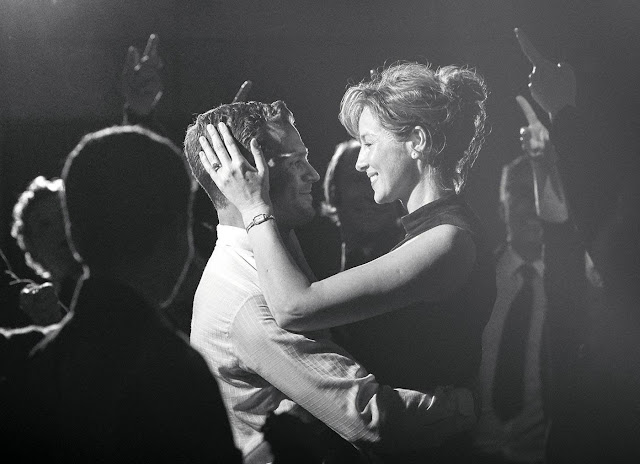
Jamie Dornan and Caitriona Balfe in Belfast.

Watching the black-and-white trailers for Belfast, Kenneth Branagh’s fictionalized memoir of growing up Protestant in the titular city at the peak of the Irish Troubles (the film begins in the summer of 1969), I feared that he’d been caught in the trap of turning his childhood into self-conscious neo-realism, like Alfonso Cuarón in the strenuously overrated Roma. I needn’t have worried. Haris Zambarloukos’s cinematography opens in almost hallucinatory color that reveals Belfast in all its complexity, modernist and glittering as well as enshrining gorgeous old buildings. And when the color morphs into black and white, it’s the bustling, lived-in black and white of the Parma Bertolucci and his photographer, Aldo Scavarda, captured in his the 1964 Before the Revolution or, as a friend observed, the black and white of the pictures Tony Richardson made in the late fifties and early sixties out of the great English New Wave dramas Look Back in Anger and The Entertainer (both shot by Oswald Morris) and A Taste of Honey (shot by Walter Lassaly). Belfast isn’t quite up to those movies – or the other movies I thought of while I sat through it, John Boorman’s 1987 Hope and Glory (based on his memories of a childhood in London during the Second World War) and Jim Sheridan’s 2002 In America (a too-little-known magic-realist marvel about a struggling Irish family living illegally in Hell’s Kitchen). But Belfast is plenty good enough. It’s vibrant and vivifying, and I was carried away by it.

Monday, December 30, 2013

“Acting” and Acting - August: Osage County & Philomena


In the first five minutes of August: Osage County, John Wells’s film of the Pulitzer Prize-winning Tracy Letts family drama, Meryl Streep devours so much scenery that it’s a wonder there’s anything left but the foundation of the Oklahoma ranch house where Violet and Beverly Weston (Sam Shepard) play out their bitter final encounter. Staggering down the stairs, her hair shorn and ragged – Violet, who has been treated for mouth cancer, has an ugly wig that she pulls off her head continually through the course of the picture – she moves from a blinking, befogged state caused by the pills she knocks down her gullet like Tic-Tac to sashaying raucousness to laughter bordering on hysteria. Her braying insults to her reflective, sweet-souled poet husband aren’t sly or compulsive with an undercurrent of ruefulness; nor are they uproarious but horrifying. That is, they aren’t complex in any way; Streep delivers them as if she were wielding a two by four. She may think that she’s channeling Bette Davis or maybe Tallulah Bankhead but she’s a lot closer to Joan Crawford here, with a touch of Claire Trevor as the alcoholic gangster’s moll in Key Largo. This is a disgraceful piece of acting, and it gets worse as the movie goes on: by the end she’s dancing by herself, yelling out the names of the family members who have finally abandoned her, weeping forlornly at the breast of the compassionate native American housekeeper (Misty Upham) who’s the only other person left on the place. Of course, Streep doesn’t need other actors around. She’d probably relish the chance to play all the roles herself.

Tuesday, November 10, 2015

Back To Basics: SPECTRE

Daniel Craig as James Bond in SPECTRE.

This review contains spoilers for SPECTRE.
 
SPECTRE is not a great Bond film. It’s a decent standalone spy thriller, but that’s too charitable, as no Bond film exists in a vacuum. As the newest and “freshest” installment in Daniel Craig’s run as 007, it’s strangely discordant and slow. It discards nearly all of the audience goodwill and story momentum generated by Craig’s energetic reboot of the character, content to hit all the expected notes and attempt nothing new or challenging with the character or his world. It feels regressive, rather than classic – the most like an Old Bond movie of any of the Craig entries, but in all the worst ways.

Friday, July 13, 2012

Beyond Precious: Wes Anderson’s Moonrise Kingdom

Kara Hayward and Jared Gilman in Moonrise Kingdom

Having just finished teaching a course on the great American cinema of the ‘70s, and spending weeks immersed in fine films by directors at their creative peaks (Steven Spielberg, Francis Ford Coppola, Brian De Palma, Hal Ashby, Martin Scorsese, Robert Altman and many others), it was something of a rude jolt to be brought back to earth having to deal with the generally underwhelming current crop of American directors. While Spielberg, De Palma and Scorsese are still around and often doing good work – creatively Coppola is missing in action – there are only a handful of relevant moviemakers (David Fincher, Curtis Hanson) from the next generation who make movies that speak to the way we live today. And when you’ve tasted the highs of The Godfather, Taxi Driver, Nashville or Shampoo, why would you want to make time for the enervated films of Kelly Reichardt (Old Joy, Meek’s Cutoff), the scattershot ones of Paul Thomas Anderson (Magnolia, There Will Be Blood) or the contemptuous movies of Todd Solondz (Welcome to the Dollhouse, Life During Wartime)? But of all the annoying/irritating minor talents being unduly praised to the skies, usually only by certain film critics, none is likely more of a chore to sit through than Wes Anderson. His latest movie, Moonrise Kingdom, is really more of the same: a hermetic, arid, mindless film that defies you to truly care about anything that’s happening on screen.

If you had to pick one word to define his films, such as Rushmore (1998), The Royal Tanenbaums (2001) and The Life Aquatic with Steve Zissou (2004), it would be precious. Not in the very valuable meaning of the word, but in the affectedly dainty or over-refined definition. With the exception of his debut movie, the sweet, likeable Bottle Rocket (1996), Anderson’s films are enshrined baubles that may look pretty – he doesn’t stint on the art direction – but beyond surface appearances have little of value on offer.

Saturday, August 16, 2025

Stratford and the Shaw Festival I: Shakespeare

From left: André Sills as Polixenes, Sara Topham as Hermione, and Graham Abbey as Leontes with members of the company of The Winter's Tale. (Photo: David House.)

Shakespeare’s romance The Winter’s Tale is one of the three or four plays I cherish most, and the Canada’s Stratford Festival hits a high mark with Antoni Cimolino’s production at the Tom Patterson Theatre. Cimolino has announced that he will step down from the artistic directorship of the company after one more season, and his Winter’s Tale is so beautiful from start to finish that you can’t help thinking this is the show he would like to be remembered for. He’s staged it on a simple set that the designer, Douglas Paraschuk, has enriched, scene to scene, with lyrical details and Michael Walton has lit exquisitely. One of the most poignant examples is the famous final scene. Paulina (Yanna McIntosh) leads the King of Sicilia, Leontes (Graham Abbey), who has been reunited with his childhood friend Polixenes (André Sills), his former ambassador Camillo (Tom Rooney) and his long-lost daughter Perdita (Marissa Orjalo) into a secret room. There, she tells them all, she has had a sculptor create an astonishingly lifelike statue of Leontes’s queen Hermione (Sara Topham), supposedly dead these sixteen years while Leontes, under Paulina’s guidance, has done penance for the grievous wrongs he committed against her, Polixenes and Perdita (then just an infant). The stage is unilluminated except for three handheld lanterns, so the statue is revealed suddenly, the lantern light painting the darkness. When Paulina works her magic and Hermione moves, the effect is so subtle that at first you wonder if you really saw what you think you saw.

Saturday, October 4, 2014

Separation and Deliverance: Revisiting Into the Arms of Strangers: Stories of the Kindertransport (2000)


The horror of the Holocaust and the fate of its survivors has been depicted from just about every conceivable perspective, but Mark Jonathan Harris's Into the Arms of Strangers: Stories of the Kindertransport (2000) found another story seldom heard. Harris had already been acclaimed previously for The Long Way Home (1997), which depicted the flight of Jewish refugees and how it lead to the state of Israel, but here he examines the fate of the children who were separated from their parents and sent into exile during the war, in many cases forever. For nine months, just before the Second World War, Britain organized an extraordinary mission of mercy. It transported and opened its doors to more than 10,000 Jewish and other children from Austria, Germany and Czechoslovakia. The children – or Kinder, as they came to be known – were placed in foster homes in the hope they would be reunited with their parents. Many of the children never saw their folks again. Amassing some stunning archival footage, Harris interviewed dozens of surviving Kinder where, now nearing the end of their lives, they finally got a chance to tell their story. In one scene, a woman recounts the moment she was torn from her mother at the train station, while another describes the dislocating estrangement of living in a foreign country and not knowing the language or customs. Into the Arms of Strangers provides numerous epiphanies that reverberate such as the story of the child who is questioned about his lofty position, because he owns a violin, but then surprises and moves his inquisitors by playing an impeccable version of "God Save the King."

Sunday, February 28, 2010

Five Reasons I Like Oscar: An Unfashionable View

Of all the many awards shows currently airing on TV, I only regularly watch one, the Oscars, which are trumpeting their 82nd edition on Sunday March 7. I don’t for a second consider The Academy Awards to be a benchmark for excellence, and all those film critics who regularly cite Oscar worthy performances ought not to be reviewing films. However, after suffering through the recent Grammy awards, which are supposed to honour excellence in music but are as mainstream as can be, I appreciate the virtues of the Oscars more than ever. Here are five reasons why.

Monday, February 10, 2014

Peter O’Toole and the Modern Breed of English Movie Actors

Before Peter O’Toole died in mid-December at the age of eighty-one, he was probably the greatest male actor in the movies; if you wanted to be more circumspect you might have tied him with Michael Caine. His career in film stretched back more than half a century, on TV and in live theatre even farther. He attended the Royal Academy of Dramatic Art from 1952 and 1954, where his classmates included Alan Bates, Albert Finney and Brian Bedford – just a sample of what can only be assumed to be the most amazing generation of British actors in history. Think about it: O’Toole’s cohort also included Maggie Smith, Sean Connery, Richard Burton, Helen Mirren, Judi Dench, Richard Harris, Terence Stamp, Vanessa Redgrave, Ian McKellen, Derek Jacobi, Rosemary Harris, Tom Courtenay, Diana Rigg, Claire Bloom, Joan Plowright and Julie Christie. Their predecessors had included such luminaries as John Gielgud, Ralph Richardson, Edith Evans, Michael Redgrave, Peggy Ashcroft, Alec Guinness, and of course Laurence Olivier: classically trained stage actors who conferred a kind of aristocratic status on the projects in which they were involved. They were strikingly different from their American peers – classier, better spoken, more pensive, with vastly more impressive dramatic ranges but (with the exceptions of Guinness and Olivier) less star dazzle. England didn’t cultivate stars; the English film industry, for all its virtues, was more sedate, more modest, a little grayer. O’Toole’s generation was more dynamic. They came up after the war, and the Suez crisis, which denoted the last gasps of the British Empire, helped to form their world view. When they began their careers the Angry Young Man playwrights were transforming the English theatre: Burton, Bloom, Plowright, Bates and Finney appeared in the exciting film versions of John Osborne’s Look Back in Anger and The Entertainer. They married the same fastidious classical training the preceding generation had received with a more democratic sense of what theatre could offer, an instinct for the camera, the uncorseting influences of the American Method and the sixties, and a willingness to explore sexuality as part of the process of building a character. And they didn’t just want to be stage and TV actors; they wanted to be movie stars too, and many of them became just that.

Monday, December 29, 2014

Christmas Musicals: Into the Woods and Annie

Meryl Streep and Mackenzie Mauzy in Into the Woods

Rob Marshall’s new movie of the Stephen Sondheim-James Lapine Into the Woods has an insurmountable problem: the show it’s based on. The appeal of this musical, which mixes several fairy tales, has always eluded me. It contains an ingenious opening number in which Sondheim sets all the narratives in motion, and a couple of other songs (Cinderella’s interior monologue, “On the Steps of the Palace,” and “Agony,” a duet between Cinderella’s and Rapunzel’s princes) are OK if somewhat overworked. But the  whole thing is too damn clever by half, with lyrics that tend to make the characters sound as if they’ve been reading self-help manuals.  And by the time the show picks up again after intermission and the characters go back into the woods because their happy endings have begun to fray, the same fate has befallen Sondheim’s inventiveness. The very concept is stupid: if taking to the woods is a metaphor for coming of age, then no one gets to do it twice. And you don’t have to darken a fairy tale dark in order to modernize it; the Brothers Grimm and Hans Christian Andersen originals are plenty dark enough. Moreover, Sondheim’s idea of “dark” is, to my ears, merely homiletic: “Children Will Listen,” “No One Is Alone.” If I have to pick a revisionist fairy-tale musical, I’ll take Once Upon a Mattress. Revue-sketch comedy trumps pop psychology any day of my week.

Monday, April 4, 2011

Measure of a Man: Danny Boyle's Frankenstein

No. Director Danny Boyle (127 Hours, Slumdog Millionaire) has not done a new film version of Frankenstein. Currently on the boards in London's West End, Boyle's brilliant play Frankenstein (it was written by Nick Dear) is a monster hit sell-out (it closes, or is supposed to, on May 2nd). I was fortunate to see it four days ago without having to drop a fortune for an airline ticket, or scalper prices at the theatre.

Beginning in 2009, the National Theatre Company in London began offering live broadcasts of shows on their stages to movie theatres around the world. It is a fabulous idea. The National Theatre attracts some of England's finest actors and actress, such as Helen Mirren, Judi Dench (I was able to see her live in London in 2009 in the scintillating play, Madame de Sade – and, gushing fan moment, got to meet her briefly at the stage door after), Derek Jacobi and Jude Law. There are risks involved in these broadcasts. Since they are sent via satellite to the cinemas around the world, there is a chance that you might pay your money and see nothing if the signal is lost. I thought that was going to happen on the night I saw Frankenstein. Before the play started, on screen there was a hostess setting up the night, followed by a short documentary on the making of the play. The sound wasn't working. After twice springing out of my seat to complain, they fixed the problem just before the play itself was to begin. The show was mildly marred all evening long by occasional sound drop-outs (something they warn about at the start), but compared to not seeing it at all because of no sound, it was something I was happy to live with.

Monday, April 9, 2018

Three Tall Women and Anna Christie: Pulitzer Prize Winners

Glenda Jackson, Alison Pill and Laurie Metcalf in Three Tall Women. (Photo: Brigitte Lacombe)

Edward Albee’s Three Tall Women won a Pulitzer Prize in 1994, but the original production was off Broadway (at the Vineyard Theatre), and until Joe Mantello’s luminous new revival with Glenda Jackson, Laurie Metcalf and Alison Pill – in the roles created by Myra Carter, Marian Seldes and Jordan Baker – it has never been performed on Broadway. I saw the Vineyard show and liked it quite a bit, though I remember finding the writing in the second act rather theoretical and pre-arranged. In act one the three characters – one in her early nineties, one in her early fifties, and one in her late twenties – have specific, realist roles, despite the fact that Albee calls them A, B and C. A is a wealthy, fading widow, estranged until recently from her son, incontinent and subject to sudden tantrums, childlike behaviors and episodes of dementia. B is her caregiver, whose mordant humor buoys up her worn patience with A’s erratic conduct. C is an emissary from A’s lawyer’s office, summoned because C’s affairs are in deplorable order. But in act two the old woman has had a stroke and lies unconscious in her bed while A, B and C embody her as an ingénue, as middle-aged and as a dowager, the two older women warning the youngest one, with a mixture of wisdom and perhaps a little sadistic glee, what she’s in for.

Monday, November 15, 2021

No Time to Die: Bonding

Daniel Craig and Léa Seydoux in No Time to Die.

The James Bond pictures that Daniel Craig has starred in over the past decade and a half – Casino Royale, Quantum of Solace, Skyfall, Spectre and the new No Time to Die – are not equally good, but they’re unified by a sense of melancholy and an elegiac quality. The painful past gets revisited; characters we care about die – significantly, of course, M, played by Judi Dench, in Skyfall, the high point of the nearly sixty-year-old series. In that sublime film, Bond returns to his childhood home on the Scottish coast to battle a villain who was once a double agent himself, using his mastery of old-school warrior skills to hobble a computer wizard representing a merciless contemporary world. No Time to Die resurrects the past in its opening section. It begins with a flashback: a child whose father is an assassin watches as the only survivor of a family he wiped out shoots her mother, and then, mysteriously, saves her (as we later learn) when, running away from him, she falls through the ice. After the credits (and a standout theme song, written by Billie Eilish and Finneas and performed by Eilish), that child grows up to become the therapist Dr. Madeleine Swann (Léa Seydoux), who appeared in Spectre. In the present she’s happily married to a retired Bond, who assures her as they drive through the Italian countryside, “We have all the time in the world.” Bond aficionados will recognize the ominous allusion. At the end of the 1969 On Her Majesty’s Secret Service, Bond (played in that film by George Lazenby) utters the same promise to his bride (Diana Rigg) as they begin their honeymoon, but the movie ends moments later with her murder – the first downbeat finale of any Bond picture, and the most affecting scene in the series until M’s demise in Skyfall. The echo in No Time to Die is a reminder, of course, that no one has all the time in the world, and that the clock is ticking.

Monday, September 29, 2014

Tragic Muse: Medea and A Streetcar Named Desire

Danny Sapani and Helen McCrory in Medea, at London's National Theatre. (Photo: Richard Hubert Smith)

The great Greek tragedies are as hard and piercing as flint, and they lead us into a terrible darkness. The best productions, like Carrie Cracknell’s of Euripides’s Medea at the National Theatre (featured a few weeks ago in the NT Live HD series), leave us feeling altered. Euripides was a master ironist and a master of language; he was also a brilliant psychologist, and never more so than in Medea, a witheringly complex and precise portrait of a woman who, cut to the bone by her husband Jason’s betrayal – he abandons her and their young sons to marry Glauce, the princess of Corinth – decides that the only way to get revenge is first to poison the bride and then murder her own boys. (She convinces herself that she’s somehow protecting the children by keeping them safe from their enemies.) Euripides doesn’t make it easy for his audience: he refuses to portray Medea as mad – to give us a way of understanding her behavior that distances her from us. The chorus of Corinthian women who interact only with her sympathizes with her anger, though it terrifies them. Her logic, ghastly as it is, is no less reasonable than Jason’s when he protests that she’s the problem, that her temper has made her her own worst enemy, and explains that marrying into the royal family will somehow benefit her and their sons.

Wednesday, August 21, 2013

Performance, Perspective, Emotion: Sarah Polley’s Stories We Tell

 
It’s a truism that when actors make a career shift into directing, the strength of the movies they make is usually in the performance factor. The most recent example is Dustin Hoffman’s Quartet from last Christmas, a silly, sentimental comedy about retirees at a home for aging musicians that manages to stay afloat through a combination of the actors in front of the camera and the musicians on the soundtrack. Sarah Polley is a beguiling case, though. The movies she’s directed, Away from Her and especially Take This Waltz, find not only their shape but also their meaning in the performing rhythms of their female stars, Julie Christie and Michelle Williams respectively. In Away from Her, the more conventional of the two pictures (though hardly conventional by comparison to anyone else’s movies), about a woman’s entering an Alzheimer’s facility and her husband’s learning to accept it, Polley, a gifted actor herself, seems at first to be surrendering the movie to Christie – a choice that only makes sense for a debut filmmaker working with one of the greatest instinctual camera performers in the history of the medium. But it’s not as simple as that. The way Polley gets at the character’s altered approach to ordering the world around her while retaining the essential mystery of what she’s going through – since the prevailing consciousness of the movie is really that of the husband (beautifully played by Gordon Pinsent), not the wife – shows the already considerable skill and dominant presence of a talented director. (The balance Polley achieves with the two principal characters recalls Richard Eyre’s work with Judi Dench as the Alzheimer’s-afflicted writer Iris Murdoch and Jim Broadbent as her husband in the unjustly ignored Iris.)

Monday, April 8, 2013

Much Ado About Nothing and Romantic Comedy

Maggie Siff and Jonathan Cake in Much Ado About Nothing, at the Duke on 42nd Street (Photo: Richard Perry)

Ben Jonson wrote satirical comedies, Shakespeare romantic ones – and then, later in his career, the two plays that scholars have categorized as problem comedies, Measure for Measure and All’s Well That Ends Well. Of his romantic comedies, Twelfth Night runs deepest, but Much Ado About Nothing has been the most influential. Almost the entire history of Hollywood romantic comedy, beginning with the first screwball comedy, Frank Capra’s It Happened One Night, in 1934, flows from its font. These movies were the consequence of the newly enforced Production Code, which forbade the hero and heroine of a romance to jump in bed together before marriage without tragic consequences (invariably for the woman). The Hays Code office, as it was popularly known, sought to neuter romance, but screwball comedy came up with a formula that kept it sexy as well as witty. The protagonists begin as adversaries – like Peter Warne (Clark Gable) and Ellie Andrews (Claudette Colbert) in It Happened One Night – distanced by both class and temperament, yet we can feel the sexual chemistry between them. Each has to learn to get past first impressions as well as to compromise, to come halfway toward the other. Their reward is a happy ending in each other’s arms, when, to use screenwriter Robert Riskin’s metaphor in Capra’s picture, the Walls of Jericho (blankets on a clothesline) erected to keep them discreetly separate from each other in a series of motel rooms come down after the hero and heroine are safely wed.

Sunday, August 15, 2010

No, Mr Bond, I Don't Want You To Die: The End of James Bond?

About three weeks ago, a friend and I were talking about James Bond. Over the past few months we'd been hearing the stories about the fact MGM was having money problems, to the point where there was speculation that the studio would fold. As a result, the planned 23rd James Bond movie was indefinitely postponed. My friend said “I don't think we'll see Daniel Craig as Bond again.” He basically believed that the money problems were so severe that it would be years before another one would be made. When it was, the producers, (Barbara Broccoli and Michael G. Wilson), would decide to reboot the series and recast. I said, "there's no way. Craig's a great Bond. I can't see them doing that."

Cut to three weeks later and this week's cover story in Entertainment Weekly magazine, “Goodbye, Mr. Bond.” The magazine predicted almost exactly what my friend had said. They wrote that the last time there was a delay like this – six years, in fact – the studio returned with a new Bond when Pierce Brosnan replaced Timothy Dalton. The difference between the last long delay and now is that they've got an absolutely perfect Bond in Daniel Craig. As M (Judi Dench) said in Casino Royale (2006), “I'm not sure a blunt instrument such as yourself will understand, Bond.” Bond is and always was an uncouth blunt instrument who happened to be on our side. The reason Craig was such a refreshing return to form after a VERY LONG fallow period was because he was a boxy, thuggish, though handsome brute who would go to any lengths to achieve his ends. The last time we had a Bond this good was, of course, Sean Connery. Yes, I know I'm in a minority in this, but Pierce Brosnan (who's been very good in other films such as The Matador (2005), The Tailor of Panama (2001) and The Thomas Crown Affair (1999)) was completely awful as Bond – a purse-lipped pretty boy who was completely unconvincing as 007. Hell, Roger Moore was better (at least in the early pictures like Live and Let Die (1973)).