Showing posts sorted by relevance for query Law and Order. Sort by date Show all posts

Monday, May 24, 2010

The Final Cha-Chung: Remembering Law & Order

In a May 17 episode that probably should have been titled “Kinky Town,” writer Ed Zuckerman provided Law & Order with a hilarious whodunit about denial, betrayal, sneaky finances and some very bizarre sex games. It serves as a wonderful next-to-last chapter for the venerable weekly examination of New York City’s criminal justice system, just cancelled by NBC after two decades. Bewilderingly, this decision comes one season short of granting creator-executive producer Dick Wolf’s fervent wish: to boast that his series is the longest-running scripted primetime drama ever on network TV, thereby beating the 20-year run of Gunsmoke.

The Mother Ship, as everyone in the industry refers to the original cops-and-courts show that predated its spinoffs, wasn’t exactly sinking. The ratings may have been less than spectacular, but the current ensemble cast arguably is the most effective in eons. Jeremy Sisto and Anthony Anderson, playing the lead detectives, demonstrate as much great chemistry as Jerry Orbach and Chris Noth did trading wisecracks while investigating murders, robberies, kidnappings and crimes of passion from 1992 to 1995. The performances delivered by Linus Roache and Alana De La Garza, as the hands-on prosecutors, also crackle with energy. He’s a sort of combination of his predecessors, the subtle Michael Moriarty and fiery Sam Waterston; She portrays the best prosecutorial sidekick since Jill Hennessy, only with less innocence. Reliably solid Waterston and S. Epatha Merkerson -- respectively, the cranky district attorney and wise precinct commander -- never fail to amaze.

Saturday, July 5, 2014

Law & Order: An Actor’s Paradise


Back in 1998, Susan Green and I wrote the only companion book on the popular legal drama Law & Order. Besides being in the rare and charmed position of having the show's creator, Dick Wolf, give us complete access to cast and crew, we were also allowed complete autonomy to write what we wanted. With that freedom in mind, we both opened up to the possibilities the book offered in terms of content. For instance, we thought why not have other voices besides ours. We quickly conceived a chapter which would include a number of other people who also had an intelligent and probing perspective on the program. After soliciting a number of people, we were thrilled to see that all of them agreed to take part. They included civil rights attorney William Kunstler, former Ontario Premier Bob Rae and theatre and film critic Steve Vineberg. Unfortunately, our publishers didn't share our enthusiasm for broadening the scope of the book and all the pieces were turned down. Speaking with Steve Vineberg recently on the phone, however, he reminded me that he still had that piece he wrote, which was about how a number of great performers provided what he termed an actor's paradise on the show, and it was still unpublished. Since Steve now writes for Critics at Large, that terrific essay has now finally found the home it was once denied.

Kevin Courrier
Editor-in-Chief
Critics at Large.

Thursday, May 24, 2012

Don't Fugeddaboutit: The World of a Jersey Shore Wordsmith

Author Gene Ritchings
Full disclosure: Gene Ritchings was our saving grace. In the late 1990s my Critics at Large colleague, Kevin Courrier, and I went down to New York City for ten days to research a book about NBC’s Law & Order. We’d gotten permission and a promise of access from the show’s creator, Dick Wolf, but that blessing did not necessarily mean instant acceptance in the Big Apple. We were interlopers who needed to conduct interviews that arguably might be more in-depth (and perhaps even invasive) than those done by the usual entertainment media briefly visiting the set.

Initially, the crew seemed to eye us with suspicion and the actors barely noticed our existence – until Ritchings, the production coordinator, took us under his wing. He also bent a few rules to help us navigate the bureaucracy and frenetic schedule that any TV series must establish to keep functioning. “We try to ward off the occasional feeling of being beleaguered and overextended and overworked because that’s the life we chose,” he said then. 

Tuesday, April 26, 2022

Off the Shelf: Law & Order, "American Dream" (1993)

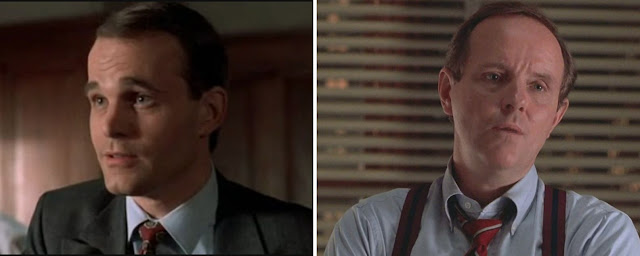
Željko Ivanek (left) and Michael Moriarty in Law & Order, "American Dream"

The recent reboot of Law & Order is singularly dispiriting – the writing has as much life as unleavened dough and the acting of the jobbed-in actors rarely rises above the mediocre. The regulars (Camryn Manheim, Anthony Anderson and Jeffrey Donovan as “order” and Sam Waterston, Hugh Dancy and Odelya Halevi as “law”) are working very hard to pretend not to notice that no one has written characters for them to play. Only Waterston has evidently thrown in the towel: he gets more mummified with every episode. I doubt it’s his own fault:  he may be pushing eighty-two, but he just gave the performance of his career as George Shultz in the Hulu miniseries The Dropout.

Friday, October 3, 2014

Dark City: FOX's Gotham

Donal Logue and Benjamin McKenzie star in Gotham, on FOX
"…with a very few examples of cruelty he will be more compassionate than those who, out of excessive mercy, permit disorders to continue, from which arise murders and plundering; for these usually harm the community at large, while the executions that come from the prince harm particular individuals." Machiavelli, The Prince

"You can't have organized crime without law and order." Don Falcone, Gotham 
I was surprised how much I enjoyed the premiere episode of Gotham. I had pre-set expectations for FOX's much publicized Batman-without-Batman prequel series, and they were mainly skeptical. Ten years of Smallville (especially the more tortured plot and character elements of its final season) loomed large in my mind as September approached. As fun as the notion of a story set in Gotham years before the arrival of its caped and cowled crusader might be in theory, Gotham seemed a project destined to be over-burdened by a famously established future continuity and a wealth of film and television adaptations of the Batman universe. Developed for television by Bruno Heller (The Mentalist, HBO's Rome), the show promises to tell the largely unwritten story of a young James Gordon, destined of course to become Police Commissioner Gordon and Batman's best official defender, but who for now is still a rookie detective finding his way in a thoroughly corrupt police department. However, if the pilot is any indication of its ambitions, Gordon (Benjamin McKenzie, Southland) is merely the face of the show's real main character, the city of Gotham itself.

Friday, December 6, 2013

Ripped From the Headlines: The Crime Novels of Robert Rotenberg

When I taught Canadian criminal law several years ago to secondary school students, they frequently made references to American law which they had derived from American films and television shows. There were Canadian television shows that portrayed with general accuracy Canadian law – Street Legal in the 1980s and more recently Wonderland on the CBC and The Associates on CTV – but none of them carried much cache for my students. And I could not recall a Canadian legal novel that would have gripped their imagination. But four novels in the last five years by a former magazine editor and a Toronto practicing lawyer for over twenty years, Robert Rotenberg, might have done the trick. Simply put, his police investigations/courtroom novels, that may remind some readers of the structure of the Law and Order series and the courtroom dramas of John Grisham, are a romp: fast-paced and highly entertaining, beginning with a murder, with several police officers and lawyers reappearing throughout. Perhaps the most important character is Toronto itself and its denizens: at one point in Stray Bullets, a character mentions that one of the largest firms in the country is Miller Ford.

Wednesday, February 5, 2025

A Smattering of Recent Releases

Tye Sheridan and Jude Law in The Order.

The Order
(available on Apple+), based on Kevin Flynn and Gary Gerhardt’s book The Silent Brotherhood: Inside America’s Racist Underground, is taut and gripping. It tells the true story of a secret white supremacist organization housed in the Pacific Northwest – the brainchild of a young man named Bob Mathews who splintered off from the Aryan Nation because he found them too weak-minded, all talk and no action – which the FBI uncovered and busted in 1985. Like other violent self-proclaimed revolutionaries (Timothy McVeigh, the Oklahoma City bomber, for one), Mathews uses William Luther Pierce’s novel The Turner Diaries, published under the pseudonym Andrew Macdonald, as a guidebook. He prepares to declare war on the U.S. government by staging, with a small cohort, a series of robberies and bombings and the murder of Alan Berg (played in the film by Marc Maron), a confrontational Jewish radio talk-show host in Denver who has been taking on rabidly anti-Semitic callers.

Monday, October 4, 2010

Whatever LoLa Wants: The New Face Of Law & Order

The familiar cha-chung sound is there to accompany the inter-titles that separate scenes, but Law & Order: Los Angeles, which premiered September 29 on NBC, seems to be a breed apart in the pantheon of creator Dick Wolf. This certainly is not a carbon copy of the groundbreaking original show -- just plain Law & Order -- now gone after 20 years on the same network. For one thing, composer Mike Post’s distinctive theme music over the opening credits is missing. Ditto for the ubiquitous verbal introduction. And the look of LoLa, as it has been dubbed, is almost shocking. Longtime fans of the Mother Ship, which is what everyone calls the now-defunct drama, and of the two New York City spin-offs, Special Victims Unit and Criminal Intent, may need to wear shades. Tinseltown is a place of bright sunlight and spacious homes in fashionable hues unknown to the gritty five boroughs, where cramped apartments, dark alleyways, shadowy streets, vacant buildings and menacing parks have been a mainstay of all three prime time cops-and-courts series. Unlike the dingy digs in those L&Os, the LA squad room is disconcertingly sleek and modern.

Friday, May 12, 2017

Looking Back: The Sergeant (1968)

Rod Steiger in The Sergeant (1968).

The Sergeant, poor cow of a movie, never had a chance. The critics of 1968 – faced with Rod Steiger’s miserable Army lifer, Sergeant Callan, pursuing John Phillip Law’s dewy-eyed Private Swanson on a godforsaken supply post in 1952 France, and then killing himself – were unanimous in panning it. “In the context of today’s liberated movie-making,” Vincent Canby wrote in The New York Times, “this study of repressed homosexuality seems almost quaint. It also is basically confused.” Steiger, Canby felt, “comes on with all the subtlety of a drag queen,” while Law seemed “remarkably dense.” In The New Yorker, Pauline Kael made more or less the same complaints, while voicing regret for the loneliness and pathos she believed were the homosexual’s lot in life. New York’s Judith Crist, with a sensitivity typical of herself and her peers, dismissed it as “a sleazily commercial film [about] a fag non-com.”

For straight critics like these, The Sergeant was mainly an offense against two hours of their time. Later, with queer critics to the fore, it became an offense against gay liberation: a mainstay on the list of “daring” sixties Hollywood movies that were seen as retrograde, even toxic in their sexual politics, with a preponderance of gay or lesbian characters either killing themselves, killing others, or getting killed. (Among the others were 1961’s The Children’s Hour, 1962s Advise and Consent, 1967’s Reflections in a Golden Eye, 1968’s The Fox, The Killing of Sister George, and The Detective, and 1969’s Staircase.) In Screening the Sexes (1973), the first study of homosexuality in the movies, critic Parker Tyler placed The Sergeant in the “Homeros in uniform” subgenre, calling it “a clean-cut, well-tailored movie like an expensive suit that has had only one wearing, then been relegated in a plastic wrap to the closet, where it will stay indefinitely.” By 1981 and The Celluloid Closet, Vito Russo’s definitive history of gayness in cinema, the AIDS holocaust was imminent, and The Sergeant’s stock was even lower. Rather than suggesting that homosexuality might be associated with anything healthy, The Sergeant dealt “only in sexually motivated manipulations, spitefulness and petty jealousy, most of it unconscious and unexplored. The result is caricature.”

Sunday, August 7, 2016

The Long Shadow: Carol Anderson’s White Rage (Part One)


“We just need to open our eyes, and our ears, and our hearts to know that this nation’s racial history still casts its long shadow upon us.”

- Barack Obama speaking in Selma on March, 7th 2015 at the fifth anniversary of the famous march


During the week of the Republican Convention when Donald Trump proclaimed himself as the candidate of law and order, and reading Carol Anderson’s historical catalogue of white resistance to black progress, White Rage: The Unspoken Truth of Our Racial Divide (Bloomsbury, 2016), two thoughts came to mind. Rightly denouncing the murder of police officers, he said nothing about the murder of black men by the police, even the murder on November 26, 2014 of twelve-year old Tamir Rice who was killed in Cleveland, the city where the convention was held. No charges were ever laid against the officer. Secondly, I wondered whether Trump was aware that he was retrieving Richard Nixon’s Southern Strategy that pandered to racists during the 1968 presidential election. Nixon was another practitioner of dog-whistle politics: a coded message that appears innocuous to the general public, but has an additional interpretation meant to appeal to the target audience, for example, to racists. According to Anderson, one of Nixon’s most trusted aides, H.R. Haldeman, Nixon “emphasized that you have to face the fact that the whole problem is really the blacks. The key is to devise a system that recognizes this while not appearing to.” Another Nixon aide, John Ehrlichman, noted after the candidate saw an ad that showed entire cities burning without ever mentioning blacks, Nixon chortled, “It’s about law and order and the damn Negro-Puerto Rican groups out there.” By not acknowledging the African-Americans killed, Trump expressed a similar contempt for African-Americans at the 2016 Republican Convention.

Sunday, January 13, 2013

Mailer's Stage: The Criterion Collection of Norman Mailer's Films - Wild 90, Beyond the Law & Maidstone

We are pleased to welcome a new critic, Devin McKinney, to our group.

Norman Mailer, who died in 2007 after a long reign as top dog among living American writers, was also a filmmaker, and he seems to have made films for two kinds of people – those who loved him, and those who hated him. In the first group is anyone sufficiently fascinated by the man’s literary output (The Naked and the Dead, Advertisements for Myself, An American Dream, The Armies of the Night, The Executioner’s Song, Harlot’s Ghost, etc.) and cultural presence (philosopher, debater, politician, provocateur) to find the films interesting as addenda to his larger accomplishment. In the second group are those whose aversion to Mailer’s macho pomp and alpha antics is so complete that it finds perverse gratification in the spectacle of, as he himself put it, “Mailer making an ass of himself.”

Is there a third audience for this work? It’s difficult to imagine that the three films recently released by the Criterion Collection in its Eclipse series will hold the least allure for a viewership indifferent to the encompassing phenomenon of Norman Mailer. Objectified, Wild 90 (1968), Beyond the Law (1968), and Maidstone (1970) are not disturbing, beautiful, corrosive, or innovative enough to captivate eyes not already looking to be turned on or off by Mailer’s charisma, obsessions, brilliance. If you don’t care about him, you probably won’t care about them.

Friday, March 20, 2015

The Cost of Sacrificing Liberty for Security: Guantánamo Diary

A Guantanamo detainee being led by a guard in March 2002. (Photo: Andres Leighton)

“Those who surrender freedom for security will not have, nor do they deserve, either one.”
Benjamin Franklin cited by Mohamedou Ould Slahi in Guantánamo Diary.
On November 20, 2001, Mohamedou Ould Slahi, a 30-year-old electrical engineer and telecommunications specialist from Mauritania, received a visit at his house from two Mauritanian officers summoning him to answer questions at the country’s intelligence ministry. “Take your car,” one of the men told him, as Slahi stood in front of his house with his mother and his aunt. “We hope you can come back today.” He has not returned. After spending a week in a cell in his native country, the authorities found no evidence against him. However, at the behest of the Americans, Slahi was rendered to a black site in Jordan for six months, and then flown blindfolded, shackled and diapered to Bagram Air Base in Afghanistan for two weeks; from there he was transported to Guantánamo in Cuba where he remains incommunicable to this day. Three years into his detention, Slahi wrote in basic idiomatic English he obviously picked up from his guards – his fourth language and acquired in Guantanamo – a manuscript which was immediately classified. It took years of litigation and negotiation by Slahi’s pro bono lawyers to force the military to declassify a redacted version, heavily black-barred (that sometimes goes on for pages, some of it to conceal the identity of his interrogators, guards and fellow detainees).

Monday, October 31, 2016

The Front Page: Old Pros

John Slattery and Nathan Lane in The Front Page at Broadway's Broadhurst Theater. (Photo by Julieta Cervantes)

In recent years every Broadway season has included a top-flight revival of a classic American play. Last year it was Long Day’s Journey into Night, the year before You Can’t Take It with You and Of Mice and Men the season before that. But they don’t always get the respect they’ve earned. The mediocre notices for Jack O’Brien’s production of the 1928 Ben Hecht-Charles MacArthur comedy The Front Page with Nathan Lane and John Slattery have been utterly perplexing. I saw the show just before the press opening and walked away in a state of bliss. O’Brien has gathered together a dazzling cast to mount what I’d say is one of the three best comedies ever written by Americans, and watching them parry and thrust, negotiate Hecht and MacArthur’s hilarious banter and glide through the perfect mechanics of the farce plot with acrobatic grace is akin to buying a ticket for a revue in vaudeville’s heyday and discovering that every single act is good enough for the coveted penultimate slot on the bill.

Thursday, April 8, 2010

An Equally Important Performer: S Epatha Merkerson Departs Law & Order


She has outlasted four district attorneys, six prosecutors and eight pairs of detectives, but Lieutenant Anita Van Buren will soon follow in their footsteps when she departs from her Manhattan NYPD job. What’s not known is if that exit might come in the form of a resignation or death, since the longtime Law & Order character has been battling cancer in the most poignant subplot of this NBC show’s twentieth season.

Feel free to insert that familiar scene-separating electronic interlude here: Cha-chung!

Actress S. Epatha Merkerson, 57, who has portrayed Van Buren since 1993, recently announced her decision to quit the series after 16 years. But she actually goes further back than that with the program, having appeared as the mother of a very young victim in “Mushrooms,” about a cruel mistake that leads to a child’s murder. Written by Robert Palm, this stunning first-season episode reveals illiteracy as a culprit in the case of an adolescent who shoots an infant; unable to read, the boy went to the wrong place when a drug lord hired him to assassinate someone at another address written on a scrap of paper.

Tuesday, August 3, 2010

The Good Wife and United States of Tara: One Circle Opens Wide, The Other One Closes

Julianne Margulies in The Good Wife

Note: the following post contains spoilers for the recent seasons of The Good Wife and United States of Tara.

I was glad to see CBS’s very fine drama The Good Wife do so well in the recent Emmy Award nominations. It was a fitting recognition of last year’s best new network TV series and also a reminder that when they want to, the free channels can also match the quality of cable series and in the comparative case of United States of Tara, which imploded in its second year, surpass them, too.

(I was also pleased to note that ABC’s clever sitcom Modern Family dominated the recent nominations, as well, from among the new network shows that premiered last season, though I am baffled by FOX’s Glee, which had the most nods among the neophyte TV series. Well mounted as Glee is, it strikes me that this musical drama about a group of outcast teens who begin to discover themselves when they join their school’s fledgling glee club, isn’t doing anything that Fame, the movie and TV series, didn’t already do back in the early eighties.)

While Modern Family is the latest smart comedy to hit the airwaves (post-Frasier, How I Met Your Mother and The Big Bang Theory), The Good Wife is the show that really reworks a tried – and tired – formula. (Modern Family, for all its many virtues, is following in the footsteps of several previous comedy series, such as The Office, both versions, and the short lived 1980 Helen Shaver/Beau Bridges series United States, by eschewing a laugh track and playing out as a mockumentary.)

Saturday, June 1, 2013

Climate of Fear: Two Post-9/11 Crime Novels


“I didn’t know what frightened me more, radical Muslims or radical Americans.”
       —Sara Paretsky, Blacklist

“‘Welcome to the police state,’ Rebus added. ‘They pulled that…stunt…because they could.’
‘You say “they” as if we are not on the same side.’
‘Remains to be seen, Siobhan.’”

       —Ian Rankin, The Naming of the Dead


When national security issues and protection of the privileged and powerful override constitutional protections and the rule of law, is that society in danger of becoming a proto-police state? This is the question raised in two excellent political crime novels by the Chicago writer Sara Paretsky and her Edinburgh counterpart Ian Rankin. Blacklist (G. P. Putnam’s Sons, 2003), Paretsky’s eleventh outing of her feisty private investigator, Vicky Warshawski (V. I.), is set against the backdrop of post-9/11 America, when the Patriot Act provided overzealous officials with powers from Homeland Security that threatened civil liberties guaranteed by the Bill of Rights. Paretsky’s story spans over fifty years going back to the blacklist period of the 1950s, a broad tapestry which enables her to draw a direct line between the fear generated by the politics of McCarthyism and the politics of fear in an America traumatized by a major terrorist attack. One common link between the historical eras is race, and whether racial minorities – in this case, blacks and Muslims – receive justice in America. Rankin’s sixteenth John Rebus novel, The Naming of the Dead (Orion Books, 2006), is set in 2005, during the week of the G8 Gleneagles summit outside of Edinburgh and the London Tube bombings. The protection of the politically powerful meant that vast numbers of security forces invaded Edinburgh and were empowered to suspend the normal rule of law, which resulted in the flouting of their power and the intimidation of citizens, including, in Rankin’s novel, the truculent Rebus. Both novels question the balance between freedom and safety when the perpetrators of violent crimes are apparently able to elude justice by exploiting their privileged status and the fear of the time.

Blacklist kicks into action when Warshawski receives a telephone call from a well-heeled client asking her to investigate a complaint made by his ninety-year old mother that she has seen lights on in the attic of their former family estate from her nursing home window. When she arrives at night in New Solway, a gated retirement community outside of Chicago, she surprises a teenage girl and stumbles into a pond where she discovers the body of a black journalist. In the process of identifying the girl and the journalist, V. I. tangles with an old-moneyed set and discovers their bitter ideological rivalries and betrayals between the far right and far left that go back to the McCarthy era, specifically to the activities of the House Committee on Un-American Activities (HUAC) who were hunting people they perceived to be communists. The journalist Marcus Whitby was a respected writer researching a story on a black dancer, who, after a period of fame, became a victim of the blacklist; she lost her teaching position and was forced to decamp to Africa in order to save her career. When Whitby travelled to the exclusive ultra-posh suburb to check on the veracity of what would be damaging revelations, he was killed. The local cops initially attributed his death to a misadventure or suicide, but V. I., hired by the Whitby family to find the truth, uses her resources, including an old friend of her late-father cop on the Chicago police force, to discredit this cover story.

Thursday, December 17, 2015

Immigrants: Brooklyn and In Jackson Heights

Saoirse Ronan in Brooklyn.

Brooklyn is a sweetheart of a movie. Written by Nick Hornby and directed by John Crowley, it’s a remarkably faithful adaptation of Colm Toíbín’s lyrical award-winning 2009 novel about the emigration of a young woman named Eilis (pronounced “Aylish”) Lacey from Ireland to Brooklyn in the early 1950s. In a still-depressed post-war Irish economy, Eilis (Saoirse Ronan) is stuck: her sister Rose (Fiona Glascott) has a job as a bookkeeper, but Eilis can’t do better than land work at a small-scale grocery run by sour, stern-faced Miss Kelly (Brid Brennan), who lectures customers who show up on Sunday to buy items she considers non-necessities. Enniscotty in County Wexford is a narrow, parochial community, but it’s all Eilis knows, so when Father Flood (Jim Broadbent), an Irish priest in Brooklyn with whom her mother (Jane Brennan) is in touch, arranges lodging and employment for Eilis, she leaves with trepidation. The movie is about how she adapts to her new surroundings and makes Brooklyn her home and how it alters her.

Wednesday, February 27, 2013

The Murder Gene: Defending Jacob, We Need to Talk About Kevin and The Good Father

There is a general belief that having a genetic predisposition for violent behaviour and growing up in an aggressive environment can be lethal. In the novels Defending Jacob by William Landay (Delacorte Books, 2012), We Need to Talk about Kevin by Lionel Shriver (Counterpoint 2003) and The Good Father by Noah Hawley (Double Day 2012), the second condition is absent yet horrific crimes are perpetrated. The mystery is not about the identity of the perpetrators – in two of them the reader is informed at the outset and in the third, early on he has a sneaking suspicion – but rather why these murders were committed, to what extent genes play a role and, perhaps most interesting, the response of the fathers when their sons are charged with murder.

The science of behavioral genetics is most explicitly raised in Defending Jacob when the fourteen year old son of the Assistant DA, Andy Barber, is accused of knifing a classmate to death. Although Andy is a successful lawyer, who with his wife, Laurie, and their son, Jacob, enjoys a comfortable suburban lifestyle until the son’s arrest, he harbours a secret that he has never told his family. His own father, whom he has not seen since he was a child is serving a life term for murder, and his grandfather and great-grandfather were violent men, both incarcerated for many years. With Jacob’s trial approaching and the possibility that his family history will be raised, he has no choice but to inform his family. They visit a scientist, who, while assuring them that “predisposition is not predestination,” solicits a DNA test from the three generations to determine whether their genes might be encoded for violence. Although Andy considers this “junk science,” he accedes to the request even though he insists that he has never been violent at any time in his life. That may or may not be true but in his understandable belief that Jacob is innocent, he will do anything to prove it. 

Wednesday, June 3, 2015

You Can Never Go Home: John Maclean's Slow West

Michael Fassbender and Kodi-Smit McPhee in Slow West.

The mythic loner of the Western has always reflected that split in the psyche of the American character where the hopes of nationhood are continually set against the rights of the individual. The Founding Fathers dreamed up a nation with a standing promise to create a country built on equality and true governance. But the hero of the Western, the one who stood tall to wrest nationhood from the anarchy of the outlaws, best supported D.H. Lawrence's idea that "the essential American soul is hard, isolate, stoic, and a killer." All of which explains why the gunslinger who brings about the law that creates governance doesn't really get to benefit from it. He never comes to live in the home he helps create. Unlike the gangster figure of the Depression Era who chose to live outside the law, and expressed what Robert Warshow described as "that part of the American psyche which rejects the qualities and the demands of modern life, which rejects 'Americanism' itself," the hero of the Western always sought Americanism, and permanent roots, even though, deep down, he knew he'd never have them.

For someone like John Wayne, the idea of home became downright elusive if not an illusion. Despite leading an obsessive search for his niece kidnapped by Comanches in The Searchers (1956), Wayne's Ethan Edwards eventually delivered her home and alive, but Ethan didn't get to share the spoils of residence, instead he's left framed outside the door against the vast country that spawned him. In The Man Who Shot Liberty Valance (1962), his Tom Doniphon, in a drunken rage, burns down the home he was building for the woman (Vera Miles) he silently loved when he discovered that she had fallen instead for the lawyer (James Stewart) who taught her to read and to dream of a country she could become a citizen of. But Tom Doniphon can't share in that dream of citizenry, he can only exist in its shadow, secretly and silently saving Stewart from the superior gunman Liberty Valance (Lee Marvin). He has to lurk in a dark alley with his rifle aimed at this vicious killer with the purpose of preserving the rule of law so that it will triumph over the brutal vigilantism of Liberty Valance.

Sunday, November 11, 2012

Hope Versus Despair: The Uninhabitable House We Live In

The recent presidential campaign dredged up a barely-hidden reserve of bigotry in America. That doesn’t seem surprising, of course, but maybe it’s something to sing about. Two lefties, Abe Meeropol and Earl Robinson, composed “The House I Live In,” a 1943 tune about their progressive yet patriotic vision for a country mired in hatred. The lyrics convey faith in our better natures, sort of like the dialogue in Thornton Wilder’s play, Our Town. Paul Robeson, Mahalia Jackson, Sam Cooke and Neil Diamond each recorded the anthem for tolerance. Also Frank Sinatra, whose neutered version was delivered in a November 1945 short movie with the same title that denounced anti-Semitism. But he angered Meeropol – who had penned “Strange Fruit” to decry lynching almost a decade earlier – by deleting lines such as “my neighbors white and black.”

Filmmaker Eugene Jarecki offers a sharp focus on neighbors white and black with The House I Live In, a wrenching documentary that won the top prize at January’s Sundance festival and has been released theatrically in time for possible Oscar consideration. Robeson’s sonorous bass-baritone is heard over closing credits, after 108 minutes of searing cinematic testimony that points out how far we are from the song’s plea for “a land of wealth and beauty with enough for all to share.”