Showing posts sorted by relevance for query Macbeth. Sort by date Show all posts

Tuesday, June 14, 2016

Electricity: Macbeth at the Stratford Festival

Brigit Wilson, Deidre Gillard-Rowlings, and Lanise Antoine Shelley in Macbeth at the Stratford Festival. (Photo: David Hou)

For me, the first measure of a Macbeth is the witches. The “weird sisters,” as they call themselves, are can’t-miss characters: They are central to Macbeth’s story, their lines are full of memorable poetry – people who have never seen the Scottish play know “Double, double toil and trouble” – chanting and prophesying. Actresses must love playing these parts. (I’ve occasionally seen them played by men, but it’s not common; and “weird siblings” doesn’t have the same ring to it.)

The witches in the Stratford Festival’s Macbeth – Brigit Wilson, Deidre Gillard-Rowlings and Lanise Antoine Shelley – are excellent, gruesome and dark and scary, and their reading of Shakespeare’s macabre verses is outstanding. The witch-scene staging, by the festival’s Artistic Director, Antoni Cimolino, is first-rate. The cauldron scene, in particular, is easily the best I’ve seen, and the witches’ disappearance at the end of it is an actual coup de théâtre. Macbeth’s “Where are they? Gone?” has never been so apropos.

Monday, November 25, 2013

Two Macbeths

The Manchester Theatre Festival production of Shakespeare’s Macbeth comes in at an hour and three-quarters without intermission; it moves like lightning. The show, which was broadcast worldwide in the National Theatre Live series and will make a New York appearance in the spring at the Park Avenue Armory, was staged by Kenneth Branagh and American director-choreographer Rob Ashford (who was responsible for the recent Broadway revivals of Promises, Promises and How to Succeed in Business Without Really Trying), and it has a glamorous duo at its center: Branagh and Alex Kingston, the English actress known to North American audiences for her work in the TV series ER. They make a charismatic couple and a sensuous one, and the setting, a deconsecrated church with an earthen floor, a candlelit altar at one end, and the audience seated in pews along two sides, tennis court style, gives the evening a rough-hewn medieval bigness and an experiential excitement even on the screen. That’s especially true in the vividly staged fight scenes (Branagh and Ashford have added the battle at the beginning of the narrative that is only reported in Shakespeare’s text) and whenever the Witches (Charlie Cameron, Laura Elsworthy and Anjana Vasan) are hovering. You can’t always make out what they’re supposed to be enacting or even what they’re saying, but they’re effective in a primal, horror-movie way, and when they appear in the smoky archways of this church or when doorways close on them so they look like they’re disappearing into the side of a building, they’re genuinely creepy. And the scene where Macbeth returns to find them to conjure emanations of his future and the future of Scotland, first oozing out from under a sheet as if they were being birthed by a monster, is close to terrifying. (Branagh and Ashford’s inspiration here seems to be David Cronenberg.)

Monday, December 14, 2015

Macbeth: Doom and Gloom

Michael Fassbender and Marion Cotillard in Macbeth, directed by Justin Kurzel. (Photo: Jonathan Olley)

In the late eighties I saw an incoherent production of Macbeth with Christopher Plummer and Glenda Jackson that looked as if the actors were making it up as they went along. As my friends and I high-tailed it to the street at intermission, never to return, I theorized that if you’d stopped the play at any point and asked the actors what they were playing, no one on stage would have been able to come up with an answer. Throughout its pre-Broadway tour the show had been shuffling off directors like a snake sheds skin: three had departed by the time we saw it, none of them memorialized by so much as a credit in the playbill. Unsurprisingly, it never opened in New York.

The new movie version of Macbeth with Michael Fassbender and Marion Cotillard, directed by Justin Kurzel (whose only previous feature-length credit is something called The Snowtown Murders), isn’t as bad as the Plummer-Jackson version – and, aside from praising the cinematographer Adam Arkapaw, that’s the single comment I can offer in its favor. It’s punishing. The entire cast, which includes David Thewlis as Duncan and Paddy Considine as Banquo, is stuck on the same lugubrious note. Until the Macbeths ascend the Scottish throne and throw a celebratory feast, everyone wears black, and the bagpipes in Jed Kurzel’s mournful score sound almost cheerful by comparison with the line readings. When Duncan informs Macbeth, whom he has just promoted to Thane of Cawdor in honor of his courage in battle, that he’ll be paying the Macbeth castle a visit, Fassbender responds as if he’d just been asked to make funeral arrangements for the traitor whose title he’s inherited. When Banquo talks to his little boy Fleance (Lochlann Harris), from whom he’s been separated by war, father and son don’t even smile at one another. It’s not enough to say that the characters have been stripped of all their complexities; they’re not playing characters at all, just harbingers of doom and gloom. When the actor cast as Macbeth reads the lines “To know my deed, ‘t were best not know myself” and “Is this a dagger that I see before me, / The handle toward my hand?” exactly the same way, it’s obvious that something is getting lost in translation: meaning.

Monday, August 29, 2011

The Royal Shakespeare Company, At Home and Abroad: Macbeth, As You Like It & The Winter's Tale

Aislín McGuckin & Jonathan Slinger in Macbeth.

The Royal Shakespeare Company's production of Macbeth at Stratford-on-Avon this season, staged by artistic director Michael Boyd, has something to do with the cult of Edward the Confessor and something to do with the desecration of Catholic churches during the Reformation, but you have to read the essays in the program to understand the connections, and even then they're not terribly clear. A directorial concept that you need liner notes for can't possibly work especially in the English theater, where you have to lay out three or four pounds for a playbill. Years ago I saw a production of The Cherry Orchard at the American Repertory Theatre in Cambridge, Massachusetts that filled the stage with constructivist cardboard cut-outs: I was baffled until I consulted the director's note at intermission and found that he thought the play was about the Russian Revolution and he was convinced that its tone was hopeful. This explanation didn't remove my bafflement, merely redirected it. You can do a lot with a classic text, but if your ideas don't sync up with what's on the page then perhaps you'd be better off calling it something else. And you'd be better off going all the way and changing the text. (Punchdrunk's popular haunted-house reimagining of Macbeth, an environmental piece which combines scenes from the play with images out of Hitchcock and leaves out the dialogue entirely, is appropriately titled Sleep No More.) The director's note in the Cherry Orchard program didn't mesh with the lines about the drowning of Ranevskaya's little boy or the loss of her estate, and in Boyd's Macbeth there's a large enough gap between the text and the visual links to these two historical periods for the whole production to fall into it. I'm sure hardly anyone in the audience has any idea why Ross (Scott Handy) reappears in the second act in a white priest's robe with an enormous cross around his neck or why there's a broken stained-glass window above the stage and a pile of rubble upstage.

Monday, January 3, 2022

Nightmare Alley and The Tragedy of Macbeth: Cinematic “Art”

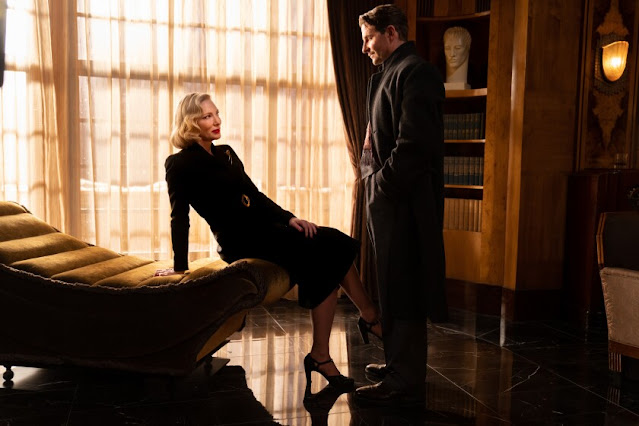
Cate Blanchett and Bradley Cooper in Nightmare Alley.

William Lindsay Gresham’s tough, darkly lyrical 1946 novel Nightmare Alley moves from the carny life to the world of phony spiritualists – scam artists who make a living off the sorrow of rich people trying desperately to contact loved ones on the other side of the grave. (In real life Harry Houdini was one of the more celebrated marks.) Gresham’s anti-hero is Stanton Carlisle, who joins a carnival and partners up with his lover, Zeena, to revive the mentalist act she used to perform with her husband Pete, a hopeless drunk who dies when Stan hands him a flask of wood alcohol. (It’s an accident: both the poison and a flask of potable gin have been stored in the same trunk. But as Gresham writes the incident, it’s one of those sinister acts of wish fulfillment, like Bruno’s murdering Guy’s blackmailing wife in Strangers on a Train.) Stan proves to be so good at the act that he soon outgrows it and takes it on the nightclub circuit, with a younger, prettier girlfriend as his assistant – Molly, whose carny performance used to involve an electric current and an alluring skimpy costume: sex and sci-fi “magic” intertwined. That’s when he crosses paths with a higher type of parasite, a psychoanalyst named Lilith who teams up with him to take advantage of her grieving patients. Stan and Lilith become lovers too, and their main target is a fabulously wealthy man named Ezra Grindle who is suffused with guilt over the fate of the girl he impregnated when he was a young man. Gresham never lets us forget how important a role sex plays in both low and high-class scams. (The Library of America, faithful purveyor of forgotten treasures, republished the book about a quarter of a century ago in a first-rate collection called Crime Novels: American Noir of the 1930s and 40s.)

Saturday, August 16, 2025

Stratford and the Shaw Festival I: Shakespeare

From left: André Sills as Polixenes, Sara Topham as Hermione, and Graham Abbey as Leontes with members of the company of The Winter's Tale. (Photo: David House.)

Shakespeare’s romance The Winter’s Tale is one of the three or four plays I cherish most, and the Canada’s Stratford Festival hits a high mark with Antoni Cimolino’s production at the Tom Patterson Theatre. Cimolino has announced that he will step down from the artistic directorship of the company after one more season, and his Winter’s Tale is so beautiful from start to finish that you can’t help thinking this is the show he would like to be remembered for. He’s staged it on a simple set that the designer, Douglas Paraschuk, has enriched, scene to scene, with lyrical details and Michael Walton has lit exquisitely. One of the most poignant examples is the famous final scene. Paulina (Yanna McIntosh) leads the King of Sicilia, Leontes (Graham Abbey), who has been reunited with his childhood friend Polixenes (André Sills), his former ambassador Camillo (Tom Rooney) and his long-lost daughter Perdita (Marissa Orjalo) into a secret room. There, she tells them all, she has had a sculptor create an astonishingly lifelike statue of Leontes’s queen Hermione (Sara Topham), supposedly dead these sixteen years while Leontes, under Paulina’s guidance, has done penance for the grievous wrongs he committed against her, Polixenes and Perdita (then just an infant). The stage is unilluminated except for three handheld lanterns, so the statue is revealed suddenly, the lantern light painting the darkness. When Paulina works her magic and Hermione moves, the effect is so subtle that at first you wonder if you really saw what you think you saw.

Monday, June 18, 2018

London and Stratford: The Shakespeare Report

Jack Laskey and Nadia Nadarajah in As You Like It at Shakespeare's Globe. (Photo: Tristram Kenton)

While I was watching As You Like It at Shakespeare’s Globe, the two quotations that kept running through my head – when I wasn’t boiling up with rage or, alternately, feeling like the life had been drained out of me – were the Stage Manager’s casual pronouncement in the third act of Thornton Wilder’s Our Town, “Wherever you come near the human race, there’s layers and layers of nonsense,” and Mollser’s query at the end of act one of Sean O’Casey’s The Plough and the Stars to Nora Clitheroe about whether there’s anyone around with “a titthle of common sense.” What prize collection of idiots would mount a production of Shakespeare’s sublime romantic comedy with a male Rosalind, a female Orlando and a deaf actress as Celia? I say “collection” because, though two people, Federay Holmes and Elle While, are listed as co-directors, the Globe’s modus operandi, under its latest artistic director, Michelle Terry (who plays three male roles in the production), is to assemble a show democratically, with the directors serving more as organizers than as auteurs. Even the costume designer, Ellan Parry, worked with each actor individually to select his or her clothing, items that come from all over because the show isn’t set in a specific period. What this catch-as-catch-can eclectic approach to costume doesn’t explain is why the outfits are so consistently ugly to look at. Were they selected to punish the audience further throughout the three interminable hours of the performance?

Wednesday, July 29, 2015

Robin Phillips: The Stratford Years

Robin Phillips, in 1977. (Photo via Torstar News Service)

Robin Phillips, who died on July 25 at the age of seventy-three, trained at the Bristol Old Vic and spent a decade as a young actor (he played the title role in the 1969 film of David Copperfield) before turning to directing. I own a copy of a TV movie of Strindberg’s Miss Julie that he directed in 1972 with a stunningly beautiful, sexually daring Helen Mirren playing opposite Donal McCann (a decade and a half before he played Gabriel in John Huston’s The Dead). After two years at the helm of the Greenwich Theatre in England, Phillips took the post of artistic director at Canada’s Stratford Festival and held it for six seasons, 1975 through 1980. I was in my twenties then, living in Montreal, and except for 1976, when I was traveling in Europe, I made sure to visit Stratford once or twice every summer, so I saw roughly a dozen and a half of the shows Phillips directed (or co-directed). I thought at the time that he was the most brilliant stage director I’d encountered in my young, fervent theatergoing life. It was an exciting time to be at Stratford: Phillips brought Maggie Smith, Brian Bedford, Peter Ustinov, Jessica Tandy and Margaret Tyzack to act alongside such Stratford stalwarts as Martha Henry, William Hutt, Douglas Rain, Alan Scarfe, Jack Wetherall and Domini Blythe. (Bedford ended up becoming one of those stalwarts.) Phillips claimed exhaustion when he left Stratford, and no wonder: during two or three of those seasons he staged five plays. His subsequent directing career was halting, though he worked in London and New York and around Canada; nothing evidently nothing he did after 1980 matched up to his achievements at Stratford. But those were glorious years, and I count myself fortunate to have attended so many of his dazzling shows.

Monday, December 9, 2024

A Lesser Lear, and a Greater

Kenneth Branagh in King Lear. (Photo: Johan Persson)

You can see the problem with the imported two-hour-without-intermission King Lear, co-directed by Kenneth Branagh, Rob Ashford and Lucy Skilbeck, in the opening scene. Lear (played by Branagh) sweeps onto the stage of The Shed and dives into the love contest among his three daughters. Goneril (Deborah Alli) recites her stock speech declaring her bottomless love for her father, but when the invisible baton is passed to Regan (Saffron Coomber), her outpouring of affection has been cut so drastically that all she seems to be saying is “Ditto.” So when Cordelia (Jessica Revell) refuses to “heave [her] heart into [her] mouth” and Lear’s response is to divide her intended portion of his land between her elder sisters, you wonder why he’s more put out than he was by Regan’s spare offering. In fact, the king seems angrier at Kent (played, bafflingly, as a woman, by Eleanor de Rohan) than anyone else. The scene has no weight; it feels like a plot set-up.

Monday, July 25, 2011

Two Richards

We are pleased to welcome a new critic, Steve Vineberg, to our group.

Two versions of Richard III are playing simultaneously in London this summer: one by Edward Hall’s all-male Propeller Company in Hampstead, and at the Old Vic a sellout version directed by Sam Mendes with the departing artistic director Kevin Spacey in the title role – the latest product of the Mendes-Spacey Bridge Project, in which English and American actors share the stage. It’s not difficult to imagine Spacey as Richard, Shakespeare’s wittiest and most charismatic villain. The problem is that his performance is exactly as you imagine it; it contains no surprises. It was bold of Spacey to shift focus from a movie career to the English boards, and those of us who had grown weary of his trademark switchblade irony – especially deadly when he offered it in combination with sentimental masochism in films like Pay It Forward, K-Pax and Beyond the Sea – hoped that it would fit him up with some new ways into his characters. Indeed he’s been better in his recent pictures (particularly Shrink), and his Richard is certainly an impressive technical achievement. He handles the language deftly, easily holding his own among the skilled English actors and providing a role model for his American cohorts (none of whom, alas, comes close to emulating him). And God knows he commands the stage, as any Richard needs to: he’s often hilarious and always mesmerizing.

Richard III is perhaps the only play Shakespeare ever wrote that functions solely as a star vehicle. Richard plots to obtain the throne; once he’s got it, about halfway through the play, he plots to secure it; and he resorts directly to the most direct method – murder. With the exception of his sister-in-law, Queen Elizabeth (whose brother and sons he kills), and the cursing, half-mad old Queen Margaret, the major supporting characters are all dupes who make the mistake of underestimating him and who pay the ultimate price for their bad judgment. (Lady Anne, whom he courts over the coffin of her father-in-law – whom he killed, as well as her husband – doesn’t exactly underestimate him, but she’s weak enough to walk into his trap with her eyes open. He marries her and then disposes of her when she no longer suits his purposes.) His male victims are merely foils for Richard, whose gleeful scheming, confided to the audience in the manner of a medieval Vice, is the play’s dramatic arc until the good Richmond gathers an army against him toward the end and Richard simply runs out of luck. Put another way, the forces of evil, as always in Shakespeare, eventually burn themselves out: the ghosts of Richard’s victims unite on the eve of battle to trouble his sleep and bless Richmond. The plot structure isn’t much different from Macbeth’s, but aside from a psychologically complex protagonist, that play has Lady Macbeth. It’s also compact, whereas Richard III drags on; Mendes’s production clocks in at three and a quarter hours, and it’s paced well. There’s not much to focus on besides Richard’s merry villainy.

Sunday, November 17, 2013

Fascism and Folly: The Donmar Julius Caesar

Julius Caesar at the Donmar Warehouse

Phyllida Lloyd’s Julius Caesar, imported from London’s Donmar Warehouse for a five-week run at St. Ann’s Warehouse in Brooklyn, is the second version this year of Shakespeare’s tragedy with a prison setting. The first was Paolo and Vittorio Taviani’s film Caesar Must Die, an account of an actual performance of the play by male inmates at a high-security Italian lock-up. In Lloyd’s production it’s enacted by the inhabitants of a woman’s prison. The audience gathers outside the heavy metal warehouse door for unsmiling uniformed guards to let them in, and then waits again, in their seats, for the actors to march in.

This Caesar, like Orson Welles’s famous 1937 brown-shirt adaptation, is about fascism, an idea that’s underscored by the setting but even more, intriguingly, by the all-female cast, which throws the boys’ club machismo and thuggery of Caesar and his associates into relief. Caesar (the terrific Frances Barber) is charismatic, a crowd pleaser, who’s playful with his friends. But the playfulness has an edge, his sense of irony a scary unpredictability. “Let me have men around me who are fat,” he declares as he opens a box of doughnuts, and the audience laughs appreciatively at this contemporary variation on a familiar line. But then he grabs Cassius (Jenny Jules), whose “lean and hungry look” has occasioned this declaration, pins him to a chair, shoves a doughnut in his maw, takes a bite out of it himself, and then wets his finger delicately and uses it to wipe Cassius’s mouth. The act is simultaneously a humiliation and a threat. Caesar’s men pay tribute to him by wearing cardboard masks of his face; when Cassius, Brutus (Harriet Walter) and Casca (Susan Brown) meet for a secret conference – they sit together at a table pretending to read magazines while they murmur rushed remarks – Casca reports that some men they know have been put to silence for taking down Caesar’s images.

Tuesday, December 8, 2020

Sean Connery: Larger Than Life

Sean Connery (1930-2020) in Diamonds Are Forever (1971).

Everyone knows that Sean Connery, who died on Halloween at the age of ninety, became a movie star the moment he stepped before the camera as James Bond, Ian Fleming’s Agent 007, in Dr. No in 1963. And for most of us who saw the early Bond pictures in the theatre as they appeared – I was thirteen when I was initiated, with the second of the series, From Russia with Love – all the subsequent Bonds, at least until Daniel Craig stepped up in 2006, always seemed like pretenders to a throne Connery had abdicated after the 1971 Diamonds Are Forever. Not that you could blame the guy. Very few of his fans took him seriously as an actor until he’d freed himself from the shackles of the leading role in the most beloved (and longest-lasting) series in movie history. He gave splendid performances as the life-embracing poet who can’t be slowed down even by a lobotomy in the 1966 comedy A Fine Madness and as the émigré Irish miner who leads a crew of violent rebels against the Pennsylvania coal barons in 1970’s The Molly Maguires – both fine movies but audiences failed to show up for them. (On the other hand, neither Woman of Straw with Gina Lollobrigida nor Marnie, directed by Alfred Hitchcock, both released in 1964, the same year as Goldfinger, did much for him. Marnie contains one of his rare bad performances – he looks befuddled, which seems like a fair response to what’s going on around him.)

Friday, August 22, 2014

Orson Welles: Modernist and Elegist

Orson Welles, on the set of Citizen Kane

There has been no one in the entire history of the American theatre quite like Orson Welles. Part prodigy, part carny spieler who rewrote his family history to such an extent over the course of his fabled career that he was largely self-invented, he talked his way onto the stage in his teens and by the mid-1930s had established himself as the most exciting young director in New York. This was at a time when FDR’s Works Progress Association had generated the Federal Theatre Project, the aim of which was to provide work for professional theatre folk and which, due to the convictions of its director, Hattie Flanagan, resided squarely in the left wing. Welles directed an all-black cast in a Haiti-set Macbeth that became popularly known as The Voodoo Macbeth; an up-to-the-minute Fascist Julius Caesar (with himself as Brutus); Marc Blitzstein’s satirical musical The Cradle Will Rock, which, locked out of its playhouse at the last minute, staged an opening night across town – without set, costumes or anything but the most rudimentary, off-the-cuff lighting – that was more dramatic and certainly more memorable than anything in the play itself.

At the same time Welles and his producing partner John Houseman brought live theatre to the air in a series of broadcasts called The Mercury Theatre that included the most famous – and infamous – of all radio programs, the 1938 Halloween dramatization of H.G. Wells’s The War of the Worlds. When he moved on to Hollywood, his debut was so eagerly anticipated that RKO Studios invited him to co-write, direct and star in his own project. That was Citizen Kane, released in 1941, when Welles was all of twenty-six years old. His directorial career, which lasted not quite three decades, was blighted by a chronic difficulty to get funding for his ventures – the consequence of a reputation as an unreliable spendthrift that was largely the fabrication of Louella Parsons, the powerful gossip columnist for William Randolph Hearst’s newspaper syndicate, whose boss was displeased with the way Kane had portrayed her boss (in a transparent fictional guise). But that career was also marked by some of the most staggering achievements in American cinema. Both as a director and as an actor Welles was a walking legend for the rest of his life, the definition of the theatrical enfant terrible and ego-driven multi-tasker. (The 1953 musical The Band Wagon, written by Comden and Green and directed by Vincente Minnelli, offers a light-hearted send-up of the Orson Welles of the popular imagination in the person of actor-director Jeffrey Cordova, played by Jack Buchanan.)

The virtual creator of conceptual directing, the first director to fit classic texts to modern settings, a conqueror of one twentieth-century technology (film) after another (radio), the first American filmmaker to make significant stylistic strides in the employment of sound (even though Kane came out fourteen years after the official birth of the talkies), one of the two American directors – the other was William Wyler – to import the deep focus lens that enabled the camera to show foreground, middle ground and background with equal clarity in the same frame, Welles was an embodiment of theatrical modernism. But he was a paradox. All of his best movies, beginning with Kane and ending with Chimes at Midnight, his last full-length dramatic feature, in 1967, in some way represent a conflict about the modern age wherein the boundless energy and hurdling drive of the new struggles with a longing for what it’s irrevocably replaced.

Tuesday, August 31, 2010

Mixed Blessings: Stratford Festival's Kiss Me, Kate & The Tempest

The Stratford Shakespeare Festival’s current productions of Cole Porter’s musical Kiss Me, Kate and William Shakespeare’s drama The Tempest highlight the limitations of what can be done with sub-standard material. While the two plays are impeccably, even superbly, directed and acted, they’re still not representative of their creators’ best work.

Wednesday, December 1, 2010

Separating Paranoia From Heightened Consciousness: Doug Liman's Fair Game

Conspiracies are as old as the dawn of civilization. They consistently intrigued Shakespeare. Bye-bye, Julius Caesar. Tough luck, Macbeth. Some speculate on the true identity of the Bard himself; Roland Emmerich’s Anonymous, due out in late 2011, will address this controversy. But, in the modern era, the very notion of a conspiracy theory gained credence immediately after the November 1963 assassination of John F. Kennedy. We have not been the same since. Nowadays, everyone’s suspicious of everything. On the lunatic fringe, there are the Truthers (Who really attacked the World Trade Center?), the Birthers (Where was Obama actually born?) and, a cherished chestnut, People Who Suspect the Fluoridation of Water is a Communist Plot.

Yet, for those of us with more reasoned fears, it’s often difficult to separate paranoia from heightened consciousness. To quote Kurt Cobain, who must have borrowed it from Joseph Heller’s Catch 22: “Just because you're paranoid doesn't mean they aren't after you.” That certainly is the case for Joseph Wilson and his wife Valerie Plame in Fair Game, a sympathetic biographical film tracing the D.C. couple’s nightmare at the hands of the vindictive Bush administration. Although unseen except in genuine news footage, the chief perpetrators are Karl Rove and the even more powerful Dick Cheney (On a Baghdad battlefield, this contemporary Richard III might plead: “A heart, a heart. My kingdom for a heart!”). But the Central Intelligence Agency — where Plame is an undercover operative until exposed for devious purposes — comes across as a bastion of back-stabbers.

Thursday, August 11, 2011

Weighed Down by the Truth: Shakespeare by the Sea’s Measure for Measure

As an English literature major, this is difficult for me to admit, but here it is: I don’t like Shakespeare. I want to like him. I should like him. I often pretend to like him, but I don’t. It seems to me that Shakespeare focuses habitually on the lackluster narratives. In Romeo and Juliet, the love story between Romeo and Rosaline always distracted me from the main action. (Ditto for the three witches in Macbeth.) And I agree with Tom Stoppard and W.S. Gilbert that Hamlet’s Rosencrantz and Guildenstern are far more intriguing than a self-centered Danish Prince. Naturally, the Shakespearean productions I find most interesting are the ones which embrace and capitalize on the back story. Shakespeare by the Sea (SBTS) is usually quite adept at this, and so I had grand expectations for their rendition of Measure for Measure. Specifically, I’d hoped they would elaborate on the history between Angelo and Mariana, which in Shakespeare’s version happens largely outside the main plot. Generally, I’d hoped for any unexpected interpretation they could offer. I was disappointed.

A Shakespearean theatre company has limited material to work with, even if Shakespeare is one of the most prolific playwrights at 37 full length plays. You can’t do the crowd-pleasing Romeo and Juliet every year. There is an art to choosing which of The Bard’s comedies, tragedies or histories you perform and a quality company chooses their drama based on what’s relevant to the culture in which they’re performing. In this regard, Measure for Measure is an ideal choice. The play’s commentary on how power and pride affect the interpretation of truth and justice is still central to our society: from America’s economic crisis (which producers would have known when they chose the play) to the tragic shootings in Norway (which they could not have known)

Monday, August 3, 2026

The Stratford Shakespeare Festival: Classics

André Sills and Krystin Pellerin in Othello. (Photo: David Hou.)

The question up for grabs in any production of Shakespeare’s Othello is why Iago sets out to destroy Othello and those he loves. In the 1995 movie with Laurence Fishburne, Kenneth Branagh’s motivation for Iago’s actions was straight off the surface of the text: he was angry at his general for selecting Cassio rather than himself as his lieutenant and devised a revenge that would punish both of them; Othello’s wife Desdemona, whom he convinced the Moor had been cheating on him with Cassio, is merely collateral damage. It wasn’t an especially interesting choice but Branagh was still the best thing in the picture. When Frank Finlay played it in the famous National Theatre production opposite Laurence Olivier (with Maggie Smith as Desdemona), which was filmed in 1965, his hatred of the Moor derived unmistakably from the fact of Othello’s race. But the best Iago I’ve ever seen was Andre Braugher in a splendid 1991 production at the Shakespeare Theater in D.C.. His Iago caught Othello, Desdemona and Cassio in his web – to quote the character’s own metaphor – for amusement; he was a sociopath. Braugher was the first Black Iago in my experience, and there were also clear nods to the men’s race: you sensed his shock that Othello would prefer a white guy to a brother. That element was prominent in Iobal Khan’s production for the Royal Shakespeare Company in 2015, which contained a number of Black characters, some African, some Caribbean, one Indian, and depicted a complicated hierarchy where culture determined class in ways that weren’t immediately apparent. Nicholas Hytner’s version at the National Theatre in 2013 was also about class – Rory Kinnear played Iago as distinctly working-class, and his racial discomfort with the Moor was mixed up with his perception that privileged men, one Black and one white, were looking down on him.

Sunday, April 18, 2010

The Body: Revisiting Deliverance


Poet and author James Dickey was once asked by TV host Dick Cavett what his novel Deliverance was about. “It’s about why decent men kill,” he answered dryly. That’s certainly the plot of both the 1970 novel and John Boorman’s feature film (1972). But it’s also like saying Macbeth is about why kings get ambitious. The power of Deliverance actually lies somewhere beyond the plot and into something more mysterious and fragile like the body. The story is about four Atlanta businessmen – the macho wilderness man Lewis (Burt Reynolds), the beefy, insecure insurance salesman Bobby (Ned Beatty), the affable musician Drew (Ronny Cox) and the thoughtful Ed (Jon Voight) – who decide to canoe down the (fictional) Cahulawassee River in Georgia in order to “commune” with nature before the river valley gets flooded and displaces the mountain locals. With the exception of Lewis, who is a man’s-man like the deerslayer of James Fenimore Cooper (or De Niro’s Michael in The Deer Hunter), and Ed (who has joined Lewis on a few expeditions); the other men are complete innocents. The locals they encounter are also deeply reserved folks isolated from the world these suburban males inhabit and some – like the young boy who duets with Drew on the famous “Duelling Banjos” – are part of inbred families. Lewis and friends, feeling their own false sense of superiority over the inhabitants, still take on the river as if to tame the body of water. What they discover along the way, however, is that nature can’t be tamed and the body is a vulnerable entity.

Thursday, February 12, 2015

Listen to the Lyon: Empire

Taraji P. Henson and Terrance Howard co-star in Empire, on FOX.

By Wikipedia’s count, Empire is the fourth non-documentary TV series to be titled Empire, including a short-lived ‘60s Western featuring the young Ryan O’Neal, an even-shorter-lived ABC Roman Empire drama featuring the young Emily Blunt and James Frain, and a 1984 corporate sitcom that starred Dennis Dugan, on his way to becoming our leading director of feature films starring comedians whose careers were launched by Lorne Michaels after he just stopped caring. Network executives probably like the sound of that title for its blunt, straightforward grandiosity; it captures what they see themselves as controlling and embodying, and imagine that ordinary TV viewers will salivate at the prospect of being given a glimpse of life at the top. Amusingly, the male protagonist of the new Empire is a street artist turned multi-million-dollar mogul who has named his music company Empire Entertainment, which tells you everything you need to know about his taste for grandiosity.

Monday, November 7, 2016

Bits and Pieces: Love, Love, Love and Tiger Style

Richard Armitage and Amy Ryan in the Roundabout Theatre's production of Love, Love, Love. (Photo: Joan Marcus)

Love, Love, Love
is a Mike Bartlett play from 2010 that is only now receiving its first American production, by the Roundabout Theatre in its off-Broadway space (Laura Pels Theatre). Bartlett, who wrote Cock and Wild, as well as the acclaimed King Charles III, is one of the most talented of the current generation of English playwrights, and I had a fine time at this play for the first two acts, which are a highly stylized comedy of manners. In act one, set in a north London flat in 1967, a straight arrow named Henry (Alex Hurt) invites a woman he’s been seeing, Sandra (Amy Ryan), home for dinner, only to see her fall for Kenneth (Richard Armitage), the hippie kid brother he’s been putting up, with escalating exasperation. In act two, set in 1990, Sandra and Kenneth are married and living comfortably in suburban Reading with their two teenagers, Rose (Zoe Kazan), who is anxious about everything, and Jamie (Ben Rosenfield), who’s affable and skin-deep. The marriage falls apart by the end of the act, after they’ve owned up to infidelities on both sides.