Showing posts sorted by relevance for query Robbie Robertson. Sort by date Show all posts

Wednesday, January 11, 2017

You Can Hear His Music: Testimony by Robbie Robertson

Robbie Robertson (right) performing on stage with Bob Dylan in 1965.

Last fall, four autobiographies were released by some of the biggest names in music history: Bruce Springsteen (Born To Run), Phil Collins (Not Dead Yet, Live), Brian Wilson (I Am Brian Wilson, A Memoir) and Robbie Robertson, who named his autobiography Testimony (Knopf), after one of his compositions. Of those four, I was most keenly interested in hearing from Robertson, particularly since I couldn’t book him for a CBC Radio Documentary I co-produced with Kevin Courrier in 2008. I assumed he would have offered some first-rate memories that, happily, are now in print. And since I am a fellow Torontonian, many of the places he writes about are familiar to me.

Robertson has penned an idealistic autobiography that is not for fans of revisionist history: “These are my stories; this is my voice, my song.” Testimony is one hell of a tale and a hefty one, at 500 pages. As a young man growing up in Toronto, he was captured by the sounds of rock 'n' roll, country and blues music that never left him. His aboriginal mother, from the Mohawk Nation in Ontario, had a very rich musical family whose strong sense of traditional storytelling was equally matched by their skills as musicians. He reports on his many visits to the Six Nations Reserve in Southwest Ontario, with great affection – “On the banks of the Grand River I found a quiet spot and sat for a while, musical memories swirling around in my head. This is where it had all begun for me,” Robertson recalls from 1966.

Monday, August 24, 2020

New Documentaries: Gordon Lightfoot, The Band, and Flannery O’Connor

Gordon Lightfoot in Gordon Lightfoot: If You Could Read My Mind (2019)

The Canadian singer-songwriter Gordon Lightfoot attained fame in the mid-1960s and in his prime – that is, until 1973 or 1974 – he turned out an album every year. He had a sweet, silver-laced voice and he wrote evocative ballads with understated poetic lyrics (like “The Last Time I Saw Her Face” and “Affair on 8th Avenue”) and big-boned, bardic folk anthems that dramatized small and large historical topics, the most famous – and best – of which was “Canadian Railroad Trilogy.” When I was in high school in Montreal in the early days of his celebrity and the late days of the folk movement, you couldn’t attend a party without someone showing up with a guitar, and you were dead certain to hear the trilogy or “Early Morning Rain,” or both. (The other guaranteed solo was “Suzanne” by that other Canadian musical legend, Leonard Cohen.) Before his writing lost its freshness and his voice wore down to a craggy thinness, I bought everything Lightfoot recorded, and I saw him in concert four times, once at Carnegie Hall.

Monday, March 28, 2022

New on Criterion: The Last Waltz (1978)

The Band on stage in The Last Waltz (1978)

In the forty-four years since Martin Scorsese released The Last Waltz, his film of The Band’s final concert, at San Francisco’s Winterland Arena on Thanksgiving Day in 1976, the movie hasn’t lost any of its visceral excitement, both as a piece of filmmaking and as a keepsake of one of the signal events in the history of rock ‘n’ roll. It’s the greatest concert movie ever made. (The other contenders, in my view, would be Bert Stern’s 1959 Jazz on a Summer’s Day, a chronicle of the 1958 Newport Jazz Festival, which inspired Scorsese; Jonathan Demme’s 1984 Talking Heads film Stop Making Sense; and Scorsese’s one-of-a-kind 2019 Rolling Thunder Revue, which casts a backward glance at the all-star show, headed by Bob Dylan and Joan Baez, that circled the continent in 1975 and 1976.) The new Criterion disc of The Last Waltz is as beautiful to look at as the film was in theatres in 1978. The veteran Hollywood production designer Boris Leven, borrowing the San Francisco Opera’s set for La Traviata and framing it with a trio of chandeliers, transformed Winterland into something that looks like a remnant of the Romantic era, and Michael Chapman, who had worked with Scorsese on Taxi Driver, lit it, while some of the most talented cinematographers in America (Vilmos Zsigmond, Laszlo Kovacs, David Myers, Bobby Byrne, Michael Watkins and Hiro Narita) manned the other six cameras covering the spectacle. It was the first concert film with a shooting script, which Scorsese had drawn up; the stories about the filming, where his meticulous planning met the inevitable challenges and accidents of a once-in-a-lifetime event that had to be captured spontaneously, are sometimes funny and always thrilling. (You won’t want to skip the extras on the Criterion disc, which include two audio commentaries, a 1978 Canadian television interview with Scorsese and The Band’s Robbie Robertson, a twenty-fifth-anniversary doc about the making of the movie, and a supremely articulate new interview with Scorsese conducted by film critic David Fear. There’s also a single outtake, a twelve-minute jam session that occurred at the end of the concert and is the only surviving piece of archival footage.)

Wednesday, August 16, 2017

Purveyor of Thresholds: Why Scott Walker Is God


"See the man with the stage fright
Just standin' up there to give it all his might.
And he got caught in the spotlight,
But when we get to the end
He wants to start all over again."
                                  – from "Stage Fright" by Robbie Robertson
Author Barney Hoskyns has rightly observed that though The Band’s leader Robbie Robertson wrote this 1970 song ostensibly about Bob Dylan, who had stopped touring live in the late '60s, it could also have been about the shy Robertson himself, who had experienced stage fright the year before during The Band’s first live concert. Naturally it could also be about any emblematic singer who has experienced what Levon Helm called “the terror of performing” or any person who, as William Ruhlmann once put it, has discovered “the pitfalls of fortune and fame.” And as the song itself declared so openly, “Since that day he ain’t been the same,” largely as a result of the personal price he had to pay for being able to “sing like a bird.”

But given the year, 1970, and given Scott Walker’s own notoriously famous stage fright (which was known to be almost paralyzing), I’ve always felt that the song especially captured some the core dilemma eating away at Walker himself. Like Dylan, who rejected both the trappings and the demands of celebrity after flying too high and too fast in the '60s, not to mention mangling his motorcycle, Walker also withdrew from the public eye after his own Icarus-like trauma: the discouragement he felt after his first four post-Walker Brothers solo records failed to meet his own exacting (and probably unattainable) expectations.

Tuesday, April 24, 2012

Remembering Levon Helm (1940-2012): Then and Now

In light of Levon Helm's passing last week from cancer at 71, Susan Green and John Corcelli recall moments from his musical life – then and now.

The audience at 1969 Isle of Wight music festival

While thumbing my way from London to Edinburgh on the A1 Motorway, I met a British fellow hitchhiker named Christopher who was only going as far as Sheffield. When we’d driven that distance aboard a clotted cream lorry that stopped for us, he more or less invited himself along on my already scheduled jaunt to the 1969 Isle of Wight music festival a week later. We also discussed issues of war and peace.

"I'm sort of fed up with being American,” I told Christopher. “Vietnam and violence on our streets and police brutality. Over here, you seem so much more..."

"Civilized?"

Saturday, August 28, 2010

Unfinished Notes From an Abandoned Book: The Weight (2009)

The Band in Martin Scorsese's The Last Waltz (1978).

A couple of years ago, I was toying with the idea of writing a book called The Weight. It was about Martin Scorsese's The Last Waltz (1978), his concert documentary about The Band's farewell Thanksgiving concert on November 25, 1976 at the Winterland in San Francisco. My thought was to send a proposal and a sample chapter to the British Film Institute for their annual chapbook publications on key films. Having just done a CBC Radio documentary on The Band's debut album, Music From Big Pink (1968), I was primed to delve into the air of melancholy that lay beneath the spirit of celebration that Scorsese caught while shooting that extraordinary concert. But I decided to abandon the project when there didn't seem to be any interest from publishers. However, I came across some of the notes I'd written in preparation for The Weight which, upon re-reading them, looked apt for a posting.  Kevin Courrier

Tuesday, August 9, 2016

Critic's Notes & Frames Vol. XIX

Comedian Lenny Bruce, who died fifty years ago, once wrote, "People should be taught what is, not what should be. All my humour is based on destruction and despair. If the whole world were tranquil, without disease and violence, I'd be standing in the breadline  right back of J. Edgar Hoover." I was first introduced to Bruce in 1970 while in high school where we were learning 'what should be.' Standing around in gym after class, where getting hassled by hyper-masculine athletic jocks comprised 'what is,' a long haired soul who appeared equally big and intimidating named Tony Sloggett handed me a book The Essential Lenny Bruce – and said, "You might like this." Then he walked away.

The Essential Lenny Bruce was a collection of this equal opportunity offender's best routines and many of them made me laugh  if not uneasily  because they didn't exactly provide comfort for my own views. At times, they weren't entirely understandable, either. In satirizing the straight world, Bruce employed both the argon of the hip and (since he was Jewish) Yiddish. Many of the hip words were pretty clear, but Yiddish was way out of my league. That left me chasing down the only Jewish guy I knew at my school, the straight arrow Mel Raskin, who was also a daily victim of the thugs in gym class. I'm still trying to imagine what must have been going through his mind as I followed him down the street asking things like, "Mel, what does shtup and putz mean?" (Mel has since, in a twisted irony known only to God, become a radio broadcaster of Oshawa Generals hockey games.)

When Bruce began to build his reputation as the "King of the Sick Comics," he took on everyone – from the Pope to Jimmy Hoffa. When he was a guest on Hugh Hefner's after-hours TV talk show, Playboy Penthouse, he did a television first  he blew his nose on camera. Bruce satirized and tested the prudishness of the audience. His daring wasn't in the romantic portrait Dustin Hoffman provided in Bob Fosse's Lenny (1974), where he was seen as the misunderstood rebel, but in his fearless approach of all that was sacred  even to liberals  and combining with that the performer's fervor in getting a rise out of the audience. We were as much the butt of his jokes as we were participants in them. One such example, which was one of the first routines I read in The Essential Lenny Bruce, was his outrageous "Christ and Moses" below in The Carnegie Hall Concert.

Wednesday, September 18, 2013

Scorsese's Jukebox


Rock music didn't make its true first appearance in movies until 1955 when Bill Haley & the Comets' "Rock Around the Clock" introduced movie audiences to its power in Richard Brooks' youth drama Blackboard Jungle. This jumping tune, heard over the opening credits, got people hopping with the kind of infectious enthusiasm not seen since the beginning of The Swing Era. Blackboard Jungle was the story of a new teacher (Glenn Ford) who begins a job at a school in the 'wrong' part of town. He initially gets a lot of grief from the underclass students he's trying to teach. But one of his colleagues gets more than just grief. He tries to interest his charges in jazz. But the music of Stan Kenton and Bix Beiderbecke makes no impressionable dent in their not-so-impressionable minds. (The poor teacher is forced to watch his prize collection of records get tossed around the room and smashed to bits.) The picture was noted for introducing to audiences the raw and exciting presence of Sidney Poitier, but the lasting memory is of a public so startled by "Rock Around the Clock" that Clare Boothe Luce, the American ambassador to Italy, protested Blackboard Jungle's inclusion in the Venice Film Festival that year because (thanks to Bill Haley & The Comets) it incited people to violence.

Tuesday, April 4, 2017

Critic's Notes & Frames Vol. XXII


If there was one songwriter in rock 'n roll who had an endless gift for memorable (and enjoyable) anthems it was Chuck Berry, who died recently in his home at the age of 90. Whether it was his pledge of allegiance in "Rock and Roll Music," his testament to roots in "Back in the U.S.A.," or the happily defiant "Roll Over Beethoven," Berry was the supreme storyteller, rock's Johnny Appleseed, a smooth talker and a smooth walker. Born in St. Louis, Berry drew his musical influences from a variety of genres. The swagger of "You Can't Catch Me" is unthinkable without Louis Jordan. The bravado of "Little Queenie" would have been right at home in the tough urban blues of Muddy Waters. "Brown Eyed Handsome Man" might have been a country music dream imagined by Bob Willis and the Playboys. His lesser-known "Havana Moon" has the swooning balladry of Nat King Cole (and it inspired Richard Berry's "Louie Louie").

Friday, July 16, 2010

Jesse Winchester, You're On My Mind


Jimmy Buffett’s schtick, which conjures up images of enjoying tequila and triple sec cocktails in the sun, never appealed to me. But the 63-year-old musician suddenly is a notch or two higher in my estimation and not just because his environmental activism -- save the manatees! -- has sharpened in reaction to the BP oil catastrophe in the Gulf of Mexico. Here’s the primary reason: When the hipster dude who turns out hits like “Margaritaville” and “Cheeseburger in Paradise” organized a free July 11 concert in his native Alabama, the show included Jesse Winchester.

This singer-songwriter with a soulful tenor voice is the antithesis of a “parrothead,” the term Buffett aficionados use to symbolize the “island escapism” sensibility of their hero. Winchester, also a Southerner, has a rather somber demeanor, even when performing as cheerful an anthem as “Laisse les Bon Temps Rouler.” With a courtly, almost old-fashioned manner, despite the perennial hippie beard, he rocketed to fame in the late 1970s as an artist living in exile who was finally able to visit his homeland again after President Jimmy Carter pardoned America’s draft resisters.


Sunday, March 1, 2015

Pop Journalism: Books on Bob Dylan, The Band and Paul Simon

“Definition of rock journalism: People who can't write, doing interviews with people who can't think, in order to prepare articles for people who can't read.”

Frank Zappa, The Real Frank Zappa Book

This quote from Frank Zappa has always struck me as funny. Funny because, having written several thousand words of music reviews over the years, it might even apply to me. Of course I rarely if ever interview anyone, it’s all just my opinion. I might borrow a controversial quote, like this one, and use it as a springboard into a discussion about something or other. But does Zappa speak for all rock journalism? I just finished reading the third of a series of new books published by Rowman & Littlefield about rock music. American rock music specifically. The publisher has selected a cross section of important American artists and matched each of them with an appropriate author to come up with books on Bob Dylan, the Band, Paul Simon and others yet to come. I have read the Dylan, Simon and The Band books. They stand individually, but they also sometimes lean on each other for support. The first book in the series is Bob Dylan: American Troubadour by Donald Brown. Brown is a theatre critic and book reviewer at the New Haven Review. He also teaches at Yale. His book begins with a timeline contrasting important events in the history of the world (Dec.7 1941 Japan attacks Pearl Harbour) with important dates in the life of Dylan (May 24, 1941 born as Robert Allen Zimmerman to parents Abram and Beatrice in Duluth, MN). A similar timeline appears in the Paul Simon book but is inexplicably missing from The Band volume. 

Tuesday, August 27, 2013

Artist as Apostate: Bob Dylan in 1966

The burning of Beatles records and magazines in the American South in 1966.

Back in 1966, John Lennon was worried about whether he'd be killed as The Beatles criss-crossed America in a summer filled with race riots and a heated controversy over a comment he made about the group being more popular than Jesus Christ. But there was another performer, one who was confused with being a prophet, having similar qualms that summer: Bob Dylan. Not only did the events in that season of hate alter the path of Dylan's career, it dramatically transformed the artist himself. He went from being a man making history to one who feared becoming its pawn. That summer determined not only his retreat from pop stardom, where a reluctant avatar suddenly saw the possibilities of betrayal, it also changed the game. With Dylan's Another Self Portrait, which contains unreleased sessions of music that make up two albums (Self PortraitNew Morning) during his retreat from his audience between 1969 and 1971, and on sale in stores today, you can hear in many of its songs the desire for solace. But the quiet in their sound, the soft beauty of "Pretty Saro," the contemplative quest in "Went to See the Gypsy," is deceptive. Another Self Portrait also has room for the tragic seduction of "House Carpenter," and the plaintive account of brutal murder in the traditional "Little Sadie." What all these songs have in common is that they portray a man seeking refuge in the more subtle confinements of the chamber room. But he couldn't hide from a world he helped create.

Sunday, December 11, 2016

Critic's Notes & Frames Vol. XXI


Brian De Palma's Home Movies is a 1979 low-budget independent film made with the help of his film class at Sarah Lawrence as a hands-on training exercise. (They were given the primary responsibilities of raising money, arranging the shooting schedule, and editing the film, all under De Palma's supervision.) What they got was a spirited primal comedy laced with episodes from De Palma's early life that also came to make sense of his movie obsessions. Kirk Douglas (who had just starred in De Palma's last thriller, The Fury) plays a film instructor who uses the medium as a form of therapy. His prize student Dennis Byrd (Keith Gordon) decides to turn the camera on his family life, which is filled with enough neurotic issues to fuel numerous sessions. Besides competing with a favoured and pompous older brother (the hilarious Gerrit Graham, who played the glam rock star, Beef in De Palma's Phantom of the Paradise), Dennis also has to deal with a mother (Mary Davenport) who pops pills because of her philandering husband (Vincent Gardenia), a physician on whom his son ultimately turns his lens to catch him in the act. When his older sibling brings home his girlfriend, Kristina (Nancy Allen), Dennis is immediately drawn to this striking blonde while still torn by guilt over his parents' marital issues. Home Movies is a shaggy satire with Oedipal gags that pop like party balloons. While the picture has a relaxed charm compared to the fervently exciting thrillers, Carrie and The Fury, that preceded it, the themes of voyeurism and fear would carry over effectively into his next picture, Dressed to Kill, where the comedy and horror have a more lasting after-bite.

Friday, October 5, 2012

Every Inch the Southern Gentleman: Quiet About It – A Tribute Album to Jesse Winchester

When I first heard about Jesse Winchester, back in the early ‘70s, his first album had not yet been released. Rumours flew that it was Bob Dylan recording under another name. It was probably down to the fact that he was managed by Albert Grossman (Dylan’s long-time manager), and was connected to The Band: Robbie Robertson produced his eponymously named first album. All it took was a look at the cover photo, and a listen, to know this was somebody new. Levon Helm played mandolin and drums on a track or two, the great unsung guitarist David Rea was present, but it was truly a songwriter’s record. I loved that first album, so much so that I have bought three or four copies of it over the years.

A year and a half ago Jesse was diagnosed with cancer of the esophagus. His friends decided to create the tribute album, Quiet About It, for him. He has some major friends. They appear here at their own expense. That’s right; they paid for their own sessions. Elvis Costello, Vince Gill, Rodney Crowell, Rosanne Cash, James Taylor, Jimmy Buffett and more. The album was released on Buffett’s Mailboat Records label. Jesse survived the treatments; he’s cancer free, but he moves a bit slower these days. After a recent concert I spoke with him. He was seated on a big old couch, out of puff, but every inch the Southern gentleman. The songs display the same generosity of spirit he showed that night. He spoke with everyone who had something to say, and signed CDs and LPs for 30 minutes. He deserved a tribute.

Sunday, February 7, 2010

Understatement: Jason Schneider's Whispering Pines

The Band

“There is no music that you can say, ‘Oh, that’s Canadian – know what I mean? It’s North American music – different countries, but you hear the exact same music, from blues to cowboy. So rather than talking about Calgary or Montreal, we talked about places that we played in."
– Robbie Robertson quoted in Whispering Pines: The Northern Roots of American Music.
It’s been commonly held for years that Canadian musical performers only achieve their due recognition when they go south of the border. While that remains something of a simplification, there are still many examples to choose from – Neil Young, Joni Mitchell, Gordon Lightfoot, just to name a few. Fortunately, in his recent book Whispering Pines: The Northern Roots of American Music…From Hank Snow to The Band (ECW Press, 2009), author Jason Schneider develops a more substantial rendering of this phenomenon. By examining the Canadian songwriting tradition as a national narrative, he’s able to illustrate how our musical artists subtly permeate the American experience rather than seek out our neighbour’s validation. In a series of essays that chart the careers of Hank Snow, Wilf Carter, Ian & Sylvia and Leonard Cohen, Schneider (Have Not Been the Same: The CanRock Renaissance) draws a delicate map of our cultural influence in popular music. He doesn’t so much examine how our identity as Canadians is felt in American music, but rather how American popular music has been enriched by our Canadian sensibilities.

Saturday, May 31, 2014

Friday, August 17, 2012

A Rollicking Good Time: Rosanne Cash & Band at Hamilton Place, August 15, 2012


Apparently the city of Hamilton doesn’t know what they missed last night. Rosanne Cash, Johnny’s daughter, played Hamilton Place to a half empty room. I sensed there was trouble selling tickets when they offered 2 for 1 for a week or two in July. They were still advertising “Tickets Available” in yesterday’s newspaper, but the audience must have been saving its money for Bruce Springsteen in October, or The Who next February. Well folks, you missed a great show!

As the lights dimmed right at 8 o’clock the firm fans soon discovered they were in for a full night of music. The opening act were three attractive young ladies in short skirts and cowboy boots who skipped onto the stage. This trio called BelleStarr included the redhead (Miranda Mulholland), the brunette (Stephanie Cadman), and the blonde (Kendal Carson). Miranda and Stephanie carried fiddles, Kendal a guitar, and they proceeded to sing a close-harmony rendition of Dolly Parton’s “Jolene.” The audience loved it. They played a few originals enhanced by Stephanie’s step-dancing which acted as percussion to drive the tunes. During the intermission, the merch table was surrounded by adoring new fans.

Thursday, March 19, 2015

Blame it on Hamilton: A Celebration


It’s Tuesday after Juno week in Hamilton. The big poster designed by Tom Wilson still overlooks James Street. Swag bags are emptied though, and the blue boxes are filled with was passed for swag in some of those bags. Booklets, ads, tickets are blowing down the road. All that remains are the memories. Memories of that week when all the clubs were full of people, and music was played everywhere. Even Limeridge Mall had an event. A music event! Not a sale. The libraries had an event, believe it or not. Hamilton Public hosted a concert in the round on their 4th floor. And McMaster Libraries did a demonstration of electronic instruments for attendees! Give your head a shake. I was there, participating, demoing the Makey Makey and my colleagues showed off the Atari Punk Console, the Little Bits Synth Kit and a theremin that was also built from a kit. The theremin was the big draw. After people bought their beer at the bar they were pulled over by the sounds of alien invasion coming from the weird black box. They then stayed to twist the knobs of the punk console or bang away on the banana piano. Yep, it’s a piano with bananas for keys (or forks, or tofu, or even raw meat). Fun wow!

Friday, December 26, 2014

Critic's Notes & Frames, Vol. X


Singer Joe Cocker, who sadly died over the holidays at 70 after a battle with lung cancer, could get to the bottom of heartache in a song like no other. Listening to him perform, with his gravel voice, was like hearing Louis Armstrong cured in a blue funk. Containing a melancholic soul that rivalled Billie Holiday, Cocker's ecstatic surrender to the naked emotion in a romantic number, at its best, could transcend masochism. Of all his memorable tracks from "Hitchcock Railway" to his soulful take on "With a Little Help from My Friends," his gospel tinged "Do I Still Figure in Your Life?" asks with maybe the greatest urgency the most poignant demand of his audience.


Film director Carlos Saura has made many dazzling dance pictures before, from Carmen (1983) to Flamenco (1995), but Iberia (2005) may be his most erotic work. Using a studio outfitted with minimalist backdrops of scrims, curtains and mirrors, Saura adapts sections of composer Isaac Albeniz's "Iberia" suite for a number of the biggest stars in the Spanish dance and music world to perform. Yet like Jonathan Demme in Stop Making Sense (1984), Saura makes us conscious of the artifice he's creating, letting us see the cameras, the lights, and the recording equipment, only then to employ the magic of performance to evaporate the artifice. Saura isn't content just capturing that alchemy, though, he goes further inside the process of performance art itself and, while using expressionistic techniques, reaches the purest essence of dance to create a fully realized expression of love for the sensuality of movement.

Monday, October 30, 2023

Killers of the Flower Moon: Martin Scorsese’s Hobbled Epic

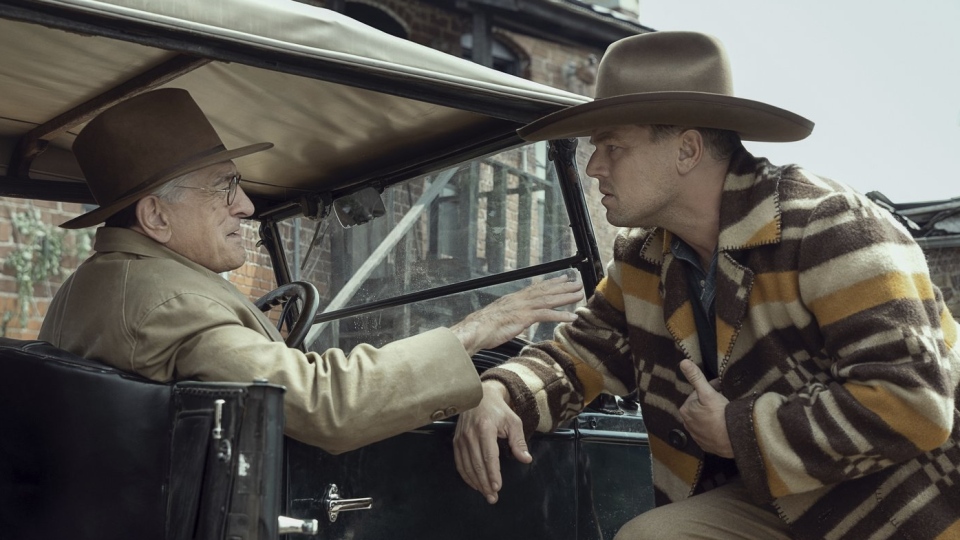
Robert De Niro and Leonardo DiCaprio in Killers of the Flower Moon.

Killers of the Flower Moon is great around the edges. Martin Scorsese’s movie, adapted from David Grann’s jaw-dropping 2017 account of the serial murders of Osage Indians in Oklahoma in the 1920s that enabled white men to secure their “headrights” – the legacy, shared equally among the community, of land rich in oil – is three and a half hours long and cost $200 million, and God knows you can see the money on the screen. The film, shot by Rodrigo Prieto, with production design by Jack Fisk and costumes by Jacqueline West, looks magnificent. The period reconstructions are dazzling and capture a cross-hatched culture, rich in visual irony, where natives, professing a faith that mixes Catholicism with the religion of their ancestors, dress in a combination of traditional garb and the flamboyant style of wealthy white men while they tool around in chauffeured Pierce Arrow roadsters and fly private airplanes. The opening scenes are lively and exciting, a circus-like montage of oil strikes and auctions and raucous general celebration that spills out of barrooms and restaurants into the streets of Fairfax, the Osage reservation town that has grown out of the oil boom. This is some of Scorsese’s best filmmaking – visually dense, outrĂ©, darkly funny. We barely have a chance to process the omnipresence of white men who have intermarried with the Osage women before it all turns sinister. The natives are dying in staggering numbers, some the victims in unsolved murders, others expiring from suspicious illnesses.