Showing posts sorted by relevance for query Sheldon Harnick. Sort by date Show all posts

Wednesday, June 28, 2023

Plays with Music: Brokeback Mountain and The Curious Case of Benjamin Button – and a Brief Farewell

Mike Faist and Lucas Hedges in Brokeback Mountain. (Photo: Manuel Harlan)

Receiving its world premiere at London’s compact, comfortable new Sohoplace in London, Brokeback Mountain, Ashley Robinson’s ninety-minute dramatization of the Annie Proulx story most people know through the 2005 film, is a trim, skillful production. Jonathan Butterell has staged it effectively in the round on Tom Pye’s pared-down set and Mike Faist and Lucas Hedges, the two actors succeeding Jake Gyllenhaal and the late Heath Ledger in the roles of the young Wyoming cowboys embarking on a forbidden, tragic gay romance, are both excellent, especially Hedges as Ennis Del Mar, the more inexperienced of the two lovers. The problem is that damn material, which is meager and phony and keeps striking the same mournful note over and over. The show includes a small band playing country-western ballads (mostly) that merely replicate the mood. You walk out of the theatre starved for a little variety – and, God knows, an ounce of humor.

Monday, February 18, 2013

Politics and Poker: Fiorello! at City Center

Danny Rutigliano, center, as Fiorello LaGuardia in Fiorello! (Photo by Sara Krulwich)

One of my earliest musical-theatre memories is of seeing Fiorello! on Broadway with my parents in 1960, after it had won the Pulitzer Prize. I can still remember some of George Abbott’s staging, most vividly the big “The Name’s LaGuardia” number in the middle of the first act, where the title character, Fiorello LaGuardia (Tom Bosley), campaigns fervently in English, Italian and Yiddish to secure the Republican vote for a Congress seat in a district nailed down for years by Tammany Hall. It’s a marvelous show-stopper, one of the most memorable pieces in the musicals of the late fifties, like “Ya Got Trouble” in The Music Man and “The Telephone Hour” in Bye Bye Birdie. This musical bio of the man who became one of New York City’s most beloved mayors – the diminutive but fierce character known as the Little Flower – is a terrific show; the original cast recording captures its brio as well as the melodic range of Jerry Bock’s music and the wit of Sheldon Harnick’s lyrics. (It was their first hit, predating She Loves Me by four years and Fiddler on the Roof by five.) So I was in a state of joyous anticipation from the moment Encores! announced that Fiorello! would be the show to open its twentieth season. (The series began with the same musical in 1994, but I missed it.)

Monday, October 26, 2015

Goodspeed's Musical Capracorn & Verdi’s Shakespeare at the Met

Duke Lafoon (right), with Ella Briggs, in A Wonderful Life at the Goodspeed Opera House. (Photo: Diane Sobolewski)

Considering the unusual kinds of musicals Sheldon Harnick collaborated on with the late Jerry Bock – Fiorello!, Tenderloin, She Loves Me, The Rothschilds and of course Fiddler on the Roof, all complex period shows with evocative settings – his determination to turn It’s a Wonderful Life into a musical is a little puzzling. Frank Capra’s 1946 movie is so well known that most Americans can probably recite whole sections of the screenplay off by heart, which makes you wonder why anyone would bother adapting it in the first place. And for those of us who aren’t seduced by its all-too-familiar charms, the project just seems untenable. The picture, with its Albert Hackett-Frances Goodrich script (the last of several versions that were floated to RKO, including efforts by Clifford Odets and Marc Connelly), may be the most beloved of all Christmas movies – though, famously, it wasn’t a hit on its original release and didn’t attain its legendary status until the Vietnam era – but it’s also certainly the weirdest. The story may have an angel named Clarence striving to earn his wings and Capra’s usual Christian-flavored populist hokum (the whole town of Bedford Falls turns out at the eleventh hour to save their friend George Bailey from bankruptcy and prison), but there’s a bitterness at its core that’s so jarringly at odds with its depiction of the self-sacrificing hero as to be pathological. Capra crafts sequences of horror and despair that linger in the mind longer after you’ve digested the treacly happy ending, like the one where the alcoholic druggist George works for in his boyhood mixes a lethal medicine by accident for one of his patients (George prevents him from sending it out) or the climactic episode in which Clarence shows George, who’s about to commit suicide, what a cold, heartless town Bedford Falls would have been had he never been born. And in his best scenes Jimmy Stewart gets so deep into George’s anger and disappointment and misery at the way life has cheated him that the upbeat finale simply isn’t convincing.

Monday, October 28, 2019

Found and Lost: Fiddler on the Roof, Fiddler: A Miracle of Miracles and The Late Show

A scene from Fiddler on the Roof at Manhattan's Stage 42. (Photo: Matthew Murphy)

Since Fiddler on the Roof swept New York five and a half decades ago, there’s never been a shortage of productions. And no wonder: with its Tchaikovsky-inflected score by Jerry Bock and Sheldon Harnick, Jerome Robbins’s exuberant dances and especially the big-boned, amazingly accomplished Joseph Stein book, Fiddler is a strong candidate for the best Broadway musical ever written. (Most likely contender: Gypsy. Extended lists furnished on request.) Of all the versions I’ve seen, Norman Jewison’s 1971 movie, which ends with images of some of the exiled Russian Jews making their slow, fateful way toward America, remains my favorite, but I loved Bartlett Sher’s 2016 Broadway revival, with Danny Burstein as Tevye and Jessica Hecht as Golde. Last spring’s West End revival, directed by Trevor Nunn, was less impressive – the performances were of highly variable quality and it contained an embarrassing quantity of schmaltz; by the time it ended every major character on stage had cried at least once, even the young revolutionary Perchik.

The idea of performing the show for New York audiences in Yiddish seems such an obvious one that it’s surprising no one thought of it before the current National Yiddish Theatre Folksbiene revival, a runaway hit at Stage 42 on Theatre Row directed by Joel Grey. Grey, who turned 87 in April, has staged the musical with graceful simplicity, in the style of a Yiddish vaudeville, with a farcical Rabbi (Adam B. Shapiro) leading the ensemble of Sholom Aleichem folk-fable shtetl types, and the choice is inspired; it even lifts the second-act village-rumor chorus number, “I Just Heard,” which has always been a dud, and makes it work. Stein’s and Harnick’s libretto is mostly comic for the long (nearly two-hour) first act, the striking exceptions being the verse of “If I Were a Rich Man” where Tevye fantasizes longingly about having the time to pray in synagogue every day, “Sabbath Prayer” and “Sunrise, Sunset.” (Shraga Friedman, who did the Yiddish translation, has turned “If I Were a Rich Man” wittily into “If I Were a Rothschild,” which also provides a reminder for musical-theatre aficionados that Bock and Harnick went on to write The Rothschilds.) The pogrom that interrupts the joyous wedding party at the end of act one marks the tonal shift that prepares us for all the sadness in the last hour – Hodel’s joining Perchik in Siberia, Chava’s marrying out of the faith, and finally the eviction of the Jews from Anatevka. The robustness and stylized humor of the first act of this Fiddler give the downbeat elements more poignancy and more potency.

Monday, March 21, 2016

She Loves Me: Bock and Harnick’s Musical Shop

Zachary Levi and Michael McGrath in She Loves Me. (Photo: Joan Marcus)

Blithe, melodic and entrancing, She Loves Me, which recently opened in a pleasing revival at the Roundabout Theatre’s Studio 54, is one of those Broadway musicals with a complicated lineage. It began as a 1937 play called Parfumerie by the Hungarian writer Miklós László (it was the last of his plays to be produced in Budapest before he fled to America to escape the Nazis). Three years later it furnished the source material for Ernst Lubitsch’s The Shop Around the Corner, perhaps the greatest of all Hollywood romantic comedies, starring Jimmy Stewart and Margaret Sullavan. The movies recycled it again in two considerably inferior versions, a 1949 musical called In the Good Old Summertime with Judy Garland and Van Johnson and an updated Nora Ephron comedy, You’ve Got Mail (1998), with Tom Hanks and Meg Ryan. And in 1963 Joe Masteroff (three years before he wrote the book for Cabaret) and Jerry Bock and Sheldon Harnick (a mere year before they furnished the score for Fiddler on the Roof) turned it into She Loves Me.

Monday, September 10, 2018

Barbara Harris, Pixie Sorceress

Barbara Harris in 1967. (Photo: Paramount Pictures)

Barbara Harris, who died a few weeks ago, was an improviser down to her soul. A native Chicagoan, she was a founding member of the first improv troupe in America, The Compass Players, helmed by her then-husband Paul Sills in the mid-fifties; when the company morphed into The Second City she accompanied it on tour to Broadway. In New York she starred in Arthur Kopit’s Oh Dad, Poor Dad, Mama’s Hung You in the Closet and I’m Feeling So Sad and in a pair of musicals for which she provided the raison d’être: On a Clear Day You Can See Forever by Alan Jay Lerner and Burton Lane in 1965 and the short-story anthology The Apple Tree by Jerry Bock and Sheldon Harnick in 1966. (She won the Tony Award – for which she had been nominated twice before – for The Apple Tree.) But she lost interest in stage work because, she said, it was really the exploration that takes place in rehearsal that excited her; she found repeating herself on stage every night stultifying. So, after playing opposite Jason Robards in A Thousand Clowns in 1965 – where she’s the only actor who doesn’t succumb to the depressing inauthenticity of the material (she’s utterly charming) – and repeating her stage performance in Oh Dad, Poor Dad in 1967, she turned her attention full-time to movies. Her pixelated presence and off-the-beam focus and slightly dazed quality seemed perfect for the era. She was nominated for an Oscar for Who Is Harry Kellerman and Why Is He Saying Those Terrible Things About Me? in 1971, likely because of one scene, the audition that her character, Allison Densmore, gives for Dustin Hoffman. (It’s the only scene in the movie worth remembering.) And she landed some leading roles over the next decade, though the only picture most movie lovers have seen her in is Nashville (1975), where she plays Albuquerque, the loony-bird aspiring singer who saves the Parthenon show in the final reel with her rendition of “It Don’t Worry Me” after the beloved country-western icon Barbara Jean (Ronee Blakley) is shot. Her last starring part was in Hal Ashby’s disastrous Second Hand Hearts opposite Robert Blake in 1981. She made four more movies and retired from the screen in 1997, then moved to Scottsdale, Arizona to teach acting. She’d outlived the epoch she was made for, God knows she’d outlived Hollywood’s capacity for figuring out how to cast an actress who fit no known mold, and once again she’d run out of patience. If the game was no longer about keeping the spark of inspiration alive, Barbara Harris didn’t want to play.


Monday, July 21, 2014

A Classic Musical and a Comedy About Musicians: Fiddler on the Roof and Living on Love

Fiddler on the Roof (Photo by Diane Sobolewski).

Working on one of those Goodspeed Opera House sets (designed by Michael Schweikardt) that are small miracles of permutation and economy, Rob Ruggiero’s production of Fiddler on the Roof refurbishes the great Broadway show for a more intimate space without sacrificing its dramatic power, the musicality of its Jerry Bock-Sheldon Harnick score, or the breadth of Joseph Stein’s book. (Parker Esse has reproduced the Jerome Robbins choreography – which, given its distinctness and celebrity, is probably the best idea. I assume it’s also a copyright requirement.) With Adam Heller giving a superb performance as Tevye the dairyman, who carries on informal conversations with God as he hauls his cart through the streets of the Russian town of Anatevka, the Goodspeed Fiddler is all that one might hope.

Monday, February 15, 2016

A Classic and a Rarity: Fiddler on the Roof and Cabin in the Sky

Lori Wilner (left), Jessica Hecht and Danny Burstein in Fiddler on the Roof. (Photo: Joan Marcus)

I fell in love with Fiddler on the Roof when, at thirteen, I heard the original cast album; by the time I saw it on Broadway I knew the wonderful Jerry Bock-Sheldon Harnick score by heart and I’d read Joseph Stein’s libretto through several times. (Those were the days when Random House regularly published new playscripts in deluxe hardback copies furnished with production photos.) Zero Mostel had already been replaced in the role of Tevye by the distinguished Group Theatre alumnus Luther Adler; I caught it again on the road a few years later with Herschel Bernardi. In my senior year at college Norman Jewison’s movie version came out, with the robust, warm-toned Israeli actor Topol in the starring role. It managed not only to reproduce the glories of the stage version (including, of course, the Jerome Robbins choreography) but to make a link, in the final moments, to the next chapter of the story of the Jewish diaspora: the exiles from the Russian shtetls, borne away on a raft in the film’s most exquisite image, would be the first generation of Jewish-Americans.

In his magnificent new Broadway revival, Bartlett Sher tries to make the leap to the twenty-first century by bookending the show with his leading man, Danny Burstein, in a parka reading from a book about the Jews of Anatevka before – and after – he dons the hat and prayer shawl of Tevye the dairyman. This frame is meant to situate the story in the larger one about refugees that is still, of course, with us. But it’s too vague to work and frankly, why would you want it to? If you felt the need to imply that the narrative of Fiddler on the Roof is only one chapter in a broader story, then the direction you’d have to head in would lead to the Holocaust – and that would be a truly terrible idea. The subject matter of the musical is rich enough; it doesn’t need generalization. Its great virtue is its specificity.

Sunday, November 9, 2014

Four Decades of the American Musical

Oklahoma! on Broadway in the 1940s.

Half a century ago The Modern Library published Six Plays by Rodgers & Hammerstein and the complete libretti of Gilbert & Sullivan operettas; when I was in grade school, those two books were the earliest purchases I made for my own library of musical-theatre scripts. I recalled my excitement at having these musicals at my fingertips when I received my copy of The Library of America’s new two-volume collection American Musicals.  It’s expertly edited by Laurence Maslon (who was responsible for Kaufman and Co.: Broadway Comedies, their aggregate of George S. Kaufman collaborations) and handsomely packaged, with gorgeous production photos – most of which I’ve never seen before – and copies of show posters and sheet music. Each of the volumes contains the books and lyrics of eight musicals, arranged chronologically and divided roughly into decades, 1927-1949 and 1950-1969.

Monday, June 20, 2022

Transitions: The Secrets of Dumbledore and Fiddler’s Journey to the Big Screen

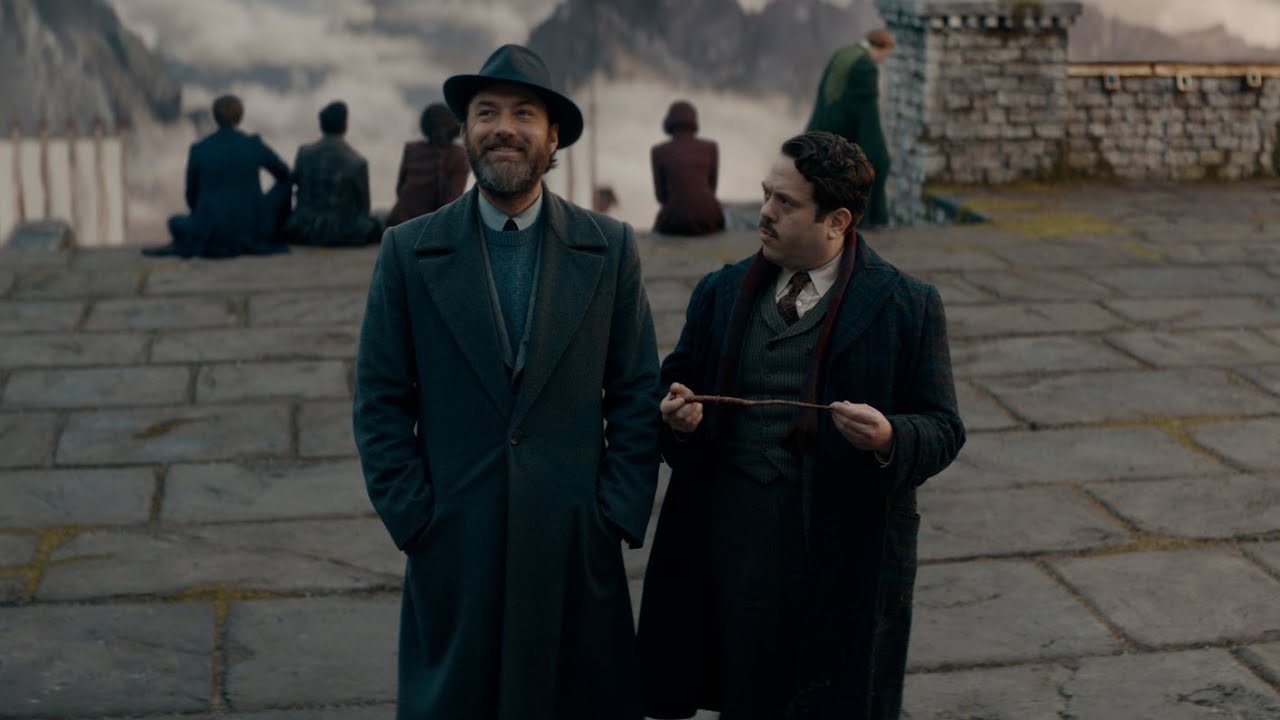
Jude Law and Dan Fogler in Fantastic Beasts: The Secrets of Dumbledore.

The third chapter of the Fantastic Beasts series, The Secrets of Dumbledore, begins with an exquisite piece of fairy-tale storytelling.  In the forests of China, Newt Scamander (Eddie Redmayne) – the English magizooogist (i.e., scholar of and caretaker for magical creatures) at the center of the narrative, set in the 1920s – oversees the birthing of a calf by a rare equine animal known as a Qilin, pronounced Chillin. The mother has a woven golden mane and a face like a mask; her tender calf is skeletal, a golden glow pulsating through his fragile skin. When the minions of the series’ villain, Gellert Grindelwald, attack, felling the mother, Newt struggles to save the baby Qilin, but he fails. He has to watch, helpless, as the calf is kidnaped and the mother expires, a single tear rolling down her cheek. It’s only then that Newt sees what everyone has missed in the chaos:  that she actually gave birth to twins.