Showing posts sorted by relevance for query Philip Kerr. Sort by date Show all posts

Wednesday, April 17, 2013

Tribute to David: Bob Douglas

David Churchill (1959-2013)

Given the sad passing of our friend and colleague David Churchill, we've decided to honour him in a manner totally fitting to our memory of him. Since he was such a strong advocate of Critics at Large from the beginning, he was quick to initiate ideas. One thing he was quite fond of were omnibus projects like the Remembering 9/11 collection (which led to our first e-book) and the Titanic 100th Anniversary commemoration. Therefore, we felt strongly that we could best salute our late columnist by creating an Omnibus of David. From April 16 until April 24, we plan to publish – daily – the best of David Churchill as chosen by our writers.

Today's piece is from Bob Douglas.
The Editors at Critics at Large.

I met David Churchill when we both played Sunday softball games about thirty years ago. He was reviewing films with Kevin Courrier at CJRT-FM, and because the radio team needed more players, I was invited to participate. Even then his enthusiasm made him a powerful presence. After the team disbanded about five years later, I had no contact with David until 2011 when I contacted him shortly before my first volume was to be published. He had self-published his novel, The Empire of Death, and I was interested in the ways he promoted it. He was most generous with his time and support for my book. After it was published, he conducted an interview with me that was posted in Critics at Large. When I posted my initial piece in January 2013, he was the first person to welcome me aboard with a wonderful email. Unfortunately, it was about that time that he became ill and we had little future contact. Had David lived, I am certain we would have had many lively exchanges and some disagreements. With his passing what I will most remember and treasure was his generous spirit.

When Kevin invited the writers at Critics at Large to choose one of David’s pieces and to write an introduction, I read back over his pieces and was impressed by the wide range of his interests – film, television, theatre, politics and books – and the infectious brio that infused what he liked and the mocking disdain for what he abhorred. Since we both shared a passion for the Bernie Gunther novels of Philip Kerr, I decided to choose one of these reviews.

David Churchill took great delight in writing about the Bernie Gunther novels of Philip Kerr. He wrote three reviews of this series for Critics at Large. Although we did not always agree – he was far more critical of Prague Fatale – you always knew where David stood and his reasons for taking that critical stance. What David understood most about Kerr’s novels was that plot was always secondary to atmospherics and character. David keenly appreciated the research that Kerr undertook whether the novel focused on Nazi Germany or Batista’s Cuba. Although we learn about the texture and mood of the eras that Kerr is writing about, perhaps even more important is the character of Bernie Gunther himself. Gunther possesses an idiosyncratic moral code reflective of the times, where one does not hesitate to lie, cheat and murder in order to survive. David seemed to savour Gunther’s world-weary cynicism, his way with alluring women and the basic noir elements of Kerr’s novels. As a tribute to David, I am reposting his review of Field Grey.

Bob Douglas is a teacher and author. His second volume to That Line of Darkness: The Shadow of Dracula and the Great War (Encompass Editions, 2011), titled That Line of Darkness: Vol. II The Gothic from Lenin to bin Laden, is available now. For more information, please visit www.thatlineofdarkness.com.

Sunday, May 27, 2018

Seeking Redemption in Philip Kerr's Greeks Bearing Gifts

The late Philip Kerr, author of the Bernie Gunther series, including Greeks Bearing Gifts. (Photo: Phil Wilkinson)

"We live in a new era of international amnesia. Who we were and what we did? None of that matters now that we're on the side of truth, justice, and the American way of life." 
 Philip Kerr, Greeks Bearing Gifts
The sardonic voice above is that of Bernie Gunther, the protagonist of Greeks Bearing Gifts (Putnam/Wood, 2018) the thirteenth entry of the wisecracking one-time Berlin detective and later private investigator by the late Philip Kerr, who recently died of cancer at the age of sixty-two. Kerr first introduced us to the cynical Gunther in his Berlin Noir trilogy: March Violets (1989),The Pale Criminal (1990) and A German Requiem (1991), set respectively in 1936, 1938 (just before Kristallnacht) and 1947, in which he first explored the legacy of Nazism. From the beginning, Kerr was strongly influenced by the American hard-boiled novelists, Raymond Chandler and Dashiell Hammett. His razor-sharp dialogue, astringent character profiles and first-person narratives have been distinctive trademarks of the series.

Kerr turned to other fiction for fifteen years before returning with The One from the Other (2006), in which Gunther poses as a Nazi war criminal as he pursues former powerful Nazis to South America. In Field Gray (2010), Gunther is commandeered to join the SD, the intelligence arm of the SS, and serve on the Eastern Front, where he is horrified by the war's atrocities and captured by the Soviets and, as a POW, toils in an uranium mine where most of the captives do not survive. Yet Gunther prevails, returns to Berlin, and is dragooned into solving a crime for the ideological zealot Reinhard Heydrich, who holds a particular fascination for Kerr: this talented and exceedingly ruthless Nazi potentate first appeared in Pale Criminal, later re-surfacing in Prague Fatale (2011) and last year's Prussian Blue. In the latter novel, Gunther repressed his scruples to also serve the loathsome Mafia-like strongman, Martin Bormann.

Sunday, June 11, 2017

Novels about the Third Reich, Part I: Philip Kerr’s Prussian Blue

Novelist Philip Kerr. (Photo: Alberto Estevez)

A new release of a Philip Kerr novel is always a welcome addition to an oeuvre of more than thirty books, including his highly received Bernie Gunther novels. From the 1989 publication of March Violets to Prussian Blue (Marian Wood Books/Bantam, 2017), Kerr has now churned out twelve novels about the acerbic-tongued German detective who has led a checkered life in the trenches of World War One, as a homicide Berlin cop working for Kripo (the criminal division of the German police), as a private detective, as a reluctant member of the SS during World War II, as a Soviet POW, and as a fugitive living under aliases in places such as Argentina and France. Throughout, Kerr’s historical research is impeccable, enabling him to convey vividly the atmospherics of the times and delineate adroitly the historical actors. Because his focus is on character and hard-boiled Chandlerian dialogue – the cynical wise-cracking Gunther rarely abstains from verbal jousts with often powerful personalities – Kerr astutely avoids providing unnecessary expository information unless it is revealed through the characters and is vital to our understanding of the period.

Thursday, March 22, 2012

Eight is Enough for Now: Philip Kerr's Prague Fatale

Never thought I'd say this. Never thought I'd have to say this. Philip Kerr needs to take another extended break from Bernie Gunther, his series of detective novels set during the rise and fall of the Nazis in Germany. Gunther is a private detective. He's a former cop who left the force (forced out?) because he became sickened by what the Nazis were doing to his city, Berlin, his country, Germany, and its people, especially the Jews. The eighth novel in the series, Prague Fatale (Putnam, 2012), was published late last fall in the UK, and will be published on April 17th in Canada (I read the UK edition which I got from overseas). It is, I'm sad to say, the only failure in this series of books.

Wednesday, October 30, 2019

An Appreciation of Philip Kerr's Final Novel Metropolis

Metropolis by Otto DIx (1927-1928).

When the Scottish-born author, Philip Kerr, died of cancer last year at the age of 62, he left behind the manuscript of Metropolis which turned out to be the 14th novel in the Bernie Gunther series. Although he wrote several standalone novels and a children's fantasy series, he will probably best be remembered for the hard-boiled, iconoclastic Berlin detective turned private investigator.

The Weimar Republic, specifically 1928 Berlin, is the locale of Metropolis. The novel is a prequel to the series that began thirty years ago with the publication of March Violets set in 1936 Nazi Germany at the time of the Olympics. Interestingly, that time-span roughly matches the aging of the novels' cynical protagonist since Kerr's penultimate novel, Greeks Bearing Gifts takes place in 1957.

Wednesday, November 10, 2010

A Well Not Dry: Philip Kerr's Field Grey

If this were (and I'm not saying it is) the last book in Philip Kerr's Bernie Gunther books, I would still be a very satisfied reader. It's not that Field Grey is the best of the now-seven novels, but there's a mournful, elegiac quality to this book that suggests a fascinating road perhaps leading to an end. The majority of the book is set in Germany in 1954 as Gunther tells stories to interrogators. This one begins shortly after the close of the last novel, If The Dead Rise Not (2009 – reviewed by me here). Gunther is not-so reluctantly coerced into helping a pretty, young female Castro rebel escape from Cuba to Haiti (Gunther, in the best noir tradition, has always been a sucker for a pretty face). During the journey across the Caribbean, Bernie's boat is captured by the American Coast Guard. Through slightly contrived circumstances, Bernie is identified, arrested and imprisoned first in New York, then Germany. He is suspected of war crimes.

Gunther has always been a fascinating character. A detective before and during the Nazi years in Berlin, he is no Nazi (he despises them – well, actually, Bernie hates pretty much everybody: Americans, British, Russians/Communists and the French, particularly the French), but he is a survivalist, so he didn't always stand up to Nazis. The times he didn't step up, he would have certainly been killed if he had. Sometimes he witnessed and even participated in some pretty bad things, but his moral code of trying to do the right thing as much as possible repeatedly saved both his skin and his soul. Bernie did some of the things he is accused of (shooting unarmed partisans in Eastern Europe during the war), but only after they had slaughtered many innocents themselves.

Sunday, June 29, 2014

When Faith Becomes Dangerous: Philip Kerr’s Prayer

Over two years ago, Lawrence Krauss posted an article in The Guardian about the vehement animosity expressed toward individuals who were not believers. A 16-year-old atheist from Rhode Island had to take time off from school after being threatened and targeted by an online hate campaign for requesting that a Christian banner be removed from her school. She is even described on the radio by a state representative as an "evil little thing." Krauss also alludes to a study that suggested that atheists were among the most distrusted groups in society on par with rapists. The article goes on to suggest that science itself has become suspect among believers. The most chilling implication of this piece is the length that believers will go to disparage and demonize unbelievers, including scientists. It convinced me that Philip Kerr’s Prayer (Putnam, 2014), his latest standalone novel, has an unnerving basis in reality. Kerr, who is probably most well-known for his historical crime novels featuring the sardonic German detective, Bernie Gunther, has now turned his attention to the role of faith in modern society and to its dark underbelly. Faith in God – or not – initially appears to be the underlying theme throughout Prayer.

Thursday, April 15, 2010

Books: Philip Kerr's Berlin Noir

Many years ago, when I was trying to come up with a good idea for a novel, I hit upon the notion of setting a murder mystery in Nazi Germany before or during the war - I don't quite remember which. I thought of having the hero work as a private detective in Berlin. I mentioned this idea to a friend of mine who said, "Oh, you mean like Omar Sharif in Night of the Generals?"

Yeah, uh, just like that. I dropped the idea, but Philip Kerr didn't. He went on to write an acclaimed series of novels about Bernie Gunther, a former Berlin cop who worked as a private investigator in Nazi Germany. The novels, now numbering six that go under the broader title of Berlin Noir, are set before or after the war, but not during. Now, I have no illusions that if I'd stuck with the idea that I'd ever come up with anything nearly as fantastic as Kerr has. His six books do many things well. First, they are well-structured murder/political mysteries, they’re exceptional character pieces, and third (and probably most importantly), his series of books has given me a far greater understanding of everyday life in Nazi Germany than most histories I've read. None of the books shy away from the rampant anti-Semitism of the time. In fact, in the early books, Gunther's clients are frequently Jewish asking him to look into the disappearance of a loved one. A Quiet Flame, the fifth book, even raises many disquieting questions regarding Argentina's anti-Jewish policies after the war.

Friday, May 17, 2013

Soul Survivor: Philip Kerr’s A Man Without Breath

Somebody has to give a damn, otherwise we are no better than the criminals themselves.
– Bernie Gunter speaking in The Pale Criminal

Scottish writer Philip Kerr’s ninth Bernie Gunther novel, A Man Without Breath (G. P. Putnam’s Sons, 2013), has all the familiar trademarks of its predecessors: impeccable research and textured detail, an ability to weave history with a mystery, and to some extent, the unabashed sass and defiance of authority by the chief protagonist, the onetime homicide detective in Weimar Berlin. In The Pale Criminal (1990), Gunter displays that barbed wit when mocking Hitler’s Mein Kampf: “That funny old book they gave free to all newlyweds? It’s the best reason to stay single I can think of.” That hard-boiled sarcasm is one of Gunter’s weapons as an anti-Nazi German who never abandoned his belief in the democratic values of the Weimar Republic. He valiantly struggled to retain some semblance of his own humanity amid the inhumanity and immortality of National Socialist Germany, the Eastern Front during the Second World War, and postwar Vienna, Argentina, Cuba and Germany.

Saturday, May 23, 2015

Heroes and Villains: Philip Kerr's The Lady From Zagreb, Donna Leon's Falling in Love and Steve Burrows' A Siege of Bitterns

Philip Kerr’s The Lady from Zagreb (Putnam) opens on the French Riviera, in 1956. But that’s just prologue; the story proper begins in the summer of 1942, in Berlin. Bernie Gunther, a captain in the SD (the Nazi security service, or Sicherheitdienst) has been assigned to the Berlin police, investigating homicides and other serious crimes. But Bernie, despite his barely veiled cynicism and smart mouth, has shown a useful talent for delicate inquiries and judicious solutions on behalf of his Nazi masters. Indeed, he has just returned from Prague, where he solved a murder at the villa of the late SS-Obergruppenführer Reinhard Heydrich, head of the German security services, even as an assassination plot unfolded against Heydrich.

Back in Berlin, Bernie finds himself under the direct command of Minister of Propaganda Joseph Goebbels, also head of Germany’s gigantic UFA film studios, who has a personal assignment for him: track down the missing father of Croatian-German actress Dalia Dresner (Goebbels, a notorious womanizer, calls her “Germany’s Garbo”), neé Sofia Branković. Bernie falls hard for the beautiful Dalia, who returns his feelings, and sets off into the chaos of wartime Yugoslavia to find her missing parent. The passages set in war-torn Croatia are bone-chilling, not just because of the German SS troops, who routinely shoot first and ask questions later, but more especially because of the ultra-nationalist UstaÅ¡e militia, allies of the Nazis but unpredictably and prodigiously vicious. It is among these barely sane irregulars that Bernie finds Dalia’s father, once a priest, now a militia leader known as Colonel Dragan, famous for the speed with which he can slash Serbian necks. Goebbels and Bernie agree to lie to Dalia, telling the screen star that her father is dead.

Sunday, October 18, 2015

A Female Spy at the Heart of the Third Reich

Author Jane Thynne.

This review contains some spoilers for Jane Thynne's A Winter Garden and The Scent of Secrets.
 
Over a month ago at the Berlin airport, I picked up a copy of the novel, A Winter Garden (Simon & Schuster, 2014) by Jane Thynne, an author with whom I was not familiar. I was most interested in finding out whether she had anything new to say about the deeply-lined runes of the Third Reich. Apart from a few academic studies that Thynne acknowledges, I do not recall any novelist that explores as she does the intensity of Nazi misogyny and contempt for women. When I finished it, I ordered the next book in the series, The Scent of Secrets (Doubleday Canada, 2015). In the UK, the same novel is published with the title, A War of Flowers. Unfortunately, the cover of The Scent of Secrets is almost identical to that of A Winter Garden. On the plus side, either Thynne or her publishers made the astute decision to hook the reader by publishing the prelude and chapter of the subsequent entry in the last few pages of the book. She succeeded with me.

Thursday, December 30, 2010

Some of the Best: Favourites of 2010


Unlike other critics, I've always kind of enjoyed compiling a list of favourites from the previous years. It gives me a chance to look back on the year and examine what I've read, seen or listened to. Some of what follows was not necessarily part of 2010, but I only got around to it this past year. In fact, one example is over 70 years old. A few I've written about on the blog in 2010, but not all. So, sit back, relax and, hopefully, enjoy.

Monday, December 13, 2010

Dan Brown's The Lost Symbol and the Current State of the Thriller

As a genre, whether in books or films, the thriller is in a terrible state. And no, it's not all Dan Brown's fault. Over the last 20 years, the thriller has devolved to the point where it is often just this side of science fiction. I love good science fiction, so this is certainly no diss of that genre, but when thriller writers and filmmakers feel compelled to produce more and more outlandish plots just to get attention, you know something is wrong in the state of Denmark (and yes, I would consider Hamlet a thriller, one of inaction perhaps, but still a thriller).

Herewith are some of the basic plots of a few thrillers in the last 30 years: a group of former Nazis clone Hitler (Ira Levin's The Boys From Brazil – 1976); a group of scientists raise the Titanic to obtain a rare mineral that the US government can then use to create a sound wave to knock down Soviet missiles (Clive Cussler's Raise the Titanic – 1976); Hitler's right-hand-man Rudolph Hess has survived the war and is now a super villain in South Africa attempting to launch a nuclear device at Israel (Greg Iles' Spandau Phoenix – 1993); a virulent form of the Ebola virus is stolen by an evil group planning to let it free on the world (Ken Follett's White Out – 2004); a plan to destroy the Vatican with antimatter is hatched by a madman who also wants to be Pope – and, oh yes, the novel's hero jumps out of a helicopter using a tarp as a parachute! (Brown's Angels and Demons – 2000); a group of people over centuries try to hide the fact Jesus married and fathered children after his crucifixion – the Catholic Church does everything in its power to eliminate those who know (Brown's The Da Vinci Code – 2003); a madman tries to show that a plan to keep The Word from the whole world is the result of a conspiracy by the Masons – many of whom are at the top of the US government (Brown's The Last Symbol – 2009, just released in paperback in October 2010). 

I could go on, but my point is that even though many of these books are pretty terrible and generally poorly written (and yes, I admit over the years I've read all of these), it just doesn't seem to matter. All of these writers (except Levin, who died in 2007) continue to write and frequently make it onto the bestseller lists around the world. And one, Dan Brown, as we all know, became a phenom because of The Da Vinci Code. I know I'm not going to convince anybody that this genre is bereft when the plots have become this idiotic because these books continue to sell and sell and sell. (Want proof? Look at the New York Times Review of Books Fiction Bestseller List for Sunday, December 12, 2010 – nine of the fifteen listed are thrillers.)

Friday, April 29, 2011

White Face, Black Shirt/White Socks, Black Shoes: Sex & Drugs & Rock & Roll (2010)

I was not a child of Woodstock; I was too young. Sure, I loved the music of The Beatles, The Byrds and The Who, and many others, but it didn't define me. Instead, the music of my formative years was the music from 1976 to 1984 that is known as New Wave – particularly from Britain and Ireland. New Wave encompassed a vast array of musical styles, including rock, post-punk, ska, reggae, jazz, music hall and others. Bands like Elvis Costello and the Attractions, The Clash, Nick Lowe, Joe Jackson, Dave Edmunds, Ultravox (pre-Midge Ure), Joy Division, The Cure, Wreckless Eric, The Specials, Madness, English Beat, The Stranglers, The Boomtown Rats, Graham Parker and the Rumour, and Ian Dury and the Blockheads, were some of the ones that captured my ears. The music of these bands was a response to the blotted excesses of the just-passed prog rock (think Emerson, Lake and Palmer; or Rick Wakeman), but it was also an answer to the thrash and bash of punk, personified in bands like the Sex Pistols and The Damned (The Clash were punks at first too, but quickly abandoned the style). Instead of bashing away and ranting at the world, à la the punks, the New Wave artists wrote short, punchy pop, rock or ska songs played with a modicum of skill. They were equally angry (Costello's “(I Don't Want to Go to) Chelsea” and The Clash's “London Calling” were signature songs of the movement), but the melody and musical skills were far more appealing to me than the scream of punk. Many of the performers I'd admired got their start on a rebellious label Stiff Records, whose motto was “If It Ain't Stiff, It Ain't Worth a Fuck.” And of these bands, the one I held closest to my heart was Ian Dury and the Blockheads. Songs like “Sex & Drugs & Rock & Roll,” “Hit Me With Your Rhythm Stick,” “Sweet Gene Vincent” and “Wake Up and Make Love With Me” still play 'in heavy rotation' in my listening universe.

Sunday, December 24, 2017

A Year of Reading: My Favourite Books of 2017

Ta-Nehisi Coates, author of We Were Eight Years in Power. (Photo: Gabriella Demczuk)

With the exception of A God in Ruins, all of the books discussed below were published in 2017. I did not realize until I assembled this list that every entry consists of either at least two historical timelines or the bleeding of the past into the present either through investigative reportage or by way of past memories surfacing into the present consciousness of characters Bob Douglas

Amor Towles’s A Gentleman in Moscow is the most outstanding book I read this year, original and beautifully written, spiced with a soupçon of Tolstoyan flavour. A Russian Count juxtaposes his early life in Czarist Russia with his current life; he was sentenced in 1922 to permanent house arrest at the Metropol Hotel. Through his impeccable manners and urbanity, he skillfully negotiates alliances that will result over thirty years later in a courageous attempt to dramatically alter the life of a young woman who has become his de facto daughter. A book to be savored and reread.


Kate Atkinson’s A God in Ruins is a most satisfying novel, punctuated with drama, poignancy and humour. Superior to its predecessor, Life After Life, which played too promiscuously with the concept of time, allowing its protagonist, Ursula Todd, to constantly relive her life, A God in Ruins focuses on a single life, that of Ursula’s younger brother, Teddy, narrated in out-of-order chapters. Teddy never fulfills the promise that he briefly showed as a minor character in the earlier novel, apart from one major exception. He excels as a skipper for a crew of bomber pilots during World War Two, and these chapters, which have been impeccably researched, are among the most powerful in the novel. His civilian life afterwards never reaches that level of intensity in part because no one wants to hear him talk about the war and partly because of circumstances. His less-than-satisfying marriage is tragically cut short and he is left with a ghastly daughter, Viola, who turns out to be a ghastly mother. Late in the novel we are given a major clue to Teddy’s fraught relationship with Viola. By the time we finish reading, we realize that Atkinson has pieced together a beautifully rendered mosaic that is deeply moving.

Sunday, June 25, 2017

Novels about the Third Reich, Part II: Jessica Shattuck’s Women in the Castle

Author Jessica Shattuck. (Photo: Grace Kwon)


Two pivotal scenes, spanning over sixty years, remain in the mind long after reading Jessica Shattuck’s character-driven, historically informed (with excellent sources acknowledged at the back), and moving Women in the Castle (William Morrow/Harper Collins, 2017). The first occurs in the prologue set in 1938 Germany, on the cusp of Kristallnacht, in a Bavarian castle during the von Lingenfels’ annual family party. Although some of the guests sport Nazi insignias, a number of others are assembled in the study of the host, Albrecht, plotting active resistance to Hitler’s zealotry – fearing that if things go wrong, their families will suffer. His wife, Marianne, interrupts and, fully cognizant of Hitler’s madness and thuggery, challenges them to take action. When her charismatic childhood friend, Connie Fledermann, appoints her the “commander of wives and children,” she accepts.

Monday, May 10, 2021

Detective Story: C.B. Strike

Holliday Grainger and Tom Burke in C.B. Strike.

I fell for J.K. Rowling’s Cormoran Strike detective novels at the beginning of the series, The Cuckoo’s Calling, which she published in 2013. (She uses a nom de plume for these books, Robert Galbraith, but the beans were spilled after the first one was published.) As fans of the Harry Potter books might have expected, they’re intricately plotted, with wide-ranging, sharply drawn characters, and you wrap yourself up in them; once I start one I have to stave off the impulse to do absolutely nothing else until it’s done but turn the pages. She’s written five; the latest, Troubled Blood, came out last September. Her heroes, Strike and Robin Ellacott, run a successful London detective agency, though she starts, in The Cuckoo’s Calling, as a temp who gets a gig at Strike’s ragtaggle business. In the course of solving the crime, the killing of a famous model that the cops have dismissed as a suicide, both Strike and Robin herself discover her gift for investigation; and by the end of the novel he’s agreed to make her his partner. 

Monday, March 14, 2022

New from Criterion: Love Affair (1939)

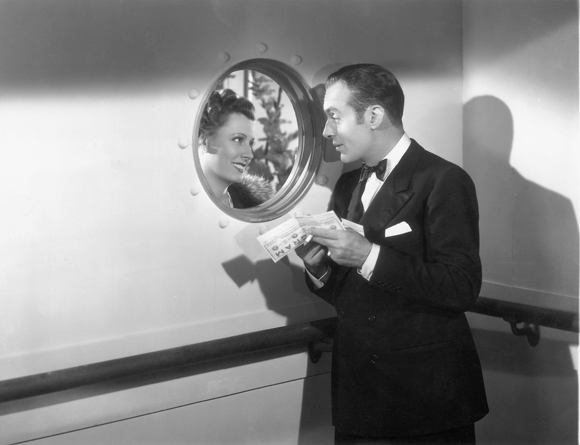
Irene Dunne and Charles Boyer's shipboard first meeting in Love Affair (1939).

The filmmaker Leo McCarey has been largely forgotten, but his Hollywood career spanned four decades and bridged the silent and talkie eras. Like Frank Capra, he received his training in silent comedy: he directed more than seventy-five shorts, and he was responsible for the collaboration of Stan Laurel and Oliver Hardy. When movies began to speak, he put his expertise at working fast and off the cuff to great effect – he directed the most brilliant of the Marx Brothers’ early Dadaist masterpieces, Duck Soup (1933), as well as helming pictures that starred W.C. Fields, Mae West and Eddie Cantor. His thirties output included two memorable comedies, Ruggles of Red Gap (with Charles Laughton as an English butler in the Wild West) and The Awful Truth, where Cary Grant strives to win back his ex-wife,  played by Irene Dunne. It also includes the romantic melodrama Love Affair, starring Dunne and Charles Boyer, which Criterion has just put out in a glistening print restored from sources in the Museum of Modern Art collection.