Showing posts sorted by relevance for query Steven Spielberg. Sort by date Show all posts

Wednesday, October 5, 2011

The Rodney Dangerfield of Film Directors: Why Can’t Steven Spielberg Get Any Respect?


Why doesn’t filmmaker Steven Spielberg get the acclaim he deserves? Arguably, he’s the best known director in Hollywood, one whom the average, casual film-goer can identify by name and face. And while he’s doesn't yet have a word in the English language that encapsulates his work (like Hitchcockian, denoting a certain type of horror/suspense movie; or Felliniesque, describing a specific hyper-realistic style of film), Spielberg has, perhaps, influenced more directors than anyone else in the history of the movies, including as a producer of  Spielberg-like movies such as Cowboys & Aliens and Real Steel. From Robert Zemeckis (Back to the Future) to Joe Dante (Gremlins), James Cameron (Avatar) to JJ Abrams (Super 8), there is no shortage of filmmakers whose style, content and tone have been borrowed, to one degree or another, from Spielberg’s oeuvre and not always in a good way. James Cameron’s movies, by comparison, lack the appealing warmth of Spielberg’s best work, while Super 8, which Spielberg produced, played out more like an ersatz Spielberg flick, a pale copy of E.T.: The Extraterrestrial and Close Encounters of the Third Kind without any original personality of its own. (Not coincidentally, I think, he also produced most of Zemeckis's and Dante's films including such standouts as Used Cars and Gremlins 2.)

Yet even when Spielberg departs from his familiar fantasy films to tackle decidedly realistic endeavours (Schindler’s List, Saving Private Ryan, Munich ), there are those who carp about the supposed softness of the material, or decry its sentimentality. While admittedly some sentimentality does indeed run through his work, he's rarely given any credit for the sheer talent on display, or for the sheer brilliance with which he animates his movies. This is something I will be examining in my forthcoming course, The Paradox of Steven Spielberg, at the LIFE Institute – Ryerson University. The simple truth is that, like the late comedian Rodney Dangerfield, he can’t get any respect.

Wednesday, December 28, 2011

Steven Spielberg’s The Adventures of Tintin and War Horse: The Artist/Entertainer at his Peak


With The Adventures of Tintin and War Horse, both released this holiday season, the two creative (but not mutually exclusive) sides of director Steven Spielberg, the entertainer and artist, are on display on our movie screens. And though the films differ in quality, they’re both accomplishments that showcase him, once again, as one of the finest filmmaking talents in the world, if you weren't already aware of that fact. Many people aren't.

The two movies also share one thing in common, they’re both European stories that, as a positive sign of Hollywood’s recognition that foreigners make up a huge share of the overall box office, have not been Americanized in the slightest. Of course, being big budget, special effects extravaganzas, as only Hollywood could really afford to make, they are still in English. That’s the other economic reality. Hollywood still won’t take chances on subtitles fearing turning local audiences off of their movies.

I actually grew up with the adventures of Tintin, the young intrepid Belgian reporter, created by the Belgian artist Hergé (Georges Remi), over 23 comic books, as my grandparents (who moved there from Poland) and my mother, who was born there, were from that country. When I was young, reading them in their original French, my memories of the strip were that they contained exciting, exotic adventures, were populated by eccentric/amusing characters and were drawn with a simple but effective style. That last might seem too hard to duplicate on screen but Spielberg, utilizing performance capture animation, pulls it off flawlessly.

Performance capture animation requires photographing actors, particularly their facial and physical expressions, and then grafting them as animated figures on the screen making them look like actors playing the roles. (Motion capture is the process of photographing the whole person. The use of it for film is performance capture.) Robert Zemeckis’ The Polar Express (2004) was one such movie but it was a rather impersonal, cold project. The Adventures of Tintin is a warmer, personality driven effort and much more pleasing and entertaining as cinema. It’s a refreshingly different looking movie, too, an animated flick that looks like it’s been bred with a live action movie, adding up to something unique on screen. 

Saturday, June 11, 2011

Train Wreck: J.J. Abrams' Super 8

In Super 8, this summer's highly anticipated SF thriller, writer/director J.J. Abrams and producer Steven Spielberg create a cluttered junkyard of a movie. While many of the unabashedly positive reviews suggest a work that's both thrilling and full of feeling, Super 8 is actually quite the opposite. Abrams and Spielberg have filled the picture with so many conflicting invocations of previous movies, from Close Encounters of the Third Kind to Stand By Me, that it has no voice of its own. Super 8 is an inchoate hall of mirrors that casts reflections of popular film tropes rather than a coherently exciting story.

Initially they do seize on a compelling dramatic idea. In the fictional town of Lillian, Ohio, in the late seventies, a group of young friends gather to make a Super 8 zombie movie. Living in their small industrial town, the only cultural feeding ground for these kids is the playground of pop music, television and horror films. There is a shaggy dog thrill they get from testing their loyalties and smarts (not to mention, their raging hormones) by acting them out in their low-budget monster extravaganza.(I also spent my teenage years in the small industrial city of Oshawa, Ontario, doing super 8 horror films with my friends.).

When they attempt to get 'production values' on the cheap by shooting a love scene one night at an abandoned train station, these budding artists get more than they bargained for when they witness and film a train derailment. They also discover that it was no ordinary train wreck. But rather than going on to explore how these eager filmmakers use their amateur craft to uncover a possible military conspiracy, Abrams takes leave for his own cultural feeding ground: Spielbergland. In creating a tribute to his film idol, Abrams ends up however denying himself an identity.

Friday, November 27, 2015

Bridge of Spies: Phony Baloney

Tom Hanks in Steven Spielberg's Bridge of Spies.

The opening sequence of Steven Spielberg’s Bridge of Spies, where, in 1957, the slippery British-born Russian spy Rudolf Abel (Mark Rylance) manages to elude the FBI for the last time before he’s caught, is both excitingly and wittily filmed. Rylance, a much-lauded stage and recently TV star (he played Thomas Cromwell in the BBC adaptation of Wolf Hall) who hasn’t been tapped by the movies until now, turns the tension between Abel’s hyperawareness and his calm, almost languid air into a sort of music-hall routine with a whiff of melancholy. But as soon as Abel is sent to prison to await trial for espionage and James Donovan (Tom Hanks) is urged by his law firm to act as his defense attorney, the movie flattens out. How did Spielberg and the writers, Joel and Ethan Coen and Matt Charman, manage to turn the fascinating, twisty story of Abel – the Cold War spy who ended up being traded to the Soviets for both the captured pilot Francis Gary Powers (Austin Stowell) and Frederic Pryor (Will Rogers), an American economics student in Berlin arrested for suspicion of espionage – into a civics lesson? Somehow, instead of releasing the storytelling master in Spielberg – the director who could make the three-hour Munich so gripping – Bridge of Spies brings out his earnest, big-studio-era, socio-sentimental side. Janusz Kaminski’s period cinematography is gorgeous and vivifying, but the movie behind it is as glazed as Always, his 1989 remake of A Guy Named Joe, with Richard Dreyfuss in the Spencer Tracy part. And this time around he’s got Tom Hanks, who plays Jim Donovan as if he were Tracy.

Friday, November 16, 2012

History as Soporific: Steven Spielberg's Lincoln

Daniel Day-Lewis stars in Lincoln

Steven Spielberg's new Lincoln movie isn't going to help any teachers convince their students that American history is actually exciting or interesting. In fact, the movie is so stupefyingly dull that it will remind you  if you've been unlucky enough to have lousy history teachers (I had a few good ones, fortunately, which is one reason I like history)  of those tiresome hours whiled away in the classroom just waiting for the bell to ring, and thus end your misery, while the teacher droned on. Luckily, with Lincoln, you have the option of leaving the cinema anytime you want to and without getting into trouble for vacating the premises. I suspect many audience members will feel like doing just that.

Instead of trying to capture the sprawling and tumultuous life of one of America's greatest Presidents, Spielberg and screenwriter Tony Kushner, utilizing a relatively small part of Doris Kearn Goodwin's book Team of Rivals, concentrate on the last few months of Lincoln's life, in early 1865, when the just re-elected Commander-in-Chief (Daniel Day-Lewis) sets out to ensure that the Thirteenth Amendment, abolishing slavery, will finally pass, a daunting task as a significant number of Democrats would have to be convinced to jump aboard the anti-slavery bandwagon. The film's focus is on his mission, as he and various minions cajole, threaten, beg and even bribe their opponents to switch sides and do what is morally right.

Granted, it can be rather difficult to capture the to and fro of political deal making, which can be dry material and make it seem interesting and compelling, though TV's The West Wing did do it on a weekly basis. And at least Lincoln isn't as tedious as Ken Loach's turgid 1995 film Land and Freedom, which was overly invested in the dull minutiae of communist political debates and wrangling. Nevertheless, Spielberg's would-be opus is still a remarkably static affair, certainly for him, and a film that, ultimately, undermines and lessens the gripping nature and lasting impact of Lincoln's stupendous feat.

Friday, March 2, 2012

Toronto’s production of War Horse: Much Spectacle But Not Much Heart

Alex Furber and 'Joey' in Toronto's production of War Horse (Photo by Brinkhoff/Mögenburg)

Toronto is a theatre town that's used to hoopla, but the first Canadian production of War Horse to hit the city has pulled out all the stops. Opening night, reportedly attended by Canada’s Governor General, was glitzy and glamourous and certainly the cavernous 2000-seat Princess of Wales Theatre was a perfect venue for this larger-than-life production. And though much of it was impressive and even occasionally awe-inspiring, I’m not sure that the spectacle didn’t overwhelm the human core of the play.

Friday, May 8, 2015

A Parting Glance of War: HBO’s Band of Brothers


Today marks the seventieth anniversary of V-E Day, the official surrender of the German government that brought the Second World War to a close in Europe. Such a round number of decades, bursting rather rudely into the centennial memorial of the Great War, reminds us yet again of the inextricable links that bound the two conflicts together. In their causes, personalities, strategies, and consequences, the world wars were two shoes that dropped from the same nationalistic European corpus. And they landed on the globe with catastrophic impact. Walt Whitman famously said of the American Civil War that the real war would never make it into the books. That declaration would apply even more fittingly for World War II. Over 60 million human beings died in the conflict, one person every three seconds for six years. The proportions of the war’s scope, chaos, brutality, and moral stakes seem to exceed all categories of meaningful expression.

Still, dozens of movies have taken the war as their subject, many made right in the midst of the conflagration. HBO’s miniseries Band of Brothers aired almost fourteen years ago now, and the decade and a half since has solidified its standing as one of the finest World War II films around. Steven Spielberg and Tom Hanks produced the show, deciding to adapt historian Steven E. Ambrose’s book of the same title after the critical and commercial success of their movie Saving Private Ryan in 1998. Ryan and Ambrose lay at the center of the nostalgic wave for the war that swept the nation in the Nineties, as the country reckoned with the rapid disappearance of the generation that served at home and abroad. Ambrose placed an emphasis on oral histories in his methodology, underscoring the experience of the common soldiers, sailors, and airmen in his writing. In Band of Brothers, he follows a small group of infantrymen, E Company of the 506th Regiment of the 101st Airborne Division, from their training at the war’s outset through their fighting in Europe until the war’s close.

Monday, November 28, 2022

Portrait of the Artist, Part I: The Fabelmans

Paul Dano, Mateo Zoryan and Michelle Williams in The Fabelmans.

The fallback of filmmakers who dramatize some version of their coming-of-age stories is to sentimentalize them. What goes wrong with Steven Spielberg’s The Fabelmans, which he co-authored with his favorite writing partner, Tony Kushner, is more complicated. The story Spielberg wants to tell is a saga. It focuses on the breakdown of the family of his alter ego, Sammy Fabelman (Gabriel LaBelle), when his brilliant engineer father Bert (Paul Dano) relocates them from Phoenix to northern California to take a better job offer and his marriage to Mitzi (Michelle Williams) disintegrates. It also includes Sammy’s encounter with anti-Semitic jocks at his new high school. The movie goes on for two and a half hours, far longer than a movie of this kind warrants, and it feels more attenuated as it unspools. I don’t think that anyone but Spielberg could get away with this kind of self-indulgence: a growing-up story and family drama that’s also a grandiose Hollywood period piece.

Tuesday, September 15, 2020

Barwood and Robbins

Mark Hamill in Corvette Summer (1978).

When TCM ran Corvette Summer not long ago, I decided to take another look at it. The last time I’d seen it was in a movie theatre in 1978 and I’d been surprised and delighted by it. It starred Mark Hamill – it was his first movie after the car accident that disfigured him during the shooting of Star Wars – as a graduating high-school senior from the suburbs of L.A. with a gift for auto mechanics (the auto shop teacher, played by Eugene Roche, is his hero) who is obsessed with a ’73 Corvette Stingray that he and his class rescued from a junkpile and reconstructed into a spangly, candy-apple, eye-popping gem. When it’s stolen and he learns that it’s been spotted in Las Vegas, he goes in search of it. The irresistible, uncategorizable Annie Potts – a wild card like Betty Hutton in her Preston Sturges comedies – plays the novice prostitute he meets when he arrives; eventually she overcomes his nervousness and gets him into bed, and then they become a couple. The movie turned out to be as much fun as I’d remembered, as great to look at, and as unusual in tone and texture. It was the first picture Matthew Robbins directed, and he inspired the usually lackluster cinematographer, Frank Stanley, to give it a rainbow palette and a neon glow. Corvette Summer is a road movie, a teen comedy and a coming-of-age movie, but it’s highly unconventional as an entry in all three of those genres. Yes, there’s a romance between Hamill’s Kenneth Dantley and Potts’s Vanessa (and a very satisfying one), but the real love story is between Kenneth and the Stingray. The story takes twists you don’t see coming, and not all of them work; neither do all the tonal shifts. But the movie’s charm never wears off, and more than four decades later it still feels fresh.

Thursday, August 9, 2012

Remembering the Munich Massacre: One Day in September and Munich


The refusal of the International Olympic Committee (IOC) to commemorate the 40th anniversary of the murder of 11 Israeli athletes by Palestinian terrorists with a moment of silence at the Opening Ceremonies of the 2012 Games, is, of course, appalling and indefensible. Deborah Lipstadt states in a piece she wrote for Tablet magazine that the decision is motivated by anti-Semitism. I’m not sure I’d go that far, though anti-Semitism is never far from the surface in modern Europe, but certainly it’s a political decision. Ankie Spitzer, widow of fencing coach Andre Spitzer, one of the Israeli victims at Munich, indicated in the August 6 issue of Sports Illustrated, in a piece on the 40th anniversary of the massacre, that Jacques Rogge, IOC head, had told her that there were more than 40 Arab delegations at the Games. Without spelling that out, his comments clearly suggested that the requested moment of silence might embarrass them as they likely would not want to observe it. (Only Jordan’s King Hussein, among all Arab leaders, actually condemned the terror attacks when they occurred. Palestinian reaction since the Munich massacre has ranged from the attendance of members of the debut Palestinian Olympic team at a memorial to the Israelis held at the 1996 games in Atlanta to recent comments by the head of the Palestine Olympic Committee that the request for the IOC to grant a minute of silence for the murdered athletes was "racist". Make of that what you will.) Whatever the actual reasons for the IOC’s slight, it puts into perspective the two most significant films made on the Munich massacre and its aftermath, Kevin Macdonald’s powerful documentary One Day in September (1999) and Steven Spielberg’s conflicted but memorable drama Munich (2005). They do what Rogge and IOC have refused to do: remember the Israeli athletes and what happened to them at the Olympics.

Ankie Spitzer is one of the main interviewees in Macdonald’s Oscar-winning film, juxtaposed for maximum effect with the compelling interview with Jamal Al-Gashey, reputedly the only surviving Palestinian terrorist from Munich (There’s some question now whether that is indeed the case.) Al-Gashey, in hiding in Africa, is matter of fact and unrepentant about what he did, but viewers of the documentary will likely be just as aghast and angry at the German authorities, who, in effect, botched the rescue attempt of the nine remaining Israeli hostages (two were killed in the initial attack in their rooms), a disaster that Ankie Spitzer, for one, blames for her husband’s and the others’ deaths.

Sunday, March 20, 2016

Tensions between History and Film: Bridge of Spies

Mark Rylance (as Rudolf Abel) and Tom Hanks (as James Donovan) in Bridge of Spies.

Near the conclusion of Steven Spielberg’s recent film Bridge of Spies, lawyer James Donovan (Tom Hanks), on a train that takes him from East to West Berlin, looks out in horror at two individuals being shot at the recently built Wall. The scene instantly recalls John le Carré’s 1963 novel, The Spy Who Came in from the Cold, and its 1965 Martin Ritt film adaption of the same name that begins and ends with corpses raked with bullets. Moreover, both films are drenched in atmospherics: the washed-out bluish cinematography of East Berlin in Bridge is similar to the black-and-white desolation and soullessness of the earlier film. The cinematography in The Spy suits the cynicism and betrayal inherent in the plot. Similarly, the visual representation of East Berlin in Bridge compliments the cold desolation of a police state that looks more like war-devastated 1945 Berlin than 1961 West Berlin.

There, however, the similarities end. The contrast in the cinematography between East Berlin and a sunlit Brooklyn is one indication of how Spielberg offers a glossy, more upbeat, interpretation of the Cold War. It is also hard to imagine him including an American official uttering anything like what Control, the head of Circus (an amalgam of MI5 and MI6) says in The Spy to his agent Alec Leamas: “Our policies are peaceful, but our methods can’t afford to be less ruthless than those of the opposition, can they?” Or later when Leamas says to the Communist idealist, Liz Gold (played by Nam Perry in the film): “What do you think spies are? .... They're just a bunch of seedy, squalid bastards like me.” Adam Sisman in John le Carré: The Biography (Bloomsbury, 2015) reveals that the cynicism infusing le Carré’s novel – we are no better than them – reflected the unhappiness in his personal and professional life. Feeling trapped in his marriage, agent David Cornwall (before he became le Carré) was also disgusted by the number of former Nazis courted by British intelligence during the Cold War, and he had to work with them. Yet in the anger that he channelled into The Spy and subsequent novels, le Carré reveals insightful truths about the soul-destroying work of spies and raises questions about the damage that can be done to a free society by the methods that are carried out by the security services, questions that remain relevant today.

Tuesday, April 3, 2018

Enemy at the Gates: Cline & Spielberg’s Ready Player One

Tye Sheridan in Ready Player One. (Photo: Jaap Buitendijk)

When Ernest Cline’s novel Ready Player One was released in 2011 to a cavalcade of positive press, its nostalgia-fueled story (commonly compared to The Matrix and Willy Wonka and the Chocolate Factory) was understood to be harmless, enjoyable fluff, a beach read for the YA crowd and anyone who enjoyed a good pop culture reference. The book depicts a dystopian future in which everyone escape their depressing lives by retreating to the Oasis, a virtual reality simulation that spans an entire galaxy of artificial experiences. People spend their whole lives plugged in: going to school, shopping, earning currency, customizing their avatar, and engaging in video game experiences, from war simulations to racing tournaments. The creator of the Oasis, James Halliday – a pastiche of late-80s and early 90s tech and gaming gurus from Gary Gygax to Steve Jobs – reveals upon his death that he’s hidden an “easter egg” somewhere in the Oasis which holds the key to a vast fortune and total control of the whole simulation. A community of die-hard Oasis junkies who call themselves “gunters” (“egg-hunters”) dedicate their lives to deciphering the clues Halliday left behind, while a corporation called IOI is also hunting for the egg, using its vast resources to wrest control of the Oasis from the population at large. Gunters, including the novel’s protagonist, Wade Watts (aka Parzival in the Oasis), take it upon themselves to become experts on every single 1980s property that Halliday enjoyed, in the hopes that this knowledge might reveal a clue about the egg, leading to a bizarre situation in which a group of teenagers from 2044 are self-imposed scholars of obscure 1980s pop culture – memorizing dialogue from John Hughes films, obsessing over solutions to Atari 2600 games, and arguing the finer points of Rush’s oeuvre.

Thursday, December 23, 2021

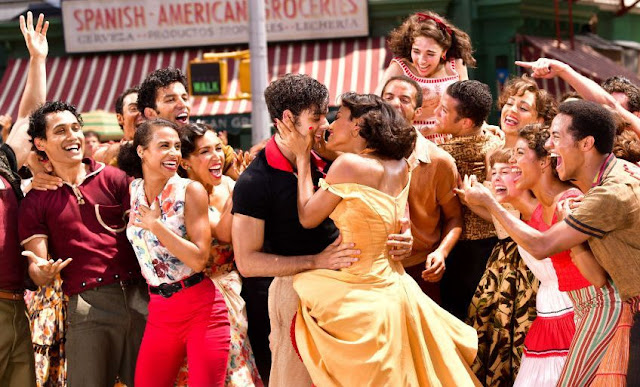
West Side Story: Rumble in the Rubble

David Alvarez Ariana DeBose in West Side Story (2021).

The enthusiasm over Steven Spielberg’s remake of West Side Story, the street-gang retelling of Romeo and Juliet that opened on Broadway in 1957 and was first filmed by Robert Wise in 1961, reminds me of the outpouring of praise that greets Rodgers and Hammerstein’s 1945 Carousel every time it generates another Broadway revival. Just imagine, runs the usual buzz, someone wrote this serious, important musical back in the dark ages when musicals were frivolous! How modern, how prescient! How daring to kill off the protagonist, to incorporate domestic abuse, to put disaffected youth on the stage! How fresh it still seems, how up-to-the-minute! Well, I see no reason to condescend to lighthearted musicals, especially when they come equipped with scores by Kern, the Gershwins, Porter, Berlin and Rodgers and Hart. But the truth is that the American musical took its first resounding step past frivolity when Kern and Oscar Hammerstein II wrote Show Boat, with its tragic racial subplot, exactly three decades before West Side Story. And that’s a good musical. 

Friday, December 9, 2011

Not Quite Magical: Martin Scorsese’s Hugo

Hugo, the film adaptation of Brian Selznick’s modern children’s classic The Invention of Hugo Cabret, is both an impressive achievement and a disappointing movie. On the one hand, it marks something of a return to form for director Martin Scorsese, who’s floundered of late with choppy films like Gangs of New York (2002) and The Departed  (2006), and superficial ones like Shutter Island (2010). Yet, while he directs the picture with supreme self-confidence, he doesn’t quite bring the right light and airy tone to the movie's subject matter.

That story owes something to the magic of early cinema, and also to the recent steampunk genre, which marries Victorian attitudes to advanced technology to create alternate worlds that are similar but not quite like our own. (It’s a pallid genre that usually leaves me cold, but in Hugo it actually possesses some frisson and verve.) It’s also a classic tale of a boy finding himself, growing up and learning that life contains both hardships and joys.

The earliest parts of the film fare the best as Scorsese, screenwriter John Logan (Rango) and cinematographer Robert Richardson (Shutter Island, Inglourious Basterds) craft a unique world, mostly set in the main train station in Paris in the early 1930s. Shot in 3D, Hugo is a live action movie with a lovely animated, fantastical look and feel. I’m still not a fan of the process, but this is one case where it nevertheless adds something to the whole.

Hugo (Asa Butterfield) is a young, sensitive boy who lives in the train station where he makes sure the giant clocks run on time, and does his level best to stay out of the clutches of the station’s police inspector, Gustav (Sacha Baron Cohen) – a disaffected war veteran who loves to catch the boys who hide out at the station and send them to (presumably nasty) orphanages. When Hugo is caught stealing by toy shop owner Papa Georges (Ben Kingsley), events are set in motion whereby he will find out who the mysterious Georges really is, meet Georges’ goddaughter Isabelle (Chloë Grace Moretz) and discover where the broken automaton brought to him by his inventor father (Jude Law) actually came from. (It was his attempt to steal parts for the robot which saw him caught by the store owner.) That journey is compelling and richly depicted, but also emotionally flat.

Thursday, December 1, 2011

On Courage and Cowardice: Criterion’s release of The Four Feathers (1939)

The Four Feathers – the classic 1939 Alexander Korda production recently released by Criterion in a spanking, spiffy new digital restoration – is an uneven, but entertaining movie; one that doesn’t entirely balance its large scale and very impressive battle sequences with its quieter, dialogue-driven scenes. More significantly, it sends out a mixed message about courage, cowardice and doing what one believes in.

Based on A.E.W. Masons’ 1902 novel, and brought to film an extraordinary seven times, this version, directed by Zoltan Korda, Alexander’s brother, is the most famous one, an adventure film cast in the spirit of Rudyard Kipling’s lauding of all things British, including its imperialistic adventures abroad. The latter is the subtext of The Four Feathers, which centres around Harry Faversham (John Clements), a sensitive young man whose family tradition  has seen all its men serve in the military. When his unit is sent to Egypt – to engage the Sudanese in an attempt to retake Khartoum, captured by Arab armies a decade earlier – he resigns his commission. That act, which he carries out because of a fervent wish to concentrate on his home life, such as his impending marriage to Ethne (June Duprez), a daughter of a general, has him labelled a coward by his three closest friends. They each send him a white feather as a sign of their disapproval of his ‘cowardice.’ (White is the colour of peace, of course, but that option doesn’t seem to exist in the gung-ho build-up to war.) But it’s the final feather, the fourth one, given to him by Ethne, albeit not without him daring her to do so, that prompts him to take drastic action to regain his honour.

Saturday, September 27, 2014

A Formula Film with a Human Face: The Criterion Collection Release of Lawrence Kasdan's The Big Chill

When Lawrence Kasdan's The Big Chill came out back in 1983, it was understandable (especially if you were a political activist in the Sixties) if you found yourself appalled at just how glib and superficial the whole treatment of the period was. In it, a group of former college radicals gather for a weekend when one of their former comrades, Alex, who has lost his way, commits suicide. As they bury him, they dredge up the good ol' days and reflect on what has happened to each of them since. This would have been perfectly compelling if The Big Chill had believably suggested that any one of these people were ever once radical, let alone political activists. The level of ease they reach together in that South Carolina home, even when they rub each other the wrong way, doesn't take into consideration the uneasy course the country has taken since they last took up sides against it. The group seems more caught up in what middle-age and their choice of occupation has done to them rather than what has happened to the United States by 1983.

For a movie supposedly about the politics of a turbulent period, there is little to find that's political in it. With no sense of what happened in the land between their time as committed activists and now, there's not even a comprehension of how some of the counter-culture (especially the Weathermen) began turning criminal, even psychopathic, like the political revolutionaries in Dostoyevsky's The Possessed, or the bombers in Jean-Luc Godard's prescient La Chinoise (1967), as the decade drew to a close. The shootings at Kent State and Jackson State in the early Seventies are never alluded to on this mournful weekend, and the picture never once mentions a President. The country itself is what ends up missing-in-action in The Big Chill. For all their former activism, and their engagement in the world, the collective gathered here are only interested in their state of mind and their own well-being rather than the state of the country. You're never convinced that this group was ever made up of idealists who, by the Eighties, turned into narcissists. They suggest instead refugees from one of Werner Erhard's human potential encounter groups rather than anyone who did time in the SDS. Despite the death of one of their own, which provides the very title of the picture, there is little in the way of a chill in the air considering where America actually was when the film came out.

Monday, January 8, 2024

Year-End Movies II: The Color Purple and May December

Taraji P. Henson in one of her spectacularly ugly costumes she wear in The Color Purple.

Why are most of the recent movie musicals so ghastly? Much as I’d loved Paul King’s Paddington movies, I walked out on his Wonka, just as I’d bailed on The Greatest Showman, which looked like it had been made by people who’d never seen a musical, and Matilda, which was so grotesque it was painful to watch, like Cats. In Wonka the overproduction magnifies everything that’s wrong with the numbers – the bland, paltry songs by Neil Hannon and Joby Talbot, the uninspired choreography (by the usually inventive Christopher Gattelli) and hapless Timothée Chalamet in the title role, pretending to be a musical-comedy performer. It’s not just that he isn’t a singer; legends have built up around non-singers who gave indelible renditions of show songs, like Rex Harrison and Richard Burton and the enchanting, recently departed Glynis Johns. It’s that Chalamet has zero showmanship. There were clunky musicals in the early days of the talkies, when the studios were desperate to find ways to show off the new technology; strident musicals from 20th Century-Fox during and after the war years; misconceived musicals during the sixties and early seventies trying to chase down an audience that had been replaced by a younger, hipper one while the studios weren’t paying attention. But these contemporary out-of-sync kitschfests are way worse.

The latest fiasco is The Color Purple, set mostly in Georgia in the first half of the twentieth century and based on the Broadway musical adaptation of the Alice Walker novel that, nearly four decades ago, generated Steven Spielberg’s unfortunate early attempt to break out of the fantasy-adventure niche. I wasn’t so hot on the book, a fruitcake whipped up out of a tawdry race melodrama and a sisterhood-is-powerful fairy tale, but it was better than the Spielberg version. The director was such a wrong match with the material that I assumed that Black audiences and critics would be offended by all the Disney cuteness. Imagine my surprise when I read an interview with Blitz Bazawule, the director of the new Color Purple, in which he proclaimed that watching Spielberg’s picture had changed his life.

Monday, March 14, 2016

The Color Purple: Voices

Cynthia Erivo in the Broadway revival of The Color Purple at the Bernard B. Jacobs Theater. (Photo: Sara Krulwich)

When Cynthia Erivo opens her mouth to sing in the Broadway revival of The Color Purple, she looks as if she’s been touched with grace, and the music that pours out is honeyed gospel. I can’t remember the last time I heard a musical-theatre performer who commanded so much unfiltered power and possessed such purity of tone. The songs by Brenda Russell, Allee Willis and Stephen Bray were obviously written to be delivered with this kind of full-throated intensity – singing that carries the force of the north wind behind it. (I didn’t see the original production, which starred LaChanze and opened in 2005.) The first ensemble number, “Mysterious Ways,” a hymn by a black Baptist preacher (Lawrence Clayton) in small-town Georgia and his congregation, practically rips the seats out of the theatre. It’s in the tradition of “Leavin’ Time” from Harold Arlen and Johnny Mercer’s St. Louis Woman and “Walk Him Up the Stairs” from Gary Geld and Peter Udell’s Purlie.

Friday, August 26, 2011

Opening the Wrong Doors: Sarah's Key

Mélusine Mayanc (centre) in Sarah's Key

Ever since the enormous, and deserved, worldwide success of Steven Spielberg’s Schindler’s List (1993), Holocaust dramas have become a regular subject in the movies. (There had been films on the Holocaust before, but Schindler’s List appeared to open the floodgates.) With cinema's penchant for trivializing tragedies like the Holocaust, fortunately only a few such movies (Life is Beautiful, The Boy in the Striped Pajamas) have descended into that odious category. But many others have fallen short in doing justice to the meaning and events of the Holocaust, an admittedly tall order for what is still such an incomprehensible and unprecedented act. Sarah’s Key (Elle s'appelait Sarah), the latest film release concerning the Holocaust, is one such disappointment.

Based on the popular, and critically acclaimed, novel by French author Tatiana de Rosnay, Sarah’s Key unearths, to a degree, the shocking events in France, during two days in July 1942, when some 13,000 French Jews – mostly women and children – were rounded up in Paris, sent to the Vélodrome d'hiver, kept in appalling and inhumane conditions, and then soon after transported to Auschwitz where most perished. In of itself, this wasn’t unusual – the concentration camps were ultimately the destination for most of Europe’s 11 million Jews and the graveyards for six million of them – but what was unique here is that it was the French police, the gendarmes, who carried out the deportations, even before their German occupiers had ordered them to do so. Sarah’s Key begins on that fateful day when the Starzynski family (mother, father and young daughter) are compelled to hastily leave their home. They comply, but not before Sarah (Mélusine Mayanc), the Starzynski’s 10-year-old daughter, instructs her younger brother, Michel, to hide in a closet and not leave until she returns to retrieve him. She locks him in for good measure and then, still clutching the key, leaves. The rest of the film deals the ramifications of her act. And while the movie’s opening scenes are suitably powerful – you’ll curse the anti-Semitic French when you view them – the film becomes progressively more cluttered, contrived and, finally, off topic.

Friday, December 23, 2011

David Fincher’s The Girl with the Dragon Tattoo: Finally, Not Satisfying


First, we had Stieg Larsson’s best selling Millennium trilogy of books. Then, the three Swedish movies based on them. And now, Hollywood has set its sights on The Girl With the Dragon Tattoo – the film adaption of the first book in the series – on the valid assumption that the project was worth doing since American audiences don’t generally go to foreign language films. But despite a first rate director, David Fincher (Zodiac, The Curious Case of Benjamin ButtonThe Social Network), screenwriter, Steve Zaillian (Mission: Impossible, Schindler’s List), and a star-studded cast, including Daniel Craig (the new James Bond, Munich) and Christopher Plummer (The Insider, The Last Station), the movie doesn’t quite cut it, which is unfortunate since the Swedish movies failed to do justice to Larsson’s terrific novels. The American movie didn’t dash my hopes entirely – Fincher’s film-making is generally top notch – but it wasn’t what it should have been, either.