“The way the thing builds with the music and everything. To me, it gets me and makes me want to cry,” creator David Chase said recently of the controversial scene which concluded HBO's The Sopranos after six seasons in 2007. That moment, which begins in a New Jersey diner with the pop horror of Journey’s “Don’t Stop Believin’”playing on the jukebox and ends with an abrupt cut to black, has been debated for years and continues to be. People still argue about whether mob boss Tony Soprano was whacked just before he could sink his teeth into some onion rings, or whether the quick shift to dark simply left his fate to our imagination. Whatever audiences chose to believe, David Chase's decision wasn't an arbitrary one. Which is partly why his emotional reaction to its conclusion is not as simple as waving goodbye to a successful franchise. “It’s not because, ‘Oh, there goes the show. There goes part of my life.’ It has nothing to do with that. It’s what’s on the screen.” What's on the screen is an assured understanding that viewers had been inside mob boss Tony Soprano's head for the full duration, just as audiences had once been in the heads of Edward G. Robinson's Little Caesar, Cagney's Tom Powers in The Public Enemy, Muni and Pacino's Scarface and Brando's Godfather. But there's a significant difference this time around. Much had changed in both the gangster genre and our relationship to it.
Independent reviews of television, movies, books, music, theatre, dance, culture, and the arts.
Friday, August 26, 2016
You Probably Don't Even Hear It When It Happens: The Sopranos & The Death of the Gangster Hero
“The way the thing builds with the music and everything. To me, it gets me and makes me want to cry,” creator David Chase said recently of the controversial scene which concluded HBO's The Sopranos after six seasons in 2007. That moment, which begins in a New Jersey diner with the pop horror of Journey’s “Don’t Stop Believin’”playing on the jukebox and ends with an abrupt cut to black, has been debated for years and continues to be. People still argue about whether mob boss Tony Soprano was whacked just before he could sink his teeth into some onion rings, or whether the quick shift to dark simply left his fate to our imagination. Whatever audiences chose to believe, David Chase's decision wasn't an arbitrary one. Which is partly why his emotional reaction to its conclusion is not as simple as waving goodbye to a successful franchise. “It’s not because, ‘Oh, there goes the show. There goes part of my life.’ It has nothing to do with that. It’s what’s on the screen.” What's on the screen is an assured understanding that viewers had been inside mob boss Tony Soprano's head for the full duration, just as audiences had once been in the heads of Edward G. Robinson's Little Caesar, Cagney's Tom Powers in The Public Enemy, Muni and Pacino's Scarface and Brando's Godfather. But there's a significant difference this time around. Much had changed in both the gangster genre and our relationship to it.
Wednesday, October 16, 2013
Cycle of Sin: Christian Themes in The Godfather
In a 2011 article for The New York Times, novelist Marilynne Robinson states that, “The Bible is the model for and subject of more art and thought than those of us who live within its influence, consciously or unconsciously, will ever know.” This thesis, which she subsequently demonstrates through a brilliant reading of The Sound and the Fury (not to mention in her own sublime fiction), comes from the literary critic Northrop Frye. He used his titanic studies The Great Code and Words With Power to illustrate how the Bible creates the “mythological universe” of Western literature–the creative playground of every artist’s consciousness and imagination. Any work of letters references, depends upon, and derives power from, the Bible. To write is to trade in the primal myths, language, archetypes, and metaphors that originate in the biblical narrative. Thus, every novel, poem, and play mediates that narrative’s meaning whether the author intends it or not – even when he intends the opposite. ‘Biblical meaning’ doesn’t equal ‘Christian doctrine’ though, but rather the instinctive way we thematize life.
The same principle applies to film – a cousin of literature, after all. And Francis Ford Coppola's twin masterpiece The Godfather and The Godfather, Part II makes for a paradigmatic example of how a movie can bear a Christian (in this case, Catholic) dimension without its doctrinal agenda (let's all agree that the third movie was a misbegotten fiasco). Coppola doesn't tell the story of the Corleone family through a Catholic lens, but the Corleones and their interlocutors are steeped in a tapestry of tradition, ritual, and code that grants them the mystique so evocative of Catholicism's archaic aura. Indeed, Coppola pulls the films' major visual and narrative motifs directly from the meaning-making worldview of its Italian American Catholic characters. And it's this worldview that imbues the story with such tragic weight.
Sunday, June 12, 2016
If History Has Taught Us Anything....Excerpt from the Introduction to Reflections in the Hall of Mirrors
![]() |
| Al Pacino as Michael Corleone in The Godfather, Part II. |
Back in 1994, when I was just beginning a free-lance career, I had an idea for a book about American movies. That year, I'd seen Ivan Reitman's sentimental comedy Dave, starring Kevin Kline as a conservative President who falls into a coma and is replaced by a look-a-like (also played by Kline) so as not to send the public into a panic. Of course, the "new" President is more liberal and ultimately alters the policies of the true President. To my mind, it was as if we were watching George H. Bush morph into Bill Clinton in one movie. From that comedy, came the idea for Reflections in the Hall of Mirrors: American Movies and the Politics of Idealism.
I wanted Reflections to examine how key American movies from the Kennedy era onward had soaked up the political and cultural ideals of the time they were made. By delving into the American experience (from Kennedy to Clinton), I thought the book could capture, through a number of films, how the dashed hopes of the Sixties were reflected back in the resurgence of liberal idealism in the Clinton Nineties. After drawing up an outline, I sent the proposal off to publishers who all sent it back saying that it would never sell. One Canadian publisher almost squeaked it through, but their marketing division headed them off at the pass. From there, I went on to co-write a book (with Critics at Large colleague and friend Susan Green) on the TV show, Law & Order, plus later do my own books about Frank Zappa, Randy Newman, the album Trout Mask Replica and The Beatles. All the while, I kept updating Reflections, seeing my idea change in the wake of Monica Lewinsky, Clinton's impeachment, the 2000 election of Bush, 9/11, and finally the rise of Barack Obama. For the past number of years, Reflections has also been a hugely successful lecture series. Here is an excerpt from the book's introduction.
- Kevin Courrier.
American films in the last fifty-odd years have come to soak up the political and cultural ideals of the time in which they were made and they often reflected a turbulent quest to define a nation. From the dashed optimism of the Kennedy era through to the renewed idealism that led Barack Obama to the White House, American movies, good and bad, were tissue samples of their age. Many of these pictures – from The Manchurian Candidate (1962) to The Butler (2013) – helped create a hall of mirrors that resembled the climatic shootout in Orson Welles's The Lady From Shanghai (1947) where you had to shatter a lot of glass to see what was going on. The construction of a hall of mirrors, however, isn't usually a conscious act although sometimes there is intent. You can see a deliberate version of one in Live Free or Die Hard (2007), the fourth installment of the Die Hard action franchise starring Bruce Willis as the terrorist fighting New York cop, John McClane, when he goes up against a group of cyber-insurgents who have hacked into the government's computers. To announce their desire to start a "fire sale," they launch an attack designed to target the nation's reliance on computer controls. To convey this, they edited together a video montage made up of segments of Presidential speeches from Roosevelt to Bush to put their message across. In creating a hall of mirrors effect, where various Presidents end up unwittingly uttering threats to the nation rather than the assurances their original speeches intended, the terrorists simply pull off a clever gag. ("I tried to find more Nixon," says one key hacker with an air of disappointment.) Their distortion of history turns into an obvious stunt, and one that we can see right through. It doesn't make a rent in our consciousness. We are still assured, despite the terrorists' initial control over American cyberspace, that John McClane will come to the rescue to get control back. But there are other hall of mirrors moments that aren't assuring, or designed as stunts, and instead seem embroidered into the fabric of a narrative that creeps out of its corners to spook us.
Wednesday, January 7, 2015
Knight of Light: Gordon Willis in Retrospective
![]() |
| A scene from Woody Allen's Manhattan (1979), shot by Gordon Willis. |
Near the opening of his 1977 film Annie Hall, Woody Allen (playing Alvy, a version of himself) anticipates a rendezvous with the title character in front of a movie house. She’s running late, however, and during the interlude two wise guys accost him, recognizing his face from television comedian appearances. Unnerved beyond even his usual neuroticism, he practically runs to Annie when she pulls up in a cab at last. “I’m standing here with the cast of The Godfather!” he blurts out as they duck inside. This must rank as one of the great meta-references in cinema. For Diane Keaton, who plays Annie, of course was in the cast of The Godfather, in the role of Kay. You can’t get a better entrance. But it’s actually a double joke, for Annie Hall shares not only a great actor with those movies, but a great cinematographer as well: Gordon Willis. Willis died last year, and he stands prominently among the film luminaries we remember in looking back at 2014. So important was his impact on the art form, in fact, that the Brattle Theatre here in Boston offered a seven-film tribute to him late last summer. And while good doesn’t describe all of those pictures, Willis’ style is so distinctive that worth seeing does.
Monday, January 13, 2014
A Note on Acting Categories

I'm continually surprised during award season to observe which actors land in the categories of leading actor and actress and which are consigned to the ranks of supporting players. In the era of the big Hollywood studios – the Academy Awards were first handed out in the late 1920s – the dividing lines were easily drawn: if your name appeared above the title of a movie (either in the credits or on billboards) you were eligible for a Best Actor or Actress nomination and if it fell below you weren’t. Since most A-list pictures were vehicles for established stars, there wasn’t much room for argument. The only actors who tended to be ignored were children, who only occasionally garnered nominations and then only in supporting categories, however large their actual roles. (The Academy usually covered their contributions with specially constructed pint-sized statuettes.)
Tuesday, June 9, 2015
Unsung and Unknown - The Wrecking Crew & I Knew it Was You: Rediscovering John Cazale
![]() |
| The Wrecking Crew. |
It's largely held to be true that when The Beatles invaded America in 1964, one of the seismic impacts they had was in wiping out the Sixties rebirth of Tin Pan Alley. An ambitious group of songwriters (Carole King and Gerry Goffin, Neil Diamond, Tommy Boyce and Bobby Hart, Ellie Greenwich and Jeff Barry, 'Doc' Pomus and Mort Shuman) were all situated in the Brill Building in New York City there looking to sell hit songs. And many great ones they did indeed sell. But The Beatles proved that by writing your own tunes and playing your own instruments you needn't be solely dependent on other songwriters to provide your material. Pretty soon, just about anyone who could pick up a guitar started performing and composing – but not all of them could do both. In Los Angeles, there lurked a famous collection of somewhat anonymous session musicians – dubbed 'The Wrecking Crew' – who played on an abundance of familiar hits by The Byrds, The Mamas and the Papas, The Beach Boys, The Monkees, not to mention just about every hit song produced by Phil Spector, including The Ronettes' "Be My Baby," The Crystals' "He's a Rebel" and Ike and Tina Turner's "River Deep, Mountain High." Totally unsung, and yet playing key roles in songs ranging from "God Only Knows," "California Dreamin'," "The Beat Goes On," "Last Train to Clarksville" and "Mr. Tambourine Man" to Frank Zappa's masterful orchestral absurdity Lumpy Gravy (1967), the Wrecking Crew were sonic dreamers and dedicated trench soldiers who conjured up a storehouse of memorable hooks, even if, as a nameless group, they existed in the dark.(The album covers for bands like The Monkees didn't even credit them as the players on the record.)
Wednesday, May 2, 2012
When Movies Still Mattered: 1970s American Cinema
![]() |
| Al Pacino and Marlon Brando in The Godfather |
Years ago, I remember watching Rancho Deluxe (1975) – a modern day comedy western starring Jeff Bridges and Sam Waterston – and marveling how this rather middling, but entertaining, Hollywood movie was still smart, adult and honest. In fact, even a second-tier movie, such as Rancho Deluxe, from 1970s American cinema (the last Golden Age of American movies) was considerably more worthwhile than almost anything coming out from Hollywood, or American independent cinema, in the 21st century. As I prepare to teach a course on this decade in cinema history, it’s worth speculating on why movies turned out so consistently good and gratifying during that time.
Much has already been written, and showcased, about the era in documentaries such as Easy Rider, Raging Bulls (2002, based on Peter Biskind’s provocative 1998 book Easy Riders, Raging Bulls: How the Sex-Drugs-and Rock N’ Roll Generation Saved Hollywood) and A Decade Under the Influence (2003). Both looked at how the younger set of Martin Scorsese, Brian De Palma, Peter Bogdanovich, Francis Ford Coppola and Steven Spielberg, as well as their elders Robert Altman (who didn’t begin his movie career until he was in his 40s) and Paul Mazursky were given the filmmaking reins in a failing and geriatric Hollywood that was out of touch with '60s American culture. Fearing complete failure, the ageing Hollywood had no choice but to take chances with whom it allowed to make movies. Also remarked upon was how a new breed of (often identifiably ethnic) actors and actresses (ordinary looking folk, and not gorgeous looking movie stars: Al Pacino, Robert De Niro, Dustin Hoffman, Barbra Streisand, Jack Nicholson) were allowed to play front and centre in movies that worked off of their eccentricities and plain appearances. But I’d argue that the dominant factor in why the movies were so good and relevant in the '70s was trust. The studio executives generally trusted (to a point) that these maverick moviemakers would still make films that had cachet and appeal and, more significantly, audiences could be expected to follow them in whatever endeavours they undertook in that regard. (The '30 and '40s movies, the last Golden Age before the '70s, did the same in an assumption of literacy on the part of the filmgoing audiences.)
Monday, January 18, 2016
Brando on Brando, and Two Valedictories
![]() |
| Actor Marlon Brando is the subject of new documentary, Listen to Me Marlon. |
Late in his life Marlon Brando recorded a series of audiotapes on which he put down his thoughts about his life and his career and, unexpectedly, about acting – unexpectedly because in the handful of interviews he agreed to after The Godfather made him famous again he tended to talk about the subject with disdain or to dismiss it altogether. Of course those of us for whom Brando was (and still is) the greatest of all American actors took his slighting of acting with a hefty helping of salt. It’s understandable that his political commitments to civil rights and especially the cause of Native Americans prompted him to put what actors do for a living in perspective and theorize that performing in front of a camera simply isn’t as important to the world as fighting injustice. But the man who put cotton in his mouth to get the right sound for Don Corleone and determined to showcase his humanity rather than play him as a gangster-movie villain (clearly with the collusion of Francis Coppola and his co-writer Mario Puzo), the man who allowed Bernardo Bertolucci to shoot him emotionally as well as physically naked in Last Tango in Paris, was still an actor profoundly committed to his art. And that was after years of making – and often transcending – the crap Hollywood mostly handed him after the too-brief halcyon days when he was generally recognized as the most exciting actor in the world. Even when he was in semi-retirement on his Tahitian island, emerging only occasionally to make movie appearances for which he charged exorbitant fees, he almost always gave audiences something to watch. His power is hardly diminished in movies like A Dry White Season, Don Juan DeMarco, The Score or The Freshman (where he does a witty parody of his own work in The Godfather), and he’s mesmerizing – and deeply unsettling – as George Lincoln Rockwell in an episode of the TV miniseries Roots II. Still, it’s amazing to discover that Brando left behind hours of commentary on acting, confirming – if confirmation was needed – his dedication to his chosen profession.
Monday, January 11, 2021
The Traitor: The Best Movie of 2020

Pierfrancesco Favino in The Traitor (Il traditore), directed by Marco Bellocchio. (Photo: Laura Siervi/Sony Pictures Classics)
The Traitor is a lush, big-boned, two-and-a-half-hour Italian Mafia epic, dense with characters, that transpires over the course of the last two decades of the twentieth century, with flashbacks to 1963 and 1974. It was released on this side of the Atlantic early last year and though it received good reviews, it didn’t make the splash it deserved to make, and by now it’s probably been largely forgotten. At least it opened here; the work of its director, Marco Bellocchio, often doesn’t. Bellocchio has been turning out movies since the mid-sixties, and often they’re astonishing, but outside Italy – or perhaps outside the European arthouse scene – he’s virtually unknown. He established a cerebral, visually daring, highly modernist style with his second and third feature-length pictures, Fists in the Pocket (1965) and China Is Near (1967), and his wit, his startlingly confident cinematic adventurousness and his left-wing politics begged comparisons with Godard, but he’s never received the recognition he’s earned. I adore those movies and the one that followed them, In the Name of the Father (1971). But after the iconoclastic bravado of those early efforts he didn’t exactly relax into bourgeois complacency; movies like Leap in the Void (1980) and The Eyes, the Mouth (1982) tease the brain and surprise the eye, and the performers – especially Michel Piccoli in the first and Angela Molina in the second – reach for complex emotional states, for effects that, perhaps, no one has caught on camera before. Since he hit his sixties (he turned eighty-one last November) it seems to me that he’s become, if anything, more ambitious and even more of a master. His 2003 Good Morning, Night, a dramatization of the Aldo Moro kidnapping by the Red Brigades (which is, for Italians, a historical black mark comparable to the JFK assassination for Americans), told from the point of view of one of the kidnappers, is one of the great political movies, and like Louis Malle’s 1974 Lacombe, Lucien, it transpires at the meeting point of history and philosophy. Vincere (2009), which focuses on Ida Dalser, Mussolini’s secret, abandoned wife (a magnificent performance by Giovanna Mezzogiorno), is as staggering a piece of expressionist filmmaking as anything that came out of Ufa Studios in Berlin in the 1920s.
Friday, May 24, 2013
Beyond Palookaville: The Criterion Collection Release of On the Waterfront
On the Waterfront is a straight-forward drama, written by Budd Schulberg (What Makes Sammy Run), about a New Jersey longshoreman and ex-boxer Terry Malloy (Marlon Brando) who comes to tackle the moral dilemma of whether to remain loyal to his mob-connected boss Johnny Friendly (Lee J. Cobb) and Terry's brother, Charlie (Rod Steiger), who is the mobster's right-hand man, or to talk instead to the crime commission and name names. It doesn't seem to belong in the same category of films that could be described as "revolutionary." But that's only if you seize solely upon the melodramatic structure of its plot. What sets On the Waterfront apart from more conventional melodrama, besides the emotional force of its storytelling, happens between the lines of the story. It even goes beyond the film into the larger world that shaped it. "On the Waterfront is no more about the real business of the docks – working conditions, union racketeering, or reform – than Hamlet is an expose of corruption in the medieval Danish court," writes filmmaker Michael Almereyda (Nadja) in the DVD liner notes. "[On the Waterfront arrives] at an elevated place in our collective consciousness, a place where familiar images and scenes continue to seem urgent, to surprise us, to trigger intense feelings, reaching past the long shadows of politics and the blind wind of success or failure." To define that elevated place Almereyda refers to, you first have to grasp the social and political issues that turned On the Waterfront into the very phenomenon that Scorsese describes.
Monday, March 21, 2022
Acting and Actors – The Method: How the Twentieth Century Learned to Act
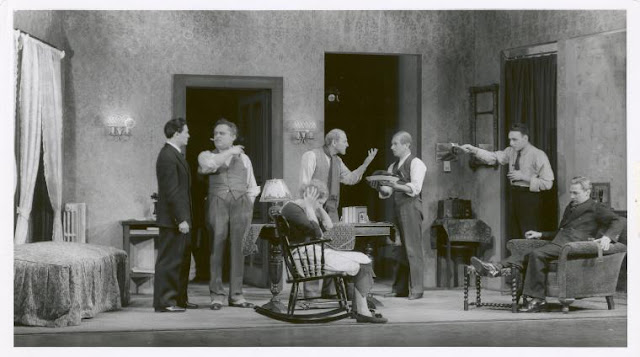
| The 1935 Broadway production of Awake and Sing! |
The Method: How the Twentieth Century Learned to Act by Isaac Butler (Bloomsbury Publishing) is a gossipy, entertaining and informative history of Stanislavskian acting – how it developed in Russia at the Moscow Art Theatre and how two of Stanislavski’s associates, Richard Boleslavsky and Maria Ouspenskaya, imported it to American shores, where, through its dissemination by the Group Theatre in the 1930s, it became the Method. Butler has rounded up an impressive amount of material and presents it coherently and compellingly. I didn’t realize how little I knew about the tensions between Stanislavski and the M.A.T.’s co-director, Vladimir Nemirovich-Danchenko; about the role each of the personalities who were drawn into Stanislavski’s circle played in the development of his approach to acting; about the effect Stalin’s rise to power had on the M.A.T. generally and on Stanislavski specifically – or certainly about Boleslavsky’s intriguing and rather crazy biography. No account I’ve read deals so clearly and in such dramatic detail with the break in the Group Theatre, when Stella Adler, its most gifted actress, challenged the weight Lee Strasberg, one of the company’s co-founders, placed on affective memory, where the actor digs into his or her past to unearth emotional dynamite to blast open a scene. Adler and Strasberg became the most important American acting teachers of the twentieth century. The Method’s examination of the differences in their styles and approaches and that of Sanford Meisner, another Group alumnus who became a famous and influential teacher, is fascinating. He identifies Adler’s greatest quality as her gift at script analysis; her book, compiled posthumously from her class notes, on Ibsen, Strindberg and Chekhov, and to a lesser extent the one on American playwrights, bear him out.
Wednesday, April 13, 2016
Going Dark: The Choices Narrow as Another Video Store Closes in Toronto
![]() |
| Happier days at Queen Video in Toronto. |
The recent closing of the flagship store of Queen Video in Toronto, after nearly thirty-five years in business, was illuminating on so many levels, from what it augured for the future of film viewing at home to what people were most interested in snapping up as the store sold off most of its 50,000 titles (some were transferred to the still-existing Queen Video outlet, further north in the city). As I picked through the detritus of what was still left on the premises on Queen Video’s last day, after a 23-day sell off of stock when DVDs were down to $1 a pop, I was saddened that another great rental outlet was closing even and, more significantly, aware of what that closing actually meant.
Wednesday, September 17, 2014
Not a Contender: The Drop
![]() |
| James Gandolfini and Tom Hardy in The Drop |
When The Godfather opened in 1972, Pauline Kael wrote of the terrifying light it shed on the dark underbelly of American society. Elia Kazan’s On the Waterfront (1954) had got it wrong, she remarked—Terry Malloy didn’t clean up the docks, after all. The mob had only gone into hibernation, gestating into the new and more virulent mutation that Coppola unleashed two decades later. But though The Godfather and Kazan’s film each concerned itself with organized crime, their characters and setting couldn’t differ more. Coppola treated his gangsters as patrician nobility; Kazan’s were street toughs and longshoremen. Michael Roskam’s new picture, The Drop, draws a closer connection, conjuring up Kazan’s milieu on the gritty, befogged docks of Brooklyn. And he’s even resurrected Terry himself in the person of Bob Saginowski (Tom Hardy), the bartender of a watering hole used to stash the Chechen mafia’s dirty money. But despite its feel of authenticity and enticing beginning, the movie’s ultimately undone by writer Dennis Lehane’s damnable propensity to preposterous climaxes and deflating character revelations.
Monday, April 14, 2025
Doppelgänger: Barry Levinson's The Alto Knights
![]() |
| Robert De Niro and Robert De Niro in The Alto Knights. (Photo: Warner Bros.) |
Witty, gripping and grandly entertaining, Barry Levinson’s The Alto Knights centers on the complicated relationship of two legendary Mafiosi, Frank Costello and Vito Genovese, who were both recruited to work for bootlegger Giuseppe Masseria in the 1920s alongside Lucky Luciano. After the murders of Masseria and his successor, Salvatore Maranzano, Genovese became Luciano’s second in command with Costello, who claimed to have abjured violence at the end of the First World War and stopped carrying a gun, as his consigliere. Genovese took over in 1936 when Luciano went to prison and expanded the operations of the organization Luciano had reconfigured as the Commission into narcotics. But he had to flee the U.S. to avoid a murder charge and took sanctuary in Italy. (Both men had been born there: Costello in Naples, Genovese in Calabria.) Costello took over, trading drugs for gambling. When Genovese returned to the States after the war – neatly bypassing conviction for that old killing when two key witnesses against him turned up dead – he didn’t take well to being his former colleague’s underboss. All of this narrative is background, much of it unstated or understated, to Levinson’s picture, which takes place in 1957, the year Costello appeared before the Senate Committee investigating the Mafia, and the year Genovese engineered the assassination of the former head of Murder Inc., Albert Anastasia, and attempted unsuccessfully to eliminate Costello.
Wednesday, April 13, 2011
A Crowded Sunday Night: The Amazing Race, Mildred Pierce, The Killing and The Borgias
So, here is how the schedule would be if I had to watch Mildred Pierce on initial broadcast: 8pm, The Amazing Race; 9pm, Mildred Pierce; 10pm to 11:10pm, The Borgias; 11pm (and miss 10 minutes) or 1am repeat, The Killing. It's a bit wearying. Fortunately, my other favourite adult show, Endgame -- starring Shawn Doyle as a sort-of Russian Nero Wolfe who suffers from agoraphobia and solves all his the mysteries by never leaving the hotel he's holed up in -- broadcasts on Monday nights. Endgame works because of Doyle's wonderful performance, but that's for another day. To my Sunday shows. I like them all, although none of them are perfect. But they are adult and are trying to get at some interesting things. They don't always succeed, but this one evening is far more entertaining than the last four months of feature film releases.
Wednesday, June 25, 2014
Costly Grace: The Immigrant
![]() |
| Joaquin Phoenix and Marion Cotillard in The Immigrant |
In director James Gray’s previous full-length feature film, 2008’s Two Lovers, a dejected, thirty-year old, bipolar Leonard (Joaquin Phoenix) comes home one night to his parents’ Coney Island apartment after a failed date with his shiksa goddess neighbor, Michelle (Gwyneth Paltrow). But his evening takes a surprising turn when Sandra (Vinessa Shaw), the daughter of his father’s business partner, shows up unexpectedly. They share some nervous tension and giggles over his family’s ancestral photos at first. Yet their initial tentative kiss soon turns soft, and they make love in his bedroom until morning. Gray underscores the entire scene with arias from a CD of Leonard’s, the Puccini beautifully matching the rhythms of the lovers: Crescendo, climax, diminuendo. The operatic current runs strong in this director. Even his 2007 crime drama, We Own the Night, with its ‘80s club scene and Russian Mafia, had a redemptive arc to it right out of classical melodrama. The Immigrant, the new film he also wrote (with Ric Menello), brings that operatic impulse unabashedly to the fore. And the result is as luminous and affecting as its imitated art form.
Friday, December 26, 2014
Critic's Notes & Frames, Vol. X
Friday, May 2, 2014
Movie Love: Ty Burr’s Gods Like Us, David Thomson’s Moments That Made The Movies and Sophie Cossette’s Sinemania!
I may not be particularly enamoured of the movies much of late – their overall quality is abysmal and they just don’t seem to have the cultural cachet they used to have – but I can still appreciate the enthusiasm of those that are still enthralled by the art form and, more so, enjoy the different approaches they take to expressing their love of cinema. Three recent books all find a way into the movies that is both atypical and idiosyncratic. They’re entertaining and informative in equal measure, fine tributes to the movie love that so many people still possess and a timely reminder of why I fell for the movies in the first place.
Sunday, March 27, 2016
Critic's Notes and Frames Vol. XVII
Saturday, July 11, 2015
Salvation: Love & Mercy
"The Beach Boys propagated their own variant on the American dream, painting a dazzling picture of beaches, parties and endless summers, a paradise of escape into private as often as shared pleasures...Yet by the late Sixties, the band was articulating, with less success, a disenchantment with that suburban ethos, and a search for transcendence."
– Jim Miller in The Rolling Stone Illustrated History of Rock & Roll (Random House, 1980).
Is it any wonder that Los Angeles is known as "the City of Lost Angels"? It's the place where sellouts go to bask in the sun, and shady deals get made under palm trees. Never mind that L.A. was the corruptible home of Raymond Chandler's incorruptible detective Philip Marlowe, it was also where Annie Hall was seduced away from Alvy Singer in Woody Allen's hit comedy. Los Angeles may be a tinsel town, a superficial jewel and pleasure palace, but its endless summers hold out a paradoxical promise. Songwriter Brian Wilson successfully depicted the seductive charms of that promise in The Beach Boys' best early music ("I Get Around," "Fun, Fun, Fun," "California Girls"), but when he tried to grow past the adolescent whims of what Jim Miller called that "paradise of escape," even calling it into question in the aching "Don't Worry Baby," Wilson was unable to take the band successfully into adulthood. The hedonistic thrill of The Beach Boys would, by the end of the Sixties, ironically become associated with the apocalyptic horrors of Charles Manson.