Showing posts sorted by relevance for query wizard of oz. Sort by date Show all posts

Thursday, March 14, 2013

Kansas Flatlands: Oz the Great and Powerful

James Franco stars in Sam Raimi's Oz the Great and Powerful, now in theaters

There is no good reason why a fresh movie spinoff of The Wizard of Oz shouldn’t be an eminently doable proposition. The new Disney film Oz the Great and Powerful – a “prequel” directed by Sam Raimi and starring James Franco as a two-bit carny magician who is whisked away to the magical land of Oz and, after proving himself through a series of heroic challenges, installs himself as the Wizard – has inspired a fair amount of anticipatory derision, and even some horrified shudders, as if it could only be an act of sacrilege, ever since it was announced. While the 1939 movie starring Judy Garland is rightly considered a classic, its status as a holy relic, like that of It’s a Wonderful Life and A Charlie Brown Christmas, has less to do with its inherent virtues than with the saintly reverence a lot of people seem inclined to feel towards anything they watched on TV ten times when they were kids. Years ago, this kind of living room repeat-viewing exposure was a rare phenomenon, but now that cable movie channels and home video have been a fixture of American life for so long that people who grew up on them are reaching maturity and getting jobs writing about movies, we’re seeing beloved-classic status automatically assigned to some real pieces of shit: movies from Top Gun, Caddyshack, Three Amigos, and even Sneakers. 

How would L. Frank Baum, the author of the original Oz books, feel about the idea that his masterwork was something more fragile and delicate than another potential franchise tent pole? He’d probably feel that he worked his hands to the bone to grow that tree and he didn’t need anyone getting in the way of it being properly sapped. Baum was an aspiring actor and playwright whose dreams of the stage had ruined him financially before he finally sat down and started writing children’s books. He wrote fourteen Oz books in all – the first great, long-running modern franchise of children’s fiction.  Baum charmed readers partly by using a theatrical ham’s instinct for showmanship as a substitute for the “mythic” qualities of European fairy tales. (Once Baum struck gold, he was quick to adapt his own work to the stage, and toured with a show that utilized film, slides, and live performers that promised a “travelogue” of Oz.) 

Judy Garland and Ray Bolger, off to see the Wizard in 1939
Pauline Kael wrote of the 1939 movie that Bert Lahr and Ray Bolger were so memorable as the Cowardly Lion and the Scarecrow because they understood “that the roles are vaudeville-comedy turns." The characters, and what the right kind of performers can bring to them, are at the core of Oz’s appeal, but every screen attempt to recapture that appeal – the 1978 movie of the Broadway musical The Wiz, Disney’s previous attempt to reboot the franchise with the 1985 Return to Oz, and the 2007 TV miniseries Tin Man – have gone big on concept at the expense of the characters. Much the same thing happens in Oz the Great and Powerful, but where some of the previous Oz films at least counted as honest failures by talented people committed to something they’d overthought, this movie doesn’t really have a concept so much as a marketing plan. It has a flat, defeated, half-hearted feeling that’s a little reminiscent of David Lynch’s Dune – another case of a gifted, idiosyncratic director “adapting” unusual material for a film that he has been made to understand isn’t really his project.

Sunday, May 21, 2017

Post Mortems: Frequency, Making History, and Emerald City

Leighton Meester, Adam Pally, and Yassir Lester in Making History.

Perhaps the biggest event of the television season is the one that didn't happen earlier this month, after an 12th-hour deal between the Writers Guild of America (WGA) and the major networks and studios averted an imminent writers' strike. True, a WGA strike threatens every decade, but the memory of the 100-day strike of 2007-2008 still looms pretty large, and with television's continually evolving face, the content of these regular negotiations always offers the rawest insight into the state of the industry, as years-old collective agreements hit headlong with new norms: 2007 revolved mainly around the surge of web-streaming, and the most recent almost-strike focused on the now-established shorter seasons of some of television's most prestigious shows. To add to the general anxiety, this year the talks also fell at roughly the same time that the networks were making their final decisions on which shows would be returning for another season and which would be axed. While some of my favourite shows (like ABC's Agents of S.H.I.E.L.D., which sat on the bubble for most of its impressive, often heartbreaking, 4th season) got last-minute pickups, there were a couple of painful casualties. Below are a few of my reflections on the 2016-2017 season that was, and won't be again.

Saturday, November 15, 2014

Appreciating Victor Fleming

Clark Gable and Vivien Leigh in Victor Fleming's Gone with the Wind
“It’s amazing: you ask people as a trivia question ‘Who directed Gone with the Wind?” and nobody knows; you give them a second clue – it’s the same guy who directed The Wizard of Oz – and they say Mervyn LeRoy. Victor Fleming was either a wonderful director or the luckiest son of a bitch in the world.”  – Joseph L. Mankiewicz
Among the big studio-era Hollywood filmmakers whose sturdy masculinity – an affinity for Westerns and other kinds of action pictures, a love of robust characters (both male and female), a comfortableness with the physical and the outdoors, a skill for shaping the distinctive qualities of all-American movie stars – Victor Fleming has traditionally been shortchanged. John Ford has been glorified, partly because he made the most consciously pictorial movies; he was always after art, and at his best he got it, in Young Mr. Lincoln, The Long Voyage Home, How Green Was My Valley. Howard Hawks, who worked in every genre, parlayed a love of raucousness and sass and tossed-off professionalism into a hard-boiled character ethic that infused all his work, whether he was making a gangster picture like Scarface or an aviator actioner like Only Angels Have Wings or a newspaper movie-cum-romantic comedy like His Girl Friday; his movies were companionable and often so speedy (the overlapping dialogue) that they felt wired. Fleming doesn’t get the same kind of respect. One reason may be that he did his best work in the thirties and very early forties and was dead by the end of the decade, whereas Hawks and Ford continued to make movies for another couple of decades; they were still around and working, if not at the height of their talents, when the film studies programs started operating in the sixties. Another reason, ironically, is that the two most famous projects Fleming was attached to, The Wizard of Oz and Gone with the Wind, came out the same year, 1939, and because they were vastly different and he wasn’t the only director who worked on either – King Vidor directed the Kansas footage in the first after Fleming prepared it, and Fleming replaced George Cukor in the latter – Fleming has been saddled with a reputation as a hired gun.

Friday, December 27, 2024

Toil and Trouble: Wicked, Part I

Bowen Yang, Ariana Grande, and Bronwyn James in Wicked, Part I.

Unbelievably, I have seen the stage musical Wicked three times. I saw the pre-Broadway tryout in San Francisco, with Idina Menzel, Kristen Chenoweth, a young Norbert Leo Butz, and Robert Morse (replaced by Joel Grey on Broadway). At more than three hours, it was bloated and unfocused, but I liked two of composer Stephen Schwartz’s songs, “Popular,” which does everything a musical comedy song should do, and the pretty and affecting “I’m Not That Girl.” And Chenoweth was hilarious. (I didn’t much care for Menzel; of course she won the Tony.) I saw it again several years later on tour in SF, when I took a friend’s daughter to see it for her birthday. Dramaturgically (we’ll get into more about dramaturgy later), it was fascinating to see how they had tightened the show up and how solid its construction now was. It still didn’t make it a great show, but there are any number of far worse musicals out there that have become hits, The Outsiders among the latest. The third time a friend, the talented Jason Graae, played the Wizard, charmingly.

Tuesday, December 8, 2015

Blunting the Snark: The Wiz Live!

Shanice Williams (left) and Elijah Kelley in NBC's The Wiz Live! (Photo by: Virginia Sherwood/NBC)

Over the last few years, the response to NBC’s live broadcasts of crowd-pleasing musicals has reminded the network’s executives of the power of snark in our culture. The concept, which began with 2013’s The Sound of Music Live!, is certainly one that theatre fans like me welcome: the network has, for three years running, staged productions for the holiday season, and the first one proved to be a monster hit in terms of ratings. Given the time of year when these specials air, they’re also smart in terms of how producers Craig Zedan and Neil Meron are attempting to recapture nostalgia for the TV specials of the 1950s, which featured stars like Mary Martin in shows like Peter Pan. Having a captive audience for a live event has become crucial in a time of declining ratings and delayed viewing, so even though many viewers tuned in to laugh at as much as enjoy The Sound of Music Live!, it still proved a savvy business decision for the network.

Monday, October 10, 2016

Judy Garland Sings: Chasing Rainbows

Ruby Rakos (centre left) and the cast of Goodspeed's Chasing Rainbows. (Photo: Diane Sobolewski)

Ruby Rakos is so good as the teenage Judy Garland, née Frances Gumm, in the new musical Chasing Rainbows: The Road to Oz that she alone justifies the trip to see the production at the Goodspeed Opera House. As a vocalist Rakos can harness both a belter’s power and a crooner’s sweetness; if you think you’ve heard enough covers of “Over the Rainbow” to last a lifetime, you might reconsider when you hear her marry delicacy to emotionality in the show’s finale. In her youth Garland had a remarkable ability to use that powerful, controlled alto to channel a depth of emotion that was startling in an adolescent. (She was sixteen when M-G-M cast her as Dorothy in The Wizard of Oz and took her career into the stratosphere.) That’s why, in the musical, her mother, Ethel Gumm (Sally WIlfert), relentlessly promotes her as the little girl with the grown-up voice – though that description shortchanges her other quality, a rousing Midwestern-flavored ebullience that gave her swing numbers, like “Everybody Sing” (from The Broadway Melody of 1938) and “Zing! Went the Strings of My Heart” (from Listen, Darling) a soaring, look-ma-no-hands vocal athleticism. Rakos gets all of that without ever trying to imitate Garland; and because she’s a real actress as well as an accomplished singer, she also gets her subject’s vaudevillian wiseacre side and her neediness, that almost frighteningly intense wide-eyed dreaminess. And she can hoof. Not only can you see why she was cast; you can’t imagine a search for a young Judy that could turn up anybody else in her class.

Monday, June 20, 2022

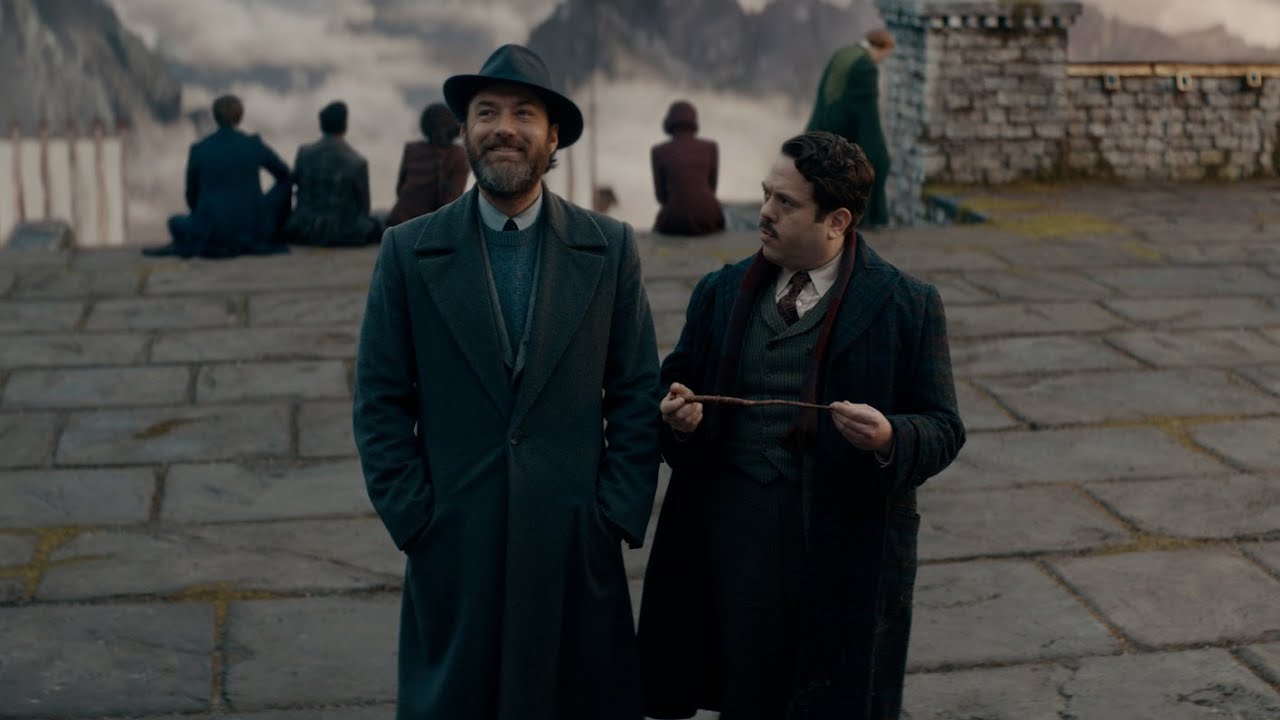
Transitions: The Secrets of Dumbledore and Fiddler’s Journey to the Big Screen

Jude Law and Dan Fogler in Fantastic Beasts: The Secrets of Dumbledore.

The third chapter of the Fantastic Beasts series, The Secrets of Dumbledore, begins with an exquisite piece of fairy-tale storytelling.  In the forests of China, Newt Scamander (Eddie Redmayne) – the English magizooogist (i.e., scholar of and caretaker for magical creatures) at the center of the narrative, set in the 1920s – oversees the birthing of a calf by a rare equine animal known as a Qilin, pronounced Chillin. The mother has a woven golden mane and a face like a mask; her tender calf is skeletal, a golden glow pulsating through his fragile skin. When the minions of the series’ villain, Gellert Grindelwald, attack, felling the mother, Newt struggles to save the baby Qilin, but he fails. He has to watch, helpless, as the calf is kidnaped and the mother expires, a single tear rolling down her cheek. It’s only then that Newt sees what everyone has missed in the chaos:  that she actually gave birth to twins.

Monday, December 28, 2020

Sadness and Joy: A Christmas Carol

Jefferson Mays in A Christmas Carol, available for streaming until January 3. (Photo: Chris Whitaker)

There have been dozens and dozens of straight dramatizations of Charles Dickens’s 1843 tale “A Christmas Carol” – on stage, on film, on radio and television, even more if we include novelties like Mr. Magoo’s Christmas Carol (1962), The Muppet Christmas Carol (1992) and the 2017 parody A Christmas Carol Goes Wrong by the English company Mischief Theatre. Scrooged, the updated 1988 version, written by Mitch Glazer and Michael O’Donoghue and directed by Richard Donner, with Bill Murray as the avaricious president of a TV network, is a special case: an imaginative retelling of the story that captures its spirit with astonishing precision, just as Glazer’s contemporary take on Great Expectations did a decade later. It is, I think, sublime – and the best thing Murray has ever done.

Saturday, May 8, 2021

Simple Joys: Christopher Wheeldon’s Alice’s Adventures in Wonderland

Lauren Cuthbertson and Federico Bonelli in the Royal Opera House's 2017 production of  Christopher Wheeldon’s Alice’s Adventures in Wonderland. (Photo: Andrej Uspenski/ROH)

One could spend years looking at all the dramatic adaptations of Lewis Carroll’s nonsense masterpiece Alice’s Adventures in Wonderland. His tale of a girl who’s either too big or too small, who tries to follow the rules even as they keep changing without reason or purpose, seems pretty much like childhood as I remember it (any kid who’s stood under an amusement park attraction’s height-limit sign only to be told they’re too short to ride knows exactly how Alice feels), so it’s no wonder this 150-year-old tale has remained a favorite of children and adults, and why it’s been retold in so many different renderings. Many also include elements of Carroll’s equally well-known sequel Through the Looking Glass, even though the only characters the two books have in common are Alice and her cat Dinah. Wonderland and Looking-Glass Land have separate denizens and different rules and guiding principles, as much as nonsense can be said to have such things. A deck of cards rules Wonderland while the game of chess and the mirror-inspired idea of oppositeness permeate Looking-Glass Land, but adaptors across the globe have felt free to mix and match elements from both. Some of these variations are abject failures; I would include the 1951 Disney cartoon, with its flat, unimaginative look and dull protagonist – Disney’s inadequacy at portraying young girls and women is one trend that’s lasted – and the 1933 Paramount Studios version, which features everyone who ever set foot on the lot and surprisingly ugly sets and costumes. Others are weird successes of a kind: the Czech animator Jan Švankmajer’s creepy and fascinating Alice from 1988; Tim Burton’s overblown 2010 Alice in Wonderland, which nevertheless has a distinctive look and very good performances from Johnny Depp, Helena Bonham Carter, and Crispin Glover. A surprisingly funny 1949 British movie with Carol Marsh as Alice and stop-motion puppets designed by Lou Bunin was suppressed for years in the U.S. by Disney, unsurprisingly. There have also been a number of television dramatizations, including a 1983 Great Performances broadcast that features a lovely performance by Richard Burton as the White Knight and a horrendous one by his daughter Kate as a bitter and sarcastic Alice, and a rather inert 1955 production with Elsa Lanchester and Eva Le Gallienne as the Red and White Queens. But I’ve never seen an adaptation that fully captures and expands upon the realms Carroll created. Until now. 

Friday, September 15, 2017

See You At The Curtain Call: Twin Peaks – The Return (2017)


Despite my best efforts, there are a few unavoidable spoilers within. 

“'We are like the spider,' said the king. 'We weave our life, and then move along in it. We are like the dreamer who dreams and then lives in the dream. This is true for the entire universe. That is why it is said, "Having created the creation, the Creator entered into it.". This is true for us. We create our world, and then enter into that world. We live in the world we have created.'"
– Thomas Egenes & Kamuda Reddy, Eternal Stories from the Upanishads

"We are like the dreamer who dreams and lives inside the dream, but who is the dreamer?” 
– David Lynch


I think it's safe to say that there hasn't been anything on television close to what director David Lynch and co-writer Mark Frost unleashed the last few months in their 18-part serial Twin Peaks – The Return. More than being simply a sequel to the original 1990 ABC series, Twin Peaks, which focused on the murder investigation of the high school senior Laura Palmer (Sheryl Lee) by FBI agent Dale Cooper (Kyle MacLachlan), or a mere continuation of the follow-up 1992 film, Twin Peaks: Fire Walk With Me, which examined the circumstances leading to that murder, Showtime's Twin Peaks – The Return was an abstract murder mystery that resisted solutions and begged even more questions. It was like finding yourself seeped in a David Lynch compendium where you experienced the full body of his work – including Eraserhead, Blue Velvet, Wild at Heart, Lost Highway and Mulholland Drive – as one long amorphous trance as plot lines vanished, dramatic moments imploded, and nightmarish visions suddenly erupted and took hold. Twin Peaks – The Return was the source of much frustration because within that Lynchian theme park of devious delight were also hours of flattened-out kitschy comedy that not only tested your patience, but drew some of his worst instincts, those that had already been on display in Wild at Heart, and parts of Lost Highway. Yet the baggy unevenness of Twin Peaks – The Return wasn't simply a case of the director's intuition taking a holiday and intermittently going wrong. Lynch, who works almost entirely from his unconscious, seemed to be refusing to make any kind of conscious judgement over the material. It was as if he'd decided instead to run the table with whatever came into his mind (bad or startlingly good) to see where it might lead him – and also, of course, the viewer. Knowing that there was an audience out there both nostalgic and fiendishly curious to return to Twin Peaks after such a long hiatus, Lynch turned this epic tale into something more than a conclusion and resolution to the story. Twin Peaks – The Return was a turbulent meditation on the past, on the nature of nostalgia, on the tropes of television serial drama, and on death itself.      

Friday, August 5, 2016

Reinvigorated: A Chorus Line at Canada's Stratford Festival


"Dance Ten, Looks Three" is a funny little number at the heart of A Chorus Line that makes light of the plastic surgery undertaken by a super talented but previously flat-chested dancer in order to get a leg up, so to speak, on her profession. With music by Marvin Hamlisch and lyrics by Edward Kleban, the song is a barely veiled act of desperation that’s been played for laughs ever since the late Michael Bennett first staged his hit musical on Broadway in 1975. In reviving A Chorus Line for Canada’s Stratford Festival this season, director/choreographer Donna Feore honours that tradition, and then some. Her punchy production, at the Festival Theatre until the end of October, gives the show’s rich veins of humour plenty of room to rush forward and invigorate the dramatic action. Feore is a masterful hand at character as well as comic timing and the performance she coaches out of Julia McLellan, the singer/dancer/actress playing the pneumatically enhanced Val, emerges as a show stopper that tickles the audience to the point it shouts out loud, roaring with approval. Enthusiasm for this powerful production continues right through to the gold-spangled finalé in which the remaining group of dancers high-step it to a repeat of "One," the song that perhaps best of all captures A Chorus Line’s chiseled focus on the individual within the group. It also serves to capture what’s great about this particular show. It is, to quote from Kleban’s lyrics, a singular sensation – an invigorating, compassionate, oftentimes hilarious hi-octane joy ride that while reverential of the Bennett original, succeeds in taking the musical in new directions. A Chorus Line reinvigorated.

Monday, June 30, 2014

Cole Porter, Late and Early

Paul Anthony Stewart and Elizabeth Stanley in Kiss Me, Kate at Barrington Stage (Photo by Kevin Sprague)

Any short list of great American musicals would have to include Cole Porter’s Kiss Me, Kate, with its witty, ingenious book by Bella and Samuel Spewack. The Spewacks turn The Taming of the Shrew into a backstage meta-musical about a musical-comedy version of Shakespeare’s comedy starring a once-married pair of gigantic egos whose behavior around each other suggests a modern variant on Petruchio and Katherine’s. You can’t do much to bury the misogyny in Shakespeare’s comedy – unless, like the great English company Propeller, you make it the critical focus of the show, i.e., deconstruct it – but Kiss Me, Kate gets away from it by making the two main characters, Fred Graham (who is also directing the musical within the musical) and his leading lady Lilli Vanessi, equally foolish and equally culpable. They hark back to the protagonists of Twentieth Century (and the musical based on it, On the Twentieth Century), played memorably in the sensationally funny 1934 Howard Hawks movie by John Barrymore and Carole Lombard, and those of the lesser known but also funny 1937 comedy It’s Love I’m After (played by Leslie Howard and Bette Davis).

Thursday, May 14, 2015

Neglected Gem #75: A Midsummer Night's Dream (1999)

Stanley Tucci and Rupert Everett in A Midsummer Night's Dream (1999).

I’ve seen so many productions – professional and amateur – of A Midsummer Night’s Dream that, much as I love the play, for some time I’ve been fairly sure I could live my life happily without seeing another. But Michael Hoffman’s 1999 film of it is so fresh and so supremely acted that my first impulse on leaving the theatre was a desire to come back again with other friends to show it off to them. Hoffman has turned Shakespeare’s Athens (which doesn’t even try to pass for ancient Greece) into turn-of-the-century Italy (“Monte Athena”). That turns out to be an inspired choice, right from the opening sequence where the feast is being prepared for the wedding of the duke, Theseus (David Strathairn), and his bride, the stranger queen Hippolyta (Sophie Marceau, whose French accent makes a suitable division from Strathairn’s American-ness). Italians would, of course, of course, focus on the sensuality of the food; the glimpses we get of the duke’s kitchen are lush. Those aren’t the very first images. As we hear the famous Mendelssohn music drift in, we see the fairies –beams of light dancing over a violet dawn that turn into butterflies as the morning light takes over the sky. There’s a tendency (unfortunate, I think) in modern productions of Midsummer to de-emphasize the ethereal quality of the supernatural elements and make them not only carnal – which they certainly are – but earthy, even brutal. Some of the directors who have gone in that direction may have taken their cue from Jan Kott’s essay “Titania and the Ass’s Head” in Shakespeare Our Contemporary. But it would be a waste to put the play on screen and ignore the resources that enable filmmakers to make the kind of magic you can’t conjure on the stage.

Monday, July 16, 2012

Peter and the Starcatcher: Handmade Vaudeville

Christian Borle (far right) and the cast of Peter and the Starcatcher (All photos by  Sara Krulwich)

The entrancing Peter and the Starcatcher, adapted by Rick Elice from the Dave Barry-Ridley Pearson novel, is an origin story for James Barrie’s Peter Pan, just as the blockbuster musical Wicked imagines the origins of the two witches in The Wizard of Oz. The complicated plot, which is set out quickly in the opening minutes (you have to listen sharply), involves two ships, the Neverland and the Wasp. The first carries a trio of orphans who are, unbeknownst to them, due to be sold into slavery, as well as Molly (Celia Keenan-Bolger), the feisty, adventure-loving daughter of Lord Aster (Rick Holmes), who is on the second ship, discharging a mission for Queen Victoria to hurl a trunk full of “star stuff” – highly dangerous stardust (its ability to make wishes come true can transform ambitious men and women into tyrants) – into the world’s oldest active volcano. (The writers were obviously thinking of The Lord of the Rings.) Molly, trained by her father to be a starcatcher, befriends the most sensitive of the orphans, a nameless lad (Adam Chanler-Berat) who doesn’t trust adults – in his experience, they always lie – yet cherishes a dream of home and mother. It is only in the second act, when the action moves to an island, that he acquires the name Peter Pan (first Peter and then Pan). Here he tangles with the pirate known as Black Stache (Christian Borle), before he’s become Captain Hook. You recognize other elements of the Barrie tale: Smee (Kevin Del Aguila) is Stache’s inseparable second-in-command, there’s a ticking crocodile, and the Indians are islanders called Mollusks. Nana the dog has her counterpart in Molly’s nanny, Mrs. Bumbrake (played in drag by Arnie Burton), who speaks in stiff-upper-lip English clichés and wears her hair in a bun that looks oddly like a dog’s ear.

Saturday, February 7, 2015

Neglected Gem #71 – Babe: Pig in the City


Those who went to Babe: Pig in the City in 1998 – George Miller’s sequel to his great 1995 Babe – to see another naturalist’s adventure set on the Hoggett farm had their expectations upended. Miller and his co-writers, Judy Morris and Mark Lamprell, clearly had no interest in repeating the achievement of the first film. Though Pig in the City begins with a farm-wide celebration of Babe’s sheep-herding triumphs, within the first few minutes Farmer Hoggett (James Cromwell) is confined to his bed in a cast and a neck brace following a nasty fall down a well – a consequence of a miscalculation on Babe’s part about how best to help “the boss.” Then the bank threatens to foreclose on his property and Hoggett’s beloved pig-faced wife Esmé (Magda Szubanski) hatches a plan to enter Babe in a fair, which requires an international plane trip, and takes Babe away from all of his farm companions, the familiar supporting cast of the first Babe (as well as, of course, Hoggett himself). Mrs. Hoggett’s scheme is set off course when a drug-sniffing customs hound at the airport decides to show off for Babe’s benefit and gets the boss’s wife detained for dope smuggling; by the time customs clears her she and Babe have missed their connections. With no imminent flight available to return them home, they trudge over to the only hotel in the vicinity that welcomes pets. But circumstances conspire to separate Esmé and Babe. First their suitcase and then Babe himself are kidnapped by a family of chimps on the floor below – and one solemn, laconic orangutan, their Uncle Thelonius. They perform with the concierge’s Uncle Fugly Floom (Mickey Rooney, in a wondrous, absurdist Keatonesque cameo), a dilapidated vaudevillian who’s been reduced to entertaining in the children’s wards of hospitals. Then Esmé gets into more trouble with the law (don’t ask). Like Babe’s stint in Fugly’s act, it’s only temporary. But the separation is enough to throw Babe into the cold city of Metropolis, where animals who have been set loose by their humans are as likely to starve as not, and where the prevailing spirit is – if you’ll forgive me – dog eat dog.

Thursday, September 20, 2018

Neglected Gem: The Secret Garden (1993)

Kate Maberly, Andrew Knott and Heydon Prowse in The Secret Garden (1993)

Agnieszka Holland’s The Secret Garden is the second film version of the beloved Frances Hodgson Burnett children’s novel about a young girl who’s sent to live in the English countryside after her parents die in colonial India. The first was directed by Fred Wilcox at MGM in 1949, in glistening black and white and (in the garden sequences) the intense storybook Technicolor we remember from The Wizard of Oz and Meet Me in St. Louis and National Velvet. Done up in the lavish MGM bound-classics style, it’s a handsome production that provides a deluxe Gothic mansion, a stunning carriage ride through the moors in a heavy evening rain, and – best of all – the formidable child actress Margaret O’Brien (the morbidly fanciful Tootie of Meet Me in St. Louis) as contrary Mary Lennox. Though Wilcox’s technique is a trifle shaky (the camera’s not always in the right place), and the late scenes drip into melodrama, the movie is highly satisfying.

Monday, May 6, 2013

Constructs: The Nance and The Assembled Parties

Nathan Lane in The Nance, at Broadway’s Lyceum Theatre (All photos by Joan Marcus)

Douglas Carter Beane’s The Nance (at Broadway’s Lyceum Theatre), set in late-Depression New York, invents a burlesque performer named Chauncey Miles (played by Nathan Lane) whose onstage persona, the “nance” or sissy in a series of revue sketches, is a way of hiding in plain sight for a gay man. Chauncey quips that “a pansy doing a pansy act is like a Negro doing blackface”; though many famous nances, like Bert Lahr as the Cowardly Lion in The Wizard of Oz, were straight in real life, many were not. The play covers the demise of burlesque on the watch of New York’s puritanical, family-values mayor, Fiorello LaGuardia, and his vigilant D.A., Paul Ross. It’s also about Chauncey’s inability to accept the love of a younger man, Ned (Jonny Orsini), whom he picks up at Horn & Hardart’s automat, where closeted gay men – there was effectively no other kind in 1937 – cruise, at the risk of being caught by the cops, beaten up and jailed for lewd and lascivious conduct.

Monday, October 7, 2019

Judy: Finale

Renée Zellweger and Finn Wittrock in Judy.


Renée Zellweger gives a fierce, fearless performance as Judy Garland in the new film Judy. She’s the movie’s Atlas, carrying it on her back; it’s not much good otherwise but you wouldn’t want to miss what she does in it. Adapted by Tom Edge from a play by Peter Quilter and directed by Rupert Goold, Judy is set in 1969, at the twilight of Garland’s career – when, bankrupt in her mid-forties, notoriously unreliable and fighting her ex-husband Sid Luft (Rufus Sewell) for custody of their two kids, Lorna (Bella Ramsey) and Joey (Lewin Lloyd), she goes to London to perform at the nightclub Talk of the Town. At first you might think, as I did, that what Zellweger is offering up is a brilliant impersonation, that it lacks the spooky lived-in feeling of Judy Davis’s version of Garland in the 2001 TV movie Life with Judy Garland: Me and My Shadows. (If you haven’t seen it, I recommend tracking it down: it’s the most amazing thing Davis has ever done, which means that it’s one of the greatest pieces of acting on record.) But when she finally gets up to sing – Arthur Schwartz and Howard Dietz’s singular paean to the power of loneliness, “By Myself,” with the lyrics altered to give it a personal slant – Zellweger’s portrayal takes hold. She gets all the elements of the singer in those late, hanging-on-by-her-fingernails days: the ironic, is-that-all-you’ve-got tone, matched to a widening gaze, as if she’s daring whatever monster she’s confronting to do its worst; the broadening of the cheekbones and the space between her eyebrows and her eyelids as she rides a song like a rollercoaster that threatens to jump its track; the way she uses those fragile shoulder blades, the bones practically bursting through the skin, to express sadness and defiance, sometimes simultaneously; the stiff, stick-like left hand, chopping at the air; the reckless belt in her voice that uses the little bit she has left of her range for an assertive thrust; the slurred final consonants; the self-deprecating pout and the half-closing of the eyes to signal defeat and resignation; the tough-broad, take-it-or-leave-it finish as she takes that weird, marionette bow. Zellweger captures Garland’s sardonic quality – part of her survivor’s apparatus – and the gallantry that made diehard loyalists out of her fans (especially gay men, who identified with her).

Friday, December 27, 2013

The Disney Treatment: Saving Mr. Banks

Tom Hanks and Emma Thompson in Saving Mr. Banks
The idea of a movie about Walt Disney persuading the English author P.L. (Pamela) Travers to let him adapt Mary Poppins to the screen is so tantalizing that you keep rooting for Saving Mr. Banks to work, long past the point where you can see it isn’t going to. Disney had been wooing Travers for twenty years before he finally got her to come to Los Angeles to collaborate with the screenwriter he’d chosen, Don DaGradi, and the songwriting Sherman brothers. But she kept putting off signing the contract, and her demands were plentiful and persnickety. In Kelly Marcel and Sue Smith’s screenplay, Travers (Emma Thompson) only agrees to make the trip because she hasn’t managed to write anything in years, and her agent convinces her that she badly needs the money. And still she arrives in Hollywood apparently determined that nothing Disney (Tom Hanks) can promise her will challenge her notion that he and his team are going to turn her 1934 children’s classic – a childhood favorite of Disney’s daughters – into something cutesy, sentimental and blandly commercialized.

Tuesday, June 17, 2014

Ad Nauseum: Edge of Tomorrow

Tom Cruise in Edge of Tomorrow

Summer blockbuster season is a polarizing time – movies showing in June and July tend to be either incredibly well-received or universally reviled. It’s difficult for a film to quietly exist in this climate, like an interesting person who goes unnoticed at a party because everyone is busy shouting. Seems as though everyone is talking about Edge of Tomorrow right now – it’s currently riding a massive wave of good press that feels amazingly at odds with its advertising, which promises a ferociously forgettable experience to any discerning moviegoer. Turns out the reality is somewhere in between: it’s nowhere near as good as you’re hearing, but it’s not as bad as you’d expect, either.

The plot is Groundhog Day meets Starship Troopers: Tom Cruise plays Major William Cage (a hearty action hero name that smacks appropriately of the 1980s), a military media liason who is sent to the front lines against his will when an invading alien force annexes Europe. During the storming of a French beach, he is killed in action, but wakes up at the dawn of the previous morning. He continues to relive the same battle over and over, until he finds a legendary soldier, Rita Vratasky (played by a very taciturn Emily Blunt), who demands that he “find her when he wakes up.” Turns out this ultimate distaff supersolider, known as “The Angel of Verdun” by the media and “Full Metal Bitch” among the ranks, was afflicted with the same time-looping curse, and they must now team up to stop the alien invasion from ever occurring. If this synopsis is making you yawn, you’re not alone. The trailers for Edge of Tomorrow do an excellent job of encapsulating the aggressively formulaic plot, but they undersell the film’s real draw: a genuine sense of fun.