Showing posts sorted by date for query the Shaw Festival. Sort by relevance Show all posts

Saturday, August 22, 2026

Short Takes: Farce and Children’s Theatre at Shaw and Stratford Festivals

Jeff Irving, Damien Atkins, and Travis Seetoo in Jeeves and Wooster in Perfect Nonsense. (Photo: Michael Cooper.)

P. G. Wodehouse gets the 39 Steps treatment at Shaw in Jeeves and Wooster in Perfect Nonsense (at the Court House, once more open to audiences until the renovation of the Royal George is completed). The narrative justification for turning this particular convoluted farce into a three-hander is that Bertie Wooster (Jeff Irving), inept as always, wants to write down the story of his latest misadventure but cannot do so without the aid of his indispensable manservant Jeeves (Damien Atkins). Jeeves plays himself and a host of other characters; he enlists the help of another domestic named Seppings (Travis Seetoo) who handles the remaining roles. Bertie remains Bertie throughout, while the breathless shifting in and out of multiple personalities by the other two men, often holding on by the skin of their teeth, gives the knockabout comedy a teetering acrobatic quality. As in The 39 Steps (and of course The Play That Goes Wrong and its sequels), the pleasure is in watching deft farceurs pretend to be fumbling amateurs. The co-authors, Robert Goodale and David Goodale, cite “The Works of P.G. Wodehouse” as their source material, but the plot comes mostly out of the 1938 novel The Code of the Woosters, wherein Bertie’s tyrannical aunt blackmails him into stealing an antique silver cow creamer for her husband from a rival collector. Under Brendan McMurtry-Howlett’s breakneck direction, the three actors are very funny, though the play goes on for about twenty minutes too long.

Wednesday, August 12, 2026

Shaw and Stratford Festivals: Twentieth-Century Classics

Julia Course and Martin Happer in Heartbreak House. (Photo: David Cooper.)

The allegorical high comedy Heartbreak House is one of George Bernard Shaw’s strangest plays; it is also, in my estimation, his greatest. (For me the other contenders are Man and Superman and Major Barbara, though I don’t pretend to have seen or read them all: he wrote more than sixty.) Set in a country house in Sussex constructed by its patriarch, Captain Shotover, in the shape of a ship, it brings together a disparate set of characters, a few of whom are related to one or another of the inhabitants but they haven’t seen each other in so long that they don’t always recognize each other. Toward the end some unidentified foreign power begins to bomb England; two of the characters are killed in the midst of attempting to protect themselves by hiding in a storage shed. And though the bombardiers move on, obviously the war goes on and for all we know it will signal the doom of civilization. In the final minutes of the drama Shaw’s characters are as witty as ever, and the mood isn’t Wagnerian, yet the play is a Götterdämmerung. Written in 1916 and 1917 and first produced in 1920, it is the playwright’s response to the First World War – the Great War, as it was called until 1939. The work it feels closest to is a masterpiece from two decades later, Jean Renoir’s The Rules of the Game, which was released on the cusp of the war that made that descriptor obsolete. Renoir’s movie doesn’t end in an apocalypse, but the tragedy at its conclusion, the senseless murder of a national hero – a case of mistaken identity – feels like an inevitable final act of carelessness and self-involvement that embodies up the attitude of the French nouveaux riches, the new aristocracy that has replaced the old, inherited one, the death of which Renoir had chronicled two years earlier in Grand Illusion.

Sunday, August 9, 2026

Musicals at Shaw and Stratford: Funny Girl and Guys and Dolls

Sara Farb as Fanny Brice (understudied by Jade Repetta at the performance our critic attended) in Funny Girl. (Photo: David Cooper.)

Since Funny Girl made Barbra Streisand a Broadway star and the 1968 William Wyler movie version enshrined what may be the greatest musical-comedy performance ever recorded, it took more than half a century for the show to generate a major revival. The one-two punch of Streisand’s stage and film triumphs created the impression that the musical was mostly a decorative shell constructed around her, despite the superb score by Jule Styne and Bob Merrill and what the threadbare musical bios of the last couple of decades – Jersey Boys, Beautiful and many others – now reveal by contrast to be a creditable book by Isobel Lennart. Funny Girl was finally revived at the Menier Chocolate Factory in London in 2015 with Sheridan Smith in the role of the Ziegfeld Follies singer-comic Fanny Brice; Smith was marvelous, but when the show transferred to the West End, her health problems delayed her appearance, and for the first half of the run she was replaced by her understudy, Natasha Barnes, who received reviews that can only be called generous. (I saw both actresses; Smith’s performance was filmed in 2018 and can be seen on BroadwayHD.) And Smith was the only reason to see it: Michael Mayer’s production, with a revised book by Harvey Fierstein, was clumsy and looked seedy. Those qualities were very much in evidence when the revival opened on Broadway four years ago, with an apparently disastrous leading performance by Beanie Feldstein, who left the run early and was replaced by Lea Michele. (It was Michele I reviewed.)

Monday, August 3, 2026

The Stratford Shakespeare Festival: Classics

André Sills and Krystin Pellerin in Othello. (Photo: David Hou.)

The question up for grabs in any production of Shakespeare’s Othello is why Iago sets out to destroy Othello and those he loves. In the 1995 movie with Laurence Fishburne, Kenneth Branagh’s motivation for Iago’s actions was straight off the surface of the text: he was angry at his general for selecting Cassio rather than himself as his lieutenant and devised a revenge that would punish both of them; Othello’s wife Desdemona, whom he convinced the Moor had been cheating on him with Cassio, is merely collateral damage. It wasn’t an especially interesting choice but Branagh was still the best thing in the picture. When Frank Finlay played it in the famous National Theatre production opposite Laurence Olivier (with Maggie Smith as Desdemona), which was filmed in 1965, his hatred of the Moor derived unmistakably from the fact of Othello’s race. But the best Iago I’ve ever seen was Andre Braugher in a splendid 1991 production at the Shakespeare Theater in D.C.. His Iago caught Othello, Desdemona and Cassio in his web – to quote the character’s own metaphor – for amusement; he was a sociopath. Braugher was the first Black Iago in my experience, and there were also clear nods to the men’s race: you sensed his shock that Othello would prefer a white guy to a brother. That element was prominent in Iobal Khan’s production for the Royal Shakespeare Company in 2015, which contained a number of Black characters, some African, some Caribbean, one Indian, and depicted a complicated hierarchy where culture determined class in ways that weren’t immediately apparent. Nicholas Hytner’s version at the National Theatre in 2013 was also about class – Rory Kinnear played Iago as distinctly working-class, and his racial discomfort with the Moor was mixed up with his perception that privileged men, one Black and one white, were looking down on him.

Friday, September 12, 2025

Stratford and the Shaw Festival: New and Old

The company of Forgiveness. (Photo: David House.)

Stratford’s production of Forgiveness (at the Tom Patterson Theatre), Hiro Kanagawa’s adaptation of Mark Sakamoto’s book Forgiveness: A Gift from My Grandparents, marks the Canadian play’s eastern premiere. (It has been staged in Vancouver and Calgary.) The play’s dual protagonists are Mitsue Sakamoto (played by Yoshie Bancroft), and Ralph MacLean (Jeff Lillico), whose lives were shaped irrevocably by their World War II experiences. Ralph grew up on the Magdalen Islands in Quebec and lied about his age to get away from his abusive alcoholic father and join the first Canadian unit stationed in Japan, before Canada and the U.S. declared war in the wake of Pearl Harbor. He was captured and spent four years in a Japanese POW camp. Mitsue and her Japanese family were deprived of their citizenship rights and forced to leave their home in British Columbia in 1942, first for an internment camp and then to harvest sugar beets on a farm in the Prairies, laboring long hours for a pittance; their initial “home” was a converted chicken coop. The ban wasn’t lifted until four years after the end of the war. What links these two stories together is the romance that flared up in Calgary, where the two main characters wound up, between Mitsue’s son Stan (Leon Quin at the performance I attended, standing in for Douglas Oyama) and Ralph’s daughter Diane (Allison Lynch). The author, Sakamoto, is their shared grandson.

Sunday, September 7, 2025

Summer Musicals

Mary Antonini as Reno Sweeney and the cast of Anything Goes. (Photo: David Cooper.)

This article includes reviews of musicals at the Shaw Festival and the Stratford Shakespeare Festival as well as at Ogunquit Playhouse in Maine.

Anything Goes opened on Broadway in 1934 and proved to be Cole Porter’s biggest hit until Kiss Me, Kate nearly a decade and a half later; it ran for 420 performances, hefty for the time. But it just escaped turning into a fiasco because the book Guy Bolton and P.G. Wodehouse, writing from different cities, cobbled together was so scattershot that the producer, Vinton Freedley, asked the director, Howard Lindsay, to rewrite it. With the collaboration of Russel Crouse he did so in three weeks, while the show was in tryouts out of town, and that’s the version audiences saw whenever it was produced over the next half-century. Lewis Milestone made a sweet movie of it in 1936 with Bing Crosby and Ethel Merman, (the leading lady of the Broadway production), though I suspect even many Porter devotees don’t know it. (The 1956 M-G-M movie with Crosby, Donald O’Connor and Mitzi Gaynor, has nothing in common with the show except the title and, in the opening section, a shipboard setting.) There was only one major revival, off-Broadway in 1962, which cut a few of the songs and interpolated others from the Porter archive, like “It’s De-Lovely” from Red, Hot and Blue (which has become a permanent addition) and “Take Me Back to Manhattan” from The New Yorkers. When it finally returned to Broadway in 1987, with Patti LuPone in the Merman role, Crouse’s son Timothy and John Weidman rewrote it, staying faithful to the spirit of the original but making their own emendations to the score. This is the Anything Goes that Kathleen Marshall directed triumphantly in a 2011 Broadway revival starring Sutton Foster and Joel Grey, and it’s the one graced by an ebullient production at the Shaw Festival this season (in their Festival Theatre) directed and choreographed by Kimberley Rampersad.

Saturday, August 23, 2025

Stratford and the Shaw Festival II: Shaw

Gabriella Sundar Singh as Barbara Undershaft in the Shaw Festival's current production of Major Barbara. (Photo: David Cooper.)

Is Major Barbara Shaw’s masterpiece? The main contenders would be Heartbreak House and Man and Superman, but when I saw Joseph Ziegler’s centennial revival of Major Barbara twenty years ago – with Diana Donnelly as Barbara, the young Salvation Army major, and Benedict Campbell as her estranged father, Andrew Undershaft, co-head of an armaments empire given the complexly ironic name of Lazarus and Undershaft – I was staggered. Ziegler’s gorgeous, immense production – it unfolded in three hours and twenty minutes and was riveting throughout – was a luminous rendering of Shaw’s brilliant, endlessly surprising dramatic argument that you can’t save the soul without feeding the stomach. (That sly thief Brecht rephrased it for the second-act finale of his Threepenny Opera: “First feed the face / And then talk right and wrong.”) In Major Barbara, Undershaft first proves to his daughter that her beloved Sally Ann is as dependent on the generosity of the warmongers and liquor salesmen as any other institution; then he seduces away her fiancé, the Greek scholar Adolphus Cusins, to become the heir to his business; and finally he sells Barbara herself on his factory, a model socialist community whose workers are beaming with health and pride. In Shaw’s witty and perverse social comedy, Lazarus and Undershaft, purveyors of death and destruction, are the heroes. No wonder Cusins calls his father-in-law-to-be Machiavelli and the Prince of Darkness.

Saturday, August 16, 2025

Stratford and the Shaw Festival I: Shakespeare

From left: André Sills as Polixenes, Sara Topham as Hermione, and Graham Abbey as Leontes with members of the company of The Winter's Tale. (Photo: David House.)

Shakespeare’s romance The Winter’s Tale is one of the three or four plays I cherish most, and the Canada’s Stratford Festival hits a high mark with Antoni Cimolino’s production at the Tom Patterson Theatre. Cimolino has announced that he will step down from the artistic directorship of the company after one more season, and his Winter’s Tale is so beautiful from start to finish that you can’t help thinking this is the show he would like to be remembered for. He’s staged it on a simple set that the designer, Douglas Paraschuk, has enriched, scene to scene, with lyrical details and Michael Walton has lit exquisitely. One of the most poignant examples is the famous final scene. Paulina (Yanna McIntosh) leads the King of Sicilia, Leontes (Graham Abbey), who has been reunited with his childhood friend Polixenes (André Sills), his former ambassador Camillo (Tom Rooney) and his long-lost daughter Perdita (Marissa Orjalo) into a secret room. There, she tells them all, she has had a sculptor create an astonishingly lifelike statue of Leontes’s queen Hermione (Sara Topham), supposedly dead these sixteen years while Leontes, under Paulina’s guidance, has done penance for the grievous wrongs he committed against her, Polixenes and Perdita (then just an infant). The stage is unilluminated except for three handheld lanterns, so the statue is revealed suddenly, the lantern light painting the darkness. When Paulina works her magic and Hermione moves, the effect is so subtle that at first you wonder if you really saw what you think you saw.

Tuesday, May 20, 2025

The Extraordinary Adam Guettel: The Light in the Piazza at The Huntington and Floyd Collins on Broadway

Emily Skinner in The Huntington Theatre's The Light in the Piazza. (Photo: Julieta Cervantes.)

The new Huntington Theatre mounting of The Light in the Piazza is the fourth production I’ve seen of this show, and except for Bartlett Sher’s spectacular original staging, at Lincoln Center in 2005, it’s the best. I think that Piazza, with its first-rate Craig Lucas book derived from Elizabeth Spencer’s 1960 novel and its soaring impressionistic score by Adam Guettel, is the greatest musical written in the twenty-first century. (Yes, I love Hamilton.) It’s an unconventional romantic musical in which the leap of faith made by the wife of a North Carolina tobacco executive named Margaret Johnson, who brings her daughter Clara to Florence on vacation in 1953, is a symbol for all of our attempts to find happiness in love, even though we know that the effort is reckless because as often as not it ends in shambles. One of the elements that make the play unusual is that though the lovers are Clara and a young Florentine named Fabrizio Naccarelli, the son of a shopkeeper, who fall in love at first sight. Margaret is the protagonist, and it’s finally she who has to overcome personal obstacles, not her daughter. She has been Clara’s protector since, at twelve, the girl was kicked in the head by a pony, apparently halting her emotional development. So when she and Fabrizio become entranced with each other, Margaret – encouraged via long distance by her husband Roy back home in Winston-Salem – attempts to stop it before the humiliating moment when the Naccarellis figure out something is wrong. But no one in the Naccarelli family is put off by Clara’s childlike nature, or even by her explosion when Fabrizio’s flirtatious sister-in-law, Franca, gets too close to him at a family get-together. The Naccarellis find her refreshingly old-fashioned; even Franca, whose attention-getting behavior is a response to her husband’s sexual duplicitousness, defends her; she thinks that Clara is right to fight for her man she loves and even wishes she had done so. Margaret has to confront the fact that the greater block to her approving Clara’s union with Fabrizio is the fact that her own marriage has been a disappointment, that she long ago ceased to believe in love.

Wednesday, August 21, 2024

Holmes on the Case: Sherlock Holmes and the Mystery of the Human Heart

Damien Atkins and ensemble in Sherlock Holmes and the Mystery of the Human Heart. (Photo: Emily Cooper)

Arthur Conan Doyle’s Sherlock Holmes tales have inspired two TV series, a series of fourteen beloved movies starring Basil Rathbone and Nigel Bruce that coincided almost exactly with the Second World War, and many other films through the years. Holmes’s theatrical history is a century and a quarter long. In 1899, only eight years after the most famous detective in the history of fiction first appeared in Conan Doyle’s A Study in Scarlet and The Sign of Four, the actor William Gillette adapted Holmes as a vehicle for his own talents. His Sherlock Holmes, loosely adapted from “A Scandal in Bohemia” and “The Final Problem,” was an enormous hit that he performed about 1300 times. Gillette also played the most famous fictional detective in a 1916 silent movie that’s available on Prime. (Newly restored, it was screened at the 2015 Silent Film Festival in San Francisco.)

The first stage Holmes I saw was The Crucifer of Blood on Broadway, written and directed by Paul Giovanni, with Paxton Whitehead as Holmes. It was extremely enjoyable, and that’s a description I would happily extend to Sherlock Holmes and the Mystery of the Human Heart, the Holmes play in the current season at the Shaw Festival, where Whitehead was once artistic director. The Mystery of the Human Heart is the third Holmes produced at the Shaw since 1918, all three directed by Craig Hall and starring Damien Atkins as Holmes, Ric Reid as Watson and Claire Jullien as Holmes’s unassailable landlady, Mrs. Hudson. (I didn’t see either The Hound of the Baskervilles or Sherlock Holmes and the Raven’s Curse.)

Wednesday, November 8, 2023

Mickey and Joey: Sabbath’s Theater and Pal Joey

Elizabeth Marvel and John Turturro in Sabbath's Theater. (Photo: Jeenah Moon)

Devoted as I am to Philip Roth’s novels, I had trouble with his National Book Award winner Sabbath’s Theater, which he released in 1995. Its stylistic excesses in the service of underlining the sexual indulgences of its sixty-four-year-old protagonist, the one-time puppeteer Mickey Sabbath, whose career was sidelined by arthritis, defeated me; I put it down after a couple of hundred pages. It’s the only one of Roth’s many books I couldn’t finish. But maybe I should give it another try. Ariel Levy and John Turturro’s stage adaptation, produced by The New Group at the Signature Theatre with Turturro as Sabbath, is a majestic piece of theatre, notwithstanding the modesty of Jo Bonney’s production: three actors, two of whom, Elizabeth Marvel and Jason Kravits, play several parts; a small space containing a few props and an upstage screen for projecting a handful of evocative images (and in one scene Kravits’s silhouette); Roth’s 451 pages trimmed down to an hour and forty minutes of text without intermission.

Tuesday, August 22, 2023

All Hail the Comic Muse

Mike Nadajewski and Kristi Frank in On the Razzle. (Photo: Emily Cooper)

This piece includes reviews of On the Razzle, Blithe Spirit and Village Wooing.

This summer the Shaw Festival has been bowing to the comic spirit. In addition to Shaw’s The Apple Cart and The Playboy of the Western World, which mix serious and humorous elements, the roster has included productions of four comedies from different eras: Marivaux’s The Game of Love and Chance (1730), performed outdoors in an improvised version – the only one of the quartet I didn’t get to; Shaw’s Village Wooing (1934), this season’s lunchtime one-act; Noël Coward’s Blithe Spirit (1941); and Tom Stoppard’s On the Razzle (1981). In truth, the last of these can claim connection to several periods. It began in 1835 as a one-act English play by John Oxenford called A Day Well Spent, which the Viennese playwright and actor Johann Nestroy adapted seven years later as Einen Jux will er sich machen (He’s Out for a Fling). Thornton Wilder reworked it for Broadway in 1938 as The Merchant of Yonkers – a failure, despite direction by the legendary Max Reinhardt – and then again in 1955 as The Matchmaker, which altered the story about shop clerks out on the town by inventing the assertive, charismatic title character (played by Ruth Gordon on Broadway) and reconfiguring the play around her. It was filmed the following year with Shirley Booth in the role and featuring three talented young performers early in their careers: Anthony Perkins, Shirley MacLaine and Robert Morse. In 1964 The Matchmaker became the musical Hello, Dolly!, which, of course, ran for years. On the Razzle is Stoppard’s rewrite of the Nestroy, not the Wilder, so there’s no Dolly Gallagher Levi dashing around in aid of the young lovers while manipulating her sour-faced client into marrying her rather than the widow he’s after or the fictitious millionairess she’s promised him.

Tuesday, August 15, 2023

The Playboy of the Western World and The Apple Cart: Flying High at the Shaw

Marla McLean and Qasim Khan in The Playboy of the Western World. (Photo: Emily Cooper)

In the preface to his 1907 masterpiece The Playboy of the Western World, the Irish playwright John Millington Synge writes, “On the stage one must have reality and one must have joy . . . In a good play every speech should be as fully flavoured as a nut or apple . . .” This dictum explains the play’s unusual style and texture, realism folded in with folk-fable imagination and humor and language so musical that it sings in your ears even when you’re just reading the text. Synge claims that he owes both the wildness of the narrative and the richness of the vernacular to his close attention to the way rural working-class Irish people speak (or did around the turn of the twentieth century).

Monday, July 31, 2023

Summer Musicals: Summer Stock and Gypsy

Corbin Bleu and the dancers in Summer Stock. (Photo: Diane Sobolewski)

Summer Stock, released in 1950, followed a particularly unhappy time in Judy Garland’s life and career – after the deterioration of her marriage to the director Vincente Minnelli, after she made her first suicide attempt and was committed to a rehab center, and after M-G-M replaced her on Annie Get Your Gun with Betty Hutton. Yet it feels like a breather for her: though her weight fluctuated during the filming (in her last big number, “Get Happy,” she’s strikingly trim), her performance is ebullient and unstrained. It was her third and final pairing with Gene Kelly – the others were For Me and My Gal in 1942 (his film debut, after he’d conquered Broadway in Rodgers and Hart’s Pal Joey) and The Pirate, for Minnelli, in 1948 – and his warmth and virility, his earthiness and easy jocularity, always brought out an appealing vaudevillian quality in her. None of her other co-stars was so ideal a vocal match for her, and though it’s great to see her with Fred Astaire in Easter Parade (1948), especially in the “Couple of Swells” number, when she and Kelly dance together they seem to belong to the same club. Summer Stock (which Charles Walters directed) is lightweight, and there’s nothing much in the George Wells-Sy Gomberg script that hadn’t been done in previous backstage movie musicals like the ones Garland and Mickey Rooney co-starred in, or Irving Berlin’s Holiday Inn. Garland plays Jane Falbury, who’s struggling to keep her farm from going under, and Kelly is Joe Ross, who persuades her to let him produce a show in her barn. But it never pushes the sweetness or the rural Americana, it has a fine supporting cast (except for Gloria De Haven as Jane’s self-centered sister: her acting is really awful), and Garland and Kelly’s scenes together are endearing.

Monday, September 5, 2022

The Importance of Being Earnest and Too True to Be Good: The Gift of Gab

Martin Happer and Julia Course in The Importance of Being Earnest. (Photo: Emily Cooper)

Tim Carroll’s production of The Importance of Being Earnest at the Shaw Festival is no doubt giving pleasure to a great many theatregoers this year.  No one has ever, to my knowledge, written a funnier play than Oscar Wilde’s 1895 comedy of Victorian manners, and Carroll’s mounting honors both the wit and the style of the text. It is also – thanks to Gillian Gallow’s set (with its multiple frames), Kevin Lamotte’s lighting and especially Christina Poddubiuk’s costumes – lovely to look at.

Monday, August 22, 2022

Crowd Pleasers: Damn Yankees and Gaslight at the Shaw Festival

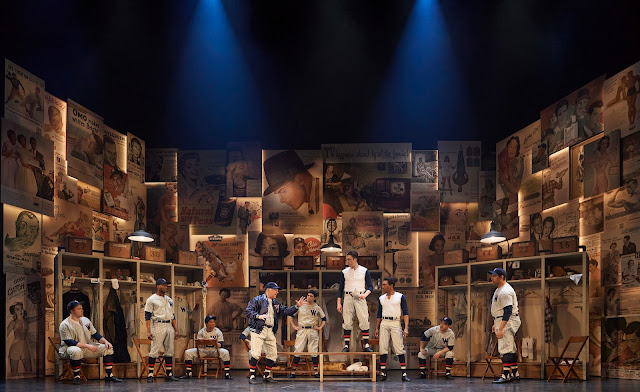
Jay Turvey with the Ballplayers in Damn Yankees, at the Shaw Festival. (Photo: Michael Cooper)

Richard Adler and Jerry Ross might have entered the pantheon of Broadway songwriters if fate hadn’t extinguished their star so fast. Adler was thirty-one and Ross twenty-eight when George Abbott commissioned them to write the score for The Pajama Game (1954), adapted by Abbott and Richard Bissell from Bissell’s novel 7-1/2 Cents, about the tensions between labor and management in a Midwestern pajama factory. It was a legendary show: Abbott and Jerome Robbins co-directed, a young Bob Fosse staged the dances, and it ran for three years. (A boisterous movie version in 1957, helmed by Abbott and Stanley Donen, captures the spirit of the original, with all but two members of the Broadway cast reprising their performances.) In 1955 lightning struck again for Adler and Ross with Damn Yankees. Adapted by Abbott and Douglass Wallop from Wallop’s book The Year the Yankees Lost the Pennant, Damn Yankees was as big a hit as The Pajama Game. But six months after its triumphant premiere, Ross died suddenly of lung disease. Adler never had another success, alone or with a collaborator, though his lovely score for the South Africa-set musical Kwamina, which he wrote for his wife, Sally Ann Howes, is ripe for rediscovery. (Its interracial love story was undoubtedly too controversial for 1961.)

Monday, August 15, 2022

Revisiting Stratford: The Miser and Girls & Boys

Colm Feore, Lucy Peacock and Qasim Khan star in The Miser, at Canada's Stratford Festival. (Photo: David Hou)

This summer I was able to cross the Canadian border for the first time since COVID, on a trip framed by brief visits to Stratford and Niagara-on-the-Lake, home of the Shaw Festival. Regrettably, my timing at Stratford didn’t allow for the chance to see All’s Well That Ends Well, a problem comedy I love that gets produced only infrequently. But I did manage to check out artistic director Antoni Cimolino’s production of Molière’s 1668 prose comedy The Miser (at the Festival Theatre) in a contemporary adaptation by Ranjit Bolt that has been embellished further with Ontario references. In Bolt’s version Molière’s title character, Harpagon, is called Harper, and his children, Élise and Cléante, who desire to marry the people they love without risking being disinherited by their parsimonious papa, are called Eleanor and Charlie. The director’s note in the program argues that the subject of greed and the generational tensions make The Miser relevant to a 2022 audience. Of course you can make that case for any of Molière’s best satires; human nature, after all, hasn’t changed much through the centuries. I’m not sure, though, that the present-day setting adds anything to the play or sharpens its thrust.

Monday, May 30, 2022

The Goodspeed Reopens with Cabaret

Aline Mayagoitia as Sally Bowles in Goodspeed's Cabaret. (Photo: Diane Sobolewski)

One of the most exasperating developments of the last several decades of theatre is the rewriting of classic plays and musicals, because the originals simply disappear – it’s as if they never existed. In the twenty-first century the alterations have mostly come out of an attempt to make the texts more palatable to contemporary audiences, which have a tendency to cheer every time a character in an older setting makes an anchronistic comment transparently inserted to produce precisely that response. Audiences are increasingly being manipulated into becoming Pavlov’s dogs, salivating when someone on stage in a show set in the forties or fifties sounds as if they’re describing Trump. Will we ever again get to see a revival of A Streetcar Named Desire that ends the way Tennessee Williams wrote it, with Stanley beginning to make love to Stella to distract her from the institutionalization of her sister Blanche, rather than replicating the unconvincing ending of the (otherwise magnificent) Elia Kazan movie, where Stella rushes upstairs to Eunice and the audience pretends that she’s actually thinking of walking out on her husband? It’s hard to believe that 1951 audiences didn’t see that rewrite for exactly what it was: a sop to the Production (Hays) Code Office. Now audiences, shamelessly coddled by recent versions of the play, are encouraged to believe that Stella has suddenly acquired a feminist consciousness.

Monday, October 14, 2019

Rosmersholm: The Pitfalls of Idealism

Hayley Atwell and company in Rosmersholm. (Photo: Johan Persson)

The idealists in Ibsen’s plays invariably end badly – sometimes by destroying the lives of others (Gregers Werle in The Wild Duck is the salient and most shocking example), but almost always by destroying themselves. In Chekhov, as in Shakespeare, human folly is the inescapable verity that always undermines the noble talk, though both these playwrights handle the fools with pity and compassion because they know in their hearts that we’re all fools. Ibsen is less pitying. In his 1886 Rosmersholm, which received an exquisite production in the West End under Ian Rickson’s direction early last summer, almost everyone on stage claims to be living according to an unassailable set of principles. John Rosmer (Tom Burke) is a one-time pastor who abandoned God after the suicide of his invalid wife Beth, but the freedom he asserts he has found is limited by his inability – like, apparently, all his ancestors, whose portraits hang on the walls of his house, Rosmersholm – to express emotion, especially sexually. (This is perhaps Ibsen’s most damning depiction of Scandinavian-Victorian coldness.) Rebecca West (Hayley Atwell), who loves him and lives at Rosmersholm with him though she does not share his bed, credits him with having brought her to enlightenment, but late in the play she confesses that she helped to drive his wife, whose caregiver she was, to her death. Rosmer’s main adversary is his brother-in-law Andreas Kroll (Giles Terrera), the local governor, who represents the forces of conservatism and, like all of Ibsen’s conservatives, is certain that his politics are the bedrock upon which civilization must stand if it is to survive. Kroll’s bugbear is Peter Mortensgaard (Jake Fairbrother), who runs a liberal newspaper; Rosmer, who has not forgiven himself for his unkind treatment of Peter and his now-dead lover (another suicide) in his days as a man of the cloth, offers to support his bid to displace Andreas, only to find that a man who has lost his faith is of no political use to Mortensgaard.

Monday, September 9, 2019

Song and Dance, Part III: Brigadoon

Matt Nethersole (centre) and the cast of Brigadoon at the Shaw Festival. (Photo: David Cooper)

If you love classic American musicals, then you may feel, as I do, a creeping dread when you attend a revival of one and find a credit in the program for “revised book.” I wasn’t aware that Alan Jay Lerner and Frederick Loewe’s lovely 1947 musical fantasy Brigadoon required revising, but the Shaw Festival’s production uses a 2014 rewrite, first seen at the Goodman Theatre in Chicago, by a playwright named Brian Hill. Hill has apparently sought to make the show more relevant to today’s audiences by turning the protagonist, the American Tommy Albright (George Krissa), into a World War II veteran and altering the motivation for the spell cast on the town of Brigadoon, which Tommy and his friend Jeff Douglas (Mike Nadajewski) come upon when they get lost in the Scottish Highlands during a hunting vacation. As Lerner wrote it, Brigadoon’s late minister asked God to put the town to sleep every night for a hundred years in order to keep it from falling under worldly influences. In Hill’s version, it’s war – and specifically (though it’s unnamed) the tragic Battle of Culloden – that devastated the Highlands and from which the minister wanted to protect his beloved Brigadoon. The director of the Shaw production, Glynis Leyshon, underscores this idea by beginning the show, clumsily, with Second World War newsreel footage. Who first came up with the harebrained notion that if an old dramatic property can’t be linked to contemporary concerns it’s not worth taking down off the shelf? City Center staged Brigadoon two years ago using the original book and the audience gave it a (well-deserved) standing ovation.