Monday, August 1, 2022

Karen Kain’s New Version of Swan Lake Fails to Fly

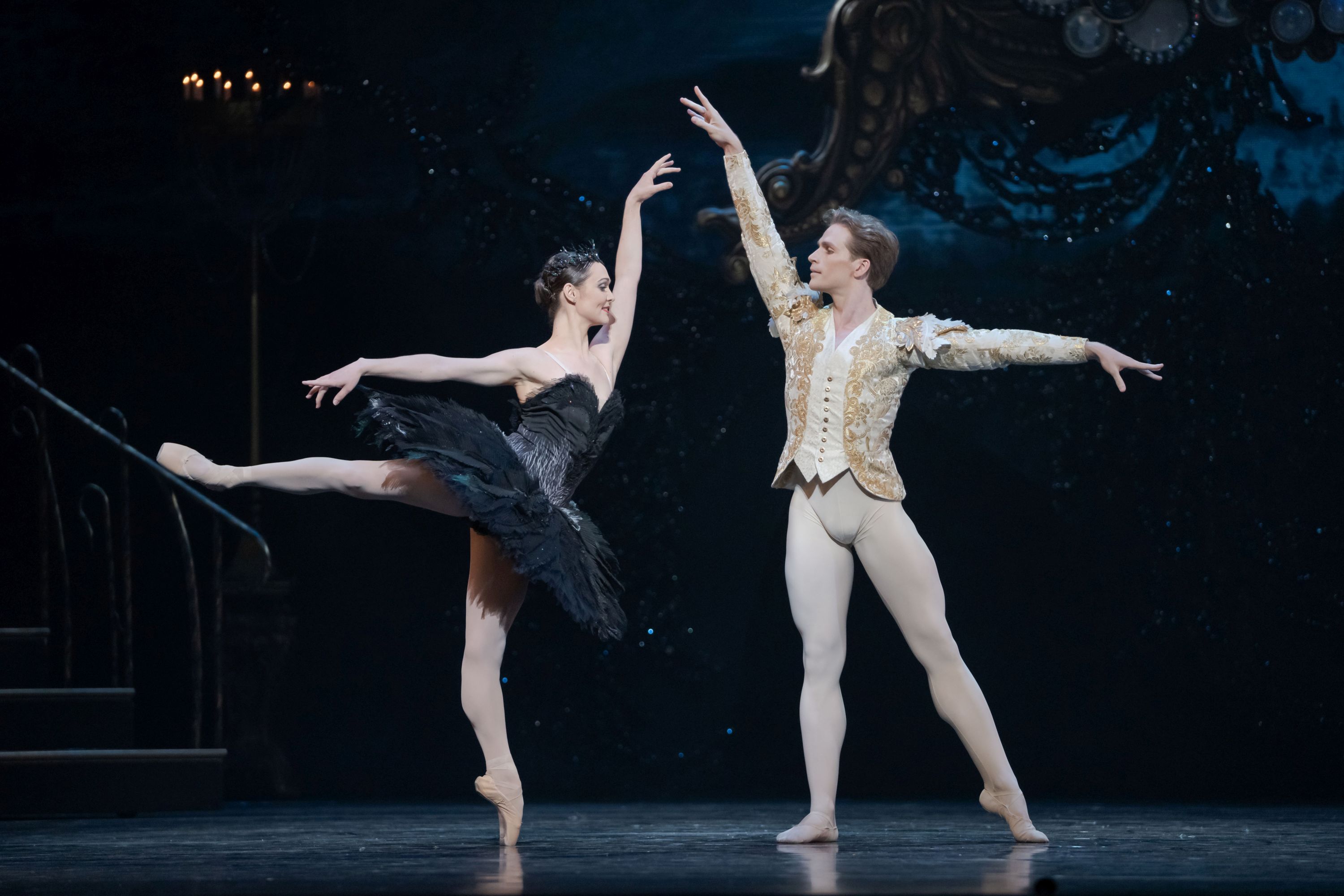
Harrison James and Jurgita Dronina in Swan Lake. (Photo: Karolina Kuras)

As far as highly anticipated world premieres go, Karen Kain’s Swan Lake had an extraordinary amount of buildup, making it – from a box office perspective alone – a hit before it even opened. Originally scheduled for 2020, and delayed two years because of the pandemic, the $3.5-million production, a presentation of the National Ballet of Canada, sold out its two-week run in advance of its debut at Toronto’s Four Seasons Centre on June 10. This is unprecedented for any ballet outside The Nutcracker, let alone one whose merits had yet to be assessed. At the end of the day, those merits were found to be wanting, making this Swan Lake, after all the hype, a total letdown.

What was wrong with it? In brief, everything.

Monday, July 25, 2022

Random Notes on Actors

Matthew Mcfadyen and Colin Firth in Operation Mincemeat.

For anyone who follows British actors – and that includes just about everybody I know who’s turned on by actors these days – Operation Mincemeat (on Netflix) is a banquet. It features Colin Firth, Matthew Macfadyen, Kelly Macdonald, Penelope Wilton and Jason Isaacs, with Alex Jennings, Hattie Morahan, Mark Gatiss and Johnny Flynn (from The Dig) in supporting roles and Simon Russell Beale, in a cameo, the latest first-rank actor to in recent years to play Winston Churchill. Across the board, the performances are superlative. The movie, beautifully directed by John Madden from an ingenious, immensely satisfying script by Michelle Alford (adapting book by Ben Macintyre), is a true-life World War II spy story and romantic melodrama. In 1943, British Intelligence Fleet Commander Charles Cholmondeley (Macfadyen, with a bushy mustache) whips up a scheme to mislead the Germans into thinking that the Allies are directing their attention to Greece while in truth they’re focusing on Sicily. Cholmondeley’s plan is to dress up a corpse as an English agent, plant phony documents on him, and have him wash up in Spain, in the Gulf of Cadiz, and then make sure that Allied moles get news of his discovery to Hitler’s ears. Working with Commander Ewen Montagu (Firth) and Hester Leggett (Wilton), head of the Admiralty’s secretarial unit, he appropriates a suicide named Glyndwr Michael for the dead man, renames him Major William Martin, and manufactures a biography for him that includes a romantic backstory. Jean Leslie (Macdonald), a widow working under Hester, gets involved when she offers her own photo to stand in for the sweetheart photo in Martin’s wallet. (Then they throw in a love letter.) Isaacs plays Admiral John Godfrey, their consistently wrongheaded boss, who is skeptical about the operation from the get-go and suspicious of Montagu because he’s convinced his left-leaning brother Ivor (Gatiss) is a Soviet spy. (The fact that the Russians are fighting on the same side as the Allies hasn’t calmed him down.)

Wednesday, July 20, 2022

The Anxious Object: The Sublime Void and Art in the Age of Anxiety

The Sublime Void (Ludion Press, Antwerp / DAP, 1993); Art in the Age of Anxiety (MIT Press/Morel Books, 2021)

“Perhaps it was always like this. Perhaps there was always a vast alien expanse between an epoch and the great art which it produced. What distinguishes works of art from all other objects is the fact that they are, as it were, things of the future, things whose time has not yet come.” – Rainer Maria Rilke.

“Art in the age of anxiety explores the ways in which everyday devices, technologies and networks have altered our collective consciousness. We are all living in an age where anxiety has become a part of our daily life.” – Omar Kholeif, curator.

When my wife Dr. Mimi first gave me these two books as a birthday gift, it was not immediately apparent how intimately connected, as if by some subterranean river of meaning, both of them were to me in the present, nor how substantially that meaning would expand exponentially over time to encompass almost every aspect of what tenuously living in both the 20th and 21st centuries actually might signify. That gift might just be the unexpected case where profundity drops down on us, apparently carried on winds that at first are not quite even discernible by us, until later on, one day, it comes crashing through the roof of our skulls and rearranges the furniture in our minds.

Monday, July 18, 2022

Epiphany: Death and Community

The cast of Epiphany. (Photo: Jeremy Daniel)

The new Brian Watkins play Epiphany, which closed last weekend at Lincoln Center’s Mitzi E. Newhouse Theater, is wildly ambitious and wildly erratic, and the two hours without intermission really began to feel long by the final half-hour. You’d have to account it a failure, but it’s an imaginative, fascinating one, a phrase I wouldn’t apply to, say, the generously reviewed POTUS or The Minutes. There were certainly some high points in the New York theatre season: The Lehman Trilogy, Girl from the North Country and Skeleton Crew, all of which I saw before COVID (the first during its run in London’s West End, the last at Boston’s Huntington Theatre), the Lynn Nottage/Ricky Ian Gordon opera of Nottage’s play Intimate Apparel and the Mint Theater’s recent revival of Elizabeth Baker’s 1909 Chains. A Case for the Existence of God didn’t reach down deep enough, but it had ideas and a pair of splendid actors, Kyle Beltran and Will Brill. The other shows I saw weren’t much good and left little or nothing behind to contemplate. But you couldn’t say the same about Epiphany, which was directed by Tyne Rafaeli. It’s often very funny and occasionally quite moving, and it tickles the brain.

Friday, July 15, 2022

A Few Brief Thoughts on Some (More) Interesting Short Films

A scene from Ottó Foky’s Scenes with Beans (1976).

It’s been a year and a half since my last shorts roundup, and the pandemic is still ongoing; the only difference is that people are starting to not care anymore. I wonder if it has something to do with how the internet has diminished our attention spans and memories. In any case, here in chronological order of premiere date are the shorts I watched that engaged me enough to want to finish them and write about them. If I don’t provide a link, I saw it on MUBI.

Monday, July 11, 2022

Chains: A Resurrection from the Mint Theater

Laakan McHardy and Jeremy Beck in Chains. (Photo: Todd Cerveris)

The Mint Theater Company, an off-Broadway house in the business of reviving obscure European and American plays, has been on my radar for several years, but I had never seen one until they began to stream shows from their archive while the New York theatre was shut down by the pandemic. The plays themselves were interesting, but what struck me was the high quality of the productions. To be honest, I felt foolish for not having checked out Mint much earlier. (They’ve been around since 1995.)

Their current offering – their second since the reopening of live theatre and their first back in their home space on Theater Row – is Chains, a 1909 realist play from England by Elizabeth Baker. Baker had been inspired to try her hand at playwriting by the work Harley Granville-Barker was presenting at the Court Theater during his three seasons as artistic director. Chains was her first effort, but it’s a sophisticated piece of dramatic writing: skillfully structured, compelling in subject matter and character, illuminated by indisputable authorial intelligence. The social setting is the lower middle class residing in the London suburbs in the years before the First World War. The chains of the title are those imposed by duty, pragmatism and convention. The protagonist, Charley Wilson (played by Jeremy Beck), is a clerk suffocated by the dullness of his job and the dim prospects of improving his lot. He and his wife Lily (Laakan McHardy) live in genteel poverty, taking in boarders to alleviate some of the financial strain. They’re counting on his getting a raise, but instead his company, on the unconvincing excuse that they’ve had a bad year, reduces his pay. When their current boarder, Fred Tennant (Peterson Townsend), decides to walk away from his job and try his luck farming in Australia, his courage and optimism affect both Charley and his sister-in-law Maggie Massey (Olivia Gilliatt), who has become engaged to a man she doesn’t love in order to escape the shop where she’s employed. Everyone else who hears the news of Fred’s decision holds onto the conservative notion that a sure thing, however suffocating to the spirit, is better than a risk; they’re inured to the idea that work isn’t supposed to be pleasant. Only Charley and Maggie identify with his bid for freedom.

Monday, July 4, 2022

Top Gun: Maverick – Pablum

Tom Cruise, Jennifer Connelly in Top Gun: Maverick.

Top Gun, which came out in 1986, was a Reagan-era special if there ever was one. It harked back to the flyboy epics of the late silent and early talkie era but eliminated everything that had made the best of them – Wings, Hell’s Angels, Only Angels Have Wings – witty, exciting and romantic, like three-dimensional characters and actors who drew on their own dimensionality to make them memorable, and substituted high gloss and displays of masculinity that would have looked embarrassing in Medieval times. There was plenty of action, but I can’t remember a single flying sequence that truly engaged the senses, let alone the brain. I would have skipped the long-delayed sequel, Top Gun: Maverick, but the director is Joseph Kosinski, whose true-life firefighter picture, the 2017 Only the Brave, is an unknown gem. So I opted to check it out. And it’s perfectly well directed, which is to say that you can sit through it without dozing off or looking for excuses to visit the lobby of your local Cineplex. But aside from the pristine cinematography by Claudio Miranda (who also lit Only the Brave and Kosinski’s Netflix sci-fi film, Spiderhead, which came right on its heels) and the climactic dogfight, Top Gun: Maverick is a stupid movie and a desperate exercise in picking the bare bones of a one-time commercial success that wasn’t any good to start with.

Thursday, June 30, 2022

Ain’t Misbehavin’ and B.R.O.K.E.N code B.I.R.D switching: Something About Race

Allison Blackwell, Jarvis B Manning Jr., Maiesha McQueen, Arnold Harper II and Anastacia McCleskey in Ain't Misbehavin'. (Photo: Daniel Rader)

The 1978 revue Ain’t Misbehavin’ walked away with the Tony Award, the New York Drama Critics’ Circle Award and the Drama Desk Award and jump-started the careers of Nell Carter and Andre De Shields. It also introduced Fats Waller, composer and ragtime pianist, to a new generation of music lovers. Richard Maltby, Jr., who conceived the show and directed the original production, compiled Waller’s signature songs and some less recognizable ones in a tribute to the musical Harlem of the twenties, thirties and forties. I remember being startled by the number of tunes I already knew but had no idea Waller had written – often with Andy Razaf as lyricist. I could identify him as the composer of “Honeysuckle Rose” and “The Joint Is Jumpin’” and the title song, but I hadn’t associated him with “Squeeze Me” (lyrics by Clarence Williams), “I Got a Feeling I’m Falling” (co-written by Harry Link, with lyrics by Billy Rose), “Keepin’ Out of Mischief Now” or the iconic “Black and Blue,” the unforgettable Louis Armstrong cover of which plays a vital role in Ralph Ellison’s Invisible Man.

Monday, June 20, 2022

Transitions: The Secrets of Dumbledore and Fiddler’s Journey to the Big Screen

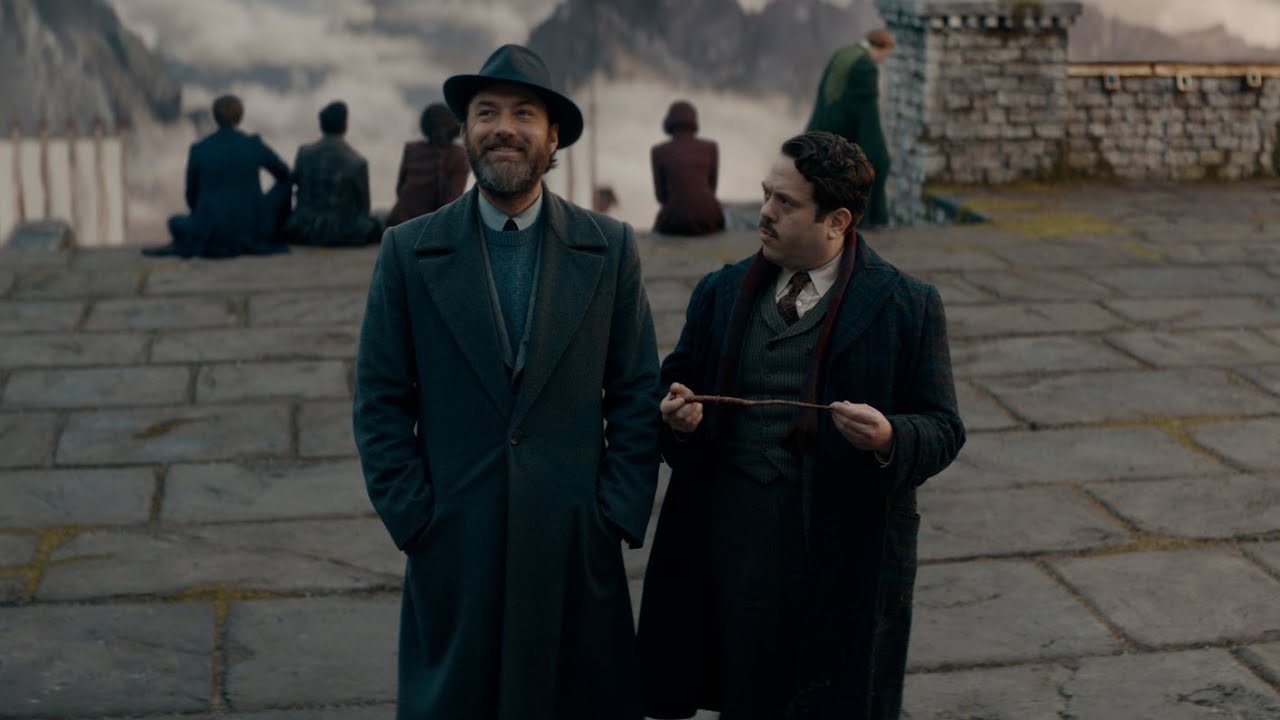
Jude Law and Dan Fogler in Fantastic Beasts: The Secrets of Dumbledore.

The third chapter of the Fantastic Beasts series, The Secrets of Dumbledore, begins with an exquisite piece of fairy-tale storytelling.  In the forests of China, Newt Scamander (Eddie Redmayne) – the English magizooogist (i.e., scholar of and caretaker for magical creatures) at the center of the narrative, set in the 1920s – oversees the birthing of a calf by a rare equine animal known as a Qilin, pronounced Chillin. The mother has a woven golden mane and a face like a mask; her tender calf is skeletal, a golden glow pulsating through his fragile skin. When the minions of the series’ villain, Gellert Grindelwald, attack, felling the mother, Newt struggles to save the baby Qilin, but he fails. He has to watch, helpless, as the calf is kidnaped and the mother expires, a single tear rolling down her cheek. It’s only then that Newt sees what everyone has missed in the chaos:  that she actually gave birth to twins.

Sunday, June 19, 2022

White Knight: The Batman

Zoë Kravitz as Catwoman and Robert Pattinson as Batman in The Batman. (Photo: Jonathan Olley/Warner Bros.)

In his 1957 architectonic study Anatomy of Criticism, structuralist Northrop Frye sketches a taxonomy of literary heroes. Those of the Mythic mode, he argues, are gods: they’re superior in kind to other characters and to their environment. They defy the laws of nature and possess divine gifts. Examples include Zeus, Bacchus, and Shiva. In a tragic narrative, they die. In a comic one, they rejoin the heavenly realm. (The Christian narrative is neither tragic, nor comic, but ironic: Christ is crucified, yet raised to the Father on the third day.)

The heroes of the Romantic mode are superior to others and their environment only by degree. Their actions are marvelous, but they themselves are human beings. In tragedy, their deaths are elegiac and tied to the decay of the created order (think Beowulf). In comedy, they ride off into a pastoral setting (e.g., the cowboy in a Western).

Following this schema, contemporary superheroes dwell in a gray area between the Mythic and Romantic modes. Some, like Superman, are gods – different from us in kind. Others, like the X-Men, are mortals but possess mutations that give them supernatural powers. And still more, like Iron Man, don’t have genetic enhancements so much as advanced technology, making them more Romantic than Mythic.

Monday, June 13, 2022

Tease: Andy Warhol in Iran

Nima Rakhshanifar and Henry Stram in Andy Warhol in Iran. (Photo: Daniel Rader)

The first play to be mounted on Barrington Stage Company’s St. Germain stage in three years is a two-hander, Andy Warhol in Iran, inspired by the artist’s 1976 trip to Tehran to snap Polaroids of the Empress Farah Pahlavi, the Shah’s wife, in preparation for painting her portrait. (Barrington Stage commissioned the piece, which is one of several new plays promised in this post-COVID season.) The two characters are Warhol – played by Henry Stram, who appeared in Richard Jones’s productions of The Hairy Ape and Judgment Day at the Park Avenue Armory – and a revolutionary named Farhad (Nima Rakhshanifar). Farhad is part of a group that hatches the idea of kidnaping Warhol from his hotel room and holding him hostage as a way of telegraphing their cause. Their scheme isn’t worked out very well, and neither, I have to say, is the plot of Brent Askari’s play, where the kidnaping is implausibly amateurish (Farhad wields a toy gun painted to make it look less obvious) and Warhol continues to cower in fear even after he figures out that he’s in absolutely no danger.

Friday, June 10, 2022

Headtrip: Everything Everywhere All at Once

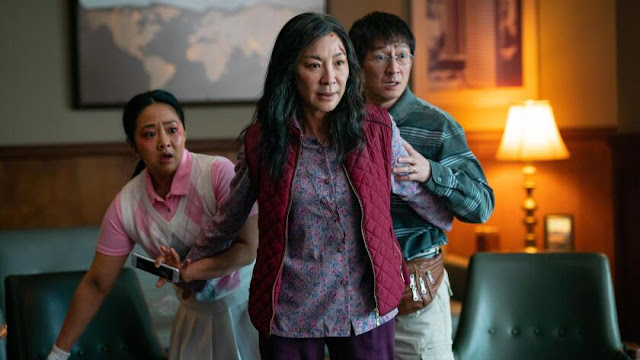
from left: Stephanie Hsu, Michelle Yeoh, and Ke Huy Quan in Everything Everywhere All at Once.

Theories of the multiverse go as far back to ancient Greek philosophy, though we associate them today with the hard sciences. Part of the discussion, historically, involves speculation about whether ours is the best of all possible worlds. Gottfried Wilhelm von Leibniz (one of the most important early modern philosophers) made this idea the cornerstone of his work The Monadology. There, the German polymath addresses theodicy, or the problem of evil. He speculates that the world we inhabit must be the best of all possible worlds, since God – who is good and who could have chosen to make any world he wished – made this one. The presence of evil, then, must have some mysterious, salutary effect – perhaps contrasting goodness for us, so we appreciate it all the more. In a world without evil, he surmises, we wouldn’t be able to recognize goodness, since it would just be the banal, uniform state of affairs. A fish doesn’t notice water unless it’s thrown on land.

Monday, May 30, 2022

The Goodspeed Reopens with Cabaret

Aline Mayagoitia as Sally Bowles in Goodspeed's Cabaret. (Photo: Diane Sobolewski)

One of the most exasperating developments of the last several decades of theatre is the rewriting of classic plays and musicals, because the originals simply disappear – it’s as if they never existed. In the twenty-first century the alterations have mostly come out of an attempt to make the texts more palatable to contemporary audiences, which have a tendency to cheer every time a character in an older setting makes an anchronistic comment transparently inserted to produce precisely that response. Audiences are increasingly being manipulated into becoming Pavlov’s dogs, salivating when someone on stage in a show set in the forties or fifties sounds as if they’re describing Trump. Will we ever again get to see a revival of A Streetcar Named Desire that ends the way Tennessee Williams wrote it, with Stanley beginning to make love to Stella to distract her from the institutionalization of her sister Blanche, rather than replicating the unconvincing ending of the (otherwise magnificent) Elia Kazan movie, where Stella rushes upstairs to Eunice and the audience pretends that she’s actually thinking of walking out on her husband? It’s hard to believe that 1951 audiences didn’t see that rewrite for exactly what it was: a sop to the Production (Hays) Code Office. Now audiences, shamelessly coddled by recent versions of the play, are encouraged to believe that Stella has suddenly acquired a feminist consciousness.

Thursday, May 26, 2022

Otherworldly: The Haunting Icons of Fatima Jamil

Red Army II, 2022 digital print on metal, 48 x 48 inches.

“Art ceases to be solely a form of self-expression alone in the electronic age. Indeed, it becomes a necessary kind of shared research and of internal probing.” – Marshall McLuhan, Through the Vanishing Point: Space in Poetry and Painting (1968).

1. Singularity

The powerfully evocative and resonant works of Fatima Jamil are encountered by the entranced viewer as a truly nuanced hybrid of Eastern and Western traditions. In fact, it strikes me that they reveal a salient truth about the artistic urge to make images and our human appetite to absorb them into our nervous systems as a kind of remedy to the stresses of everyday living: the fact that there is no East or West in the immersive dimension of dreams. I instinctively refer to her otherworldly visions as icons, but not in the liturgical and canonical sense of that word, rather in the neutral sense of being iconic: a picture, image or other representation residing in analogy. She is also a visual storyteller par excellence.

Tuesday, April 26, 2022

Off the Shelf: Law & Order, "American Dream" (1993)

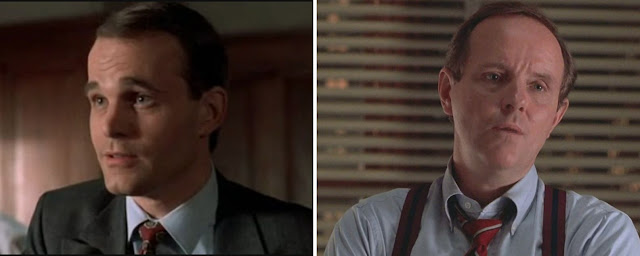
Željko Ivanek (left) and Michael Moriarty in Law & Order, "American Dream"

The recent reboot of Law & Order is singularly dispiriting – the writing has as much life as unleavened dough and the acting of the jobbed-in actors rarely rises above the mediocre. The regulars (Camryn Manheim, Anthony Anderson and Jeffrey Donovan as “order” and Sam Waterston, Hugh Dancy and Odelya Halevi as “law”) are working very hard to pretend not to notice that no one has written characters for them to play. Only Waterston has evidently thrown in the towel: he gets more mummified with every episode. I doubt it’s his own fault:  he may be pushing eighty-two, but he just gave the performance of his career as George Shultz in the Hulu miniseries The Dropout.

Friday, April 22, 2022

Self-Renewal: New Tricks by Christopher House

Christopher House in New Tricks. (Photo: Ömer Yükseker)

Canadian modern dance innovator and Order of Canada recipient Christopher House officially became a senior citizen when he turned 65 in 2020. That’s the age of retirement in Canada and after 25 years as artistic director and chief choreographer of Toronto Dance Theatre, House exercised his prerogative and announced he was quitting the company.

He had planned to have a big send-off – a retrospective season showcasing some of the work he had created over the decades for one of the country’s leading modern dance troupes, in addition to a couple of new commissions made especially for him to dance in. But then the pandemic rudely disrupted what was to have been his grand finale, compelling House to leave his position without the anticipated fanfare.

The curtain never did come crashing down on his dancing career, which in retrospect is a good thing. Without a fixed ending, House has just kept on going, creating, and performing now as an independent solo artist. New Tricks, a multipart work whose premiere took place at The Citadel: Ross Centre for Dance during the last two weekends of March, is the first choreography he has made since becoming a pensioner, and it's among the best he has produced in years.

Monday, April 18, 2022

The Disintegration of the American Theatre: A Report from the Front

The cast of The Minutes, the new play by Tracy Letts at New York's Studio 54.

This is a review of The Minutes. It includes spoilers.

For the first half of its ninety-minute running time (sans intermission), Tracy Letts’s new play The Minutes (at Studio 54) is an inconsequential but frequently hilarious chronicle of a meeting of the government of a small town called Big Cherry located in an unspecified state. Working on David Zinn’s evocative set, the fine director Anna D. Shapiro – whose Broadway credits include Letts’s August: Osage County as well as The Motherfucker with the Hat and the beautiful 2014 revival of Of Mice and Men – and a flawless cast flesh out the idiosyncrasies, the long-festering petty tensions and the various ineptitudes of this motley group, two of whom (played by Blair Brown and the delightful Austin Pendleton, whose timing is both eccentric and unequalled) have served on the town council for decades. There are three main points of focus. One is the attempt of Mr. Hanratty (Danny McCarthy) to obtain funding for an accessible fountain in the town center, which goes down because hardly anyone in the room has any interest in Hanratty’s spirit of inclusiveness: as Mr. Breeding (Cliff Chamberlain), the most forthrightly insensitive person in the room, expresses it, the definition of “disabled” is an inability to do things that “normal” people have no trouble with. The second is the proposal of Mr. Blake (K. Todd Freeman) to institute a game called Lincoln Smackdown for the annual town heritage festival in which attendees try to knock down someone dressed as Abraham Lincoln (who, in real life, had no connection to Big Cherry). Meanwhile the newest addition to the council, Mr. Peel (Noah Reid of the TV series Schitt’s Creek), who missed the last meeting because he was out of town for his mother’s funeral, is struggling to catch up but hits a brick wall: another member has been unaccountably ousted, and he can’t get anyone to tell him why. Equally mysteriously, the town clerk (Jessie Mueller) has not distributed the minutes from the previous week that might explain his absence. Whenever Peel tries to stop the proceedings and address the mystery, the mayor (played by Letts himself) shuts him down on one pretext or another.

Friday, April 8, 2022

A Rejuvenated Sleeping Beauty at the National Ballet of Canada

Harrison James and Heather Ogden with artists of the National Ballet of Canada in The Sleeping Beauty. (Photo: Teresa Wood)

As a harbinger of spring, the National Ballet of Canada’s recent presentation of The Sleeping Beauty was an especially happy occasion. The first lavishly designed full-length ballet to open on the Four Seasons Centre stage since the March 2020 lockdowns, it burst on the eye like a garden of suddenly blooming flowers. Oh the sumptuousness of it all. And how sorely such choreographed extravagance, the ultimate in escapism, has been missed during the bleak days of the pandemic.

Thursday, April 7, 2022

A Dance to the Music of Time: 4-Dimensional Sculptures by Joachim Waibel

Nude portraits of antique clocks without their hands, silently holding their vigil and thus calmly reminding us of Henri Bergson’s bold 1911 admonition: “Time is invention, or it is nothing at all.”


“For reasons not at the time explicable, there are specific occasions when events begin suddenly to take on a significance previously unsuspected, so that before we really know where we are, we ourselves, scarcely aware that any change has taken place, are careening uncontrollably down the slippery avenues of eternity.”  – Anthony Powell, 1955.

When the French novelist Marcel Proust finally published his long-awaited seven-volume magnum opus In Search of Lost Time in 1913, after labouring meticulously, some would say obsessively, over his work for almost as many years as there were volumes, he was sharing with us the culmination of his devotion to memorializing not just memory but the actual passage of time itself. He had attempted and clearly succeeded in producing almost a balsamic reduction of himself and his reveries in words that are at once poetic and precise. Further, he had achieved a landmark, not only in literature but in the poetics of psychological introspection, coming in the end to almost perfectly embody the ethos of poet Wallace Steven’s definition of poetry: the search for the inexplicable.

Wednesday, April 6, 2022

Street Dance on Stage: In My Body by Bboyizm/Crazy Smooth

 Bboyizm dancers in Crazy Smooth’s In My Body. (Photo: Jerrick Collantes)

Hip hop is a ruthlessly athletic dance form that pushes the body to the limits. The acrobatic moves, requiring immense stores of physical prowess and stamina, are so demanding that break dancing is set to become an Olympic sport when the games resume in Paris in 2024. The fast footwork, head spins, aerial flips and floor drops take a toll. Not for nothing are break dancers called b-boys and b-girls, names connoting the youthful vigour needed to pull it off. Crazy Smooth, aka Yvon Soglo, knows.

The Benin-born, Gatineau-based break dancer has been involved in hip hop culture since 1997, going on to form Bboyizm, an award-winning street-dance company that has been instrumental in the preservation and proliferation of street dance in Canada since its founding in 2004. Today, at age 41, he’s still a b-boy, but a b-boy with knee problems and a middle-age crisis on his hands. How to keep dancing when the spirit is willing but the body is getting weaker with each advancing year? It’s a question that drives In My Body, a thrilling interactive street dance work whose Toronto premiere took place at the Bluma Appel Theatre, inside the St. Lawrence Centre for the Arts, on March 17.