Showing posts sorted by relevance for query Bob Fosse. Sort by date Show all posts

Monday, August 12, 2019

Song and Dance, Part II: Fosse/Verdon

Sam Rockwell and Michelle Williams in Fosse/Verdon.

Sam Rockwell’s portrait of Bob Fosse – the legendary director-choreographer whose body finally succumbed to drugs, alcohol, nicotine and workaholism at the age of sixty, in 1987 – in the eight-part F/X miniseries Fosse/Verdon is one of those rare dramatic reincarnations of a celebrity that you feel, as you watch, you will retain forever in your mind alongside the work of the real one. (Some other examples: Judy Davis as Judy Garland and Geoffrey Rush as Peter Sellers, both also in TV dramatizations, and Annette Bening as Gloria Grahame in the 2017 movie Film Stars Don’t Die in Liverpool.) I saw Rockwell was at the Williamstown Theatre Festival in 2000 in the supporting role of the desk clerk in a production of Lanford Wilson’s The Hot L Baltimore, which is set in the lobby of a low-rent residential New York hotel. The director, Joe Mantello, staged a pre-show during which some of the members of the ensemble wandered on and improvised behavior that sketched in their characters before we heard any of the dialogue Wilson had scripted for them. I can’t remember what any of the other actors did because Rockwell made his simple tasks so interesting – so detailed and so quirky – that my companion and I kept our eyes on him the whole time. And nearly twenty years later, his performance, in the margins of the show, is the only one I still recall. I had already started spotting him in movies like Galaxy Quest and Michael Hoffman’s version of A Midsummer Night’s Dream, where he exhibited the same distinctive combination of focus, precision and humor, all guided by an unpredictable perspective, as if his character occupied some space in the world that no one else had ever noticed before. Both those movies came out in 1999; Rockwell has played dozens of roles since, many of them in bad or forgettable movies, and I haven’t always liked him. (I hated his Oscar-winning performance in Three Billboards Outside Ebbing, Missouri, but it would be unfair to pin the blame on Rockwell, since nothing in that repellent movie made an iota of sense.) But I think his gifts are both outsize and off-kilter, and when he’s good he can be sensational. He was the best thing about Vice, for instance, drawing on impressive resources for satirical impersonation to play George Bush Jr. But what he does as Bob Fosse goes way beyond impersonation, though he gets down the man’s slouching grace and his sexy slightness and the way the cigarette tucked insouciantly in the corner of his mouth completed him as definitively as it completed Bette Davis or Humphrey Bogart. Rockwell gets inside Fosse – his compulsions about work and sex, his ambition and unsatisfiable perfectionism, his cynicism about show business and about his own talents, the erotic charm that was generated as much by his world-weariness as by his persistence and the appeal of being around his genius.

Monday, December 31, 2012

Back to the 70s: Pippin and Annie

Patina Miller as Leading Player in Pippin
Pippin opened on Broadway in the fall of 1972, toward the end of what was unmistakably the Year of Bob Fosse. His film of Cabaret rethought the syntax of the movie musical, both stylistically (the numbers were Brechtian commentaries on theme, character and historical setting rather than expressions of emotion) and visually (he was the first director of film musicals to employ editing as a rhythmic element). On television he collaborated with his Cabaret star, Liza Minnelli, on an inventive, highly theatrical one-woman revue called Liza with a ‘Z’. And he returned to Broadway, where he’d received his training as a choreographer and then as a director, with Pippin. I saw it a few months after graduating from college and I recall it as the first truly schizoid experience I ever had at the theatre. The staging was mesmerizing, exactly the feat of wizardry that the opening number, “Magic to Do,” set the audience up to expect, but the material itself – Roger O. Hirson’s book and Stephen Schwartz’s songs – was threadbare. And since Fosse’s trademark theme, which he imposed on everything he worked on, was the discrepancy between the razzle-dazzle surface and the shoddy, corrupt underneath, the show seemed constantly to be commenting on its own inadequacies, reminding us that what we were watching was merely trompe l’oeil executed by a seasoned (and cynical) magician. It was a hell of a spectacle, and it wasn’t much fun.

Monday, August 24, 2015

Sweet Charity: Manhattan Waif

Julie Martell (centre) with the cast of Sweet Charity, at Niagara-on-the-Lake's Shaw Festival. (Photo by David Cooper)

The 1966 musical Sweet Charity is built around a debased modern version of a fairy-tale heroine, an eternally optimistic New York taxi dancer who falls for men who invariably let her down. The book, which Neil Simon based on the great Fellini movie Nights of Cabiria, employs the Manhattan setting to localize Charity’s story, just as Fellini made use of Rome; one episode, where Charity, in the right place at the right time, finds herself on an improbable date with a dishy Italian superstar who’s just quarreled with his paramour, is straight out of the film. But Simon and the songwriters, Cy Coleman and Dorothy Fields, and the director-choreographer, Bob Fosse – who conceived the project as a vehicle for his frequent muse and one-time wife Gwen Verdon, a magnificent show dancer with an endearing cracked voice full of burgundy bubbles – softened the narrative. Cabiria (played, unforgettably, by Fellini’s wife, Giulietta Masina), is a hooker who pictures herself living out the last act of a romance; the first man who treats her like a lady, Oscar (François Périer), turns out to be a thief who swindles her out of her life savings. (One of Fellini’s coups is the way he uses a pair of props, a cigarette and a pair of shades, to suggest a sinister side to Oscar moments before Cabiria intuits his true intentions.) In the musical, Oscar is a timid, earnest fellow Charity connects with when they’re trapped in an elevator together; their courtship takes them all over the city, including a hippie church and Coney Island).

Monday, April 10, 2023

Musical Revivals I: Funny Girl and Dancin’

Lea Michele in Funny Girl. (Photo: Matthew Murphy)

The Broadway revival of Funny Girl is a hit, but its path has been slippery. Michael Mayer’s production started in London, opening at the Meunier Chocolate Factory in 2016 with Sheridan Smith. But when it transferred to the Savoy Theatre in the West End, Smith dropped out due to stress and exhaustion and was replaced by her understudy, Natasha Barnes. That’s when I caught it, and without a luminous Fanny Brice to anchor the musical that made Barbra Streisand famous – and vice-versa – it wasn’t much. The modesty of the staging and designs was just over the line from looking seedy, and since the cast was so small, the supporting players as well as the chorus had to join in the dances that bridged – somewhat desperately – the many scenes, Funny Girl being a representative of the last successful decade of large-scale Broadway musicals.

Friday, October 8, 2010

Empathy: Jeffrey Friedman and Rob Epstein's Howl

When Allen Ginsberg wrote his epic poem “Howl” in 1955, after being encouraged by the anarchist scribe Kenneth Roxworth to free his voice, it was an attempt to recreate the spontaneous prose that his friend and novelist Jack Kerouac accomplished in On the Road (1951). “I thought I wouldn’t write a poem but just write what I wanted to without fear, let my imagination go, open secrecy, and scribble magic lines from my real mind – sum up my life – something I wouldn’t be able to show anybody, writ for my own soul’s ear and a few other golden ears,” Ginsberg once said about his famous ode.

The new film, Howl, by Jeffrey Friedman (The Celluloid Closet) and Rob Epstein (The Times of Harvey Milk), sets out to get inside those “magic lines” to illuminate how Ginsberg’s poem, with it’s free-form jazz rhythms, worked its hoodoo on an awakening audience of American bohemians seeking cosmic freedom in the mid-fifties. Howl, which stars James Franco as Ginsberg, is a film of bottomless empathy for its subject. The movie examines how Ginsberg’s “Howl” provided a framework for the acceptance of his homosexuality, as well as a vehicle for coming to terms with his mother’s death from mental illness. (The poem itself was written for Carl Solomon whom he met in a mental institution.) Yet “Howl” would also go on to ignite an obscenity trial in 1957 once San Francisco poet Lawrence Ferlinghetti, owner of City Lights Books, published the work in 1956 as part of a collection titled Howl and Other Poems. While celebrating the quest for spiritual freedom in Ginsberg’s work, Friedman and Epstein successfully get at the irreverent roots of Ginsberg’s rebellion and why “Howl” became such a passionately impish and angry sonnet.

Friday, July 15, 2016

Farewell to John McMartin (1929-2016)

From left: Alexis Smith, John McMartin, Dorothy Collins and Gene Nelson in the 1971 production of Follies.

During my junior year in college, Stephen Sondheim’s Follies tried out in Boston and I saw it on opening night, with John McMartin – who died last week, at the age of eighty-six – in the leading male role. The musical is set at a reunion of showgirls in the about-to-be-torn-down Broadway house where they appeared in annual editions of an elaborate revue, and the main characters are two couples – one-time chorines and best friends and the men they married – whose lives turned out to be marked by longing, regret and increasing bitterness. McMartin played Ben Stone, celebrated diplomat and author, who starts out by denying that he wishes he’d lived his life differently, then falls in love all over again with the woman he didn’t marry (played by Dorothy Collins) – or rather, with his romanticized memory of her and of the man he used to be. I’ve never forgotten McMartin’s devastating performance. In act one, when he sang “The Road You Didn’t Take,” Ben’s supposed refusal to admit that his might not have been the right road, McMartin’s pebble-strewn tremolo conveyed the heartbreak and the escalating rage bubbling up beneath his insistence. It remains one of the greatest dramatic performances of a song I’ve ever experienced in a theatre. At the last televised birthday tribute to Sondheim, in 2010, McMartin reprised it. He was eighty by then, but astonishingly his rendition had lost none of its emotional power.

Monday, February 9, 2026

Dance You Want to Know: Small Screens, Post‑Pandemic Stages and the Pull of the Crowd

A still from CDK Company's dance video, Gotye's "Somebody That I Used to Know."

I’ve been noticing something. It started, as these things often do now, on my phone. One of my favourite pop laments, Gotye’s “Somebody That I Used to Know”, kept resurfacing not as a song, but as a dance: a viral clip of dozens of young bodies in retro office‑casual dress, swirling and lunging in tight formation across a pastel‑toned courtyard. The choreography by Netherlands-based CDK Company was sharp but not presentational, massed yet curiously intimate, as if a crowd scene from an old Hollywood musical had slipped into 2020s streetwear and discovered contemporary release technique. I watched it over and over, wondering: what am I looking at here? A music video? A fashion film? A new kind of ensemble dance built for the camera rather than the stage?

Friday, April 29, 2011

White Face, Black Shirt/White Socks, Black Shoes: Sex & Drugs & Rock & Roll (2010)

I was not a child of Woodstock; I was too young. Sure, I loved the music of The Beatles, The Byrds and The Who, and many others, but it didn't define me. Instead, the music of my formative years was the music from 1976 to 1984 that is known as New Wave – particularly from Britain and Ireland. New Wave encompassed a vast array of musical styles, including rock, post-punk, ska, reggae, jazz, music hall and others. Bands like Elvis Costello and the Attractions, The Clash, Nick Lowe, Joe Jackson, Dave Edmunds, Ultravox (pre-Midge Ure), Joy Division, The Cure, Wreckless Eric, The Specials, Madness, English Beat, The Stranglers, The Boomtown Rats, Graham Parker and the Rumour, and Ian Dury and the Blockheads, were some of the ones that captured my ears. The music of these bands was a response to the blotted excesses of the just-passed prog rock (think Emerson, Lake and Palmer; or Rick Wakeman), but it was also an answer to the thrash and bash of punk, personified in bands like the Sex Pistols and The Damned (The Clash were punks at first too, but quickly abandoned the style). Instead of bashing away and ranting at the world, à la the punks, the New Wave artists wrote short, punchy pop, rock or ska songs played with a modicum of skill. They were equally angry (Costello's “(I Don't Want to Go to) Chelsea” and The Clash's “London Calling” were signature songs of the movement), but the melody and musical skills were far more appealing to me than the scream of punk. Many of the performers I'd admired got their start on a rebellious label Stiff Records, whose motto was “If It Ain't Stiff, It Ain't Worth a Fuck.” And of these bands, the one I held closest to my heart was Ian Dury and the Blockheads. Songs like “Sex & Drugs & Rock & Roll,” “Hit Me With Your Rhythm Stick,” “Sweet Gene Vincent” and “Wake Up and Make Love With Me” still play 'in heavy rotation' in my listening universe.

Monday, May 30, 2022

The Goodspeed Reopens with Cabaret

Aline Mayagoitia as Sally Bowles in Goodspeed's Cabaret. (Photo: Diane Sobolewski)

One of the most exasperating developments of the last several decades of theatre is the rewriting of classic plays and musicals, because the originals simply disappear – it’s as if they never existed. In the twenty-first century the alterations have mostly come out of an attempt to make the texts more palatable to contemporary audiences, which have a tendency to cheer every time a character in an older setting makes an anchronistic comment transparently inserted to produce precisely that response. Audiences are increasingly being manipulated into becoming Pavlov’s dogs, salivating when someone on stage in a show set in the forties or fifties sounds as if they’re describing Trump. Will we ever again get to see a revival of A Streetcar Named Desire that ends the way Tennessee Williams wrote it, with Stanley beginning to make love to Stella to distract her from the institutionalization of her sister Blanche, rather than replicating the unconvincing ending of the (otherwise magnificent) Elia Kazan movie, where Stella rushes upstairs to Eunice and the audience pretends that she’s actually thinking of walking out on her husband? It’s hard to believe that 1951 audiences didn’t see that rewrite for exactly what it was: a sop to the Production (Hays) Code Office. Now audiences, shamelessly coddled by recent versions of the play, are encouraged to believe that Stella has suddenly acquired a feminist consciousness.

Saturday, March 29, 2014

Cabaret: The Crooked Frame in “The Attack on Modern Art in Germany 1937”

Alan Cumming in the 1998 production of Cabaret.

Indulge me in serving up what might appear as an improbable conceit: that the current New York production of Sam Mendes’s Cabaret, that (as I write) is in previews on Broadway, could have been included in the Degenerate Art Exhibition of avant-garde paintings and sculptures on display uptown at the Neue Galerie. The Mendes production is a revival of his own 1998 reinterpretation of the 1966 Harold Prince Broadway blockbuster and the 1972 celebrated Bob Fosse film, all of which are loosely based on Christopher Isherwood’s Berlin Stories and his experiences in Berlin during the early 1930s when he befriended a cabaret singer who became the inspiration for Sally Bowles. If Prince and, to a greater extent, Fosse’s glossy sheen and honky-tonk gaiety were inspired by the garishly-coloured and provocative subject matter depicted in the paintings of George Grosz, Otto Dix, Ernst Ludwig Kirchner and Max Beckmann, Mendes offers a grungier, economically desperate and grimmer look. Both the characters and the set – the Kit Kat Klub alternates with a dowdy rooming house without any evidence of conspicuous wealth – communicate a sense of impending danger, false hope, resignation and the threat of radical change that will forever alter their lives and designate the cabaret as degenerate just like the modernist artworks that provided some of the cinematographic cornucopia in the Fosse film.

Tuesday, July 9, 2013

Arc of a Song: On Broadway

Songwriters Cynthia Weil and Barry Mann, circa 1966 (Getty Images)

In the history of popular music, or music written since 1900, we currently enjoy an evolution of 113 years worth of the art of the song. I’d like to take a look at one song, “On Broadway,” and four contrasting versions that reflect the times in which they were recorded.

“On Broadway” was written by Cynthia Weil and Barry Mann, two of the most successful songwriters to come out of the famous Brill Building, the songwriter’s haven of New York City. It was first recorded in 1962 by a girl-group known as The Cookies, whose version was more of a light novelty pop song. Jerry Leiber and Mike Stoller, who shared an office with Weil and Mann in the Brill Building, took the song to a different, now familiar, version, setting the tune to an R&B rhythm and changing the phrasing to reflect an more nuanced and personal story about a young person looking for hope “on Broadway”. The result of Weil/Mann/Leiber/Stoller collaboration was the remarkable 1963 recording by The Drifters.

Wednesday, October 31, 2012

Phoenix Descending: The Young and the Restless and the Doomed

River Phoenix (1970-1993)

As a starstruck little girl, I experienced a broken heart when 24-year-old James Dean died in an automobile accident on September 30, 1955. From that day on, I began each entry in my diary with “Dear Jimmy.” A somewhat similar sadness took hold when drugs claimed the life of 23-year-old River Phoenix on Halloween 1993. But in starstruck adulthood, I no longer kept a diary with which to deny the untimely deaths of sensitive young actors.

Like Dean, Phoenix projected vulnerability, intensity and an edgy sense of potential self-destruction in his films. These qualities, which graced them both with a charisma lacking in most of their otherwise talented Hollywood peers, almost made tragedy seem inevitable. From a troubled adolescent in Stand by Me (1986) to the anguished son of fugitive parents in Running on Empty (1988), Phoenix brought that special something to the screen. In director Gus Van Sant’s My Own Private Idaho (1991), he portrays a character with narcolepsy. Never very lively while awake, he abruptly falls asleep anywhere, anytime – much like a junkie nodding out. It’s an uncanny performance in a strange movie based on Shakespeare’s Henry IV.

Tuesday, August 9, 2016

Critic's Notes & Frames Vol. XIX

Comedian Lenny Bruce, who died fifty years ago, once wrote, "People should be taught what is, not what should be. All my humour is based on destruction and despair. If the whole world were tranquil, without disease and violence, I'd be standing in the breadline – right back of J. Edgar Hoover." I was first introduced to Bruce in 1970 while in high school where we were learning 'what should be.' Standing around in gym after class, where getting hassled by hyper-masculine athletic jocks comprised 'what is,' a long haired soul who appeared equally big and intimidating named Tony Sloggett handed me a book –The Essential Lenny Bruce – and said, "You might like this." Then he walked away.

The Essential Lenny Bruce was a collection of this equal opportunity offender's best routines and many of them made me laugh – if not uneasily – because they didn't exactly provide comfort for my own views. At times, they weren't entirely understandable, either. In satirizing the straight world, Bruce employed both the argon of the hip and (since he was Jewish) Yiddish. Many of the hip words were pretty clear, but Yiddish was way out of my league. That left me chasing down the only Jewish guy I knew at my school, the straight arrow Mel Raskin, who was also a daily victim of the thugs in gym class. I'm still trying to imagine what must have been going through his mind as I followed him down the street asking things like, "Mel, what does shtup and putz mean?" (Mel has since, in a twisted irony known only to God, become a radio broadcaster of Oshawa Generals hockey games.)

When Bruce began to build his reputation as the "King of the Sick Comics," he took on everyone – from the Pope to Jimmy Hoffa. When he was a guest on Hugh Hefner's after-hours TV talk show, Playboy Penthouse, he did a television first – he blew his nose on camera. Bruce satirized and tested the prudishness of the audience. His daring wasn't in the romantic portrait Dustin Hoffman provided in Bob Fosse's Lenny (1974), where he was seen as the misunderstood rebel, but in his fearless approach of all that was sacred – even to liberals – and combining with that the performer's fervor in getting a rise out of the audience. We were as much the butt of his jokes as we were participants in them. One such example, which was one of the first routines I read in The Essential Lenny Bruce, was his outrageous "Christ and Moses" below in The Carnegie Hall Concert.

Sunday, August 8, 2010

This is It: Some Final Thoughts on Michael Jackson

I recently caught up with Kenny Ortega's 2009 documentary Michael Jackson's This is It and thankfully it isn't an act of exploitation. Now I wouldn't put Ortega in the same league as Bob Fosse (Cabaret), but This is It certainly proves that great choreographers can sometimes make pretty good film directors. The movie documents Jackson's rehearsals and preparations for the comeback he was about to launch on July 13, 2009. When he died on June 25th, however, the only remnants of what might have been were captured by Ortega's film team shooting Jackson running through musical numbers, auditioning and directing the dancers, the conceptual stage design work, and some interviews with those who took part in the preparation for the show that never was.

What's particularly staggering - and thrilling - about this extremely entertaining picture is that it manages to both fundamentally shape the process of Jackson's art as well as demonstrate it. That is, we get to see Michael Jackson (who looks in peak form) working out the program as well as executing the numbers. This is It also reveals that the concerts were designed as a Michael Jackson musical primer that would cover his entire career dating back to the Jackson Five. Ortega stages the numbers as if he's imagining what they'd look like in their finished form. He thinks like a dancer so the images move fluidly with the music. (The footage was filmed at the Staples Center and Los Angeles Forum arenas in California.)

Monday, June 11, 2018

Effigies of Wickedness!, The Rink, Brief Encounter: Words and Music

Lucy McCormick, Le Gateau Chocolat, Peter Brathwaite, and Katie Bray in Effigies of Wickedness! (Photo: Helen Murray)

When the Nazis staged an exhibition of “degenerate music” in Düsseldorf in 1938, the accompanying manifesto characterized the targeted music – some the work of Jewish and black artists, much of it political and cynical and satirical, some of it experimental – as “effigies of wickedness.” The current co-production of the Gate Theatre and the English National Opera, a cabaret of German songs from 1920 through 1939 but mostly representing the Weimar era (which officially ended with Hitler’s rise to power in 1933), has taken that phrase as its title. This is social and political theatre – Brechtian theatre – at its most potent. In the Gate’s compact Notting Hill space above a pub, four dazzling singer-actors – Peter Brathwaite, Katie Bray, Lucy McCormick and the drag performer Le Gateau Chocolat – and three wonderful musicians (Geri Allen, Cassie Kinoshi and Fra Rustumji), under the direction of the Gate’s artistic director Ellen McDougall and the musical direction of Phil Cornwell, present fourteen songs, most of them translated into English by Seiriol Davies and David Tushingham. Many who love Bob Fosse’s Cabaret may understand that the Kit Kat Klub numbers are imitating a style of commentary art songs that was popular in the late twenties and early thirties, but we know almost nothing from the repertoire of Berlin’s kabarett theatre: the score of Kurt Weill and Bertolt Brecht’s The Threepenny Opera (1928), perhaps a smattering of songs from their Happy End and The Rise and Fall of the City of Mahagonny (1929 and 1930 respectively). The only tune I recognized in Effigies of Wickedness! was “Petroleum Song” (lyric by Felix Gasbarra), which Teresa Stratas recorded in her magnificent two-album set of Weill songs nearly thirty years ago. All the others were revelations to me, and every one is a gem. The production illuminates the work of forgotten composers like Misha Spoliansky, Hanns Eisler and Frederick Hollander, whose name may be familiar to Marlene Dietrich aficionados. (He wrote the music for The Blue Angel and, emigrating to Hollywood in the crush of German-Jewish artists fleeing Hitler in the early thirties, worked on several of her American movies as well as many others.)

Saturday, November 12, 2011

Love Lies Bleeding: A Pop Ballet That Really Pops

The artists of Alberta Ballet rock out to "Benny and the Jets" in Love Lies Bleeding

Jean Grand-Maître took the stage at Toronto’s Sony Centre on Tuesday night, just moments before Alberta Ballet would perform the area premiere of his full-length Love Lies Bleeding, set to and directly inspired by the music of Elton John. Microphone in hand, Grand-Maître genially asked the capacity crowd how many had come to the ballet for the first time. A roar rippled through the auditorium and the Canadian choreographer smiled. It was a sign that his mandate of creating pop ballets for the Calgary-based company since becoming director in 2002 was indeed working: bums in seats, but more importantly, bums attached to people who might not otherwise be caught dead watching men in jock straps pointing their toes in an undulating sea of ballerinas. But as if wanting to quell any lingering reservations, Grand-Maître told the audience not to worry: “This is not really a ballet,” he continued. “It’s more like a rock concert. So sit back, relax and unleash your inner pop star.”

"Rocket Man": Yukichi Hattori, Company Artists
For the next two hours that is pretty much what happened. The crowd screamed, it sang, it clapped along; some in the house could be seen even dancing in their seats. At the end, it rose en masse to give the ballet an instantaneous standing ovation on top of prolonged applause. To ballet purists it was a somewhat different story. The choreography is more borrowed than original: Bob Fosse meets the cross-dressing Les Ballets Trockadero de Monte Carlo, meaning lots of crotch thrusts and drag queens galore. Such details have entertainment value, but don’t necessarily advance the art form. Still, there was plenty to like, even admire. It is one of the few ballets to foreground men in ballet as opposed to women and for that is to be applauded as something rare indeed. It also has at its centre an aerial number, choreographed by Adrian Young, which literally sets the dancers flying, a wonder to behold. But the ballet scales heights in other ways: Love Lies Bleeding is the Alberta Ballet’s Tommy, a reference to the ballet inspired by The Who’s rock-opera of the same name created for Montreal’s Les Grands Ballets Canadiens in 1970 by resident choreographer by Fernand Nault, a work that first put Canadian ballet on the international map. So while not a new invention, Love Lies Bleeding is ballet for the masses whose popularity may bode well for the future of the art itself, enticing even more bums down the line to wiggle in their seats.

Monday, August 22, 2022

Crowd Pleasers: Damn Yankees and Gaslight at the Shaw Festival

Jay Turvey with the Ballplayers in Damn Yankees, at the Shaw Festival. (Photo: Michael Cooper)

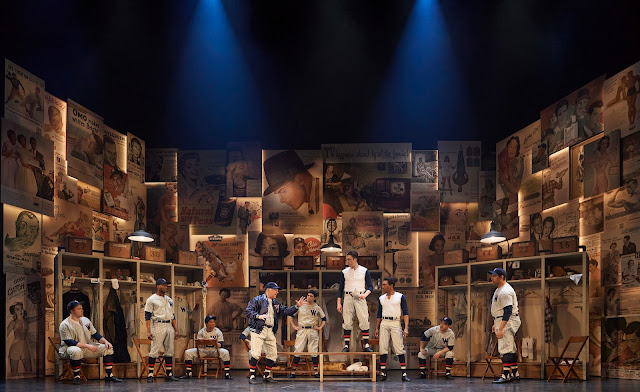
Richard Adler and Jerry Ross might have entered the pantheon of Broadway songwriters if fate hadn’t extinguished their star so fast. Adler was thirty-one and Ross twenty-eight when George Abbott commissioned them to write the score for The Pajama Game (1954), adapted by Abbott and Richard Bissell from Bissell’s novel 7-1/2 Cents, about the tensions between labor and management in a Midwestern pajama factory. It was a legendary show: Abbott and Jerome Robbins co-directed, a young Bob Fosse staged the dances, and it ran for three years. (A boisterous movie version in 1957, helmed by Abbott and Stanley Donen, captures the spirit of the original, with all but two members of the Broadway cast reprising their performances.) In 1955 lightning struck again for Adler and Ross with Damn Yankees. Adapted by Abbott and Douglass Wallop from Wallop’s book The Year the Yankees Lost the Pennant, Damn Yankees was as big a hit as The Pajama Game. But six months after its triumphant premiere, Ross died suddenly of lung disease. Adler never had another success, alone or with a collaborator, though his lovely score for the South Africa-set musical Kwamina, which he wrote for his wife, Sally Ann Howes, is ripe for rediscovery. (Its interracial love story was undoubtedly too controversial for 1961.)

Tuesday, May 16, 2023

Gypsy at the Goodspeed: The Vaudeville Spirit

Talia Suskauer and Laura Sky Herman in Gypsy. (Photo: Diane Sobolewski)

You know that Jenn Thompson, the director of the Goodspeed Opera House’s production of Gypsy, has a steady hand on the wheel right from the opening scene. It’s an audition for child acts in a dilapidated Seattle theatre in the grim last years of vaudeville, when the talkies dealt it a long, painful death that coincided with the Depression. The stage is crowded with kids in a variety of garish get-ups and their mothers until Uncle Jocko (Edward Juvier), the ulcerated, borderline creepy, far-from-unbiased comic hosting the variety show, banishes the latter. Then Rose (Judy McLane), who is promoting her little girl, Baby June (Emily Jewel Hoder), bulls her way down the aisle; the rules don’t apply to her. June has a head full of blonde curls and an affected squeal; she’s a nightmarish proto-Shirley Temple, flanked by her awkward older sister Louise (Cameron Blake Miller). Thompson’s staging picks up the show-biz chaos, its comedy and preposterousness and desperation, which finds its most feverish embodiment in Rose, the quintessential stage mother – perhaps the greatest and most original creation in the history of musical theatre.

Monday, April 6, 2015

Lerner and Loewe and a Touch of Cy Coleman

Vanessa Hudgens stars in Gigi, at Broadway's Neil Simon Theatre. (Photo by Joan Marcus)

Gigi, which is now being revived on Broadway, has a long lineage. Initially it was a story by Colette, written in 1945 and set around the turn of the century, about a teenage Parisienne (the title character) who comes from a family of highly respected courtesans and is being brought up by her grandmother, Mamita, and trained by her great-aunt Alicia to follow in their footsteps. (Her mother took another path: she’s a singer in the ensemble of the Opéra Comique and barely present in her daughter’s life.) When Gaston Lachaille, a millionaire playboy who, through his friendship with Mamita, has been a sort of big brother to Gigi all her life, realizes that she’s grown into a beautiful and desirable young lady, Alicia and Mamita make complicated legal arrangements with him to take over her care. But Gigi has a mind of her own and, though she has fallen in love with Gaston, she resists the life of a rich man’s mistress. The story is a delightful comedy about the tension between social and sexual mores on the one hand and emotional authenticity on the other, and about impulses that flout convention – and upset the apple cart everyone has been riding without thinking much about it.

Wednesday, September 9, 2015

When You Speak Love: Christian Petzold's Phoenix

Ronald Zehrfeld and Nina Hoss

The German director Christian Petzold garnered some deserved attention for his 2012 movie Barbara, which told the story of an East German doctor (Nina Hoss) in the 1980s, banished to a country hospital as punishment for applying for an exit visa, who plots to defect but is sidelined by her emotional involvement in the case of a female patient. As a chronicle of life in East Germany in the years before the Berlin Wall came down, Barbara is smaller-scale than The Lives of Others – one of a small handful of movies since the millennium that truly deserve to be called masterpieces – but it demonstrates a piecing intelligence, a gift for working with actors (Hoss gives a superlative performance), and an easy mastery of film vocabulary. It’s an elegant and fiercely compelling piece of moviemaking, and I think that Phoenix, his new picture, is even better.

Petzold is again working with his co-writer on Barbara, Harun Farocki, and again features Hoss opposite the fine actor Ronald Zehrfeld, who played the head of the clinic Barbara is exiled to. In Phoenix Hoss, in a performance of profound tremulous feeling, plays Nelly Lenz, a Jewish cabaret singer who returns from the camps at the end of the Second World War so badly disfigured that she hides her face under a bandage. Her experience has left her so fragile that she barely seems able to function. She arrives back in Berlin under the care of another woman, Lene Winter (Nina Kunzendorf), who seems to have an administrative job that gives her access to government documents. (I think we’re meant to assume that Lene and Nelly met in the camps, but the movie is rather mysterious on the source of their association.) Lene guides her through reconstructive surgery that leaves her looking somewhat but not exactly like the woman she was before she was taken by the Nazis, and Lene makes plans for the two of them to emigrate to Israel. But Nelly didn’t think of herself as a Jew in the days before the Holocaust, and she still doesn’t. And what she wants is to find her Gentile husband Johnny, a pianist who hid her from the Gestapo in a boat until they finally caught up with her. Lene is convinced that it was Johnny who turned Nelly in at the end, but Nelly is still crazy about him and doesn’t believe her friend’s version of events. Haunting the seedier clubs, she locates Johnny (Zehrfeld), working not as a musician but as a waiter, and of course he doesn’t recognize her. But he notes her resemblance to his wife, who, he is certain, died during the war.