Showing posts sorted by relevance for query Elia Kazan. Sort by date Show all posts

Friday, May 24, 2013

Beyond Palookaville: The Criterion Collection Release of On the Waterfront

"I can't discuss it as a movie anymore," director Martin Scorsese tells film critic Kent Jones in an interview included on the new Criterion Collection release of Elia Kazan's powerhouse 1954 drama On the Waterfront. "It's more of a phenomenon. Are there better movies? Probably. I see how the story is structured to make a point...[Yet] there is something revolutionary about that film." There are few movies that take us beyond the experience of simply watching one. Certainly Citizen Kane (1941) does, with its dazzling sound and visual innovations, where director Orson Welles – having come to Hollywood out of his daring work in theatre and radio – combines the two mediums in order to treat our eyes in the way we often use our ears. In doing so, he distracts us from some of the shallowness and the flaws in the plot and unleashes something boldly new and entertaining. Jean Renoir's The Rules of the Game (1939) is undoubtedly another, where all the rules of genre get broken to create a masterpiece of multiple genres mingling together into something so new that the viewer is both engaged and moved by a picture that defies classification.

On the Waterfront is a straight-forward drama, written by Budd Schulberg (What Makes Sammy Run), about a New Jersey longshoreman and ex-boxer Terry Malloy (Marlon Brando) who comes to tackle the moral dilemma of whether to remain loyal to his mob-connected boss Johnny Friendly (Lee J. Cobb) and Terry's brother, Charlie (Rod Steiger), who is the mobster's right-hand man, or to talk instead to the crime commission and name names. It doesn't seem to belong in the same category of films that could be described as "revolutionary." But that's only if you seize solely upon the melodramatic structure of its plot. What sets On the Waterfront apart from more conventional melodrama, besides the emotional force of its storytelling, happens between the lines of the story. It even goes beyond the film into the larger world that shaped it. "On the Waterfront is no more about the real business of the docks – working conditions, union racketeering, or reform – than Hamlet is an expose of corruption in the medieval Danish court," writes filmmaker Michael Almereyda (Nadja) in the DVD liner notes. "[On the Waterfront arrives] at an elevated place in our collective consciousness, a place where familiar images and scenes continue to seem urgent, to surprise us, to trigger intense feelings, reaching past the long shadows of politics and the blind wind of success or failure." To define that elevated place Almereyda refers to, you first have to grasp the social and political issues that turned On the Waterfront into the very phenomenon that Scorsese describes.

Sunday, August 12, 2012

When the Political Becomes Personal: Soulpepper's Production of Arthur Miller's The Crucible

Hannah Miller in Soulpepper's Production of The Cruicble - Photo by Cylla von Tiedemann

The Salem witch trials of 1692 do, at first glance, seem so awfully far away. Oh those Puritans and their superstitions! How primitive! 

But American playwright Arthur Miller thought differently. In them he found what he thoughts was an apt metaphor for the ills plaguing his own day. His 1953 play, The Crucible, revisits that historic event to expose the venality of modern times. The result is an allegory about the abuse of power that still resonates with audiences some 60 years after its New York premiere. To see it on stage at Toronto’s Young Centre for the Performing Arts where Soulpepper Theatre Company is performing The Crucible now through Sept. 22, is to feel the deadly chill of those hysterical persecutions all over again.

Monday, February 2, 2015

Flesh and Soul: A Life of Tennessee Williams

Tennessee Williams at his desk in 1948. (Photo: W Eugene Smith/Time Life Pictures/Getty Images)

John Lahr’s biography, Tennessee Williams: Mad Pilgrimage of the Flesh, which came out from W.W. Norton late last year, evolved in a curious fashion. In 1995 a San Francisco theatrical producer named Lyle Leverich with no other books to his credit published a very fine first volume of a Williams bio called Tom: The Unknown Tennessee Williams that took the playwright’s story up through the triumphant Broadway opening of The Glass Menagerie in 1945. Lahr had an odd connection to Leverich’s book in a number of ways. Maria St. Just, Williams’ infamously possessive and tyrannical literary executor, had attempted to frighten Leverich off by asking Lahr to write an authorized biography (which he refused to do). Then, ironically, it was Lahr whose help Leverich and his publisher asked in getting St. Just off his back, after she had succeeded in holding up the publication of his book for five years, and Lahr ended up writing a profile on her in The New Yorker. Eventually Tom saw the light of day, but Leverich died four years later, before completing the second part of his project. He and Lahr had become friends, and he had asked Lahr if he would finish the biography if he proved unable to; he went so far as to put that request in his will. That’s how Mad Pilgrimage of the Flesh came into being, nearly two decades later. Lahr claims in the preface that it didn’t turn out to be part two of Leverich’s bio but its own stand-alone bio. But though the writers’ styles and approaches are understandably different, there’s so little overlap in the stories they tell that effectively they are indeed two halves of a deeply engrossing story, and readers who want to learn as much as they can about Williams’ life and career are advised to read them back to back. (Each runs roughly 600 pages.)

Wednesday, September 17, 2014

Not a Contender: The Drop

James Gandolfini and Tom Hardy in The Drop

When The Godfather opened in 1972, Pauline Kael wrote of the terrifying light it shed on the dark underbelly of American society. Elia Kazan’s On the Waterfront (1954) had got it wrong, she remarked—Terry Malloy didn’t clean up the docks, after all. The mob had only gone into hibernation, gestating into the new and more virulent mutation that Coppola unleashed two decades later. But though The Godfather and Kazan’s film each concerned itself with organized crime, their characters and setting couldn’t differ more. Coppola treated his gangsters as patrician nobility; Kazan’s were street toughs and longshoremen. Michael Roskam’s new picture, The Drop, draws a closer connection, conjuring up Kazan’s milieu on the gritty, befogged docks of Brooklyn. And he’s even resurrected Terry himself in the person of Bob Saginowski (Tom Hardy), the bartender of a watering hole used to stash the Chechen mafia’s dirty money. But despite its feel of authenticity and enticing beginning, the movie’s ultimately undone by writer Dennis Lehane’s damnable propensity to preposterous climaxes and deflating character revelations.

Thursday, July 3, 2014

Cradle of Lust: Baby Doll (1956)

Eli Wallach and Carroll Baker in Baby Doll (1956)

Last week, in my roundup of movies set in Mississippi, I left out one of my all-time favorites, the Elia Kazan-Tennessee Williams collaboration Baby Doll (1956). The oversight fell all the more stinging when, the day before my piece appeared, Eli Wallach died. Wallach, who was 98, appeared in well over a hundred movies and TV shows, in addition to his legendary stage career; a nice Jewish boy from Brooklyn, he was probably best remembered by general moviegoers for having played Mexican bandits in The Magnificent Seven and The Good, the Bad and the Ugly. But he made his screen debut in Baby Doll, as a Sicilian whose fiery temper and sense of justice are tempered by his suavity and sure knowledge that, in rural Mississippi, he is surrounded by people who will do business with him so long as it suits their purposes but who regard him as The Other. It may have been the biggest star performance Wallach ever gave in a movie; it was almost certainly the sexiest.

Thursday, February 11, 2010

Of Schulberg and Hughes

Budd Schulberg
Within 24 hours last summer, two very different Hollywood legends passed away. Novelist and screenwriter Budd Schulberg (What Makes Sammy Run, The Disenchanted, On the Waterfront), who died peacefully at the age of 95, was one. The other was John Hughes, writer and director of The Breakfast Club and Ferris Bueller’s Day Off, who had created a veritable industry of teen comedies during the ‘80s. Both men became part of very different Hollywood zeitgeists.

Schulberg invoked an age and political climate still left fully unresolved. The era of the Hollywood Blacklist and McCarthyism, where both he and Elia Kazan (who would direct Schulberg’s script of On the Waterfront) would testify before the House of Un-American Activities. The notion of ratting on your friends, the theme of Waterfront, was key to understanding a time where McCarthy’s virulent paranoia was destroying lives and turning the Red Menace into a careerist’s game of watching some backs while knifing others. Yet there were those, like Kazan and Schulberg (as well as many others), who had earlier been part of the Communist movement with its hopes of fighting injustice at home and fascism abroad. But they came to see its true face in the ideology of Stalinism. In that moment, some of these same idealists quickly became realists. But the question arose, to paraphrase Victor Navasky (Naming Names), of what is the greater sin: Stalinism or McCarthyism? Some chose Stalinism as the bigger evil because they watched writers, composers and artists whose work they loved testifying at show trials and often later being executed. The American version of show trials, they felt, was certainly destructive, but ultimately not as lethal. In any event, choices were made and the era was challenged by men like Budd Schulberg.

Monday, March 21, 2022

Acting and Actors – The Method: How the Twentieth Century Learned to Act

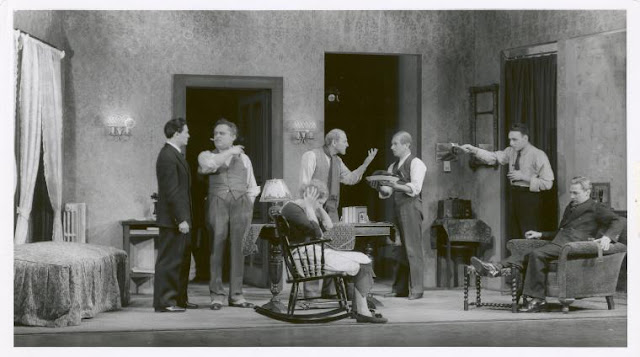
The 1935 Broadway production of Awake and Sing!

The Method: How the Twentieth Century Learned to Act by Isaac Butler (Bloomsbury Publishing) is a gossipy, entertaining and informative history of Stanislavskian acting – how it developed in Russia at the Moscow Art Theatre and how two of Stanislavski’s associates, Richard Boleslavsky and Maria Ouspenskaya, imported it to American shores, where, through its dissemination by the Group Theatre in the 1930s, it became the Method. Butler has rounded up an impressive amount of material and presents it coherently and compellingly. I didn’t realize how little I knew about the tensions between Stanislavski and the M.A.T.’s co-director, Vladimir Nemirovich-Danchenko; about the role each of the personalities who were drawn into Stanislavski’s circle played in the development of his approach to acting; about the effect Stalin’s rise to power had on the M.A.T. generally and on Stanislavski specifically – or certainly about Boleslavsky’s intriguing and rather crazy biography. No account I’ve read deals so clearly and in such dramatic detail with the break in the Group Theatre, when Stella Adler, its most gifted actress, challenged the weight Lee Strasberg, one of the company’s co-founders, placed on affective memory, where the actor digs into his or her past to unearth emotional dynamite to blast open a scene. Adler and Strasberg became the most important American acting teachers of the twentieth century. The Method’s examination of the differences in their styles and approaches and that of Sanford Meisner, another Group alumnus who became a famous and influential teacher, is fascinating. He identifies Adler’s greatest quality as her gift at script analysis; her book, compiled posthumously from her class notes, on Ibsen, Strindberg and Chekhov, and to a lesser extent the one on American playwrights, bear him out.

Friday, March 14, 2014

Neglected Gem #51: Something Wild (1961)

Ralph Meeker and Carroll Baker in Something Wild (1961)

No one in Hollywood in the late fifties and early sixties attempted anything remotely like Jack Garfein’s movie Something Wild (1961). (The movie has no connection to Jonathan Demme’s great romantic comedy of the same name, made twenty-five years later.) I first saw it on Saturday Night at the Movies when I was in high school in the late sixties, and though I didn’t know what the hell to make of it, for years afterwards my mind retained images from the dream sequence, where the protagonist, Mary Ann (played by Carroll Baker), in a gang of schoolgirls, stares at a painting with a moving eye in a museum and then endures the mocking laughter of her classmates as the features of their faces vanish. Garfein and his co-screenwriter Alex Karmel, adapting Karmel’s novel Mary Ann, had clearly absorbed the lessons of the Surrealist painters – De Chirico especially seems to haunt Mary Ann’s nightmare – as well as the Expressionist playwrights of the 1920s, and applied them to the conventions of film noir in a more florid and inventive way than anyone had previously. Visually the film noirs of the forties and fifties had always leaned toward that style; of all genres, noir was the one that gave directors and cinematographers the greatest license to import the ideas of the German Expressionist pictures of the silent and early talkie eras, and naturally that was the genre toward which filmmakers who ran away from Hitler and landed in Hollywood tended to gravitate. But Something Wild takes a more experimental approach to the narrative elements of noir, particularly the portrayal of the city as a weird and dangerous place.

Monday, December 3, 2012

Golden Boy: Art vs. Commerce

Tony Shalhoub, Seth Numrich, Dagmara Dominczyk, and Michael Aronovin Golden Boy (Photo by Paul Kolnik)
 
When you read about the Group Theatre, the legendary company that introduced Stanislavskian acting to the American theatre in the 1930s, you can’t help wondering what their performances were really like. You can get some sense of this pioneering Method acting style when you watch John Garfield, the only one of the troupe who became a movie star, or Lee J. Cobb, who went on to play Willy Loman in Death of a Salesman on Broadway (and revisited the role years later on television) and the gangster Johnny Friendly in On the Waterfront, or the few remnants Morris Carnovsky, the Group’s master actor, has left us of his work, in featured movie roles and TV appearances. But the first time I really got a feel for the Group Theatre style was when a PBS documentary about them included a clip I’d had no idea even existed: Luther Adler’s screen test from the mid-thirties, which replicated a scene that he and Phoebe Brand had played together on stage in Clifford Odets’s Awake and Sing! (Adler and his sister Stella, the children of the celebrated Yiddish Theatre star Jacob Adler, were two of the Group’s leading actors; Brand, who married Carnovsky, came out of retirement to play Nanny in Vanya on 42nd Street.) The clip is maybe two minutes long, and you can’t even see Brand’s face, yet it’s a revelation. Certainly the acting is grounded by a rock-bound naturalism, but it’s more heightened than I’d imagined, more theatrical – in the best way. The scene is between Moe Axelrod and Hennie Berger, one-time lovers who are still desperate for each other but so resentful and defensive that they circle each other warily like nervous animals, every now and then reaching out a paw to swipe one another; and the two actors aren’t afraid to go for broke. You can hear the stage training in the broad vocal palette, in Brand’s free use of tremolo (a more old-fashioned choice than I would have guessed, but extremely effective here) to underscore her character’s woefulness and in the nobility in Adler’s stature and in the way he holds his face to the light.  (Among the Method actors of the next generation of Method actors, Ben Gazzara notably retained that quality.) You believe fully that you’re watching the characters, yet you don’t forget you’re watching actors. Perhaps no Method actor could make you forget that until Marlon Brando.

I thought of Adler’s screen test during Golden Boy, Bartlett Sher’s magnificent new Broadway production of the 1937 Odets play that was the Group’s biggest hit. (Adler played the title role, Carnovsky was his father, and Cobb, Garfield and Brand were all in the company, as well as the Hollywood actress Frances Farmer and two future directors, Elia Kazan and Martin Ritt.) Odets trained as an actor with the Group but early on he began to write plays for them; seven were produced during the Group’s decade-long existence (it finally collapsed in 1941), including Waiting for Lefty, Paradise Lost and of course Odets’s masterpiece, Awake and Sing! He was the closest they had to an official playwright-in-residence, and Golden Boy is his most personal play. Before he wrote it, and again afterwards, he spent time in Hollywood, where he knew his talents were being squandered, as Hollywood squandered the gifts of so many of the great east-coast writers in the thirties and forties, but which offered him a luxurious lifestyle that, like so many others, he found hard to resist. The battle between what you do for your soul and what you do to make a buck is at the heart of Golden Boy, in which Joe Bonaparte, the working-class son of Italian immigrants, a talented violinist, becomes a boxer, a choice that breaks his own heart as well as his father’s and imperils his soul.

Monday, April 9, 2012

Winners and Losers: Death of a Salesman & The Best Man

There seems to be a new production of Death of a Salesman every decade or decade and a half, and always with an actor you wouldn’t want to miss in the role of Arthur Miller’s psychically disintegrating third-rate drummer Willy Loman. Lee J. Cobb, with Mildred Dunnock as Willy’s long-suffering wife Linda, resurrected the play when they performed it on television in 1966, recreating the performances they’d given under Elia Kazan’s direction on Broadway in 1949. (The TV version, directed by Alex Segal and featuring George Segal and James Farentino as the Loman sons, Biff and Happy, was beautifully executed.) George C. Scott gave a frightening rendition of Willy as a walking time bomb in New York in 1975 opposite Teresa Wright. Directed by David Rudman, Dustin Hoffman reimagined Willy as a distinctly Jewish little man on Broadway in 1984; everyone else in the family – Kate Reid as Linda, John Malkovich as Biff and Stephen Lang as Happy – towered over him. (The TV movie adaptation is so badly directed by Volker Schlondorff that it manages to undercut Hoffman’s amazing performance, though it preserves the power of Malkovich’s.) Robert Falls brought a production to New York from Chicago in 1999 with Brian Dennehy that scaled up the expressionistic touches; it got laudatory reviews but it was misconceived, and Dennehy was hammy and self-serious. Now we have Mike Nichols’s revival with Philip Seymour Hoffman and a recreation of the famous 1949 Jo Mielziner set. And though some people (like Ben Brantley in The New York Times) have caviled about Hoffman’s age – he’s 44 and Willy is 62 – both Cobb in the original Broadway production and Dustin Hoffman in 1984 were also much younger than the character. (Cobb was 37, Hoffman 46.) Actually Philip Seymour Hoffman is superb. The trouble is that goddamn play.

Monday, October 12, 2015

The Method Meets Stand-Up: Lily Tomlin in The Search for Signs of Intelligent Life in the Universe

Lily Tomlin (as Trudy the bag lady) in the film version of The Search for Signs of Intelligent Life in the Universe (1991).

Though it has often been the case that actors celebrated for their work on the stage are replaced in the film adaptations by established movie stars, there’s a long and respectable history of great stage actors who have recreated their signature performances on the screen; it goes back at least to Walter Huston in Dodsworth (1936), if not even farther. Often it denotes pedigree in the eyes of Oscar voters: sixteen women and men have won Academy Awards for performances they originated on the stage.* In the case of actors who have an instinctual sense for the camera, the work may deepen on film: I suspect that was the case with Marlon Brando in A Streetcar Named Desire, and I know from personal experience that it was true of Barbra Streisand in Funny Girl, Stockard Channing in Six Degrees of Separation and Lily Tomlin in The Search for Signs of Intelligent Life in the Universe, the one-woman show Jane Wagner wrote for her in 1985 and John Bailey filmed in 1991, in which she plays a dozen different characters. When Tomlin opened it on Broadway theatre critics searched for new superlatives to describe her performance; she had a triumphant national tour with it afterwards, and it was the subject of a PBS documentary. I saw it in Boston prior to the New York opening, and I was mesmerized by her invention, by her emotional range, and by the physical commitment. It was a Saturday night, and she still had a second evening show to give, but she moved as if she’d been shot out of a cannon, and the level of energy never lessened – she even did handstands. It was one of the most amazing performances I’ve ever seen on a stage, and it was even greater on screen, yet the critical reception it got was merely respectful and no one turned out to see it. Perhaps a movie of a one-person show – especially one that acknowledges its stage origins (though one can hardly envision a movie version of a one-person show that didn’t) – is easy to dismiss as a kind of second-hand special event, though in fact Bailey, a cinematographer making his directorial debut, developed a real concept that altered the stage play while paradoxically preserving it at the same time. Perhaps the ideal audience for this sort of entertainment had mostly seen it on stage or caught excerpts on PBS and didn’t bother checking it out at the movies. Or perhaps the show had been touted so loudly and so long when Tomlin was performing it live that it already felt old hat by the time it came out on film.

Monday, May 18, 2020

Hollywood: Ryan Murphy’s Woke Fantasyland

Jeremy Pope, Darren Criss, and Laura Harrier in Hollywood. now streaming on Netflix.

This review contains spoilers.

Ryan Murphy’s latest offering, the Netflix limited series Hollywood (co-created with Ian Brennan), is so flat-footed and dopey that you watch it with a sort of indolent fascination, as if you’d been brained with a frying pan just before turning on your television set. It should be a camp classic, but it isn’t quite; still, it’s too stupefying to be boring. Murphy has chosen Hollywood in 1947 as the locale for a woke fantasy – an alternate history in which people of color and women and gay men manage, in the course of just a few months, to liberate themselves and make Hollywood the forefront of a cultural revolution decades before America got around to it. Despite opposition from a crew of two-dimensional bigots, while the head of Ace Studios (Rob Reiner) is hovering near death after a heart attack his wife (Patti LuPone) takes over the reins and, stirred by the pleas of her friend Eleanor Roosevelt (Harriet Harris), lets a young director (Darren Criss) cast his African American girlfriend (Laura Harrier) in the lead of a movie called Meg written by a gay black writer (Jeremy Pope). The producer (Joe Mantello) invents wide distribution to get over the southern boycotts; the movie is an immediate hit and wins a raft of Oscars, including three for non-whites. At the ceremony the writer kisses his boyfriend – a young unknown named Rock Hudson (Jake Picking) – on the mouth before going up to accept his. Hollywood changes overnight. All it takes is a few courageous souls.

Monday, May 30, 2022

The Goodspeed Reopens with Cabaret

Aline Mayagoitia as Sally Bowles in Goodspeed's Cabaret. (Photo: Diane Sobolewski)

One of the most exasperating developments of the last several decades of theatre is the rewriting of classic plays and musicals, because the originals simply disappear – it’s as if they never existed. In the twenty-first century the alterations have mostly come out of an attempt to make the texts more palatable to contemporary audiences, which have a tendency to cheer every time a character in an older setting makes an anchronistic comment transparently inserted to produce precisely that response. Audiences are increasingly being manipulated into becoming Pavlov’s dogs, salivating when someone on stage in a show set in the forties or fifties sounds as if they’re describing Trump. Will we ever again get to see a revival of A Streetcar Named Desire that ends the way Tennessee Williams wrote it, with Stanley beginning to make love to Stella to distract her from the institutionalization of her sister Blanche, rather than replicating the unconvincing ending of the (otherwise magnificent) Elia Kazan movie, where Stella rushes upstairs to Eunice and the audience pretends that she’s actually thinking of walking out on her husband? It’s hard to believe that 1951 audiences didn’t see that rewrite for exactly what it was: a sop to the Production (Hays) Code Office. Now audiences, shamelessly coddled by recent versions of the play, are encouraged to believe that Stella has suddenly acquired a feminist consciousness.

Tuesday, December 31, 2019

Fond Farewells: Rip Torn and Rene Auberjonois

Rip Torn and Jeff Morris in Payday (1973).

In my final 2019 posting on Critics at Large I’d like to pay tribute to two marvelous character actors who passed away this year, Rip Torn (who died on July 9 at the age of 88) and Rene Auberjonois (only 79 when he died on December 8). These two men could hardly have been less alike in style or in the kinds of roles they were drawn to, but though they had long careers and occasionally appeared in movies or TV series that were popular enough to draw attention to their gifts, the quality of their best work has tended to be overlooked.

Monday, March 27, 2017

Social Problem Plays: The Price and Sweat

Mark Ruffalo and Jessica Hecht in The Price at Broadway's Roundabout Theatre. (Photo: Joan Marcus)

Arthur Miller’s plays may have been inspired by Ibsen’s realist dramas, but he rarely seemed able to get at the great unresolvables beneath their well-made social-problem surface. They creak and they clang as the banalities slide into the grooves his dramaturgy has made for them – even when the ideas themselves haven’t always been thought through. (After all these years and God knows how many productions, I’m still not sure exactly what’s being indicted in Death of a Salesman, and, as for The Crucible, however much one might deplore HUAC and the blacklist, it wasn’t much like the Salem witch hunts. For one thing, as Elia Kazan’s wife Molly Day Thacher pointed out in a famous letter to Miller, there actually were Communists in show business.)

The Price, Miller’s last major play, first produced on Broadway in 1968 and currently in revival by the Roundabout Theatre, is particularly clunky. Two brothers meet in the attic of a Manhattan brownstone where Victor, the younger, took care of their father in the twilight years that followed the stock market crash and the death of his wife – two disasters from which, according to Vic, the old man never recovered. A talented scientist, Vic sacrificed his dreams of a research career and joined the police force in order to support him while his brother Walter went to medical school and on to a distinguished and affluent career. Now the building is being torn down and Victor is hoping to secure a good price for the antique furniture from an appraiser whose name he found in the phone book. He’s tried to contact his brother, whom he hasn’t seen in a decade and a half and who hasn’t answered his calls. Just as he’s about to make a deal with the appraiser, Solomon, who’s something of an antique himself, Walter shows up in time for the first-act curtain, and the two brothers – as well as Victor’s wife Esther – learn, as the ten-ton ironies fall about the play’s title, just how high a price we pay for the choices we make in our youth. The second act of the play is mostly a long pitched battle between the estranged brothers, who spell each other with revelations and corresponding accusations. By the time the play is over, it’s long since turned into a very slow tennis match with hammers for rackets.

Tuesday, June 6, 2017

When Suggestion Becomes Statement: John Neumeier's A Streetcar Named Desire

Sonia Rodriguez and Guillaume Côté in the National Ballet of Canada’s production of A Streetcar Named Desire.
(Photo: Karolina Kuras)

Ballets there are many. But few have the equivalent of a PG-13 rating. Tickets to the student matinee of the National Ballet of Canada's production of A Streetcar Named Desire, at Toronto's Four Seasons Centre for the Performing Arts through June 10, come with a warning that the "mature subject matter" – often a euphemism for pornography – is suitable for grades 10 and up only.

But relax. While the depictions of suicide, prostitution and rape are graphic, they are not corrupting. Neither are they sordid or morbid or at risk of getting anyone arrested. John Neumeier's ballet, based on the Tennessee Williams play of the same name, shines a light on life's underbelly, its dark perversions, while also making room for a fantastical dreamer like Blanche DuBois. It's a stunning achievement, despite a few bumps encountered along Streetcar's fabled route. To wit: the first act threatens to be boring while the second pokes you in the eye with a prolonged act of forcible violation as repellent as it is artistically risqué. Subtlety takes a backseat to psychology, the result of a need to know about underlying causes, blunting the overall impact.

Tuesday, August 23, 2016

Fireball Career: Peter L. Winkler's The Real James Dean

Elizabeth Taylor and James Dean in Giant (1956).

Humphrey Bogart once said of James Dean that he “died at just the right time,” explaining that “If he had lived, he'd never have been able to live up to his publicity." Bogart makes a cameo appearance in Peter L. Winkler’s The Real James Dean (Chicago Review Press, 2016), trying to “carry on a gentleman’s conversation” with the new kid in town while the shy, “starstruck” Dean stares at his feet and mumbles. According to Merv Griffin, Bogart finally grabbed Dean by the lapels and called him “a little punk” and a “two-bit nothing” for being so discourteous as not to look him in the eye when spoken to. Given the generational divide as well as the differences in personality between the two men, it’s possible that Bogart thought he was being patronized when he complimented Dean on his technique and got back the response, “Yeah? That’s okay by me.” Their mutual friend Joe Hyams points out that Bogart, having become Bogart by this point, kept his “insecurities” to himself, while Dean, the Method man, wore his on his sleeve, the better to keep them handy for when he needed them to fuel his work. The Real James Dean (subtitled “Intimate Memories from Those Who Knew Him Best”) makes two things very clear: Dean, however much he may have flirted with exhibitionism and self-indulgence onscreen and enjoyed the rewards of success and celebrity off it, was a heroically committed actor who saw himself as an artist, and that side of him is only part—maybe not even the biggest part—of the reason for the impact he made on the culture, and why it continues to reverberate. This isn’t a biography or a critical study but a smartly chosen selection of things written and said about Dean by those who knew him, worked with him, loved him, revered him, are still conflicted about him. It’s fascinating to take in Dean’s life and career through the eyes of so many people who knew him at different times in his life.

Tuesday, January 17, 2012

Childhood’s End: Criterion’s The Complete Jean Vigo

Shame on those who, during their puberty, murdered the person they might have become.
- Jean Vigo, Towards a Social Cinema.

In Bernardo Bertolucci’s Last Tango in Paris (1972), a movie about the collapse of the conventional romantic paradigm, there’s a particularly haunting moment midway through when Jeanne (Maria Schneider) and her fiancé Tom (Jean-Pierre Léaud), who is making a film about their courtship and marriage, meet at a waterside dock so that he can propose to her on camera. As they debate back and forth about whether they will, or whether they won’t, he puts a life buoy over her head and pins her arms. He traps her in what looks like a huge wedding ring. But she quickly dispenses with it and chucks it into the water below. As it sinks to the bottom of the sea, we can read the name L’Atalante on the buoy. Aside from making a direct reference to the final (and only) feature film in the terribly brief career of French director Jean Vigo, Bertolucci is also paying tribute to the sad passing of the romantic stirrings of our youth, of a childhood’s end; while keeping faith with a carnal appetite that made Jean Vigo a patron saint for the New Wave that Bertolucci was once part of in the early Sixties.

The Criterion Collection, in their own significant way of honoring the work of Jean Vigo, has recently released a sumptuous DVD package of his complete work.The discs as well include a number of invaluable supplementary materials, all proving that Vigo was indeed one of the most instinctually radical of film directors until his tragic death from tuberculosis at the age of 29 in 1934. In just under three hour of film footage (three shorts and one feature), Jean Vigo becomes before our eyes this luminously idealistic figure, a Byronic pop artist, who set out to preserve the innocent rebellion of childhood. The anarchistic and zealous pining for transcendence from authoritarian rule and dogma brought forth in Vigo a vivacious need to celebrate pure freedom; expressed not only in the content of his movies, but also in his flamboyant expressiveness, an expressiveness that echoed the spontaneity of true invention. While his work shares some of the revolutionary fervor found in the early Russian cinema, it does so without the latter’s schematic design. To experience Vigo is to feel instead like a balloon caught up in a quick breeze and pulled into states of elation that make sensual desire palpable.

Jean Vigo
Vigo’s impetuous and tragic life was equaled by no one except maybe actor James Dean in the Fifties. While both became iconic figures of youthful revolt and romantic allure, Vigo is James Dean without the crippling neurosis, the brooding contortions. If Dean was, in truth, a rebel with a cause – a need to be loved and accepted – Vigo was the rebel without one. He became what French film director Jacques Rivette called “an incessant improvisation of the universe, a perpetual and calm and self-assured creation of the world.” In The Complete Jean Vigo, we watch a young artist discover the playful child in himself until the sojourn ends with L’Atalante, where he seeks ways to preserve that playful child in an adult world with adult emotions and adult circumstances.

Monday, February 6, 2017

Shirley Booth: Only the Lonely

Shirley Booth and Burt Lancaster in Come Back, Little Sheba (1952).

Shirley Booth played the titular domestic on the TV sitcom Hazel for just five years, 1961 through 1966, but it so defined her that it obscured everything she had done before – twenty-five years of starring roles on Broadway and a handful of movies that included her Oscar-winning performance in Come Back, Little Sheba in 1952. It was that film that brought her to Hollywood, to recreate the role she’d played on stage two years earlier (which had won her the second of her three Tony Awards). Booth broke through in 1935 in George Abbott and John Cecil Holm’s comedy Three Men on a Horse; her stage work, varied and prolific, included The Philadelphia Story opposite Katharine Hepburn, Joseph Cotton and Van Heflin (she played the hard-boiled photographer Liz Imbrie), My Sister Eileen,Goodbye, My Fancy, The Time of the Cuckoo and Desk Set, as well as a trio of musicals: A Tree Grows in Brooklyn, By the Beautiful Sea and Juno, Marc Blitzstein’s adaptation of Sean O’Casey’s Juno and the Paycock. (When Hollywood optioned them, Hepburn took over the Booth parts in The Time of the Cuckoo – renamed Summertime – and Desk Set.) She had a long career – about half a century, though much of it remains inaccessible to us except through photographs.

Saturday, June 15, 2013

Back to High School: The Great Gatsby

Leonardo DiCaprio in The Great Gatsby

Baz Luhrmann’s The Great Gatsby bears little resemblance to the slender masterpiece on which it is based – F. Scott Fitzgerald’s now iconic 1925 novel – but that probably won’t come as much of a surprise to anyone who has followed this director’s career. While his critics see him as a sort of Andrew Lloyd Webber of movies whose histrionic period pieces (Moulin Rouge!Romeo + Juliet) put one in mind, to borrow a phrase from Pauline Kael, of “a dog with the broken bones of a cat sticking out,” few of Luhrmann’s fans would likely contest that characterization. To them, Luhrmann’s movies are carnival sensations, romances to excess that celebrate the hysterical pace of the modern age in brazen, trashy style (and anyone who doesn’t like their cats grafted messily onto dogs is just a purist, patrician snob). There’s a faint odor of schoolyard allegiance that clings to the debate around Baz Luhrmann, and it never fails to make me feel like the teenager who chooses to stay home with a book while all her friends go out to a rave.