Showing posts sorted by relevance for query Hugh Jackman. Sort by date Show all posts

Thursday, August 8, 2013

Call of the Mild: The Wolverine


The first time Hugh Jackman played Wolverine, in his first American movie (and only the third movie his career), Bryan Singer’s X-Men (2000), a star was born. The character of Wolverine an endlessly regenerating Canadian wild man who can sprout razor-sharp claws from his knuckles, and who has a three-note emotional range, brooding, seething, and full explosion was a product of a period in the mid-70s when Marvel comics writers were trying to adjust to a changing pop culture landscape in which movie stars like Clint Eastwood and Charles Bronson were playing judge-jury-and-executioner types as righteous heroes. Comics fan were hungry to see him on the screen, but comics fans and lots of other people are always hungry to see things on screen that would probably look pretty silly if almost anyone tried to create a reasonably plausible, live-action version of them.

Somehow, Jackman managed to make everything about Logan that’s the superhero equivalent of his slave name, what people call Wolverine when he’s not bounding through the air eviscerating people seem both believable and attractive, from the redwood-sized chip on his shoulder to his inherent nobility to his lupine-rockabilly hairdo and facial hair. It was the kind of performance that makes you eager to see what else the actor can do, and at the same time makes you want to know when you can see him play that character again. The Wolverine, directed by James Mangold from a script written by Mark Bombeck, Scott Frank, and the uncredited Christopher McQuarrie, marks Jackman’s fifth time out wearing Logan’s spiked claws and gelled hair horns. He was 31 when X-Men came out, and he’s 44 now, which, given the fact that Logan doesn’t visibly age, might have been a problem at an earlier point in our history. It’s a funny thing that people, or at least some movie stars, age so much slower than they used to, but it’s also a lucky thing, since it now takes so many lifetimes to get a movie made. In four fewer years that it’s taken Jackman to play Wolverine in three X-Men movies and two solo outings, Sean Connery had played James Bond five times, walked away from the franchise, come back to play him one more time, and walked away again.

Monday, January 28, 2019

The Front Runner: Satire and Beyond

Hugh Jackman (centre) in The F.ront Runner.

Movie-wise, 2018 culminated in the lamest Christmas season in years; aside from Mary Poppins Returns, Spider-Man: Into the Spider-Verse, three of the six segments in the Coen Brothers’ The Ballad of Buster Scruggs, and Peter Jackson’s extraordinary World War I documentary They Shall Not Grow Old, I didn’t see a single film I could get behind. And the dim slate of Academy Award nominations for Best Picture confirm the widespread disgruntlement about the caliber of last year’s releases. Actually, it wasn’t quite as terrible a year for movies as the list of nominees indicates. It’s just that in 2018, even more radically than in most years, the majority of the interesting films were sidelined – they opened only briefly, and only in a few cities, and didn’t draw the attention they deserved. (Ironically, the other cadre of movies worth checking out resided at the other end of the spectrum: the franchise movies that saturated the cineplexes over the summer, most of which were immensely enjoyable.) This was the year of Blaze, Hearts Beat Loud, The Sisters BrothersPaddington 2, Leave No Trace, Juliet, Naked, Christopher Robin, The Death of Stalin, Don’t Worry, He Won’t Get Far on Foot and Journey’s End. And of The Front Runner, Jason Reitman’s movie about Gary Hart’s doomed bid for the Democratic presidential candidacy in 1988, which a friend helpfully steered me to a couple of weeks ago. It’s amazing that a movie as good as this one, by a respected director and with a major star (Hugh Jackman), released at the beginning of prestige-movie season (it came out Thanksgiving week), could have slipped by virtually unnoticed.

Wednesday, March 15, 2017

No More Guns in the Valley: James Mangold’s Logan

Dafne Keen and Hugh Jackman in Logan.

Logan is perhaps the most unusual Marvel film yet made. It more closely resembles director James Mangold’s 2007 remake of 3:10 to Yuma than its own predecessor, 2013’s The Wolverine (also directed by Mangold), not just in looks, but in spirit. Logan has more of the Western in it than the popcorn-fueled superhero norm; it’s absolutely insane to think that it shares DNA with last year’s X-Men: Apocalypse. It doesn’t feel like a superhero movie, or an X-Men movie, at all. It feels like a swan song, haunting and terribly sad. It also feels like the first time that anyone has been able to truly make a meal of the character of Wolverine – so, of course, it has to be the last time.

Saturday, September 21, 2013

Torture Porn: Denis Villeneuve's Prisoners

Hugh Jackman & Jake Gyllenhaal

During Prisoners I felt like I’d been strapped to my chair and was being whipped around through a house of horrors I hadn't signed on for. The director, the Québecois Denis Villeneuve, is extremely accomplished, and the movie is beautifully made, with sequences that are marvels of suspense and mood. He’s working with a superb cinematographer, Roger Deakins, and with a talented cast who create distinctive, interesting characters. But everyone is at the service of material – Aaron Guzikowski’s script – that amounts to the worst sort of gut-wrenching manipulation, sold to us as a meaningful disquisition on evil and how the loss of a child can diminish one’s humanity. Prisoners is a cheap thriller dressed up to look like an important movie, its 150-minute length offered as proof of prestige. It’s loathsome.

Wednesday, May 28, 2014

X-Ceptional – X-Men: Days of Future Past


In my review of Captain America: The Winter Soldier, I made a point of mentioning I was a fan of the X-Men series, and it should also be noted that I’ve enjoyed the X-Men film franchise since its fresh-faced beginnings in 2000. It’s a series that seems to be improving with age, recovering from severe stumbles like X-Men: The Last Stand (2006) to finally hit its stride only, what – six, seven films in? Except for the excellent X-Men: First Class (2011), I think the strongest of the franchise were the original two films, both directed by Bryan Singer. Singer returns to the helm for the latest installment, X-Men: Days of Future Past, and I think with all this bearing in mind, it’s safe to say that on entirely its own merits, X-Men: DoFP is a fine superhero action film, and in the context of its own series, it’s nothing short of brilliant.

Monday, December 24, 2012

Les Misérables: Blockheaded Blockbuster

Isabelle Allen and Hugh Jackman in Tom Hooper's Les Misérables, now in theatres

Les Misérables is one of those blockbuster musicals that has never received or needed critical approval, like Miss Saigon, Mamma Mia! and the entire oeuvre of Andrew Lloyd Webber. The same can be said of a handful of American musicals, most recently Spider-Man: Turn Off the Dark, but mostly it’s a European-import phenomenon. By the time Les Mis began its first Broadway run twenty-five years ago, its effect was a bifurcation of the musical genre into shows – a handful every season – that essentially perpetuate the traditions of the Broadway musical and those, like those listed above, that target tourists, groups and devoted repeat attenders. If you score with that sort of hit, critics are extraneous. I saw Spider-Man early in its notorious preview run, while Julie Taymor was still associated with it, and the immense theatre that housed it was packed to the gills with kids in Spider-Man costumes chaperoned by their parents. A couple of the cast members had already sustained injuries, the show had become simultaneously a scandal and a media joke, but it was clear that no matter how long it stayed in previews (months, as it turned out) and how dreadful the reviews would be (pretty dreadful), parents would continue to truck in from the suburbs or from out of town with their eager offspring and keep the musical running at capacity.

I’ve seen some of these shows out of some combination of professional obligation and curiosity (I skipped Miss Saigon and I just can’t get myself to one of Webber’s shows, because the music drives me insane) – including Les Mis, which I checked out during the first of its national tours. (It’s been in revival so often, and there have been so many national tours, that it feels like the show has been running non-stop for a quarter of a century.) I ducked out at intermission, which came after nearly two hours; I felt I’d got my money’s worth. The Trevor Nunn staging was impressive: he worked ingeniously against the revolve and some of the stage pictures were nifty. But except for the “Master of the House” number, performed by the innkeeper Thénardier, all of Claude-Michel Schönberg’s music blended together into The Ballad or The March, and by ten p.m. I figured I’d heard plenty. I confess I’ve never been a fan of the material anyway. A friend once assured me that, as a lover of Dickens, I’d be sure to respond to Victor Hugo, but I tried the novel twice and couldn’t get very far; I felt oppressed by the layers of banal detail. Nonetheless, historically it’s an important work because it embodies the elements of Romanticism. It has an outlaw hero: Jean Valjean, who goes to prison for two decades for stealing a loaf of bread to keep his nephew from starving and who is dogged by the intractable Inspector Javert for breaking his parole. Its sympathies are populist, it’s loaded with melodramatic plot twists, and it’s set against the teeming background of the 1832 June Rebellion in Paris. And with all that spectacle and all those characters in high dudgeon, it’s been a favorite of moviemakers: Tom Hooper’s new movie of the musical marks the eighth film version. (Half have been in French, half in English.)

Monday, November 7, 2022

Music Men: Almost Famous and The Music Man

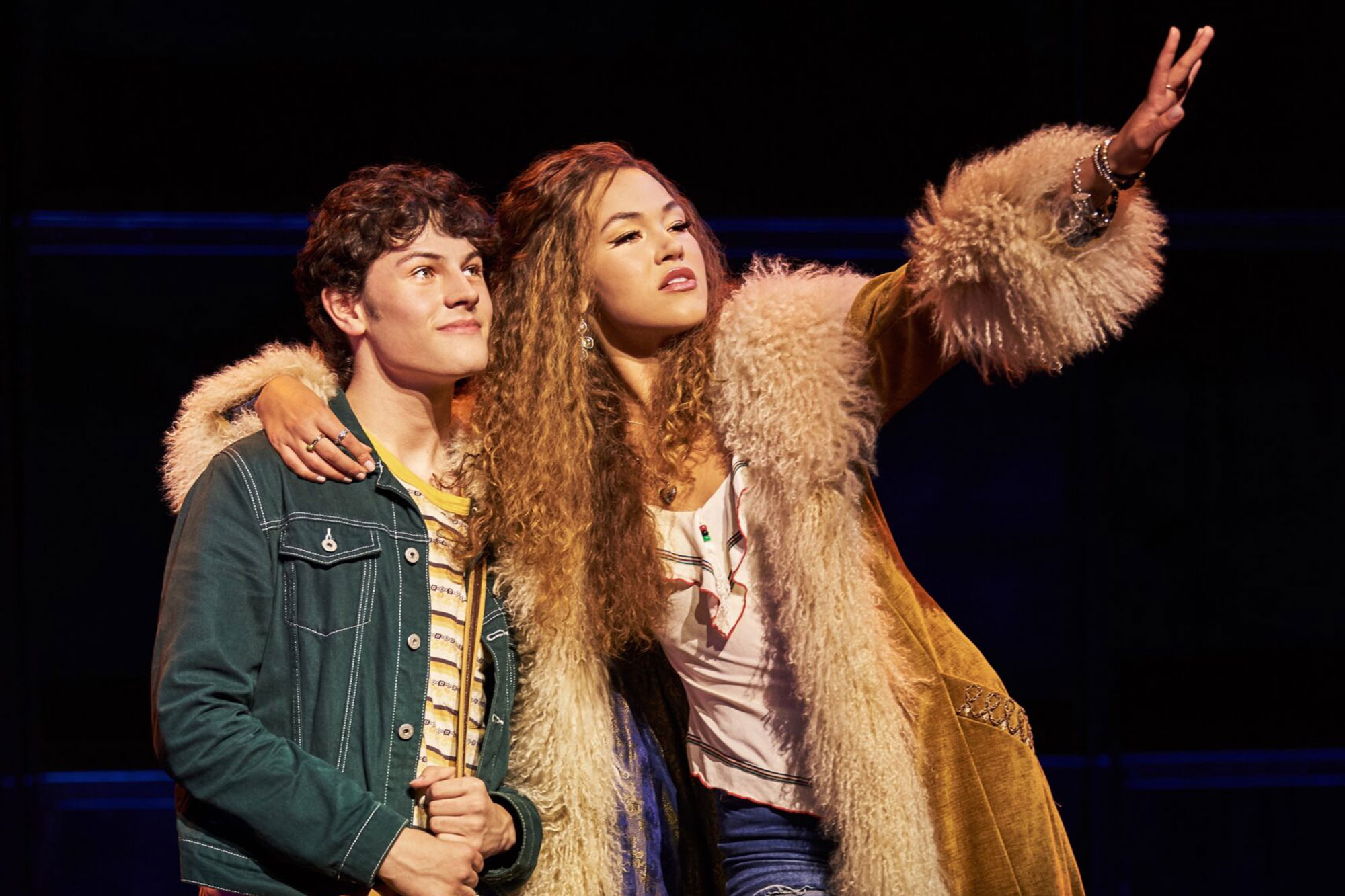
 Casey Likes and Solea Pfeiffer in Almost Famous. (Photo: Neal Preston)

Affable and well-acted and entertaining as it is, I’ve always thought that Cameron Crowe’s Almost Famous, from 2000, was something of a crock. Crowe’s first career was as a rock journalist; at fifteen he got to travel with The Allman Brothers. So the picture, about a San Diego teenager named William Miller whose writing impresses Rolling Stone editor Ben Fong-Torres sufficiently to persuade Fong-Torres to let him go on the road with a band called Stillwater and write a profile on them, is autobiographical. And it must be the most romanticized coming-of-age memoir any writer has ever shaped. Crowe’s baby-faced protagonist (appealingly played by Patrick Fugit) never really falls from innocence. William’s possessive mother – his only surviving parent – drops her son off at the stadium for the Stillwater show she cries after him, “Don’t take drugs!,” and she repeats her warning when she takes him to the tour bus and in every one of her hysterical phone calls. It’s a culture joke: she’s meant to represent every parent in 1973 who ever feared losing her child to the rock ‘n’ roll vampires. But William takes her seriously. He travels all over the country with Stillwater, hangs out with them between shows and with the ebullient groupies known as the BandAids, and he never even smokes a joint. Crowe seems to be looking at his own adolescence through a haze. William eventually loses his virginity, but it doesn’t seem to alter him in any way. He counsels both his hero, the band’s guitarist Russell Hammond (Billy Crudup), and the leader of the BandAids, Penny Lane (Kate Hudson), Russell’s girlfriend on the road and the object of William’s first serious crush, liberating her and making him into a better human being. And in the end the kid’s story gets on the cover of Rolling Stone. William is a juvenile version of the knight whose purity of heart is rewarded at last.

Tuesday, May 31, 2016

Inexcusable – X-Men: Apocalypse

Jennifer Lawrence (in blue) and Oscar Isaac (in gray) in X-Men: Apocalypse.

Batman v Superman made me angry . It was an affront to my sensibilities, both as a nerd who cares about how comic book characters are portrayed, and as a conscious human being who paid real, hard-earned money for my ticket. X-Men Apocalypse, the newest entry in Bryan Singer’s comic book saga, isn’t the kind of bad superhero movie that makes you angry. It’s mostly just the kind that makes you sleepy. Consider it like free time: if you have any plans to make, or philosophical ruminations you’d like to ponder, or quiet meditation to catch up on, or any particularly interesting games to play on your phone, then your screening of X-Men Apocalypse can function as a twelve-dollar relaxation getaway (albeit with a few violent CGI explosions). I think thanks are due Bryan Singer, for giving us all a safe space in which to ignore his crappy movie, and focus on the things that really matter, like what you want to have for dinner that night. Thanks, Bryan!

I gave Singer’s last X-Men film, Days of Future Past, a glowing review. I haven’t seen it since, so perhaps the bloom will have fallen off the rose by now, but I genuinely liked the film at the time, and made a point of referencing the intelligence of its storytelling and how it treated both its source material and its audience with respect. It’s kind of amazing that in two years the situation has totally flipped with this new sequel: Singer has abandoned everything that made his franchise interesting or unique, and I’ve abandoned the franchise as a result. I’m done with this X-Men crap; I’m out. If it’s all going to be the same stuff – the same character relationships that never evolve, the same mutants using the same powers, the same tired origin story beats we’ve seen a million times before – regurgitated with less passion and engagement each time, then there’s nothing these X-Men movies have to offer anymore. I came away from Apocalpyse feeling baffled: it’s boring, bloated, familiar, and pointless.

Thursday, June 20, 2013

Bigger, Louder and Messier: Man of Steel


Zack Snyder’s new blockbuster Man of Steel is the second attempt to reboot Superman as the hero of his own movie franchise since the Christopher Reeve series went off the rails with Superman III and the embarrassing, Golan-Globus-funded fourth installment. (After that, the character was downsized and farmed out to television in the series' Superboy, Lois & Clark, and Smallville.) The first try, Bryan Singer’s Superman Returns (2006), didn’t exactly bankrupt the studio, but it’s generally remembered as a disappointment. It took the material very seriously, and many reviewers pointed out that the images of Superman hovering above the Earth, his cape billowing and his head hanging down as if to express his disappointment in us, suggested a zero-gravity Christ. Man of Steel, written by David S. Goyer, takes the material at least as seriously, and it has none of the leavening of humor that Singer provided; as superhero devotionals go, it’s practically The Greatest Story Ever Told to Superman Returns Life of Brian.

Tuesday, March 10, 2015

Short Circuit: Neill Blomkamp’s Chappie

Die Antwoord's Ninja, Jose Pablo Cantillo, and Chappie in Neill Blomkamp's Chappie.

It used to be that a film depicting “a robotic police force in the crime-ridden future of 2016” was a far-flung concept, usually with at least twenty years’ time for filmgoers to remember to be kind to one another and help prevent such a terrible vision from becoming reality. Neill Blomkamp’s Chappie was released this year, in 2015, which I admit makes me nervous. I hope the world of Chappie is meant to take place in some alternate reality – because if not, then we wasted the time we had, and that future has come to pass.

Anyone who has seen the film’s trailer – or any combination of Short Circuit (1986), Robocop (1987), I, Robot (2004) or even Her (2013) – will already be able to plot out Chappie’s story beats: robot becomes sentient, robot learns the highs and lows of human emotion, robot questions its existence, credits, curtain. Likewise, anyone familiar with Blomkamp’s previous work – especially 2009’s risky, fascinating District 9 – will be unsurprised that he offers more of the same: thoughtful SF quandaries that are lost in a hail of gunfire, and dull storytelling that is disguised by beautiful visual design. That Blomkamp has failed to evolve over the course of his three feature films is a contradictory comfort. His consistency is to be admired, but not at the cost of the high-concept themes and narratives hinted at by his early films. I think I could be forgiven for hoping that by now he’d have found the path away from mindless violence and into the light of refreshing, challenging SF material. Instead, he’s stuck in limbo, and we’re stuck with Chappie.

Monday, December 30, 2024

Three Musicals: Once Upon a Mattress, She Loves Me and A Wonderful World

Sutton Foster as Princess Winnifred in Once Upon a Mattress. (Photo: Joan Marcus)

Once Upon a Mattress
, the Looney Tunes alteration of Hans Christian Andersen’s fairy tale “The Princess and the Pea” with book by Jay Thompson, Marshall Barer and Dean Fuller, music by Mary Rodgers and lyrics by Barer, opened on Broadway in 1959 and has been playing high schools and children’s theatres ever since. This musical is so familiar to stage kids and their loyal parents that it’s easy to forget how jovial and funny it is, and how tuneful and witty the score is. So it was a boon to New York theatregoers that Encores! opted to stage it early in the year with Sutton Foster as Princess Winnifred – a production, adapted by Amy Sherman-Palladino and staged by Lear de Bessonet, that wound up in the current Broadway season, with most of the Encores! cast, for a limited but enthusiastically received run. (There was a revival in the late nineties starring Sarah Jessica Parker.)

Tuesday, May 7, 2019

From the Musical Theatre Canon: The Music Man, Kiss Me, Kate and Lady in the Dark

Ellie Fishman and Edward Watts in The Music Man. (Photo: Diane Sobolewski)

Meredith Willson’s The Music Man became a classic as soon as it opened on Broadway in 1957, with Robert Preston in the role of “Professor” Harold Hill, the scamming salesman who transforms a pre-World War I Iowa town – and himself – in the course of persuading the locals to purchase instruments and uniforms for a children’s band. Willson, who wrote book, music and lyrics, did as much to develop the archetype of the American snake-oil salesman as Eugene O’Neill had in The Iceman Cometh, though his version was sweeter and came with a bona fide happy ending. (Preston recreated his career performance in the 1962 movie version.) Revivals of the show are generally good news: Susan Stroman’s opened on Broadway in 2000 and ran for two years, and it was so glorious that I saw it twice, once with Craig Bierko playing Hill and once with Robert Sean Leonard, who was even better than Bierko. (Eric McCormack played the role between Bierko and Leonard.) I’m looking forward to seeing Hugh Jackman in the part next season.

In the meantime there’s an exuberant new production at the Goodspeed Opera House, directed by Jenn Thompson and choreographed by Patricia Wilcox, with Goodspeed veteran Michael O’Flaherty doing his usual yeoman service as musical director. The Music Man is the ideal show for Goodspeed – big-boned, spirited, infectious, with a lot of wonderful ensemble numbers that show off the way imaginative staging can make a limited space feel like it’s being expanded from the inside. The choreographic high points of this production are “Marian the Librarian” in act one and “Shipoopi” at the outset of act two. But even the staging of the barbershop quartet numbers, especially “Lida Rose,” counterpointed by “Will I Ever Tell You?,” the most tuneful ballad Willson wrote for Marian (Ellie Fishman) and introduced by the four men (Branch Woodman, C. Mingo Long, Jeff Gurner and Kent Overshown) strolling down the theatre aisle, is tremendously satisfying. The show moves from scene to scene in a graceful arc aided by the scenic designer Paul Tate dePoo III, whose inventions compensate for his single mistake, an unfortunate (and anachronistic) painted backdrop more or less in the mold of the American regionalist Thomas Hart Benton.

Thursday, December 30, 2010

Some of the Best: Favourites of 2010


Unlike other critics, I've always kind of enjoyed compiling a list of favourites from the previous years. It gives me a chance to look back on the year and examine what I've read, seen or listened to. Some of what follows was not necessarily part of 2010, but I only got around to it this past year. In fact, one example is over 70 years old. A few I've written about on the blog in 2010, but not all. So, sit back, relax and, hopefully, enjoy.

Monday, March 9, 2026

Grief and The Goshawk: H Is for Hawk and Other Recent Movies

Claire Foy in H Is for Hawk. (Photo: Roadside Pictures.)

Among the books I brought with me on a trip at the end of my semester break this year was a lovely recent memoir called Raising Hare in which the author, Claire Dalton, who has grown up with the principle that human beings should never interfere with the workings of the wild, chronicles the discovery of a leveret on her land, close to death. Despite her predilections, Dalton makes the decision to try to save the young hare’s life and then, instinctually, begins to share her home – exterior and interior – with this creature with which she’s fallen in love, redesigning it to accommodate its needs and comforts.