Showing posts sorted by relevance for query Jeff Goldblum. Sort by date Show all posts

Tuesday, November 14, 2017

Thor: Ragnarok – What Were You The God Of, Again?

Chris Hemsworth in Thor: Ragnarok.

“I don’t hang with the Avengers any more. It all got too corporate.” – Thor, Thor: Ragnarok
You’d be justified in thinking I’ve been too kind to Marvel’s most recent films. They really are singularly excellent at the art of seduction; of presenting you with dazzling visual spectacle anchored by just enough plot and character coherence that you leave the theatre feeling satisfied, even if their appeal begins to wither once you’re back outside. I really have no desire to ever watch Doctor Strange again, even though I gave it a glowing review. I can understand the shame that sometimes follows, where you feel you’ve somehow been duped. But I don’t ever feel taken advantage of, personally. Disposable, enjoyable, escapist chicanery on the silver screen is as much an essential part of a balanced cinematic diet as anything else. It’s quite enough for me that Marvel’s legion of technicians, production designers, digital artists, costumers, and stunt performers work their asses off to deliver what most moviegoers see as exciting one-off experiences (especially since the sequel is already coming down the pike right behind the one you just saw, guaranteeing that these talented people are still getting work). I don’t hate the formula. The formula works.

Thursday, August 1, 2013

Neglected Gem #43: The Tall Guy (1989)

Jeff Goldblum in The Tall Guy (1989)

Mel Smith, who died a couple of weeks ago, was one of those living legends of British comedy who never managed to crack the American market. (He was a youngish legend, felled by a heart attack at just 60 years old.) Smith became a TV star as part of the cast of Not the Nine O’Clock News, an early-‘80s sketch comedy series that also launched the careers of Rowan Atkinson, Chris Langham, Pamela Stephenson, and Griff Rhys Jones. Its humor was assumed to be too British and topical to export; instead, there was an Americanized HBO version, Not Necessarily the News, which is best remembered as the testing ground for Rich Hall’s “Sniglets”. His long-running series with Griff Rhys Jones, Alas Smith and Jones, was broadcast on A&E for a few years, but Smith and Jones’ attempt to take their act to the movies, the 1985 sci-fi comedy Morons from Outer Space, was a washout.

In 1989, Smith began directing movies himself, with The Tall Guy, a romantic comedy starring Jeff Goldblum and a then-unknown Emma Thompson. On the basis of The Tall Guy, George Lucas hired Smith to direct the expensive, sprawling period comedy Radioland Murders, one of those highly touted Lucas dream projects (such as Howard the Duck and Willow) that make it seem impossible that this guy ever had a commercially viable idea in his life, and that pretty much finished Smith in Hollywood. He did have a hit in 1997 with a big-screen spinoff of Rowan Atkinson’s TV character Mr. Bean, but that was a watered-down version of a pre-sold property, and anyway, Mr. Bean is a mostly-mute sweetums played by a comedian who was meant to always be mean-spirited, talkative, hyper-articulate, and snarling (as in the Blackadder shows).

Griff Rhys Jones and Mel Smith, in Alas Smith and Jones
Though it both pains and confuses me to say it, George Lucas did have one good idea in his life: Smith should have been besieged with offers from people who’d seen The Tall Guy. (It may be remembered that the best idea Lucas ever had that was related to the Star Wars franchise was to hire Irvin Kershner to direct one of them.) The fact that Smith was apparently never besieged with offers to direct big movies may, in fact, be directly connected to the fact that not too many people ever saw The Tall Guy. After the shoot wrapped, it took a few years before the movie was released in England, and then another year for it to come to the U.S. When it opened here in the fall of 1990, it had the aura of a neglected movie that had just missed the bullet of a direct-to-video release, and many of the reviews reflected that. It was the first produced feature film screenplay by Richard Curtis, and it has a mixture of cornball innocence – reflected in the kind of goofy touches (such as a montage of all the characters celebrating the hero and heroine’s coming together by singing along to Madness’ “It Must Be Love”) that only a beginner would include in a movie – that’s made all the more disarming with its sophisticated, satirical take on its theatrical milieu, which is that of a couple of world-weary insiders. (I seem to remember Gary Giddins, who reviewed it in the Village Voice, dismissively brushing it away with the observation that there were silly clips from the movie running alongside the closing credits.)

Friday, July 8, 2016

Independence Day: Resurgence – Definitely Bigger than the Last One


Well, let’s not waste any time: Independence Day: Resurgence would have been far better with Will Smith in it. He’s been replaced by a gaggle of charisma-free B-listers and a host of returning faces who gamely try to fill the void, but they can’t save the film from its asinine script and its lack of interesting action. It’s a ridiculously, overtly, willfully stupid film, and it knows it; this is both bad (because we should not forgive a work its sins simply for making confession – I’m looking at you, Jurassic World) and good (because self-awareness helps the comedic aspects, intentional or otherwise, land on their feet, and is really the only reason the film works at all). Thank our malevolent alien overlords for Jeff Goldblum.

Tuesday, January 8, 2013

Stepping Forward into the Past: Safety Not Guaranteed

Mark Duplass and Aubrey Plaza in Safety Not Guaranteed.

                                    “…. if there were a devil he would not be the one who decided against God, 
                                      but he that in all eternity came to no decision.”  
                                                                                                               – Martin Buber, I and Thou

Surprise, Joss Whedon once said, is “a holy emotion.” Surprise “makes you humble…shows you that you’re wrong, the world is bigger and more complicated than you’d imagined.” It is also becoming scarce on television (the subject Whedom was discussing) and even rarer in film. Every once in a while, however, a movie comes along and does just that. And Safety Not Guaranteed isn’t merely surprising: it is also, in a very real way, about surprise – about why we need it and about everything that conspires to make us unable to experience it.

Safety Not Guaranteed screened at Sundance last January, was in the theatres this past summer, and came out on DVD in the fall. I knew of it – mainly because of Susan Green’s interview with the film’s director Colin Trevorrow for Critics at Large in June – but I finally sat down to watch the film last week. Though I knew the plot’s launching points (a mysterious classified ad) and that it boasted the stars of two of my favourite sitcoms (Aubrey Plaza from Parks and Recreation, and Jake Johnson from New Girl), I went in with few if any expectations. Three parts rom-com and one part science fiction, Safety Not Guaranteed starts small and grows, slowly and surely, through its 86-minute running time – ultimately telling a story that does justice to the intelligence of its characters and its audience. Neither sickly sweet nor mockingly cynical, the film is still sincerely romantic; for all its ambitions, it remains structurally and self-consciously informed by the established rules of romantic comedy. The first feature by independent filmmaker Trevorrow and screenwriter Derek Connolly, Safety Not Guaranteed has three charming lead actors, a deceptively simple plot, and a marvelously constructed script. Even as the final credits were rolling, it made me want to generate a “Most Underrated Films of 2012” list just so I could put its name on it!

Saturday, September 27, 2014

A Formula Film with a Human Face: The Criterion Collection Release of Lawrence Kasdan's The Big Chill

When Lawrence Kasdan's The Big Chill came out back in 1983, it was understandable (especially if you were a political activist in the Sixties) if you found yourself appalled at just how glib and superficial the whole treatment of the period was. In it, a group of former college radicals gather for a weekend when one of their former comrades, Alex, who has lost his way, commits suicide. As they bury him, they dredge up the good ol' days and reflect on what has happened to each of them since. This would have been perfectly compelling if The Big Chill had believably suggested that any one of these people were ever once radical, let alone political activists. The level of ease they reach together in that South Carolina home, even when they rub each other the wrong way, doesn't take into consideration the uneasy course the country has taken since they last took up sides against it. The group seems more caught up in what middle-age and their choice of occupation has done to them rather than what has happened to the United States by 1983.

For a movie supposedly about the politics of a turbulent period, there is little to find that's political in it. With no sense of what happened in the land between their time as committed activists and now, there's not even a comprehension of how some of the counter-culture (especially the Weathermen) began turning criminal, even psychopathic, like the political revolutionaries in Dostoyevsky's The Possessed, or the bombers in Jean-Luc Godard's prescient La Chinoise (1967), as the decade drew to a close. The shootings at Kent State and Jackson State in the early Seventies are never alluded to on this mournful weekend, and the picture never once mentions a President. The country itself is what ends up missing-in-action in The Big Chill. For all their former activism, and their engagement in the world, the collective gathered here are only interested in their state of mind and their own well-being rather than the state of the country. You're never convinced that this group was ever made up of idealists who, by the Eighties, turned into narcissists. They suggest instead refugees from one of Werner Erhard's human potential encounter groups rather than anyone who did time in the SDS. Despite the death of one of their own, which provides the very title of the picture, there is little in the way of a chill in the air considering where America actually was when the film came out.

Friday, December 27, 2024

Toil and Trouble: Wicked, Part I

Bowen Yang, Ariana Grande, and Bronwyn James in Wicked, Part I.

Unbelievably, I have seen the stage musical Wicked three times. I saw the pre-Broadway tryout in San Francisco, with Idina Menzel, Kristen Chenoweth, a young Norbert Leo Butz, and Robert Morse (replaced by Joel Grey on Broadway). At more than three hours, it was bloated and unfocused, but I liked two of composer Stephen Schwartz’s songs, “Popular,” which does everything a musical comedy song should do, and the pretty and affecting “I’m Not That Girl.” And Chenoweth was hilarious. (I didn’t much care for Menzel; of course she won the Tony.) I saw it again several years later on tour in SF, when I took a friend’s daughter to see it for her birthday. Dramaturgically (we’ll get into more about dramaturgy later), it was fascinating to see how they had tightened the show up and how solid its construction now was. It still didn’t make it a great show, but there are any number of far worse musicals out there that have become hits, The Outsiders among the latest. The third time a friend, the talented Jason Graae, played the Wizard, charmingly.

Sunday, January 8, 2012

Pod Culture: The Reagan Era (Excerpt from Reflections in the Hall of Mirrors)

First things first. Although technically yesterday was the second anniversary of Critics at Large, today commemorates when we actually began two straight years (and counting) of daily posts on the arts. We started with only three writers feeding coal into this literary furnace and today we have thirteen active scribes who've taken up the shovel. Thank you and congratulations to all –especially those of you who have been actively reading and supporting our efforts every step of the way.

To kick off our third year, here's an excerpt from Reflections in the Hall of Mirrors: American Movies and the Politics of Idealism, my latest book currently in progress (which also explains my periodic absence from
Critics at Large). But it just so happens that I'm also about to begin a nine-part lecture series on Reflections a week from Monday at the Miles Nadal JCC in Toronto (see details here). While I considered posting material from the Introduction ("If History's Taught Us Anything...") which covers the first lecture where I examine The Kennedy Era (through The Godfather, Part II and The Manchurian Candidate), the section was just too long to include here. Therefore, I'm jumping ahead instead to a portion from The Reagan Era where I discuss Phil Kaufman's 1979 remake of Invasion of the Body Snatchers (a post which is still long but I beg your indulgence).

I know that, in the literal sense, Invasion of the Body Snatchers was made in
The Carter Era, but Reflections in the Hall of Mirrors is not a literal interpretation of the American movies in each Presidential period. I work from the notion that since movies operate like waking dreams there is an unconscious nation that lies beneath the conscious one. In this post, I've tweezed together the opening portion from the book's introduction and the section on Invasion from the chapter Mourning in America: The Reagan Era. The students from my recent film criticism class, who composed terrific reviews of Invasion of the Body Snatchers, will no doubt recognize most of this material from a review of the movie that I also wrote for the class. 

Thursday, July 5, 2018

Eight Million DPM – Jurassic World: Fallen Kingdom

Director J.A. Bayona, contemplating his Trevorrow-esque career trajectory. (Photo: IMDB)

My initial impression of Jurassic World (2015) was largely positive; I saw it as a fun reworking of the franchise’s formula that succeeded in being entertaining even when it failed at being coherent. The bloom’s since come off the rose: with the benefit of hindsight, it’s hard not to see past the film’s cynical, calculated maneuverings, which aim to capitalize on the affection you might have felt for Spielberg’s dinosaur films without bothering to earn that affection itself. In that way, it’s a lot like John Hammond (Richard Attenborough), whom Ian Malcolm (Jeff Goldbum) criticizes for the hubris of thoughtlessly “standing on the shoulders of geniuses.” Director/writer Colin Trevorrow doesn’t only show little respect for the material he’s in charge of – he also proves over and over again that he’s not very good at realizing it for the screen. His parks, like Hammond’s, have proven to be failures. Thankfully, though, nobody (in the real world, anyway) is being devoured as a result of his negligence.

I wish that Jurassic World: Fallen Kingdom, directed by J.A. Bayona, had found enjoyable ways to play with the dinosaur toys he and Trevorrow inherited from Spielberg. I’ve long since let go of any hope that the franchise will recapture the intelligence, tension, and dramatic stakes of the first film; that would require a full reset, a shift in tone or genre, and a filmmaker with a unique vision at the helm. Instead, all I want is for the Jurassic World films to become the shlocky, ridiculous creature features they clearly ought to be. But like its predecessor, Fallen Kingdom wants to have its cake and eat it too, attempting to deliver both exciting dinosaur action and dramatic sci-fi storytelling and succeeding at neither.

Tuesday, November 7, 2017

Critic's Crypt: On a Century of Horror Cinema, Part II


Welcome back to this special Critic’s Crypt retrospective, where I explore almost a hundred years of horror cinema over a marathon month of screenings. In Part I, we covered the classical 1930s, the subversive 1950s, and the revolutionary 1970s. Now, for Part II, we pick up the trail of horror history with the loud and lurid 1980s.

– Justin Cummings
***

Friday, April 4, 2014

The Latest Great Expectations

Ralph Fiennes as Abel Magwitch in Mike Newell's Great Expectations

It would never have occurred to me to cast Ralph Fiennes as Charles Dickens, but he’s superb in The Invisible Woman,which he also directed. And you can scarcely recognize him in the opening scenes of the latest version of Great Expectations (2012) where he plays the convict Abel Magwitch, who alters the life of the protagonist, Pip, bankrolling his ascension to the life of a London gentleman in payment for the boy’s kindness to him during his attempted escape. Fiennes’s performance is small-scale – as readers of the novel know, Magwitch drops out of the story early on, not to return until the final act – but he’s as good as Finlay Currie in the classic David Lean film from 1946 or Robert De Niro in the underappreciated Alfonso Cuarón remake from 1998, which updates the story to contemporary Florida and Manhattan. David Nicholls, the screenwriter (he wrote When Did You Last See Your Father?,which I liked, and One Day, which I didn’t), and Mike Newell (Four Weddings and a Funeral, Donnie Brasco), the director, focus the first part of the movie on the mistreatment of Pip (Toby Irvine) at the hands of most of the adults in his life.

Monday, January 18, 2021

Master Acting Classes: The Right Stuff (1983)

Fred Ward, Dennis Quaid, Scott Paulin, Ed Harris, Charles Frank, Scott Glenn and Lance Henriksen in The Right Stuff (1983).

In The Right Stuff, writer-director Philip Kaufman pulls off the near-impossible. Not only does he find a deeply satisfying way to dramatize Tom Wolfe’s cheeky, novelistic non-fiction chronicle of the development of the NASA space program, but in the course of three hours and fifteen minutes he moves from satirizing it to celebrating it. He does it with the aid of his brilliant collaborator Caleb Deschanel, whose astonishingly varied cinematography moves from a replication of the velvety, myth-bound westerns of John Ford in the thirties and forties and George Stevens in the fifties through a wide, muted yet clear-eyed reflection of the late fifties and early sixties in New Mexico and Florida to a gloriously trippy depiction of John Glenn’s triple orbit around the earth in the Friendship Seven in 1962. And he does it with the aid of one of the most thrilling ensemble casts ever put together – almost all of whom were relative unknowns in 1983.

Monday, May 3, 2021

George Segal, 1934-2021

George Segal in Who’s Afraid of Virginia Woolf? (1966).

When George Segal died at eighty-seven on March 23, most people would have recognized him as the co-star of the hit TV sitcoms The Goldbergs (which began in 2013 and is still running) and Just Shoot Me! (1997-2003). The long second act of his career, beginning around 1987, unfolded almost entirely on the small screen; his occasional movie appearances were in supporting roles in undistinguished pictures. But between the mid-sixties and the mid-seventies he was a force to be reckoned with. Strikingly handsome, charismatic, with an infectious warmth, he was groomed initially for romantic leading-man roles. The first picture he had a significant role in was Stanley Kramer’s 1965 Ship of Fools, though the movie was idiotic and the part – a painter chafing against the possessiveness of his well-heeled girlfriend (Elizabeth Ashley) – was wan and underwritten. But in King Rat (released the same year), cast as Corporal King, a scavenger in the officers’ section of a Japanese POW camp, he commanded the screen, and it was obvious that he had far more to offer than looks and charm. King was the kind of part a young Clark Gable would have played, but Gable would have made sure to make the character likable; Segal doesn’t, and the writer-director, Bryan Forbes (adapting a James Clavell novel), allows him some complicated scenes and reserves of mystery. His exchanges with James Fox as a British officer who forges an unexpected friendship with King are the emotional core of the film.

Monday, June 20, 2022

Transitions: The Secrets of Dumbledore and Fiddler’s Journey to the Big Screen

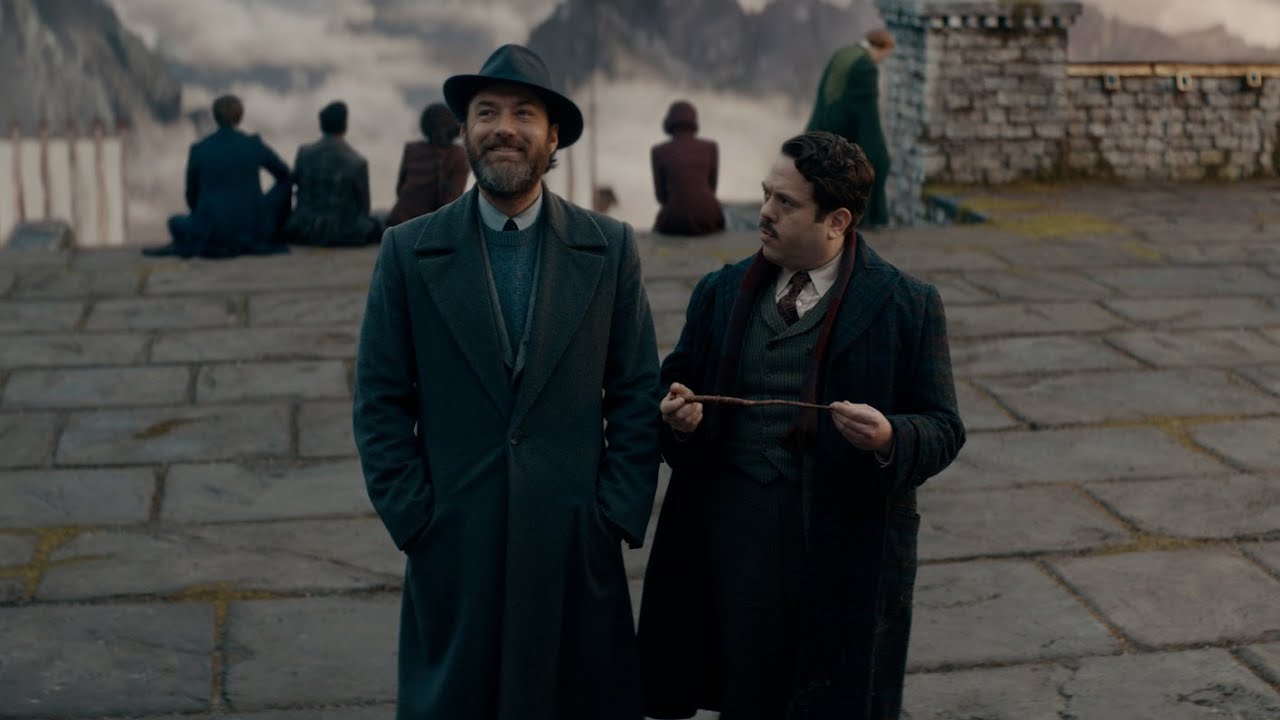
Jude Law and Dan Fogler in Fantastic Beasts: The Secrets of Dumbledore.

The third chapter of the Fantastic Beasts series, The Secrets of Dumbledore, begins with an exquisite piece of fairy-tale storytelling.  In the forests of China, Newt Scamander (Eddie Redmayne) – the English magizooogist (i.e., scholar of and caretaker for magical creatures) at the center of the narrative, set in the 1920s – oversees the birthing of a calf by a rare equine animal known as a Qilin, pronounced Chillin. The mother has a woven golden mane and a face like a mask; her tender calf is skeletal, a golden glow pulsating through his fragile skin. When the minions of the series’ villain, Gellert Grindelwald, attack, felling the mother, Newt struggles to save the baby Qilin, but he fails. He has to watch, helpless, as the calf is kidnaped and the mother expires, a single tear rolling down her cheek. It’s only then that Newt sees what everyone has missed in the chaos:  that she actually gave birth to twins.