Showing posts sorted by relevance for query susan sontag. Sort by date Show all posts

Saturday, June 23, 2018

The Women Who Write: Michelle Dean's Sharp

A close-up of the cover art for Michelle Dean's Sharp. (Photo: Amazon)

The incontestable assertion behind Michelle Dean’s Sharp: The Women Who Made an Art of Having an Opinion (Grove Atlantic; 384 pp.) is that “the forward march of American literature is usually chronicled by way of its male novelists.” The book, whatever its minor shortcomings, is a witty, healthy corrective to a myopia that afflicts many of us. An obvious fact of American literature is that it has been overwhelmingly phallocentric in nature, from its romantic traditions to its symbology – not to mention the critical canon, erected by men, that has only in the last few decades begun to be meaningfully dismantled. Even, or especially, for a reader who loves the likes of Melville, Hemingway, and Mailer, the mighty winds of maleness can grow stale and suffocating. One tires of that world of suffering loners, bilious bromance, and bullet-headed misogyny; one needs to immerse oneself in other minds, hear other voices, be maddened and inspired by other egos. And so one falls gladly and hungrily upon the singular works of – oh, I don't know – Shirley Jackson, Zora Neale Hurston, Patricia Highsmith, Vernon Lee, Mary Shelley, Mavis Gallant, Paule Marshall, Jane Austen, Toni Morrison, Iris Murdoch, Carson McCullers, Muriel Spark, Joyce Carol Oates, Harriet Beecher Stowe, Alice Walker, Edith Wharton, Flannery O'Connor, Gertrude Stein, Colette, Willa Cather, Alison Lurie, Grace Paley, Ann Petry, Dawn Powell, and many others less famous.

If a few names are conspicuously missing from that list, it’s because they are present in Sharp. This critical history is a rogues’ gallery of literary femaleness – even though most of the women in it rightly bristled at being defined as “woman writers.” Dean’s exemplars are, in chapter if not birth order, Dorothy Parker; Rebecca West; Hannah Arendt; Mary McCarthy; Susan Sontag; Pauline Kael; Joan Didion; Nora Ephron; Renata Adler; and Janet Malcolm. Most have at least a few things in common. While some succeeded in other genres, almost all are distinguished for their non-fiction, with fully half reaching eminence via The New Yorker. Several were at the center of at least one major literary controversy (McCarthy’s feud with Lillian Hellman; Adler’s New York Review of Books attack on Kael; the defamation suit brought by one of Malcolm’s subjects). Each was or is noted for, as Dean’s subtitle puts it, “having an opinion”: that is, a contentious opinion, boldly and unequivocally stated. Above and beyond these are other commonalities – of spirit, of temperament – which enabled the women to power through sexist barriers that limited, or shut out altogether, many of their contemporaries. “Through their exceptional talent,” Dean writes, “they were granted a kind of intellectual equality to men other women had no hope of.”

Wednesday, May 26, 2021

How to Throw Your Voice Visually: Becoming Photography

Chuck Samuels: Becoming Photography (Kerber Verlag, 2021).
 
“From the idea that the self is not given to us, I think there is only one practical consequence: we have to create ourselves as a work of art.” – Michel Foucault

Much of what we now define as the poetics of images, the aesthetics of the camera, and the politics of photography comes to us from the thoughtful pens of cultural theorists such as the German critic Walter Benjamin, the French philosopher Roland Barthes, the American polemicist Susan Sontag, and the British art historian John Berger. Their speculations on what makes photography not only an art form but a special and privileged form of modernist consciousness have paved the way for a deep appreciation of both the magic potential and the seductive powers of technological reproduction. Our ways of seeing and thinking about seeing have often been guided by their ruminations on what happens when we photograph something or someone, and their penetrating analysis of the photographic arts has inspired and influenced generations of image-makers. 

Saturday, August 31, 2013

The Unrepentant Leni Riefenstahl

“The artist is to be exempt from the moral laws that are binding on ordinary people. Just pronounce the magic word ‘Art’, and everything is O.K.”

– George Orwell, “Benefit of Clergy: Some Notes on Salvador Dali”

In 1974 Susan Sontag wrote a two-part widely read and controversial essay, “Fascinating Fascism,” that was prompted by the publication of Leni Riefenstahl’s photographic book about the Nubian people in the Sudan. Although acknowledging that the images were “ravishing,” Sontag was disturbed about the “disquieting lies” Riefenstahl was peddling about her life – some were included in the book’s dust jacket – at a time when her cinematic output was being de-contextualized at film festivals and museum retrospectives. The former Nazi propagandist was celebrated by some feminists – especially problematic since Riefenstahl had never been concerned about the condition of women, only her own career – and celebrities from Mick Jagger to Andy Warhol who admired her creativity. Sontag set out to rebuke Riefenstahl’s rewriting of her personal history, and to define and condemn what she called “fascist aesthetics” arguing that her early mountain films, her documentaries made during the Third Reich, which Sontag acknowledged as “superb films,” and the Nuba photographs constituted a “triptych of fascist visuals.” My purpose is to critique what Sontag got right and to demonstrate that Ray Müller’s highly praised 1993 documentary, The Wonderful, Horrible Life of Leni Riefenstahl, rather than clarifying Riefenstahl’s misrepresentations, ends up largely affirming them.

Wednesday, December 29, 2021

The Bearable Darkness of Being: Teju Cole’s Words and Images

(University of Chicago Press)
“Objects have the longest memories of all. Beneath their stillness, they are alive with all the terrors they have ever witnessed.” – Teju Cole, New York Times, 2014

I – Setting the Stage

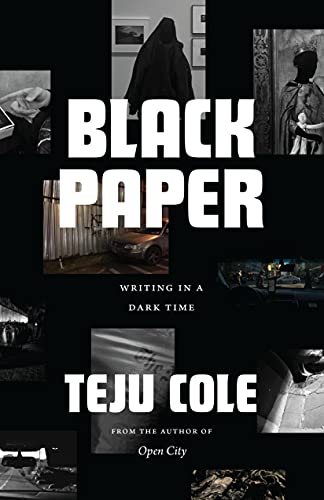
Teju Cole’s riveting new book of inspiring essays, Black Paper, published by the University of Chicago Press, is the latest gift from his fruitful and ever-accelerating career as one of our premiere culture critics. For several years he was the photography critic for The New York Times Sunday Magazine, a prestige posting from which he surveyed our world with sheer poetic clarity. Like many other people, one of the great joys in my life has been allotting a certain amount of time, variable depending on mood, to settling in for the duration needed to read the Sunday edition. Literally doing nothing for long enough to actually simply live, without any purpose at all other than traveling through the words and images elegantly and eloquently being presented in the frequently obscenely fat and multi-sectioned contents of the newspaper of record. Just lugging it home is enough to make me feel like I’ve won a survival contest whose reward is the pleasure of idleness for about two hours. The official word for this practice is, of course, reverie.

And each of us fortunate to be able to indulge in such relatively harmless pleasures has a certain strategic approach to reading it: how to begin, where to start, in what order, which section of which department, and so on. In my case, the first thing I separate out from the obese pile of newsprint (still such an analog joy in today’s gruesomely online digital world: news that actually comes off on your fingertips in vast dark smears) is the Sunday Magazine. There again, an opulent abundance awaits the reader, whether it be fashion, food or furniture. For me, it’s a seemingly humble little column in the up front section called “On Photography,” written by the breathtakingly gifted image maker and thinker Teju Cole. In my opinion, he is a national treasure. Unless you knew it was there, his regular column, which used the same name as a famous 1977 book of essays on photography by the great Susan Sontag, might be easy to glide right past in your search for end-of-week distraction. Once discovered, however, it was a must-see/read destination. It’s deceptively discreet presentation, generally a single quotidian image accompanied by about a page and a half of simmering type, also practiced a similar craft espoused by Sontag, that of ekphrasis, the poetic expression of emotive texts in direct personal response to works of visual art, in this case photographs.

His quietly poetic style was absolutely perfectly manifested to arrest the reader/viewer for far longer than you may have thought possible at first. The quote used above, for instance, has stayed with me on my writing desk for seven years and confronts me daily with an awareness that is nearly confounding in its emotive depths. The only other writers capable of achieving that kind of utter resistance to absorption are perhaps different in each of our lives, W.G Sebold and David Foster Wallace in mine, for instance, but the skilled surfing of the meanings hiding inside things is a shared ability you have to have been born with. Cole is so accomplished in both his chosen arts, images and words, that he’s overwhelming in a kind of shy and almost retiring, reticent way (he is what my late father used to call ‘scary brilliant’) and also so seductive that once you know he was there, embedded amongst the early ads in the magazine like a simmering bomb of beauty, you started to explore his other means of expression and find to your astonishment that he has also exhibited his own photographs with drastic success and written reflections on being absolutely alive in repeated forays into published essays that have created a formidable edifice.

Scary brilliant, and it is rare for a practitioner of an art such as fabricating the frozen music of images to also be so singularly adept at being a culture critic who can so fluidly explore the beauties or terrors of his peer photographers that one feels invited into a secret cult of sorts: the place where the rituals of aesthetic aura are being celebrated in ways that also bring us perilously close to actually understanding the meaning of such terms as affect, the power of emotional impact in action, and agency, the power of taking action in the world based on privately cultivated propulsion. Alas, Cole was the photography critic for The New York Times Magazine only from 2015 to 2019, and I’ve missed him every Sunday since. But he’s also, fortunately for me and his other followers, been very busy elsewhere, and now has the extra time away from a weekly column to exhibit his own work as well as dive deeper into our visual culture as an astute assessor of our precarious life in the 21st century.

In a review in Feature Shoot Magazine of a Cole solo exhibit, the critic Miss Rosen observed with an acute eye and mind just what makes him so special for so many of us:

The relationship between image and text is one of the most challenging pairings to exist. They demand complete attention and so one must choose: to look or to read—and in what order? Perhaps it seems deceptively simple: one simply does as they are inclined. Yet regardless of preference, they inform each other, infinitely. When we read, we see the picture in our mind. When we look, we write the words ourselves. Now we are asked to forgo our imagination and focus on the given context. Yet few can bridge the gap that exists between the linguistic and visual realms, the distinctive forms of intelligence that operate independently and interdependently at the same time. Most often, we simply opt out somewhere along the line, wanting to return to the freedom to imagine for ourselves rather than listen to what we are told. Writer Teju Cole understands this well. As photography critic for The New York Times Magazine, Cole mastered the painting of pictures with words that illuminate and elucidate in equal part, so that his words both add and peel back layers from that which appears before our eyes.

In his first solo show in 2017, Blind Spot and Black Paper, at Steven Kasher Gallery, New York, the writer brought us along for a journey around the world, looking at life not only through his eyes but experiencing it through his prose. The exhibition, which accompanied the publication of his fourth book, featured a selection of 30 color photographs accompanied by a single paragraph. Each piece of text is a beautifully encapsulated prose poem that draws us into uncharted depths, giving voice to the image that quietly beckons us with its simple, subtle lyricism of color, shape, and form.

And that insight of his into the stillness of objects and their memory that so impacted me, with places actually being just bigger objects, is richly evident in many of his ekphrastic experiments, as demonstrated so well when we travel through some of his powerful images and evocative words. 
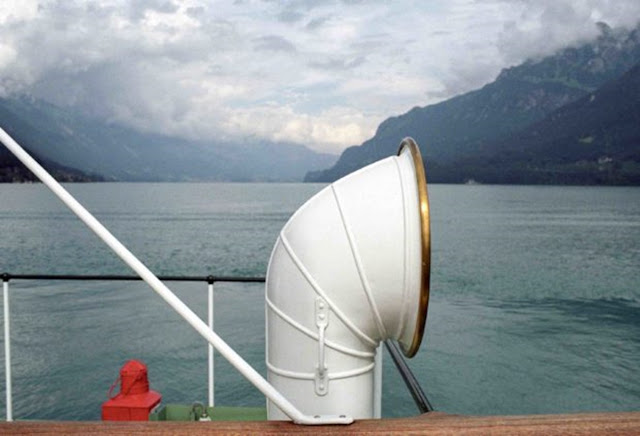
Brienzerzee, from Fernweh (2014, Stephen Kasher Gallery, NY)

I opened my eyes. What lay before me looked like the sound of the alphorn at the beginning of the final movement of Brahms’s First Symphony. This was the sound, this was the sound I saw.
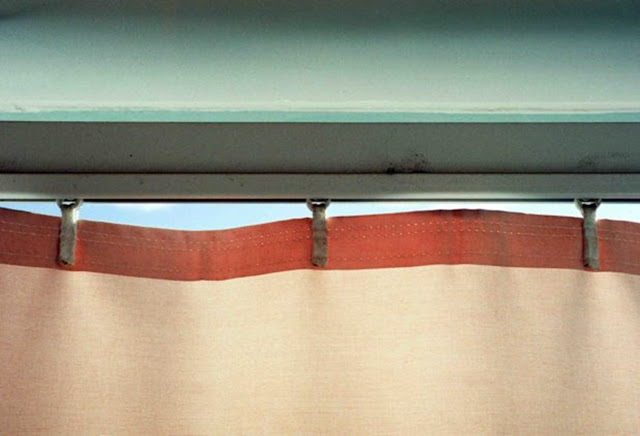
Zurich, from Fernweh, (2014, Stephen Kasher Gallery, NY)

Stillness. In the interior, she reads with lowered eyes, unaware of what comes next. A presence made of absence.

Zurich, from Fernweh (2015, Stephen Kasher Gallery, NY).

I sat there for hours and watched the sun slip across the landscape. Anything can happen. The point is to shatter serenity; the absurdity of contrast between before and after is the very point
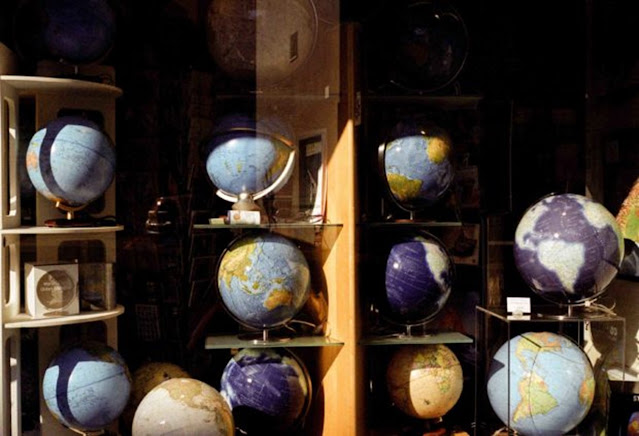
Zurich, from Fernweh (2014, Stephen Kasher Gallery, NY).

You take around 7500 steps each day. If you live to eighty, that comes to 200 million steps over the course of your life, a hundred thousand miles. You don’t consider yourself a great walker, but you will have circumnavigated the globe on foot four times over.


II – Staging the Play

Teju Cole is as versatile as he is prolific. A novelist, photographer, critic, curator and the author of seven tantalizing books, among them Open City, Blind Spot, Golden Apple of the Sun, Fernweh, and his latest one, Black Paper, he was a 2018 Guggenheim Fellow, and is currently the Gore Vidal Professor of the Practice of Creative Writing at Harvard. Based on even that snapshot of his résumé, and my reading of his ruminations over the course of many rewarding years, one thing I know for certain is that it is virtually impossible for Professor Cole to teach any other living human being how to write the way he does. His style is so graceful, elliptical, digressive, entertaining and educational, even or especially for the average lay reader, that I’m pretty sure all his lucky students can really do is keep their mouths shut and hope to somehow soak up some of his splendour, perhaps by osmosis. And Black Paper feels like a little way station in a snowy niche on the way to the top of a mountain range where spookily gifted writers such as Walter Benjamin or Harold Rosenberg go on vacation. It is also almost a work of theatre, not because it is in any way theatrical, but rather because the scope of its sweep, into and out of a vertiginous array of subjects and themes, has an epic-tragedy kind of vibe about it.

Characterizing him as “a kind of realm” in The New York Review of Books, Norman Rush summed up Cole’s mission quite nicely: “Teju Cole is an emissary for our best selves. He is sampling himself for our benefit, hoping for enlightenment and seeking to provide pleasure to us through art.” The key notion here is that of sampling, usually a musical term for collaging different fragments of different musical sources into a unified score, frequently one with a hip-hop flavour. That active aspect of mixing, matching and merging is precisely what Cole does in most of his works, whether on images or on social and cultural issues, and especially as conducted in Black Paper, perhaps the most far-ranging, diverse and multi-faceted sampling of his acutely aware experiences of our postmodern world yet.

His bicultural origins – he was born in America in 1975, raised in Nigeria until he was 17 and brought back to America with his family to study art and then medicine, before returning abroad to study African art history and Northern Renaissance art at Columbia U. in New York, serving as writer-in-residence at Bard College and writing a flurry of novels – have all accumulated the perfect amount of intellectual gravitas and cosmopolitan charm to gracefully, i.e., effortlessly, startle us with a truly polyglot stew of knowledge. He stirs this dreamy stew ideally in Black Paper, where he declares, “Darkness is not empty.” as he proceeds to navigate his way through a variety of meditations on what it means to maintain our humanity in a time of darkness. One solution, he has suggested here, is to be intensely attentive to our experience, so much so that it’s not so much about seeing what’s going on, to take it all in, but also to consider what it is we’re not seeing and what is not happening, but which should be.

The essays in this new collection, ranging across five separate parts, commencing with a masterful consideration about what makes the Italian painter Caravaggio so important, through territories he calls “Elegies” (containing great insights into the image historian John Berger and cultural historian Edward Said), “Shadows” (containing clear glimpses into the work of artists Kerry James Marshall and Lorna Simpson), “Coming to Our Senses” (with skillfully clarifying approaches to ethics) “In a Dark Time” (with touching portraits of refusal, resistance, and cooperative living) and “Epilogue: Black Paper” (a stirring counterpoint to Caravaggio which abstractly explores the links between literature and activism while still remaining a deeply humanist document). Along the way, he also manages to make manifest the power of the colour black in the visual arts and the role of the shadow in photography. The last section also contains one of the most heart-wrenchingly simple observations about our shared harrowing time that I’ve read in ages: “An incalculable number of people cried themselves to sleep in those days.”

What’s a premiere photography critic doing writing about the painting of Caravaggio, you might well ask? Well, first of all, Cole is so eloquent that he could write about the history sheep farm fences and make it transformative and compelling, and after all, the subtitle of his new book is Writing in a Dark Time, which brings us to Caravaggio in the most logical of ways. Caravaggio, apart from leading a tragic life, dying young, influencing every painter after him, and in the cauldron of his own feverish brain practically inventing the Baroque style in art, was utterly immersive in a manner consistent with our present era. He was also among the first exponents of complete subjectivity in art, one of the hallmarks of our own age, and he skillfully indulged his own private obsessions practically to the exclusion of all else. Most importantly, perhaps, Caravaggio was photography. For the roughly 250 years from Caravaggio to the French invention of the camera in about 1840, his representational style was the main means of producing mimetic memorials to actuality.

Cole, an accomplished novelist as well as essayist, not only knows this but also acts upon it, by bookending his approach to Caravaggio with his appreciation of a contemporary such as Lorna Simpson, an American conceptual photographer and multimedia artist whose radical works on paper extended the exploration of representation, identity and history. In some strange ways, apart from the shift from painting to photography, she is examining the edges of perception in precisely the same way that Caravaggio did. Cole also reminds us of what the novelist Mary Gaitskill stressed so well: “Fiction is to literal representation what painting is to photography: it’s just not claiming to be ‘real’ in the same way at all.” And it is precisely because Cole himself blurs the arbitrary lines between fiction, essay, poem, elegy, document, social activist, artist and critic that he is able to stride so confidently across the landscape of subjects and themes in this new book. He thus approaches the drastically fractured moment in history we currently occupy via a stunning constellation strategy: discussing the confrontation with the parallel arcs of unsettling art in unsettling times from every possible angle.

Unsettling, yes. Here is why we need to nourish ourselves on Cole’s proteins, whose own images are strong but whose words are even stronger, once again reflecting on the traveling vitamin called Caravaggio:

Porto Ercole was the final unanticipated stop. He’s buried somewhere there. But his real body can be said to be elsewhere: the body, that is, of his painterly achievement. He was a murderer, a slaveholder, a terror and a pest. But I don’t go to Caravaggio to be reminded of how good people are, and certainly not because of how good he was. To the contrary: I seek him out for a certain kind of otherwise unbearable knowledge. Here was an artist who depicted fruit in its ripeness and at the moment it has begun to rot, an artist who painted flesh at its most delicately seductive and its most grievously injured. I don’t have to know him to know that I need to know what he knows, the knowledge that hums, centuries later, on the surface of his paintings, knowledge of all the pain. Loneliness, beauty, fear and awful vulnerability our bodies have in common.
Caravaggio, Flagellation of Christ (1607, Naples).

See what I mean? Our own weird time often seems as dark of Caravaggio’s time was, which is why he still matters, since he seems to know us almost more than we know ourselves, and even at least as much as a contemporary artist such Kerry James Marshall does. They are both, as Cole so deftly demonstrates, about repentance, atonement, reconciliation and redemption. Caravaggio knew he needed to repent, in fact he was repenting almost every twenty minutes, and he especially repented in each painting, while Marshall masterfully reminds us, especially white culture, that it is high time for the rest of us to repent as well. In a hundred years, if there were to still exist an archive of memory such as the famed Encyclopedia Britannica, and that’s a big if, one can easily imagine a single entry capable of adequately covering and capturing the strange years between 2020 and 2022. And that entry would have been written by Teju Cole in Black Paper: Writing in a Dark Time:

Many fell ill, illnesses that showed on the face and illnesses that didn’t. We knew and we didn’t know. Poverty began to burrow into those lives. Shame made a home in some people, some went hungry, hunger hollowed them out. The stock market was up, but many pockets were empty.

 Donald Brackett is a Vancouver-based popular culture journalist and curator who writes about music, art and films. He has been the Executive Director of both the Professional Art Dealers Association of Canada and The Ontario Association of Art Galleries. He is the author of the recent book Back to Black: Amy Winehouse’s Only Masterpiece (Backbeat Books, 2016). In addition to numerous essays, articles and radio broadcasts, he is also the author of two books on creative collaboration in pop music: Fleetwood Mac: 40 Years of Creative Chaos2007, and Dark Mirror: The Pathology of the Singer-Songwriter, 2008, as well as the biographies Long Slow Train: The Soul Music of Sharon Jones and The Dap-Kings2018, and Tumult!: The Incredible Life and Music of Tina Turner2020. His latest work in progress is a new book on the life and art of the enigmatic Yoko Ono, due out in early 2022. 

Monday, October 25, 2021

Panem et Circenses: Town Bloody Hall

 Germaine Greer and Norman Mailer in Town Bloody Hall (1979).

Chris Hegedus and D.A. Pennebaker’s Town Bloody Hall (1979) is an unauthorized record of a public “Debate on Women’s Liberation” held in Manhattan in 1971. I say unauthorized because the venue prohibited filming, but the filmmakers came anyway at the behest of Norman Mailer, moderator and author of the anti-feminist essay “The Positive Sex,” which served as the excuse for the event. Four prominent feminists take the stage with him, and the audience is a Who’s Who of the New York literati. You can read here about the fascinating background of the event and the film’s production history.

Thursday, April 19, 2012

Outlier: Paul Goodman Changed My Life

2011 was an exceptional year for documentaries about outliers: Bill Cunningham New York, William S. Burroughs: A Man Within, Magic Trip (about Ken Kesey), Public Speaking (about Fran Leibowitz), The Man Nobody Knew: In Search of My Father, CIA Spymaster William Colby. One of the most fascinating is Jonathan Lee’s Paul Goodman Changed My Life, a study of the prolific anarchist Paul Goodman. Goodman has now been largely forgotten but in the early and mid-sixties his 1959 Growing Up Absurd – one of Lee’s many interviewees, the Esalen Institute president Gordon Wheeler, assures us – could be found on the book shelf of every dorm room in every liberal arts college across the country. (By the time I attended one, in 1968, it had vanished: warmly embraced by the Berkeley Free Speech Movement, Goodman was démodé by the time campus protest turned uglier and more chaotic in the Nixon era.) Growing Up Absurd is part sociology, part philosophy and part politics. Its thesis is that young American men in the Eisenhower years were growing up cognizant of the corrupted state of their institutions – education, government, business, law – and in increasingly hopeless and desperate rebellion against them. It still makes compelling reading, and despite the selectivity of Goodman’s subject matter (he doesn’t address the condition of young women, writing as he does a decade and more before the women’s movement, and out of a peculiarly old-fashioned sensibility about gender politics), the bulk of his observations still seem relevant more than half a century later.

Saturday, January 23, 2010

The Church of the Cultured Mind: The Cinematheque's The Best of the Decade List


“I have had enough serious interest in the products of the ‘higher’ arts to be very sharply aware that the impulse which leads me to a Humphrey Bogart movie has little in common with the impulse which leads me to the novels of Henry James or the poetry of T.S. Eliot…To define that connection seems to me one of the tasks of film criticism, and the definition must be first of all a personal one. A man watches a movie, and the critic must acknowledge that he’s that man.”

--Robert Warshow, The Immediate Experience, 1955.

We seemed to have come a slippery distance from the time when critic Robert Warshow eagerly expressed curiosity about an impulse, or a justification to make a connection between what is often deemed “high culture” and “low culture.” One look at the TIFF Cinematheque Best of the Decade list tells you that there is no desire, or curiosity, to connect with anything but their own church of refined taste. This is why it is really immaterial to discuss what’s on their list of the best films of the past decade. In examining their choices, I’m sure that we can all find things we love (The Gleaners and I, Yi Yi), things we dislike (Syndromes and a Century, Caché), even things we didn’t see – and perhaps might want to (Songs from the Second Floor). What is more important, as the previous writers on this site attested, is to discuss what isn’t on it – and why.

Thursday, April 26, 2012

A Gentle Rebellion: Moyra Davey at Murray Guy

Moyra Davey's Les Goddesses
We are pleased to welcome a new critic, Amanda Shubert, to our group. 

Moyra Davey’s small, unprepossessing gallery show at Murray Guy in Chelsea, New York City, on view until May 6, is hardly the art event of the season. Toronto-born, Davey now lives in New York, where her steady production of photographic and video work, astonishingly lyrical and persistently feminist, is dwarfed next to the conspicuous spectacle and titanic scale of much postmodern photography. (Davey’s gallery show coincides with a major retrospective of the work of Davey’s better known contemporary in feminist photography, Cindy Sherman, at New York’s Museum of Modern Art.) All the same, the exhibition afforded me more pleasure, visual and intellectual, than any installation of contemporary work I’ve seen in years. Entitled Spleen. Indolence. Torpor. Ill-humour – a phrase taken from the journal of one of Mary Wollstonecraft’s rebellious daughters, whose stories are one dimension of the thrillingly multi-faceted video installation, Les Goddesses, at the heart of the exhibition – the show pairs two new gridded photographic series, “Trust Me” (2011) and “Subway Riders” (2012), with a sequence of Davey’s earliest photographs from the late 1970s. 

The eloquent counterpoint of these pieces is terrifically complex. The web of visual relationships within the photographic works is mirrored in the allusive, essayistic narrative Davey delivers in Les Goddesses. The 61 minute video installation, with voice over by Davey, draws together the biographies of Mary Wollstonecraft and her daughters Mary Shelley, Claire Clairmont and Fanny Imlay, the travel diary of Goethe, and the cinematic philosophies of Louis Malle and Jean-Luc Godard with fragmentary portraits of family members and friends, all set against stunning views of Davey’s apartment with all of its everyday dust and clutter suffused with light from open windows. It is as though we were looking into one of her photographs, perfectly still yet shot through with passing time.

Wednesday, August 15, 2018

Portugal/Brazil: Melancholy Redux – The Shared Literary Ethos of Assis, Pessoa, and Lispector

Machado de Assis's Collected Stories, Fernando Pessoa's Book of Disquiet, and Clarice Lispector's Collected Stories. (Photo: Getty Images)

This is an appreciation of three new translations of seminal works by perhaps the greatest writers in a shared language in the late 19th and early to mid 20th century. But these three remarkable writers, all of whom specialized in creating scintillating short stories of extreme structural brevity and emotional precision, had much more in common than only writing in Portuguese. They also shared a deep subterranean conduit of melancholy realism and occasionally a surreal current of open-hearted embrace for the uncanny aspects of everyday life. They each documented waking dreams: everyday life under a magnifying glass.

For my purposes, and for the purposes of this brief study of their work (which is not a review of all three new translations at once but rather is a celebration of their radical stylistic spirit) there is a kind of metaphysical conveyor belt running directly from Machado through Pessoa and leading powerfully into the lap of the almost unbearably glamorous Lispector. (A lap-dance for intellectuals, perhaps.) That conveyor belt also operates in the gloomy nocturnal geographical navigations traveling from Portugal to Brazil and back again, fueled by the quirky and deceptive simplicity of their native language (to which I, alas, have no access apart from the seemingly brilliant handiwork of three gifted translation artisans) as it mysteriously runs uphill into a passionate yet tautly restrained English.

Friday, February 2, 2018

Justice Served at the High Temple of Art: The Connoisseurship of Paul Magriel

Bronze statuette of a veiled and masked dancer from the Greek Hellenistic Period (3rd to 2nd Century B.C.) from the Met that enthralled Paul Magriel.

Of the millions who flock yearly to New York's Metropolitan Museum of Art, only a handful know what to look for, and how. It always drove Paul Magriel crazy. "The random business of people walking in, taking in 25 paintings, one after the other, it's just mind-boggling," the self-taught art connoisseur once fumed. "You have to separate your time, your consciousness and your visual sensibility and be so specific about what you're doing and how you're doing it that you get some benefits, otherwise it's such a waste. It's not only a waste – it's an abuse of the artist. You're not giving him justice."

To make sure justice is duly served at the high temple of art that is the Met, in 1982 Magriel began leading unofficial tours of its varied and rich collections. A regular visitor of the museum for more than five decades, he had been dismayed to see so many people shuffling through the Met as if it were a cultural shopping mall, plugged into their Acoustiguides, staring in a daze at dozens of pictures at a time, buzzing around the big exhibits heavily publicized by the museum, and ultimately ignoring the store of treasures in the Met's incomparable holdings of roughly three million objects. He started by taking friends, one or two at a time, on tours that concentrated on his own favorite objects, a range far-reaching in style, theme and material, but all chosen for having given him immense pleasure. After developing four 90 tours of about 25 objects each, word quickly spread.

Friday, September 25, 2020

Balls: The Criterion Collection Release of Town Bloody Hall (1979)


“It was a trivializing, peripheral, silly sort of event, in the best uptown tradition,” Germaine Greer said in 2004 of the panel discussion — or public forum, or celebrity sideshow, or one-off improvised sitcom episode — that was staged by the Theatre of Ideas at New York’s Town Hall on April 30, 1971, under the banner “A Dialogue on Women’s Liberation.” In one respect at least, she wasn’t wrong: the event, which put Greer onstage with three other women representing a range of feminisms, plus Norman Mailer, was very much a production of and for the Manhattan intellectual elite. But the evening was also what it promised to be, a theater of ideas — ideas held up, tossed down, kicked about, laughed at, shouted over, defended, derided. It was raucous and suspenseful and dirty and funny and unsettling, and everything else we’d want theater to be.

It’s all there in Town Bloody Hall, which D.A. Pennebaker (along with two other cameramen) filmed on the night, and which Pennebaker’s creative partner and wife, Chris Hegedus, edited into shape in 1979. The film has now been restored and given its first DVD release by the Criterion Collection, with stellar extras including a new interview with Hegedus; years-later interviews with Greer and Mailer; a partial reunion panel convened in 2004; audio commentary from Hegedus and Greer; and the complete Dick Cavett Show of December 1, 1971, in which Mailer, his brow darkened by drink and professional resentment, took a combative posture toward guests Gore Vidal and Janet Flanner, Cavett, and finally the audience. The Criterion release is a nifty package, and the main attraction still packs a punch. Whatever evasions are attributable to the event or its participants, as a film and as a document Town Bloody Hall is nothing less than thrilling for anyone who cares about the people, the issues, or the history. 

Friday, April 13, 2018

The Assassination of Art Nuko by the Curator John O’Brian

Cruising down the Rideau in Ottawa by Carl Chaplin.

We are pleased to welcome a new critic, Kirk Tougas, to our group.

Obviously an exaggeration, but a Vancouver artist has been "disappeared" by guest curator John O’Brian in BOMBHEAD at the Vancouver Art Gallery. Rephrased, perhaps an alternate title could be Shadowboxing with History: How Curators Can Erase Artists, but between erasure and assassination, let’s settle on the latter.

Saturday, March 14, 2015

Talking Out of Turn #36: bp Nichol (1988)

From 1981 to 1989, I was assistant producer and co-host of the radio show, On the Arts, at CJRT-FM in Toronto. With the late Tom Fulton, who was the show's prime host and producer, we did a half-hour interview program where we talked to artists from all fields. In 1994, after I had gone to CBC, I had an idea to collate an interview anthology from some of the more interesting discussions I'd had with guests from that period. Since they all took place during the Eighties, I thought I could edit the collection into an oral history of the decade from some of its most outspoken participants. The book was assembled from interview transcripts and organized thematically. I titled it Talking Out of Turn: Revisiting the '80s. With financial help from the Canada Council, I shaped the individual pieces into a number of pertinent themes relevant to the decade. By the time I began to contact publishers, though, the industry was radically starting to change. At one time, editorial controlled marketing. Now the reverse was taking place. Acquisition editors, who once responded to an interesting idea for a book, were soon following marketing divisions who were only concerned with whether the person doing it was hot enough to sell it.

For a few years, I flogged the proposal to various publishers but many were worried that there were too many people from different backgrounds (e.g. Margaret Atwood sitting alongside Oliver Stone) which made it look as if they hadn't read the outline. Another publisher curiously chose to reject it because, to them, it appeared to be simply a book about me promoting my interviews (as if I was trying to be a low-rent Larry King) rather than seeing it as a commentary on the decade through the eyes of the guests. All told, the book soon faded away and I turned to other projects. However, when uncovering the original proposal and sample interviews a number of years ago, I felt that maybe some of them could find a new life on Critics at Large.

Tom Fulton, producer of On the Arts
In a decade, that many considered to be drowning in narcissism, I decided to include interviews in Talking Out of Turn with artists who posed alternatives in the Eighties to self-centredness when it came to examining the self. That included Wallace Shawn talking about the process of making (with Louis Malle and Andre Gregory) the highly experimental fictional documentary My Dinner with Andre (1981), D.M. Thomas inserting into fiction the theories of Freud and the horror of the Holocaust in The White Hotel (1981), and William Diehl, a pulp fiction writer (Chameleon, Sharky's Machine), who was also a pacifist who wrote violent dramas to purge himself of the turbulence he had within him. The chapter on biography also included the Canadian poet bp Nichol whose life work in both narrative and experimental poetry was almost always autobiographical in nature. Whether it was his epic poem, The Martyrology or the more compact Selected Organs (Black Moss Press, 1988), Nichol never lost touch with his personal attachment to language which became a living organism in his work. One might call Selected Organs a body of work and a work of the body. It was also only a portion of a larger volume (planned over eight years) to be titled Organ Music, which featured autobiographical chapters focusing on the organs: The Vagina, The Mouth, The Chest, The Tonsils, The Hips, etc.

Thursday, January 8, 2015

Critic's Notes & Frames Vol. XI: Je Suis Charlie


On Wednesday morning, the French satirical paper Charlie Hebdo was attacked by three masked gunmen who stormed the building and killed ten of its staff and two police officers. The gunmen are currently identified as Muslim extremists. The attack came shortly after the paper tweeted a satirical drawing of ISIS leader Abu Bakr Al-Baghdadi. Irreverent and stridently non-conformist in tone, the publication has always been anti-religious while taking on the extreme right, Islam, Judaism and Catholicism. Its sensibility was clearly defined by its former editor, Stéphane Charbonnier, as "left-wing pluralism." In September 2012, the newspaper had published a series of satirical cartoons of Muhammed, some of which feature nude caricatures of him, in response to the anti-Islamic film, Innocence of Muslims, which led to attacks on U.S. embassies and increased security in France. Before yesterday's attack, the magazine had also been the victim of an earlier terrorist attack  a firebombing in 2011.

Curiously, I'd already been planning an edition of Critic's Notes scheduled for today, but after the horrible events yesterday in Paris, I've decided to forgo that one in favour of this new post. In solidarity with those who perished for exercising their freedom of speech, I've decided to let others have their voice in response to those events and to sit back and listen to those voices. In the spirit of Charlie's pluralism, I've also included contrary ones, as well, to keep to the spirit of equal opportunity democracy. Wherever possible, I tried to create links to the original articles (unless they were quotes from social media). For the first time, the picture of the pen that has always lead off this column takes on an added significance.