Director Arthur Penn and actor Tony Curtis passed away one day apart last week: September 28 and 29. Both talents, it can be argued, were never truly fulfilled. At the very least, they never achieved their possible greatness. Considering Curtis was acting in films and TV from 1949 until 2008 (and was rumoured to be up for another role when he died), his reputation rests on very few projects: The Sweet Smell of Success, (1957), The Defiant Ones (1958), The Vikings (1958), Some Like It Hot (1959), Spartacus (1960) and maybe The Boston Strangler (1968). Except for The Defiant Ones and Some Like It Hot, the pictures he's remembered for are ones where he was not the lead. Was he ever a great actor? Probably not, but when he was good, he could be very good. Yet, due mostly to his own choices in life (he was more interested in jumping the bones of, supposedly, 1000 women and living the Hollywood life, than in really practicing his craft), Curtis never thrived as perhaps he should have.
Independent reviews of television, movies, books, music, theatre, dance, culture, and the arts.
Sunday, October 3, 2010
Unfulfilled Potential: Remembering Arthur Penn and Tony Curtis
Director Arthur Penn and actor Tony Curtis passed away one day apart last week: September 28 and 29. Both talents, it can be argued, were never truly fulfilled. At the very least, they never achieved their possible greatness. Considering Curtis was acting in films and TV from 1949 until 2008 (and was rumoured to be up for another role when he died), his reputation rests on very few projects: The Sweet Smell of Success, (1957), The Defiant Ones (1958), The Vikings (1958), Some Like It Hot (1959), Spartacus (1960) and maybe The Boston Strangler (1968). Except for The Defiant Ones and Some Like It Hot, the pictures he's remembered for are ones where he was not the lead. Was he ever a great actor? Probably not, but when he was good, he could be very good. Yet, due mostly to his own choices in life (he was more interested in jumping the bones of, supposedly, 1000 women and living the Hollywood life, than in really practicing his craft), Curtis never thrived as perhaps he should have.
Monday, February 13, 2023
Some Like It Hot Refurbished, and a Brief Word of Farewell
![]() |
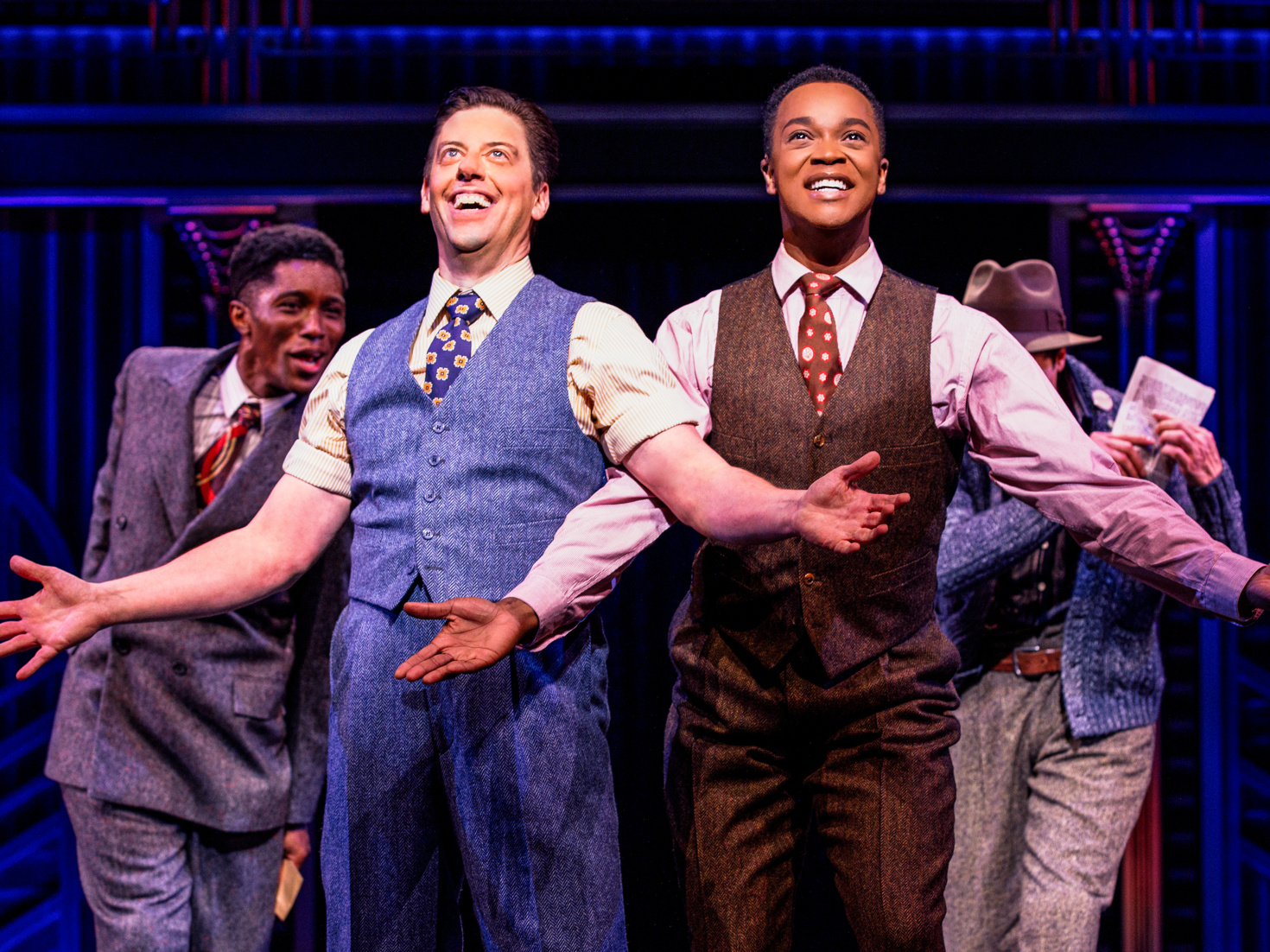
| Christian Borle & J. Harrison Ghee in Some Like It Hot. (Photo: Marc J. Franklin) |
The best romantic comedy released in the early fifties, William Wyler’s Roman Holiday with Audrey Hepburn and Gregory Peck, was about the impossible romance of a princess and a reporter; it was a cross between a genteel version It Happened One Night and a reverse Cinderella story. But then Hollywood romantic comedy degenerated into sex cartoons with Jayne Mansfield at one end of the spectrum and mechanical farces at the other. One might have feared that the form was dead, until Billy Wilder’s divine Some Like It Hot came to the rescue at the end of the decade. It wasn’t remotely like any previous movie in this genre. (But then, Wilder’s The Lost Weekend hadn’t been like any other social problem picture or Sunset Boulevard like any other film noir.) Wilder and his co-writer I.A.L. Diamond took a page from Shakespeare’s cross-dressing comedies and then doubled it. When two jazz musicians witness the St. Valentine’s Day Massacre they run like hell, straight into drag. They figure their only retreat from the gangsters on their tail is to vanish into dresses and wigs and join an all-girls’ band. Tony Curtis’s Joe, a.k.a. Josephine, falls for the lead singer, Sugar (Marilyn Monroe at her most sublime), and chooses a second disguise – a millionaire named Shell Oil Jr. who entertains her on a borrowed yacht, where Curtis draws her in with a dead-on Cary Grant imitation. Jack Lemmon’s frantic Jerry/Daphne finds himself the object of the yacht’s actual owner, Osgood Fielding III (Joe E. Brown) – a courtship that Wilder and Diamond leave up in the air when the rest of the plot is resolved. The final line – spoken by Brown – when Jerry reveals his true gender to Osgood is one of the two best curtain lines in American romantic comedy. (The other concludes Charade, with Hepburn and Cary Grant, which followed Some Like It Hot four years later.)
Wednesday, June 18, 2014
Talking Out of Turn #33: Vito Russo (1981)
![]() |
| author Vito Russo |
From 1981 to 1989, I was assistant producer and co-host of the radio show, On the Arts, at CJRT-FM in Toronto. With the late Tom Fulton, who was the show's prime host and producer, we did a half-hour interview program where we talked to artists from all fields. In 1994, after I had gone to CBC, I had an idea to collate an interview anthology from some of the more interesting discussions I'd had with guests from that period. Since they all took place during the Eighties, I thought I could edit the collection into an oral history of the decade from some of its most outspoken participants. The book was assembled from interview transcripts and organized thematically. I titled it Talking Out of Turn: Revisiting the '80s. With financial help from the Canada Council, I shaped the individual pieces into a number of pertinent themes relevant to the decade. By the time I began to contact publishers, though, the industry was radically starting to change. At one time, editorial controlled marketing. Now the reverse was taking place. Acquisition editors, who once responded to an interesting idea for a book, were soon following marketing divisions who were only concerned with whether the person doing it was hot enough to sell it.
![]() |
| Tom Fulton, the executive producer of On the Arts. |
Talking Out of Turn had one section devoted to reviewers who ran against the current of popular thinking in the Eighties. That chapter included discussions with Globe and Mail film critic and author Jay Scott (Midnight Matinees) who spoke about how, despite being one of Canada's sharpest and wittiest writers on movies, he was initially a reluctant critic; author Margaret Atwood, who turned to literary criticism in her 1986 book Second Words, discussed – from an author's perspective – the value of criticism and how it was changing for the worse during this decade; New Yorker film critic Pauline Kael, who had returned to writing in the Eighties after a brief hiatus as a consultant in Hollywood, talked to me in 1983 about how the Reagan decade was already having a deadening impact on the movie industry; and Vito Russo, who in 1981, wrote a book called The Celluloid Closet: Homosexuality in the Movies, which examined the way gays and lesbians had been portrayed in the history of American movies.
In his book, Russo moves from decade to decade, weaving into his narrative a chronological and thematic awareness of the various representations of gay life; that is, the attitudes that lay hidden and closeted in American culture. He examines with both humour and affectionate insight the early work of 'movie sissies' like actors Eric Blore, Edward Everett Horton and Franklin Pangborn, who gave form to what couldn't be acknowledged openly. Russo moves from these 'buddy movies' of the Thirties and Forties to contemporary representations which often ranged from predatory and psychotic (Cruising, American Gigolo) to victims (Advise and Consent, The Children's Hour). He even delves into hidden homosexual dynamics not acknowledged such as the unspoken love between Judah Ben-Hur (Charlton Heston) and Messala (Stephen Boyd) in Ben-Hur (1959), the covert lesbian attraction that Elizabeth Wilson has for Kim Stanley's Marilyn Monroe character in The Goddess (1958), and the originally cut scene between Laurence Olivier and Tony Curtis in Stanley Kubrick's Spartacus (1960), where Olivier's Roman general admits his bi-sexuality to his slave Antoninus (Curtis) whom he's trying to seduce.
The Celluloid Closet was made into a fine documentary in 1995 by Rob Epstein and Jeffrey Friedman where they had the benefit of using Russo's book to select clips that supported his thesis. This fall, at Ryerson University, I'll be teaching a course through the LIFE Institute based on their material. Since this interview with Vito Russo takes place over thirty years ago, just as the AIDS epidemic was first becoming national news, there isn't the sense of dread here that came to overshadow the rest of the decade. (Although he was a huge activist bringing awareness to the needs of the LGBT community, by the end of the decade, AIDS would also claim Russo himself.) Looking back to 1981, it was a year when dozens of Toronto police officers conducted simultaneous raids on Toronto's most popular bathhouses and arrested more than 300 gay men. Times may have indeed changed since those raids, but certain attitudes haven't (including having a mayor who continues to spout invective towards homosexuals – even ignoring them as citizens – without much of a whisper of protest from his supporters). Since Toronto is hosting WorldPride this year, it just seemed fitting to post this talk with Vito Russo on the eve of the celebration.
Monday, July 29, 2024
Boeing Boeing: Farce Unmoored
![]() |
| Christopher Innvar, Stephanie Jean Lane, and Mark H. Dold in Boeing Boeing. (Photo: Daniel Rader) |
The irony of farce is that, though it’s supposed to be ridiculous, it can only work if it’s grounded in reality. There’s a delectable scene in the British stage hit The Play That Goes Wrong where a phone rings and one of the hapless amateurs stuck on stage in a fiasco of stunning proportions is expected to answer it. But the platform underneath him has come apart and he’s in danger of sliding off it onto the floor below and possibly breaking his neck. So the actor standing next to the phone, spurred by a desperate need to play out his string, rigs a series of increasingly nutty links between the jangling instrument and his stranded castmate. What makes the moment hilarious is the loopy logic of the two actors who are breaking their backs improvising a piece of compensatory staging, as if they could somehow save the show if only the poor bastard on the semi-collapsed platform could answer that phone. It’s the kind of logic that Buster Keaton was a genius at, where the performer meets a loose-screw issue with sober, one-step-at-a-time persistence.
I thought about The Play That Goes Wrong while I was watching Barrington Stage Company’s mounting of Boeing Boeing. The comedy, by the French playwright Marc Camoletti, was first produced in London in an English translation by Beverly Cross and Francis Evans in 1962, where it remained on the boards for seven years. (Jerry Lewis and Tony Curtis co-starred in a Hollywood movie adaptation in 1965.) Matthew Warchus revived it in the West End in 2007; the Broadway transfer, with a tip-top cast led by Mark Rylance and Bradley Whitford, was the funniest two and a half hours I’ve ever spent in a theatre. The play isn’t much more than a sketch for a series of farce routines. But it has a strong enough premise to support them: an architect living in Paris near Orly Airport conducts simultaneous affairs with three different flight attendants from different countries and different airlines, and he and his college buddy, who happens to be visiting him, find their mental resources stretched nearly to the breaking point when all three women show up on the same day. And, as in any bare-bones farce, the sharper the routines and the more skillful the actors the richer the entertainment.
Wednesday, January 23, 2019
It’s Been a Hard Day’s Life: Growing Up Berman
![]() |
| Tosh Berman (left) gesturing tantrically with family friend Allen Ginsberg. (Photo: Wallace Berman) |
Review of the new memoir, Tosh: Growing Up in Wallace Berman’s World by Tosh Berman, published by City Lights Books.
"If the first movie your father takes you to as a child is . . . And God Created Woman, you can be sure of two things. First, that your father is an extraordinary person. Second, that you are destined to lead an extraordinarily interesting life." – Ron Mael, SparksBoth of Mael’s observations ring totally true in this engaging, endearing, and surprisingly modest chronicle of a life lived under the white hot lights of a radical couple of proto-hippie parents: Wallace and Shirley Berman, an avant-garde artist famed as one of the originators of “assemblage art” and his gorgeous and exceedingly generous (for letting him be who he was) wife and muse. The Bermans were obviously not your average family, and their son Tosh (from the Russian Antosha) is partly the living evidence of a life lived for reasons far beyond the quotidian behavioral realm of domestic security or conventional social structures. His father , and the legendary works of art he made, as well as the stratospheric friendships he cultivated, were a vital transitional link between the beat culture of the '50s and the hippie counterculture of the '60s. Thus young Tosh grew up on the circus high-wire in the big-top tent of accelerated Change.
Monday, March 12, 2012
Mark Rylance: Everyman in Extremis
![]() |
| Mark Rylance in Measure for Measure, at the Globe Theatre in 2004. |
Actors call this kind of spontaneity, which derives from a thorough and acute awareness of the dramatic situation and the energies of the other actors on the stage and a focus so complete that it seals out any other world – even in the presence of a live audience – acting in the moment. Mark Rylance possesses that ability in a greater degree than any other actor I’ve ever seen, even including Walken. Rylance is a Midwesterner but he’s spent so much of his career (which spans more than three decades) in London that audiences can be forgiven for thinking he’s a Brit: he was the artistic director of Shakespeare’s Globe Theatre for ten years, where he famously played Hamlet and Angelo in Measure for Measure, and his last Broadway role, as the alcoholic trailer dweller Rooster Byron in Jez Butterworth’s Jerusalem, is an English play that originated in London's Royal Court Theatre. His technique transcends national distinctions. It’s steeped in the kind of physical fluency that the British are far more deft at than Americans, yet when you see him in a comedy he seems to be continuing the legacy of the great silent movie clowns. Not so much Chaplin (who, of course, hailed from the English music hall) as Keaton, and even more the lesser-known but brilliant Harry Langdon – seen at his best in Tramp, Tramp, Tramp and the two comedies he did for Frank Capra, The Strong Man and Long Pants – whose persona was the most debased and battered of them. In Matthew Warchus’s 2008 Broadway revival of Boeing-Boeing (also a transplant from the West End, with only Rylance repeating his performance), Rylance suggested some loopy hybrid of Langdon and a maddened Alec Guinness from his Ealing Studios days (I’m thinking especially of Guinness’s performance in The Man in the White Suit), an Everyman in extremis whose panic and determination have pitched him right on the edge of hysteria.
Friday, July 20, 2018
Acting Without Fear: First Reformed & A Very English Scandal
![]() |
| Ethan Hawke in First Reformed. (Photo: IMDB) |
The daring of Ethan Hawke’s recent movie performances – in Born to Be Blue, where he played the great, drug-addled jazz trumpeter and vocalist Chet Baker; in Maudie, where he played Everett, the difficult, armored fish vendor who employs the whimsical Nova Scotia artist Maudie Lewis as a housekeeper and winds up marrying her; and now in writer-director Paul Schrader’s First Reformed – is spellbinding. In his mid-forties, he’s become one of our greatest actors, consistently exploring territory beyond what he’s tried before. I voted for him as best actor in the Boston Society of Film Critics last year and the year before; every year brings its share of first-rate performances, but it seems to me that no one else is going as far or as deep as Hawke in inhabiting a set of utterly unalike personalities, and that his range expands each time out.
Saturday, March 10, 2018
Romantic Comedy at the End of the Millennium: The Last, Brief Golden Age
![]() |
| James Stewart and Margaret Sullavan in The Shop Around the Corner (1940). |
Friday, October 14, 2016
Curtis Hanson: A Career in Perspective
![]() |
| Eminem and Curtis Hanson (right) on the set of 8 Mile in 2002. (Photo: Eli Reed) |
Film director Curtis Hanson, who died in September at the too-young age of seventy-one, was stuck in B-movie territory for a decade and a half before he graduated, in 1987, with the thriller The Bedroom Window. (One of his last B-pictures, Losin’ It, about three SoCal high-schoolers who drive to Tijuana to get rid of their virginity, was coarse and chaotic but very likable. One of them was played by Tom Cruise, just months before Risky Business made him a star, and I’ve never enjoyed watching him as much since.) Once he made it to the majors, so to speak, Hanson made eleven pictures, and I like all or part of every single one except for his first hit, the witless 1992 Gothic The Hand That Rocks the Cradle – it was efficiently directed, but the dunderheaded script was insurmountable. What made him so reliable a filmmaker was a combination of his bred-in-the-bone understanding of genre conventions, his transparent love of actors and his undervalued gift for getting fine work out of them, and his relaxed finesse as a storyteller. This last is no surprise: from his first days in movies, the early seventies, he was a screenwriter as well as a director, penning the compulsively watchable, enjoyably amoral Canadian mystery The Silent Partner (directed by Daryl Duke and starring Elliott Gould, Susannah York and Christopher Plummer) in 1978 and contributing to the scripts of Samuel Fuller’s White Dog and Carroll Ballard’s Never Cry Wolf in the early eighties. And he kept his hand in: he wrote The Bedroom Window and co-wrote the best picture he ever turned out, L.A. Confidential, with Brian Helgeland, as well as one of his last movies, Lucky You, with Eric Roth.
Monday, June 20, 2022
Transitions: The Secrets of Dumbledore and Fiddler’s Journey to the Big Screen
![]() |
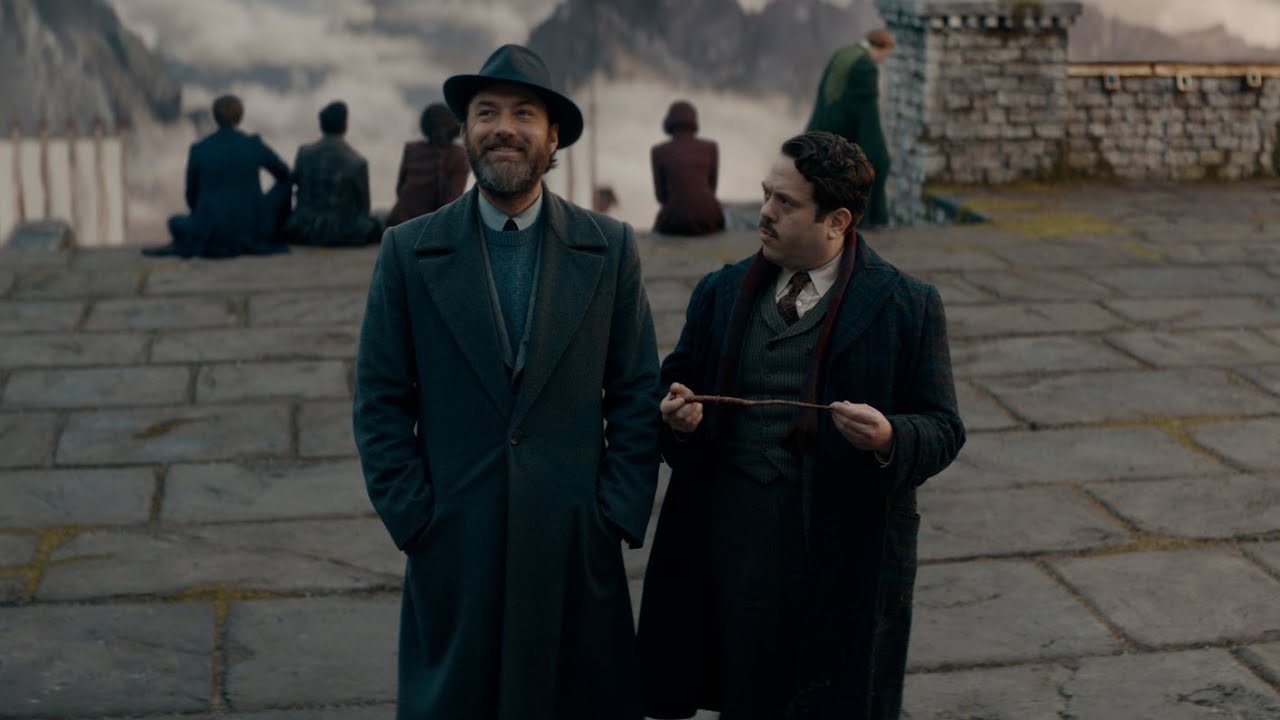
| Jude Law and Dan Fogler in Fantastic Beasts: The Secrets of Dumbledore. |
The third chapter of the Fantastic Beasts series, The Secrets of Dumbledore, begins with an exquisite piece of fairy-tale storytelling. In the forests of China, Newt Scamander (Eddie Redmayne) – the English magizooogist (i.e., scholar of and caretaker for magical creatures) at the center of the narrative, set in the 1920s – oversees the birthing of a calf by a rare equine animal known as a Qilin, pronounced Chillin. The mother has a woven golden mane and a face like a mask; her tender calf is skeletal, a golden glow pulsating through his fragile skin. When the minions of the series’ villain, Gellert Grindelwald, attack, felling the mother, Newt struggles to save the baby Qilin, but he fails. He has to watch, helpless, as the calf is kidnaped and the mother expires, a single tear rolling down her cheek. It’s only then that Newt sees what everyone has missed in the chaos: that she actually gave birth to twins.