Showing posts sorted by relevance for query Nathan Lane. Sort by date Show all posts

Monday, October 31, 2016

The Front Page: Old Pros

John Slattery and Nathan Lane in The Front Page at Broadway's Broadhurst Theater. (Photo by Julieta Cervantes)

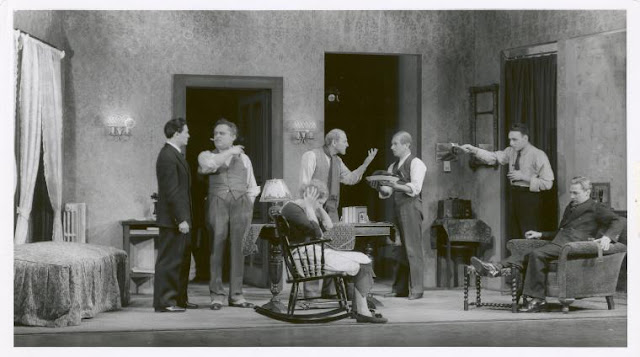
In recent years every Broadway season has included a top-flight revival of a classic American play. Last year it was Long Day’s Journey into Night, the year before You Can’t Take It with You and Of Mice and Men the season before that. But they don’t always get the respect they’ve earned. The mediocre notices for Jack O’Brien’s production of the 1928 Ben Hecht-Charles MacArthur comedy The Front Page with Nathan Lane and John Slattery have been utterly perplexing. I saw the show just before the press opening and walked away in a state of bliss. O’Brien has gathered together a dazzling cast to mount what I’d say is one of the three best comedies ever written by Americans, and watching them parry and thrust, negotiate Hecht and MacArthur’s hilarious banter and glide through the perfect mechanics of the farce plot with acrobatic grace is akin to buying a ticket for a revue in vaudeville’s heyday and discovering that every single act is good enough for the coveted penultimate slot on the bill.

Monday, May 6, 2013

Constructs: The Nance and The Assembled Parties

Nathan Lane in The Nance, at Broadway’s Lyceum Theatre (All photos by Joan Marcus)

Douglas Carter Beane’s The Nance (at Broadway’s Lyceum Theatre), set in late-Depression New York, invents a burlesque performer named Chauncey Miles (played by Nathan Lane) whose onstage persona, the “nance” or sissy in a series of revue sketches, is a way of hiding in plain sight for a gay man. Chauncey quips that “a pansy doing a pansy act is like a Negro doing blackface”; though many famous nances, like Bert Lahr as the Cowardly Lion in The Wizard of Oz, were straight in real life, many were not. The play covers the demise of burlesque on the watch of New York’s puritanical, family-values mayor, Fiorello LaGuardia, and his vigilant D.A., Paul Ross. It’s also about Chauncey’s inability to accept the love of a younger man, Ned (Jonny Orsini), whom he picks up at Horn & Hardart’s automat, where closeted gay men – there was effectively no other kind in 1937 – cruise, at the risk of being caught by the cops, beaten up and jailed for lewd and lascivious conduct.

Monday, June 19, 2017

London Revivals, Part I: Political Morality Plays

Andrew Garfield and Nathan Stewart-Jarre in Angels in America: Millennium Approaches. (Photo: Helen Maybanks)

This piece contains reviews for the National Theatre's Angels in America, Donmar Warehouse's The Resistible Rise of Arturo Ui, and Young Vic's Life of Galileo.

The hottest ticket in London this summer – aside from Harry Potter and the Cursed Child, just beginning its second year in the West End – is the National Theatre revival of Tony Kushner’s Angels in America, directed by Marianne Elliott (War Horse, The Curious Incident of the Dog in the Night-Time) and starring Nathan Lane and Andrew Garfield. I couldn’t get up much enthusiasm about it, but then I’m the stubborn cuss who doesn’t like Angels in America. No one could say that I haven’t done due diligence with the play. I saw Part I: Millennium Approaches, in its original National Theatre production in 1992 (with Henry Goodman as Roy Cohn), and both Part I and Part II: Perestroika, on Broadway in 1993 (with Ron Liebman as Cohn, Stephen Spinella as Prior Walter, Marcia Gay Harden as Harper Pitt and Jeffrey Wright as Belize). I’ve also seen Mike Nichols’s 2003 HBO film version (with a cast including Al Pacino, Mary-Louise Parker, Meryl Streep, Emma Thompson, Patrick Wilson, and James Cromwell).

Kushner subtitled the work, which runs for seven hours and forty minutes in its complete form at the National, A Gay Fantasia on National Themes, and clearly one of the elements that critics and prize-winning committees and the vast number of theatre professors who regularly include it on the syllabi of modern drama classes respond to is the enormity of its ambitions. It’s intended to be a chronicle of the AIDS crisis from the point of view of the gay community; a coming-out play; an excoriation of the repressive spirit of Republican politics targeted specifically at Roy Cohn (played by Lane in this latest production), Joe McCarthy’s counsel and a Department of Justice prosecutor at the Rosenberg trial, and a closeted gay man who died of AIDS in 1986; and a comparative exploration of Mormonism, Protestantism and Judaism focusing on politics and sexuality at the end of the twentieth century, with a disquisition on race in America. Three of the characters are Mormon, three are Jewish, one is white Protestant and one is African American, and there are many others, the roles divided among a small cast whose efforts, in any production of the play, are equivalent in physical endurance alone to running a pair of marathons. In style Angels in America is alternately realist, surrealist and Brechtian, with interludes of satirical caricature.

Saturday, February 16, 2019

Neglected Gem: Life with Mikey (1993)

Nathan Lane, Christina Vidal and Michael J. Fox in Life with Mikey (1993).

Life with Mikey was director James Lapine’s second movie, released two years after Impromptu, a high-toned 1991 farce with a dream cast that included Judy Davis, Hugh Grant, Mandy Patinkin, Bernadette Peters, and Emma Thompson. Lapine was previously known as a prominent Broadway director and librettist, who had collaborated with both Stephen Sondheim (Into the Woods, Sunday in the Park with George) and William Finn (Falsettos). Impromptu was well-received, although it didn’t set the box office afire. Life with Mikey’s budget was a third of what Impromptu cost, yet it grossed more than three times more as much as that first film. That would seem to qualify it as a success, yet Lapine has never made another film. (He did direct an adaptation of novelist Anne Tyler’s Earthly Possessions for HBO in 1999.)

It’s a bit of a stretch to call Life with Mikey a “gem.” (All right, more than a bit.) The screenplay, by journeyman Marc Lawrence, who’s written some movies I’ve liked (Music and Lyrics) and many I haven’t (Miss Congeniality, the remake of The Out of Towners), is sitcom fodder glazed with an almost opaque sentimentality, featuring a pot-holed plot that strains credulity. But the movie has lingered in my memory since I first saw it, due to the perfect casting of Michael J. Fox in the title role and the generous, quirky milieu that surrounds him.

Friday, July 3, 2026

Lemons: Joe Mantello Directs Arthur Miller’s Death of a Salesman

Laurie Metcalf, a carton of organic milk, and Nathan Lane in Death of a Salesman. (Photo: Emilio Madrid.)

When I heard director Joe Mantello was setting the current revival of Arthur Miller’s Death of a Salesman in a garage, I misheard it as the garage. So I assumed it meant the garage attached to the Lomans’ house. As far as reconceptions of classic American theater go, it’s not the worst idea I’ve ever heard. But no: It wasn’t the garage, it was a garage. But what set designer Chloe Lamford provides isn’t even a garage—it’s a huge industrial warehouse with a large rollup metal door and piles of debris and dirt everywhere. (That Lamford won a Tony for her set is far more unsettling than anything in the play.) The characters sleep on metal benches, eat meals at a metal table, and walk barefoot on the dirty floor. The structure earns garage-icity when the metal door ascends and Willy Loman drives his car into the warehouse to begin the play. (It ends with Willy backing the car off the stage. Symbolism.) I get that the America Dream is a lie, that Willie’s life is a big empty warehouse (I would argue that it’s actually a small empty warehouse), but do you need to hit the audience with a sledgehammer (and an ugly one at that) to make that point? Salesman isn’t a naturalistic play--there are flashbacks and fantasy sequences; Jo Mielziner’s famous set for the original Broadway production was widely seen as an expressionistic wonder -- but when the stage is so bereft of any hint of visual beauty or interest, you wonder why Willy doesn’t kill himself sooner.

Monday, August 26, 2013

Shaw Musicals 2013: Guys and Dolls & The Light in the Piazza


Everyone knows that Guys and Dolls is a great American musical, but more often than not productions of it are disappointing – cartoonishly overstated, terminally cute, or generally misguided (which is the word I’d use to describe Joseph L. Mankiewicz’s 1955 movie version). The 1992 Broadway revival was a popular and critical hit, but I didn’t derive much pleasure from it: the cast, headed by Nathan Lane and Faith Prince, seemed to be working way too hard, the staging was uninventive, and the tempo of Frank Loesser’s songs was slowed down, as if on the assumption that the audience couldn’t otherwise keep up with the witty lyrics. Oddly, amateur mountings of the show often locate its vaudevillian spirit and its robust style – phantasmagorical (the Damon Runyonland milieu) but with a strong underpinning of romantic feeling – better than professional ones, which tend to substitute slickness for charm. But Tadeusz Bradecki’s production at the Shaw Festival in Niagara-on-the-Lake, Ontario, is expertly staged and choreographed (by Parker Esse) and vastly entertaining. It gets the balance right: it’s raffish without pandering, open-hearted but not sentimental.

The show takes a little while to kick in. “Runyonland,” the instrumental ensemble number that Loesser supplied in place of an overture, begins intriguingly with silhouettes behind the scrim, but when that scrim flies up to reveal Peter Hartwell’s set, a semi-abstract black-and-white cityscape of midtown Manhattan, your heart sinks – not because it’s monochromatic (Sue LePage’s colorful costumes play vibrantly against it) but because it’s ugly. And, as usual, the company isn’t large enough to fill the huge Festival stage, so the number doesn’t do what it was written to do, set the mood and style of Runyon’s bustling, eccentric world of gamblers and minor-league show-biz pros and street hustlers (as adapted by book writers Jo Swerling and Abe Burrows) – even with Shaw veteran Guy Bannerman exiting as a gesticulating blind man and then reappearing a moment later as a pretzel vendor. In the first dialogue exchange, among the goofball gamblers Nicely-Nicely Johnson (Thom Allison) and Benny Southstreet (Billy Lake) and the vigilant cop Lieutenant Brannigan (Bannerman again), the actors seem to have been directed to act like Loony Tunes figures.

Thursday, September 10, 2026

Summer Smash: The Producers at Ogunquit

Jason Kravitz, Stephanie Gibson, and Dan DeLuca in The Producers. (Photo: Nile Scott Studios.)

The inspired premise of Mel Brooks’s debut movie The Producers – that a veteran Broadway impresario, trying to save himself from prison for fraud by producing a sure-fire flop, lands on a stunningly offensive operetta with Hitler as its hero – has convinced buffs for six decades that the movie is a comic masterpiece. Well, it’s intermittently hilarious, but it’s a pretty crummy picture. On the other hand, the multi-Tony-Award-winning Broadway musical Brooks fashioned from it a quarter of a century ago, directed and choreographed by Susan Stroman, is a solid gold entertainment, the most thoroughly satisfying project Brooks ever worked on. He wrote the music and lyrics and collaborated with Thomas Meehan on the book. At the Ogunquit Playhouse, James Gray has replicated Stroman’s original staging and a tip-top company is giving it a splendid twenty-fifth-anniversary revival through September 26.

Monday, May 20, 2019

Sentimental Journeys: Frankie and Johnny in the Clair de Lune, Burn This, Doris Day

Michael Shannon and Audra McDonald in Frankie and Johnny in the Clair de Lune. (Photo: Deen van Meer)

I’ve been skipping productions of Terrence McNally’s two-hander Frankie and Johnny in the Clair de Lune for decades – I didn’t see Kathy Bates with F. Murray Abraham or with Kenneth Welsh in the off-Broadway version in 1987, or Edie Falco with Stanley Tucci in the last revival, in 2002 – but I opted to see the latest one, on Broadway, with Audra McDonald and Michael Shannon. It’s a lousy play, an American variation on an English kitchen-sink drama that begins with a pair of lovers in bed naked, having sex, and then takes a couple of hours to show them opening up to each other in other ways. The (stock) idea is that they’re both desperately lonely but he’s willing to acknowledge it and she isn’t, and, attempting to persuade her that she should see him as more than a one-night stand, he’s got his work cut out for him because emotionally she’s closed down. It’s an unconventional courtship drama with the same basic structure as Lanford Wilson’s Talley’s Folly (1980), which takes a far more inventive approach to the man’s effort to win over the cautious, distanced woman – and which has far more interesting characters. Talley’s Folly is a comedy with serious undertones; Frankie and Johnny tries for loopy romanticism but ends up glum and monochromatic, though with a sentimental ending.

Monday, October 13, 2014

The Country House: Chekhov in the Berkshires

Blythe Danner in The Country House (Photo by Joan Marcus)

In Donald Margulies’s new play, The Country House, at the Manhattan Theatre Club’s Samuel J. Friedman Theatre, Blythe Danner plays Anna Patterson, the matriarch of a theatrical family. A famous actress, Anna has returned to the Williamstown Theatre Festival – and to her summer home in the Berkshires – a year after losing her daughter, also an actor, to cancer. The family assembles in this house of memories. Anna’s son Elliot Cooper (Eric Lange) is a difficult, obstreperous man who can’t get parts because no one wants to work with him and who has stumbled into middle age without finding a romantic partner. At this juncture he’s suddenly decided to become a playwright; he’s planning to ask his unsuspecting family to read his first effort aloud. His brother-in-law Walter Keegan (David Rasche), who parlayed a successful career as a stage director into an even more enviable one as a filmmaker, shows up with his new, younger fiancée, Nell McNally (Kate Jennings Grant) – also an actress – a beauty whom everyone is drawn to despite their discomfort with the way Walter has moved on so speedily after the death of his wife. Nell draws the admiration of both Elliot – who acted with her one summer, years earlier, and has romanticized that brief friendship into unrequited love – and another celebrity appearing that summer in Williamstown, Michael Astor (Daniel Sunjata), the star of a hit sci-fi TV series whom Anna, with motives that are not entirely pure, has invited to sleep on the living-room couch while his house is being fumigated. The only person in the house who isn’t charmed by Nell is Walter’s daughter Susie (Sarah Steele), a Yale student, the only character on stage without either a theatrical career or an interest in obtaining one. Susie is incensed at what she sees as her father’s disloyalty to her mother’s memory, and when Michael falls for Nell, she has even more reason to hate her stepmother-to-be, since she’s had a crush on the handsome actor since she was a little girl.

Monday, October 31, 2022

On Beckett: The Bill Irwin Show

Bill Irwin in On Beckett. (Photo: Craig Schwartz)

At the top of On Beckett, the one-man show Bill Irwin brought to Boston last week in the Arts Emerson series at the Emerson Paramount Theatre, the star tips and slightly rumples his bowler, bends his knees, throws his weight onto his ankles, stoops, leans forward and bears down on his left shoulder. All of these adjustments take merely a few seconds, yet he’s transformed utterly, and you think you’re in for a mesmerizing evening that brings together this actor’s clown gifts and his profound understanding of Samuel Beckett, whom he has been studying for half a century and whose work he famously takes tremendous pleasure in performing. I saw Irwin play Vladimir in a revival of Waiting for Godot on Broadway in 2009, opposite Nathan Lane as Estragon, and he was brilliant; the whole cast was. (John Goodman and John Glover played Pozzo and Lucky.) So these preparatory moments, after a somewhat overlong introduction, filled me with happy anticipation.

Monday, December 26, 2011

The School for Scandal at the Barbican, Butley in the West End

Ensemble members in various states of dress and undress stride cheekily up and down in a runway-style pre-show before settling down to the text in Deborah Warner’s production of Richard Brinsley Sheridan’s unbeatable comedy of manners The School for Scandal at the Barbican. This opening promises fun, but after about ten minutes of the actual play you realize you’ve been led down the garden path. Lady Sneerwell (Matilda Ziegler), who presides over the metaphorical school of the title, a crew of self-involved gossips who pick the reputations of London high society like vultures pecking at corpses, makes out with Snake (Gary Sefton) and shares a line of coke with him; that’s about the level of Warner’s invention. The hip-contemporary underwear-dominated costumes supervised by Binnie Bowerman quickly give way to the eighteenth-century outfits you see in most versions of the play, though every now and then someone walks onstage with an anachronistic costume piece, or someone pulls out a cell phone, and the transitions between scenes are flashy strobe-lit video projections that operate as Brechtian interruptions. It makes perfect sense to update the setting of The School for Scandal (originally produced in 1777), but I don’t get the nervous, ADHD shift between the play’s real setting and modern day – though Warner is hardly the first director to try this sort of post-modern theatrical trick.

Tuesday, October 21, 2025

How To Live and Die at the Canadian Opera Company: Roméo et Juliette and Orfeo ed Euridice in Toronto

Stephen Costello and Kseniia Proshina in Roméo et Juliette. (Photo: Michael Cooper.)

The Canadian Opera Company’s 2025–26 season opens with a stylistically mismatched pairing: Roméo et Juliette, Charles Gounod’s 1867 Shakespeare-inspired opera in director Amy Lane’s over-extravagant Malmö Opera rental, and the revival of Canadian director Robert Carsen’s minimalist 2011 staging of Orfeo ed Euridice, Christoph Willibald Gluck’s 1762 rendering of the Greek myth. The two productions run in rotation at Toronto’s Four Seasons Centre through to the end of this month.

Saturday, February 27, 2016

90s Redux: The People v. O.J. Simpson

John Travolta, David Schwimmer and Cuba Gooding, Jr. in The People v. O.J. Simpson: American Crime Story.

I still remember the day that the jury in the O.J. Simpson murder trial reached a verdict. I was eleven at the time, and my parents had judiciously shielded me from many of the more gruesome and scandalous elements of the story, but I still knew that it was a big deal, if for no other reason than that a famous football player was on trial. Besides, everyone else seemed fascinated by it; when the verdict came through, I was at recess, and one of the teachers had brought a radio outside so that he could listen to the proceedings. As soon as he relayed the news to me and my fellow fifth-graders, who were huddling close to hear, we took off in a swarm, shouting out the verdict to everyone else on the playground. None of us knew what that decision really meant, but it certainly felt like a momentous occasion.

Scott Alexander and Larry Karaszewski, the creators of FX’s new American Crime Story, presumably planned the first season of their anthology series with the hope that viewers would have a similarly personal recollection of the Simpson trial. In some ways, they’ve set up a tricky scenario for themselves: because the trial received such exhaustive coverage, there’s a lot of it that’s not only a matter of public record, but which also looms large in people’s memories of the mid-90s, restricting the amount of license that they and their cast can take with the story and characters. In that regard, it helps that they’ve chosen to adapt Jeffrey Toobin’s book, The Run of His Life: The People v. O.J. Simpson. I’m unfamiliar with Toobin’s account of the trial, but I’m willing to bet that basing a series like this, which covers fairly recent events featuring many individuals who are still alive, on a pre-existing nonfiction book will help deflect any accusations of rewriting history unfairly.

Monday, June 8, 2015

Comedy, Verbal and Physical: The Beaux’ Stratagem, Hay Fever, & The Play That Goes Wrong

Member of the cast of The Beaux’ Stratagem at London's Nation Theatre. (Photo by Manuel Harlan)

George Farquhar’s delightful Restoration comedy The Beaux’ Stratagem is about two young men, Aimwell and Archer, described as “two gentlemen of broken fortune,” who arrive at a scheme for setting themselves up, they hope, for life. Touring the English provinces, they trade off, one pretending to be a gentleman of means and wooing a rich lady, while the other playacts the role of his servant. In Litchfield, the setting of this comedy of manners, it’s Aimwell’s turn to be the suitor. He casts his eye on Dorinda, while Archer finds himself falling for her sister-in-law, Mrs. Sullen. Unfortunately, Mrs. Sullen is trapped in a miserable marriage to a drunkard and spendthrift whose only evident reason for making the match was his wife’s money. Farquhar’s play comments on the market society that produces such dismal unions; when Aimwell finds himself actually falling for the target of his “stratagem,” he repents his dishonesty and makes a clean breast of it to Dorinda. The play is lighthearted, though, even in its political background. The English and French are at war and the English are holding the French troops in Litchfield as prisoners, but the bonds they constrain them are silken ones: they’re free to roam about and enjoy the pleasures of the town.

The play was first performed in 1707, but Simon Godwin’s richly entertaining production at the National Theatre seems to be set later – the costumes by Lizzie Clachan are Georgian, perhaps just because the clothes from that period are more lush and the shapes trimmer and more flattering. (No one who sees Clachan’s gorgeous outfits is likely to complain about the shift.) She also designed the triple-tiered set, which is built on four staircases and doubles as the home of Lady Bountiful (Jane Booker), the mother of Dorinda (Pippa Bennett-Warner) and Sullen (Richard Henders), and the inn where Aimwell (Samuel Barnett) and Archer (Geoffrey Streatfield) have put up in Litchfield. This scaffold-like construction is convenient for the frequency of scenes in which characters overhear each other’s conversations as well as serving as a kind of metaphor for the interplay of classes. Archer is playing the part of a servant (though, when Mrs. Sullen observes that his manners are “above the livery of a footman,” he covers the discrepancy by confessing that he was born a gentleman) and becomes friendly with Lady Bountiful’s valet, Scrub (dour-looking Pearce Quigley, who reads his lines in a tossed-off, lightly ironic tone that’s very funny), while flirting, in the early scenes, with the innkeeper’s amiable daughter Cherry (Amy Morgan).

Saturday, March 11, 2017

Mommy Issues: HBO’s Big Little Lies

Reese Witherspoon, Shailene Woodley and Nicole Kidman in HBO's Big Little Lies.

At first glance, the star power involved with David E. Kelley’s small-screen adaptation of Liane Moriarty’s novel Big Little Lies is so dazzling that it’s easy to believe that this is like nothing you’ve ever seen on TV before. Keep looking, though, and you’ll be able to easily compare the show, which premiered February 19 and airs on Sunday nights on HBO, to other television offerings. That comparison, once made, isn’t always terribly flattering to the new arrival.

The marquee names attached to Big Little Lies include Shailene Woodley, Nicole Kidman, and Reese Witherspoon, with the latter two also serving as executive producers. The show traces the disturbances caused by the arrival of Woodley’s Jane Chapman, an underemployed single mom, and her son Ziggy (Iain Armitage) in the posh seaside neighborhood of Monterey, California. When Ziggy is accused of assaulting the daughter of the high-powered Renata Klein (Laura Dern), it pits Klein against Jane and her self-appointed champion Madeline (Witherspoon), setting in motion a series of events that culminate in a murder in the midst of a trivia night event. Kelley obscures the identity of both the victim and the perpetrator of that crime, giving us brief glimpses of the initial stages of the police investigation into the murder, as well as snippets of interviews with members of the community, in between longer scenes that slowly walk us through the backstory leading up to the killing.

Monday, March 21, 2022

Acting and Actors – The Method: How the Twentieth Century Learned to Act

The 1935 Broadway production of Awake and Sing!

The Method: How the Twentieth Century Learned to Act by Isaac Butler (Bloomsbury Publishing) is a gossipy, entertaining and informative history of Stanislavskian acting – how it developed in Russia at the Moscow Art Theatre and how two of Stanislavski’s associates, Richard Boleslavsky and Maria Ouspenskaya, imported it to American shores, where, through its dissemination by the Group Theatre in the 1930s, it became the Method. Butler has rounded up an impressive amount of material and presents it coherently and compellingly. I didn’t realize how little I knew about the tensions between Stanislavski and the M.A.T.’s co-director, Vladimir Nemirovich-Danchenko; about the role each of the personalities who were drawn into Stanislavski’s circle played in the development of his approach to acting; about the effect Stalin’s rise to power had on the M.A.T. generally and on Stanislavski specifically – or certainly about Boleslavsky’s intriguing and rather crazy biography. No account I’ve read deals so clearly and in such dramatic detail with the break in the Group Theatre, when Stella Adler, its most gifted actress, challenged the weight Lee Strasberg, one of the company’s co-founders, placed on affective memory, where the actor digs into his or her past to unearth emotional dynamite to blast open a scene. Adler and Strasberg became the most important American acting teachers of the twentieth century. The Method’s examination of the differences in their styles and approaches and that of Sanford Meisner, another Group alumnus who became a famous and influential teacher, is fascinating. He identifies Adler’s greatest quality as her gift at script analysis; her book, compiled posthumously from her class notes, on Ibsen, Strindberg and Chekhov, and to a lesser extent the one on American playwrights, bear him out.

Monday, May 11, 2020

This Nutty World: The Triple Glories of Kaufman and Hart

George S. Kaufman and Moss Hart in 1937.

Moss Hart was an aspiring young playwright, still living in the Bronx with his family and working in the office of a theatrical agent, when he sent producer Sam Harris a copy of his satirical comedy about the talking-picture revolution. Harris liked it but thought it needed a veteran’s knowhow, so he teamed Hart up with George S. Kaufman, the author or co-author of many Broadway hits. The story of Once in a Lifetime, which underwent significant changes during an extended pre-New York tour, was rewritten over the summer and rewritten again before it opened to rave reviews at the end of September 1930, is well-known to theatre buffs because it forms the triumphant final section of Hart’s memoir, Act One. Act One is the best theatrical memoir I’ve ever read – and I’ve read it four times, twice when I staged my own productions of Once in a Lifetime. The play would be my choice for the finest comedy ever written by Americans, with the possible exception of Ben Hecht and Charles MacArthur’s The Front Page. Both are hard-boiled comedies, a genre that contemporary playwrights and screenwriters seldom attempt.

Thursday, October 4, 2012

The (Funny) Way We Live Now: Modern Family

The cast of Modern Family.

Note: The following contains spoilers.

Modern Family (ABC), like The Big Bang Theory (CBS), is an excellent comedy that offers up likeable, compelling characters while not forgetting to make the viewer laugh. But while The Big Bang Theory is an old-fashioned – in style – comedy, with a laugh track, videotaped before a live audience with a two camera system, Modern Family is a more modern creature, a filmed on location, single-camera show without a laugh track. But just as The Big Bang Theory also uses hip lingo and au courant situations, Modern Family displays a taste for old-school humour, pratfalls, slapstick and the like. Melding those two disparate elements make it a very unique series indeed. The best two comedies on television both can claim that stature, allowing each to make their distinctive mark.

In so many significant ways, Modern Family is the finest exemplar of how we actually are today. Created by Steve Levitan and Christopher Lloyd (not the Taxi/Back to the Future actor), with nine other writers on the producing team, it centres on three Los Angeles, California-based families, who are related to each other in various ways. The traditional nuclear family, the Dunphys, are represented by Claire (Julie Bowen), a stay-at-home mother (yes, they still exist!), Phil (Ty Burrell), a real estate agent, and their three kids, Haley (Sarah Hyland), Alex (Ariel Winter) and Luke (Nolan Gould). Claire’s father, curmudgeonly business owner Jay Pritchett (Ed O’Neill) has a blended family, made up of his Colombian second wife Gloria (Sofia Vergara) and her preternaturally grown-up teenage son Manny (Rico Rodriguez). And Claire’s brother, Jay’s son, lawyer Mitchell Pritchett (Jesse Tyler Ferguson) also has a stay-at-home partner, Cameron (Eric Stonestreet); the couple recently adopted a Vietnamese girl Lily (Aubrey Anderson-Emmons). Each week, interspersed with one-on-one interviews by an off-camera individual for a purported mock documentary, Modern Family wrings smart and knowing episodes out of seemingly ordinary, even banal scenarios that nevertheless result in some of the funniest moments ever seen on network TV. It’s not surprising it dominated the comedy categories at last week’s Emmy Awards. (It won for Best Comedy series, and there were nods for Bowen and Stonestreet as Best Supporting Actress and Actor, respectively, and a Best Directing award for Levitan.). This is one show that deserves the accolades it regularly receives.

Monday, July 14, 2025

Splat: James Gunn's Superman

Superman (David Corenswet), looking glum. (Warners Brothers.) 

The beginning of James Gunn’s new iteration of the Man of Steel is somewhat promising: Superman (David Corenswet) has intervened to prevent a foreign war, and Lex Luthor (Nicholas Hoult) is running a successful PR campaign to convince people the supposedly apolitical Supe took sides and broke international law. But things rapidly devolve from there. A giant robot machine thingy from the aggressor country is terrorizing Metropolis, except it’s really not a giant machine robot thingy, it’s regular sized, and it’s not really a robot, it’s a supervillain under Luthor’s sway. I’m sure the supervillain’s name was mentioned, but I missed it, and he’s sort of indistinguishable from Luthor’s attack squad, The Raptors, who are either robots or superbeings themselves. Luthor breaks into the Fortress of Solitude and discovers that the message from Jor-el (Bradley Cooper) and Lara (some woman I thought was Lady Gaga but wasn’t) that Superman can only listen to half of—because the second half was damaged—is actually a message telling the Man of Steel to enslave the earth and rule over it. (I’m pretty sure that’s not canon.) Luthor also has a private prison in a “pocket universe” where he keeps his enemies and ex-girlfriends, and there are portals in and out that are in danger of decaying and becoming black holes that could destroy Earth. I think the guards in this prison realm are also Raptors but they might not be. When Superman is captured and put in one of the cells in the pocket universe, there’s a superbeing in his cell who can turn his body into Kryptonite, which is how Supey is kept under control. The superbeing is kept under control because his alien baby is in a cell opposite with someone else who will kill the alien baby if the guy in Superman’s cell doesn’t do what Luthor wants—which, as stated previously, is keep Superman under control. Lex is, of course, a combination of Elon Musk and Donald Trump, and it turns out he’s in league with the aggressor country because he wants to develop the lesser one as Trump wants to do with the Gaza Strip. Also the Justice League, which consists of Green Lantern (Nathan Fillion) and some really deep cuts from the DC stable, Hawkgirl and Mr. Terrific, is around to help Superman out when needed. Maybe. Green Lantern refers to the group as the “Justice Gang,” and Hawkgirl objects to the name, which you’d better find funny because it happens 87 times. I have no idea what Mr. Terrific’s superpower is, but he’s really good with tech stuff. Not to mention another supervillain called the Engineer—not sure what her powers are either—and a murderous clone of Superman, just for fun. Exhausted yet? I sure am.

Tuesday, February 27, 2018

Mark Morris's Pepperland: Getting High

Mark Morris Dance Group in Pepperland. (Photo: Gareth Jones)

Pepperland, American choreographer Mark Morris’s latest work, is a new Beatles-inspired dance and, to paraphrase the Fabs, it takes you on a boat on a river to travel back to a not-so-distant time when patchouli scented the air and love was all you needed to change the world. Inspired by Sgt. Pepper’s Lonely Hearts Club Band but taking its title from the George Martin instrumental in the animated film Yellow Submarine, the Beatles project which soon followed the 1967 record that Rolling Stone calls the greatest rock album of all time, the nearly hour-long work reimagines the Swinging Sixties as a Technicolor dream. That's how Paul McCartney once described the decade he and his bandmates not only dominated but redefined. Accordingly, the mood is nostalgic in a sunny, giddy, carefree sort of way. The dancing, dexterously and whimsically performed by 14-members of the Brooklyn-based Mark Morris Dance Group, skips and leaps and somersaults. The direction is up.