Showing posts sorted by date for query Encores!. Sort by relevance Show all posts

Wednesday, November 26, 2025

On Repression: Fun Home and Bat Boy

Sarah Bockel and Nick Duckart in Fun Home. (Photo: Marc J. Franklin.)

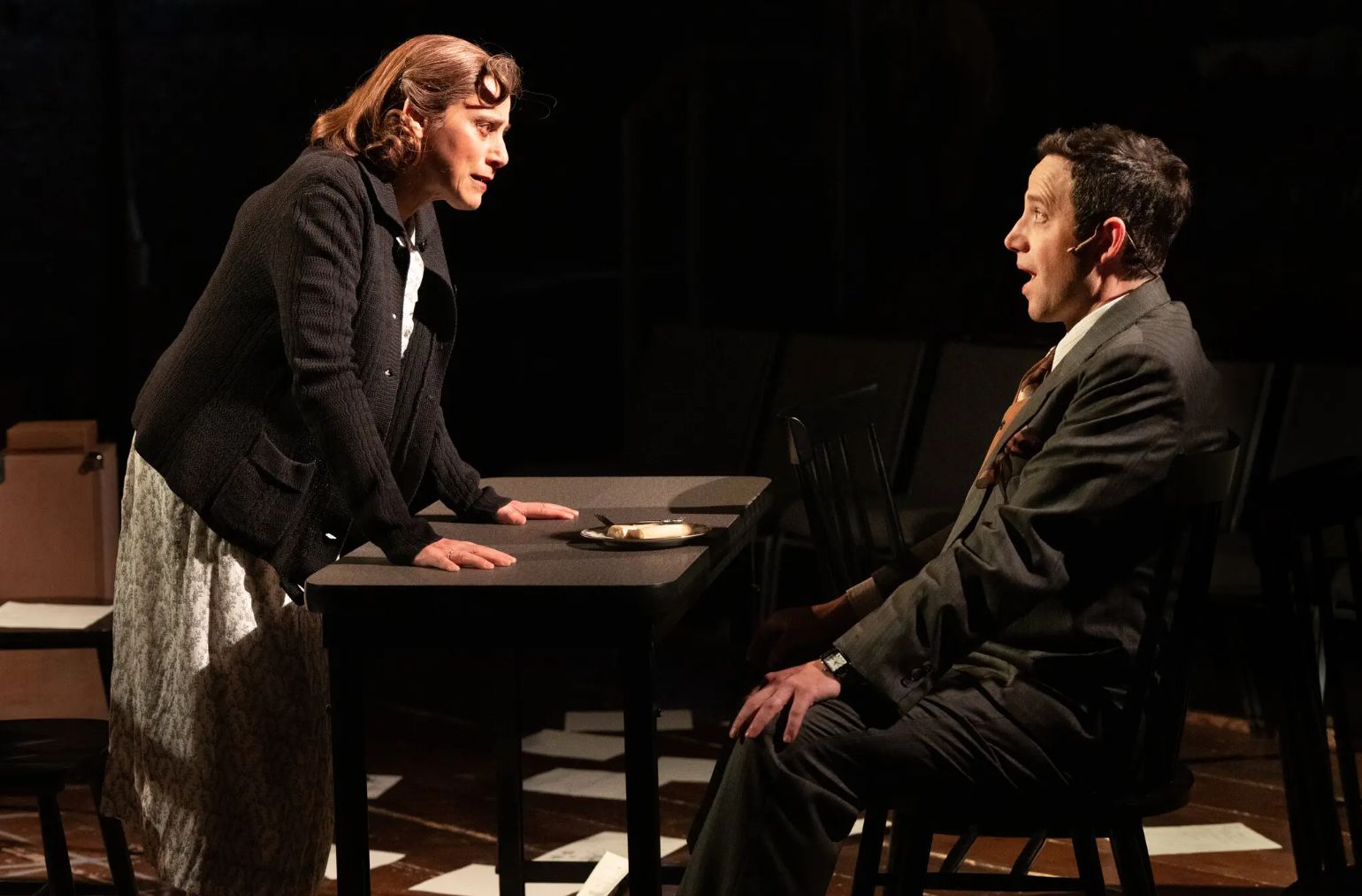
It’s not the Huntington Theatre Company’s fault that the opening night performance of Fun Home occasioned repeated displays of virtue signaling on the part of the audience; that’s what you get these days when you produce a play that wears its liberal heart on its sleeve. (The cheering began with the pre-show announcement, for God’s sake.) But Logan Ellis’s production of the musical, adapted by Lisa Kron from Alison Bechdel’s autobiographical graphic novel, makes it easy for an audience to declare their allegiance. The show, which premiered at the Public Theatre twelve years ago under Sam Gold’s direction, is already didactic. It’s a memory play narrated by a character based on Bechdel, who grew up in Beech Creek, Pennsylvania in the 1960s and 70s, in a museum-like Victorian house that doubled as the small town’s funeral parlor (hence fun home, the family’s nickname for it), with a father who divided his time between undertaking and teaching high school English. Though Alison’s reminiscences permit her to revisit her eleven-year-old self, they focus on her coming out as an Oberlin freshman and, in the wake of that announcement, her mother Helen’s revelation that Alison’s father Bruce was a closeted gay man with a taste for young, sometimes underage men. Bechdel’s trajectory ends happily: she grows up to become a famous cartoonist. Bruce, on the other hand, ends up a suicide.

Thursday, July 3, 2025

Mixed Media Report

This round-up includes reviews of Adolescence, Good Night, and Good Luck and Mission: Impossible: The Final Reckoning, as well as a tribute to Charles Strouse.

Stephen Graham and Owen Cooper in Adolescence. (Photo: Netflix.)

It’s a confirmed truth that British actors can do just about anything, but the consistency and range of performances in the recent four-part English series Adolescence (streaming on Netflix) is so impressive that it may have set a new standard. The style of the limited series, created and written by Stephen Graham, who plays one of the principal roles, and the prolific playwright and screenwriter Jack Thorne and directed by Philip Barantini, is documentary realism, and the characters are etched in such precise psychological detail that they register more as figures in an Impressionist group painting come to life than as actors at work. You carry them away with you; I watched the first half at the end of the evening and woke up early the next morning with them still crowded into my brain. (I couldn’t get back to sleep until I’d finished the series.) My praise is meant to extend to the young performers, who give performances of unwavering authenticity on a par with the adults. Those of us who love watching English TV drama – and that includes almost everyone I know – have our favorite actors, but the only member of the cast of Adolescence I recognized was Graham, whom I’d admired as the captain of the whaling ship in The North Water and as Jamie Bell’s brother in the movie Film Stars Don’t Die in Liverpool. I assume that my lack of familiarity with the others enhanced the freshness of the experience, but then British actors are chameleons anyway.

Tuesday, April 8, 2025

Potpourri: Love Life, Don’t Eat the Mangos and Beckett Briefs

Kate Baldwin and Brian Stokes Mitchell in Love Life. (Photo: Joan Marcus.)

The review of Don’t Eat the Mangos contains spoilers.


The great Jewish Weimar composer Kurt Weill fled Berlin for New York in the early thirties. Nothing he wrote for Broadway earned him the fame he’d garnered as Bertolt Brecht’s collaborator in Germany, but he produced the music for eight shows between 1936 and 1949 (he died in 1950 at the age of fifty while he was working on a musical based on Adventures of Huckleberry Finn) with a fascinating range of librettists including Moss Hart, Ira Gershwin, S.J. Perelman, Ogden Nash and Maxwell Anderson. And though the shows were a mixed bag, his music was usually glorious. The 1947 opera he and the poet Langston Hughes fashioned from Elmer Rice’s play Street Scene, set in a Manhattan tenement, may be the most exquisite score anyone has written for Broadway besides Porgy and Bess.

Saturday, January 4, 2025

New on Broadway: Eureka Day, Death Becomes Her and Swept Away

From left: Thomas Middleditch, Amber Gray, Bill Irwin, Chelsea Yakura-Kurtz, and Jessica Hecht in Eureka Day. (Photo: Jeremy Daniel)

Eureka Day premiered in a production by Berkeley’s Aurora Theatre Company half a dozen years ago, and it’s finally arrived on Broadway via off-Broadway (in 2019) and London (in 2022). Written by Jonathan Spector and directed by Anna D. Shapiro, it’s a sensationally funny satire of contemporary woke communities – about the impossibility of reaching consensus among progressive people who are trying painfully hard to maintain, or at least convey, sensitivity to each other’s viewpoints when reality seems to have deliquesced into a bog of ferociously held competing opinions. The characters we meet are five members of the board of a private Berkeley elementary school called Eureka Day School who find they have to meet a crisis: a mumps epidemic that divides the parents, some of whom believe in traditional medical practices and some of whom resolutely do not. The school’s middle-aged director is Don, who has a gentle manner and almost bottomless patience but whose demeanor, as Bill Irwin plays him, suggests that his desperation to keep an even keel and indicate respect toward all the other voices in the room has been eating away at him. (He’s like one of Christopher Durang’s befuddled heroes, but without the repressed anger that flares up suddenly every now and then.) Eli (Thomas Middleditch) is a tech billionaire and young father whose generosity has funded the struggling school’s various initiatives, like an all-gender washroom. Eli’s son and the daughter of another board member, Meiko (Chelsea Yakura-Kurtz), are good friends, and their play dates enable the adults to engage in extramarital games of their own; though Eli claims that he and his wife have an open relationship, it turns out that either he’s misrepresented the situation to Meiko or else he and his wife don’t necessarily agree on the rules. The latest addition to the group is Carina (Amber Gray), a Black woman whose perspective, according to the longest-running member, Suzanne (Jessica Hecht), is particularly welcome. Suzanne articulates that view euphemistically, but it comes across as presumptuous and condescending – especially since Carina, like the others, comes from a comfortable middle-class background. But Suzanne is a genius at spurious apologies that sound perfectly sincere, so the colleagues who find her putting words in their mouths tend to trip over themselves when they call her out on it, or come across as more brusque than they’d intended.

Monday, December 30, 2024

Three Musicals: Once Upon a Mattress, She Loves Me and A Wonderful World

Sutton Foster as Princess Winnifred in Once Upon a Mattress. (Photo: Joan Marcus)

Once Upon a Mattress
, the Looney Tunes alteration of Hans Christian Andersen’s fairy tale “The Princess and the Pea” with book by Jay Thompson, Marshall Barer and Dean Fuller, music by Mary Rodgers and lyrics by Barer, opened on Broadway in 1959 and has been playing high schools and children’s theatres ever since. This musical is so familiar to stage kids and their loyal parents that it’s easy to forget how jovial and funny it is, and how tuneful and witty the score is. So it was a boon to New York theatregoers that Encores! opted to stage it early in the year with Sutton Foster as Princess Winnifred – a production, adapted by Amy Sherman-Palladino and staged by Lear de Bessonet, that wound up in the current Broadway season, with most of the Encores! cast, for a limited but enthusiastically received run. (There was a revival in the late nineties starring Sarah Jessica Parker.)

Monday, November 27, 2023

The Turbulent Thirties: I Can Get It for You Wholesale and Spain

Judy Kuhn and Santino Fontana in I Can Get It for You Wholesale. (Photo: Sara Krulwich)

The composer-lyricist Harold Rome, who died in 1993, has been more or less forgotten, but he was one of the few Broadway songwriters who wore his leftist politics on his sleeve. He broke through in a 1937 revue called Pins and Needles that focused on the uneasy relationship between management and labor and was produced by the International Ladies’ Garment Workers’ Union, whose members performed the sketches and musical numbers. How it managed to move from a tiny studio above the Labor Stage (the former Princess Theatre) to a Broadway house is something of a mystery, but counting all three editions, it ran for more than three years and made Rome’s reputation. His career spanned more than three more decades. A few of his shows were successful: the 1946 revue Call Me Mister, about returning servicemen; Wish You Were Here (1952), an adaptation of the Arthur Kober play Having Wonderful Time, set at an adult summer camp in the Catskills; Fanny (1954), based on a trilogy of French romantic dramas by Marcel Pagnol; and Destry Rides Again (1959), with Andy Griffith and Dolores Gray taking the roles played famously by Jimmy Stewart and Marlene Dietrich in the 1939 picture, a hybrid western-romantic comedy. (Destry Rides Again was the first show I saw on Broadway, when I was eight.) Until this season the only one that has been revived in New York, to my knowledge, is Fanny, which made it onto an Encores! slate in 2010 and proved to be just as bland and unmemorable as the original cast album indicated. It would be fun for someone to mount Wish You Were Here, which contains some lovely songs; Eddie Fisher made the hit parade with his recording of the title song. But don’t get your hopes up: in the original version the director, Joshua Logan, and the designer, Jo Mielziner, flooded the orchestra pit to create a swimming pool, which made even a pre-Broadway tryout tour impossible.

After the one-of-a-kind Pins and Needles, Rome’s most interesting musical was I Can Get It for You Wholesale (1962), which Jerome Weidman culled from his 1939 novel about life in Manhattan’s garment district. If musical theatre mavens know it at all, it’s for introducing Barbra Streisand, who played the indispensable secretary of the show’s protagonist, Harry Bogen, and brought down the house with her big number, “Miss Marmelstein.” (Bogen was played by Elliott Gould, nearly a decade before Robert Altman made him a movie star in M*A*S*H; Gould became Streisand’s first husband. And Streisand was among the singers who made the only recording of the score for Pins and Needles the same year, to honor the twenty-fifth anniversary of its premiere.) Perhaps Trip Cullman’s sharp-edged, sharp-witted production of Wholesale for Classic Stage Company, which closes December 17, will have the effect of bringing a woefully neglected musical to light. Weidman’s son John, who wrote the books for three of Stephen Sondheim’s shows – including, in this critic’s opinion, his finest, the 1975 Pacific Overtures – has reworked the original book, and never having read the original I can’t say how much he’s altered it. One change I could deduce by looking at the 1962 playbill online: he’s added an opening episode with real punch that dramatizes Harry’s first bitter experience of the tough (and anti-Semitic) New York streets, which, at about thirteen years of age, he has to navigate while delivering goods for garment manufacturers. Weidman, Cullman and the inventive choreographer, Ellenore Scott, have initiated this section with a dance number featuring the talented young dancer Victor de Paula Rocha as the young Harry and ended it with Judy Kuhn as Mrs. Bogen introducing the song “Eat a Little Something,” which didn’t appear until late in the second act in the original production. In this iteration that version of the song is a reprise, sung to Santino Fontana as the grown-up Harry.

Wednesday, November 15, 2023

Steve: Merrily We Roll Along and Here We Are

Daniel Radcliffe, Jonathan Groff, and Lindsay Mendez in Merrily We Roll Along. (Photo: Matthew Murphy)

Every time there’s a new edition of the Stephen Sondheim-George Furth musical Merrily We Roll Along critics proclaim that this notorious 1981 failure has finally been fixed or that it was misunderstood in its time but now we can see clearly the gem that was always hiding under the unjust hype. I didn’t like the show from the first and none of the productions I’ve seen has changed my mind. But since I’ve written about two of them on Critics At Large, I’ll be brief here about my objections. I think that, like its source material, a 1934 play of the same name by George S. Kaufman and Moss Hart, it’s disastrously misconceived: a play about a messed-up three-way friendship that begins when the three main characters – a composer and playwright-lyricist who were once collaborators and a novelist-turned-drama critic – are already middle-aged and moves backwards to their hopeful youth, by which time we dislike them so much that we have no sympathy left for the people they used to be. Furth’s book is as thin as rice paper and as phony as plastic, and only a few of the songs are worth much (mainly the two ballads, “Not a Day Goes By” and “Good Thing Going”). Ironically, the 2016 documentary Best Worst Thing That Ever Could Have Happened, directed by the original Charlie, Lonny Price, in which (among other things) he listens to the resurfaced interview tape Harold Prince had him make when he auditioned for the part, works in precisely the way the musical doesn’t: it truly is about a man in middle age looking back on the naĂŻve, hopeful kid he once was. It made me cry as Merrily We Roll Along had never come close to doing.

Wednesday, November 8, 2023

Mickey and Joey: Sabbath’s Theater and Pal Joey

Elizabeth Marvel and John Turturro in Sabbath's Theater. (Photo: Jeenah Moon)

Devoted as I am to Philip Roth’s novels, I had trouble with his National Book Award winner Sabbath’s Theater, which he released in 1995. Its stylistic excesses in the service of underlining the sexual indulgences of its sixty-four-year-old protagonist, the one-time puppeteer Mickey Sabbath, whose career was sidelined by arthritis, defeated me; I put it down after a couple of hundred pages. It’s the only one of Roth’s many books I couldn’t finish. But maybe I should give it another try. Ariel Levy and John Turturro’s stage adaptation, produced by The New Group at the Signature Theatre with Turturro as Sabbath, is a majestic piece of theatre, notwithstanding the modesty of Jo Bonney’s production: three actors, two of whom, Elizabeth Marvel and Jason Kravits, play several parts; a small space containing a few props and an upstage screen for projecting a handful of evocative images (and in one scene Kravits’s silhouette); Roth’s 451 pages trimmed down to an hour and forty minutes of text without intermission.

Friday, June 30, 2023

Shining Through: Encores’ The Light in the Piazza

Anna Zavelson and Ruthie Ann Miles in The Light in the Piazza. (Photo: Joan Marcus)

Director Chay Yew provides The Light in the Piazza, the final offering of Encores’ 2023 season, a slight spin on the 2005 original by casting the two lead roles with Asian-American actresses. Margaret Johnson, the role that won Victoria Clark a Tony, is now played by Ruthie Ann Miles, while her daughter Clara, a luminous Kelli O’Hara in the original, is newcomer Anna Zavelson. 

Monday, April 10, 2023

Musical Revivals I: Funny Girl and Dancin’

Lea Michele in Funny Girl. (Photo: Matthew Murphy)

The Broadway revival of Funny Girl is a hit, but its path has been slippery. Michael Mayer’s production started in London, opening at the Meunier Chocolate Factory in 2016 with Sheridan Smith. But when it transferred to the Savoy Theatre in the West End, Smith dropped out due to stress and exhaustion and was replaced by her understudy, Natasha Barnes. That’s when I caught it, and without a luminous Fanny Brice to anchor the musical that made Barbra Streisand famous – and vice-versa – it wasn’t much. The modesty of the staging and designs was just over the line from looking seedy, and since the cast was so small, the supporting players as well as the chorus had to join in the dances that bridged – somewhat desperately – the many scenes, Funny Girl being a representative of the last successful decade of large-scale Broadway musicals.

Monday, February 13, 2023

Some Like It Hot Refurbished, and a Brief Word of Farewell

Christian Borle & J. Harrison Ghee in Some Like It Hot. (Photo: Marc J. Franklin)

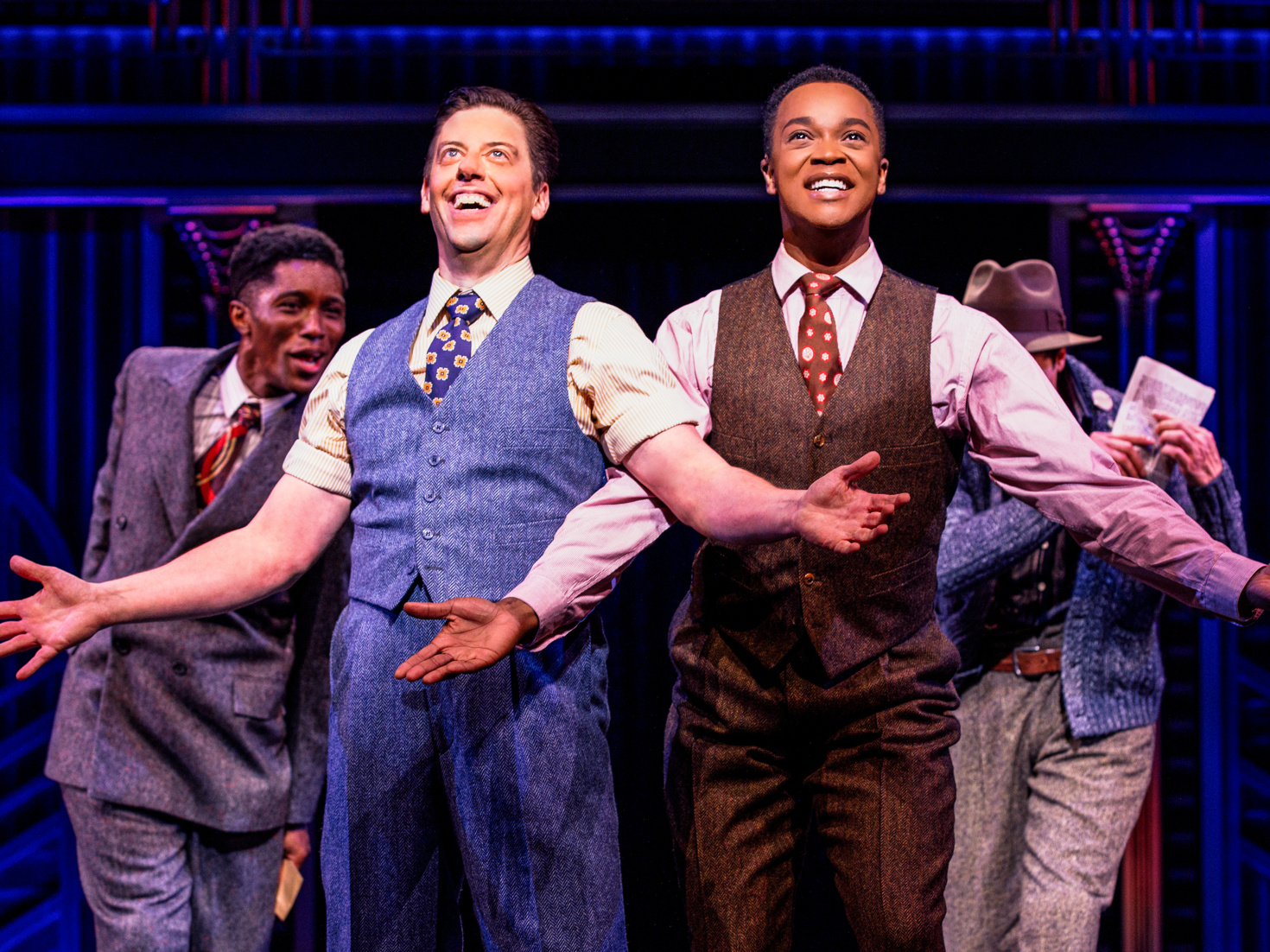
The best romantic comedy released in the early fifties, William Wyler’s Roman Holiday with Audrey Hepburn and Gregory Peck, was about the impossible romance of a princess and a reporter; it was a cross between a genteel version It Happened One Night and a reverse Cinderella story. But then Hollywood romantic comedy degenerated into sex cartoons with Jayne Mansfield at one end of the spectrum and mechanical farces at the other. One might have feared that the form was dead, until Billy Wilder’s divine Some Like It Hot came to the rescue at the end of the decade. It wasn’t remotely like any previous movie in this genre. (But then, Wilder’s The Lost Weekend hadn’t been like any other social problem picture or Sunset Boulevard like any other film noir.) Wilder and his co-writer I.A.L. Diamond took a page from Shakespeare’s cross-dressing comedies and then doubled it. When two jazz musicians witness the St. Valentine’s Day Massacre they run like hell, straight into drag. They figure their only retreat from the gangsters on their tail is to vanish into dresses and wigs and join an all-girls’ band. Tony Curtis’s Joe, a.k.a. Josephine, falls for the lead singer, Sugar (Marilyn Monroe at her most sublime), and chooses a second disguise – a millionaire named Shell Oil Jr. who entertains her on a borrowed yacht, where Curtis draws her in with a dead-on Cary Grant imitation. Jack Lemmon’s frantic Jerry/Daphne finds himself the object of the yacht’s actual owner, Osgood Fielding III (Joe E. Brown) – a courtship that Wilder and Diamond leave up in the air when the rest of the plot is resolved. The final line – spoken by Brown – when Jerry reveals his true gender to Osgood is one of the two best curtain lines in American romantic comedy. (The other concludes Charade, with Hepburn and Cary Grant, which followed Some Like It Hot four years later.)

Monday, November 14, 2022

Political Theatre for Pre-Programmed Audiences: Parade and Straight Line Crazy

Micaela Diamond and Ben Platt in Parade at New York City Center. (Photo: Joan Marcus)

The 1998 musical Parade, written by Alfred Uhry (book) and Jason Robert Brown (music and lyrics), dramatizes the notorious case of Leo Frank, who was framed for the 1913 rape and murder of Mary Phagan, a thirteen-year-old who worked in the factory he superintended in Marietta, Georgia. Frank was a Brooklyn Jew who went South to marry and manage his father-in-law’s business. His trial, manipulated by anti-Semitic forces, ended in a guilty verdict and a death sentence that was commuted to life in prison by the governor, John Slaton, in view of evidence that the prosecutor, Hugh Dorsey, had coaxed witnesses to lie on the stand. But Frank didn’t live to see that new evidence generate a new trial – he was lynched in 1915. Historical scholarship points to Jim Conley, a Black janitor in the factory who provided the most damning testimony against Frank, as the likely killer.  The Frank case had the ironic double effect of reanimating the KKK in Georgia and giving birth to the Anti-Defamation League. (And Dorsey followed Slaton straight into the Governor’s mansion.)

Tuesday, October 11, 2022

42nd Street: Tapping Their Way to Glory

Carina-Kay Louchey and Max von Essen lead the cast of 42nd Street in the "Lullaby of Broadway" number. (Photo: Diane Sobolewski)

You know you’re in for a bright evening when, immediately after Adam Souza and the band finish the overture for the Goodspeed Opera House’s production of 42nd Street the curtain rises just high enough to reveal the legs and fervently tapping feet of a dozen or so expert chorus girls and boys. The opening was the inspiration of the show’s original director-choreographer, Gower Champion, and if the dancers are skilled, a mood of impending joy descends on the audience at the outset. In this case, the dancers are marvelous, and the show that follows in their wake is a first-rate entertainment.

Tuesday, February 8, 2022

The Tap Dance Kid: Which Show Are We In?

Alexander Bello and Trevor Jackson in The Tap Dance Kid. (Photo: Joan Marcus)

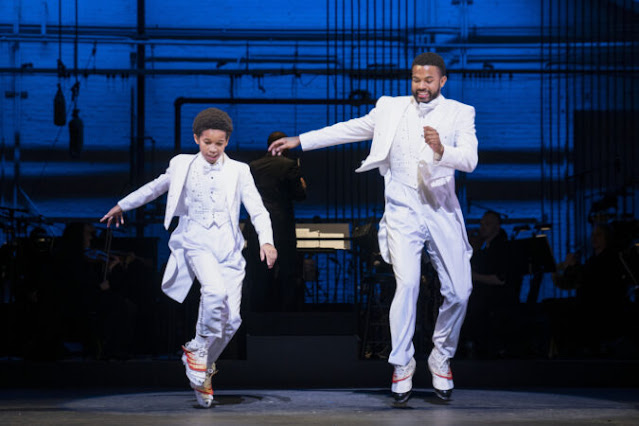
The return of the Encores! series to City Center over the weekend after two years in hiatus was eagerly anticipated, but the occasion – a revival of the 1983 musical The Tap Dance Kid – turned out to be dispiriting. To start with, the show, which I missed the first time out, isn’t very good. Charles Blackwell’s book (based on a novel by Louise Fitzhugh – of Harriet the Spy fame – called Nobody’s Family Is Going to Change) is a retread of the antique melodramatic plot about the boy who has to fight his stiff-backed father’s bias against show business to follow in his dancer-choreographer uncle’s footsteps and dance his heart out on the stage. Here he’s a ten-year-old Black kid from the Buffalo suburbs named Willie (played by the personable Alexander Bello) whose mother, Ginnie (Adrienne Walker), danced with her kid brother Dipsey (Trevor Jackson) and their gifted father when they were children. Ginnie raised Dipsey in cheap hotels on the road and took care of him when Daddy Bates went on benders. Then she married William (Joshua Henry), an ambitious lawyer who promised her a safe, respectable life. He delivered, but his vision of family life and of what bringing glory to the race is highly restrictive. He’s suiting up his son, who is bored in school but deliriously happy when he’s taking tap lessons from his uncle, for a career in law, while his teenage daughter Emma (Shahadi Wright Joseph), a bright young woman who covets that career for herself, can do nothing to gain his approval. He’s not interested in Emma; she’s only a girl. And he bullies his wife, silencing her objections and making jokes about the troublesome women in this family. When Willie’s bad grades provoke his father into taking away his tap shoes and banning Dipsey from his home, the boy runs away to his uncle, who’s rehearsing a musical downtown that he hopes will be his ticket to Broadway. What it needs to succeed, in case you haven’t guessed, is a talented tap dance kid.

Wednesday, December 1, 2021

Remembering Sondheim

;
Stephen Sondheim, New York, July 10, 1961. (Photo: Richard Avedon)

Stephen Sondheim was ninety-one when he died on the day after Thanksgiving, yet it was a shock. Unreasonably, I thought he would live forever. For nearly three decades he’d been the sole surviving legendary songwriter from the golden age of musical theatre (Alan Jay Lerner and Frederick Loewe left us in 1986 and 1988 respectively; Irving Berlin in 1989; Jule Styne in 1994) – for he was still in his twenties when he collaborated with Leonard Bernstein on West Side Story and with Styne on Gypsy. He was all of thirty-five when he worked with Richard Rodgers on Do I Hear a Waltz? (Arthur Laurents, who departed ten years ago, wrote the books for all three shows.) Sondheim hadn’t written a new musical since Road Show in 2003, though he was toiling for years on an adaptation of Luis Buñuel’s two final movies. But there were countless major revivals of his work – Company, with a female Bobby, is on Broadway at present – and he generally showed up for them. Revue after revue was constructed around his songs, and every milestone birthday prompted a star-studded event, all of them except his Covid-shrouded ninetieth televised on PBS. Movies were still being made of his musicals; still more are promised, even though none of them has been any good. (I haven’t seen Steven Spielberg’s remake of West Side Story, which is about to be released.) Sondheim was continually, tirelessly present, so who could ever imagine him gone?

Monday, May 11, 2020

This Nutty World: The Triple Glories of Kaufman and Hart

George S. Kaufman and Moss Hart in 1937.

Moss Hart was an aspiring young playwright, still living in the Bronx with his family and working in the office of a theatrical agent, when he sent producer Sam Harris a copy of his satirical comedy about the talking-picture revolution. Harris liked it but thought it needed a veteran’s knowhow, so he teamed Hart up with George S. Kaufman, the author or co-author of many Broadway hits. The story of Once in a Lifetime, which underwent significant changes during an extended pre-New York tour, was rewritten over the summer and rewritten again before it opened to rave reviews at the end of September 1930, is well-known to theatre buffs because it forms the triumphant final section of Hart’s memoir, Act One. Act One is the best theatrical memoir I’ve ever read – and I’ve read it four times, twice when I staged my own productions of Once in a Lifetime. The play would be my choice for the finest comedy ever written by Americans, with the possible exception of Ben Hecht and Charles MacArthur’s The Front Page. Both are hard-boiled comedies, a genre that contemporary playwrights and screenwriters seldom attempt.

Monday, March 16, 2020

Parodies: The Confession of Lily Dare and Little Shop of Horrors

Nancy Anderson and Charles Busch in The Confession of Lily Dare. (Photo: Carol Rosegg)

The last two shows I caught in New York before the theatre went dark were both lighthearted parodies, Charles Busch’s The Confession of Lily Dare (produced by Primary Stages at the Cherry Lane Theatre in the West Village) and the latest revival of Little Shop of Horrors (at the midtown off-Broadway house the Westside). Busch has chosen an obscure subject for a 2020 audience – the mother-love melodramas that were popular in the late 1920s and early ‘30s, the days just before the Hays (Production) Code went into effect in Hollywood, imposing decades of infantilizing self-censorship on filmmakers. But the matinee audience sitting around me, howling with delight, seemed to get the references. (They must have been devoted TCM viewers.) In Lily Dare, the closest pals and associates of a notorious San Francisco madam, a whore named Emmy Lou (Nancy Anderson) and a gay honky-tonk pianist named Mickey (Kendal Sparks), meet at her grave and recall her meteoric rise and tragic downfall. Busch himself, a drag performer imbued with firecracker wit, hair-trigger timing and devastating charisma, played Lily in flashbacks.

Tuesday, May 7, 2019

From the Musical Theatre Canon: The Music Man, Kiss Me, Kate and Lady in the Dark

Ellie Fishman and Edward Watts in The Music Man. (Photo: Diane Sobolewski)

Meredith Willson’s The Music Man became a classic as soon as it opened on Broadway in 1957, with Robert Preston in the role of “Professor” Harold Hill, the scamming salesman who transforms a pre-World War I Iowa town – and himself – in the course of persuading the locals to purchase instruments and uniforms for a children’s band. Willson, who wrote book, music and lyrics, did as much to develop the archetype of the American snake-oil salesman as Eugene O’Neill had in The Iceman Cometh, though his version was sweeter and came with a bona fide happy ending. (Preston recreated his career performance in the 1962 movie version.) Revivals of the show are generally good news: Susan Stroman’s opened on Broadway in 2000 and ran for two years, and it was so glorious that I saw it twice, once with Craig Bierko playing Hill and once with Robert Sean Leonard, who was even better than Bierko. (Eric McCormack played the role between Bierko and Leonard.) I’m looking forward to seeing Hugh Jackman in the part next season.

In the meantime there’s an exuberant new production at the Goodspeed Opera House, directed by Jenn Thompson and choreographed by Patricia Wilcox, with Goodspeed veteran Michael O’Flaherty doing his usual yeoman service as musical director. The Music Man is the ideal show for Goodspeed – big-boned, spirited, infectious, with a lot of wonderful ensemble numbers that show off the way imaginative staging can make a limited space feel like it’s being expanded from the inside. The choreographic high points of this production are “Marian the Librarian” in act one and “Shipoopi” at the outset of act two. But even the staging of the barbershop quartet numbers, especially “Lida Rose,” counterpointed by “Will I Ever Tell You?,” the most tuneful ballad Willson wrote for Marian (Ellie Fishman) and introduced by the four men (Branch Woodman, C. Mingo Long, Jeff Gurner and Kent Overshown) strolling down the theatre aisle, is tremendously satisfying. The show moves from scene to scene in a graceful arc aided by the scenic designer Paul Tate dePoo III, whose inventions compensate for his single mistake, an unfortunate (and anachronistic) painted backdrop more or less in the mold of the American regionalist Thomas Hart Benton.

Monday, March 25, 2019

Musical Evenings: I Married an Angel, Choir Boy, Spamilton

Sara Mearns and Mark Evans in I Married an Angel. (Photo: Joan Marcus)

I Married an Angel is the sixth musical by Richard Rodgers and Lorenz Hart to be revived by Encores! The original production opened on Broadway in 1938 at the midpoint of an amazing string of hit R&H shows between 1935 and 1942 that came on the heels of their half-decade at M-G-M: Jumbo, On Your Toes, Babes in Arms and I’d Rather Be Right preceded it and The Boys from Syracuse, Too Many Girls, Pal Joey and By Jupiter followed it. (Only Higher and Higher, in 1940, was a disappointment at the box office.) I Married an Angel had initially been planned for M-G-M, an adaptation of a Janos Vaszary farce about the union of a man and a (literal) angel. (This was the era when Hungarian plays found a home in Hollywood, and some of them, like William Wyler’s The Good Fairy and Ernst Lubitsch’s The Shop Around the Corner, were wonderful.) Jeanette MacDonald, who had just had a success with Love Me Tonight , with its ebullient R&H score, was set to play the earthbound angel. But the project was abandoned, and by the time they resurrected it for Broadway they had taken on a new collaborator, George Balanchine, who’d staged the dances – and ballets – for both On Your Toes and Babes in Arms. So the role of Angel was reconceived for a dancer, Vera Zorina, whom Balanchine himself married during the New Year’s Eve performance.

Monday, February 18, 2019

Call Me Madam: Turn Up the Brio

Jason Gotay and Carmen Cusack in Call Me Madam. (Photo: Stephanie Berger)

When Irving Berlin’s musicals entered the realm of political comedy, he and his collaborators tended to keep the mood light; Face the Music (1932), Louisiana Purchase (1940) and Call Me Madam (1950) are more on the order of spoofs than satires. All three boast delightful scores, so it isn’t surprising that Encores! has produced all three – and, fortunately for us, released cast recordings of them. Its current season began the weekend before last with a revival of its 1995 revival of Call Me Madam, marking only the second time the series has remounted a show. Typically, Encores! has met the musical and choreographic demands of the material. Under the expert musical direction of Rob Berman, a veteran of more than thirty of these productions, the orchestra plays exuberantly and the vocal performances are generally as satisfying as comfort food prepared with a loving hand. That’s equally true of the dance numbers, staged adroitly by Denis Jones, who makes the reduced performing space of the City Center stage (which the cast has to share with the musicians) feel like the expanse space of a large Broadway house. Yet the show, particularly in the first act, is a little lackluster.