Showing posts sorted by date for query Judi Dench. Sort by relevance Show all posts

Sunday, July 19, 2026

Lesley Manville in Les Liaisons Dangereuses: An Actress Becomes a Legend

Lesley Manville and Aidan Turner in Les Liaisons Dangereuses. (Photo: Sarah Lee.)

It’s not likely that many people read Choderlos de Laclos’ spectacular 1782 epistolary novel Les Liaisons Dangereuses these days, but Christopher Hampton’s dramatic version, first produced in 1985, has become, deservedly, a repertory staple. In the original West End production and again on Broadway, the matched anti-heroes, Madame de Merteuil and the Vicomte de Valmont, best of friends and former lovers who manipulate everyone around them for their amusement and to enact private revenge plots, were played by Lindsay Duncan and Alan Rickman. In the triumphant 1988 Stephen Frears movie, called Dangerous Liaisons, Glenn Close and John Malkovich took over the roles, a case of seeming miscasting that, as it turned out, worked brilliantly. (There have been two other film adaptations, a very amusing updated one from 1959 directed by Roger Vadim, with Jeanne Moreau and Gérard Philipe and an unfortunate one called Valmont, directed by Miloš Forman, with Annette Bening and Colin Firth, released the year after Frears’s. And Sarah Michelle Gellar and Ryan Phillippe are featured in 1999’s Cruel Intentions, which sets the story in a Manhattan prep school. It’s trashy but a sexy, funny diversion.)

Saturday, August 16, 2025

Stratford and the Shaw Festival I: Shakespeare

From left: André Sills as Polixenes, Sara Topham as Hermione, and Graham Abbey as Leontes with members of the company of The Winter's Tale. (Photo: David House.)

Shakespeare’s romance The Winter’s Tale is one of the three or four plays I cherish most, and the Canada’s Stratford Festival hits a high mark with Antoni Cimolino’s production at the Tom Patterson Theatre. Cimolino has announced that he will step down from the artistic directorship of the company after one more season, and his Winter’s Tale is so beautiful from start to finish that you can’t help thinking this is the show he would like to be remembered for. He’s staged it on a simple set that the designer, Douglas Paraschuk, has enriched, scene to scene, with lyrical details and Michael Walton has lit exquisitely. One of the most poignant examples is the famous final scene. Paulina (Yanna McIntosh) leads the King of Sicilia, Leontes (Graham Abbey), who has been reunited with his childhood friend Polixenes (André Sills), his former ambassador Camillo (Tom Rooney) and his long-lost daughter Perdita (Marissa Orjalo) into a secret room. There, she tells them all, she has had a sculptor create an astonishingly lifelike statue of Leontes’s queen Hermione (Sara Topham), supposedly dead these sixteen years while Leontes, under Paulina’s guidance, has done penance for the grievous wrongs he committed against her, Polixenes and Perdita (then just an infant). The stage is unilluminated except for three handheld lanterns, so the statue is revealed suddenly, the lantern light painting the darkness. When Paulina works her magic and Hermione moves, the effect is so subtle that at first you wonder if you really saw what you think you saw.

Tuesday, August 22, 2023

All Hail the Comic Muse

Mike Nadajewski and Kristi Frank in On the Razzle. (Photo: Emily Cooper)

This piece includes reviews of On the Razzle, Blithe Spirit and Village Wooing.

This summer the Shaw Festival has been bowing to the comic spirit. In addition to Shaw’s The Apple Cart and The Playboy of the Western World, which mix serious and humorous elements, the roster has included productions of four comedies from different eras: Marivaux’s The Game of Love and Chance (1730), performed outdoors in an improvised version – the only one of the quartet I didn’t get to; Shaw’s Village Wooing (1934), this season’s lunchtime one-act; Noël Coward’s Blithe Spirit (1941); and Tom Stoppard’s On the Razzle (1981). In truth, the last of these can claim connection to several periods. It began in 1835 as a one-act English play by John Oxenford called A Day Well Spent, which the Viennese playwright and actor Johann Nestroy adapted seven years later as Einen Jux will er sich machen (He’s Out for a Fling). Thornton Wilder reworked it for Broadway in 1938 as The Merchant of Yonkers – a failure, despite direction by the legendary Max Reinhardt – and then again in 1955 as The Matchmaker, which altered the story about shop clerks out on the town by inventing the assertive, charismatic title character (played by Ruth Gordon on Broadway) and reconfiguring the play around her. It was filmed the following year with Shirley Booth in the role and featuring three talented young performers early in their careers: Anthony Perkins, Shirley MacLaine and Robert Morse. In 1964 The Matchmaker became the musical Hello, Dolly!, which, of course, ran for years. On the Razzle is Stoppard’s rewrite of the Nestroy, not the Wilder, so there’s no Dolly Gallagher Levi dashing around in aid of the young lovers while manipulating her sour-faced client into marrying her rather than the widow he’s after or the fictitious millionairess she’s promised him.

Monday, January 17, 2022

Belfast: Memories of an Irish Childhood

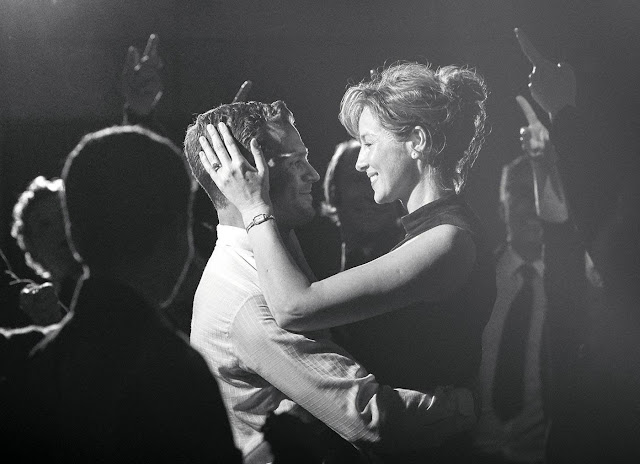
Jamie Dornan and Caitriona Balfe in Belfast.

Watching the black-and-white trailers for Belfast, Kenneth Branagh’s fictionalized memoir of growing up Protestant in the titular city at the peak of the Irish Troubles (the film begins in the summer of 1969), I feared that he’d been caught in the trap of turning his childhood into self-conscious neo-realism, like Alfonso Cuarón in the strenuously overrated Roma. I needn’t have worried. Haris Zambarloukos’s cinematography opens in almost hallucinatory color that reveals Belfast in all its complexity, modernist and glittering as well as enshrining gorgeous old buildings. And when the color morphs into black and white, it’s the bustling, lived-in black and white of the Parma Bertolucci and his photographer, Aldo Scavarda, captured in his the 1964 Before the Revolution or, as a friend observed, the black and white of the pictures Tony Richardson made in the late fifties and early sixties out of the great English New Wave dramas Look Back in Anger and The Entertainer (both shot by Oswald Morris) and A Taste of Honey (shot by Walter Lassaly). Belfast isn’t quite up to those movies – or the other movies I thought of while I sat through it, John Boorman’s 1987 Hope and Glory (based on his memories of a childhood in London during the Second World War) and Jim Sheridan’s 2002 In America (a too-little-known magic-realist marvel about a struggling Irish family living illegally in Hell’s Kitchen). But Belfast is plenty good enough. It’s vibrant and vivifying, and I was carried away by it.

Monday, January 10, 2022

The Lost Daughter, and Notes on Novice Directors

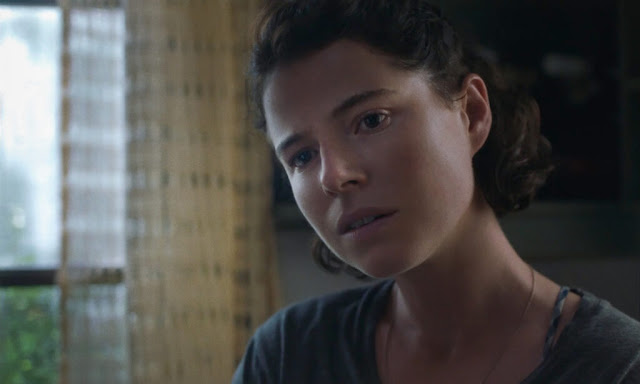
Jessie Buckley in The Lost Daughter.

When first-rate actors turn into directors, one thing you can usually count on is the quality of the performances. Rebecca Hall’s work with Tessa Thompson and Ruth Negga in Passing is so finely tuned and so subtle that it feels almost preconscious, as if Hall kept catching the two women in the moments before their identification with their characters had translated into action. That description makes it sound as if the actresses weren’t actually engaged in the process of acting, because any good teacher will tell you that acting is action, and when actors don’t play an action (otherwise known as an objective) what they generally wind up producing is a wash of generalized emotion. (That’s what’s happened to Kate Winslet’s work over the last ten years.) But Thompson and Negga aren’t generalizing; they’re so deeply engrained in their characters that it’s as if Hall were simply on their wavelength, recording their process – except, of course, there’s nothing simple about pulling that off. I sometimes had that experience watching the actresses in Ingmar Bergman’s movies (including some of the bad movies) – the sense that the relationship between them and the director was as intimate as the one between a great photographer and his or her subject. The comparison seems especially apt in the case of Passing, which has the feel of black-and-white photographs from the twenties and thirties – and that may be the reason the movie makes some viewers impatient or bored. It’s a piece of experimental filmmaking in which the novice director is striving to get on the screen states of being that haven’t been dramatized before. 

Monday, November 15, 2021

No Time to Die: Bonding

Daniel Craig and Léa Seydoux in No Time to Die.

The James Bond pictures that Daniel Craig has starred in over the past decade and a half – Casino Royale, Quantum of Solace, Skyfall, Spectre and the new No Time to Die – are not equally good, but they’re unified by a sense of melancholy and an elegiac quality. The painful past gets revisited; characters we care about die – significantly, of course, M, played by Judi Dench, in Skyfall, the high point of the nearly sixty-year-old series. In that sublime film, Bond returns to his childhood home on the Scottish coast to battle a villain who was once a double agent himself, using his mastery of old-school warrior skills to hobble a computer wizard representing a merciless contemporary world. No Time to Die resurrects the past in its opening section. It begins with a flashback: a child whose father is an assassin watches as the only survivor of a family he wiped out shoots her mother, and then, mysteriously, saves her (as we later learn) when, running away from him, she falls through the ice. After the credits (and a standout theme song, written by Billie Eilish and Finneas and performed by Eilish), that child grows up to become the therapist Dr. Madeleine Swann (Léa Seydoux), who appeared in Spectre. In the present she’s happily married to a retired Bond, who assures her as they drive through the Italian countryside, “We have all the time in the world.” Bond aficionados will recognize the ominous allusion. At the end of the 1969 On Her Majesty’s Secret Service, Bond (played in that film by George Lazenby) utters the same promise to his bride (Diana Rigg) as they begin their honeymoon, but the movie ends moments later with her murder – the first downbeat finale of any Bond picture, and the most affecting scene in the series until M’s demise in Skyfall. The echo in No Time to Die is a reminder, of course, that no one has all the time in the world, and that the clock is ticking.

Tuesday, December 8, 2020

Sean Connery: Larger Than Life

Sean Connery (1930-2020) in Diamonds Are Forever (1971).

Everyone knows that Sean Connery, who died on Halloween at the age of ninety, became a movie star the moment he stepped before the camera as James Bond, Ian Fleming’s Agent 007, in Dr. No in 1963. And for most of us who saw the early Bond pictures in the theatre as they appeared – I was thirteen when I was initiated, with the second of the series, From Russia with Love – all the subsequent Bonds, at least until Daniel Craig stepped up in 2006, always seemed like pretenders to a throne Connery had abdicated after the 1971 Diamonds Are Forever. Not that you could blame the guy. Very few of his fans took him seriously as an actor until he’d freed himself from the shackles of the leading role in the most beloved (and longest-lasting) series in movie history. He gave splendid performances as the life-embracing poet who can’t be slowed down even by a lobotomy in the 1966 comedy A Fine Madness and as the émigré Irish miner who leads a crew of violent rebels against the Pennsylvania coal barons in 1970’s The Molly Maguires – both fine movies but audiences failed to show up for them. (On the other hand, neither Woman of Straw with Gina Lollobrigida nor Marnie, directed by Alfred Hitchcock, both released in 1964, the same year as Goldfinger, did much for him. Marnie contains one of his rare bad performances – he looks befuddled, which seems like a fair response to what’s going on around him.)

Sunday, December 22, 2019

Kitty Litter: Cats

Dame Judi Dench in Cats.

For the last few days, my Facebook feed has been inundated with memes and tweets and hot takes and quips and hit pieces all commenting on the single biggest scandal ever to hit the English-speaking world: Cats, the movie. Director Tom Hooper’s hallucinogenic, CGI-fueled take on Andrew Lloyd Webber’s mammoth musical success is apparently an impeachable offense, and the country is united in proclaiming it so. There are so many cat puns floating around the Internet that I’m sure the one I’ve used for my title has already gone viral for someone else, but as I’ve done my best to ignore the raging interwebs, I use it here with pride.

When Cats the stage musical first came out about 5,000 years and 2.45 billion performances ago, there were apparently millions of folks who thought, People singing and dancing dressed up as cats!? Sign me up for a couple hundred tickets! I wasn’t one of them, as the thought of people dancing and singing dressed up as cats makes me wonder if life is worth living. Besides, I’ve seen Lloyd Webber’s Starlight Express, which is basically the same thing as Cats, but the people are singing and dancing dressed up as train cars, zooming around on roller skates. (Reader, I have suffered.)

Monday, April 9, 2018

Three Tall Women and Anna Christie: Pulitzer Prize Winners

Glenda Jackson, Alison Pill and Laurie Metcalf in Three Tall Women. (Photo: Brigitte Lacombe)

Edward Albee’s Three Tall Women won a Pulitzer Prize in 1994, but the original production was off Broadway (at the Vineyard Theatre), and until Joe Mantello’s luminous new revival with Glenda Jackson, Laurie Metcalf and Alison Pill – in the roles created by Myra Carter, Marian Seldes and Jordan Baker – it has never been performed on Broadway. I saw the Vineyard show and liked it quite a bit, though I remember finding the writing in the second act rather theoretical and pre-arranged. In act one the three characters – one in her early nineties, one in her early fifties, and one in her late twenties – have specific, realist roles, despite the fact that Albee calls them A, B and C. A is a wealthy, fading widow, estranged until recently from her son, incontinent and subject to sudden tantrums, childlike behaviors and episodes of dementia. B is her caregiver, whose mordant humor buoys up her worn patience with A’s erratic conduct. C is an emissary from A’s lawyer’s office, summoned because C’s affairs are in deplorable order. But in act two the old woman has had a stroke and lies unconscious in her bed while A, B and C embody her as an ingénue, as middle-aged and as a dowager, the two older women warning the youngest one, with a mixture of wisdom and perhaps a little sadistic glee, what she’s in for.

Friday, December 1, 2017

Books into Misbegotten Movies: Wonderstruck and Murder on the Orient Express

Jaden Michael, Oakes Fegley and Julianne Moore in Wonderstruck.

Todd Haynes got the 1950s in Carol, but he doesn’t even come close to getting the 1920s in Wonderstruck, his movie of Brian Selznick’s children’s book, which Selznick himself adapted. The gimmick in the novel is that it cross-cuts – as anyone who has read The Invention of Hugo Cabret (2007) knows, Selznick is an overtly cinematic writer – between 1977 and 1927. In the 1977 scenes, a boy from rural Minnesota named Ben, who has recently lost his mother and has been taken in by his aunt and uncle, runs away to seek the man he believes is his father in New York City, following a clue he discovered among his mother’s things. In the 1927 scenes, a girl named Rose runs away from her overprotective father, first to find her famous stage- and movie-star mother Lillian Mayhew and then, when that doesn’t work out very well, her older brother Walter, who works at the Museum of Natural History. Rose was born deaf; Ben was born deaf in one ear, but he’s struck by lightning that takes away the hearing in his other one. That’s a hint of, or perhaps a metaphor for, the greater connection they turn out to share when the two stories come together.

Monday, January 30, 2017

More Kings, More Turmoil: The Return of The Hollow Crown

Benedict Cumberbatch as King Richard III in The Hollow Crown.

Extending the British television series The Hollow Crown to include all the rest of Shakespeare’s history plays (except King John) is a boon for completists, perhaps. (PBS ran all three parts of Season 2 before the new year.) But moving from the Henriad, which covers the reigns of Richard II, Henry IV and Henry V, to the next chronological section, from the crowning of Henry VI to the crowning of Henry VII, is anti-climactic. Richard II, Henry IV, Part 1 and Henry V are masterpieces, and Henry IV, Part 2 contains some great scenes, but the three parts of Henry VI, which Shakespeare wrote – or perhaps collaborated on – at the beginning of his career, aren’t very good plays. I applauded the first act of Ivo Von Hove’s Kings of War, which cut Henry VI to the bone and made it dramatically exciting; after sitting through Dominic Cooke’s version (from an adaptation by him and Ben Power), I admire it even more.

Monday, November 21, 2016

Ayckbourn and Osborne: Brit Classics

Nael Nacer, Mahira Kakkar, and Karl Miller in Boston’s Huntington Theatre Company's Bedroom Farce. (Photo: T. Charles Erickson)

The comedies of the ridiculously prolific English playwright Alan Ayckbourn – eighty plays and counting – have typically proved to be tricky hurdles for American actors. The combination of his brand of banter (which spins, often hilariously, off the banality of middle-class English conversation), the physical demands of his scenarios (which ring inventive changes on typical sex-farce set-ups) and his peculiarly offhand satirical tone (he’s not a cruel playwright but he certainly isn’t warm) make for a challenging combination. Maria Aitken’s production of Ayckbourn’s 1975 Bedroom Farce for Boston’s Huntington Theatre Company is performed so delightfully, however, that you can barely see the hoops the eight actors have to jump through to make it work. The title itself is a characteristic Ayckbourn gag: it prepares us for a sex roundelay, when in fact the closest any of the characters comes to infidelity is a harmless, unpremeditated kiss at a party between Trevor (Karl Miller), who’s in the midst of a tiff with his wife Susannah (Katie Paxton), and his ex-girl friend Jan (Mahira Kakkar), who has left her husband Nick (Nael Nacer) at home in bed with an aching back. What the title actually refers to is the set – cleverly designed, in this instance, by Alexander Dodge – which divides the stage into three bedrooms. Stage left is Jan and Nick’s, occupied throughout the play by the unhappily laid-up Nick. Center stage is that of the party givers, Malcolm (Richard Hollis) and Kate (Emma Kaye). The bedroom stage right belongs to Trevor’s parents, Ernest (Malcolm Ingram) and Delia (Patricia Hodges), a homey, conventional couple celebrating their anniversary who, following a disappointing meal at a once-favorite restaurant, retire for a comfy night until their sanctum is unexpectedly invaded by their neurotic daughter-in-law. She doesn’t feel right about going home after she and Trevor have quarreled so extravagantly and vociferously at Malcolm and Kate’s that they managed to drive all the other guests out of the house.

Monday, February 8, 2016

The Winter’s Tale: Branagh and Dench

Judi Dench as Paulina and Kenneth Branagh as Leontes in The Winter's Tale at the Garrick. (Photo: Johan Persson)

Kenneth Branagh’s new theatre company opened its inaugural season at the Garrick in the West End with productions of Terence Rattigan’s Harlequinade (double-billed with his one-woman piece All on Her Own with Zoë Wanamaker) and The Winter’s Tale. Luckily those of us who didn’t happen to be in the neighborhood were able to see the latter in HD. It stars Branagh himself and the great, unstoppable Judi Dench. They give luminous performances as King Leontes of Sicilia, whose fit of jealousy plunges his kingdom into darkness, and his wife’s gentlewoman Paulina, the only member of the court unafraid to stand up to him when he accuses his Queen Hermione (Miranda Raison) of adultery and treason and proclaims the baby she births in prison the bastard son of his childhood friend Polixenes (Hadley Fraser).

Tuesday, November 10, 2015

Back To Basics: SPECTRE

Daniel Craig as James Bond in SPECTRE.

This review contains spoilers for SPECTRE.
 
SPECTRE is not a great Bond film. It’s a decent standalone spy thriller, but that’s too charitable, as no Bond film exists in a vacuum. As the newest and “freshest” installment in Daniel Craig’s run as 007, it’s strangely discordant and slow. It discards nearly all of the audience goodwill and story momentum generated by Craig’s energetic reboot of the character, content to hit all the expected notes and attempt nothing new or challenging with the character or his world. It feels regressive, rather than classic – the most like an Old Bond movie of any of the Craig entries, but in all the worst ways.

Monday, December 29, 2014

Christmas Musicals: Into the Woods and Annie

Meryl Streep and Mackenzie Mauzy in Into the Woods

Rob Marshall’s new movie of the Stephen Sondheim-James Lapine Into the Woods has an insurmountable problem: the show it’s based on. The appeal of this musical, which mixes several fairy tales, has always eluded me. It contains an ingenious opening number in which Sondheim sets all the narratives in motion, and a couple of other songs (Cinderella’s interior monologue, “On the Steps of the Palace,” and “Agony,” a duet between Cinderella’s and Rapunzel’s princes) are OK if somewhat overworked. But the  whole thing is too damn clever by half, with lyrics that tend to make the characters sound as if they’ve been reading self-help manuals.  And by the time the show picks up again after intermission and the characters go back into the woods because their happy endings have begun to fray, the same fate has befallen Sondheim’s inventiveness. The very concept is stupid: if taking to the woods is a metaphor for coming of age, then no one gets to do it twice. And you don’t have to darken a fairy tale dark in order to modernize it; the Brothers Grimm and Hans Christian Andersen originals are plenty dark enough. Moreover, Sondheim’s idea of “dark” is, to my ears, merely homiletic: “Children Will Listen,” “No One Is Alone.” If I have to pick a revisionist fairy-tale musical, I’ll take Once Upon a Mattress. Revue-sketch comedy trumps pop psychology any day of my week.

Saturday, October 4, 2014

Separation and Deliverance: Revisiting Into the Arms of Strangers: Stories of the Kindertransport (2000)


The horror of the Holocaust and the fate of its survivors has been depicted from just about every conceivable perspective, but Mark Jonathan Harris's Into the Arms of Strangers: Stories of the Kindertransport (2000) found another story seldom heard. Harris had already been acclaimed previously for The Long Way Home (1997), which depicted the flight of Jewish refugees and how it lead to the state of Israel, but here he examines the fate of the children who were separated from their parents and sent into exile during the war, in many cases forever. For nine months, just before the Second World War, Britain organized an extraordinary mission of mercy. It transported and opened its doors to more than 10,000 Jewish and other children from Austria, Germany and Czechoslovakia. The children – or Kinder, as they came to be known – were placed in foster homes in the hope they would be reunited with their parents. Many of the children never saw their folks again. Amassing some stunning archival footage, Harris interviewed dozens of surviving Kinder where, now nearing the end of their lives, they finally got a chance to tell their story. In one scene, a woman recounts the moment she was torn from her mother at the train station, while another describes the dislocating estrangement of living in a foreign country and not knowing the language or customs. Into the Arms of Strangers provides numerous epiphanies that reverberate such as the story of the child who is questioned about his lofty position, because he owns a violin, but then surprises and moves his inquisitors by playing an impeccable version of "God Save the King."

Monday, September 29, 2014

Tragic Muse: Medea and A Streetcar Named Desire

Danny Sapani and Helen McCrory in Medea, at London's National Theatre. (Photo: Richard Hubert Smith)

The great Greek tragedies are as hard and piercing as flint, and they lead us into a terrible darkness. The best productions, like Carrie Cracknell’s of Euripides’s Medea at the National Theatre (featured a few weeks ago in the NT Live HD series), leave us feeling altered. Euripides was a master ironist and a master of language; he was also a brilliant psychologist, and never more so than in Medea, a witheringly complex and precise portrait of a woman who, cut to the bone by her husband Jason’s betrayal – he abandons her and their young sons to marry Glauce, the princess of Corinth – decides that the only way to get revenge is first to poison the bride and then murder her own boys. (She convinces herself that she’s somehow protecting the children by keeping them safe from their enemies.) Euripides doesn’t make it easy for his audience: he refuses to portray Medea as mad – to give us a way of understanding her behavior that distances her from us. The chorus of Corinthian women who interact only with her sympathizes with her anger, though it terrifies them. Her logic, ghastly as it is, is no less reasonable than Jason’s when he protests that she’s the problem, that her temper has made her her own worst enemy, and explains that marrying into the royal family will somehow benefit her and their sons.

Monday, July 14, 2014

Playwrights: Benefactors, A Great Wilderness, The Normal Heart, A Little Night Music

Walton Wilson, David Adkins, and Barbara Sims in Benefactors (Photo by Emily Faulkner)

Eric Hill’s compelling production of Benefactors at the Berkshire Theatre Group’s Unicorn space in Stockbridge provides audiences with an opportunity to become acquainted with an intelligent, intriguing text by Michael Frayn that doesn’t receive many revivals. (It won the Olivier Award for best new play in 1984.) The play, set between 1968 and 1970, is a four-hander about the relationship between David (David Adkins), an architect with a commitment to providing housing for the poor, and his wife Jane (Corinna May) and their neighbors across the road, Colin (Walton Wilson), a journalist, and Sheila (Barbara Sims). David and Colin have known each other since university, and when they find themselves living in close proximity the two couples and their children are constantly in and out of each other’s houses. Colin is a difficult man with a contrary temperament and a tendency to belittle his wife; self-effacing, easily intimidated, and somewhat in awe of David and Jane, Sheila barely opens her mouth at first when the quartet gets together for dinner. But she begins to spend more and more time hanging out with Jane during the day, and eventually confides her fears that Colin is going to leave her. To help her develop a life of her own, Jane encourages David to hire Sheila as a secretary – to take over the work Jane herself has been doing for him – and the shift ushers in a new phase of their lives.

Saturday, April 19, 2014

Notes on the Method: Michelle Williams as Marilyn Monroe

Michelle Williams as Marilyn Monroe.

Is there anything trickier for an actor than playing a show-business legend? Jimmy Cagney in Yankee Doodle Dandy (1942) and Barbra Streisand in Funny Girl (1968) didn’t have to worry about getting down George M. Cohan and Fanny Brice because so few moviegoers would have been able to compare them to the personalities they were depicting – Cohan had made only one obscure film, and by the time Funny Girl came out Brice’s handful of screen appearances were long forgotten. They were stage performers (Brice also had a radio fan base); an established movie star like Cagney or a newly minted movie star like Streisand easily trumped a ghost from an earlier Broadway era. But Judy Davis in Life with Judy Garland: Me and My Shadows and Geoffrey Rush in The Life and Death of Peter Sellers – both made for television – were playing movie stars of mythic status, so they had to find a way to replicate their eccentric physical presences while simultaneously inhabiting them from the inside, and miraculously both did. Davis, giving perhaps her greatest performance, burrowed so deep into Garland’s persona that when she lip-synched that famous contralto, with its spring-air freshness and warmth in the thirties and forties and its increasingly desperate tremolo in the fifties and sixties, the results were spooky. Rush approximated Sellers’s madly gifted clowning and made up the rest, since whereas the whole world got to see Garland’s neuroses – in A Star Is Born and on her TV show (and you can hear it on the Judy Garland at Carnegie Hall album) – Sellers’s complicated psychology was always completely separate from the characters he played in the movies.

Sunday, March 2, 2014

And the Oscar Doesn’t Go To…: Ten Snubs by the Academy

I've long made my peace with the Academy Awards, although I do still remember being pretty infuriated in 1980 when Milo Forman’s Hair wasn’t nominated for Best Picture. Instead of watching the Oscar telecast, I went off and saw the movie again that night. Since then I’ve calmed down and stopped taking the show so seriously: partly because there is a rough justice in the winners. Most good actors do win an Oscar but usually not for the right film. Despite the show’s frequent dull bits, I also enjoy many parts of the ceremony. I like seeing the movie stars, the moving ‘In Memoriam’ tribute to the industry folk who have passed away in the last year and I revel in the excitement of those winners. They're usually from outside the U.S. and they are absolutely thrilled to get one of the gold statues, a testimony to how much Hollywood accolades still mean to so many people who make movies. You’re also guaranteed to hear at least a couple of great speeches from the winners, particularly from the British contingent.