![]() |
| From left: Thomas Middleditch, Amber Gray, Bill Irwin, Chelsea Yakura-Kurtz, and Jessica Hecht in Eureka Day. (Photo: Jeremy Daniel) |
Independent reviews of television, movies, books, music, theatre, dance, culture, and the arts.
Saturday, January 4, 2025
New on Broadway: Eureka Day, Death Becomes Her and Swept Away
Monday, March 21, 2022
Acting and Actors – The Method: How the Twentieth Century Learned to Act
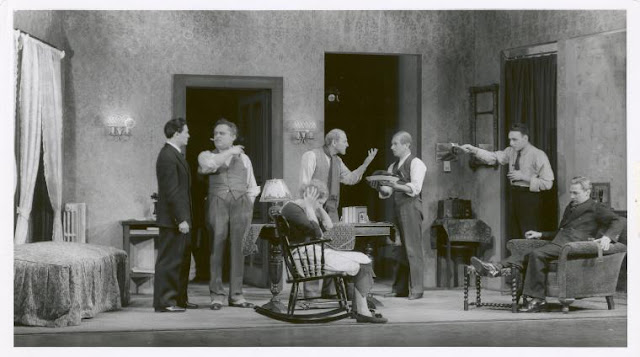
| The 1935 Broadway production of Awake and Sing! |
The Method: How the Twentieth Century Learned to Act by Isaac Butler (Bloomsbury Publishing) is a gossipy, entertaining and informative history of Stanislavskian acting – how it developed in Russia at the Moscow Art Theatre and how two of Stanislavski’s associates, Richard Boleslavsky and Maria Ouspenskaya, imported it to American shores, where, through its dissemination by the Group Theatre in the 1930s, it became the Method. Butler has rounded up an impressive amount of material and presents it coherently and compellingly. I didn’t realize how little I knew about the tensions between Stanislavski and the M.A.T.’s co-director, Vladimir Nemirovich-Danchenko; about the role each of the personalities who were drawn into Stanislavski’s circle played in the development of his approach to acting; about the effect Stalin’s rise to power had on the M.A.T. generally and on Stanislavski specifically – or certainly about Boleslavsky’s intriguing and rather crazy biography. No account I’ve read deals so clearly and in such dramatic detail with the break in the Group Theatre, when Stella Adler, its most gifted actress, challenged the weight Lee Strasberg, one of the company’s co-founders, placed on affective memory, where the actor digs into his or her past to unearth emotional dynamite to blast open a scene. Adler and Strasberg became the most important American acting teachers of the twentieth century. The Method’s examination of the differences in their styles and approaches and that of Sanford Meisner, another Group alumnus who became a famous and influential teacher, is fascinating. He identifies Adler’s greatest quality as her gift at script analysis; her book, compiled posthumously from her class notes, on Ibsen, Strindberg and Chekhov, and to a lesser extent the one on American playwrights, bear him out.
Monday, April 12, 2021
No Rock Bottom to the Life: Mark Harris’s Biography of Mike Nichols
![]() |
| Mike Nichols directs Elizabeth Taylor in Who's Afraid of Virginia Woolf (1966). |
Mark Harris wrote two of my favorite contemporary books about movies, Pictures at a Revolution (2008, about the transition from the old to the new Hollywood in the late 1960s) and Five Came Back (2014, about the five major Hollywood directors who made documentaries during the Second World War). But after reading his new 600-page biography of Mike Nichols, I can’t figure out why he the hell he wrote it.
Sunday, January 10, 2021
Bad Date: The Prom
![]() |
| Meryl Streep and James Corden in The Prom, now streaming on Netflix. |
Early on in The Prom, director Ryan Murphy’s new Netflix movie musical based on the modest Broadway hit, Andrew Rannells, playing a Juilliard-trained actor who bartends between gigs, hears a bunch of kids singing “Day by Day” from Godspell and promptly vomits into a bucket. I had a similar impulse throughout The Prom. It’s cheap, nasty, badly cast, assaultive in its songs, choreography, and camera work, and so awash in sentimentality you could fall into a glycemic coma. In other words, perfect fodder for Ryan Murphy, whose work (Glee, Hollywood, American Horror Story) revels in the mean and the sappy.
Monday, April 27, 2020
Take Me to the World: Sondheim, Off the Cuff
![]() |
| Take Me to the World: A Sondheim 90th Birthday Celebration is currently streaming at Broadway.com. |
After technical screw-ups that delayed the show for a little more than an hour, last night Broadway.com carried a virtual concert in honor of Stephen Sondheim’s ninetieth birthday to benefit Artists Striving to End Poverty (ASTEP). A plethora of (practically all) Broadway performers, most of whom have Sondheim shows on their résumés, sent him birthday wishes, conveyed their gratitude, and performed his songs from their living rooms – or, in the bizarre case of Mandy Patinkin, outdoors, a capella, with his dog in tow. (His choice of song was “Lesson #8” from Sunday in the Park with George: he was the original Georges Seurat, in 1984. It sounded awful.) The title of the improvised revue, cleverly alluding to the circumstances that made its catch-as-catch-can circumstances necessary, was Take Me to the World, from one of the handful of tunes Sondheim wrote for an obscure 1966 television musical, Evening Primrose. Well, relatively obscure, since in the world of Sondheim lovers no treasure remains to be unearthed; you can watch the DVD of Evening Primrose (which is based on a story by John Collier), and many people have recorded both this song and the other rapturous ballad from it, “I Remember.”
Monday, January 6, 2020
Little Women: Temporal Bigotry
![]() |
| Emma Watson, Saoirse Ronan, Florence Pugh, and Eliza Scanlen in Greta Gerwig's Little Women. |
Greta Gerwig’s Little Women is the first movie version in which almost none of the charm and poignancy of the beloved Louisa May Alcott novel, published in 1868 and 1869, comes through. Not counting the lost silents – there were two, in 1917 and 1918, one in England and one in America – Gerwig’s is the fourth major adaptation for the big screen. George Cukor’s 1933 film, with its picture-postcard visuals, came out from RKO, though it's in the mold of MGM’s vellum-bound, studio-set approach to the Victorian classics. It’s beautifully adapted (by Sarah Y. Mason and Victor Heerman, though imdb.com lists nine other uncredited contributors, including Charles Brackett) and meticulously detailed, with an A-list cast that features Spring Byington as Marmee, Joan Bennett as Beth, the stunning beauty Frances Dee as Meg and Douglass Montgomery as Laurie. And in Katharine Hepburn’s portrayal of Jo it touches greatness. It was Hepburn’s second year in Hollywood and her fourth picture, and no one has ever been more ideally suited to the role of Alcott’s feisty, ambitious, iconoclastic – and autobiographical – heroine. In the early scenes she overplays Jo’s gawkiness and tomboyishness, but she seems to find her stride as her character does, her grandiose romantic flourishes taking on the shape of Jo’s discovery of the world and her place within it. Hepburn shows us how Jo grows up, and I can’t be the only viewer who has never forgotten the moment when her Jo, after rejecting Laurie’s marriage proposal, confesses to Marmee in an anguished moan, “I feel as if I’d stabbed my best friend in the heart!”
Saturday, December 29, 2018
Nonsense and Sensibility: Mary Poppins Returns
![]() |
| Lin-Manuel Miranda, Pixie Davies, Joel Dawson, Nathanael Saleh and Emily Blunt in Mary Poppins Returns. (Photo: Jay Maidment) |
Author P.L. Travers’s Mary Poppins was tart, acerbic, dowdy and spindly, had a life of her own (her adventures with Bert in the chalk painting had no Banks children in tow), and thought a great deal of herself. Julie Andrews’s Mary Poppins, in the 1964 Disney movie, was dowdy and pretty in a clean-scrubbed sort of way, looked in the mirror a lot, and didn’t seem to think of anything. It’s an Oscar-winning performance that really isn’t much of one. Time Magazine stated, “If she did nothing but stand there smiling for a few hours, she would cast her radiance. It would be enough.” Apparently, both Andrews and the Academy agreed. Her Oscar was also a reaction to her not getting on film a role she made famous on Broadway, which may be why the disheveled hat Andrews wears as Poppins bears more than passing resemblance to Eliza Doolittle’s flower girl get-up in My Fair Lady, and why the song David Tomlinson sings as Mr. Banks, "The Life I Lead," sounds suspiciously Henry Higgins-ish. To be fair, Andrews does seem to be having a lively time when she and Dick Van Dyke danced to “Supercalifragi . . . ” -- well, you know the rest. But in general, she's rather fuzzy where she needs to be crisp. There’s a lack of clear choices in her portrayal; she seems to be coasting. In contrast, Emily Blunt in the new sequel Mary Poppins Returns is witty, sharp-tongued, and game for anything. She adores nonsense, and loathes fools. Spectacularly dressed (by Sandy Powell), she looks great and knows it. With her ramrod posture, impeccable line readings, and great timing, as well as a wicked sense of fun, Blunt is sublime. She bridges the distance between Travers and Andrews with an interpretation all her own.
Monday, September 10, 2018
Barbara Harris, Pixie Sorceress
![]() |
| Barbara Harris in 1967. (Photo: Paramount Pictures) |
Barbara Harris, who died a few weeks ago, was an improviser down to her soul. A native Chicagoan, she was a founding member of the first improv troupe in America, The Compass Players, helmed by her then-husband Paul Sills in the mid-fifties; when the company morphed into The Second City she accompanied it on tour to Broadway. In New York she starred in Arthur Kopit’s Oh Dad, Poor Dad, Mama’s Hung You in the Closet and I’m Feeling So Sad and in a pair of musicals for which she provided the raison d’être: On a Clear Day You Can See Forever by Alan Jay Lerner and Burton Lane in 1965 and the short-story anthology The Apple Tree by Jerry Bock and Sheldon Harnick in 1966. (She won the Tony Award – for which she had been nominated twice before – for The Apple Tree.) But she lost interest in stage work because, she said, it was really the exploration that takes place in rehearsal that excited her; she found repeating herself on stage every night stultifying. So, after playing opposite Jason Robards in A Thousand Clowns in 1965 – where she’s the only actor who doesn’t succumb to the depressing inauthenticity of the material (she’s utterly charming) – and repeating her stage performance in Oh Dad, Poor Dad in 1967, she turned her attention full-time to movies. Her pixelated presence and off-the-beam focus and slightly dazed quality seemed perfect for the era. She was nominated for an Oscar for Who Is Harry Kellerman and Why Is He Saying Those Terrible Things About Me? in 1971, likely because of one scene, the audition that her character, Allison Densmore, gives for Dustin Hoffman. (It’s the only scene in the movie worth remembering.) And she landed some leading roles over the next decade, though the only picture most movie lovers have seen her in is Nashville (1975), where she plays Albuquerque, the loony-bird aspiring singer who saves the Parthenon show in the final reel with her rendition of “It Don’t Worry Me” after the beloved country-western icon Barbara Jean (Ronee Blakley) is shot. Her last starring part was in Hal Ashby’s disastrous Second Hand Hearts opposite Robert Blake in 1981. She made four more movies and retired from the screen in 1997, then moved to Scottsdale, Arizona to teach acting. She’d outlived the epoch she was made for, God knows she’d outlived Hollywood’s capacity for figuring out how to cast an actress who fit no known mold, and once again she’d run out of patience. If the game was no longer about keeping the spark of inspiration alive, Barbara Harris didn’t want to play.
Friday, July 20, 2018
Acting Without Fear: First Reformed & A Very English Scandal
![]() |
| Ethan Hawke in First Reformed. (Photo: IMDB) |
The daring of Ethan Hawke’s recent movie performances – in Born to Be Blue, where he played the great, drug-addled jazz trumpeter and vocalist Chet Baker; in Maudie, where he played Everett, the difficult, armored fish vendor who employs the whimsical Nova Scotia artist Maudie Lewis as a housekeeper and winds up marrying her; and now in writer-director Paul Schrader’s First Reformed – is spellbinding. In his mid-forties, he’s become one of our greatest actors, consistently exploring territory beyond what he’s tried before. I voted for him as best actor in the Boston Society of Film Critics last year and the year before; every year brings its share of first-rate performances, but it seems to me that no one else is going as far or as deep as Hawke in inhabiting a set of utterly unalike personalities, and that his range expands each time out.
Friday, February 16, 2018
The Post: The Old Hollywood Machinery
The Post, about how its daring 1971 coverage of the Pentagon Papers put The Washington Post in the front rank of American newspapers, is a newspaper picture with a pedigree. Steven Spielberg, working with his usual team of experts – cinematographer Janusz Kaminski, editor Michael Kahn (working with Sarah Broshar), production designer Rick Carter and composer John Williams – directed from a screenplay that Liz Hannah co-authored with Josh Singer (co-writer of Spotlight). And his cast, headed by Meryl Streep as publisher Kay (Katharine) Graham and Tom Hanks as editor Ben Bradlee, presents the most impressive collection of character actors, culled from stage, movies and TV, on screen in the past year, all of them working at the top of their game. Bruce Greenwood plays Robert McNamara, Defense Secretary under JFK and LBJ, who ordered the Pentagon Papers, forty-seven volumes that documented the history of White House obfuscation about the Vietnam War; Matthew Rhys (of The Americans) is an uncanny visual match for former Marine Daniel Ellsberg, who, having drafted the study in 1966, brought it to light by having a copy left on the desk of a general assignment reporter at The New York Times. Bob Odenkirk is Ben Bagdikian, assistant managing director for national affairs at The Post, who guesses that Ellsberg – a one-time colleague of his at the RAND Corporation – is the source of the leak and tracks him down so that, when an injunction from Attorney General John Mitchell ties the hands of The Times, preventing it from offering any further coverage, The Post can pick up the ball. Tracy Letts is The Post’s chairman of the board, Fritz Beebe; Bradley Whitford, looking like an old-world southern gentleman in a bow tie, is Arthur Parsons, a composite character based on several Post advisers who discourages Graham from publishing articles about the papers; Jesse Plemons (of Friday Night Lights) is the senior legal counsel for the paper, whose youth amuses Bradlee. Sarah Paulson plays Ben’s sculptor wife Tony. Carrie Coon plays editorial writer (and future editorial page editor) Meg Greenfield and Jessie Mueller is Judith Martin, who, when the main part of the narrative begins, has been denied an invitation to cover presidential daughter Tricia Nixon’s wedding because she crashed Tricia’s older sister Julie’s wedding three years earlier. The ubiquitous Michael Stulhbarg, who also appeared in two other high-profile Christmas-season releases, The Shape of Water and Call Me by Your Name, is Abe Rosenthal, managing editor at The Times. David Constabile and Johanna Day are Graham’s close friends Art and Ann Buchwald.
Monday, June 19, 2017
London Revivals, Part I: Political Morality Plays
![]() |
| Andrew Garfield and Nathan Stewart-Jarre in Angels in America: Millennium Approaches. (Photo: Helen Maybanks) |
This piece contains reviews for the National Theatre's Angels in America, Donmar Warehouse's The Resistible Rise of Arturo Ui, and Young Vic's Life of Galileo.
The hottest ticket in London this summer – aside from Harry Potter and the Cursed Child, just beginning its second year in the West End – is the National Theatre revival of Tony Kushner’s Angels in America, directed by Marianne Elliott (War Horse, The Curious Incident of the Dog in the Night-Time) and starring Nathan Lane and Andrew Garfield. I couldn’t get up much enthusiasm about it, but then I’m the stubborn cuss who doesn’t like Angels in America. No one could say that I haven’t done due diligence with the play. I saw Part I: Millennium Approaches, in its original National Theatre production in 1992 (with Henry Goodman as Roy Cohn), and both Part I and Part II: Perestroika, on Broadway in 1993 (with Ron Liebman as Cohn, Stephen Spinella as Prior Walter, Marcia Gay Harden as Harper Pitt and Jeffrey Wright as Belize). I’ve also seen Mike Nichols’s 2003 HBO film version (with a cast including Al Pacino, Mary-Louise Parker, Meryl Streep, Emma Thompson, Patrick Wilson, and James Cromwell).
Kushner subtitled the work, which runs for seven hours and forty minutes in its complete form at the National, A Gay Fantasia on National Themes, and clearly one of the elements that critics and prize-winning committees and the vast number of theatre professors who regularly include it on the syllabi of modern drama classes respond to is the enormity of its ambitions. It’s intended to be a chronicle of the AIDS crisis from the point of view of the gay community; a coming-out play; an excoriation of the repressive spirit of Republican politics targeted specifically at Roy Cohn (played by Lane in this latest production), Joe McCarthy’s counsel and a Department of Justice prosecutor at the Rosenberg trial, and a closeted gay man who died of AIDS in 1986; and a comparative exploration of Mormonism, Protestantism and Judaism focusing on politics and sexuality at the end of the twentieth century, with a disquisition on race in America. Three of the characters are Mormon, three are Jewish, one is white Protestant and one is African American, and there are many others, the roles divided among a small cast whose efforts, in any production of the play, are equivalent in physical endurance alone to running a pair of marathons. In style Angels in America is alternately realist, surrealist and Brechtian, with interludes of satirical caricature.
Friday, May 12, 2017
Looking Back: The Sergeant (1968)
![]() |
| Rod Steiger in The Sergeant (1968). |
The Sergeant, poor cow of a movie, never had a chance. The critics of 1968 – faced with Rod Steiger’s miserable Army lifer, Sergeant Callan, pursuing John Phillip Law’s dewy-eyed Private Swanson on a godforsaken supply post in 1952 France, and then killing himself – were unanimous in panning it. “In the context of today’s liberated movie-making,” Vincent Canby wrote in The New York Times, “this study of repressed homosexuality seems almost quaint. It also is basically confused.” Steiger, Canby felt, “comes on with all the subtlety of a drag queen,” while Law seemed “remarkably dense.” In The New Yorker, Pauline Kael made more or less the same complaints, while voicing regret for the loneliness and pathos she believed were the homosexual’s lot in life. New York’s Judith Crist, with a sensitivity typical of herself and her peers, dismissed it as “a sleazily commercial film [about] a fag non-com.”
For straight critics like these, The Sergeant was mainly an offense against two hours of their time. Later, with queer critics to the fore, it became an offense against gay liberation: a mainstay on the list of “daring” sixties Hollywood movies that were seen as retrograde, even toxic in their sexual politics, with a preponderance of gay or lesbian characters either killing themselves, killing others, or getting killed. (Among the others were 1961’s The Children’s Hour, 1962’s Advise and Consent, 1967’s Reflections in a Golden Eye, 1968’s The Fox, The Killing of Sister George, and The Detective, and 1969’s Staircase.) In Screening the Sexes (1973), the first study of homosexuality in the movies, critic Parker Tyler placed The Sergeant in the “Homeros in uniform” subgenre, calling it “a clean-cut, well-tailored movie like an expensive suit that has had only one wearing, then been relegated in a plastic wrap to the closet, where it will stay indefinitely.” By 1981 and The Celluloid Closet, Vito Russo’s definitive history of gayness in cinema, the AIDS holocaust was imminent, and The Sergeant’s stock was even lower. Rather than suggesting that homosexuality might be associated with anything healthy, The Sergeant dealt “only in sexually motivated manipulations, spitefulness and petty jealousy, most of it unconscious and unexplored. The result is caricature.”
Tuesday, April 25, 2017
Out of Vogue: Joan Juliet Buck and The Price of Illusion
![]() |
| Joan Juliet Buck and her father, Jules Buck, in London, 1968. (Photo courtesy of Joan Juliet Buck) |
The shiny surfaces in The Price of Illusion reflect a high-gloss world of celebrity and glamour which the author, former Vogue and Vanity Fair editor and writer Joan Juliet Buck, has polished to brittle brilliance. As the title of her recently published memoir suggests, the book is less a hedonistic romp through a high life made fabulous by the ubiquitous presence of Hollywood royalty and designer labels, and more an archly ironic reflection on the pitfalls of vanity and a preoccupation with appearances. Witty and stylishly written, it is an absorbing and entertaining read, a richly sashed window looking onto a whirlwind time. It has just the right amount of A-list love affairs (Donald Sutherland and Brian De Palma figure large) mixed in with insider fashion gossip concerning the likes of Karl Lagerfeld, Yves Saint Laurent, Pierre Bergé and André Leon Tally, to make it juicy, even as the narrative skirts the edges of personal tragedy.
"It is a morality tale," says Buck, 69, during a recent telephone call from her home in the Hudson Valley countryside outside New York. The bucolic setting is deliberate. Buck recently chose it over Manhattan to be as far away from her former life in the fast lane as she could comfortably get. A pop-culture chronicler whose four-and-a-half-decades-long career started at age 23 when she became the London correspondent for Andy Warhol's Interview Magazine and then features editor for British Vogue and a foreign correspondent for Women's Wear Daily the same year, she speaks through drags of an ever-present cigarette, a habit picked up around the time a young Tom Wolfe made her the subject of "The Life and Hard Times of a Teenage London Society Girl," his essay about the 1960s counterculture. Her voice sounds dry, and slightly gravelly. But her intelligent commentary is as sharp as her prose. "I was always looking for the truth,"she exhales. "But growing up I didn't have many guidelines."
Monday, November 28, 2016
Unmemorable Revivals: Plenty and Les Liaisons Dangereuses
![]() |
| Rachel Weisz and Bryon Jennings (background) in Plenty, at New York's Public Theater. (Photo: Joan Marcus) |
David Hare’s Plenty, currently receiving its first New York revival at the Public (where it was originally produced in 1982), is the portrait of an Englishwoman named Susan Traherne who experienced the most fulfilling part of her life during World War II, when she was a Special Operatives Executive courier in France. That nothing in her subsequent life has come close to bringing her that kind of satisfaction has made her restless and unhinged. She meets her husband, Raymond Brock, in Brussels in 1947 when he’s working for the Foreign Office there, and he marries her, as much out of kindness as out of love, when she’s at a low ebb in the early fifties; their union barely survives her manic eruptions, one of which forces him to resign his post at the embassy in Iran and derails his career, and it falls apart at last in the early sixties. Plenty is a complicated work with a fascinating subject that only a few other writers have tackled: how do you negotiate the rest of your life after an exciting, romantic period of total engagement that can never be equaled? (One of the characters in Terence Rattigan’s The Deep Blue Sea, a one-time RAF flyer, suffers from this kind of letdown, and it’s the fate of the protagonist in Willa Cather’s beautiful 1923 novel One of Ours.) But as is sometimes the case with Hare’s plays, Plenty works better in your head when you’re reflecting on it afterwards than it does in performance. I’m not sure why, exactly: Hare is an unusually intelligent writer and the material is certainly dramatic, but I felt the same detachment from it in the new David Leveaux production, with Rachel Weisz as Susan, as I had when I saw the 1985 movie version, directed by Fred Schepisi, with Meryl Streep in the role.
Friday, October 14, 2016
Curtis Hanson: A Career in Perspective
![]() |
| Eminem and Curtis Hanson (right) on the set of 8 Mile in 2002. (Photo: Eli Reed) |
Film director Curtis Hanson, who died in September at the too-young age of seventy-one, was stuck in B-movie territory for a decade and a half before he graduated, in 1987, with the thriller The Bedroom Window. (One of his last B-pictures, Losin’ It, about three SoCal high-schoolers who drive to Tijuana to get rid of their virginity, was coarse and chaotic but very likable. One of them was played by Tom Cruise, just months before Risky Business made him a star, and I’ve never enjoyed watching him as much since.) Once he made it to the majors, so to speak, Hanson made eleven pictures, and I like all or part of every single one except for his first hit, the witless 1992 Gothic The Hand That Rocks the Cradle – it was efficiently directed, but the dunderheaded script was insurmountable. What made him so reliable a filmmaker was a combination of his bred-in-the-bone understanding of genre conventions, his transparent love of actors and his undervalued gift for getting fine work out of them, and his relaxed finesse as a storyteller. This last is no surprise: from his first days in movies, the early seventies, he was a screenwriter as well as a director, penning the compulsively watchable, enjoyably amoral Canadian mystery The Silent Partner (directed by Daryl Duke and starring Elliott Gould, Susannah York and Christopher Plummer) in 1978 and contributing to the scripts of Samuel Fuller’s White Dog and Carroll Ballard’s Never Cry Wolf in the early eighties. And he kept his hand in: he wrote The Bedroom Window and co-wrote the best picture he ever turned out, L.A. Confidential, with Brian Helgeland, as well as one of his last movies, Lucky You, with Eric Roth.
Saturday, September 24, 2016
The Wrong Kind of Easy: Eight Days a Week – The Touring Years
![]() |
| A scene from The Beatles: Eight Days a Week – The Touring Years. |
Ron Howard’s The Beatles: Eight Days a Week – The Touring Years is a documentary covering the Beatles’ life as a live band from 1963 to 1966, with interludes on their studio work, and everything about it is easy. Why shouldn’t it be? The Beatles were nothing if not easy – “easy,” as Bob Dylan put it in Chronicles, “to accept.” But there are different kinds of ease. Dylan wrote that the Beatles “offered intimacy and companionship like no other group,” with the implied knowledge that intimacy is one of the scariest things in life, for it contains everything that is possible in human relationships. Intimacy is sometimes looking the other in the face in complete silence and not knowing. Intimacy is risking enough so that, if you lose the other, you might lose yourself. The Beatles’ ease was never the ease of knowing that every landing would be soft, or every revelation safe; theirs was the ease of surrendering, gladly and freely, a part of yourself that you’d never get back. To surrender to something as powerful and lovely as the Beatles, and as laden with promises of sadness and death – that was the intimacy they offered, the terrifying intimacy of lovers.
Though it’s full of screaming and it talks about pressure, Eight Days a Week is the wrong kind of easy. It’s as comfortable as going through high school yearbooks. It is soft, smooth, and shallow – the essence of nostalgia and of anodyne. I want so much more than this movie is giving. But the paradox is that its ease makes it difficult, at least while sitting, as I did, in a packed suburban theater with an adoring audience made mostly of white baby boomers – many of whom, surely, were in the Beatles’ concert audiences as kids – to know what that “so much more” might involve. Because what it does give is clearly useful and heartfelt. What should a film about the Beatles’ touring incarnation, from the arrogant innocence of ’63 to the seared disgust of ’66, amount to, what should it give? Something you feel only in its absence. Something deeper than this, scarier; some vision taking in both the blissful scream and the bottomless hunger, the vertiginous height and grinding depth of Beatlemania. Something capturing and elaborating glimpses that were caught in previous documentaries: The Beatles Anthology, The Brian Epstein Story, George Harrison: Living in the Material World. Something that sniffs out mystery and alienation, that doesn’t seek only a smile, a nod, a surge of warmth, a safe landing. Something familiar, but also intimate; something uncanny.
Sunday, July 24, 2016
Eleanor Roosevelt through Different Lenses (Part 1): Ken Burns' The Roosevelts
![]() |
| Eleanor Roosevelt speaking at the Chicago World’s Fair in 1933. (Photo: Franklin D. Roosevelt Presidential Library) |
Since Ken Burns adapted David McCullough's book, The Great Bridge, about the construction of the Brooklyn Bridge, to an Academy Award winning Brooklyn Bridge (1981), he has produced and directed numerous masterful feature length documentaries for PBS. His signature trademarks are a combination of still photos, archival film footage, unseen actors reading the words of historical characters, apt American music and an array of historians, journalists and (if possible) surviving contemporaries who offer compelling anecdotes and insights into the era, an issue and the characters. Burns avoids dramatic re-enactments. His oeuvre includes The Statue of Liberty (1985), the iconic The Civil War (1990), Baseball (1994), The West (1996), Lewis & Clark (1997), Not for Ourselves Alone: The Story of Elizabeth Cady Stanton and Susan B. Anthony (1999), Jazz (2001), The War (2007), The National Parks (2009), Prohibition (2011), The Dust Bowl (2012), The Central Park Five (2013). Most recently PBS has aired Cancer: The Emperor of All Maladies (2015), a six-hour treatment of Indian-American physician Siddhartha Mukherjee’s Pulitzer prize-winning biography of cancer, the one film Burns did not direct because he was so personally connected to the subject: his mother died of cancer when he was a young boy. In 2016, he returned to directing and producing the thrilling Jackie Robinson that excelled in weaving together sport, politics and race.
It is, however, Burns’ 2014 mammoth seven-part, fourteen-hour The Roosevelts: An Intimate History, on the private and public lives of Theodore, Franklin and Eleanor Roosevelt, that is the one I will be discussing today – focusing mostly on the second generation of Roosevelts. As with many of the films cited above, Burns collaborated with biographer and historian Geoffrey C. Ward, who wrote the elegant and accessible script and is one of the historians – along with Doris Kearns Goodwin, David McCullough, Jon Meacham and journalist George Will – who offers trenchant insights. Actor Peter Coyote won an Emmy award for his compelling narration. The stellar cast of actors’ voices include Meryl Streep for Eleanor Roosevelt, Paul Giamatti for Teddy Roosevelt, and Edward Herrmann for FDR, an astute choice since he persuasively played the role in the television series Eleanor and Franklin (1976) and Eleanor and Franklin: The White House Years (1977).
Saturday, April 2, 2016
Fearless Satire: The Criterion Blu-ray Release of The Manchurian Candidate (1962)
![]() |
| Frank Sinatra and Janet Leigh in John Frankenheimer’s The Manchurian Candidate (1962). |
(Spoiler alert: This article discusses plot details that The Manchurian Candidate keeps hidden until quite late in the narrative. Though they are quite famous, if you don’t know them you might prefer to see the movie first and encounter the revelations with all the suspense and surprise that the 1962 audience would have experienced.)
Political conspiracy thrillers flourished during the early days of the Cold War and especially during the Korean War. Generally their heroes were pure-hearted Federal agents who succeeded in stemming the insidious behavior of Communist infiltrators, icy devils with no more dimensions than the Nazis bad guys Hollywood had featured just a few years earlier. The exception was Leo McCarey’s notorious and distasteful 1952 My Son John, in which the Commie is a young American man (Robert Walker) who comes home to give the commencement speech at his old high school and alarms his mother (Helen Hayes) by mocking his parents’ patriotism and refusing to attend church with them. He is also clearly gay, though the movie doesn’t say so explicitly; you deduce it from the flourishes in Walker’s performance, which are recycled from the truly splendid one he gave the year before in Hitchcock’s Strangers on a Train. The idea seems to be some debased version of the Renaissance notion about the clustering of vices in a corrupted personality. In the great Jacobean tragedy The Changeling by Thomas Middleton and William Rowley, when the husband of the protagonist realizes she’s a murderess and her partner in crime calls her a whore, the husband replies, “It could not choose but follow.” More specifically in My Son John, the un-American elements in John’s behavior – cynicism, atheism, homosexuality – all point to his being under the influence of a foreign power.
Thursday, December 24, 2015
2015: My Cultural Year in Review
![]() |
| Kirsten Dunst and Jesse Plemons in the second season of Fargo. |
It’s been a long year. We’re coming close to the end. As Mr. Lennon said, “So this is Christmas, and what have we done?” Well we’ve listened to a lot of music, and read a lot of books. Watched some movies. And some TV. Maybe my favourite TV show has been Fargo, Season 2 of which I have just finished, and I have to say I loved every minute of it. The first season was interesting, had a few surprises, like when Officer Molly got shot but the second season was where we found out just what happened at the Sioux Falls massacre. The concept of going back twenty years to explain this was sheer genius. If you haven’t watched Fargo, I recommend you start from the beginning. See the movie first and marvel at the work of Joel and Ethan Coen. Next try the first season to see how beautifully the television producers have translated North Dakota and environs to the small screen. Billy Bob Thornton was the perfect villain, and Allison Tolman as Molly Solverson was extraordinary. Her expressive eyes just captured the viewer and never let you go.
Thursday, November 5, 2015
Rebels With a Cause: Sarah Gavron’s Suffragette
![]() |
| Carey Mulligan in Suffragette. |
Suffragette’s setting of 1912 East London is a strange paradox. Sarah Gavron’s film takes pains to distance itself from being a stuffy period drama; the action is so real and filmed in such a way that were it not for the bustles and fancy hats, the story could be taking place today. On the other hand, the political environment it showcases is so shockingly archaic that one can hardly believe it was just over a hundred years ago. Poverty is rampant. Working conditions are abject. Women are overworked, abused, and voiceless. More specifically, British women in 1912 are unable to vote. As iconic Suffragette Emmeline Pankhurst (played by iconic actress Meryl Streep) reminds them in the film, peaceful demonstrations in the name of “votes for women” have gone nowhere prior to 1912. Suffragette tells the story of a band of women who recognize this and, like many other women at the time who were longing for a better life, turn to civil disobedience in the pursuit of equality.