Showing posts sorted by date for query Robert De Niro. Sort by relevance Show all posts

Monday, March 9, 2026

Grief and The Goshawk: H Is for Hawk and Other Recent Movies

Claire Foy in H Is for Hawk. (Photo: Roadside Pictures.)

Among the books I brought with me on a trip at the end of my semester break this year was a lovely recent memoir called Raising Hare in which the author, Claire Dalton, who has grown up with the principle that human beings should never interfere with the workings of the wild, chronicles the discovery of a leveret on her land, close to death. Despite her predilections, Dalton makes the decision to try to save the young hare’s life and then, instinctually, begins to share her home – exterior and interior – with this creature with which she’s fallen in love, redesigning it to accommodate its needs and comforts.

Tuesday, September 23, 2025

Barbra Streisand, Robert Redford and The Way We Were


I opted to listen to Barbra Streisand’s 2023 memoir, My Name Is Barbra, rather than reading it in hard copy so that I could hear her inimitable phrasing – the quality that made me a diehard fan of her albums when I started collecting them in 1964, at the age of thirteen. (The first one I owned, a gift from my aunt and uncle, was the original cast album of Funny Girl, which had recently opened on Broadway; I played “Don’t Rain on My Parade” through so many times that it’s a miracle I didn’t wear down the vinyl.) I was lucky: Streisand’s movie career began the week I started university, when she opened in the film version of Funny Girl, and I saw each of those great early performances – in Hello, Dolly!, The Owl and the Pussycat, Up the Sandbox and The Way We Were – as they came out, on the big screen. What I mostly desired from the memoir was information about, and her personal response to, her early triumphs on stage (her scene-stealing supporting performance in I Can Get It for You Wholesale led to Funny Girl), television (where she, Joe Layton and Dwight Hemion reconceived the variety special with the explosively inventive My Name Is Barbra in 1965), LP and film. My usual experience with the memoirs of performers I love is that they’re fun as long as they chronicle the origins of a career but run out of steam once the writer has made the leap into stardom. And this one comes in at a shade under a thousand pages! Plus I haven’t cared much for Streisand’s pop albums and found only a few of her later pictures interesting – though, notably, I’ve never missed one. (Her film career had pretty much faded by the early nineties.)

Monday, April 14, 2025

Doppelgänger: Barry Levinson's The Alto Knights

Robert De Niro and Robert De Niro in The Alto Knights. (Photo: Warner Bros.)

Witty, gripping and grandly entertaining, Barry Levinson’s The Alto Knights centers on the complicated relationship of two legendary Mafiosi, Frank Costello and Vito Genovese, who were both recruited to work for bootlegger Giuseppe Masseria in the 1920s alongside Lucky Luciano. After the murders of Masseria and his successor, Salvatore Maranzano, Genovese became Luciano’s second in command with Costello, who claimed to have abjured violence at the end of the First World War and stopped carrying a gun, as his consigliere. Genovese took over in 1936 when Luciano went to prison and expanded the operations of the organization Luciano had reconfigured as the Commission into narcotics. But he had to flee the U.S. to avoid a murder charge and took sanctuary in Italy. (Both men had been born there: Costello in Naples, Genovese in Calabria.) Costello took over, trading drugs for gambling. When Genovese returned to the States after the war – neatly bypassing conviction for that old killing when two key witnesses against him turned up dead – he didn’t take well to being his former colleague’s underboss. All of this narrative is background, much of it unstated or understated, to Levinson’s picture, which takes place in 1957, the year Costello appeared before the Senate Committee investigating the Mafia, and the year Genovese engineered the assassination of the former head of Murder Inc., Albert Anastasia, and attempted unsuccessfully to eliminate Costello.

Monday, October 30, 2023

Killers of the Flower Moon: Martin Scorsese’s Hobbled Epic

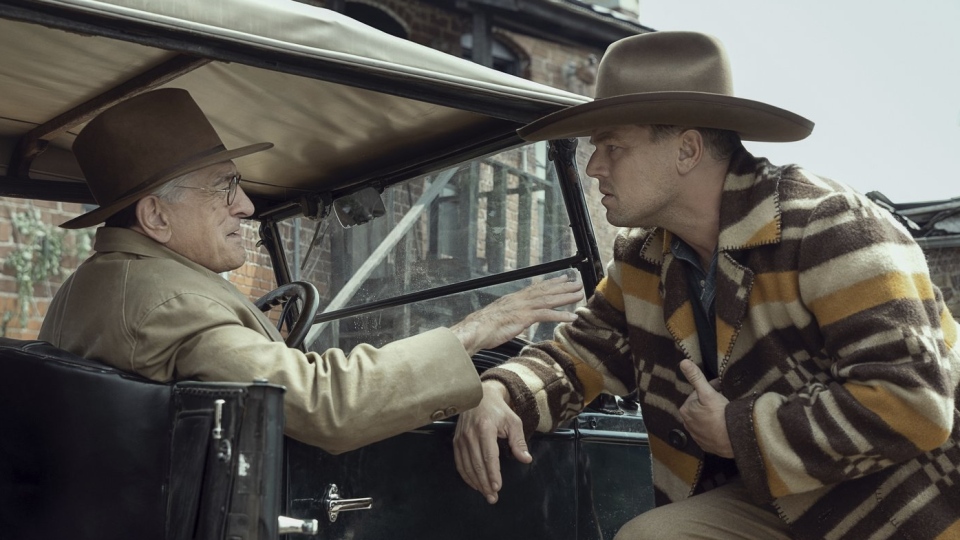
Robert De Niro and Leonardo DiCaprio in Killers of the Flower Moon.

Killers of the Flower Moon is great around the edges. Martin Scorsese’s movie, adapted from David Grann’s jaw-dropping 2017 account of the serial murders of Osage Indians in Oklahoma in the 1920s that enabled white men to secure their “headrights” – the legacy, shared equally among the community, of land rich in oil – is three and a half hours long and cost $200 million, and God knows you can see the money on the screen. The film, shot by Rodrigo Prieto, with production design by Jack Fisk and costumes by Jacqueline West, looks magnificent. The period reconstructions are dazzling and capture a cross-hatched culture, rich in visual irony, where natives, professing a faith that mixes Catholicism with the religion of their ancestors, dress in a combination of traditional garb and the flamboyant style of wealthy white men while they tool around in chauffeured Pierce Arrow roadsters and fly private airplanes. The opening scenes are lively and exciting, a circus-like montage of oil strikes and auctions and raucous general celebration that spills out of barrooms and restaurants into the streets of Fairfax, the Osage reservation town that has grown out of the oil boom. This is some of Scorsese’s best filmmaking – visually dense, outré, darkly funny. We barely have a chance to process the omnipresence of white men who have intermarried with the Osage women before it all turns sinister. The natives are dying in staggering numbers, some the victims in unsolved murders, others expiring from suspicious illnesses.

Monday, May 29, 2023

New York, New York: Stepping Around the Heart of Scorsese’s Movie Musical

 The wonderful "Wine and Peaches" number in New York, New York. (Photo: Paul Kolnik)

Martin Scorsese’s 1977 New York, New York, perhaps the only Big Band musical film after the collapse of the Big Band era, is about the meeting – collision is more accurate – of two young musical hopefuls in Manhattan on V-J Day, both newly out of the service. Jimmy Doyle (Robert De Niro, at the end of his astonishing early career – the year after Taxi Driver) is a relentlessly confident saxophonist and Francine Evans (Liza Minnelli, in her least-known great performance) is a vocalist. He keeps asking her out; she keeps telling him no. But his persistence, obnoxious as it sometimes gets, is inseparable from his charm, and though she tries to resist she ends up acceding to every one of his demands. She does go out with him, she lands him a job by performing a duet with him at an audition – it’s “You Brought a New Kind of Love to Me,” and they’re a knockout together (Georgie Auld, who plays a supporting role, dubs Jimmy’s sax) – and they become lovers, then husband and wife. You’d have to be De Niro to pull off this part. The marriage is a disaster, because Jimmy is demonically focused on his career and professionally competitive, and when Francine doesn’t – or can’t – do exactly what he demands of her, he steams. And he cheats on her. The divergence in their careers – she becomes a star of stage and movie musicals, he becomes one of the inventors of bop – operates as a symbol for all the ways in which their relationship is unworkable.

Monday, March 28, 2022

New on Criterion: The Last Waltz (1978)

The Band on stage in The Last Waltz (1978)

In the forty-four years since Martin Scorsese released The Last Waltz, his film of The Band’s final concert, at San Francisco’s Winterland Arena on Thanksgiving Day in 1976, the movie hasn’t lost any of its visceral excitement, both as a piece of filmmaking and as a keepsake of one of the signal events in the history of rock ‘n’ roll. It’s the greatest concert movie ever made. (The other contenders, in my view, would be Bert Stern’s 1959 Jazz on a Summer’s Day, a chronicle of the 1958 Newport Jazz Festival, which inspired Scorsese; Jonathan Demme’s 1984 Talking Heads film Stop Making Sense; and Scorsese’s one-of-a-kind 2019 Rolling Thunder Revue, which casts a backward glance at the all-star show, headed by Bob Dylan and Joan Baez, that circled the continent in 1975 and 1976.) The new Criterion disc of The Last Waltz is as beautiful to look at as the film was in theatres in 1978. The veteran Hollywood production designer Boris Leven, borrowing the San Francisco Opera’s set for La Traviata and framing it with a trio of chandeliers, transformed Winterland into something that looks like a remnant of the Romantic era, and Michael Chapman, who had worked with Scorsese on Taxi Driver, lit it, while some of the most talented cinematographers in America (Vilmos Zsigmond, Laszlo Kovacs, David Myers, Bobby Byrne, Michael Watkins and Hiro Narita) manned the other six cameras covering the spectacle. It was the first concert film with a shooting script, which Scorsese had drawn up; the stories about the filming, where his meticulous planning met the inevitable challenges and accidents of a once-in-a-lifetime event that had to be captured spontaneously, are sometimes funny and always thrilling. (You won’t want to skip the extras on the Criterion disc, which include two audio commentaries, a 1978 Canadian television interview with Scorsese and The Band’s Robbie Robertson, a twenty-fifth-anniversary doc about the making of the movie, and a supremely articulate new interview with Scorsese conducted by film critic David Fear. There’s also a single outtake, a twelve-minute jam session that occurred at the end of the concert and is the only surviving piece of archival footage.)

Monday, March 21, 2022

Acting and Actors – The Method: How the Twentieth Century Learned to Act

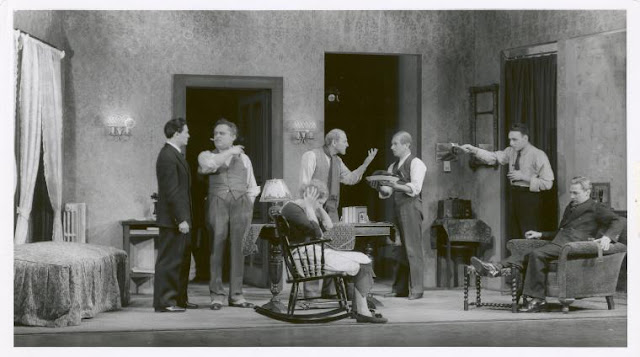
The 1935 Broadway production of Awake and Sing!

The Method: How the Twentieth Century Learned to Act by Isaac Butler (Bloomsbury Publishing) is a gossipy, entertaining and informative history of Stanislavskian acting – how it developed in Russia at the Moscow Art Theatre and how two of Stanislavski’s associates, Richard Boleslavsky and Maria Ouspenskaya, imported it to American shores, where, through its dissemination by the Group Theatre in the 1930s, it became the Method. Butler has rounded up an impressive amount of material and presents it coherently and compellingly. I didn’t realize how little I knew about the tensions between Stanislavski and the M.A.T.’s co-director, Vladimir Nemirovich-Danchenko; about the role each of the personalities who were drawn into Stanislavski’s circle played in the development of his approach to acting; about the effect Stalin’s rise to power had on the M.A.T. generally and on Stanislavski specifically – or certainly about Boleslavsky’s intriguing and rather crazy biography. No account I’ve read deals so clearly and in such dramatic detail with the break in the Group Theatre, when Stella Adler, its most gifted actress, challenged the weight Lee Strasberg, one of the company’s co-founders, placed on affective memory, where the actor digs into his or her past to unearth emotional dynamite to blast open a scene. Adler and Strasberg became the most important American acting teachers of the twentieth century. The Method’s examination of the differences in their styles and approaches and that of Sanford Meisner, another Group alumnus who became a famous and influential teacher, is fascinating. He identifies Adler’s greatest quality as her gift at script analysis; her book, compiled posthumously from her class notes, on Ibsen, Strindberg and Chekhov, and to a lesser extent the one on American playwrights, bear him out.

Monday, May 3, 2021

George Segal, 1934-2021

George Segal in Who’s Afraid of Virginia Woolf? (1966).

When George Segal died at eighty-seven on March 23, most people would have recognized him as the co-star of the hit TV sitcoms The Goldbergs (which began in 2013 and is still running) and Just Shoot Me! (1997-2003). The long second act of his career, beginning around 1987, unfolded almost entirely on the small screen; his occasional movie appearances were in supporting roles in undistinguished pictures. But between the mid-sixties and the mid-seventies he was a force to be reckoned with. Strikingly handsome, charismatic, with an infectious warmth, he was groomed initially for romantic leading-man roles. The first picture he had a significant role in was Stanley Kramer’s 1965 Ship of Fools, though the movie was idiotic and the part – a painter chafing against the possessiveness of his well-heeled girlfriend (Elizabeth Ashley) – was wan and underwritten. But in King Rat (released the same year), cast as Corporal King, a scavenger in the officers’ section of a Japanese POW camp, he commanded the screen, and it was obvious that he had far more to offer than looks and charm. King was the kind of part a young Clark Gable would have played, but Gable would have made sure to make the character likable; Segal doesn’t, and the writer-director, Bryan Forbes (adapting a James Clavell novel), allows him some complicated scenes and reserves of mystery. His exchanges with James Fox as a British officer who forges an unexpected friendship with King are the emotional core of the film.

Tuesday, December 8, 2020

Sean Connery: Larger Than Life

Sean Connery (1930-2020) in Diamonds Are Forever (1971).

Everyone knows that Sean Connery, who died on Halloween at the age of ninety, became a movie star the moment he stepped before the camera as James Bond, Ian Fleming’s Agent 007, in Dr. No in 1963. And for most of us who saw the early Bond pictures in the theatre as they appeared – I was thirteen when I was initiated, with the second of the series, From Russia with Love – all the subsequent Bonds, at least until Daniel Craig stepped up in 2006, always seemed like pretenders to a throne Connery had abdicated after the 1971 Diamonds Are Forever. Not that you could blame the guy. Very few of his fans took him seriously as an actor until he’d freed himself from the shackles of the leading role in the most beloved (and longest-lasting) series in movie history. He gave splendid performances as the life-embracing poet who can’t be slowed down even by a lobotomy in the 1966 comedy A Fine Madness and as the émigré Irish miner who leads a crew of violent rebels against the Pennsylvania coal barons in 1970’s The Molly Maguires – both fine movies but audiences failed to show up for them. (On the other hand, neither Woman of Straw with Gina Lollobrigida nor Marnie, directed by Alfred Hitchcock, both released in 1964, the same year as Goldfinger, did much for him. Marnie contains one of his rare bad performances – he looks befuddled, which seems like a fair response to what’s going on around him.)

Monday, August 24, 2020

New Documentaries: Gordon Lightfoot, The Band, and Flannery O’Connor

Gordon Lightfoot in Gordon Lightfoot: If You Could Read My Mind (2019)

The Canadian singer-songwriter Gordon Lightfoot attained fame in the mid-1960s and in his prime – that is, until 1973 or 1974 – he turned out an album every year. He had a sweet, silver-laced voice and he wrote evocative ballads with understated poetic lyrics (like “The Last Time I Saw Her Face” and “Affair on 8th Avenue”) and big-boned, bardic folk anthems that dramatized small and large historical topics, the most famous – and best – of which was “Canadian Railroad Trilogy.” When I was in high school in Montreal in the early days of his celebrity and the late days of the folk movement, you couldn’t attend a party without someone showing up with a guitar, and you were dead certain to hear the trilogy or “Early Morning Rain,” or both. (The other guaranteed solo was “Suzanne” by that other Canadian musical legend, Leonard Cohen.) Before his writing lost its freshness and his voice wore down to a craggy thinness, I bought everything Lightfoot recorded, and I saw him in concert four times, once at Carnegie Hall.

Monday, June 1, 2020

Allen Garfield: A Fond Farewell

Allen Garfield and Peter O'Toole in The Stunt Man (1980).

Allen Garfield died on April 7 at the age of eighty, one of the early COVID-19 casualties in the acting community. He was a fantastically vivid performer who managed to straddle the line between the old Hollywood and the new. He was a character actor who, like the most memorable big-studio stock-company players, could bring verve and wit to supporting roles that lit up the margins of the movies he appeared in, but his bristling, aggressive, off-center style was quintessentially modern. (He had attended the Actors Studio in New York.) He belonged in the American renaissance era; he would have been too daring, too subversive for the forties or the fifties.

Monday, January 27, 2020

The Forgettable and the Forgotten: We All Fall Down and Ivan Passer

Eleanor Reissa and Stephen Schnetzer in We All Fall Down. (Photo: Nile Hawver)

The Huntington Theatre Company’s commitment to producing new work is admirable, but is We All Fall Down, the Lila Rose Kaplan piece receiving its premiere at the Calderwood Pavilion, really the best script they could find? It’s a cutesy sitcom about an assimilated Jewish family holding its first Passover Seder in their Westchester home, and when, around the last third of the play, the broad jokiness more or less gives way and Kaplan finally reveals why the hell the matriarch, Linda (Eleanor Reissa), has gathered them and a couple of friends to honor a tradition she has never believed in, the tone simply shifts to melodrama. Yes, that’s right: this play is firmly in the I-laughed-I-cried genre. There isn’t a moment of authenticity in the entire ninety-five minutes.

Monday, January 13, 2020

The Big Guns: The Irishman, Marriage Story and 1917

Joe Pesci and Robert De Niro in The Irishman. (Photo: Niko Tavernise/Netflix)

This article includes reviews of The Irishman, Marriage Story and 1917. 

The Irishman is the cinematic equivalent of a thick, expensive coffee-table book prominently displayed in Rizzoli’s for the Christmas trade. Martin Scorsese’s three-hour-and-twenty-nine-minute epic has as much prestige as one awards-season release can handle. Steven Zaillian (screenwriter of Schindler’s List, Moneyball and The Girl with the Dragon Tattoo, creator/co-writer of the TV limited series The Night Of) wrote the adaptation of Charles Brandt’s bestseller I Heard You Paint Houses, a biography of Teamsters Union official Frank “The Irishman” Sheeran, a middleman for the Bufalino crime family who, shortly before his death, told Brandt that he’d murdered Jimmy Hoffa. (Sheeran’s claim has been disputed since the 2004 publication of Brandt’s book, by the journalist Bill Tonelli in Slate and by the Harvard law professor Jack Goldsmith in The New York Review of Books.) Rodrigo Prieto, the terrific cinematographer associated with Alejandro Iñárritu and Scorsese’s collaborator on The Wolf of Wall Street and Silence, shot it, in handsome dark tones befitting a classic. The star, Robert De Niro, shares the screen with both Al Pacino (as Hoffa) and De Niro’s Raging Bull co-star Joe Pesci (as Russell Bufalino, who pulls Sheeran’s strings). The list of the cast, which also includes Harvey Keitel, Ray Romano, Bobby Cannavale and Anna Paquin, is thirty-three computer screens long on imdb.com.

Monday, January 21, 2019

The Wolves and The Engagement Party: Young Talents

The cast of The Wolves. (Photo: Mark S. Howard)

Sarah DeLappe’s The Wolves is set among the members of a teenage girls’ soccer team during a series of pre-game warm-ups. The play’s off-Broadway run in New York two seasons ago was sold out, and now it’s opening all over the country to enthusiastic audiences; I caught the production at Boston’s Lyric Stage. DeLappe has a finely tuned ear for the chatter of adolescent girls – the mix of sincerity and sarcasm, the accidental humor, the push and pull of their discussion of world events, the way their parents’ values and opinions season their own but don’t bury their own tentative perceptions of the world around them, the tension between blasé worldliness and naiveté when it comes to sex. And she knows just how to use language to differentiate them, though the playbill identifies them only by their numbers, and it’s not until the last scene that we learn a couple of their names, when we finally meet one of the soccer moms. She’s the first grown-up we see. The coach, Neil, is in the stands, but he seems to be hungover all the time – at least, that’s how the girls describe him – and in any case he’s very hands-off. So what little coaching they get is from their captain, #25 (Valerie Terranova), and it’s generic; you can feel her reluctance to take on the role of an authority figure.

Friday, July 20, 2018

Acting Without Fear: First Reformed & A Very English Scandal

Ethan Hawke in First Reformed. (Photo: IMDB)

The daring of Ethan Hawke’s recent movie performances – in Born to Be Blue, where he played the great, drug-addled jazz trumpeter and vocalist Chet Baker; in Maudie, where he played Everett, the difficult, armored fish vendor who employs the whimsical Nova Scotia artist Maudie Lewis as a housekeeper and winds up marrying her; and now in writer-director Paul Schrader’s First Reformed – is spellbinding. In his mid-forties, he’s become one of our greatest actors, consistently exploring territory beyond what he’s tried before. I voted for him as best actor in the Boston Society of Film Critics last year and the year before; every year brings its share of first-rate performances, but it seems to me that no one else is going as far or as deep as Hawke in inhabiting a set of utterly unalike personalities, and that his range expands each time out.

Friday, July 13, 2018

Don't Waste Your Time: Let the Sunshine In, You Were Never Really Here, & Disobedience

Juliette Binoche in Let the Sunshine In. (Photo: IMDB)

As a long-time film critic, I can confess to bringing expectations and biases to the films I see. But I also believe I can be honest in my reactions to preferred filmmakers when their films disappoint me and equally be pleasantly surprised by those directors whose movies I’ve never expected much from. Steven Spielberg is one of my favourite directors but his latest movie, Ready Player One, a loud, empty and dull SF dystopian drama, may be his worst  ever. On the other hand, while I've never been a big fan of Quentin Tarantino, his Inglourious Basterds, a smart alternate-history World War Two drama, marked a leap into maturity and emotional depth for him -- albeit a short-lived one, as the films that followed, such as The Hateful Eight, fell back into his glib, gratuitously violent and profane modus operandi. Of three films I've seen recently, one filmmaker let me down, one encouraged me to come to a negative conclusion about its director, and one confirmed my suspicions about what its director is lacking.

Saturday, January 6, 2018

Critic's Notes & Frames Vol. XXV


There was always a sly self-deprecation and a sweet sensuality in pianist Fats Domino's voice which added great warmth and emotional intensity to his work. After building a solid rapport with black audiences in the early fifties, he infiltrated the white charts later in the decade with a succession of crossover hits including the moody "Blue Monday," the rollicking "Whole Lotta Loving," and the subversive "Blueberry Hill." Since Fats (who went to spirit in 2017) didn't possess in his voice the swagger of Howlin' Wolf and Muddy Waters, he preferred seduction to aggression and the words would often be couched in innuendo. Randy Newman learned much from Fats Domino in both style and humour. He also did some of the arrangements on Fats is Back!, Domino's 1969 comeback album. Fats returned the favour by covering Newman's Domino-inspired "Have You Seen My Baby?" from 12 Songs. One can't imagine Domino covering, as critic Scott Montgomery once mused, Newman's songs about sex and arson ("Let's Burn Down the Cornfield"), a genteel rapist ("Suzanne"), or suicide by way of a beach cleaning machine ("Lucinda"). But "Have You Seen My Baby," which borrows its opening line from Ernie K-Doe, is right in Fats's wheelhouse. It's a playful romp that easily takes its place in the canon of great New Orleans rhythm and blues – especially with shrewd Newman lines like "I say, 'Please don't talk to strangers, baby' / But she always do / She say, 'I'll talk to strangers if I want to / 'Cause I'm a stranger, too.'"

Sunday, December 31, 2017

The Best of CAL 2017

Critics at Large Summer Meeting, August 4/17 (l.to r. Kevin Courrier, Danny McMurray, Steve Vineberg, Devin McKinney, Justin Cummings, Bob Douglas and Mark Clamen)

Back in January 2010, David Churchill, Shlomo Schwartzberg and I came up with the idea of Critics At Large. We envisioned a daily online arts journal that would provide for us the freedom to write – a freedom we were beginning to lose working in magazines and newspapers. Growing rapidly tired of plying our trade in a field where desperate careerism was taking the place of collegiality and editors were beginning to reward expedience, we wanted to remain more true to the pleasures of critical writing. We also wanted to discover what kind of reader we could cultivate and who they might turn out to be. Over the last eight years, many things changed in both our writing and in our audience. For one thing, Critics At Large became less a haven for frustrated writers and more an accomodating home for a diverse and hopeful group who saw the magazine as a possibility. We began attracting a motley crew from various backgrounds who helped change Critics at Large for the better. A number of men and women, young and old, experienced and not, came to shape our identity rather than take on the one we already had. Along that path, we also attracted veteran arts critics who wanted to continue to address the work that inspired them, but we also drew inexperienced writers trying to find the true value of having a voice to speak with. When I read individual pieces each day, I marvel at the sheer range of material and the keen passion each writer brings to their subject. As for our readers, not only have they been rapidly growing, but the diversity of opinion in the magazine has helped us reach out to a much wider audience.What became most important for me, as one of its co-founders, was watching Critics At Large grow beyond my own expectations into a continually morphing organism that embraces the freedom our writers bring to it. For those who believe that arts criticism isn't about having the right opinion, but instead is a means by which the writer and reader mutually discover their own personal relationship to the arts, I think we are succeeding in getting there. As a way to celebrate that goal, and, I suppose, to amply demonstrate it, here is a look back at some of my own favourite pieces from 2017. They aren't presented in any order of preference. Rather than commenting on the writer and their work, I've selected specific quotes that I think best reflects their value to me as critics. As I continue on as editor, writer, and reader, I can truly say that I'm proud to call them colleagues.

Kevin Courrier
Editor-in-Chief
Critics At Large

Saturday, October 14, 2017

Neglected Gem # 108: The Clock (1945)

Robert Walker and Judy Garland in Vincente Minnelli's The Clock (1945)

When it was released in 1945, The Clock was a moderate box-office success. But most people wouldn’t recognize the title today unless they’ve happened across it on Turner Classic Movies, where it’s a perennial. The plot is simple. Corporal Joe Allen (Robert Walker), a soldier on a forty-eight-hour leave in New York before departing for the front falls in love with Alice Maybery (Judy Garland), a secretary he encounters by chance in Penn Station – she trips over his foot at the bottom of an escalator and loses her heel. Drawn to her immediately, he asks her to show him the sights of the city; surprising herself, she agrees, and they spend the afternoon at the Metropolitan Museum. He asks her to meet him that night, and they spend the entire evening together, into the small hours of the morning, when they are befriended by a milkman and wind up making his deliveries for him when he gets hurt. By now Alice and Joe are deeply in love. They decide to get married before he returns to camp, but obtaining a license and getting to the justice of the peace by the end of business hours present challenges they almost fail to overcome. They do overcome them, however, and spend their wedding night in a hotel before Joe has to leave Alice. That’s the entire story.

The Clock gave Garland her first non-musical role, and it was the first non-musical project for its director, Vincente Minnelli, whom she requested as a replacement when the original director, Fred Zinnemann, didn’t work out. Both star and director had just come off Meet Me in St. Louis, an unqualified triumph, and they married as soon as The Clock wrapped; their feelings for each other surely leaked into the picture, which is one of Hollywood’s loveliest romantic dramas. No one ever shot Garland as exquisitely as Minnelli – or lit her like George Folsey, the cinematographer on both movies. (Minnelli directed her in only one subsequent film, The Pirate, and he was behind the camera for her numbers in Ziegfeld Follies and Till the Clouds Roll By as well.)

Wednesday, June 14, 2017

Time Waits for No One


Coming back to Ryerson University to teach a film course for the first time since being diagnosed with cancer over a year ago, I decided to start with a class about the nature of time. Even though I had had the idea shortly before I became sick, it had acquired some poignancy during the months of treatment. Time wasn't just the philosophical exercise I first considered, but a tangible entity that I was growing quite intimate with. I came to see that you can't beat time because – to paraphrase George Harrison – time flows on within you and without you. We may try to organize time through our calendars and appointment books to construct a linear path of going forward through the weeks, months and years. But we can run out of time despite what our daytimer tells us. When we are awake, we are conscious of time passing. Yet we sleep for eight hours a night and it never seems like eight hours when we open our eyes to the morning.

Time is independent of our existence whether we are conscious of it or not. It may be one reason why some of us fear going to sleep at night because it's then that our futile control over time slips out of our grasp. As we enter the world of dreams, time shifts into realms of abstract reality. It's movies that allow us to experience time in that abstract reality, as if we were to find ourselves in a waking dream. Perhaps that's why some people fear movies and choose to attend only some pictures, while avoiding others that may disturb their sense of order. Unlike in the other arts such as literature, theatre, opera and the visual arts, where we can experience a work in linear time – giving us full control of what we read, watch and hear – movies are about surrendering our control to the eye of the camera and the sensibility of the person behind the lens.