Monday, May 27, 2024

Toni Stone, Mother Play, Uncle Vanya: Deserting the Audience

Stanley Andrew Jackson and Jennifer Mogbock in Toni Stone. (Photo: T. Charles Erickson)

The titular protagonist of Toni Stone, currently playing in the Huntington Theatre’s revered space in Boston’s Back Bay, is the first woman who played baseball regularly in a professional league. She played for three Negro leagues in the forties and fifties, culminating in a season with the Indianapolis Clowns of the Negro American League, where she replaced Hank Aaron, who had been picked up by the Milkwaukee Braves. It’s an appealing story for the stage and especially for contemporary audiences. But the playwright, Lydia R. Diamond, hasn’t worked out how to dramatize it.

Thursday, May 16, 2024

Water for Elephants: Big Top

Photo by Matthew Murphy.

The Broadway circus musical Water for Elephants, culled from Sara Gruen’s 2007 bestseller, assembles a cast of thirty singers, dancers, acrobats and puppeteers, some of whom have performed with legitimate circuses, some with the Cirque du Soleil, some with the Montreal artist collective The 7 Fingers (known in Canada by its full-length French title, Les 7 doigts de la main). I’ve never had such a good time reading the cast bios in a playbill. The smart, snappy book of Water for Elephants is by Rick Elice, who wrote Peter and the Starcatcher; the songs, the best of which are roisterous and infectious and have a folky twang, are by Pigpen Theatre Company, which created the delightful offbeat fairy tale The Old Man and the Old Moon. Jessica Stone’s production is simultaneously expansive and intimate; Takeshi Kata’s set is a series of scaffolds backed by a cyclorama with projections by David Bengali. The show is mixed-media in the truest sense – the choreography of the musical numbers by Jesse Robb and Shana Carroll (who is also credited with the circus design) always incorporates gymnastics and puppetry.

Friday, May 10, 2024

New Sensations: Gauthier Dance Reinvigorates the Stage

Marie Chouinard’s Le Chant du Cygne: Le Lac (from Swan Lakes). (Photo: Jeanette Bak)

Gauthier Dance//Dance Company Theaterhaus Stuttgart recently made its Toronto debut as part of the 2023/24 Torque season of contemporary dance at Harbourfront Centre. The April 18 opener marked a brilliant homecoming for artistic director Eric Gauthier, a former National Ballet of Canada dancer – originally from Montreal – who spent years as a soloist with the Stuttgart Ballet under the direction of fellow Canadian Reid Anderson. Now 47, Gauthier transitioned into choreography before founding the company that bears his name in 2007. And that company is a delight – jaunty, versatile armed with a sense of humour, and charismatic. The 16 multinational dancers effortlessly connect with the audience, shattering the fourth wall with ease especially when (as happened in Toronto) they invite spectators to join them on stage for an immersive experience of shared joy and movement.

Friday, April 12, 2024

Cry Me a River: The Sweet Sorrow of Film Noir


“Life is a tragedy when seen in a close-up, but a comedy when seen in the long shot.” – Charlie Chaplin

Melodrama: the essential link between classical tragedy and ‘dark film’. “Suffering, with style” is the succinct and totally apt way that Turner Classic Movies curator Eddie Muller characterizes this unique mode of film noir storytelling: “The men and women of this sinister cinematic world are driven by greed, lust, jealousy and revenge, which leads inexorably to existential torment, soul crushing despair and a few last gasping breaths in a rain soaked gutter. But damned if these lost souls don’t look sensational riding the Hades Express. If you’re going straight to hell, you might as well travel with some style to burn.”

From the moment the term film noir or dark film was first employed by advanced French critics in the post-World War Two global culture, there was also an instant debate about what it encapsulated so vividly. Muller, who is also an author of crime fiction himself, further defines the concept as being about a protagonist who, driven to act out of some desperate desire, does something that he or she knows to be wrong, even understanding what dire consequences will follow. Karma always looms large in noir.

Monday, April 8, 2024

Christopher Durang, 1949-2024

Christopher Durang and E. Katherine Kerr in Laughing Wild, in 1987.

It’s hard to imagine a more tragic-ironic fate for the playwright Christopher Durang than the disease from which he suffered for the last eight years of his life, logopenic primary progressive aphasia, which renders its victims unable to find the words they need to express what they want to say. (He died of complicated from the illness on April 2.) Durang was one of the great wits of contemporary American drama. His plays are outrageous and uproarious. In terms of style he’s an absurdist, but his work isn’t like that of any other absurdist; itis wildly playful and manically inventive, and it runs on pretzel logic. In Beyond Therapy the two protagonists are a newly formed couple whose road to happiness is blocked as much by their shrinks as by the man’s inability to give up his gay lover – his shrink is a bona fide fruitcake while hers has been sleeping with her. One of the main characters in Betty’s Summer Vacation is a serial killer. The characters in the two-hander Laughing Wild wind up in overlapping dreams:  she dreams that she has murdered and then replaced the talk show host Sally Jessy Raphael and he dreams that he shows up on her talk show dressed as an obscure Catholic figure called the Infant of Prague.

Monday, April 1, 2024

Singing Drunks: Days of Wine and Roses

Brian d'Arcy James and Kelli O'Hara in Days of Wine and Roses. (Photo: Joan Marcus)

At first Days of Wine and Roses, written by JP Miller, was a ninety-minute drama on Playhouse 90 in 1958, at the height of the era of live TV drama, starring Cliff Robertson as a corporate drunk and Piper Laurie as the woman he falls in love with and turns into a fellow alcoholic. The tragedy is that while he finally gives up the bottle and gets his life together, she can’t stop – she winds up choosing booze over both him and their little girl. At this point not many viewers remember the original, which is distinguished by Laurie’s complexly delicate performance. (You can watch it on Prime.) But the 1962 movie, directed by Blake Edwards, is justly famous, for the performances of Jack Lemmon and Lee Remick as the couple, Joe and Kirsten Clay, and Charles Bickford, repeating his role as Kirsten’s rough-hewn Swedish papa, is quite fine. The narrative is a conventional addict story but its unadorned quality lends it a certain authenticity, and Lemmon isn’t as showy as he is in other dramatic roles; he may be responding to Remick, an underappreciated actress whose modesty is one of her virtues.

In the new stage musical, adapted by Craig Lucas with music and lyrics by Adam Guettel, which just closed on Broadway (it premiered at the Atlantic Stage Company last spring), Brian d’Arcy James and Kelli O’Hara played the sodden Clays, and it’s hard to imagine two actor-singers who could have been more effective in the parts. James gets Joe’s hail-fellow-well-met affability but with an understated desperation that’s there from the opening party scene, where, as head of public relations at the agency where he and Kirsten both work, he’s expected to supply not just liquor but also women for clients; there’s a subtle suggestion that he imbibes not just to have fun but so he doesn’t have to think too much about the seedier side of his job. Drinking loosens him up but when, in the early days after their daughter Lila (Tabitha Lawing) is born, Kirsten eases off and he feels he’s lost his playmate, it can also make him angry. He explodes in the scene – famous in Lemmon’s version in the film – where, when he’s convinced her to cheat after a domestic near-disaster has kept them sober for a couple of months, he can’t locate a bottle he’s hidden in her father’s greenhouse. Partly because as an actor James has a sweetness and gentleness, his fury in this sequence, which takes in the boss who fired him for drink-fueled irresponsibility, is surprising and upsetting.

Friday, March 29, 2024

Subtly Scintillating: The National Ballet of Canada’s Winter Season Triple Bill

Koto Ishihara in UtopiVerse. (Photo: Karolina Kuras. Courtesy of The National Ballet of Canada)

The National Ballet of Canada's Winter 2024 program — at Toronto’s Four Seasons Centre, March 20-March 24 — presents a dynamic blend of tradition and innovation, showcasing three distinct works that push the boundaries of contemporary ballet.

Leading the charge is William Yong’s Utopiverse, a world premiere exploration of alternate realities and the human quest for utopia. It is a first classical dance commission for Yong, a Hong Kong-born independent choreographer whose Toronto-based Zata Omm Dance Projects is known for creating interdisciplinary eco-conscious works that merge dance, technology and other art forms for creative explorations.

Tuesday, March 26, 2024

In Passing: The Enigmatic Paintings of Janna Watson

 Air Signs Talking, 48 x 48 in.

“Tantra is a technique that allows you to connect with your inner energy and experience transformation. One can visualize energy moving through the body with each and every breath.” – David Frawley

“Wu wei invites spontaneous and inevitable behaviors to happen naturally. Rather than painting a pre-planned idea, I let go of the ego in order to unify myself with the environment.” – Janna Watson

Tantric diagrams. The visually compelling paintings of Flesherton-born and Toronto-based artist Janna Watson, usually produced on sensual birch wood panels, represent a significant development in what has been called biomorphic abstraction. With their energetic dance-like forms coming together, gently colliding and receding apart, they also provide an added visual bonus of taking gestural abstraction itself to new heights of emotive splendor. Viewing her colourful and almost calligraphic work offers us a chance to vividly remember a time when our tired retinas, less lulled by flickering digital pixels, were much more open to being transported out of ourselves and into the open-ended narrative that great painting always invites and provides.

Monday, March 18, 2024

Journalism on Stage: The Connector and Corruption

Sanjit De Silva and Toby Stephens in Corruption. (Photo: T Charles Erickson)

In his new play, Corruption, which opened last week at Lincoln Center, the excellent American political playwright J.T. Rogers dramatizes the scandal in Britain that brought down Rupert Murdoch’s newspaper News of the World when it was revealed that phone hacking and police bribery were commonplace procedures at the publication. Most of the targets were show-biz celebrities, politicians and members of the royal family, but the investigation showed that the phones of thousands of ordinary citizens had also been hacked, including those of a murdered schoolgirl and the relatives of victims of the 2005 London bombings. Rogers’s previous plays include The Overwhelming (about the Rwandan genocide), Blood and Gifts (about the war in Afghanistan) and the Tony Award-winning Oslo (about the Oslo Peace Accords between Israel and Palestine). Corruption is based on Dial M for Murdoch: News Corporation and the Corruption of Britain, an account of the scandal co-written by two men who took major roles in illuminating it: Tom Watson, a Member of Parliament (and future Labour Party Deputy Leader) serving on the Culture, Media and Sport Committee and Martin Hickman, a journalist for The Independent.

Rogers has chosen Watson (played by Toby Stephens) as his protagonist, but he doesn’t attempt to whitewash him: as government whip during Gordon Brown’s tenure as Prime Minister, his assertiveness crossed the line into bullying and intimidation. When Watson attempts to enlist a fellow MP, Chris Bryant (K. Todd Freeman), in the uncovering of the News of the World debacle, Bryant’s initial reluctance is personal: he hasn’t forgiven Tom for homophobic slurs, and when he does join the fight he insists that their collaboration isn’t an indication of friendship. Still, the lines that separate the good guys from the bad guys in this drama are very clear. It’s an intelligent, well-acted production, exciting (especially in the second act), directed by Bartlett Sher (who staged both Oslo and Blood and Gifts) with his usual command of rhythm and tempo and his highly skillful choreographing of ensembles, and Michael Yeargan has designed a fine set, a halo of screens playing news clips that spins over the stage. But by definition agit-prop plays aren’t subtle. The English playwright James Graham, who wrote Ink (about Murdoch’s early career) and Dear England among others, tends to present rousing material in an entertaining fashion in the first act and then convince himself in the second that he’s making a profound statement; you end up feeling cheated. Rogers reaches farther in Blood and Gifts and certainly in Oslo, which is his best work; in Corruption he’s satisfied to let the material speak for itself. I don’t think that’s a failing; neither the play nor the production makes extravagant claims for itself, and the subject matter is undeniably compelling and infuriating. But his writing here has more punch than elegance.

Saturday, March 16, 2024

Down the Rabbit Hole with the National Ballet of Canada

Tirion Law and Svetlana Lunkina Alice's Adventures in Wonderland. (Photo: Karolina Kuras. Courtesy of The National Ballet of Canada)

The National Ballet of Canada's presentation of Alice's Adventures in Wonderland transcends mere entertainment, offering an unbridled exploration of creativity, imagination, and the human experience. Christopher Wheeldon's shape-shifting choreography, inspired by Lewis Carroll's timeless tale, serves as a poignant reflection on the power of storytelling and the journey of self-discovery. A mesmerizing use of computer-generated imagery, eye-popping colour and actual dancing in the aisles allow for a fully immersive experience, accessible to all.

Wednesday, February 21, 2024

Dressed For Success: Fashioning the Beatles, by Deirdre Kelly

The Beatles with Little Richard, 1962 (Photo: Horst Fascher/Redferns)

“Now I'm stepping out of this old brown shoe
Baby, I'm in love with you
I'm so glad you came here, it won't be the same now
I'm telling you.

I may appear to be imperfect
My love is something you can't reject
I'm changing faster than the weather”

– “Old Brown Shoe”, George Harrison, Abbey Road.

Although composed and recorded in the late phase of their stellar career, a humble but lovely gem by the always underrated Mr. Harrison for their last masterpiece Abbey Road during their slow motion breakup, the tune “Old Brown Shoe” still seems to encapsulate some of the supersonic swift living the band survived through during the magnificent eight years of their astronomical rise to fame and fortune. “I’m changing faster than the weather” also seems to echo both the breathtaking musical stylistic shifts they underwent as well as to mirror the under-reported fashion styles they first embraced, then embodied and finally shared with the rest of us lesser mortals. Deirdre Kelly’s masterful and insightful documenting of their dramatic clothing coolness, Fashioning the Beatles: The Looks that Shook the World, now finally addresses their nearly supernatural chic and how it paralleled the shockingly inspiring evolutionary leaps they took in the art of the popular song. It’s a literary gift of the highest order.

Monday, February 12, 2024

German Imports: The Teachers’ Lounge and Afire

Leonie Benesch and Leonard Stettnisch in The Teachers'  Lounge.

In the unnerving German drama The Teachers’ Lounge, a theft in the faculty lounge of a secondary school and a young teacher’s protest against the suspicion that one of her students was responsible lead to chaos. The set-up is complicated. When someone steals money from the wallet of a teacher, Thomas Liebenwerda (Michael Klammer), the principal, Dr. Böhm (Anne-Kathrin Gummich), and the vice-principal, Milosz Dudek (Rafael Stachowiak), cross-examine the two sixth-grade student representatives to the class council in front of the other teachers, asking them to identify classmates who may have been acting strangely or walking around with an unusual amount of cash. This approach makes the students’ math teacher, Carla Nowak (Leonie Benesch), markedly uncomfortable. Then the administrators interrupt her class and demand that the boys produce their wallets. The only one carrying a lot of money turns out to be a Middle Eastern student, Ali (Can Rodenbostel), and though they accept his explanation, his interrogation brings his angry parents to the school. (No one uses the phrase “racial profiling”; no one has to.) Upset by the administration’s assumption that the thief must have been one of the kids, Carla decides to conduct her own clandestine investigation. She leaves her jacket on a chair in the lounge with her wallet inside, and sets her laptop to film what happens after she slips out of the room. Indeed, someone lifts money from the wallet, and though the video doesn’t reveal a face, she recognizes the thief’s blouse. But when she confronts its owner, the school secretary, Friederike Kuhn (Eva Löbau), hoping she’ll simply own up to the act and return the money, instead Friederike denies it vehemently, so Carla brings in Dr. Böhm and produces the video. The secretary’s response is tears and outrage, and Carla, struggling to be fair-minded, loses confidence in her allegation. By then, however, it’s too late. Böhm has no choice but to proceed with the accusation, and Dudek points out that Carla had no legal right to film the people in the lounge without their permission. When Friederike makes a scene at a regularly scheduled meeting between Carla and the parents of her math students, insisting on censuring her accuser publicly and threatening to take her to court, inevitably the kids hear about it and rumors fly. Friedriche’s son Oskar (Leonard Stettnisch), who is Carla’s most talented pupil, is not only confused and unsettled by the assumption that his mother is guilty but finds himself targeted by classmates who assume that he must be a thief too: “like mother, like son.”

Monday, February 5, 2024

In Court and at Dinner: Anatomy of a Fall and Menus-Plaisirs: Les Troisgros

Milo Machado Graner in Anatomy of a Fall.

The gripping French film Anatomy of a Fall may be the most unconventional courtroom thriller I’ve ever seen. When Samuel Maleski is found dead beneath the attic window of his chalet in the French Alps, his wife, Sandra Voyter (Sandra Müller) is charged with murder. The case put together by her legal team – Vincent Renzi (Swann Arlaud), who is an old friend, and Nour Boudaoud (Saadia Bentaïeb) – is that he jumped, and Sandra claims that his behavior since their eleven-year-old son Daniel (Milo Machado Graner) was hit by a motorcycle, seriously damaging his optic nerve, has veered into depression and that one incident where he passed out drunk may well have been a suicide attempt. (She wondered if the white spots she saw in his vomit could have been undigested pills.) But the case of the prosecution challenges this theory because of the position of the blood spatter on the snow where he fell and a tape the police found of an argument between husband and wife, which he recorded the day before he died.

Monday, January 29, 2024

Moby Dick for Puppets

Photo by Christophe Raynaud deLage.

In a six-day run at Boston’s Paramount Theater under the auspices of Arts Emerson, the Norwegian company Plexus Polaire staged Herman Melville’s Moby Dick in eighty-five brisk minutes with a cast of seven actor-puppeteers and three musicians. But though some of the effects were nifty and imaginative and the production held one’s attention, I’m not entirely sure what I saw. The show, directed by Yngvild Aspeli, is narrated, like the novel, by Ishmael, the only member of the crew who survives Captain Ahab’s single-minded pursuit of the immense sea beast that chewed off his leg in a previous whaling expedition, and it takes care to introduce us to all the members of the crew of the Pequod. But aside from Ishmael only a couple, the harpooner Queequeg (who becomes Ishmael’s closet friend) and the cabin boy Pip, are allowed to make much of an impression, and when the puppets are in close proximity on the shadowy stage it’s difficult to tell them apart. Aspeli – or the company in collaboration (the program doesn’t offer a writing credit) – hasn’t necessarily chosen the excerpts from the book to clarify the plot, so even if you know it pretty well you might have trouble following the story line.

Thursday, January 25, 2024

Year-End Movies IV: Monster and All of Us Strangers

Hinata Hiiragi and Soya Kurokawa in Monster.

The movies of the Japanese director Hirokazu Kore-eda are not just different from those of other filmmakers; they’re also often unlike each other. He seems to trod a new path each time out, and his narrative strategies are always fresh. His pictures aren’t even always in Japanese: his last, Broker, which was one of the best films of 2022, was shot in South Korea with Korean actors, and its predecessor, The Truth, was set in Paris and featured Isabelle Huppert and Juliette Binoche as mother and daughter and Ethan Hawke as Binoche’s American husband. The common denominator is a focus on unconventional family units, usually involving small children. The two fifth-grade boys at the heart of his latest, Monster, Minato (Soya Kurokawa), the protagonist, and the smaller and younger-appearing Yori (Hinata Hiiragi), have each lost one parent and are being raised by the other – Yori by a hard-drinking father (Akihiro Kakuta) and Minato by his mother, Saori (Sakura Ando), who is still mourning the death of her husband and struggles to balance caring for her son with a tiring job in a laundry. 

Thursday, January 18, 2024

Inner Sanctum: The Star-Crossed Music of George Crumb and Yoshiko Shimizu

KAIROS Records, 2023.

“Whatever you think can’t be done, someone will come along and do.” – Thelonious Monk

“Don’t play the piano part, I’m playing that, and don’t listen to me: I’m supposed to be accompanying you.” – Thelonious Monk

This new KAIROS recording of works by the esteemed American composer George Crumb, played by the stellar Japanese pianist Yoshiko Shimizu, is a poetic work of the highest order. In addition to being an intensely uplifting collaborative love letter between a composer and his primary performing interpreter, it also contains one of my favourite musical titles ever, Celestial Mechanics, composed by Crumb in 1979, which might be a pinnacle in the annals of works for piano in the four-hands format. It is not a stretch in this case to claim that Crumb’s challenging but rewarding works constitute a unique domain: astrophysics for piano achieved via contemporary recording technology. If that sounds somewhat scientific, allow me to return to my preferred poetic license: these are diagnostic investigations into the human heart. Even friends or readers familiar with my reasoning may pause and ponder: astrophysics for piano? How does this work? Well, it works exactly the way it sounds. The movements of interstellar masses in space through time usually refers to large objects such as planets in their elliptical guided tours of various galaxies; however, it also occurs within an inner sanctum of silence where microscopic movements of sub-atomic particles collide with each other in a kind of unexpected resonance. And they all dance to a sacred tune, one Crumb calls “Cosmic Dances for Amplified Pianos.”

Monday, January 15, 2024

Year-End Movies III: The Boy and the Heron and The Boys in the Boat

The heron in Hayao Miyazaki's The Boy and the Heron.

One of the cinematic high points of 2023 was surely the great Japanese animator Hayao Miyazaki’s return from retirement with The Boy and the Heron. (His last feature was The Wind Rises in 2013, though imdb.com lists a 2018 short, unknown to me, called Boro the Caterpillar.) Conceived and written by Miyazaki, The Boy and the Heron is a gorgeous fairy tale set, like The Wind Rises, during the Second World War. The young hero, Mahito (voiced in the dubbed version by Luca Padovan), loses his mother during the bombing of Tokyo; a year later his father, Shoichi (Christian Bale), moves them into the countryside, where he has opened a new factory. He is now romantically involved with Natsuko (Gemma Chan), who is carrying his child. This will be Mahito’s new home, but it’s alienating to him. Aside from the sudden news that a woman he has never met before, whom he addresses politely as “ma’am,” is about to become his new stepmother, there’s little actual education going on in his new school. The children spend more time working the land for the war effort than in the classroom, and as soon as he arrives he’s bullied by his classmates; his response is to bash himself in the head with a rock, claiming a fall, so he doesn’t have to go back the next day. Yet in unexpected ways this unfamiliar environment links up with the boy’s identity. Natsuko, it turns out, is his aunt and looks eerily like her, and this is the place where the two sisters grew up; the strange, Medieval tower that is the most striking landmark was created by their great-uncle. And a talking grey heron (Robert Pattinson) who gloms onto Mahito insists that he’s an emissary sent to take him to his mother, who isn’t dead at all. The boy’s adventures begin when Natsuko, whom he has seen, from his bedroom window, entering the woods, vanishes, and his quest, at the heron’s invitation, to find his mother becomes, in the mysterious transformative manner of a dream, a search for Natsuko. It takes him into the tower and out again into an island world where pelicans and parakeets are omnivorous creatures the size of human adults (the main pelican is voiced by Willem Dafoe, the main parakeet by Dan Stevens) and where the bent-backed, protective domestics from Mahito’s world are echoed by small wooden dolls that reside on shelves and around beds and operate as totems.

Monday, January 8, 2024

Year-End Movies II: The Color Purple and May December

Taraji P. Henson in one of her spectacularly ugly costumes she wear in The Color Purple.

Why are most of the recent movie musicals so ghastly? Much as I’d loved Paul King’s Paddington movies, I walked out on his Wonka, just as I’d bailed on The Greatest Showman, which looked like it had been made by people who’d never seen a musical, and Matilda, which was so grotesque it was painful to watch, like Cats. In Wonka the overproduction magnifies everything that’s wrong with the numbers – the bland, paltry songs by Neil Hannon and Joby Talbot, the uninspired choreography (by the usually inventive Christopher Gattelli) and hapless Timothée Chalamet in the title role, pretending to be a musical-comedy performer. It’s not just that he isn’t a singer; legends have built up around non-singers who gave indelible renditions of show songs, like Rex Harrison and Richard Burton and the enchanting, recently departed Glynis Johns. It’s that Chalamet has zero showmanship. There were clunky musicals in the early days of the talkies, when the studios were desperate to find ways to show off the new technology; strident musicals from 20th Century-Fox during and after the war years; misconceived musicals during the sixties and early seventies trying to chase down an audience that had been replaced by a younger, hipper one while the studios weren’t paying attention. But these contemporary out-of-sync kitschfests are way worse.

The latest fiasco is The Color Purple, set mostly in Georgia in the first half of the twentieth century and based on the Broadway musical adaptation of the Alice Walker novel that, nearly four decades ago, generated Steven Spielberg’s unfortunate early attempt to break out of the fantasy-adventure niche. I wasn’t so hot on the book, a fruitcake whipped up out of a tawdry race melodrama and a sisterhood-is-powerful fairy tale, but it was better than the Spielberg version. The director was such a wrong match with the material that I assumed that Black audiences and critics would be offended by all the Disney cuteness. Imagine my surprise when I read an interview with Blitz Bazawule, the director of the new Color Purple, in which he proclaimed that watching Spielberg’s picture had changed his life.

Wednesday, January 3, 2024

Year-End Movies I: The Holdovers and Ferrari

Dominic Sessa and Paul Giamatti in The Holdovers.

The review of The Holdovers contains spoilers.

In The Holdovers a prodigiously bright but desperately unhappy teenager with a checkered academic history and the sour, supercilious Ancient Civilizations teacher at his boarding school are stuck with each other’s company over Christmas week of 1970, when the campus, a few hours’ drive from Boston, is deserted except for these two, the cook and the caretaker. Initially there are four other “holdovers” but the screenwriter, David Hemingson, employs a wobbly plot twist to scatter them so that he and the director, Alexander Payne, can home in on the teacher, Paul Hunham (Paul Giamatti), the boy, Angus Tully (Dominic Sessa), and the cook, Mary Lamb (Da’Vine Joy Randolph).

Friday, December 29, 2023

Out of the Darkness: Opera Atelier’s Orpheus and Eurydice

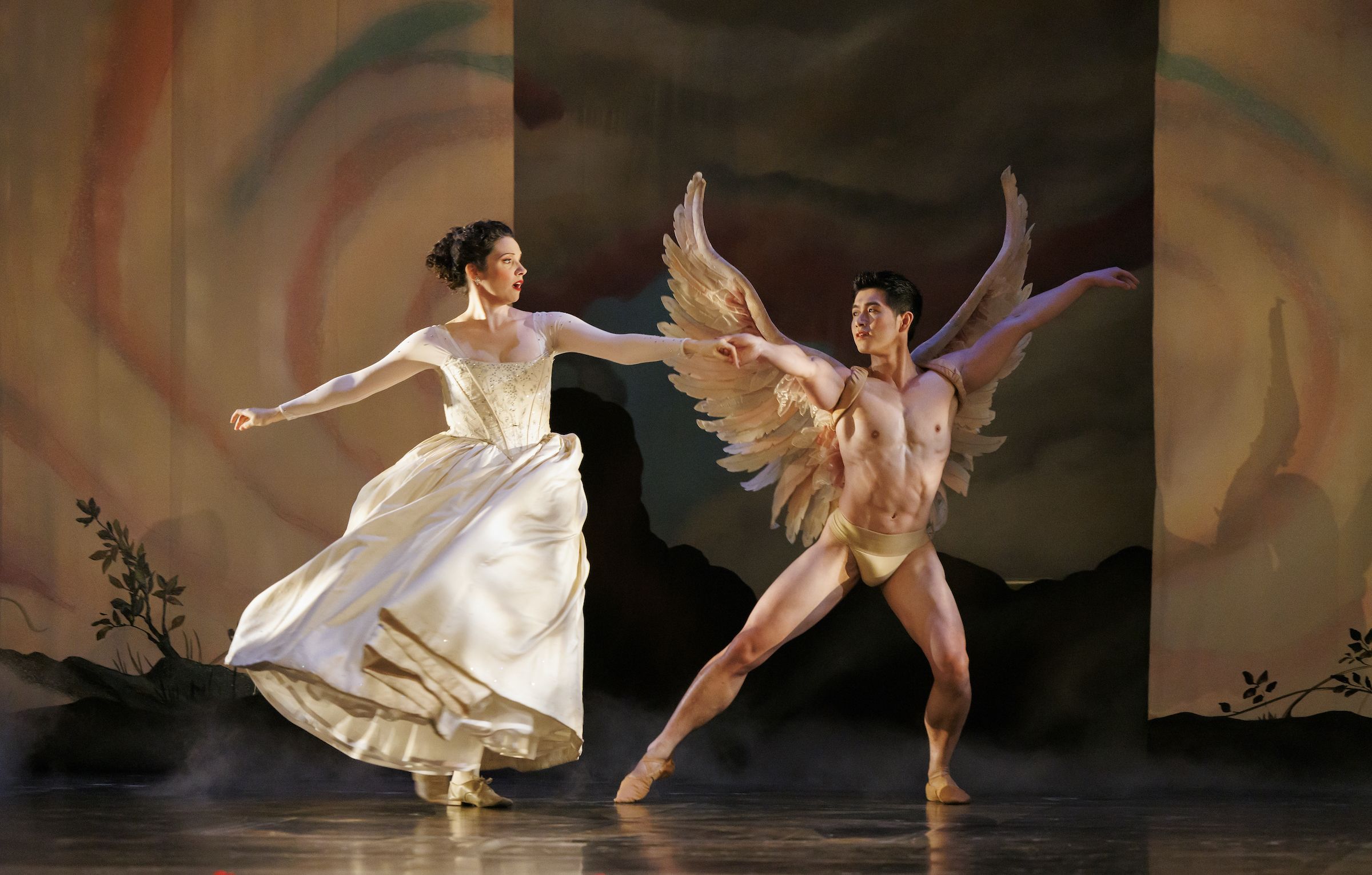
Mireille Asselin as Eurydice, with Artist of Atelier Ballet Xi Yi, in Orpheus and Eurydice. (Photo: Bruce Zinger)

Life after death? The question is purely rhetorical in Christoph Willibald Gluck’s plucky retelling of the ancient Orpheus and Eurydice story. His 1774 French opera ends not – as in the original Ovid myth – in tragedy but in a triumph of love conquering all. As outlined in Ranieri de' Calzabigi’s 18th-century libretto, boy gets girl and lives happily ever after, uplifted by melodious music, song and ballet. Canada’s acclaimed Opera Atelier company, known for its historically accurate stagings of Baroque opera, amplifies the joy in Gluck’s dramatically divergent ending in an energetic production recently presented at Toronto’s Elgin Theatre.

Assembling an all-star cast of Canadian singers for their season opener, Opera Atelier co-founders Marshall Pynkoski and Jeanette Lajeunesse Zingg successfully transform Gluck’s Orpheus and Eurydice into a celebration of not just life but also the power of art to exist for eternity as a testament to the best of human achievement.