|
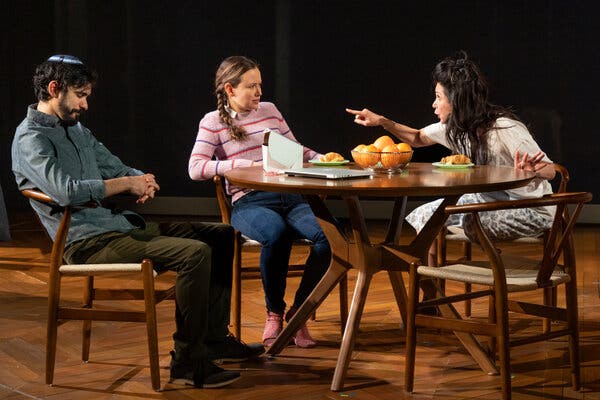
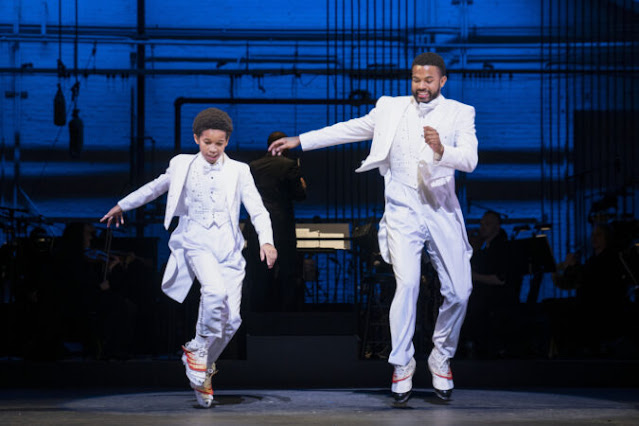
| Juliette Redden and D.C. Anderson and cast in Anne of Green Gables. (Photo: Diane Sobolewski) |
Based on Lucy Maud Montgomery’s 1908 children’s novel – the most popular work of literature ever to come out of Canada and the first in a series of nine books – the new musical Anne of Green Gables (at the Goodspeed Opera House) is the latest effort to make a classic story feel contemporary. The narrative, about a willful, self-dramatizing orphan girl named Anne Shirley who is adopted by Matthew and Marilla Cuthbert, a pair of aging unmarried siblings on Prince Edward Island, by accident (they’d requested a boy to help work their farm) and winds up winning over the entire town of Avonlea, is easily recognizable. But the playbill identifies the setting vaguely as “the start of a New Century,” and the playwright-lyricist, Matte O’Brien, has circled the proto-feminist elements in red and added a not-too-convincing queer subtext to Anne’s friendship with her classmate Diana Barry, to whom she provides intellectual encouragement and helps to pry out of the grasp of her stiflingly conventional mother. The ensemble, boys and girls from their peer group, has been costumed (by Tracy Christensen) to look like teenagers from the turn of the twenty-first century, and Matt Vinson’s music has a generic 1970s, Stephen Schwartzish folk-rock feel. (Three or four of the tunes are quite pretty.) The disjunction between the chorus numbers and the plot appears to have been inspired by the potent Duncan Sheik-Steven Sater musical Spring Awakening, but there it had a point. The Frank Wedekind play Sater and Sheik adapted was so far ahead of its time when it was written in 1891 that it took much of the twentieth century for the culture to catch up to it, so when, on Broadway in 2006, the teenagers in Victorian outfits sang out their plaints of abuse and sexual confusion to rock rhythms, the strange period mix sounded exactly right. But you have to work at making Anne Shirley and the citizens of Avonlea, adolescent and adult alike, sound like they could have been at home two decades ago.