Showing posts sorted by relevance for query Frances McDormand. Sort by date Show all posts

Tuesday, January 9, 2018

Deplorable: Three Billboards Outside Ebbing, Missouri

Woody Harrelson and Frances McDormand in Three Billboards Outside Ebbing, Missouri.

It felt pretty close to doing full penance just getting through all the grisly condescension and sanctimony of Martin McDonagh's Three Billboards Outside Ebbing, Missouri. That the picture has been garnering huge acclaim and numerous Best Film awards maybe shouldn't be too surprising given the current political climate. Dialogue in the Trump era has coarsened into Twitter feuds, talking heads on radio (who don't actually talk, but yell), and news anchors on television staking out positions rather than discussing issues, and a poisonous air of tabloid prurience perfumes the culture. People do little reflecting now and plenty more reacting. So Three Billboards keeps itself pretty busy staking out positions and reacting loudly in a cartoon atmosphere filled with ugly caricatures. Instead of reflecting on the current calamity, or even satirizing it cleverly, McDonagh chooses to distort the mood of the country and exploit it for pure effect. And the calculating unpleasantness of Three Billboards, with its queasy mixture of slapstick violence and sentimentality, would be bad enough were it not also trying to say something important. The film deliberately abandons any claim to dramatic realism, or even coherence, in order to manipulate and sway frustrated liberal sentiments and prejudices by crudely calling out "the deplorables" – the yahoos-in-a-basket whom Hillary Clinton identified as Trump's supporters in a misguided campaign speech. But the picture, with dialogue as broadly obvious as a billboard, ends up itself being deplorable by endorsing the same demagogic tactics that made Trump president in the first place.

Monday, February 22, 2021

Nomadland and Never Rarely Sometimes Always: Small Potatoes

Frances McDormand in Nomadland (2020).

Fern (played by Frances McDormand), the protagonist of Nomadland, loses her job and her home in a Nevada company town after the 2008 financial downturn and takes to the road in an RV, traveling through the west to wherever she can find work. The writer-director Chloé Zhao, dramatizing a non-fiction book by Jessica Bruder (its subtitle is Surviving America in the Twenty-First Century), initially presents the character’s itinerant lifestyle as an economic necessity that she makes the best of. But in the second half of the film, when we see her pass up two offers (of different kinds) to settle down, we learn that she’s always been resistant to staying in one place – that she only lived for years in tiny Empire, Nevada (which ceased to exist after the company shuttered), because her husband, now dead of cancer, loved it so much. The movie seems to be moving in two different directions at the same time – to be commenting on the way the downturn uprooted the lives of many working-class people and to be promoting the nomadic lifestyle as a viable choice. Dramatically it’s confused.

Friday, July 24, 2015

Olive Kitteridge: Portrait of a Marriage

Frances McDormand and Richard Jenkins in the HBO miniseries, Olive Kitteridge.

Note: There are spoilers ahead in this review. 

The Maine coastal town where the sensational four-part HBO miniseries Olive Kitteridge, directed by Lisa Cholodenko and now on DVD, is set seems blighted by disaster and grief, but the story isn’t a Gothic. Jane Anderson’s screenplay, based on the Pulitzer Prize-winning 2009 novel by Elizabeth Stout, puts the lives of the women and men who inhabit this community under a microscope to reveal how difficult the path is that all of us take through life, tortuous and stone-strewn and obscure. Some of the fates that befall subordinate characters are unusual. One is shot on a hunting foray by his best friend, who mistakes him for a deer. (Perhaps Stout was thinking of the plaintive reel “Molly Bán,” where a young man shoots his fiancée because, her apron up to shield her from a rainstorm in the forest, he takes her for a swan.) Another, whom we only hear about, becomes a psychotic killer. Most of the tragedies, though, are ordinary enough. The assistant to the local pharmacist, Henry Kitteridge (Richard Jenkins), collapses of a heart attack in the street outside the store and dies. Henry himself, in the middle of Part 3 (“A Different Road”), has a stroke and hangs on for four years, unable to communicate with his wife Olive (Frances McDormand), a retired math teacher.

Wednesday, January 23, 2013

Big Screen Tales of Big Business Targeting Little People: Local Hero and Promised Land

Frances McDormand and Matt Damon in Promised Land

A lone red telephone booth on the outskirts of a Scottish fishing village. Skype in a Pennsylvania farming town. Those diverse means of communication for the protagonists are among the distinctions between, respectively, 1983’s offbeat Local Hero and the more formulaic Promised Land now in theaters. But the two films have quite a lot in common. In both, corporate America descends on small, insular communities in hopes of reaping the riches that lie within the good earth. Some folks are seduced by the promise of easy money, especially in hardscrabble times; others want to protect the land and their homegrown traditions.

Three decades ago, writer-director Bill Forsyth set Local Hero the west coast of his native Scotland and hired the great cinematographer Chris Menges to do it justice. In the fictitious hamlet of Ferness, life goes on much as it ever has until the arrival of Macintyre or “Mac” (Peter Riegert) and Danny (Peter Capaldi), advance men for a Texas oil company called Knox. Their boss (Burt Lancaster) has instructed them to buy up all the real estate so he can build a refinery. Although many people are happy to sell, an old coot (Fulton Mackay) who owns the valuable beachfront property refuses to budge. Promised Land – coauthored by two of its stars, Matt Damon and John Krasinski – had Gus Van Sant at the helm. In rural McKinley, the advance team for a natural gas conglomerate called Global is comprised of Steve (Damon) and Sue (Frances McDormand). Their boss (Terry Kinney) has instructed them to buy up all the real estate so he can begin to drill, using a controversial process known as fracking. Although many citizens are happy to sell, an old coot (Hal Holbrook) makes a persuasive case against the takeover.

Friday, July 13, 2012

Beyond Precious: Wes Anderson’s Moonrise Kingdom

Kara Hayward and Jared Gilman in Moonrise Kingdom

Having just finished teaching a course on the great American cinema of the ‘70s, and spending weeks immersed in fine films by directors at their creative peaks (Steven Spielberg, Francis Ford Coppola, Brian De Palma, Hal Ashby, Martin Scorsese, Robert Altman and many others), it was something of a rude jolt to be brought back to earth having to deal with the generally underwhelming current crop of American directors. While Spielberg, De Palma and Scorsese are still around and often doing good work – creatively Coppola is missing in action – there are only a handful of relevant moviemakers (David Fincher, Curtis Hanson) from the next generation who make movies that speak to the way we live today. And when you’ve tasted the highs of The Godfather, Taxi Driver, Nashville or Shampoo, why would you want to make time for the enervated films of Kelly Reichardt (Old Joy, Meek’s Cutoff), the scattershot ones of Paul Thomas Anderson (Magnolia, There Will Be Blood) or the contemptuous movies of Todd Solondz (Welcome to the Dollhouse, Life During Wartime)? But of all the annoying/irritating minor talents being unduly praised to the skies, usually only by certain film critics, none is likely more of a chore to sit through than Wes Anderson. His latest movie, Moonrise Kingdom, is really more of the same: a hermetic, arid, mindless film that defies you to truly care about anything that’s happening on screen.

If you had to pick one word to define his films, such as Rushmore (1998), The Royal Tanenbaums (2001) and The Life Aquatic with Steve Zissou (2004), it would be precious. Not in the very valuable meaning of the word, but in the affectedly dainty or over-refined definition. With the exception of his debut movie, the sweet, likeable Bottle Rocket (1996), Anderson’s films are enshrined baubles that may look pretty – he doesn’t stint on the art direction – but beyond surface appearances have little of value on offer.

Monday, January 3, 2022

Nightmare Alley and The Tragedy of Macbeth: Cinematic “Art”

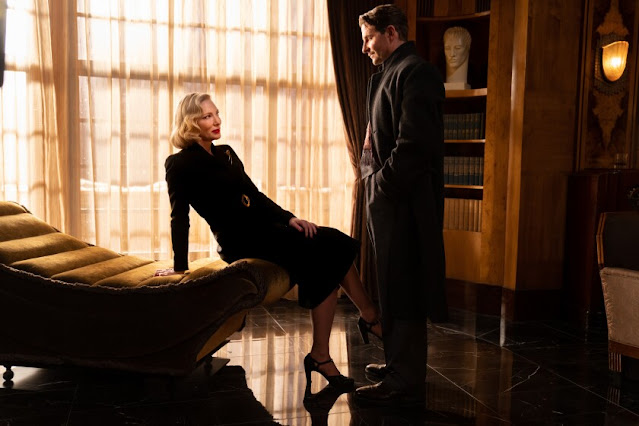
Cate Blanchett and Bradley Cooper in Nightmare Alley.

William Lindsay Gresham’s tough, darkly lyrical 1946 novel Nightmare Alley moves from the carny life to the world of phony spiritualists – scam artists who make a living off the sorrow of rich people trying desperately to contact loved ones on the other side of the grave. (In real life Harry Houdini was one of the more celebrated marks.) Gresham’s anti-hero is Stanton Carlisle, who joins a carnival and partners up with his lover, Zeena, to revive the mentalist act she used to perform with her husband Pete, a hopeless drunk who dies when Stan hands him a flask of wood alcohol. (It’s an accident: both the poison and a flask of potable gin have been stored in the same trunk. But as Gresham writes the incident, it’s one of those sinister acts of wish fulfillment, like Bruno’s murdering Guy’s blackmailing wife in Strangers on a Train.) Stan proves to be so good at the act that he soon outgrows it and takes it on the nightclub circuit, with a younger, prettier girlfriend as his assistant – Molly, whose carny performance used to involve an electric current and an alluring skimpy costume: sex and sci-fi “magic” intertwined. That’s when he crosses paths with a higher type of parasite, a psychoanalyst named Lilith who teams up with him to take advantage of her grieving patients. Stan and Lilith become lovers too, and their main target is a fabulously wealthy man named Ezra Grindle who is suffused with guilt over the fate of the girl he impregnated when he was a young man. Gresham never lets us forget how important a role sex plays in both low and high-class scams. (The Library of America, faithful purveyor of forgotten treasures, republished the book about a quarter of a century ago in a first-rate collection called Crime Novels: American Noir of the 1930s and 40s.)

Saturday, June 23, 2012

A Face with a View: Sean Penn and This Must Be the Place

While visiting Paris last August, a particular movie poster kept catching my eye. Nestled incongruously among the myriad of CGI images of Tintin, Snowy, and Captain Haddock (damn the French were excited about that Tintin movie!) was the strikingly large and dour face of Sean Penn. With teased hair, pale skin, lipstick and eyeliner reminiscent of an 80s-era glam rocker, Penn’s heartbreaking countenance was almost impossible to ignore. I was intrigued. I wrote down the movie’s title, This Must Be the Place (suggestively in English even in this French context), and vowed to find out more about it. The thumbnail description that I soon found left me all the more fascinated: Penn, it seemed, was playing an ageing 80s rock star who, upon the death of his father, ends up on a road trip across America in search of a Nazi war criminal. All that, plus an unapologetic nod to perhaps my favourite Talking Heads’ song, and I was hooked. I returned to Toronto soon after, and waited patiently for the film’s North American release. Months passed, and nothing. By the New Year, I’d forgotten about it completely.

That is, until a few weeks ago, when I finally had the chance to see it – and I’ve been talking it up ever since. This Must Be the Place turns out to be either the strangest road movie ever made or the single quirkiest Holocaust-themed movie since Tarantino’s Inglourious Basterds (although I should stress that Nazis notwithstanding the two films have absolutely nothing else in common). The only reason I'd hesitate to call This Must Be the Place a Neglected Gem is that I’m hoping there's still time it will find the wider audience it deserves. (The film has played widely in France, Italy and the U.K., but as far as I can tell it hasn’t yet had any theatrical play in the U.S. or Canada. As of today, it certainly hasn’t screened in Toronto.) With the visual punch of Down by Law, and the quirky dialogue, characters and situations of Mystery Train, the movie looks and feels like a lost early Jim Jarmusch project – and no doubt the director intended it to be just that. Written and directed by Italian filmmaker Paolo Sorrentino – most famous for The Consequences of Love (2004) and Il Divo (2008) – This Must Be the Place (though it is a Italian/French co-production) is Sorrentino’s first English-language feature, and apparently he wrote the screenplay with Sean Penn specifically in mind. And it is Penn’s film: he’s in practically every scene and his stunning performance carries the whole movie.

Saturday, February 20, 2016

Thumbs down!: The Coen Brothers’ Hail, Caesar!

George Clooney in Joel and Ethan Coen's Hail Caesar!

Hail, Caesar!, the latest film from Joel and Ethan Coen, may be their most lacklustre film to date. The story, set in 1951, revolves around the goings-on when movie star Baird Whitlock (George Clooney) is kidnapped and harried studio executive Eddie Mannix (Josh Brolin) has to retrieve him before the plug has to be pulled on the studio's expensive Biblical epic, Hail, Caesar!: The Story of the Christ, which stars Whitlock. Hail, Caesar! has a lot of potential as a screwball comedy, skewering as it does everything from self-centered actors to pretentious directors to the leftist politics of the time but the movie is pretty much dead on arrival. The actors are bored and mostly boring, the set pieces, made up fake movies of various genres, musicals, high comedies, Westerns etc., are flat and unimaginative, and the whole production barely makes a comedic ripple. Remember how disinterested and indifferent the Coens were when they won the Best Picture Oscar for No Country for Old Men? Imagine a movie made with that same spirit of ennui and you have Hail, Caesar! in a nutshell.

Wednesday, January 12, 2011

Getting It Right #2: Joel and Ethan Coen's True Grit

My issue over the years with filmmakers Joel and Ethan Coen is that they hate people. Not in a misanthropic or curmudgeonly manner (I have always found misanthropes fascinating and curmudgeons amusing), but in a smug 'people are idiots' mindset. Look at pictures such as the reprehensible Fargo where every character, including the supposed heroine Marge (Frances McDormand), is treated with complete contempt because of their 'funny accent' or their 'stupid' actions (Marge doesn't even solve the crime, she stumbles across the solution by accident). The Coens are the worst sort of people-haters because, based on the evidence in several of their films, they think they're better than everybody else.

And yet, when they get it right, they have created, if not great pictures, ones where I've come away feeling amused/entertained/satisfied. Pictures like Blood Simple, Raising Arizona, The Big Lebowski and Miller's Crossing fall into this category for me. Most of the others are either 'god, I hate this movie' or 'yawn'. Even their Oscar-winning No Country for Old Men is a bit pointless when you get right down to it. This brings me to their biggest hit in their careers: the remake of True Grit, now in theatres and this past weekend’s number one at the box office. I'd heard very good things about True Grit, so I was interested in seeing it. But people had also said wonderful things about Fargo, Barton Fink, and The Ladykillers. The picture seemed right up the 'aren't people stupid' alley that the Coens have mined over the years. It's a western, so lots of chances for: funny accents, ill-bred idiots, numb-nutted gunslingers and dumb-as-dirt cowpokes. So imagine my surprise when I came out of the theatre, well, moved (an emotion I'd never felt in any of the Coen brothers' movies).

Friday, May 18, 2012

Neglected Gems #15: Palookaville (1995)

Palookaville, the title of the disarming first feature by Alan Taylor, refers to the generic state of existence shared by the three main characters. Russell (Vincent Gallo), Sid (William Forsythe) and Jerry (Adam Trese) are unemployed friends in their thirties – too old to be living the way they are, and painfully conscious of it. Russell boards with his family; he survives off the salary his brother-in-law (Gareth Williams), a cop, brings home. Russell’s girl, Laurie (Kim Dickens), lives next door, so he has to sneak through their bedroom windows to sleep with her. Sid’s wife left him ten years ago; he lives alone with her photo on the night table, and with his smelly dog. His phone is disconnected, his couch is repossessed, and he takes most of his dinners at Russell’s house (he’s a favorite of Russell’s mom’s). Jerry’s wife Betty (Lisa Gay Hamilton) works in a supermarket, where her manager paws her; when Jerry interrupts a groping session, he blows up and the boss retaliates by firing Betty. Furious, she makes Jerry go back and apologize so she can continue to support the family (they’ve got a baby).

Tuesday, November 16, 2010

Solitary Man: The Crucible of Michael Douglas

Glenn Close and Michael Douglas in Fatal Attraction.

For most of his movie career, Michael Douglas has built his box office success as the everyman who always gets his way – even when he loses. Whether he's playing a financial sleaze in Wall Street (1987), or the cocky adventurer in Romancing the Stone (1984), Douglas always finds a way to lure the audience to his side. But it's not because he has the suave romantic allure of an Errol Flynn, or that he plays creepy in the appealingly baroque style of James Woods, or performs in the high-wire theatrics of Nicolas Cage. Douglas builds his appeal by turning the everyman into a solitary man. His pictures almost always feature him as the sharp cookie who has everything, a loving family in Fatal Attraction (1987) and Disclosure (1994), or the financial world at his beck and call in Wall Street, but somebody is always out to take it all away. Even though he has put the wheels in motion towards his own destruction, he becomes exonerated as the victim of forces beyond his control. Perhaps that's the key to the appeal of these movies; the mass audience is never asked to wonder what Michael Douglas has done to earn all this grief.

Saturday, November 20, 2010

Produced and Abandoned: Beyond Rangoon

It’s taken almost 15 years but John Boorman’s sadly underrated and neglected drama Beyond Rangoon (1995) has finally been released on DVD. One of the riskiest pictures Boorman (Deliverance, Excalibur) has ever made, Beyond Rangoon is a potently absorbing piece of work. The story focuses on Laura Bowman (Patricia Arquette), an American nurse whose husband and son are murdered during a home invasion. In order to give herself time to heal, she agrees to accompany her sister (Frances McDormand) on a trip to Burma. Since they are making the trip in 1988, they encounter the rise of the democracy movement led by pacifist Aung San Suu Kyi against the brutality of the military dictatorship under General Ne Win.(Suu Kyi's release from house arrest last week, after spending 15 of the last 21 years imprisoned, adds another layer of poignancy for the contemporary viewer.)

The daring in Boorman’s work here is the way he subtly illuminates how the Burmese uprising stirs Bowman out of the catatonic shock over her family’s murder. She not only rediscovers her calling as a nurse, but becomes politically motivated as well. When she makes herself a target for killing by the government, she simultaneously comes to terms with the intimate details of the deaths she's experienced closer to home. Bowman immediately wakes up to a fragile world where life and death have become delicately intertwined.

Monday, November 7, 2022

Music Men: Almost Famous and The Music Man

 Casey Likes and Solea Pfeiffer in Almost Famous. (Photo: Neal Preston)

Affable and well-acted and entertaining as it is, I’ve always thought that Cameron Crowe’s Almost Famous, from 2000, was something of a crock. Crowe’s first career was as a rock journalist; at fifteen he got to travel with The Allman Brothers. So the picture, about a San Diego teenager named William Miller whose writing impresses Rolling Stone editor Ben Fong-Torres sufficiently to persuade Fong-Torres to let him go on the road with a band called Stillwater and write a profile on them, is autobiographical. And it must be the most romanticized coming-of-age memoir any writer has ever shaped. Crowe’s baby-faced protagonist (appealingly played by Patrick Fugit) never really falls from innocence. William’s possessive mother – his only surviving parent – drops her son off at the stadium for the Stillwater show she cries after him, “Don’t take drugs!,” and she repeats her warning when she takes him to the tour bus and in every one of her hysterical phone calls. It’s a culture joke: she’s meant to represent every parent in 1973 who ever feared losing her child to the rock ‘n’ roll vampires. But William takes her seriously. He travels all over the country with Stillwater, hangs out with them between shows and with the ebullient groupies known as the BandAids, and he never even smokes a joint. Crowe seems to be looking at his own adolescence through a haze. William eventually loses his virginity, but it doesn’t seem to alter him in any way. He counsels both his hero, the band’s guitarist Russell Hammond (Billy Crudup), and the leader of the BandAids, Penny Lane (Kate Hudson), Russell’s girlfriend on the road and the object of William’s first serious crush, liberating her and making him into a better human being. And in the end the kid’s story gets on the cover of Rolling Stone. William is a juvenile version of the knight whose purity of heart is rewarded at last.

Friday, October 14, 2016

Curtis Hanson: A Career in Perspective

Eminem and Curtis Hanson (right) on the set of 8 Mile in 2002. (Photo: Eli Reed)

Film director Curtis Hanson, who died in September at the too-young age of seventy-one, was stuck in B-movie territory for a decade and a half before he graduated, in 1987, with the thriller The Bedroom Window. (One of his last B-pictures, Losin’ It, about three SoCal high-schoolers who drive to Tijuana to get rid of their virginity, was coarse and chaotic but very likable. One of them was played by Tom Cruise, just months before Risky Business made him a star, and I’ve never enjoyed watching him as much since.) Once he made it to the majors, so to speak, Hanson made eleven pictures, and I like all or part of every single one except for his first hit, the witless 1992 Gothic The Hand That Rocks the Cradle – it was efficiently directed, but the dunderheaded script was insurmountable. What made him so reliable a filmmaker was a combination of his bred-in-the-bone understanding of genre conventions, his transparent love of actors and his undervalued gift for getting fine work out of them, and his relaxed finesse as a storyteller. This last is no surprise: from his first days in movies, the early seventies, he was a screenwriter as well as a director, penning the compulsively watchable, enjoyably amoral Canadian mystery The Silent Partner (directed by Daryl Duke and starring Elliott Gould, Susannah York and Christopher Plummer) in 1978 and contributing to the scripts of Samuel Fuller’s White Dog and Carroll Ballard’s Never Cry Wolf in the early eighties. And he kept his hand in: he wrote The Bedroom Window and co-wrote the best picture he ever turned out, L.A. Confidential, with Brian Helgeland, as well as one of his last movies, Lucky You, with Eric Roth.

Monday, January 26, 2026

Movies and the Other Arts: Sentimental Value, The Choral, Hamnet

Stellan Skarsgård and Renate Reinste in Sentimental Value. (Photo: Neon.)

The house that provides the key setting in Joachim Trier’s Sentimental Value is a real beauty – a late 19th-century Oslo domicile in a Norwegian style known as Dragonstil (“dragon style”) that looks like a candy house, built of dark blue wood with cherry trim and a gabled roof. (In real life it’s called Villa Filipstad and belongs to Lars Lillo-Stenberg.) Luxuriously lit by Kasper Tuxen Andersen, it’s the most gorgeous house at the center of a movie since the gracious country residence in Olivier Assayas’s 2008 Summer Hours, loaded with the art made and collected by Edith Scob’s uncle, which she leaves to her three grown children when she dies early in the film. That picture could also have been called Sentimental Value; like Trier’s it’s about legacy, but of a different kind. Sentimental Value is about a famous filmmaker, Gustav Borg (Stellan Skarsgård), who inherited the house from his aunt; she lived there after Borg’s mother, a Resistance fighter during the Second World War who was imprisoned and tortured by the SS, hanged herself in it. When Borg and his wife divorced, his wife got it in the settlement. His two daughters, Nora (Renate Reinsve) and Agnes (Inga Ibsdotter Lilleaas), identify it with their childhood and especially with their mother, a therapist who has recently died of cancer. We see in a flashback that as kids they used to listen to her sessions with her patients through an old stove that carried their voices up to the second floor. Gustav, now seventy, wants to make a comeback film in this house, and he’s anxious for Nora, a well-known actress, to play the lead, a woman he insists is not based on his mother but whose story bears significant resemblance to her. Borg plans to end the movie with the protagonist’s suicide, by the same means and even in the same room as his mother’s. (When he makes the dramatic claim that she’ll even kick aside the same chair his mother did, Agnes comments quietly to her sister that the chair that now occupies that room came from IKEA.)