Showing posts sorted by relevance for query Billy Wilder. Sort by date Show all posts

Sunday, December 29, 2024

The Big Carnival: Billy Wilder’s Ace in the Hole (1951)

Kirk Douglas in Billy Wilder's Ace in the Hole. (All movie stills courtesy of Paramount Studios.)

“The biology of the shadow has yet to be fully explored.”
Andrei Biely, 1913

“We are a nation of hecklers. The most hard boiled, undisciplined people in the world.”
Billy Wilder, 1950

I think it’s fair to say, at least from my perspective, that someone has finally come along and fully studied the biology of the shadow. After their divorce as filmmaking partners, both Charles Brackett and Billy Wilder went on to make solo efforts that pushed film noir even further towards an unexpected edge. Brackett produced Niagara with Marilyn Monroe in 1953, and Wilder created Ace in the Hole (a.k.a. The Big Carnival) with Kirk Douglas in 1951. By a strange coincidence, unless it was synchronicity, just after writing the section of the tumultuous story having to do with their final noir masterpiece as collaborators, Sunset Boulevard, I happened upon a TCM broadcast of Wilder’s first independent effort after their break-up. I had seen Ace in the Hole several times previously; however, it had seldom resonated in quite the same way as it did while I was watching it from a retrospective point of view. So I sat back with a glass of wine and my notebook, prepared to venture once again into Billy’s post-Brackett domain. My instinctive initial response was even more severe than my first viewings had been.

Tuesday, September 17, 2024

The Lost Weekend: A Brilliant Darkness

Ray Milland in The Lost Weekend (1945).

“It’s like the doctor was just telling me—delirium is a disease of the night, so good night.” – Bellevue Nurse Bim, in The Lost Weekend.
The Lost Weekend, released November 29, 1945. Paramount Pictures. Directed by Billy Wilder, Produced by Charles Brackett, Screenplay by Charles Brackett and Billy Wilder, based on a novel by Charles Jackson. Cinematography by John Seitz. Edited by Doane Harrison. Music by Miklos Rozsa.  Duration: 101 minutes. Featuring Ray Milland and Jane Wyman, Phillip Terry, Howard Da Silva, Doris Dowling, Frank Faylen. Wilder has explained that part of what originally drew him to this material was having worked with Raymond Chandler on the screenplay for Double Indemnity, subsequent to Brackett’s brief vacation. Chandler had been a recovering alcoholic during that stint and claimed that the stress and tumult of his working relationship with Wilder (actually not that much different from Wilder’s relationship with Brackett) caused him to start drinking again to survive the collaboration. Wilder has claimed that he made the film, about a drunk with chronic writer’s black, at least partly in order to explain Chandler to himself.

One’s Company, Two’s a Crowd: that could be the business card logo of struggling novelist Don Birnam in The Lost Weekend, but also of his real life alter ego Charles Jackson, author of the novel on which Billy Wilder and Charles Brackett based their Academy Award-winning 1945 cinematic study of the struggle to outrun your own shadow. This unsettling masterpiece of internalized noir is an example of a certain brand of dark cinema at its finest, and when it was shown recently on the TCM network we got to see exactly why that is: it’s a kind of exotic corporate merger between personal and professional angst, exploring two competing compulsions, writing and drinking, and it takes no prisoners in exposing the raw nerve inhabiting and inhibiting the urge to tell stories. Ironically, it also demonstrated to Brackett and Wilder that, at least for the time being, they were stronger working in tandem than apart, despite the fact that they could barely stand being in the same room together.

Wednesday, June 21, 2017

Double Solitaire: Creative Partnerships Made in Hell

William Holden and Gloria Swanson in Sunset Boulevard (1950), written by Charles Brackett & Billy Wilder, directed by Wilder.

“When two great saints meet it is a humbling experience." – Paul McCartney, 1968.

1. brackettandwilder

It was called the Golden Age of Hollywood for good reason. The early evolutionary phase of the film industry, which I personally designate as roughly being from 1929 to 1959, immediately established the stylistic devices, narrative techniques, creative content and future direction that cinema would take as both a visual art form and a commercial business enterprise. Most importantly, perhaps, the paradoxical fact that cinema could be both entertaining and profitable, as well as both philosophically challenging and emotionally comforting, was etched in celluloid almost from its beginnings at the turn of the century. Fine cinema is quite simply the best of both worlds.

Among the many screenwriters, producers and directors who blazed that ever-expanding trail, few would have quite the lasting impact on both comedy and tragedy as impressive and influential as the iconic achievements of the volatile collaborative partnership between writer-producer Charles Brackett and writer-director Billy Wilder.

Friday, April 12, 2024

Cry Me a River: The Sweet Sorrow of Film Noir


“Life is a tragedy when seen in a close-up, but a comedy when seen in the long shot.” – Charlie Chaplin

Melodrama: the essential link between classical tragedy and ‘dark film’. “Suffering, with style” is the succinct and totally apt way that Turner Classic Movies curator Eddie Muller characterizes this unique mode of film noir storytelling: “The men and women of this sinister cinematic world are driven by greed, lust, jealousy and revenge, which leads inexorably to existential torment, soul crushing despair and a few last gasping breaths in a rain soaked gutter. But damned if these lost souls don’t look sensational riding the Hades Express. If you’re going straight to hell, you might as well travel with some style to burn.”

From the moment the term film noir or dark film was first employed by advanced French critics in the post-World War Two global culture, there was also an instant debate about what it encapsulated so vividly. Muller, who is also an author of crime fiction himself, further defines the concept as being about a protagonist who, driven to act out of some desperate desire, does something that he or she knows to be wrong, even understanding what dire consequences will follow. Karma always looms large in noir.

Monday, February 13, 2023

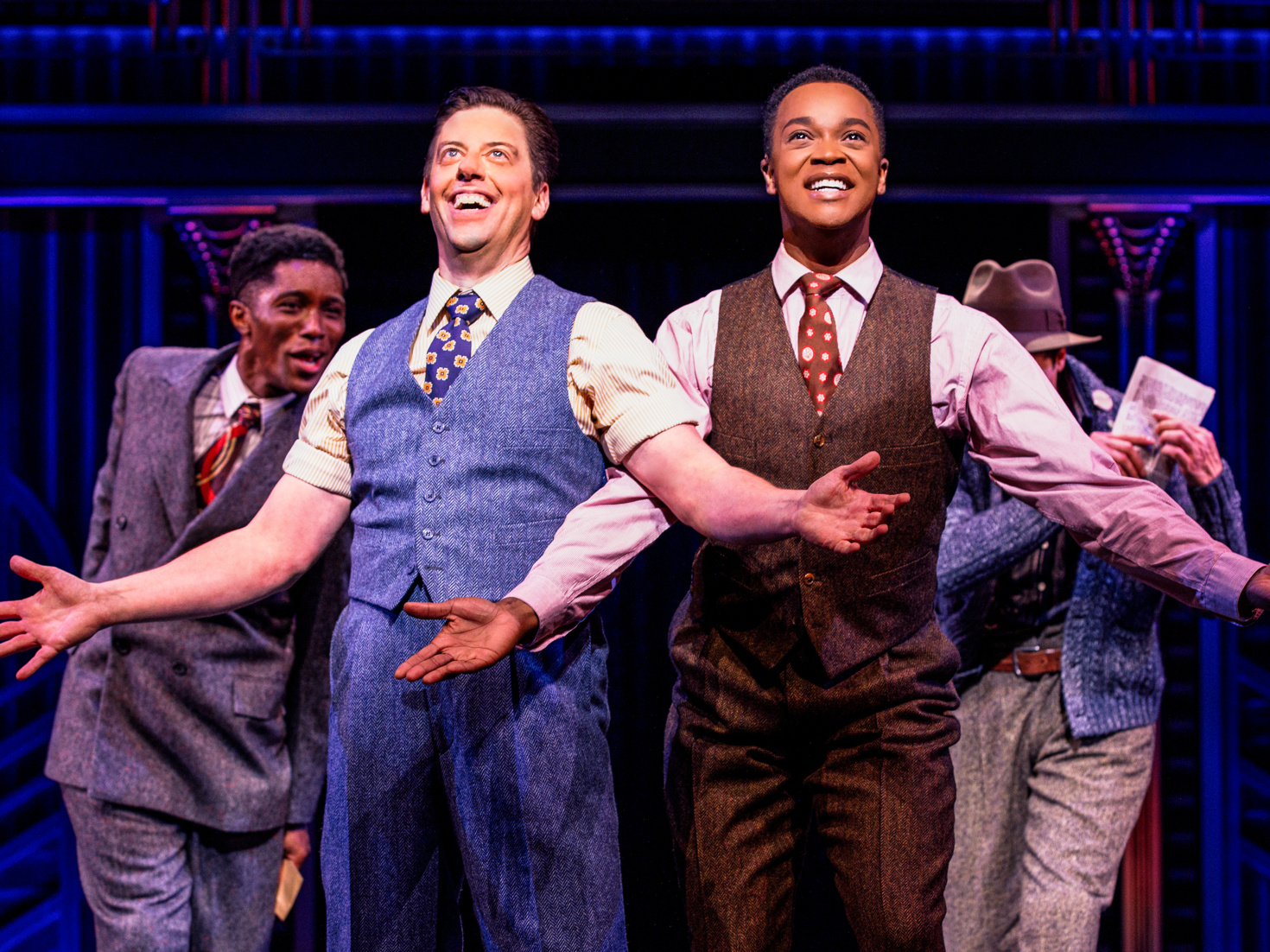
Some Like It Hot Refurbished, and a Brief Word of Farewell

Christian Borle & J. Harrison Ghee in Some Like It Hot. (Photo: Marc J. Franklin)

The best romantic comedy released in the early fifties, William Wyler’s Roman Holiday with Audrey Hepburn and Gregory Peck, was about the impossible romance of a princess and a reporter; it was a cross between a genteel version It Happened One Night and a reverse Cinderella story. But then Hollywood romantic comedy degenerated into sex cartoons with Jayne Mansfield at one end of the spectrum and mechanical farces at the other. One might have feared that the form was dead, until Billy Wilder’s divine Some Like It Hot came to the rescue at the end of the decade. It wasn’t remotely like any previous movie in this genre. (But then, Wilder’s The Lost Weekend hadn’t been like any other social problem picture or Sunset Boulevard like any other film noir.) Wilder and his co-writer I.A.L. Diamond took a page from Shakespeare’s cross-dressing comedies and then doubled it. When two jazz musicians witness the St. Valentine’s Day Massacre they run like hell, straight into drag. They figure their only retreat from the gangsters on their tail is to vanish into dresses and wigs and join an all-girls’ band. Tony Curtis’s Joe, a.k.a. Josephine, falls for the lead singer, Sugar (Marilyn Monroe at her most sublime), and chooses a second disguise – a millionaire named Shell Oil Jr. who entertains her on a borrowed yacht, where Curtis draws her in with a dead-on Cary Grant imitation. Jack Lemmon’s frantic Jerry/Daphne finds himself the object of the yacht’s actual owner, Osgood Fielding III (Joe E. Brown) – a courtship that Wilder and Diamond leave up in the air when the rest of the plot is resolved. The final line – spoken by Brown – when Jerry reveals his true gender to Osgood is one of the two best curtain lines in American romantic comedy. (The other concludes Charade, with Hepburn and Cary Grant, which followed Some Like It Hot four years later.)

Saturday, June 17, 2017

Embracing the Banal: Two Celebrity Bios by Gene Wilder and Goldie Hawn

Gene Wilder

If you are a huge admirer of the diverse talents of the gifted comic actors the late Gene Wilder and Goldie Hawn, you won't find much evidence of those qualities in their digressive and disappointing memoirs: Wilder's Kiss Me Like a Stranger: My Search for Love and Art and Hawn's A Lotus Grows in the Mud (both released in 2005). One of the biggest ironies of popular celebrity autobiographies is that whenever the authors go to great lengths in telling us how they struggled through personal trials and tribulations, very little of what makes them appealing as artists comes across. They are out to prove that, deep down, they are really ordinary folks just like us. They, too, face insecurities, damaged relationships and death.

Although some readers might find comfort in recognizing some of their own traits in these stars, the fact is that celebrities don't abide like average people. Artists make their living doing work that springs largely from their passions and abilities; the general public earns its living by having a job. Celebrities appearing ordinary, though, is part of what makes this genre so popular. Like most TV talk shows, these books contain an abundance of familiar anecdotes about learning life's important lessons, rather than revealing what makes them so compelling in their craft. Wilder and Hawn aren't negligible talents. Yet A Lotus Grows in the Mud and (to a lesser degree) Kiss Me Like a Stranger fall into the same category of celebrity bios as those written by much lesser talents. The memoirs share a dogged impulse to strip away the appealing ingredients of their own distinctive gifts and embrace the banal.

Sunday, October 27, 2024

Cries in the Night: Children of Film Noir – Nocturnarama, A Noir Childhood

.
‎BearManor Media (June 2023).
“Nailing down a coffin lid is far easier than nailing down a universally agreed upon definition of the term film noir.”  – Robert Strom

Every so often a book comes along that somehow manages to evoke our childhood and our love of films at the same time. Robert Strom’s Cries in the Night: Children in Film Noir is just such a book.

I grew up in a place I used to call Shadowland, a quiet suburb of Toronto known officially as Don Mills (the first formally designed suburb in North America) where there wasn’t much to do but listen to music and watch movies. Luckily I was also a kid in the 1960’s, a time when the best of both of those pursuits was available to us in abundance. When I was about ten years old my life was changed forever by a secret practice I used to engage in when the rest of my relatively normal suburban family was fast asleep at night. Back in those days, after midnight the public broadcasting system in Canada used to transmit overnight classic movies across the airwaves and into our homes, and I would quietly go out into our dark living room, turn on the television and start watching old films long into the wee wee hours. That was my initial and probably too young exposure to dark movies I would never have been allowed to watch in theatres or during the daylight.

Wednesday, July 17, 2024

Tales from the Making of Niagara, 1953 by Richard Shmelter

Publicity still from Niagara (Photo by Gene Korman).
“Marilyn Monroe and Niagara Falls, a raging torrent of emotion that even nature can’t control.” – Boisterous but accurate publicity poster for the film’s release.

“I only stop when I’m done.” – Equally accurate self-analysis from Marilyn herself. 

I’ve always had a special place in my heart for Niagara, though some friends prefer to refer to my ardor for it in other ways: obsession, fixation compulsion, fetish. They’re quite right, of course. Maybe it evokes the frequent family road trips I took as a youngster from Toronto to Niagara Falls, or perhaps it was the obvious increase in temperature provoked in a ten-year-old boy caught in the torrential environment of Marilyn Monroe. Guilty as charged. I also enjoy reminding such friends that all those states of mind they teasingly attribute to my passion for this film are essentially the core features of the film noir genre itself.

I can’t count the number of times an argument, or let’s call it a heated disagreement, ensued between myself and other viewers or reviewers who took the noir genre more literally in its black and white, dark urban streets, femme fatale and psycho-thriller overtones. Some friends were underwhelmed by the splashy aura of the falls motif in Niagara, the nearly rural touristy setting, and of course the palette, even if they were mutually taken with Marilyn’s Rose and her sinister appeal. I’m a huge fan of all of those nourish aspects too, but I’m also a huge defender of Niagara as a late-blooming and innovative exponent of the genre that becomes all the more obvious if you simply watch it in black and white as a viewing experiment.

So I’m delighted to report that Richard Shmelter, author of the thoroughly readable and charmingly obsessive Tales from the Making of Niagara, 1953, published by Malibu Sunset Media, not only shares my sense of its brilliantly noirish sunlit darkness, but also acclaims it as the film that first put Monroe on the stellar star map and also made her what she clearly was, has been and I suppose always will be: what he calls an iconic influencer. The fact is that, in the absence of a historical context back then in the 50’s for the very postmodern social media concept of what an influencer is and does, Shmelter demonstrates that the impact of her persona and gravitas makes it not only acceptable to call her that, but almost imperative. I guess that kind of makes her a posthumous influencer.

Sunday, May 17, 2026

Object Lessons: Videotape


(Bloomsbury Books.)

“Objects have the longest memories of all. Beneath their stillness, they are alive with all the experiences they have ever witnessed.”
--Teju Cole

Object Lessons, published by Bloomsbury Books, is an illuminating series of short, beautifully designed books about the hidden lives of ordinary things. As Oana Godeanu-Kenworthy’s incisive biography of this impactful technology reveals, over the span of a single decade, the VHS format changed the privileged relationship between privacy and entertainment, pried open the closed societies behind the Iron Curtain, and then mysteriously sank back into oblivion. Although what we now call streaming has assumed prominence, the legacy of the humble videotape still continues to inform modern entertainment. And I’m delighted to say that both Godeanu-Kenworthy and I appear to share a similar, if not parallel, fondness for the technology that preceded our present stream-mad dimension. Here’s my outset admission: I’ve always been a huge fan of the analog world, its haptic tone and the various shapes it took, and I still am. The author of this charming little book, which has a giant subject and theme that belies its scale, also shares in her book’s beginnings what might account for her fondness. Our first exposure to any given medium of expression is often the most effective for our successive modes of experience.

Wednesday, May 16, 2012

Kitchen-Sink Gangsters: Down Terrace and London Boulevard

Robin and Robert Hil star in Down Terrace

As I said in my post last year about the death of the DVD rental shop, one thing I would miss was the habit of walking the aisles looking at all the titles and stumbling across a gem I'd never heard of. Then after reading the plot on the back of the box, I decided whether to take a flier and rent it. The Eclipse was one such gem I discovered this way, which I've already discussed here. Now, with the announcement three weeks ago that Rogers would no longer rent DVDs, that window of discovery, for me at least (there are no independent DVD rental shops in the city north of Toronto where I live), has now closed.

However, I had one final chance this past weekend that resulted in, if not huge dividends, at least some very pleasant surprises. Three weeks ago, after Rogers announced their decision, I ventured to our one-remaining store to see what deals I could get. All DVDs were listed as buy one get one free. So, I was able to pick up about 8 or 9 recent films, such as Hugo, The Girl with the Dragon Tattoo (2012), A Dangerous Method, Cave of Forgotten Dreams, plus others, for about $7 each. Over the next two weeks, I went a couple of more times to see if the discount got greater. It had not. But this past Friday I decided to go one more time. The discount was now buying one get two free. They had been pretty picked over, but there were still a few things of interest, such as the three discs of Season Two of The Republic of Doyle. Then just as I was about to wrap it up, the manager came out and announced they had just been informed all DVDs were now $1 each. That changed things. I bought 27 movies. Timing is everything.

Tuesday, March 13, 2018

The Cinema of Stillness: Painting With Film

Above: some of the uncanny overlaps between frames from films by the Russian cinema poet Andrei Tarkovsky (left) and the great American realist painter Andrew Wyeth (right).

"What is art? . . . Like a declaration of love: the consciousness of our dependence on each other. A confession. An unconscious act that reflects the true meaning of life – love and sacrifice."
– Andrei Tarkovsky
Recently, culture critic and film scholar Hava Aldouby illuminated a unique zone of viewing pleasure by reminding us that the great Federico Fellini professed a desire to create “an entire film made of immobile pictures.” For me, the most tantalizing of films are those that draw extensively on art history, and particularly painting, as a reservoir for their highly retinal and idiosyncratic visual imagery. David Lynch, for example, said he liked making “moving paintings.” Something like Goya in action.

Thursday, August 11, 2022

Shining On Brightly: The Power of Sharing the Spotlight

(W.W. Norton Press)

“The Beatles, like Duke Ellington, are virtually unclassifiable musicians.” – Lillian Ross, writing in The New Yorker in 1967.

How can one possibly explain the majestic presence of music such as Duke Ellington/Billy Strayhorn’s  “Lush Life” and “Chelsea Bridge”? Or the shimmering beauty of Lennon/McCartney’s “She’s Leaving Home” and their entire “Abbey Road Medley”? What secret alchemical equation is behind the binary Odd Couple Code in the creative arts that makes such great collaborations so fruitful? A team of rivals, often incompatible and yet somehow incomparable, whose rivalry makes the team grow stronger and succeed far in excess of what either competitive team member could achieve alone, is an often mystifying but vastly entertaining cultural phenomenon. As long as they maintain the precarious balance required to equally channel their dramatically opposite energies in the same direction, that is.   

Help!: The Beatles, Duke Ellington and the Magic of Collaboration, the wonderful book by Thomas Brothers from W.W. Norton, is one of the most informative and inspiring places to begin examining this remarkable ability for two artists to meld into a unified field, a single creative force in tandem. The odd-couple metaphor of a relational golden mean suggests something hidden but potentially profound, something we could even call reciprocal maintenance. This arrangement of forces basically requires both partners to take turns, maybe even alternate, at being the dominant prevailing portion of the whole, pivoting frequently to allow the opposite partner to assume the same majority role as often as possible. 

Monday, September 12, 2011

Musicals in Revival: Anything Goes & How to Succeed in Business Without Really Trying

Except for Kiss Me, Kate, no Cole Porter show has been revived as often as Anything Goes, the 1934 shipboard musical he wrote with P.G. Wodehouse, Guy Bolton, Howard Lindsay and Russel Crouse. Wodehouse and Bolton penned the original script, about a shipwreck; when the cruise ship the S.S. Morro Castle went down in a fire weeks before rehearsals were scheduled to start, marking the worst maritime disaster of the decade. Lindsay, who was also directing, and Crouse quickly refashioned the plot as a romantic farce about a young man who stows away on a ship to stop one of its passengers, the girl he loves, from marrying the man her mother has picked for her and through the device of a purloined passport ends up being mistaken for a celebrated gangster.

The book of the musical as it was finally produced is peerlessly silly, though every time it’s mounted afresh on Broadway someone is hired to tinker with it: the version that is currently intoxicating Manhattan audiences carries credits to Crouse’s son Timothy and Stephen Sondheim’s sometime collaborator John Weidman. Even the Porter score gets treated as a work in progress. All productions include “I Get a Kick Out of You,” “You’re the Top,” “Blow, Gabriel, Blow,” “All Through the Night” and the title tune, and since the sixties “It’s De-Lovely” from Red, Hot and Blue and “Friendship” from Du Barry Was a Lady are common bonuses. The 2011 edition adds “Easy to Love” (which Porter wrote for the film Born to Dance) and “Goodbye, Little Dream, Goodbye” (from an obscure British play called O Mistress Mine) while restoring the often excised “There’ll Always Be a Lady Fair,” “The Gypsy in Me” and “Buddie, Beware.”

Purists may whine, but it doesn’t seem to make much difference what tiny omissions and additions script doctors make to Anything Goes or how the Porter repertoire gets mined, as long as the shape of the original is retained and the mainstays of the score don’t go missing. After all, it’s not Fiddler on the Roof. The Porter songbook is rich in variety but the adjectives we might apply to one of his songs – effervescent, brittle, madcap, flamboyantly witty – would fit any of the others, and only Kiss Me, Kate (indisputably his finest score) is so intricately tied to a dramatic context that its songs can’t be slipped with impunity into other shows. That said, I think that the creative team behind the newest revival, headed by director-choreographer Kathleen Marshall and music supervisor-arranger Rob Fisher, has assembled the most pleasing combination of originals and interpolations yet. And it’s hard to imagine them being performed more delightfully.

Sunday, September 24, 2023

At the Threshold: The Unmoored Dreaming

Album cover art: Bjorn Vandenneucker
“What is typical of our century and largely promoted by the media, is the general belief that everything that is broadcast or distributed must be instantly comprehensible. But that is an enormous misconception. It is rooted in the assumption that there is such a thing as an audience. We must correct this view and make it clear that people are individuals, each of whom is following a unique path toward learning and development and free to make personal choices. So let us be less eager to teach and to prescribe rules, and rather just say: ‘If you want to listen, you can; here are the recordings and scores. We give concerts; we will provide information. But whether or not you come or you are interested is your own business.”
– Karlheinz Stockhausen, “Every Day Brings New Discoveries” (1991)

New music, and I do mean new, has arrived in our space-time continuum. And poised, rather gracefully I might add, somewhere between the free jazz traditions of Ornette Coleman and Anthony Braxton, and the new music domains of George Crumb and John Cage. Yes, this is lofty territory, but these two composer-performers hold their own in the rarified atmospheres I’ve often delineated as soundtracks for an imaginary film, or national anthems for a utopian country. In this case, the country is a multi-cultural effort. The Unmoored Dreaming is a free jazz group consisting of Goncalo Oliveira, a Portuguese guitarist based in Den Haag, and Bjorn Vandenneucker, a double bass player and composer based in Brussels, that explores its mutually created repertoire in an expansive and open format. Open is the operative word here, since their charming music doesn’t so much begin or end as simply happen. And elegantly so.

The Unmoored Dreaming is also the title of their eleven-piece debut album, the result of what the duo call their “reinless traveling through sonic landscapes,” which was released on Bandcamp in April of 2023. As disparate as jazz and serialism might at first appear to be, the tangible and even haptic link between them is clearly the delivery of multiple tempos played simultaneously. The individual pieces in the recording from this daringly confident collaborative duo are also linked as in a suite of sonatas, though each work also stands comfortably alone on its own. Their partnership itself is also identified with and embodied by that evocative name, which captures the shared motive and aesthetic agenda of their initial release, recorded, mixed and produced by Manolo Cabras at Studio Noyer in Brussels.

Friday, July 18, 2014

Five Came Back: How the Second World War Changed Five Directors

Five Came Back: A Story of Hollywood and the Second World War marks the second time in a row the film critic and historian Mark Harris has got hold of a great book subject. His 2008 volume, Pictures at a Revolution, uses the five movies nominated for the 1967 Best Picture Oscar – Bonnie and Clyde, Doctor Dolittle, The Graduate, Guess Who’s Coming to Dinner and In the Heat of the Night – to talk about the death of the old Hollywood, which still believed in the values of the big-studio era of the thirties, forties and fifties, and the shift to the new Hollywood, with its link to counterculture audiences. Harris’s strategy is ingenious, and the book is one of the best historical studies of a movie era ever published. In Five Came Back – another quintet – he turns to the work that John Ford, George Stevens, John Huston, William Wyler and Frank Capra, “the most influential and imaginative American film directors to volunteer for service,” did for the Armed Forces during the Second World War.

Monday, March 13, 2023

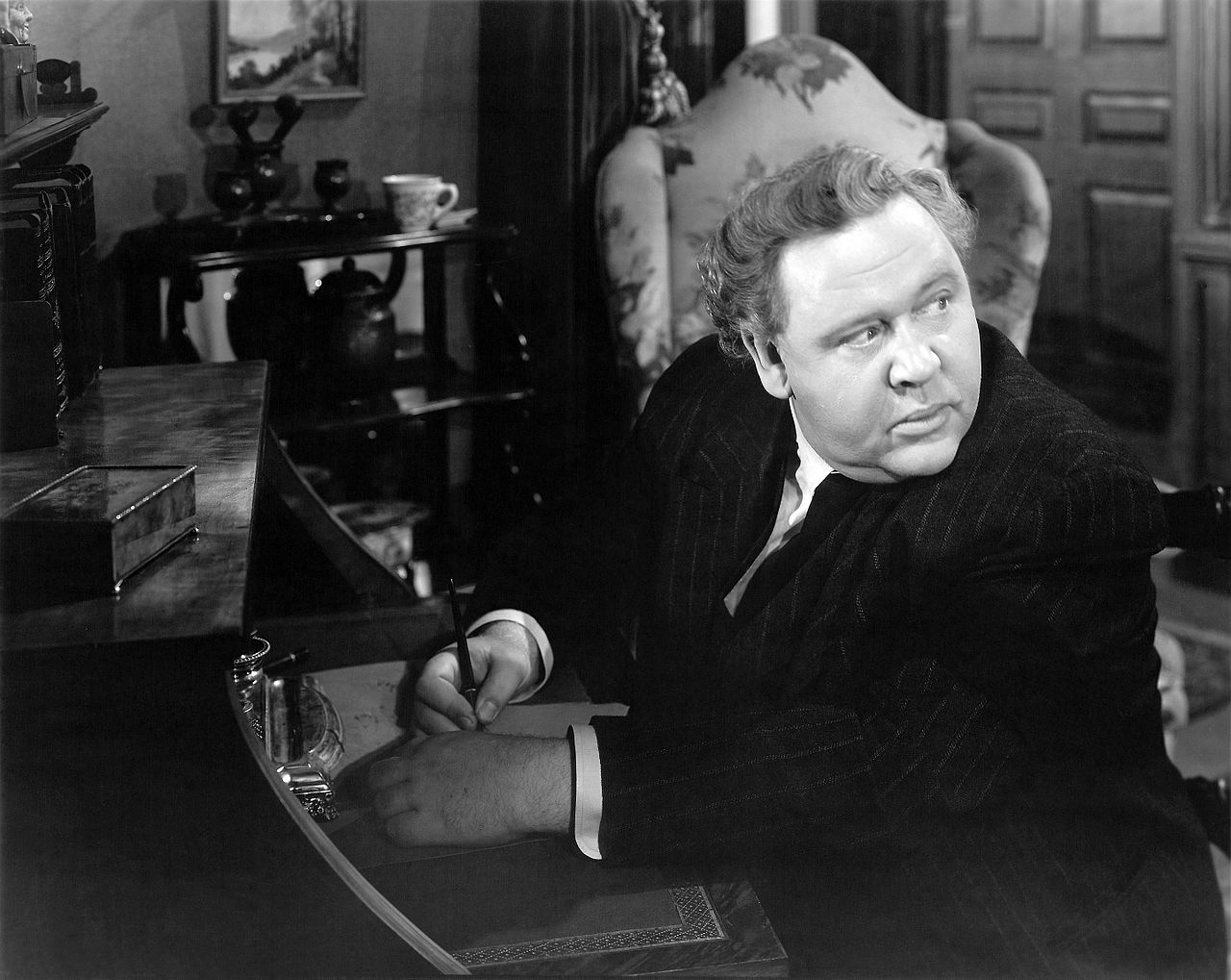
Neglected Gem: The Suspect (1944)

Charles Laughton in The Suspect (1944).

Robert Siodmak began his filmmaking career in Germany, hot-footed it to France when Hitler came to power and wound up among the many German émigrés in Hollywood, including his friend Billy Wilder, who had co-written his first two films, People on Sunday and The Man in Search of His Murderer. (Siodmak was on the last ship to America before the Nazis marched on Paris.) His American career never made him as famous as Wilder or Fritz Lang, but he made some very good pictures, including The Spiral Staircase, The Killers and The Crimson Pirate. Perhaps the best of them is The Suspect, adapted by Bertram Millhauser and Arthur T. Horman from a novel by James Ronald, which Criterion Channel is showcasing this month.

Monday, March 27, 2023

Tár: Vitriol

Cate Blanchett with Zethphan D. Smith-Gneist in Tár.

Todd Field’s Tár is one of those self-important, self-promoting movies of the moment that might as well be waving a banner that proclaims, “You’d better take me seriously.” It’s angry but the anger is generalized, and though it takes on the hot-button topic of celebrity sexual misconduct, it doesn’t present a coherent argument. Field must believe that if it did, it couldn’t pass itself off as complex and provokingly unresolved. Tár reminded me of a number of movies I despise:  Sidney Lumet’s alleged attack on television, the 1976 Network (screenplay by Paddy Chayefsky); half a decade earlier, Mike Nichols’s alleged critique of the superficiality of American sexual relationships, Carnal Knowledge (screenplay by Jules Feiffer); two decades earlier than that, Billy Wilder’s puffed-up indictment of tabloid journalism and the callousness of the American public, Ace in the Hole (screenplay by Wilder, Lesser Samuels and Walter Newman). All of these films substituted bitterness and cynicism for character logic and used them as battering rams, and Tár follows suit. The discomfort they heap on audiences is supposed to be an indication of profundity, proof that they’re revealing ugly truths that only morally committed filmmakers would have the courage to put on the screen. But there isn’t a convincing moment in Tár. It’s two hours and forty minutes of foul-smelling hot air. No wonder Field – who both wrote and directed – hasn’t made a movie in sixteen years. (His debut feature, the shallow, manipulative In the Bedroom, came out in 2001; his second, Little Children, a saga of paralyzed suburbanites that flatters the audience by putting us in a position from which we can look down at the pathetic characters, followed in 2006.) It takes a long time to store up so much rancid baloney.

Sunday, May 28, 2023

Tina Bids Farewell: The Exuberant Buddhism of the Late Tina Turner

Tina Turner, in 2018. (Photo: Charles Gates)

“The Buddhist concept of changing poison into medicine works. My life has proven it."  – Tina Turner, Living Buddhism, July 2018.

As a Buddhist, I don’t, of course, believe in the customary concepts of heaven or hell, since as fellow practitioners well know, we humans do a pretty good job of manufacturing our own versions of those two domains right here on earth while we’re alive in this material world. Like many of you, though, I do, however, believe in reincarnation, and that’s where my mind first went when I learned of the passing of the great Tina Turner at the age of 83 at her home in Switzerland on May 23, 2023, with her beloved second husband Erwin Bach at her side. Her first husband, the notoriously abusive Ike Turner, whose sole role in history has become his introduction of a shy sixteen-year-old girl named Anna Mae Bullock to the recording industry and his transformation of that girl into Tina, the larger-than-life talent we all came to adore, has drifted off into whatever hellish domain awaits the cruel and inhuman among us. But Tina, she might well have gone elsewhere.

Thursday, January 9, 2025

Time Transfixed: The Momentary Music of Hemisphere


“My desire was not to compose, but to project sounds into time, free from any compositional rhetoric. Music which specifically defined pitch but allowed the temporal dimension to remain indeterminate, thus creating a sonic world where each instrument is living out its own individual life in its own individual sound world.”
Morton Feldman

To become transfixed is to be rendered motionless with wonder, to be immobilized by astonishment. To some extent it touches upon the condition which in more classical eras was associated with what was known as the sublime, a state akin to awe. The sublime is still with us, of course, but it is often sublimated since the course of modernism conducted its now well-known radical discontinuity. This was especially the case in the domain of music, which is a durational art, one occurring strictly as momentary sonic situations, relying historically on the laws of harmony in order to soothe the savage breast. The aleatory and organic flow of what became known as “new music,” however, tended to naturally embrace dissonance in a manner which celebrates time transfixed. If we try to imagine the notion of time transfixed we can also determine how frozen time might amount to space itself: to hear and see them as one in the same quantum thing, or, in Zen terms, no-thing.

Friday, February 21, 2025

The Brain Doctor: William Burroughs (1914-1997)

Portrait of William S. Burroughs by Lance Austin Olsen.

“Language is a virus.”
W. B.

William S. Burroughs’ supernal and subterranean Beat influence on Allen Ginsberg and Jack Kerouac alone would secure him a stable place in the modernist canon of American letters, as would Norman Mailer’s prescient early acclamation, “Burroughs might be the only American writer of sheer genius.” For me, Alexander Kafka penned what I’ve long felt was an ideal characterization of this experimental literary legend: “Burroughs was an ethereal intermediary between the here and the fiery beyond, pausing to give us the purgatorial skinny.” That skinny was transmitted in haunting and disturbing novels such as Junky (1953), Naked Lunch (1959), The Soft Machine (1961), and The Ticket That Exploded (1962), among many others. However, it was through his influence on every other aspect of 20th-century culture in all media that his spectral presence as a testifier was most perhaps most long-lasting.