Showing posts sorted by relevance for query Brecht and Weill’s The Threepenny Opera. Sort by date Show all posts

Monday, April 7, 2014

A Threepenny Opera Con Brio

Photo by Kevin Thomas Garcia

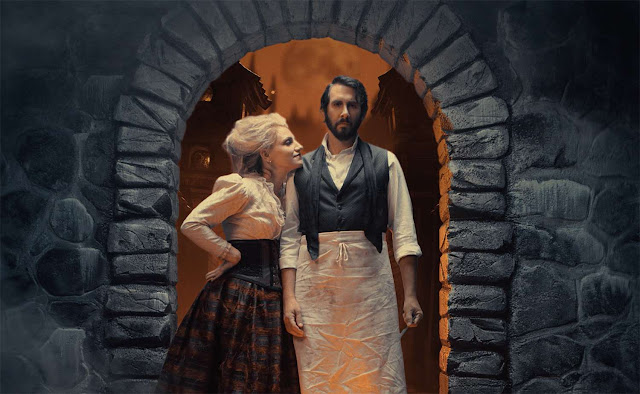
Productions of The Threepenny Opera usually stumble over the paradox that though it’s a great play, technically it’s not a very good one. The script by Bertolt Brecht is massively overwritten, with long passages of dialogue that no translation from the German (I’ve encountered several) has succeeded in rendering without awkwardness. The comic scenes may have been partly improvised in rehearsal when the show was first mounted in Berlin in 1928, or else Brecht may have built them around the vaudevillian talents of his cast; now the exchanges between the gangster Macheath (Mack the Knife) and his gang, Mackie and his pal, Chief of Police Tiger Brown, Brown and Jonathan Peachum, the ruthless boss of all of London’s beggars, and Peachum and his equally devious wife just sit on the page, challenging actors to figure out how to make them funny. Yet the play, a raucous social satire that updates John Gay’s eighteenth-century satirical burlesque The Beggar’s Opera, is vibrant, theatrical to the gills, and every time the action pauses for one of Brecht and Kurt Weill’s songs, you know you’re watching and listening to one of the signal achievements in modern theatre. Weill’s music is thrilling: glittering and acid, robust and plaintive, simultaneously redolent of the music hall, the salon and the jazz club.

Monday, July 11, 2016

Three Musicals: Threepenny Opera, Little Shop of Horrors, and The Flying Lovers of Vitebsk

Rosalie Craig and Rory Kinnear in The Threepenny Opera at London’s National Theatre. (Photo byRichard Hubert Smith)

There’s an exciting new production by Rufus Norris of The Threepenny Opera at London’s National Theatre, with Rory Kinnear, dashing and ironic and brilliant, as Bertolt Brecht’s anti-hero Captain Macheath ("Mack the Knife"), the audacious and unsettling gangster whose insatiable taste for the ladies is his downfall. The trademark supertitles are missing, but Norris knows his Brecht. The National’s current artistic director, he staged London Road there in 2011, a Brechtian musical based on interviews with the residents of a middle-class neighborhood where a serial killer has been dispatching prostitutes; it’s one of the most extraordinary evenings I’ve ever spent in a theatre. Norris made a film of it last year but it wasn’t released on this side of the Atlantic. He’s directed Threepenny as a mélange of carnival side-show, music hall entertainment and pantomime (in the English sense of the word). Vicki Mortimer’s set is a constantly revolving series of scaffolding and flats dressed with construction paper – the actors make their entrances by tearing through it. At the top of the first act, members of the ensemble enact a comic dumb-show version of Mack’s nefarious deeds behind a cut-out frame while the Balladeer (George Ikediashi, who shows up later with a Jamaican accent as the pastor who marries Mack and Polly Peachum, and then in drag at the whorehouse) sings the “Moritat,” a.k.a. “The Ballad of Mack the Knife.” The eight-member band, including music director David Shrubsole on piano and harmonium, appears in the midst of the action, and on some numbers Shrubsole, looking like a seedy undertaker in black with a top hat, accompanies Polly (Rosalie Craig) or Jenny (Sharon Small), cabaret style, on one of the ballads. For the “Army Song,” Mack and his pal Tiger Brown (Peter de Jersey), the chief police inspector, hold onto each other in terror, lit by a downstage special, while lanterns swing ominously back and forth upstage, and on the final verse bloody body bags drop down from the flies. (Paule Constable designed the expressionistic lighting.)

Monday, March 19, 2018

Skeleton Crew and The Threepenny Opera: The Working Class and the Underclass

Toccarra Cash and Jonathan Louis Dent in Skeleton Crew. (Photo: T. Charles Erickson)

Dominique Morisseau’s Skeleton Crew is performing at Huntington Theatre’s second space in the Calderwood Pavilion, and indeed there are productions currently or scheduled all over the country, including elsewhere in New England. (Dorset Theatre in Vermont has announced it as part of its summer season.) It’s no surprise. Morisseau’s drama, about four Detroit auto factory workers in 2008 dealing with the imminent closing of their plant, is a finely crafted piece of work with distinct, complex characters and plausibly shifting relationships. And under Megan Sandberg-Zakian’s direction, the Huntington production is vivified by four splendid actors, staking out Wilson Chin’s subtle, grounded set: the plant’s locker room-cum-kitchen and break room, with an expressionistic backdrop of elevated car doors that swing into action during scene shifts. Adam Honoré’s lighting and the character touches in Ari Fulton’s costume design also merit commendation.

Monday, February 16, 2015

The Merry Widow: Broadway at the Met

Renée Fleming and Nathan Gunn in Franz Lehár's The Merry Widow. (Photo: Brigitte Lacombe)

Franz Lehár’s 1905 Viennese operetta The Merry Widow has been filmed twice in English, three times if you count Erich von Stroheim’s perverse and entertaining silent version. But it isn’t revived very often on stage, so I anticipated the version in the Metropolitan Opera season, which the Met offered as part of its Live in HD series last month, with pleasure. This production cross-pollinates the worlds of the opera and the musical theatre. It stars opera diva Renée Fleming opposite Broadway leading lady Kelli O’Hara and Nathan Gunn, an opera singer who sometimes appears in concert versions of musicals; the new translation is by Jeremy Sams, who furnished the best translation of Brecht and Weill’s The Threepenny Opera that anyone has done to date; and the staging is by the explosively talented – and prolific - director-choreographer Susan Stroman. But though this Merry Widow has its points, it turns out to be something of a disappointment: tired and sagging in the middle, its fin-de-siècle exuberance strained, the farce strenuously overplayed. I couldn’t tell whether Stroman, whose recent stage work hasn’t garnered the enthusiastic reception she once drew, was trying too hard or whether she just wasn’t a match for the frothy, high-comic style of the material. I hope it’s the latter; I wouldn’t like to think that the ungenerous response to her dazzlingly inventive work on Bullets Over Broadway – likely a ricochet effect from the way the culture lashed out at Woody Allen around that time – has shaken her confidence.

Monday, April 17, 2023

Musical Revivals II: Sweeney Todd and Camelot

Annaleigh Ashford and Josh Groban in Sweeney Todd.

Despite the intermittently brilliant Stephen Sondheim score and a superb cast headed by Len Cariou and an unforgettable Angela Lansbury, I had a medium cool experience with the original 1979 Broadway production of Sweeney Todd. It felt inflated, overproduced (a response I have had to a few other Prince shows), and determined to make a statement competitive with that of Brecht and Weill’s The Threepenny Opera, which was the obvious inspiration for Sondheim, book writer Hugh Wheeler and Prince. But the material, a grisly horror derived from Christopher Bond’s 1973 rewrite of a mid-Victorian melodrama, is thin. At the end of the first act, thinking he’s missed his chance to murder the  corrupt Judge Turpin, who trumped up a charge against him and had him transported so he could get his mitts on Sweeney’s innocent wife Lucy, Sweeney, “the demon barber of Fleet Street,” sings “Epiphany,” in which he decides that he’s going to visit his frustrated revenge on his customers because “they all deserve to die.” And Mrs. Lovett, his landlady, who runs a pathetic pie shop with the only stringy meat she can afford, comes up with the scheme of using the corpses to make her wares sweeter and juicier.  Todd loves the idea, so they become business partners. In the first-act finale, “A Little Priest,” he argues that since society is built on men devouring each other, he and Mrs. Lovett might as well make the metaphor literal. “A Little Priest” is a wonderful burlesque-style novelty number constructed on a series of increasingly funny puns about their imagined victims. But it’s not exactly “The Second Threepenny Finale” (“What keeps a man alive? He lives on others”). Sweeney Todd is a cleverly devised penny dreadful, not a social satire.

What turned me around about the musical was the 2005 Broadway revival, directed by John Doyle, which had begun life in the West End. Starring Michael Cerveris as Sweeney and Patti LuPone as Mrs. Lovett, it was leaner and tighter than the original, with ingenious Brechtian effects – and it made no attempt to sell itself as profound social commentary. The new Sweeney Todd, directed by Thomas Kail, with musical direction by Alec Lacamoire – both Hamilton alumni – is almost as good as Doyle’s. And it has an even better Mrs. Lovett than LuPone, Annaleigh Ashford, whom I loved in Dogfight and the 2014 revival of You Can’t Take It with You (with James Earl Jones) and the 2017 revival of Sunday in the Park with George (where she played opposite Jake Gyllenhaal). She’s amazing. Slighter and more kinetic than her predecessors, Ashford looks like a devilish rag doll, and every physical choice she makes – and many of her vocal ones (like switching keys twice in the middle of her show-stopping first song, “The Worst Pies in London”) – is inspired. When she played this role Lansbury embodied the play’s music-hall origins, while LuPone’s numbers were like Brecht and Weill done as punk rock. Ashford is lighter on her feet and loonier, and her performance harks back to revue comedy – specifically to Imogene Coca, who partnered Sid Caesar so sublimely in the live TV days.

Monday, June 9, 2025

More on the Broadway Musical Season: Dead Outlaw, Buena Vista Social Club and Just in Time

Andrew Durand (left) and Company in Dead Outlaw. (Photo: Matthew Murphy.)

The general complaint about Broadway musicals in the twenty-first century is that too many of them recycle the plots of old movies. But ever since the advent of the sophisticated book musical with Show Boat in 1927, composers and librettists have looked to other media for source material, though during the golden age of American musicals they more often began as straight plays or novels. Did critics and aficionados bemoan the fact that My Fair Lady adapted Pygmalion, Guys and Dolls was derived from a pair of Damon Runyon stories and Kiss Me, Kate was based on The Taming of the Shrew? The proof, as always, is in the pudding. The recent history of the musical would be significantly poorer without Hairspray, The Band’s Visit and, God knows, The Light in the Piazza. Anyway, the evidence suggests that musicals are becoming more imaginative, not less so. This season’s crop included a Korean import about two robots in love, a nineteenth-century whaling tale that ended in shipwreck and cannibalism, and, weirdest of all, the new Dead Outlaw, a rock musical conceived by David Yazbek, who also penned the music and lyrics along with Erik Della Penna.  

Monday, October 1, 2012

Thriller: Donna Murphy on the Musical Stage

Donna Murphy in LoveMusik in 2007

We seem to be living in a golden age of musical-theatre women. The one whose name is most often on everyone’s lips is Kelli O’Hara, with her simon-pure soprano embroidered by often startlingly impassioned phrasing, whether the character she’s playing is fragile (The Light in the Piazza) or essentially conventional (South Pacific). Victoria Clark has a wide emotional range and suggests a complex response to the world deriving from accumulated experience; as O’Hara’s mother in Piazza, perhaps the best musical-theatre role ever written for a middle-aged actress, she managed to balance romantic skepticism (based on her own disappointing marriage) and optimism (based on an awakening awareness of the romantic possibilities for her damaged daughter). On the other end of the scale of middle-aged performers, Patti LuPone is a diva with grit in place of glamour, a gleaming sense of irony and an unerring instinct for how to make a song dramatic, whether in the old-fashioned Broadway manner (Gypsy) or in the Brechtian style (Sweeney Todd). Marin Mazzie, who’s been around since Ragtime and the marvelous Kathleen Marshall production of Kiss Me, Kate, has a warm soprano and an expansive presence that effortlessly fills a Broadway house. Sutton Foster has a more streamlined personality – she’s colder but more dazzling, and the best lead dancer around, as she demonstrated most recently in Marshall’s Anything Goes. Celia Keenan-Bolger is diminutive but she has a powerful core of feeling; she’s mostly attracted notice in comic roles (recently Peter and the Starcatcher), but she can be amazing in dramatic ones that call for arias of longing – Merrily We Roll Along, the Encores! revival of that Marc Blitzstein rarity Juno. Laura Benanti has a frisky, inventive wit: her show-stopping “Model Behavior” in Women on the Verge of a Nervous Breakdown is the funniest musical performance I can remember seeing on a stage since Angela Lansbury introduced “The Worst Pies in London” in the original cast of Sweeney Todd nearly three and a half decades ago. Among the clowns, Faith Prince seems to have been largely forgotten – she’s become a cabaret performer – but when she starred in a revival of Bells Are Ringing on Broadway in 2001, she proved to be almost a match for the original star, the late Judy Holliday, plus she made the lilting Jule Styne melodies sound sweeter than they ever had before. Kristin Chenoweth can be hilarious, but vocally there’s almost nothing she can’t pull off (her album, Let Yourself Go, is a virtuoso accomplishment), and she was heartbreaking in the revival of the Bacharach-David Promises, Promises a couple of seasons ago. And any era that produces Audra McDonald, owner of the most versatile and most expressive dramatic singing voice since Barbra Streisand, would need to be considered a golden age by definition.

I’d be hard put to pick a favorite, but no one thrills me more on stage than Donna Murphy. Movie buffs who recognize her name from the tiny parts she’s essayed in blockbusters like Spider-Man 2 and The Bourne Legacy have no idea what she’s like on stage, where she’s always a headliner. I first saw her in a production of Pal Joey at Boston’s Huntington Theatre in 1992, as Vera, the brittle, knowing older woman who keeps the ambitious womanizer Joey, but throws him out on his ass when he proves to be more trouble than she figures he’s worth. Vera is the high-comic element in the low-down, hard-boiled John O’Hara/Rodgers and Hart material, and Murphy’s confidence in the role was almost alarming; you wondered where she could have acquired it before she’d even turned thirty-five. Two years later she had her first Broadway lead, in Stephen Sondheim and James Lapine’s Passion. Since then she’s been seen as Anna in The King and I (my impatience with Rodgers and Hammerstein kept me away from that one); as Ruth in Wonderful Town (first at Encores! and then in a full-scale Broadway expansion, both directed by Kathleen Marshall); as Lotte Lenya in Lovemusik; with Victoria Clark in Follies; in a misbegotten and short-lived original piece called The People in the Picture; and as the Witch in Into the Woods, in Central Park last summer. She was a sensationally effective as Phyllis in Follies – sardonic yet wistful, giving that self-consciously clever poison-pen letter “Could I Leave You” much more a kick than it deserved, and exuberantly leggy, like a sleek version of Charlotte Greenwood, in “The Story of Lucy and Jessie.” But her finest work has been in Passion, Wonderful Town and Lovemusik.

Monday, June 11, 2018

Effigies of Wickedness!, The Rink, Brief Encounter: Words and Music

Lucy McCormick, Le Gateau Chocolat, Peter Brathwaite, and Katie Bray in Effigies of Wickedness! (Photo: Helen Murray)

When the Nazis staged an exhibition of “degenerate music” in Düsseldorf in 1938, the accompanying manifesto characterized the targeted music – some the work of Jewish and black artists, much of it political and cynical and satirical, some of it experimental – as “effigies of wickedness.” The current co-production of the Gate Theatre and the English National Opera, a cabaret of German songs from 1920 through 1939 but mostly representing the Weimar era (which officially ended with Hitler’s rise to power in 1933), has taken that phrase as its title. This is social and political theatre – Brechtian theatre – at its most potent. In the Gate’s compact Notting Hill space above a pub, four dazzling singer-actors – Peter Brathwaite, Katie Bray, Lucy McCormick and the drag performer Le Gateau Chocolat – and three wonderful musicians (Geri Allen, Cassie Kinoshi and Fra Rustumji), under the direction of the Gate’s artistic director Ellen McDougall and the musical direction of Phil Cornwell, present fourteen songs, most of them translated into English by Seiriol Davies and David Tushingham. Many who love Bob Fosse’s Cabaret may understand that the Kit Kat Klub numbers are imitating a style of commentary art songs that was popular in the late twenties and early thirties, but we know almost nothing from the repertoire of Berlin’s kabarett theatre: the score of Kurt Weill and Bertolt Brecht’s The Threepenny Opera (1928), perhaps a smattering of songs from their Happy End and The Rise and Fall of the City of Mahagonny (1929 and 1930 respectively). The only tune I recognized in Effigies of Wickedness! was “Petroleum Song” (lyric by Felix Gasbarra), which Teresa Stratas recorded in her magnificent two-album set of Weill songs nearly thirty years ago. All the others were revelations to me, and every one is a gem. The production illuminates the work of forgotten composers like Misha Spoliansky, Hanns Eisler and Frederick Hollander, whose name may be familiar to Marlene Dietrich aficionados. (He wrote the music for The Blue Angel and, emigrating to Hollywood in the crush of German-Jewish artists fleeing Hitler in the early thirties, worked on several of her American movies as well as many others.)

Sunday, March 11, 2018

Crime, Politics and Spectacle: Netflix's Babylon Berlin

Severija Janušauskaitė as the cross-dressing singer Svetlana Sorokina in Babylon Berlin.
 "The rise of the Nazis, and the devastation of WWII and the Holocaust, have been widely depicted in film and TV. Rarely seen is the period just before, when democracy – in the form of the idealistic, if flawed, Weimar Republic – was still fresh in Germany and the country was in the midst of a cultural, political and social revolution."
                                           – Tom Twyker, a director of Babylon Berlin
Babylon Berlin (on Netflix) is an exhilarating, gritty sixteen-part series that is a mash-up of genres. On the most basic level, it is a propulsive police procedural and political thriller that has been adapted from the crime novel of the same name by Volker Kutscher (Picador, translated in 2016), the first in a series planned by the author that will culminate in the 1938 Kristallnacht. More importantly, the drama – reportedly the most expensive German television production to date, involving three directors in every episode – is a vivid evocation of 1929 Berlin a few months before the crash of the American stock market, accented with film noir. Ten years after the end of the Great War veterans still carry its scars; the war's consequences accelerate extremist politics from the left and the right, threatening the rule of law and destabilizing the fragility of the Weimar Republic; pockets of poverty in the city remain with its attendant political and social ramifications, particularly for vulnerable women. And the attempt to blot out a humiliating defeat and, for most Germans, a shameful peace treaty explains in part its frenetic cultural, social and sexual life. Very little of the political, social and cultural tapestry of Berlin portrayed in the series is based on the novel. The series' other strength is its focus on character development, which enables the actors to grow into their roles and deliver strong performances.

Wednesday, September 9, 2015

When You Speak Love: Christian Petzold's Phoenix

Ronald Zehrfeld and Nina Hoss

The German director Christian Petzold garnered some deserved attention for his 2012 movie Barbara, which told the story of an East German doctor (Nina Hoss) in the 1980s, banished to a country hospital as punishment for applying for an exit visa, who plots to defect but is sidelined by her emotional involvement in the case of a female patient. As a chronicle of life in East Germany in the years before the Berlin Wall came down, Barbara is smaller-scale than The Lives of Others – one of a small handful of movies since the millennium that truly deserve to be called masterpieces – but it demonstrates a piecing intelligence, a gift for working with actors (Hoss gives a superlative performance), and an easy mastery of film vocabulary. It’s an elegant and fiercely compelling piece of moviemaking, and I think that Phoenix, his new picture, is even better.

Petzold is again working with his co-writer on Barbara, Harun Farocki, and again features Hoss opposite the fine actor Ronald Zehrfeld, who played the head of the clinic Barbara is exiled to. In Phoenix Hoss, in a performance of profound tremulous feeling, plays Nelly Lenz, a Jewish cabaret singer who returns from the camps at the end of the Second World War so badly disfigured that she hides her face under a bandage. Her experience has left her so fragile that she barely seems able to function. She arrives back in Berlin under the care of another woman, Lene Winter (Nina Kunzendorf), who seems to have an administrative job that gives her access to government documents. (I think we’re meant to assume that Lene and Nelly met in the camps, but the movie is rather mysterious on the source of their association.) Lene guides her through reconstructive surgery that leaves her looking somewhat but not exactly like the woman she was before she was taken by the Nazis, and Lene makes plans for the two of them to emigrate to Israel. But Nelly didn’t think of herself as a Jew in the days before the Holocaust, and she still doesn’t. And what she wants is to find her Gentile husband Johnny, a pianist who hid her from the Gestapo in a boat until they finally caught up with her. Lene is convinced that it was Johnny who turned Nelly in at the end, but Nelly is still crazy about him and doesn’t believe her friend’s version of events. Haunting the seedier clubs, she locates Johnny (Zehrfeld), working not as a musician but as a waiter, and of course he doesn’t recognize her. But he notes her resemblance to his wife, who, he is certain, died during the war.

Tuesday, April 8, 2025

Potpourri: Love Life, Don’t Eat the Mangos and Beckett Briefs

Kate Baldwin and Brian Stokes Mitchell in Love Life. (Photo: Joan Marcus.)

The review of Don’t Eat the Mangos contains spoilers.


The great Jewish Weimar composer Kurt Weill fled Berlin for New York in the early thirties. Nothing he wrote for Broadway earned him the fame he’d garnered as Bertolt Brecht’s collaborator in Germany, but he produced the music for eight shows between 1936 and 1949 (he died in 1950 at the age of fifty while he was working on a musical based on Adventures of Huckleberry Finn) with a fascinating range of librettists including Moss Hart, Ira Gershwin, S.J. Perelman, Ogden Nash and Maxwell Anderson. And though the shows were a mixed bag, his music was usually glorious. The 1947 opera he and the poet Langston Hughes fashioned from Elmer Rice’s play Street Scene, set in a Manhattan tenement, may be the most exquisite score anyone has written for Broadway besides Porgy and Bess.