Showing posts sorted by relevance for query Jesse Plemons. Sort by date Show all posts

Sunday, January 30, 2022

Exposure: Jane Campion’s The Power of the Dog

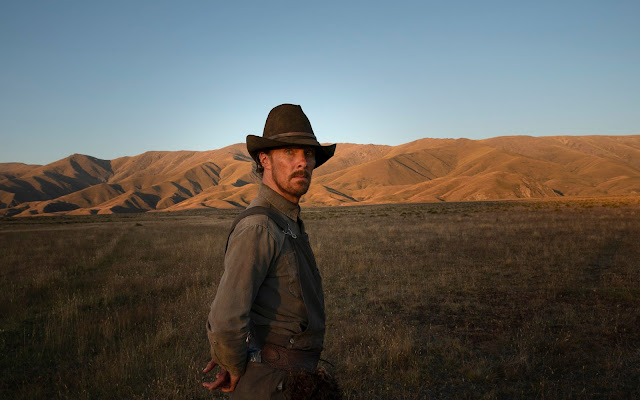
Benedict Cumberbatch in The Power of the Dog, currently streaming on Netflix.

Reading the rapturous reviews of The Power of the Dog is a bit like talking to an anti-vaxxer. The experience is so disorienting – the depiction of reality so inverted – that after a while you begin to question your own sanity. I forced myself to sit through the movie a second time, just to be sure I hadn’t missed something. I hadn’t. Jane Campion has made a pretentious, incoherent, excruciating adaptation of Thomas Savage’s 1967 novel of the same name. Many audience members may feel similarly, I suspect, but raising questions can invite gaslighting from critics ready to anoint the film. Witness Slate editor Jeffrey Bloomer, a self-described Campion fan, who found the viewing experience “absolutely miserable.” In response to his heresy, the poor man is led by reviewer Dana Stevens through some kind of struggle session to get him to recant his view and assent to the picture’s inscrutable wisdom. Watching them try to decode the movie like an ancient rune is disturbing. It seems every year brings us an empty art house film that the chattering classes adore. But The Power of the Dog has to rank near the top for eliciting such an Orwellian campaign of misinformation. 

Saturday, May 3, 2014

How To Say Goodbye: Coming-of-Age in Friday Night Lights


For those who haven't watched Friday Night Lights, this piece contains some spoilers. Ed.

Episodes 5 and 6 of season four of Friday Night Lights, which aired in 2010, may be the best two hours of television I’ve ever seen. They’re certainly the most poignant, and I couldn’t keep them out of my head for weeks after I watched them. Almost everyone I know loves Friday Night Lights, Peter Berg’s imaginative expansion of the H.G. Bissinger non-fiction volume about high school football in a small Texas town, yet it stayed under the radar and never made it into the running for the big awards. A narrow but steady audience kept it on the air for five seasons, though every year its fans were on tenterhooks, waiting to see whether it would get renewed for another season. When it returned for its second go-round, in 2007, the writers seemed to be caving in to network pressure to make it more conventional by threading in overblown plot lines. But the level of the acting, the series’ most striking element, never fell, and by the third season the melodrama had vanished and the writing was more delicately observant than ever.

The first three seasons of Friday Night Lights focused on the fortunes of the Dillon High School football team, the Panthers, led by Coach Eric Taylor (Kyle Chandler), and on the lives of the players and of their parents and significant others, citizens of a town where the Friday night games are the most important event of the week and where Monday-morning quarterbacking is not just a tradition but a civic duty. (Eric inevitably has to sweep up the For Sale signs that jokers, probably in their cups, scatter on his lawn during the night after the Panthers lose a game.) In these episodes the Taylors are a thoroughgoing Dillon H.S. family: Eric’s wife Tami (Connie Britton) begins as a guidance counselor and then (in season three) becomes principal, and their daughter Julie (Aimee Teagarden) dates retiring, deeply sensitive Matt Saracen (Zach Gilford), whom Eric molds into an accomplished quarterback when the gifted, charismatic Jason Street (Scott Porter) is paralyzed in a football accident in the show’s opening hour. Jason loses his girl friend Lyla Garrity (Minka Kelly) – the daughter of Eric’s best friend, car salesman and Panther booster Buddy Garrity (Brad Leland) – to his pal Tim Riggins (Taylor Kitsch), a talented player whose ascension to adulthood has been hampered by alcoholic indolence, an ease at getting his way through sexual charm, a dearth of good male role models at home, and a deep-seated conviction that he’s essentially worthless. The other major teenage character is Tim’s ex-girl friend Tyra Collette (Adrianne Palicki), a plain-spoken good ol’ girl whose tough act conceals a terror that she’s not good enough to make it into college and the wide world beyond Dillon. In season two she has a relationship with Matt’s nerdy, generous best friend Landry Clarke (Jesse Plemons) and forges an unlikely friendship with Julie; the fact that both are A students suggests Tyra’s secret longing to be taken seriously. In the plausibly incestuous social landscape of the community, Buddy and his receptionist, Tyra’s mother Angela (Dana Wheeler-Nicholson), have an affair that breaks up his marriage, while Tyra’s older sister Mindy (Stacey Oristano) winds up married to Tim’s brother Billy (Derek Phillips), who has been his unofficial and semi-competent guardian since their ne’er-do-well father deserted them.

Friday, February 16, 2018

The Post: The Old Hollywood Machinery


The Post, about how its daring 1971 coverage of the Pentagon Papers put The Washington Post in the front rank of American newspapers, is a newspaper picture with a pedigree. Steven Spielberg, working with his usual team of experts – cinematographer Janusz Kaminski, editor Michael Kahn (working with Sarah Broshar), production designer Rick Carter and composer John Williams – directed from a screenplay that Liz Hannah co-authored with Josh Singer (co-writer of Spotlight). And his cast, headed by Meryl Streep as publisher Kay (Katharine) Graham and Tom Hanks as editor Ben Bradlee, presents the most impressive collection of character actors, culled from stage, movies and TV, on screen in the past year, all of them working at the top of their game. Bruce Greenwood plays Robert McNamara, Defense Secretary under JFK and LBJ, who ordered the Pentagon Papers, forty-seven volumes that documented the history of White House obfuscation about the Vietnam War; Matthew Rhys (of The Americans) is an uncanny visual match for former Marine Daniel Ellsberg, who, having drafted the study in 1966, brought it to light by having a copy left on the desk of a general assignment reporter at The New York Times. Bob Odenkirk is Ben Bagdikian, assistant managing director for national affairs at The Post, who guesses that Ellsberg – a one-time colleague of his at the RAND Corporation – is the source of the leak and tracks him down so that, when an injunction from Attorney General John Mitchell ties the hands of The Times, preventing it from offering any further coverage, The Post can pick up the ball. Tracy Letts is The Post’s chairman of the board, Fritz Beebe; Bradley Whitford, looking like an old-world southern gentleman in a bow tie, is Arthur Parsons, a composite character based on several Post advisers who discourages Graham from publishing articles about the papers; Jesse Plemons (of Friday Night Lights) is the senior legal counsel for the paper, whose youth amuses Bradlee. Sarah Paulson plays Ben’s sculptor wife Tony. Carrie Coon plays editorial writer (and future editorial page editor) Meg Greenfield and Jessie Mueller is Judith Martin, who, when the main part of the narrative begins, has been denied an invitation to cover presidential daughter Tricia Nixon’s wedding because she crashed Tricia’s older sister Julie’s wedding three years earlier. The ubiquitous Michael Stulhbarg, who also appeared in two other high-profile Christmas-season releases, The Shape of Water and Call Me by Your Name, is Abe Rosenthal, managing editor at The Times. David Constabile and Johanna Day are Graham’s close friends Art and Ann Buchwald.
Thursday, December 24, 2015

2015: My Cultural Year in Review

Kirsten Dunst and Jesse Plemons in the second season of Fargo.

It’s been a long year. We’re coming close to the end. As Mr. Lennon said, “So this is Christmas, and what have we done?” Well we’ve listened to a lot of music, and read a lot of books. Watched some movies. And some TV. Maybe my favourite TV show has been Fargo, Season 2 of which I have just finished, and I have to say I loved every minute of it. The first season was interesting, had a few surprises, like when Officer Molly got shot but the second season was where we found out just what happened at the Sioux Falls massacre. The concept of going back twenty years to explain this was sheer genius. If you haven’t watched Fargo, I recommend you start from the beginning. See the movie first and marvel at the work of Joel and Ethan Coen. Next try the first season to see how beautifully the television producers have translated North Dakota and environs to the small screen. Billy Bob Thornton was the perfect villain, and Allison Tolman as Molly Solverson was extraordinary. Her expressive eyes just captured the viewer and never let you go.

Friday, November 27, 2015

Bridge of Spies: Phony Baloney

Tom Hanks in Steven Spielberg's Bridge of Spies.

The opening sequence of Steven Spielberg’s Bridge of Spies, where, in 1957, the slippery British-born Russian spy Rudolf Abel (Mark Rylance) manages to elude the FBI for the last time before he’s caught, is both excitingly and wittily filmed. Rylance, a much-lauded stage and recently TV star (he played Thomas Cromwell in the BBC adaptation of Wolf Hall) who hasn’t been tapped by the movies until now, turns the tension between Abel’s hyperawareness and his calm, almost languid air into a sort of music-hall routine with a whiff of melancholy. But as soon as Abel is sent to prison to await trial for espionage and James Donovan (Tom Hanks) is urged by his law firm to act as his defense attorney, the movie flattens out. How did Spielberg and the writers, Joel and Ethan Coen and Matt Charman, manage to turn the fascinating, twisty story of Abel – the Cold War spy who ended up being traded to the Soviets for both the captured pilot Francis Gary Powers (Austin Stowell) and Frederic Pryor (Will Rogers), an American economics student in Berlin arrested for suspicion of espionage – into a civics lesson? Somehow, instead of releasing the storytelling master in Spielberg – the director who could make the three-hour Munich so gripping – Bridge of Spies brings out his earnest, big-studio-era, socio-sentimental side. Janusz Kaminski’s period cinematography is gorgeous and vivifying, but the movie behind it is as glazed as Always, his 1989 remake of A Guy Named Joe, with Richard Dreyfuss in the Spencer Tracy part. And this time around he’s got Tom Hanks, who plays Jim Donovan as if he were Tracy.

Friday, September 28, 2012

Definitely an Oxymoron: Paul Thomas Anderson’s The Master

Joaquin Phoenix & Philip Seymour Hoffman in The Master

I’m not really surprised that Paul Thomas Anderson’s latest movie The Master is as atrocious as it is. This is, after all, the filmmaker who’s inflicted Magnolia (1999), Punch-Drunk Love (2002) and There Will be Blood (2007) upon us. But I do marvel anew at the superlatives and fulsome praise being lavished on Anderson by the majority of film critics, even though the over-praising of this director, who actually has little of value to offer, is also par for the course. The Master is being festooned with adjectives – audacious, brilliant, masterful – that are more rightly applied to genuine filmmakers, talents such as Robert Altman, Orson Welles, Jean Renoir and Steven Spielberg, directors who've actually made movies that last and have impacted on the cinematic medium in new and unique ways. In fact, The Master, which Anderson wrote as well, isn't deserving of any commendations at all. It’s a film that is rife with idiotic, pulpy dialogue, mannered, artificial acting, sloppy plotting and a storyline that, despite its obvious pretensions to the contrary, doesn't add up to anything memorable at all.

Monday, October 30, 2023

Killers of the Flower Moon: Martin Scorsese’s Hobbled Epic

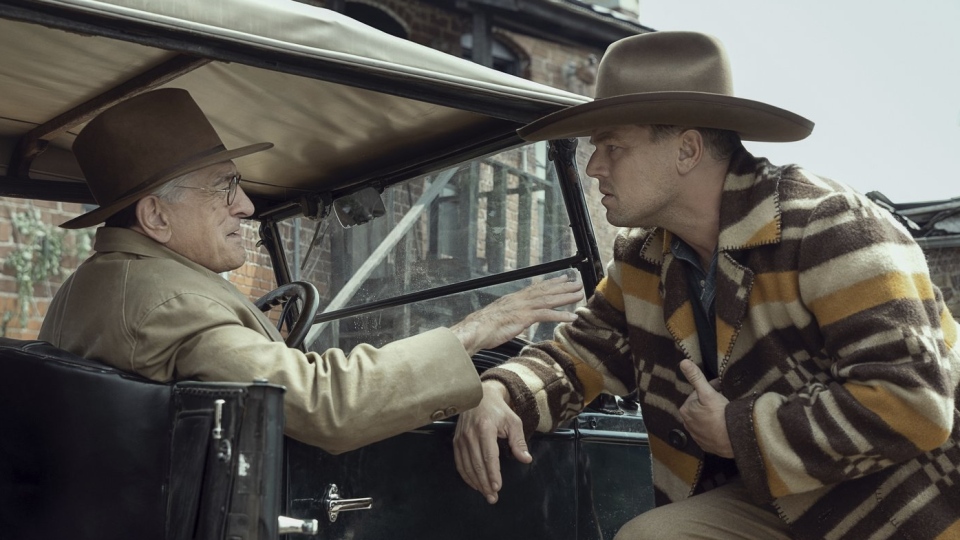
Robert De Niro and Leonardo DiCaprio in Killers of the Flower Moon.

Killers of the Flower Moon is great around the edges. Martin Scorsese’s movie, adapted from David Grann’s jaw-dropping 2017 account of the serial murders of Osage Indians in Oklahoma in the 1920s that enabled white men to secure their “headrights” – the legacy, shared equally among the community, of land rich in oil – is three and a half hours long and cost $200 million, and God knows you can see the money on the screen. The film, shot by Rodrigo Prieto, with production design by Jack Fisk and costumes by Jacqueline West, looks magnificent. The period reconstructions are dazzling and capture a cross-hatched culture, rich in visual irony, where natives, professing a faith that mixes Catholicism with the religion of their ancestors, dress in a combination of traditional garb and the flamboyant style of wealthy white men while they tool around in chauffeured Pierce Arrow roadsters and fly private airplanes. The opening scenes are lively and exciting, a circus-like montage of oil strikes and auctions and raucous general celebration that spills out of barrooms and restaurants into the streets of Fairfax, the Osage reservation town that has grown out of the oil boom. This is some of Scorsese’s best filmmaking – visually dense, outrĂ©, darkly funny. We barely have a chance to process the omnipresence of white men who have intermarried with the Osage women before it all turns sinister. The natives are dying in staggering numbers, some the victims in unsolved murders, others expiring from suspicious illnesses.

Saturday, October 10, 2015

Black Mass: Not Enough Color

Johnny Depp as James “Whitey” Bulger, in Black Mass.

As James “Whitey” Bulger in Black Mass, Johnny Depp levels a cobra’s hooded gaze at his enemies and at those he suspects might become his enemies. That isn’t much of a distinction, and it doesn’t take much to cross it. Depp gives a thoughtful, intelligent performance as a charismatic sociopath, and in some scenes he’s very frightening. But he needs more colors, and I don’t think that’s his fault but the fault of the screenplay, which Mark Mallouk and Jez Butterworth culled from Dick Lehr and Gerard O’Neill’s book Whitey: The Life of America’s Most Notorious Mob Boss. I haven’t read the source material, but Depp is obviously faithful to the Bulger you saw in the news every day during his 2013 trial and who emerges in last year’s riveting documentary Whitey: United States of America v. James J. Bulger. The prosthetics have transformed Depp’s face so that he looks eerily like Bulger, but this kind of real-person camouflage, impressive as it is, always misses the point. (God knows it did when Steve Carell was buried under his make-up in Foxcatcher: the combination of Carell’s vocal tics and that artificial face, constructed to replicate that of a true-life lunatic most people couldn’t identify anyway, made him look and sound like an automaton.) Black Mass, which was directed by Scott Cooper, is a prestige project, carefully assembled and made with obvious integrity. But it would be a more satisfying movie if Depp were slyer, more ironic – if he loosened up and had more fun with the part. You don’t want Jack Nicholson’s Bulger-inspired turn in The Departed, whose behavior was so clownish and preposterous that you couldn’t believe his gang didn’t just stage an insurrection and take him out, but you do need to get more of a sense of the character’s charm and of an outrageousness that isn’t just linked to a pathological taste for violence.

Friday, July 24, 2015

Olive Kitteridge: Portrait of a Marriage

Frances McDormand and Richard Jenkins in the HBO miniseries, Olive Kitteridge.

Note: There are spoilers ahead in this review. 

The Maine coastal town where the sensational four-part HBO miniseries Olive Kitteridge, directed by Lisa Cholodenko and now on DVD, is set seems blighted by disaster and grief, but the story isn’t a Gothic. Jane Anderson’s screenplay, based on the Pulitzer Prize-winning 2009 novel by Elizabeth Stout, puts the lives of the women and men who inhabit this community under a microscope to reveal how difficult the path is that all of us take through life, tortuous and stone-strewn and obscure. Some of the fates that befall subordinate characters are unusual. One is shot on a hunting foray by his best friend, who mistakes him for a deer. (Perhaps Stout was thinking of the plaintive reel “Molly Bán,” where a young man shoots his fiancĂ©e because, her apron up to shield her from a rainstorm in the forest, he takes her for a swan.) Another, whom we only hear about, becomes a psychotic killer. Most of the tragedies, though, are ordinary enough. The assistant to the local pharmacist, Henry Kitteridge (Richard Jenkins), collapses of a heart attack in the street outside the store and dies. Henry himself, in the middle of Part 3 (“A Different Road”), has a stroke and hangs on for four years, unable to communicate with his wife Olive (Frances McDormand), a retired math teacher.