Showing posts sorted by relevance for query Kathleen Marshall. Sort by date Show all posts

Monday, May 2, 2016

Anything Goes: Cole Porter at the Goodspeed

Desirée Davar (as Erma), and members of the Goodspeed cast, in Anything Goes. (Photo: Diane Sobolewski)

East Haddam, Connecticut’s fabled Goodspeed Opera House initiates its 2016 season with Anything Goes, Cole Porter’s breezy 1934 musical set aboard a cruise ship crossing the Atlantic. And though the Goodspeed voyage, under Daniel Goldstein’s direction, isn’t without its obstacles, overall it’s a pleasurable one. The libretto to Anything Goes was originally written by Guy Bolton and P.G. Wodehouse, though Howard Lindsay and Russel Crouse revised it before the Broadway premiere, and over the years it’s been re-revised continually: every time it’s newly mounted in New York it’s tinkered with and the song list altered to add or substitute Porter jewels from other shows. Since the 1962 production (with Eileen Rodgers and Hal Linden), the 1987 production (with Patti LuPone and Howard McGillin) and Kathleen Marshall’s ebullient, deluxe 2011 production (with Sutton Foster and Colin Donnell) have all been recorded, Porter aficionados can check them against each other and evaluate the addenda and omissions. In terms of the libretto, there are three versions – the 1934, the 1962 (by Bolton himself) and the 1987 by Crouse’s son Timothy and John Weidman, which Kathleen Marshall hewed to and which Goodspeed has chosen to produce as well. (If you want to know what the show sounded like in 1934, get a copy of the 1989 EMI studio recording overseen by John McGlinn, who conducts the London Symphony Orchestra behind a disparate ensemble including opera diva Frederica Von Stade and the peerless Jack Gilford.)

Monday, September 12, 2011

Musicals in Revival: Anything Goes & How to Succeed in Business Without Really Trying

Except for Kiss Me, Kate, no Cole Porter show has been revived as often as Anything Goes, the 1934 shipboard musical he wrote with P.G. Wodehouse, Guy Bolton, Howard Lindsay and Russel Crouse. Wodehouse and Bolton penned the original script, about a shipwreck; when the cruise ship the S.S. Morro Castle went down in a fire weeks before rehearsals were scheduled to start, marking the worst maritime disaster of the decade. Lindsay, who was also directing, and Crouse quickly refashioned the plot as a romantic farce about a young man who stows away on a ship to stop one of its passengers, the girl he loves, from marrying the man her mother has picked for her and through the device of a purloined passport ends up being mistaken for a celebrated gangster.

The book of the musical as it was finally produced is peerlessly silly, though every time it’s mounted afresh on Broadway someone is hired to tinker with it: the version that is currently intoxicating Manhattan audiences carries credits to Crouse’s son Timothy and Stephen Sondheim’s sometime collaborator John Weidman. Even the Porter score gets treated as a work in progress. All productions include “I Get a Kick Out of You,” “You’re the Top,” “Blow, Gabriel, Blow,” “All Through the Night” and the title tune, and since the sixties “It’s De-Lovely” from Red, Hot and Blue and “Friendship” from Du Barry Was a Lady are common bonuses. The 2011 edition adds “Easy to Love” (which Porter wrote for the film Born to Dance) and “Goodbye, Little Dream, Goodbye” (from an obscure British play called O Mistress Mine) while restoring the often excised “There’ll Always Be a Lady Fair,” “The Gypsy in Me” and “Buddie, Beware.”

Purists may whine, but it doesn’t seem to make much difference what tiny omissions and additions script doctors make to Anything Goes or how the Porter repertoire gets mined, as long as the shape of the original is retained and the mainstays of the score don’t go missing. After all, it’s not Fiddler on the Roof. The Porter songbook is rich in variety but the adjectives we might apply to one of his songs effervescent, brittle, madcap, flamboyantly witty would fit any of the others, and only Kiss Me, Kate (indisputably his finest score) is so intricately tied to a dramatic context that its songs can’t be slipped with impunity into other shows. That said, I think that the creative team behind the newest revival, headed by director-choreographer Kathleen Marshall and music supervisor-arranger Rob Fisher, has assembled the most pleasing combination of originals and interpolations yet. And it’s hard to imagine them being performed more delightfully.

Monday, October 1, 2012

Thriller: Donna Murphy on the Musical Stage

Donna Murphy in LoveMusik in 2007

We seem to be living in a golden age of musical-theatre women. The one whose name is most often on everyone’s lips is Kelli O’Hara, with her simon-pure soprano embroidered by often startlingly impassioned phrasing, whether the character she’s playing is fragile (The Light in the Piazza) or essentially conventional (South Pacific). Victoria Clark has a wide emotional range and suggests a complex response to the world deriving from accumulated experience; as O’Hara’s mother in Piazza, perhaps the best musical-theatre role ever written for a middle-aged actress, she managed to balance romantic skepticism (based on her own disappointing marriage) and optimism (based on an awakening awareness of the romantic possibilities for her damaged daughter). On the other end of the scale of middle-aged performers, Patti LuPone is a diva with grit in place of glamour, a gleaming sense of irony and an unerring instinct for how to make a song dramatic, whether in the old-fashioned Broadway manner (Gypsy) or in the Brechtian style (Sweeney Todd). Marin Mazzie, who’s been around since Ragtime and the marvelous Kathleen Marshall production of Kiss Me, Kate, has a warm soprano and an expansive presence that effortlessly fills a Broadway house. Sutton Foster has a more streamlined personality – she’s colder but more dazzling, and the best lead dancer around, as she demonstrated most recently in Marshall’s Anything Goes. Celia Keenan-Bolger is diminutive but she has a powerful core of feeling; she’s mostly attracted notice in comic roles (recently Peter and the Starcatcher), but she can be amazing in dramatic ones that call for arias of longing – Merrily We Roll Along, the Encores! revival of that Marc Blitzstein rarity Juno. Laura Benanti has a frisky, inventive wit: her show-stopping “Model Behavior” in Women on the Verge of a Nervous Breakdown is the funniest musical performance I can remember seeing on a stage since Angela Lansbury introduced “The Worst Pies in London” in the original cast of Sweeney Todd nearly three and a half decades ago. Among the clowns, Faith Prince seems to have been largely forgotten – she’s become a cabaret performer – but when she starred in a revival of Bells Are Ringing on Broadway in 2001, she proved to be almost a match for the original star, the late Judy Holliday, plus she made the lilting Jule Styne melodies sound sweeter than they ever had before. Kristin Chenoweth can be hilarious, but vocally there’s almost nothing she can’t pull off (her album, Let Yourself Go, is a virtuoso accomplishment), and she was heartbreaking in the revival of the Bacharach-David Promises, Promises a couple of seasons ago. And any era that produces Audra McDonald, owner of the most versatile and most expressive dramatic singing voice since Barbra Streisand, would need to be considered a golden age by definition.

I’d be hard put to pick a favorite, but no one thrills me more on stage than Donna Murphy. Movie buffs who recognize her name from the tiny parts she’s essayed in blockbusters like Spider-Man 2 and The Bourne Legacy have no idea what she’s like on stage, where she’s always a headliner. I first saw her in a production of Pal Joey at Boston’s Huntington Theatre in 1992, as Vera, the brittle, knowing older woman who keeps the ambitious womanizer Joey, but throws him out on his ass when he proves to be more trouble than she figures he’s worth. Vera is the high-comic element in the low-down, hard-boiled John O’Hara/Rodgers and Hart material, and Murphy’s confidence in the role was almost alarming; you wondered where she could have acquired it before she’d even turned thirty-five. Two years later she had her first Broadway lead, in Stephen Sondheim and James Lapine’s Passion. Since then she’s been seen as Anna in The King and I (my impatience with Rodgers and Hammerstein kept me away from that one); as Ruth in Wonderful Town (first at Encores! and then in a full-scale Broadway expansion, both directed by Kathleen Marshall); as Lotte Lenya in Lovemusik; with Victoria Clark in Follies; in a misbegotten and short-lived original piece called The People in the Picture; and as the Witch in Into the Woods, in Central Park last summer. She was a sensationally effective as Phyllis in Follies – sardonic yet wistful, giving that self-consciously clever poison-pen letter “Could I Leave You” much more a kick than it deserved, and exuberantly leggy, like a sleek version of Charlotte Greenwood, in “The Story of Lucy and Jessie.” But her finest work has been in Passion, Wonderful Town and Lovemusik.

Monday, October 14, 2024

My Best Friend’s Wedding and Stereophonic: Too Much Music and Not Enough

Matt Doyle and Krystal Joy Brown in My Best Friend's Wedding. (Photo: Nile Scott Studios)

The notion of a jukebox stage musical based on the 1997 romantic comedy My Best Friend’s Wedding, featuring the songs of Burt Bacharach and Hal David and directed and choreographed by Kathleen Marshall (who has helmed ace Broadway revivals of Kiss Me, Kate, Wonderful Town and Anything Goes), sounded promising. (The movie uses Bacharach-David tunes in key moments.) But the show, which is premiering at Ogunquit Playhouse in Maine, is both synthetic and clunky. The movie, written by Ron Bass and directed by P.J. Hogan, is an unconventional romantic comedy in which the heroine, Julianne, a magazine food critic, plays every dirty trick she can think of to stop her best friend and one-time lover Michael from walking down the aisle with Kimmy, the woman he’s fallen head over heels in love with, but her schemes keep backfiring. It’s a tricky proposition, because we fall in love with Kimmy too, yet Julianne is the heroine and the movie won’t work if we end up disliking her. The movie pulls it off because Julia Roberts, in a wonderful comic-neurotic performance, plays Julianne.

Monday, May 28, 2012

Back to Coolidge: Nice Work If You Can Get It and Gentlemen Prefer Blondes

Matthew Broderick and the Cast of Nice Work If You Can Get It

With the obvious exception of George and Ira Gershwin, no one involved with the new Broadway musical Nice Work If You Can Get It is at his or her best:  not the director-choreographer, Kathleen Marshall (also represented currently on Broadway by her irresistible production of Cole Porter’s Anything Goes), or the two stars, Matthew Broderick and Kelli O’Hara, or the scenic designer, Derek McLane or the costume designer, Martin Pakledinaz.  Joe DiPietro’s book is a limp reworking of the plot of the Gershwins’ 1926 hit musical Oh, Kay! (the original was the work of those skillful musical-comedy wordsmiths, Guy Bolton and P.G. Wodehouse) about the romance of a playboy and a bootlegger whose hooch is stashed in the cellar of his Long Island mansion.  It would have made sense for Marshall to stage a revival of Oh, Kay!, which still has a lot of charm and a delectable score.  (You can hear the score complete, impeccably restored by Tommy Krasker, on a 1994 Nonesuch recording with Dawn Upshaw as Kay.)  Nice Work is a jukebox musical with twenty-one Gershwin tunes shoehorned in, many of them randomly.  Often musicals in the pre-Show Boat days (Oh, Kay! was one of the last, opening just thirteen months earlier) and even afterwards were just vehicles for songs and performers, but as disposable as the dramatic situations may have been, the songs generally fit them.  At least a third of the song cues in Nice Work are about as convincing as the ones in Mamma Mia!:  Billie (O’Hara), the renamed heroine, may be feisty but she’s not the kind of girl who would demand of a would-be lover, “Treat Me Rough.”  And why, exactly, is she singing “Hangin’ Around with You” while (masquerading as a domestic) she serves dinner to Jimmy (Broderick) and his house guests?

Only two of the songs, “Someone to Watch Over Me” (the hit of the original show) and “Do, Do, Do,” have been rescued from Oh, Kay!  The rest come from a variety of other Gershwin scores.  “Do It Again” from The French Doll predates George’s collaboration with Ira (Buddy DeSylva wrote the lyric). “Treat Me Rough” and “But Not for Me” are from Girl Crazy, “Looking for a Boy” and the show’s cabaret-set opener, “Sweet and Lowdown” from Tip-Toes, “I’ve Got to Be There” from Pardon My English.  “By Strauss,” which most Gershwin fans probably remember best from the 1951 Vincente Minnelli film An American in Paris, was a one-off contribution by the brothers to a 1936 musical called The Show Is On.  “I’ve Got a Crush on You” was written for Treasure Girl and then reused in the second version of Strike Up the Band, which is also the source of “Hangin’ Around with You.”  “Delishious” and “Blah Blah Blah” hail from the Gershwins’ first movie score, Delicious, and “Demon Rum” from The Shocking Miss Pilgrim  not made until 1946, nine years after George’s death, and containing songs Ira and Kay Swift dug out of his manuscripts.  The other seven songs are all associated with Fred Astaire, Gershwin’s personal favorite among the interpreters of his own work.  “Fascinating Rhythm” and “Lady Be Good” are from Lady, Be Good! And “’S Wonderful” from Funny Face – the two musicals the Gershwins wrote for Astaire and his sister and first dancing partner, Adele.  “Let’s Call the Whole Thing Off” and “They All Laughed,” among the last songs George penned, were sung by Astaire and Ginger Rogers in the film Shall We Dance, and Astaire crooned “Nice Work If You Can Get It” in A Damsel in Distress the same year, 1937.  Nice Work’s single contribution to the history of Gershwin performance is its rediscovery of a plaintive ballad called “Will You Remember Me?” that the brothers wrote for Lady, Be Good! but never used.

Monday, December 1, 2014

Schwartz and Dietz, Comden and Green

Michael McKean, Tony Sheldon, and Tracey-Ullman in The Band Wagon (All Photos by Joan Marcus)

Of the great songwriters and songwriting teams of the twenties, thirties and forties, perhaps only Arthur Schwartz (music) and Howard Dietz (lyrics) have fallen into obscurity. That’s less because Schwartz often collaborated with other lyricists (especially Dorothy Fields) than because the shows he and Dietz wrote together haven’t survived.  Some were revues, which are always too topical for revival – The Grand Street Follies of 1926 and 1929, The Little Show and The Second Little Show, Three’s a Crowd, At Home Abroad, Inside U.S.A. The others produced some lovely songs but they divided up into only moderate successes and downright failures. The musical the partners are best known for, The Band Wagon, was reportedly one of the last great revues, brittle and sophisticated – and it boasted a superb score. It was the last show to co-star Fred Astaire and his first and apparently most brilliant dancing partner, his sister Adele, who had played opposite him in the Gershwins’ Lady, Be Good! and Funny Face and whose insouciant flapper personality was iconic for the Jazz Age. After The Band Wagon closed, Adele married a lord and retired from show business, and Fred performed solo in only one more play, Cole Porter’s Gay Divorce, before he trekked west to try his hand in Hollywood.

The irresistibly companionable and hilarious movie entitled The Band Wagon has no connection to the 1931 Broadway show except for the songwriters. Arthur Freed, who ran the musicals unit at M-G-M in the forties and fifties, had the idea of devising a movie to take advantage of the George and Ira Gershwin songbook. George had been dead for nearly a decade and a half when An American in Paris was released in 1951, and it was such a huge hit, even garnering the Academy Award for Best Picture, that two years later Freed produced The Band Wagon (1953), which essentially did the same for Schwartz and Dietz. (Vincente Minnelli directed both movies.) The team wrote one new song for the picture, “That’s Entertainment,” and Schwartz supplied the music for the “Girl Hunt” ballet, a Mickey Spillane parody that comes almost at the end of the film.

Monday, May 30, 2016

Three Musicals: My Paris, Anastasia, Presto Change-O

Mara Davi and Bobby Steggert in My Paris, at New Haven’s Long Wharf Theatre.. (Photo: T. Charles Erickson)

The music in My Paris is breezy but it gives off the unmistakable whiff of melancholy and regret. It’s on the cusp of light jazz, honky-tonk and folk; it’s reminiscent of the sort of thing Django Reinhardt used to play in Paris in the twenties and thirties, but most of the time it sounds like the music chanteurs like Charles Aznavour and Charles Trenet are famous for. That’s no surprise, since Aznavour himself wrote the score, and even though Jason Robert Brown’s translations saddle it with banalities, sometimes of the self-help brand (one second-act number is called “You Do It for You”), the music is a good enough reason to check out this new musical about Henri de Toulouse-Lautrec at New Haven’s Long Wharf Theatre. (It was workshopped at the Goodspeed Opera House last summer.)

Monday, December 30, 2024

Three Musicals: Once Upon a Mattress, She Loves Me and A Wonderful World

Sutton Foster as Princess Winnifred in Once Upon a Mattress. (Photo: Joan Marcus)

Once Upon a Mattress
, the Looney Tunes alteration of Hans Christian Andersen’s fairy tale “The Princess and the Pea” with book by Jay Thompson, Marshall Barer and Dean Fuller, music by Mary Rodgers and lyrics by Barer, opened on Broadway in 1959 and has been playing high schools and children’s theatres ever since. This musical is so familiar to stage kids and their loyal parents that it’s easy to forget how jovial and funny it is, and how tuneful and witty the score is. So it was a boon to New York theatregoers that Encores! opted to stage it early in the year with Sutton Foster as Princess Winnifred – a production, adapted by Amy Sherman-Palladino and staged by Lear de Bessonet, that wound up in the current Broadway season, with most of the Encores! cast, for a limited but enthusiastically received run. (There was a revival in the late nineties starring Sarah Jessica Parker.)

Monday, June 30, 2014

Cole Porter, Late and Early

Paul Anthony Stewart and Elizabeth Stanley in Kiss Me, Kate at Barrington Stage (Photo by Kevin Sprague)

Any short list of great American musicals would have to include Cole Porter’s Kiss Me, Kate, with its witty, ingenious book by Bella and Samuel Spewack. The Spewacks turn The Taming of the Shrew into a backstage meta-musical about a musical-comedy version of Shakespeare’s comedy starring a once-married pair of gigantic egos whose behavior around each other suggests a modern variant on Petruchio and Katherine’s. You can’t do much to bury the misogyny in Shakespeare’s comedy – unless, like the great English company Propeller, you make it the critical focus of the show, i.e., deconstruct it – but Kiss Me, Kate gets away from it by making the two main characters, Fred Graham (who is also directing the musical within the musical) and his leading lady Lilli Vanessi, equally foolish and equally culpable. They hark back to the protagonists of Twentieth Century (and the musical based on it, On the Twentieth Century), played memorably in the sensationally funny 1934 Howard Hawks movie by John Barrymore and Carole Lombard, and those of the lesser known but also funny 1937 comedy It’s Love I’m After (played by Leslie Howard and Bette Davis).

Saturday, July 11, 2026

Recent Plays: The Balusters, Fallen Angels, Top Hat and The Fear of 13

The company of The Balusters. (Photo: Jeremy Daniel.)

David Lindsay-Abaire’s The Balusters, which enjoyed a twelve-week limited run as part of the Manhattan Theatre Club season, focuses on the tensions between neighbors of different races, cultural backgrounds and predilections whose veneer of politesse cracks under the pressure of their pursuit of different agendas. It’s a distinctly twenty-first century version of a social high comedy built around a melting-pot aristocracy that’s assumed to have eliminated the exclusionary class barriers of an earlier time but hasn’t really: the old divisions keep popping up, along with the old resentments. This variation of high comedy has produced some highly entertaining American plays (like Smart People and last season’s Eureka Day) and one masterpiece, Bruce Norris’s Clybourne Park. The Balusters isn’t on the same level.

Monday, May 12, 2014

Stroman’s Spree: Bullets Over Broadway

Heléne Yorke, Zach Braff and Lenny Wolpe in the musical Bullets Over Broadway (Photo by Sara Krulwich)

Bullets Over Broadway is such a lark that its tepid reviews and poor showing in the Tony nominations feel like a bad joke. The musical isn’t without its flaws. But I’m not sure what the people who put it together – Woody Allen, who adapted the screenplay he and Douglas McGrath had written for the 1994 movie; Susan Stroman, the director-choreographer; designers Santo Loquasto (sets), William Ivey Long (costumes) and Donald Holder (lighting); and Glen Kelly, who adapted the 1920s tunes – could have done to make it much more entertaining.

Friday, July 15, 2016

Farewell to John McMartin (1929-2016)

From left: Alexis Smith, John McMartin, Dorothy Collins and Gene Nelson in the 1971 production of Follies.

During my junior year in college, Stephen Sondheim’s Follies tried out in Boston and I saw it on opening night, with John McMartin – who died last week, at the age of eighty-six – in the leading male role. The musical is set at a reunion of showgirls in the about-to-be-torn-down Broadway house where they appeared in annual editions of an elaborate revue, and the main characters are two couples – one-time chorines and best friends and the men they married – whose lives turned out to be marked by longing, regret and increasing bitterness. McMartin played Ben Stone, celebrated diplomat and author, who starts out by denying that he wishes he’d lived his life differently, then falls in love all over again with the woman he didn’t marry (played by Dorothy Collins) – or rather, with his romanticized memory of her and of the man he used to be. I’ve never forgotten McMartin’s devastating performance. In act one, when he sang “The Road You Didn’t Take,” Ben’s supposed refusal to admit that his might not have been the right road, McMartin’s pebble-strewn tremolo conveyed the heartbreak and the escalating rage bubbling up beneath his insistence. It remains one of the greatest dramatic performances of a song I’ve ever experienced in a theatre. At the last televised birthday tribute to Sondheim, in 2010, McMartin reprised it. He was eighty by then, but astonishingly his rendition had lost none of its emotional power.

Monday, June 9, 2014

Audra McDonald, Sutton Foster and Those Damn Yankees

Audra McDonald and Shelton Becton (left) in Lady Day at Emerson’s Bar & Grill. (Photo by Evgenia Eliseeva)

Playing Billie Holiday in 1959, just months before her death, in Lady Day at Emerson’s Bar & Grill, Audra McDonald does an uncanny vocal impersonation of the great jazz singer in her late phase, when heroin had worn her astonishingly pliable buttered-rum contralto down to a nub yet her phrasing hadn’t lost its ability to wipe you out and she could still swing. It’s an impressive stunt – but it’s a stunt, and one that I wish McDonald, who has the finest instrument among today’s musical-theatre stars, hadn’t attempted. I had the same problem when, more than forty years ago, Diana Ross mimicked Holiday’s voice in the movie Lady Sings the Blues. It’s one thing when an actress who isn’t a singer plays a famous vocalist and lip-syncs her songs: in the title role of the TV movie Life with Judy Garland: Me and My Shadows, Judy Davis got so far into the character that when you heard Garland’s singing voice come out of her, the results were spookily convincing. (It’s the best work Davis has ever done, which means, of course, that it’s one of the greatest performances ever put on the screen.) It’s quite another thing when one towering singer buries her own style and picks up another’s. I understand why McDonald chose to go this route: Holiday’s sound is distinctive and famous, like Garland’s. But so is Audra McDonald’s – and, certainly, Diana Ross’.

Actually I wish McDonald had passed on this project altogether. Lanie Robertson’s play (which I reviewed twenty years ago at Providence’s Trinity Repertory Company, when an actress named Rose Weaver took the part) is nothing but a series of monologues strung around fourteen songs – some of them Holiday standards (“What a Little Moonlight Can Do,” “Crazy He Calls Me,” “God Bless the Child,” “Easy Living,” “Strange Fruit,” “Don’t Explain” and “T’ain’t Nobody’s Business If I Do”) and some fairly obscure. (The final number, George Cory and Douglas Cross’ “Deep Song,” which I’d never heard Holiday sing until Charlie Haden built a beautiful instrumental around it on his 1992 album Haunted Heart, is a personal favorite.) Holiday, performing in a dive in South Philly because, as a result of her drug conviction, she’s lost her cabaret card in New York, is drunk and high when she staggers onto the stage to accompany a three-piece combo, and in the course of the evening she gets drunker and higher. The set-up is both dramatically hobbled and purely melodramatic and the script is bald; it barely qualifies as a play at all. And McDonald, normally a splendid actress, gives a shrill, maudlin performance interrupted by a couple of moments of authentic power: one when she remembers getting the news of her father’s death and one when she talks bitterly about the humiliation of losing the right to perform professionally in New York, where she’d become famous in the thirties.

Monday, February 23, 2015

Lady, Be Good!: Flapper-Era Gershwin

Tommy Tune in Lady, Be Good! at New York’s City Center. (Photo by Sara Krulwich)

George Gershwin wrote sixteen Broadway musical scores in the 1920s (two were shared with other composers), and though some of the early ones rendered up small treasures like “Drifting Along with the Tide,” “I’ll Build a Stairway to Paradise” and “Somebody Loves Me,” his first distinguished work was for Lady, Be Good! in 1924. It was his initial collaboration with his brother Ira, and the first he wrote for the peerless team of Fred and Adele Astaire, who later starred in the Gershwins’ Funny Face. (In Hollywood, at what turned out to be the final years of George’s far-too-short life, he and Ira wrote two fantastic movie scores for Astaire and Ginger Rogers, and one for Astaire without Rogers.) Adele never made a movie – she retired in 1932 to marry an English lord – but she was reportedly Fred’s most gifted dance partner, and if there is no visual record of the quality of her dancing, the recordings they did together preserve her quicksilver flapper personality. Several of the most charming ones are from Lady, Be Good!, including “Hang on to Me” and the ineffable “Fascinating Rhythm,” a syncopated tune that seems to embody an entire era.

Sunday, September 7, 2025

Summer Musicals

Mary Antonini as Reno Sweeney and the cast of Anything Goes. (Photo: David Cooper.)

This article includes reviews of musicals at the Shaw Festival and the Stratford Shakespeare Festival as well as at Ogunquit Playhouse in Maine.

Anything Goes opened on Broadway in 1934 and proved to be Cole Porter’s biggest hit until Kiss Me, Kate nearly a decade and a half later; it ran for 420 performances, hefty for the time. But it just escaped turning into a fiasco because the book Guy Bolton and P.G. Wodehouse, writing from different cities, cobbled together was so scattershot that the producer, Vinton Freedley, asked the director, Howard Lindsay, to rewrite it. With the collaboration of Russel Crouse he did so in three weeks, while the show was in tryouts out of town, and that’s the version audiences saw whenever it was produced over the next half-century. Lewis Milestone made a sweet movie of it in 1936 with Bing Crosby and Ethel Merman, (the leading lady of the Broadway production), though I suspect even many Porter devotees don’t know it. (The 1956 M-G-M movie with Crosby, Donald O’Connor and Mitzi Gaynor, has nothing in common with the show except the title and, in the opening section, a shipboard setting.) There was only one major revival, off-Broadway in 1962, which cut a few of the songs and interpolated others from the Porter archive, like “It’s De-Lovely” from Red, Hot and Blue (which has become a permanent addition) and “Take Me Back to Manhattan” from The New Yorkers. When it finally returned to Broadway in 1987, with Patti LuPone in the Merman role, Crouse’s son Timothy and John Weidman rewrote it, staying faithful to the spirit of the original but making their own emendations to the score. This is the Anything Goes that Kathleen Marshall directed triumphantly in a 2011 Broadway revival starring Sutton Foster and Joel Grey, and it’s the one graced by an ebullient production at the Shaw Festival this season (in their Festival Theatre) directed and choreographed by Kimberley Rampersad.

Monday, July 21, 2014

A Classic Musical and a Comedy About Musicians: Fiddler on the Roof and Living on Love

Fiddler on the Roof (Photo by Diane Sobolewski).

Working on one of those Goodspeed Opera House sets (designed by Michael Schweikardt) that are small miracles of permutation and economy, Rob Ruggiero’s production of Fiddler on the Roof refurbishes the great Broadway show for a more intimate space without sacrificing its dramatic power, the musicality of its Jerry Bock-Sheldon Harnick score, or the breadth of Joseph Stein’s book. (Parker Esse has reproduced the Jerome Robbins choreography – which, given its distinctness and celebrity, is probably the best idea. I assume it’s also a copyright requirement.) With Adam Heller giving a superb performance as Tevye the dairyman, who carries on informal conversations with God as he hauls his cart through the streets of the Russian town of Anatevka, the Goodspeed Fiddler is all that one might hope.

Monday, February 13, 2023

Some Like It Hot Refurbished, and a Brief Word of Farewell

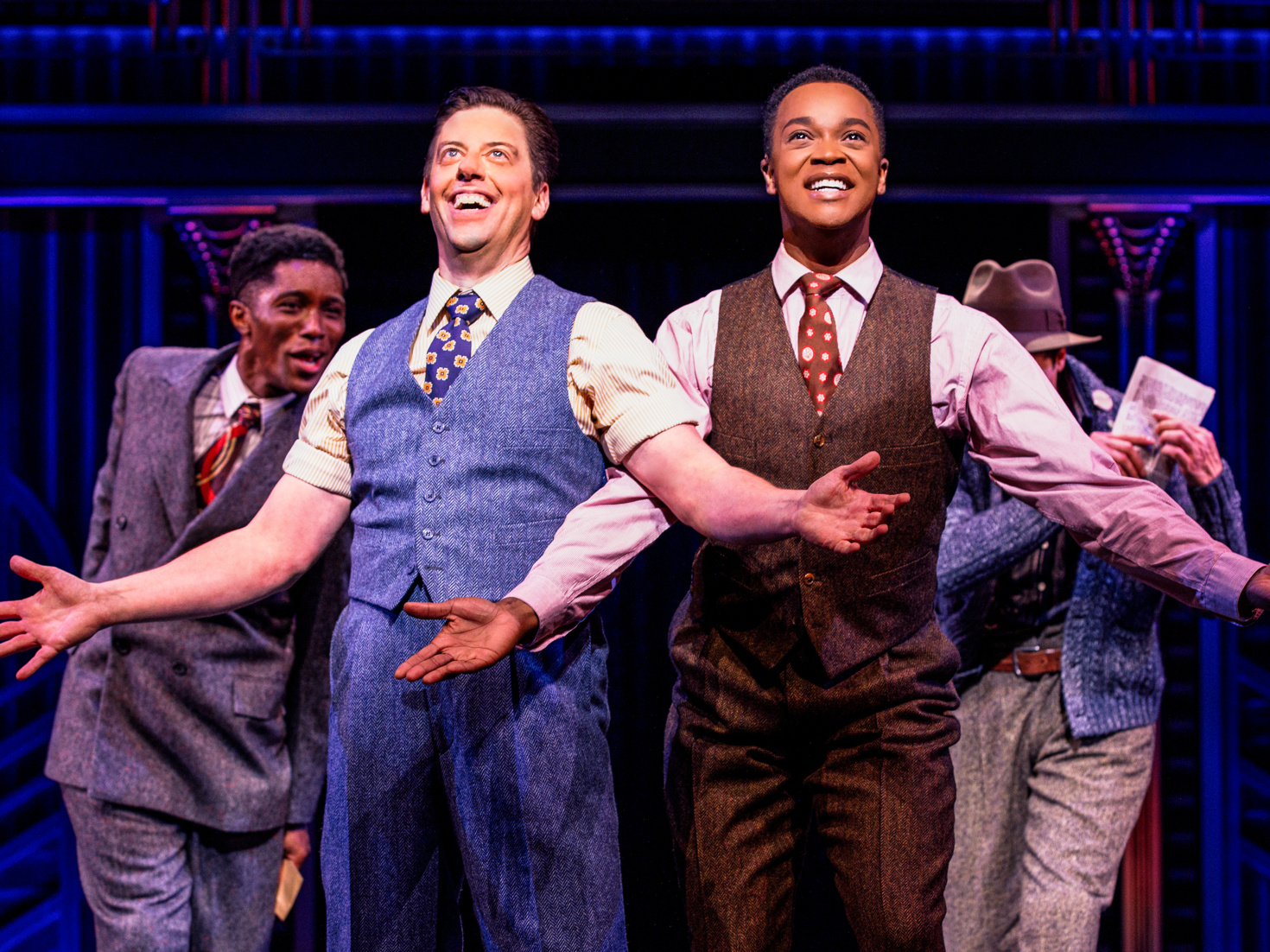
Christian Borle & J. Harrison Ghee in Some Like It Hot. (Photo: Marc J. Franklin)

The best romantic comedy released in the early fifties, William Wyler’s Roman Holiday with Audrey Hepburn and Gregory Peck, was about the impossible romance of a princess and a reporter; it was a cross between a genteel version It Happened One Night and a reverse Cinderella story. But then Hollywood romantic comedy degenerated into sex cartoons with Jayne Mansfield at one end of the spectrum and mechanical farces at the other. One might have feared that the form was dead, until Billy Wilder’s divine Some Like It Hot came to the rescue at the end of the decade. It wasn’t remotely like any previous movie in this genre. (But then, Wilder’s The Lost Weekend hadn’t been like any other social problem picture or Sunset Boulevard like any other film noir.) Wilder and his co-writer I.A.L. Diamond took a page from Shakespeare’s cross-dressing comedies and then doubled it. When two jazz musicians witness the St. Valentine’s Day Massacre they run like hell, straight into drag. They figure their only retreat from the gangsters on their tail is to vanish into dresses and wigs and join an all-girls’ band. Tony Curtis’s Joe, a.k.a. Josephine, falls for the lead singer, Sugar (Marilyn Monroe at her most sublime), and chooses a second disguise – a millionaire named Shell Oil Jr. who entertains her on a borrowed yacht, where Curtis draws her in with a dead-on Cary Grant imitation. Jack Lemmon’s frantic Jerry/Daphne finds himself the object of the yacht’s actual owner, Osgood Fielding III (Joe E. Brown) – a courtship that Wilder and Diamond leave up in the air when the rest of the plot is resolved. The final line – spoken by Brown – when Jerry reveals his true gender to Osgood is one of the two best curtain lines in American romantic comedy. (The other concludes Charade, with Hepburn and Cary Grant, which followed Some Like It Hot four years later.)

Tuesday, May 7, 2019

From the Musical Theatre Canon: The Music Man, Kiss Me, Kate and Lady in the Dark

Ellie Fishman and Edward Watts in The Music Man. (Photo: Diane Sobolewski)

Meredith Willson’s The Music Man became a classic as soon as it opened on Broadway in 1957, with Robert Preston in the role of “Professor” Harold Hill, the scamming salesman who transforms a pre-World War I Iowa town – and himself – in the course of persuading the locals to purchase instruments and uniforms for a children’s band. Willson, who wrote book, music and lyrics, did as much to develop the archetype of the American snake-oil salesman as Eugene O’Neill had in The Iceman Cometh, though his version was sweeter and came with a bona fide happy ending. (Preston recreated his career performance in the 1962 movie version.) Revivals of the show are generally good news: Susan Stroman’s opened on Broadway in 2000 and ran for two years, and it was so glorious that I saw it twice, once with Craig Bierko playing Hill and once with Robert Sean Leonard, who was even better than Bierko. (Eric McCormack played the role between Bierko and Leonard.) I’m looking forward to seeing Hugh Jackman in the part next season.

In the meantime there’s an exuberant new production at the Goodspeed Opera House, directed by Jenn Thompson and choreographed by Patricia Wilcox, with Goodspeed veteran Michael O’Flaherty doing his usual yeoman service as musical director. The Music Man is the ideal show for Goodspeed – big-boned, spirited, infectious, with a lot of wonderful ensemble numbers that show off the way imaginative staging can make a limited space feel like it’s being expanded from the inside. The choreographic high points of this production are “Marian the Librarian” in act one and “Shipoopi” at the outset of act two. But even the staging of the barbershop quartet numbers, especially “Lida Rose,” counterpointed by “Will I Ever Tell You?,” the most tuneful ballad Willson wrote for Marian (Ellie Fishman) and introduced by the four men (Branch Woodman, C. Mingo Long, Jeff Gurner and Kent Overshown) strolling down the theatre aisle, is tremendously satisfying. The show moves from scene to scene in a graceful arc aided by the scenic designer Paul Tate dePoo III, whose inventions compensate for his single mistake, an unfortunate (and anachronistic) painted backdrop more or less in the mold of the American regionalist Thomas Hart Benton.

Monday, May 13, 2013

Three Musicals, Three Eras

Tessa Faye and the cast of Goodspeed's Good News (Photo by Diane Sobolewski)

Of the collegiate musicals that used to be a staple of the Broadway stage, like Best Foot Forward and Rodgers and Hart’s Too Many Girls, Good News!, with its sweet and snappy DeSylva, Brown and Henderson songs, is probably the most enjoyable. (That is unless you count the 1943 movie version of the Gershwins’ Girl Crazy, which changes the setting from a ranch to a rural college.) Good News! opened in 1927 and though its cast of characters is mostly undergraduate, it presents a juvenile version of the Roaring Twenties, with its sorority flappers and freewheeling football players and its air of unrestrained frivolity – its tacit conviction that youth ought to be able to last forever. Vince Pesce’s new production at the Goodspeed Opera House in East Haddam, Connecticut is true to that ebullient spirit. Typically for a Goodspeed show, it’s expertly sung and danced and the numbers (choreographed by Pesce) are spirited.  One – “The Varsity Drag,” one of the play’s big hits, which comes before intermission – is a rabble-rouser that finds half a dozen clever ways to get the high-stepping ensemble back and forth across the relatively compact space.

The double conflict centers on the feasibility of getting Tait College football star Tom Marlowe (Ross Lekites) into the climactic game against Tait’s traditional competition, Colton, after he’s flunked his astronomy exam. Professor Kenyon (Beth Glover), a Tait alumna, reluctantly agrees to give him a make-up, and his debutante girl friend, Pat Bingham (Lindsay O’Neil), persuades her egghead cousin, Connie Lane (Chelsea Morgan Stock), to tutor him. When, inevitably, Tom and Connie fall in love, he realizes that if he plays he’ll be duty-bound to marry Pat, who’s pinned their engagement to the outcome of the game. Professor Kenyon’s unresolved one-time relationship with the football coach (Mark Zimmerman) and a secondary (comic) love triangle involving the most formidable physical specimen on the team, Beef Saunders (Myles J. McHale), spunky Babe O’Day (Tessa Faye), and a skinny clown named Bobby Randall (Barry Shafrin) round out the romantic entanglements
.

Monday, February 6, 2012

Befogged: On a Clear Day You Can See Forever

David Turner, Jessie Mueller, & Harry Connick Jr. in On a Clear Day You Can See Forever (Photo: Nicole Rivelli)

It’s rather fascinating to sit through the new Broadway revival of the Burton Lane-Alan Jay Lerner musical On a Clear Day You Can See Forever because you keep trying to get into the heads of Peter Parnell (who revised the book) and Michael Mayer (who re-conceived and staged it). They must have thought it would work, but it’s hard to imagine how, even given the level of delusion on which the Broadway musical theatre sometimes operates – think of Twyla Tharp’s Bob Dylan musical The Times They Are A-Changin’ and Spider-Man: Turn Off the Dark, and didn’t someone just close a musical based on Bonnie and Clyde? On a Clear Day has a sumptuous score, but the book has always been trouble. When it began in Boston in 1965, before the original leading man, Louis Jourdan, had been replaced by John Cullum, Lerner was struggling with so many plot strands that the show ran nearly four hours, and after he’d trimmed it down to a presentable length for its Broadway opening it felt truncated, still excessively busy and random, as if he’d taken an axe to whichever overgrowths he could get at rather than melting the whole scenario down to a viable dramatic form.

The premise is complicated, to say the least. A psychiatrist named Mark Bruckner is approached by a nervous, chattering young woman named Daisy Gamble who hopes he can hypnotize her to stop smoking. He puts her under – she’s so susceptible that he barely has to say anything before she’s snoozing in his chair – and when he regresses her he discovers she had a previous life as an aristocrat in late-eighteenth-century London whose sexy portrait-painter husband wouldn’t stay faithful to her. In the course of interviewing Daisy’s witty, literate, elegant, independent-minded alter ego, Melinda Wells, Mark finds himself falling in love with her. So he spends as much time as he can with Daisy, who falls for him, mistakenly believing he’s courting her twentieth-century self – the only personality she’s aware she possesses. Mark is certainly a relief from her square fiancé Warren, who’s looking for employment with the company that can offer the best pension and who is happiest with Daisy when she’s at her most conventional.